.jpg)

Global influencer marketing spend is projected to reach $40.51 billion in 2026, up from $31.07 billion in 2025, according to Mordor Intelligence.
Gigapay is the mass creator payout platform that lets brands and agencies pay hundreds of Instagram creators across Europe with one vendor, one invoice, and full compliance built in.
A large share of that spend flows through Instagram, which holds about 29% of influencer marketing revenue, and most of it goes to creators who get paid per campaign rather than on contracts.
For brands running European campaigns, that means hundreds of small cross-border payments every month, each with its own tax, VAT, and reporting requirements.
This guide breaks down how to pay Instagram creators across Europe in bulk in 2026, including creator rates, payment methods, compliance rules, costs, and a step-by-step payout process.
Key Takeaways
- Influencer marketing spend reaches $40.51 billion in 2026, with Instagram holding 29%.
- 92% of influencers name Instagram as their primary channel in 2026.
- Bulk creator payouts fail on tax compliance far more often than on transfers.
- DAC7 reporting, VAT reverse charge, and Germany's KSK levy apply across Europe.
- A Merchant of Record turns hundreds of creator payments into one vendor invoice.
Why Instagram Creator Payments Are Growing Across Europe in 2026
Instagram carries more influencer marketing budget than any other platform, and European brands are spreading that budget across far more creators than they did two years ago.
Instagram Remains the Primary Platform for European Creators
The numbers behind Instagram's position in 2026 are clear:
- 92% of influencers name Instagram as their primary channel, according to a WARC and impact.com survey. TikTok comes second at 43%.
- Instagram holds 29.25% of global influencer marketing revenue, roughly $9.09 billion, per Mordor Intelligence.
- Instagram influencers averaged a 1.36% engagement rate per post in 2025, according to Sprout Social.
- Germany, France, Spain, the Netherlands, and Italy rank among the key European markets for influencer marketing, with the UK among the top five countries globally, per the Collabstr 2025 report.
For a brand running campaigns in three or four of these markets at once, the creator roster quickly spans multiple tax systems, currencies, and invoicing rules.
Brands Now Work With Hundreds of Creators per Campaign
The biggest structural shift in 2026 is the move from a few large influencers to many small ones:
- Micro-influencers (10,000 to 100,000 followers) hold 39.35% of influencer marketing market value, about $12.23 billion, per Mordor Intelligence.
- 54% of marketers mainly work with nano and micro influencers, according to Aspire.
- Nano-influencers reach click-through rates of 4% or higher, well above the rates macro campaigns typically deliver.
Fashion retailer Boozt tripled its creator collaborations after removing payment friction for nano and micro creators, without expanding its team. The marketing result is better targeting and higher engagement. The operational result is a payment problem: a campaign with 300 creators produces 300 payments, 300 potential invoices, and 300 sets of tax data to collect and report.
How Much Do Instagram Creators Earn in Europe in 2026?
Most Instagram creator payments are small, frequent, and spread across many people, which is exactly what makes bulk payouts an operational problem rather than a banking one.
Instagram Creator Rates by Follower Tier in 2026
Current benchmark rates per piece of content, based on Influee's 2026 pricing data compiled from Shopify, Modash, and industry benchmarks (USD):
European rates track these benchmarks closely in the major markets, with Germany, France, and the UK at the upper end of each range and Southern and Eastern European markets typically below them.
Average Instagram Earnings Stay Modest for Most Creators
The averages tell a different story than the headline rates:
- The average asking price per Instagram post was $363.64 in 2025, down 13% year over year, per Collabstr.
- Average brand spend per Instagram influencer was $212, per the same report.
- 59% of creators in the Nordics earn less than €1,000 a month, even though 67% of them create content full or part-time, according to research Gigapay has shared from the Nordic market.
What Creator Earnings Mean for Bulk Payments
A European campaign budget of €100,000 might reach 15 macro creators or 400 nano and micro creators. More brands are choosing the second option, which means finance teams process hundreds of payments in the €100 to €500 range.
At that size, the admin cost of onboarding a creator as a vendor, collecting their tax data, and processing their invoice can approach the value of the payment itself.
Gigapay's State of Influencer Payments research also found payment terms stretching to 120 days for some creators, which pushes the people brands most want to work with toward competitors who pay faster.
Why Is Paying Instagram Creators in Bulk Across Europe So Complicated?
The transfer itself is the easy part. SEPA moves euros between accounts in seconds. The complexity sits in everything around the transfer: tax status, invoicing, reporting, and vendor management across more than 30 national systems.
One Campaign Can Touch 30 Different Tax Systems
The EU has 27 member states, and European campaigns regularly add the UK, Norway, and Switzerland. Each country has its own rules for self-employment income, social contributions, and what counts as a reportable payment.
European courts have also issued decisions on influencer employment classification, which means a creator treated as a contractor in one country can create misclassification exposure in another.
Most Instagram Creators Are Not Registered Businesses
Nano and micro creators usually operate as private individuals. They have no company registration, no VAT number, and no way to issue a compliant invoice. Standard procurement processes assume vendors with all three, so finance teams either block these creators entirely or approve them through exception processes that take weeks. Brands lose exactly the creators who deliver the highest engagement rates.
VAT and Invoicing Rules Change at Every Border
Whether VAT applies to a creator payment depends on the creator's status, their country, and who the contractual counterparty is. When creators invoice through an intermediary in another EU country, the reverse charge mechanism generally applies and no VAT appears on the invoice.
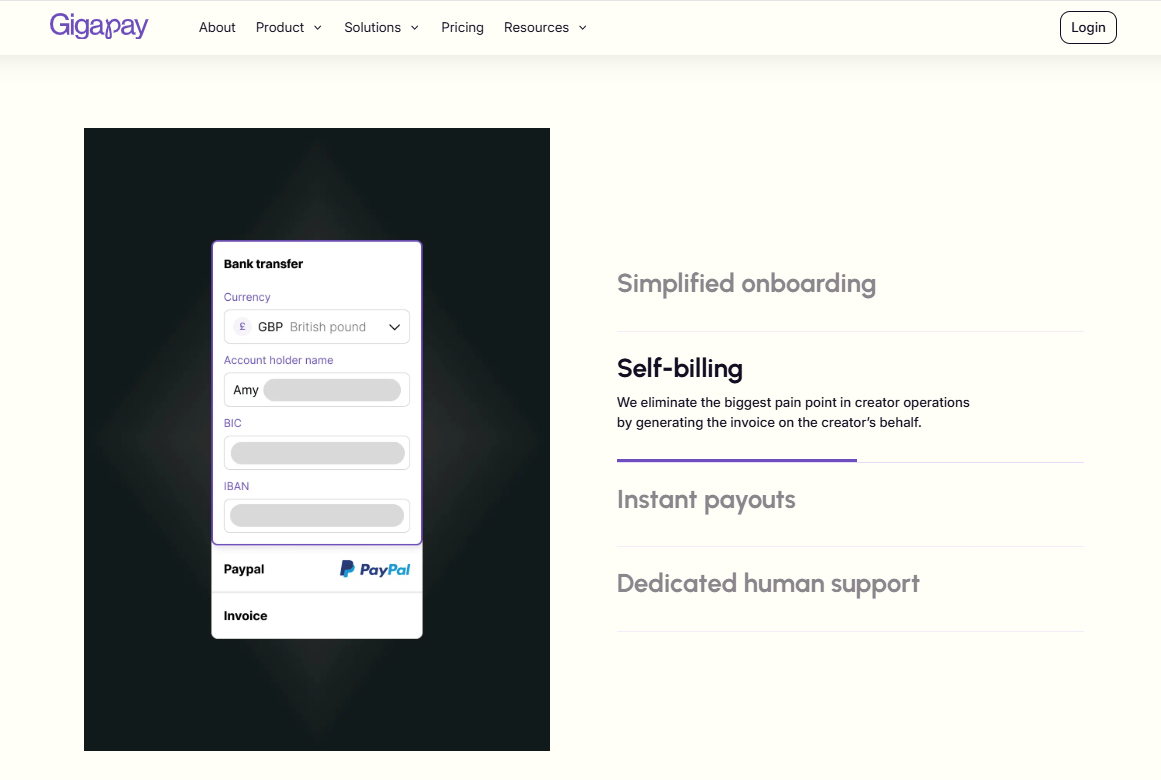
Self-billing, where the paying party generates the invoice on the creator's behalf, is permitted in most European countries but not all, and the formal requirements differ by market.
DAC7 Makes Creator Payments Reportable to Tax Authorities
DAC7 is the EU directive that requires digital platforms to report income earned by sellers and service providers to tax authorities, which then exchange that data across member states. Platforms that pay creators must collect verified names, addresses, tax identification numbers, VAT numbers, and company registration details.
A brand paying creators ad hoc through bank transfers has no system for collecting or validating any of this.
The Euro Only Covers Part of Europe
A pan-European creator roster gets paid in euros, but also in British pounds, Swedish kronor, Danish and Norwegian kroner, Polish złoty, Czech koruna, Hungarian forints, Romanian lei, and Swiss francs. Every extra currency adds FX costs, conversion spreads, and reconciliation work.
Vendor Sprawl Buries Finance Teams
Onboarding 300 creators as individual vendors means 300 ERP records, 300 sets of banking details to verify, and hundreds of invoices per campaign. Gigapay's analysis of a brand running 600 creator collaborations a year puts the manual admin burden at roughly 840 hours annually. That is where the 60, 90, and 120-day payment terms come from: the backlog, not the bank.
How to Pay Instagram Creators in Bulk: Step-by-Step Process for 2026
This is the process a compliant bulk payout follows, whether you run it manually or through a payout platform.
- Build the payout list: Export every creator from the campaign with the agreed fee, currency, and deliverable. One row per creator is the format every bulk system works from.
- Collect creator data once, before the first payment: You need full name, address, country of tax residence, tax identification number, bank details, and VAT number where one exists. Collecting this after the campaign ends is how payments stall for weeks.
- Verify identity and eligibility: KYC verifications confirm the creator is who they say they are and that the bank account belongs to them. For creators in countries flagged by the FATF, as of the March 2026 update, extra due diligence applies.
- Confirm each creator's tax status: A creator can be a private individual, a sole trader, or a company. The status determines how they are paid, whether VAT applies, and what gets reported. Do not force individuals to register a business; a payout model that accepts individuals keeps your best nano and micro creators in the campaign.
- Set the payment currency per creator: Pay creators in their local currency through local rails: SEPA Instant in the eurozone, Faster Payments in the UK, and local equivalents elsewhere. Creators absorbing FX costs on their own fees is a common reason they decline repeat campaigns.
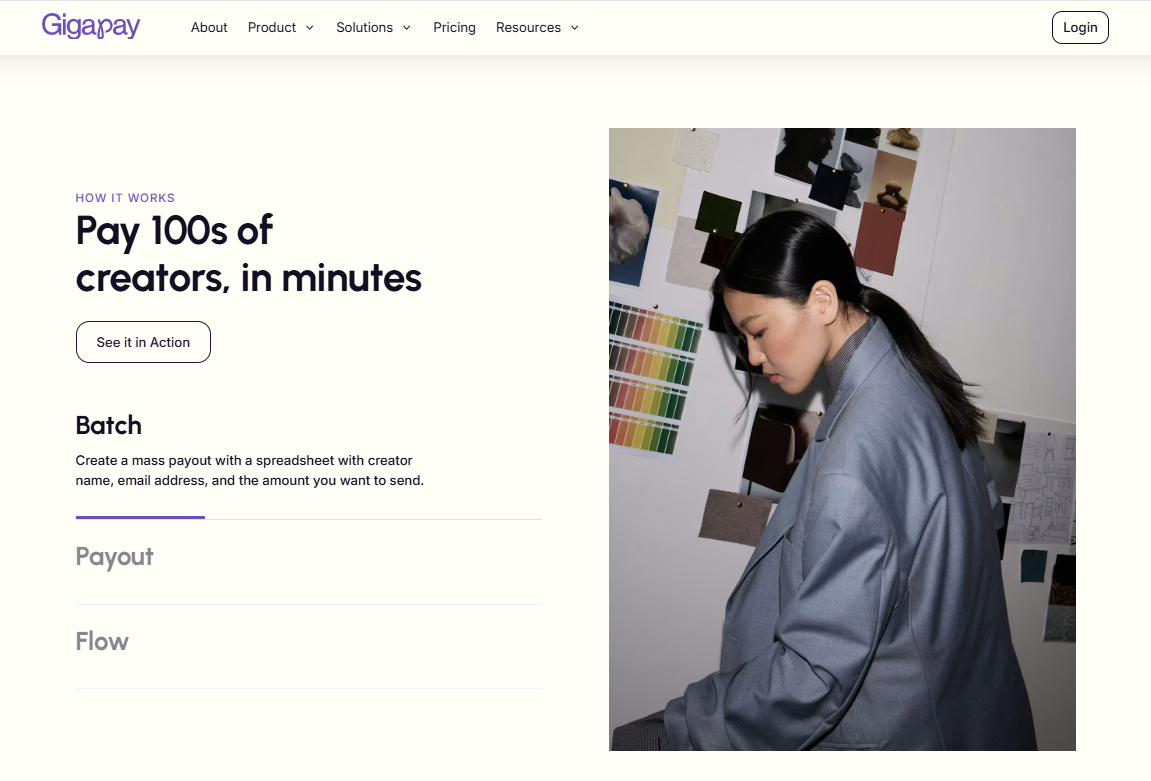
- Execute the batch: Upload the payout list as a CSV or push it through an API. On a platform like Gigapay, one upload pays hundreds of creators in minutes, and each creator receives their money instantly once they complete onboarding.
- Automate the invoicing: Self-billing generates compliant invoices on behalf of creators, and a consolidated invoice covers the whole batch for your finance team. Gigapay clients cut invoice volume by about 80% this way.
- Report what the law requires: DAC7 reporting for EU creator earnings, income reporting to national tax authorities, and country-specific obligations like Germany's KSK data. This step is the difference between a payment process and a compliant one.
- Reconcile against one invoice: The batch should land in your ERP as a single vendor line with campaign-level detail behind it, not as 300 separate transactions to match by hand.
Run manually, this process consumes hundreds of hours per year. Run through a Merchant of Record, steps 2 through 9 are the platform's job.
What Payment Methods Work for Bulk Creator Payouts in Europe?
Five approaches dominate in 2026. They differ less in how fast money moves and more in who carries the compliance work afterward.
Why a Merchant of Record Differs From a Payment Processor
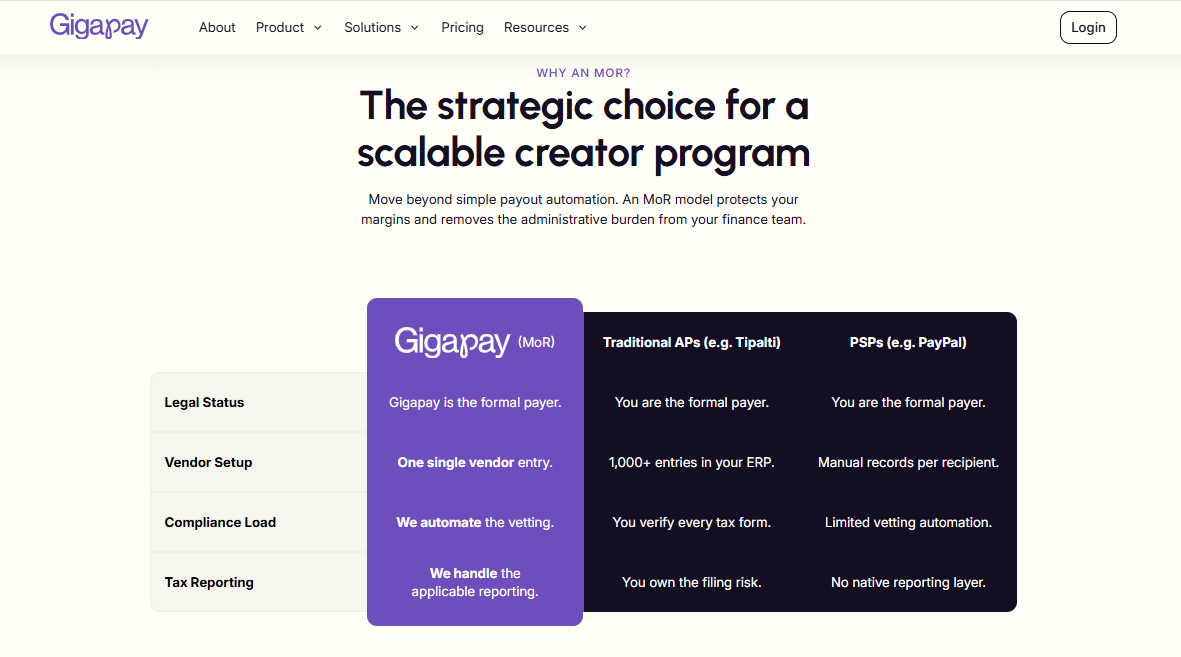
A payment processor moves money and leaves the tax, invoicing, and reporting obligations with you. A Merchant of Record becomes the contractual counterparty: it purchases the creator's deliverable and resells it to you, so the creator invoices the MoR and you receive one consolidated invoice from one vendor.
The administrative and legal responsibilities connected to the purchase sit with the MoR, while creators remain responsible for their own income taxes as independent professionals. For a brand, the practical difference shows up in the ERP: one vendor record instead of hundreds, and one invoice per campaign instead of one per creator.
When Manual Payments Still Make Sense
Paying three creators in your home market twice a year does not need infrastructure. A spreadsheet, a SEPA batch from your bank, and a diligent accountant cover it. The breaking point arrives between 20 and 50 creators per quarter, when data collection, invoice chasing, and reporting outgrow what a finance team can absorb alongside its normal work.
How Gigapay Handles Bulk Instagram Creator Payments Across Europe
Gigapay operates as a Merchant of Record for creator payments. Instead of onboarding 300 creators as vendors, a brand signs one contract with Gigapay, uploads a spreadsheet or calls an API, and the creators get paid.
One Upload Pays Hundreds of Creators
- Batch payouts run via CSV upload or API across 65+ countries and 50+ currencies.
- Payments move on local rails: SEPA Instant in the EU, Faster Payments in the UK, ACH in the US. Creators receive their money instantly.
- Funding works in USD, EUR, GBP, SEK, DKK, and NOK.
- API integration takes 2 to 5 days, with sandbox and production environments and webhook support for automation.
Creators Get Paid Without a Registered Business
Creators onboard as a private individual, sole trader, or company, and no VAT number or business registration is required. Every creator completes KYC verification before their first payout. For individuals, Gigapay pays the compensation and reports it to the tax authorities, with income data exchanged internationally.
Creators also get a dedicated human support team and EarlyPay, which gives them instant access to scheduled funds. Gigapay's creator NPS stands at 88.
Compliance and Reporting Run Automatically
Gigapay handles DAC7 reporting for EU creator earnings, KU14 reporting for Denmark, and provides the data German clients need for KSK. Tax IDs and VAT numbers are validated during onboarding. The platform is ISO 27001 certified and GDPR compliant. Creators remain independent professionals responsible for their own income taxes, and Gigapay's reporting keeps every payment visible to the authorities that require it.
Finance Teams Keep One Vendor and One Invoice
Self-billing generates invoices on behalf of creators automatically, and each campaign closes with one consolidated invoice. Clients report an 80% reduction in invoice volume. The Goat Agency, part of WPPMedia, reports that Gigapay significantly cut the time spent managing payments.
What Gigapay Costs
Enterprise includes EarlyPay, a dedicated customer success manager, and unlimited users and API capacity. There is no per-creator seat pricing.
What Compliance Rules Apply to Instagram Creator Payments in Europe in 2026?
Four regulatory areas decide whether a bulk payout process is compliant: income reporting, VAT, country-specific levies, and employment classification.
DAC7: EU-Wide Reporting of Creator Income
DAC7 requires digital platforms to report what sellers and service providers earn to tax authorities, which share the data across EU member states. For creator payments, that means collecting and verifying official names, addresses, tax registration numbers per member state, VAT numbers, company registration numbers, and any permanent establishment in the EU. Gigapay files DAC7 reports through the Swedish tax authority for EU countries where it applies.
VAT and the Reverse Charge Mechanism
When a creator with a registered business invoices a counterparty in another EU country, the reverse charge system generally applies and no VAT appears on the invoice. In a Merchant of Record setup, the creator invoices the MoR rather than the client directly, so reverse charge applies in most cases even when the creator and the brand sit in the same country. Private individuals without registered activity do not issue invoices at all; their compensation is paid out and reported as income.
Germany's KSK: A Levy Most Brands Discover Too Late
The Künstlersozialkasse funds social security for freelance creative workers, including influencers. Under the 2026 rules, companies based in Germany owe a 4.9% levy on payments for creative work above €1,000 per year, and the obligation applies whether the influencer is based in Germany or abroad.
Companies based outside Germany do not pay the contribution. The reporting obligation sits with the German client, not with an intermediary, so German brands need their payment data organized for KSK regardless of how they pay.
Employment Classification Is a Live Risk
European courts have ruled on influencer employment status, and the direction is clear: a creator who works under close direction, on an ongoing basis, for one main client can be reclassified as an employee, with back-dated social contributions attached. Paying creators as verified independent professionals, with documentation to match, is the protection.
AML Checks on Cross-Border Payouts
The FATF updates its high-risk and increased-monitoring lists three times a year. As of the March 2026 update, the grey list includes European jurisdictions such as Monaco and Bulgaria, which means payments involving those countries warrant extra due diligence. A bulk payout process needs screening built in, because nobody manually checks 300 counterparties against a sanctions list.
How Much Does It Cost to Pay Instagram Creators in Bulk?
The visible cost of a bulk payout is the platform fee. The real cost is the admin hours, and that is where the comparison gets decided.
Manual Process vs Payout Platform: The Numbers
Gigapay's ROI analysis of a brand running 600 creator collaborations per year:
At 600 collaborations, the difference is roughly €93,000 a year and the equivalent of half a full-time employee returned to actual finance work.
The Hidden Costs Nobody Budgets For
- FX spreads: Paying non-euro creators from a euro account through a standard bank adds conversion costs on every payment, often 1–3% hidden in the rate.
- Error cycles: A failed payment from a wrong IBAN or missing tax data takes more time to fix than ten correct payments take to send.
- Late payment churn: Creators who wait 60 to 120 days for their fee decline the next campaign. Replacing a proven creator costs more than paying one on time.
- Compliance remediation: Missing DAC7 data or an overlooked KSK obligation turns into retroactive work with tax authorities, which costs multiples of doing it correctly upfront.
What Platforms Charge
Payout platforms in this category price as a subscription plus a transaction fee. Gigapay's Base plan runs €279 per month plus 4.9% per payout, with volume discounts at Enterprise level from €1.8 million in annual payouts. Against an €800 average payout, the fee is about €39, while the manual admin cost per payment in the 600-collaboration scenario above works out to over €230.
Common Mistakes to Avoid When Paying Instagram Creators in Bulk
These are the failure patterns that show up repeatedly when brands scale European creator programs:
- Onboarding every creator as an ERP vendor: Vendor onboarding was designed for suppliers you work with for years, not for a creator you pay €250 once. The process adds weeks of delay per creator and permanent clutter to your vendor master data.
- Requiring a registered business from every creator: This single policy excludes most nano and micro creators in Europe, the segment with the highest engagement rates and 54% of marketers' focus.
- Collecting tax data after the campaign: Chasing 300 creators for TINs and addresses in January, when DAC7 data is due, is the most expensive way to do it. Collect everything at onboarding, before the first payment.
- Paying everyone in euros: A Polish or Swedish creator paid in euros pays the conversion cost out of their own fee and remembers it at the next negotiation.
- Treating classification as paperwork: A contractor agreement does not protect you if the working relationship looks like employment. European court decisions on influencer status have made this a real liability.
- Letting payment terms stretch: Gigapay's research found creators waiting up to 120 days for payment. The brands that pay instantly get first access to the best creators; the ones that pay in 90 days get what is left.
- Skipping verification on small payouts: A €200 payment to an unverified account carries the same fraud and AML exposure as a large one, and at bulk volume the screening has to be automated to happen at all.
Conclusion
Gigapay is the mass creator payout platform for brands and agencies that pay hundreds of Instagram creators across Europe and need every payment to be fast, correct, and reported.
Paying creators in bulk in 2026 comes down to three things: collecting verified tax data before the first payment, paying in local currency on local rails, and keeping DAC7, VAT, and country-specific obligations like KSK covered without burying your finance team.
A Merchant of Record consolidates all of it behind one contract and one invoice, which is why brands like Boozt tripled their creator collaborations without adding headcount.
Book a demo to see how one spreadsheet upload pays your entire creator roster.
Read Next:
- Micro-Influencer Rates in Europe 2026: What Brands Pay by Country and Platform
- Why Creators Put Fast-Paying Brands First, Paying in Seconds, Not Net-60 (2026)
- How to Pay TikTok Creators in Other Countries When TikTok One Won't (2026)
FAQs:
1. What is the best way to pay Instagram creators across Europe in bulk in 2026?
The best way to pay Instagram creators across Europe in bulk in 2026 is through a Merchant of Record platform like Gigapay, which pays creators instantly in 50+ currencies from one CSV upload or API call, handles KYC, invoicing, and DAC7 reporting, and gives your finance team one vendor and one consolidated invoice instead of hundreds.
2. How do brands pay hundreds of Instagram creators at once?
Brands pay hundreds of Instagram creators at once by uploading a payout list as a CSV file or sending it through an API to a bulk payout platform. The platform verifies each creator's identity and tax status, pays them in their local currency through local rails like SEPA Instant, generates invoices via self-billing, and reports the income where required.
3. Do Instagram creators in Europe need a registered business to get paid?
Instagram creators in Europe do not need a registered business to get paid when the payment runs through a Merchant of Record like Gigapay. Creators can onboard as private individuals, sole traders, or companies, and for individuals the platform pays the compensation and reports it as income to the relevant tax authorities.
4. What is DAC7 and how does it affect Instagram creator payments?
DAC7 is the EU directive that requires digital platforms to report income earned by sellers and service providers, including creators, to tax authorities that exchange the data across member states. It affects Instagram creator payments by requiring verified names, addresses, tax identification numbers, and VAT or company registration details for creators before income is reported.
5. How much does it cost to pay Instagram creators in bulk?
Paying Instagram creators in bulk costs a platform subscription plus a transaction fee, such as Gigapay's Base plan at €279 per month plus 4.9% per payout. Paying the same creators manually costs far more in practice: Gigapay's analysis puts 600 annual collaborations at roughly €139,590 in manual admin costs versus about €46,350 through the platform.
.jpg)
.jpg)
.jpg)