.jpg)

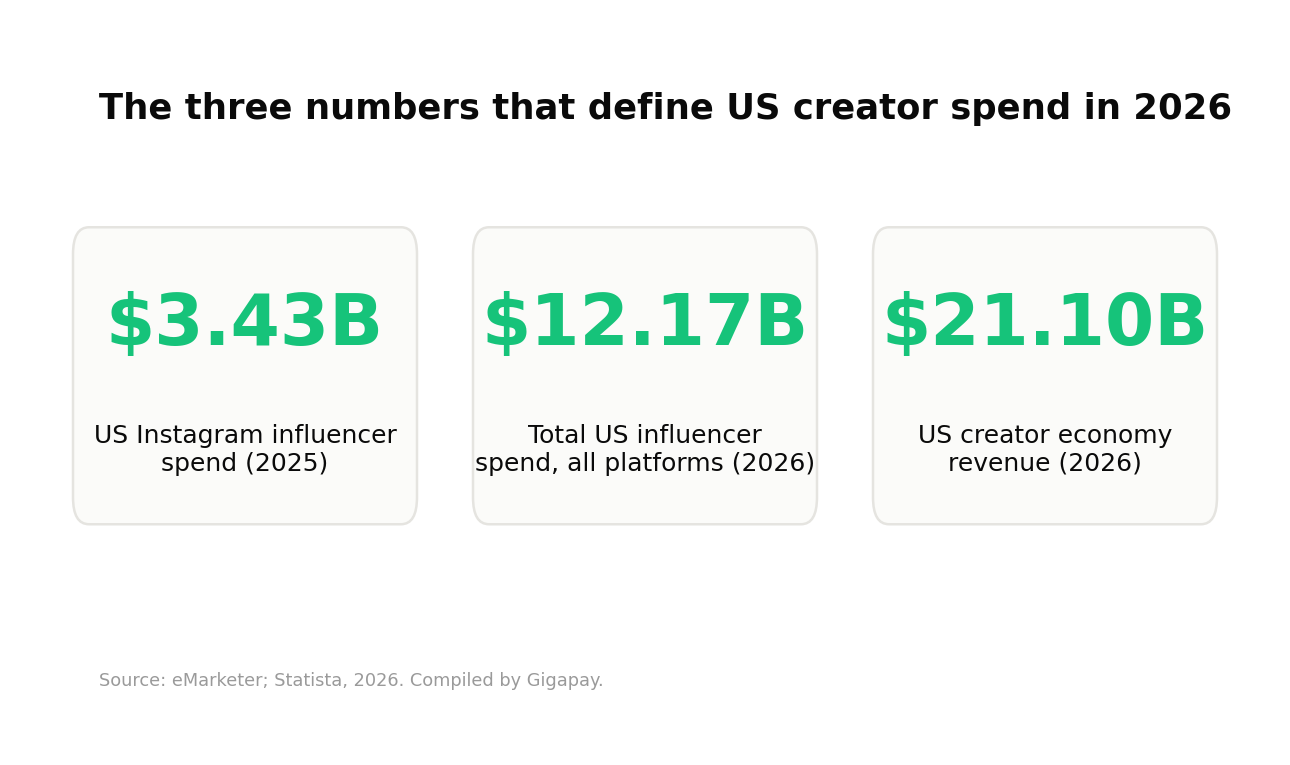
US influencer marketing has grown up. In 2026 it is a $12.17 billion channel across all platforms, up 15.7% in a single year and on track for $13.7 billion by 2027. Instagram alone carried $3.43 billion of US influencer spend in 2025, and the wider US creator economy will generate $21.10 billion in revenue this year, more than double its 2022 figure.
The budget is real, it is compounding at double digits, and it is spreading down the follower ladder toward the smaller creators who deliver the strongest engagement.
This report reads the 2026 data from two sides:
- The buyer's side: how much brands spend, how Instagram fits the mix, and what a creator actually costs by tier, format, and niche.
- The side most market reports skip: what creators genuinely earn, and how far the money that lands in their account sits below the number on the rate card.
The findings that matter most:
- Spend is moving to micro and nano creators: Smaller accounts post far higher engagement and return roughly 2.8 times the ROI of mega-influencer campaigns, and 67% to 73% of marketers now prioritise them.
- Price is set by engagement, niche, and authenticity more than by follower count: Two creators with identical reach can be priced three to five times apart, and a finance creator can charge two to three times a lifestyle creator at the same size.
- Most creators earn modestly: Almost half earn under $10,000 a year, 56% of full-time creators sit below the US living wage, and the top 10% of creators now capture 62% of all brand payments.
- Take-home is well below gross: Creators lose 15.3% to self-employment tax before income tax, set aside 25% to 30% of every payment, and wait 30 to 120 days to be paid.
Put those together and the operating picture is clear. Finding creators and agreeing rates is the straightforward part of running a program at scale. Paying hundreds of them correctly, compliantly, and on time is where the hours and the risk pile up, and it is the part that decides whether a rising budget turns into campaigns or into overhead.
A $12 Billion Channel: The State of US Influencer Spend
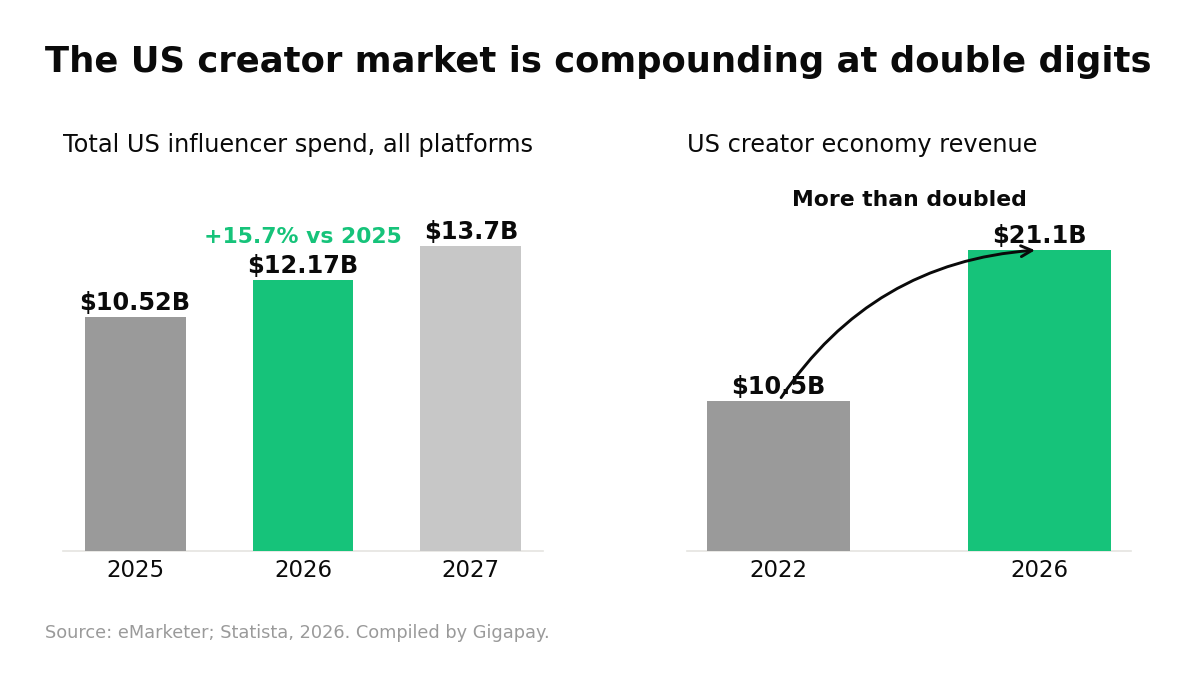
The US influencer market is now a core media channel rather than an experimental line item. Total US spend across all platforms reaches $12.17 billion in 2026, a 15.7% rise in a single year, and it is forecast to climb to $13.7 billion by 2027. That sits inside a global market Statista puts above $32.5 billion, growing around 25% year over year.
The broader creator measure tells you where budgets are heading. US social media creator revenue, which counts brand deals alongside platform payouts, subscriptions, and creator-owned products, reaches $21.10 billion in 2026, more than double its 2022 level. Brands are following the audience with real money: marketers now put a median of 26% of their social budgets into creator spend, up from 18% in 2024, and 87.5% of brands expect their influencer budgets to rise this year, with a majority planning increases of 50% or more.
The demand is backed by the platforms carrying it. Meta reported first-quarter 2026 advertising revenue of $55.02 billion, up 33% year over year, with ad impressions up 19%. When the underlying ad engine grows at that pace, creator budgets grow with it.
For brands, the takeaway is simple: the creator channel has moved from the margins of the plan to the centre of it, and the competition for the best creators is only getting sharper.
Instagram's Dual Role: Brand Anchor, Creator Sideline
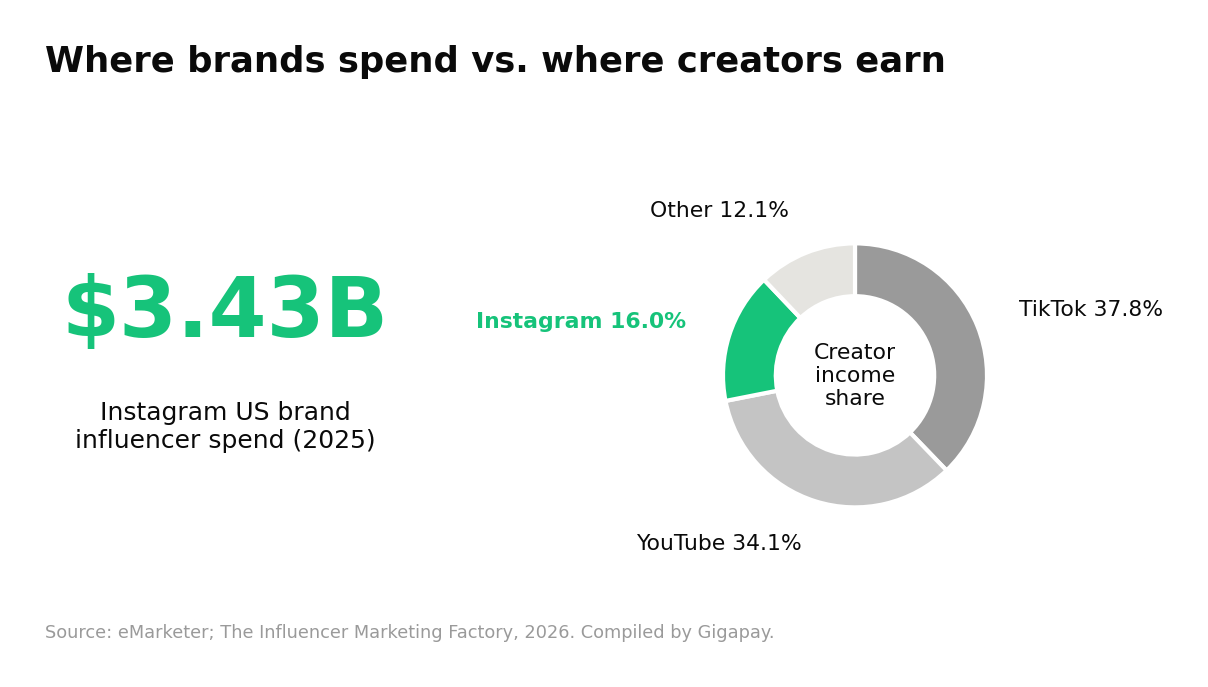
Instagram holds a peculiar position in 2026. It remains the anchor platform for brand campaigns while ranking well behind TikTok and YouTube as a source of creator income. US brands spent $3.43 billion on Instagram influencer marketing in 2025, the platform still leads on branded-content volume, and 32% of marketers report their strongest returns coming from it. When a brand wants polished, on-brand visual content with reliable performance, Instagram is the default.
The picture inverts when you ask creators where their money comes from. Across US creators, TikTok drives 37.8% of income, YouTube 34.1%, and Instagram just 16%. Instagram plays a scaling role in most brand mixes, strong for lifestyle and visual categories and dependable for campaign volume, while creators lean on short-form video and long-form YouTube for the bulk of their earnings. Both facts hold at the same time, and a campaign plan that ignores either one misreads the platform.
Instagram's own creator economy is worth roughly $21 billion and hosts around 67 million active creator accounts worldwide, yet only 4.2% of those creators earn $50,000 or more a year. That concentration is exactly why brands increasingly build programs around many smaller creators rather than betting the budget on a handful of large names.
The Rate Card: What Instagram Creators Charge by Tier
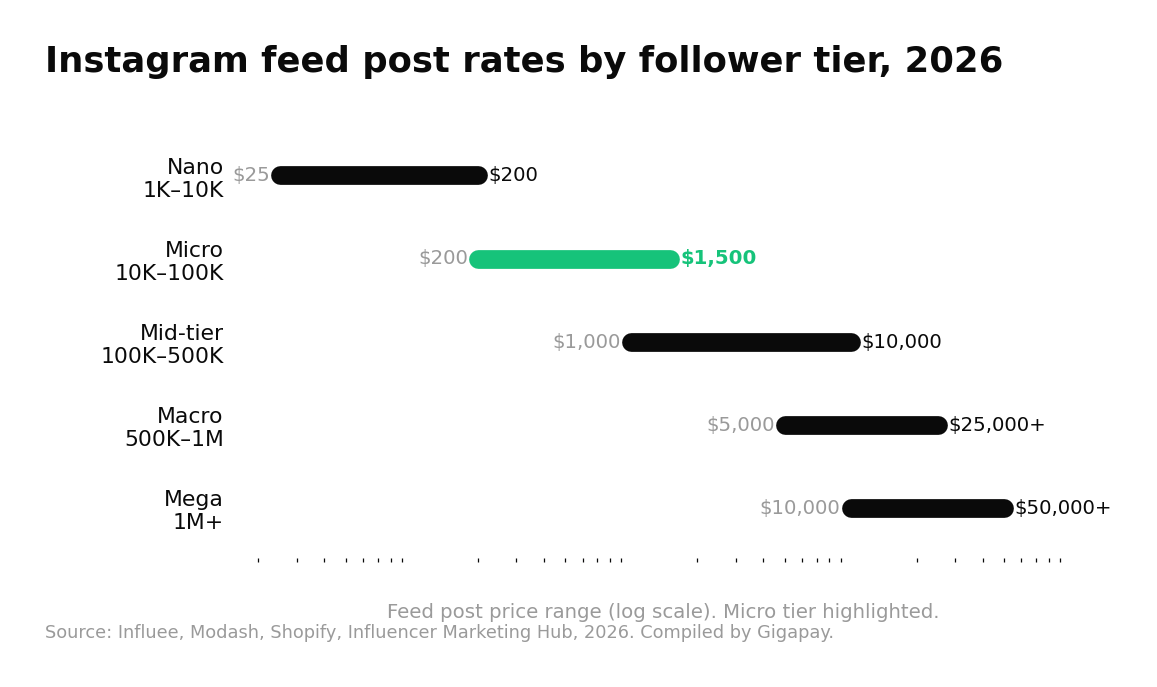
Rates scale with reach, but the jumps between tiers are steep and the ranges inside each tier are wide. A nano creator's feed post can cost less than a team lunch, while a mega creator's single Reel can cost more than a monthly salary.
The 2026 benchmarks below are cross-referenced across Influee, Modash, Shopify, Stan, Scrumball, and Influencer Marketing Hub.
A baseline that circulates in 2026 rate guides is roughly $100 per 10,000 followers, adjusted up for engagement, niche, and format. Treat it as a floor rather than a quote.
Later's data gives a useful mid-market anchor: a creator with 100,000 to 150,000 followers commands a median sponsored post around $400 and a Reel around $1,500, which shows how far a single format choice moves the final number.
The width of those ranges is the real story. Two creators with the same follower count can be priced three to five times apart depending on how engaged and how authentic their audience is. For a brand running a large program, that means negotiating hundreds of individual rates, each one defensible and each one slightly different. Every agreement then becomes a payment to process, a tax record to file, and a creator to onboard.
Format Economics: Why Reels Command the Premium
Format moves the price as much as follower count does:
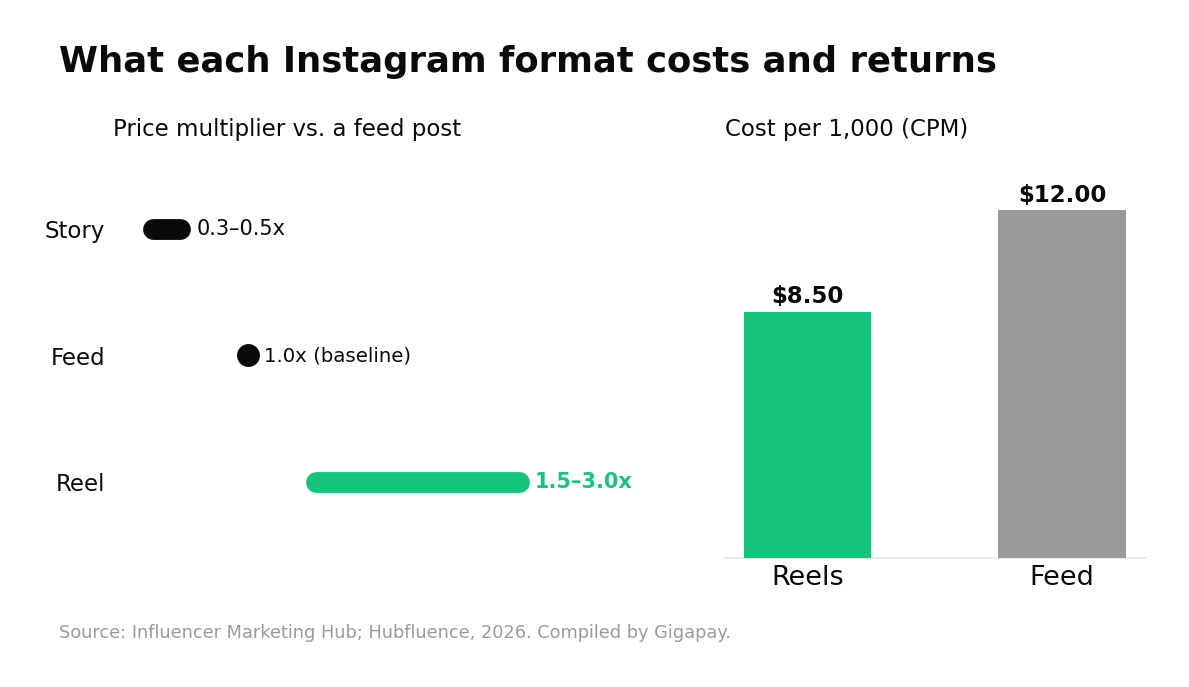
- Reels carry the premium in 2026, often 1.5 to 3 times the price of a feed post, because they earn the most algorithmic reach and take the most effort to produce.
- Feed posts and carousels sit at the baseline.
- Stories are the cheapest asset, usually 30% to 50% of a feed post's rate, and brands typically buy them in bundles of three to five frames rather than one at a time.
The buyer's efficiency numbers point the same way. Instagram Reels run around $8.50 CPM against roughly $12.00 CPM for feed, and nano and micro creators offer the best value of all at $5 to $25 CPM. Two thirds of brands now prefer Reels for influencer content, which keeps upward pressure on Reel pricing even as more creators learn to produce them well.
For a campaign planner, the discipline is to price the format to the objective. Reels earn their premium when the goal is reach and awareness. Story bundles do efficient work for urgency, promo codes, and time-boxed offers. Feed posts and carousels hold their value when the asset needs to live on the profile as a lasting reference.
Paying a Reel premium for a job a Story could do is one of the most common ways a creator budget leaks.
The Niche Premium: Why a Finance Creator Out-earns a Lifestyle Creator
Two micro creators with identical reach can be priced worlds apart depending on what they talk about. Audiences with high purchase intent and high trust barriers command premiums, and finance is the clearest case.
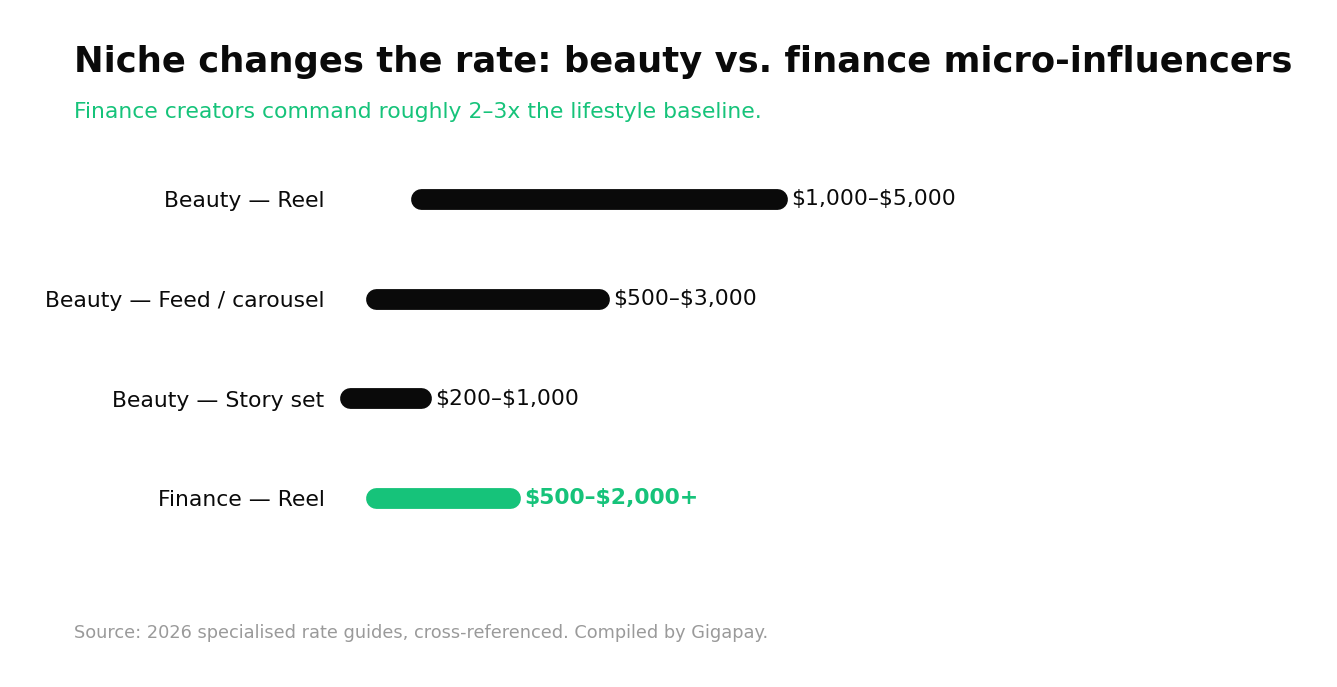
A personal-finance or investing creator, and B2B creators generally, often charge two to three times the rate of a lifestyle or fashion creator at the same follower count, because their audiences convert and their recommendations carry weight.
Beauty and skincare give the most detailed 2026 breakdown available. A beauty micro-influencer typically charges $1,000 to $5,000 for a dedicated Reel, $500 to $3,000 for a static feed post or carousel, and $200 to $1,000 for a Story set of three to five frames. A finance micro creator might charge $500 to $2,000 or more for a single Reel, with the premium coming from audience intent rather than production polish.
Engagement by niche reinforces the pattern. Music and dance and fitness and sports both post median engagement rates around 2.8%, comfortably above the platform average, which is why creators in those categories hold their rates even against larger accounts in softer niches.
Niche is not a footnote on the rate card. It is one of the single biggest levers on price, and brands that match the niche to the audience they actually want to reach get far more for the same spend.
Beyond the Follower Count: Engagement and Authenticity Set the Price
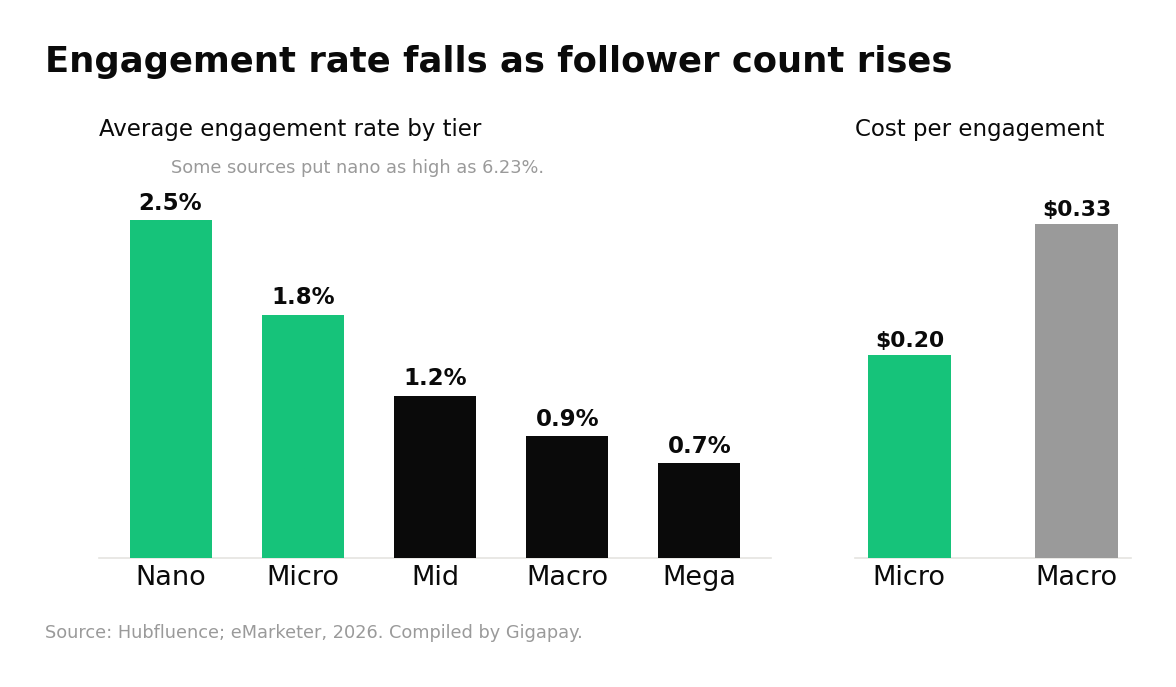
The strongest through-line in 2026 pricing is that engagement quality, not follower count, decides real value. Engagement rates fall as accounts grow. Nano creators average around 2.5%, micro around 1.8%, mid-tier around 1.2%, macro around 0.9%, and mega around 0.7%, with some eMarketer references putting nano as high as 6.23%.
Whichever benchmark you use, the direction never changes: the smaller the account, the harder the audience leans in.
That gap has direct budget consequences. Micro-influencer campaigns deliver roughly 2.8 times the ROI of mega-influencer campaigns, and the cost per engagement runs about $0.20 for micro creators against $0.33 for macro. This is the arithmetic behind the shift, and it explains why between 67% and 73% of marketers now build their programs around smaller creators and why nano and micro tiers keep taking a larger share of both spend and performance.
Authenticity now sits alongside engagement as a pricing input. HypeAuditor, working with The Influencer Marketing Factory across more than five million creators, found brands increasingly setting rates on verified audience data rather than headline follower counts. The reason is defensive as much as strategic. Some audits put fraudulent or bot activity as high as 41.3%, posts carrying a plain #ad or #sponsored tag lose about 23% of their engagement, and Instagram's official Paid Partnership label earns 38% higher trust.
Brands that verify an audience before they price it protect both their budget and their measurement, and increasingly they refuse to pay premium rates on reach they cannot confirm.
The Earnings Reality: How the Creator Economy Actually Pays
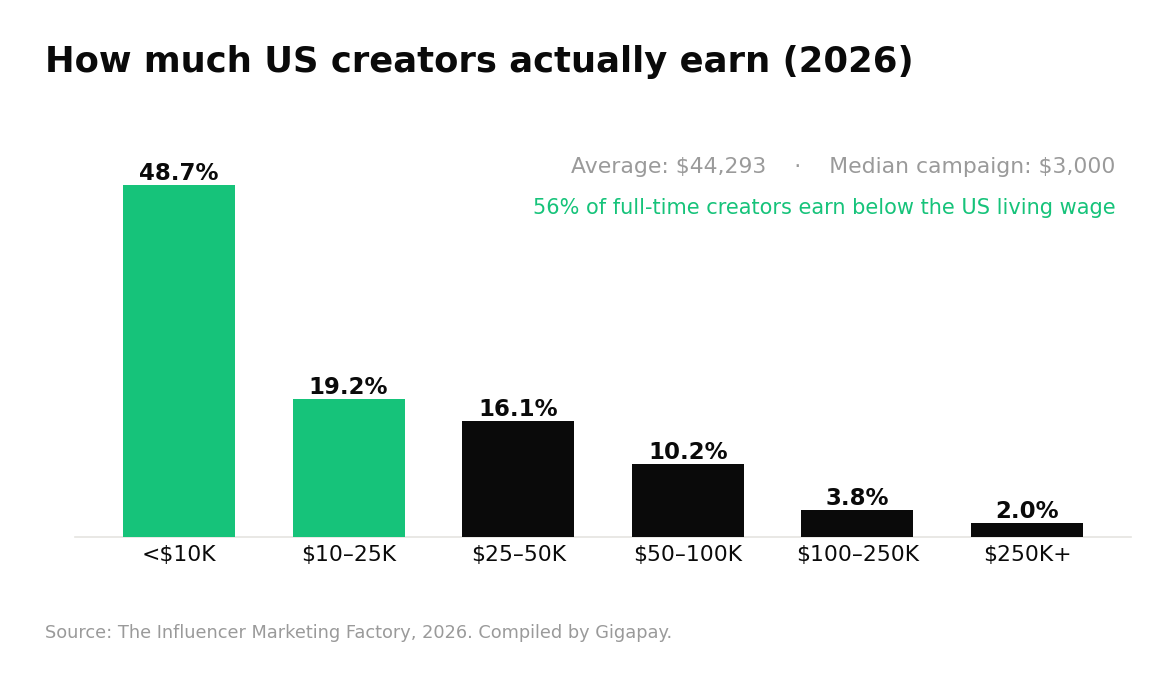
The rate card describes the deal. It says very little about the life. When US creators report their real annual earnings, the distribution is heavily bottom-weighted.
- Almost half, 48.7%, earn under $10,000 a year.
- Another 19.2% earn $10,000 to $25,000.
- 16.1% earn $25,000 to $50,000.
- 10.2% earn $50,000 to $100,000.
- 3.8% earn $100,000 to $250,000.
- 2.0% clear $250,000.
The average of around $44,293 is pulled upward by top earners, while the median campaign payment sits near $3,000.
The money is concentrating rather than spreading. The top 10% of creators captured 62% of all brand payments in 2025, up from 53% in 2023, and only 5.8% of influencers earn $100,000 or more from brand deals. At the same time, 56% of full-time creators earn below the US living wage of roughly $44,000.
This is the structural reason brands can build large, cost-effective programs from nano and micro creators, and it is also why fast, predictable payment is a genuine competitive advantage when recruiting them. For most creators, no single brand is life-changing, so the brand that pays reliably becomes the one they prioritise.
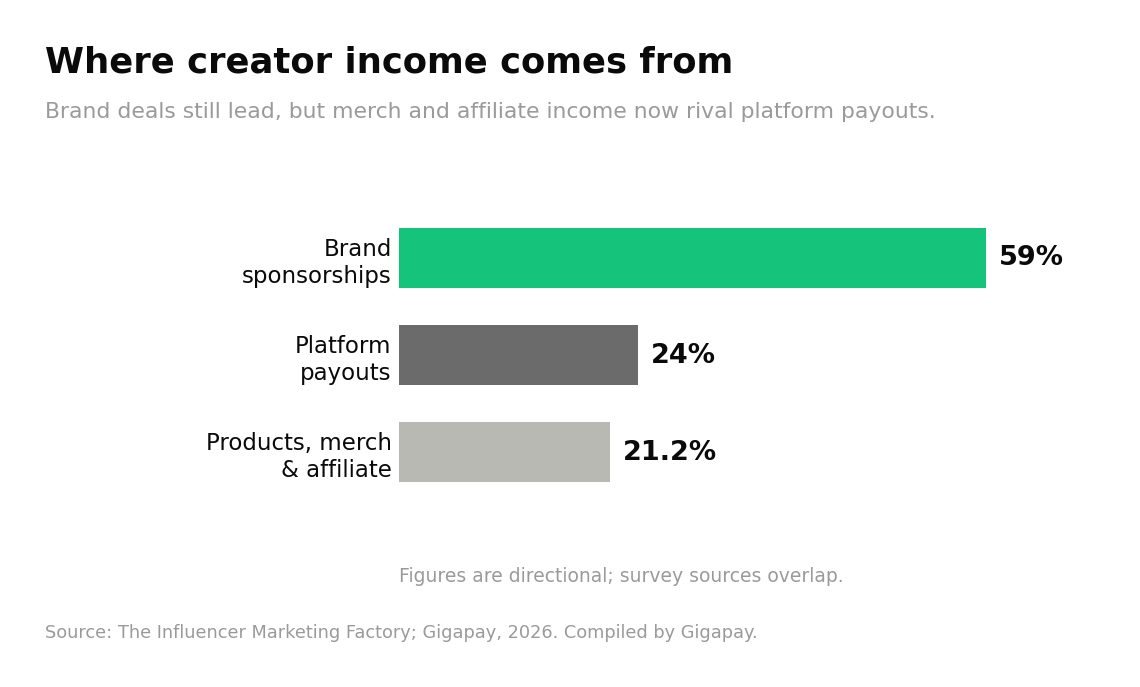
Creators have answered by building income from more than one place. Brand sponsorships still lead at around 59% of creator income, platform payouts contribute near 24%, and product, merchandise, and affiliate revenue now make up 21.2%.
The professional creator of 2026 runs a small media business with several revenue lines, which is why 84.7% post more than once a week and why the largest audience segment across Instagram, TikTok, and YouTube is now the maturing 25 to 34 age group. The audience is growing up, and the creators serving it are professionalising alongside it.
The Payment Gap: Tax, Delays, and What Lands in the Creator's Account
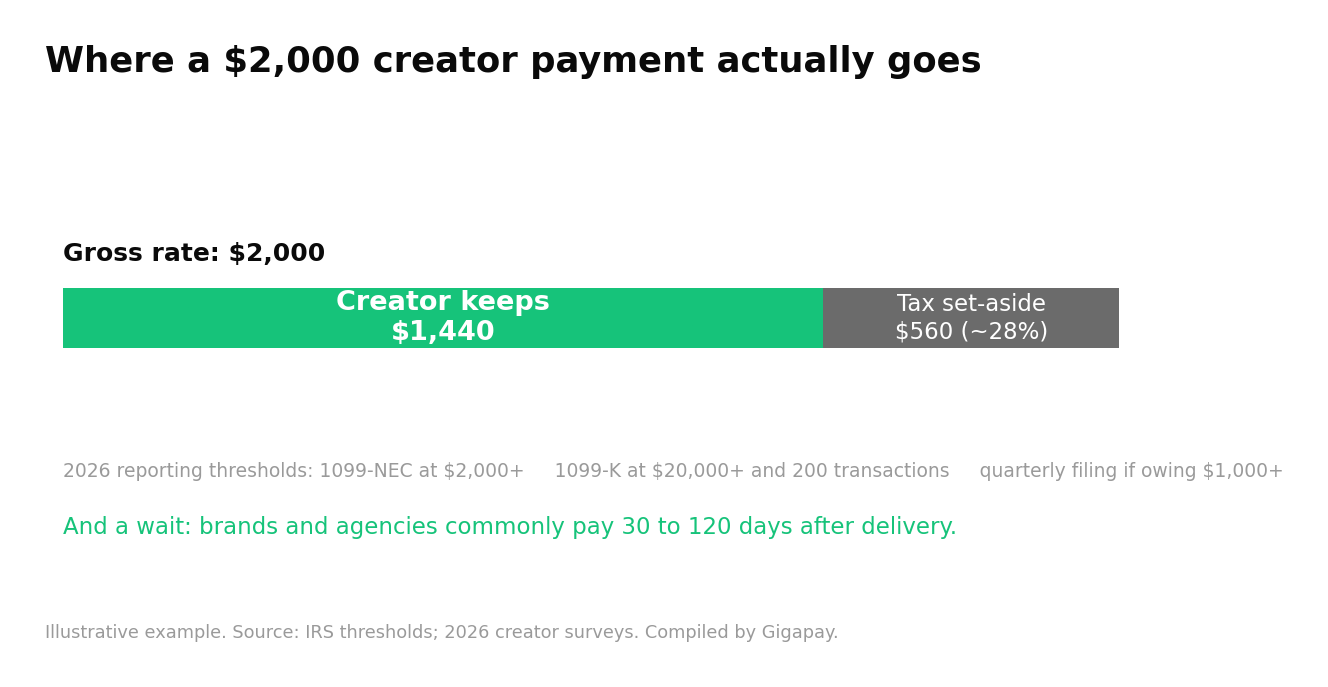
A creator's quoted rate and the money that reaches their bank account are rarely the same figure, and the distance between them is where most of the friction lives. In the US, brands issue a Form 1099-NEC for any creator paid $600 or more, and payment platforms issue a 1099-K once business payments pass $2,000 in a year.
Self-employed creators then owe self-employment tax of 15.3% on net earnings, on top of income tax, so most set aside 25% to 30% of every payment to cover it. Anyone expecting to owe $1,000 or more in federal tax must file quarterly estimated payments or face penalties.
Timing widens the gap further. Payment delays of 30 to 120 days are common across brands and agencies, and stretched terms hit smaller creators hardest because they have the least cushion to absorb them. A $2,000 Reel booked in March and paid in July is a very different deal from the same Reel paid on delivery, and for the nano and micro creators brands most want to recruit at scale, that delay is often the difference between a yes and a no.
For the brands and agencies on the other side of the payment, this is the point where a growing program quietly becomes an operational problem. Every rate turns into an onboarding task, a tax form, a currency conversion, and an invoice to reconcile.
- Finance holds payments while it chases missing tax documentation.
- Procurement stalls campaigns because it cannot process hundreds of individual creators as vendors fast enough.
- The admin does not scale as cleanly as the ambition does, and every late payment erodes the creator goodwill that marketing worked to build.
What This Means for Brands Scaling Creator Programs
Read across the data and one operating picture emerges. Budgets are rising fast, the strongest returns come from running many smaller creators rather than a few large ones, and the hardest part of the job arrives after the deals are signed. Paying everyone correctly, compliantly, and on time is the work that decides whether a bigger budget becomes more campaigns or just more overhead.
That is the exact wall scaling brands hit. A program running 600 creator collaborations a year can absorb around 840 hours of admin and carry 300-plus individual vendor records in the finance system, and every late or failed payment chips away at relationships marketing fought to win.
The rate benchmarks in this report are the easy half of the equation. The payments, the tax reporting, and the onboarding are where the hours and the compliance risk accumulate.
Gigapay is built for that moment. As a Merchant of Record, Gigapay becomes the single vendor in your finance system and takes over most of the administrative and legal responsibility connected to paying creators, so marketing can book the collaborations it wants while finance keeps control and stays audit-ready.
Brands upload one file, creators get paid instantly across 65-plus markets, and hundreds of vendor records collapse into a single invoice. That is how a brand grows from 50 to 5,000 creators without adding an admin hire, and how the rising spend in this report becomes campaigns rather than cost.
Turn a bigger creator budget into more collaborations instead of more admin. Send your first mass payout the same day you sign, and pay every creator instantly, from one file, on one invoice, fully compliant.
FAQs:
1. How much are US brands spending on influencer marketing in 2026?
US brands are projected to spend $12.17 billion on influencer marketing across all platforms in 2026, growing 15.7% year over year and forecast to reach $13.7 billion by 2027. Instagram accounted for $3.43 billion of US influencer spend in 2025.
2. How big is the US creator economy in 2026?
US social media creator revenue is expected to reach $21.10 billion in 2026, more than double its 2022 level. The figure combines brand deals, platform payouts, subscriptions, and creator-owned products.
3. What is the average Instagram influencer rate in 2026?
Rates scale with reach and niche. A common baseline is around $100 per 10,000 followers. Micro creators (10K–100K) typically charge $200–$1,500 for a feed post and $500–$5,000 for a Reel, while mega creators (1M+) can charge $10,000–$50,000+ per post. Reels command a 1.5–3x premium over feed posts.
4. Which platform earns creators the most money?
Among US creators, TikTok drives the largest share of income at 37.8%, followed by YouTube at 34.1% and Instagram at 16%. Instagram still leads on brand campaign volume and is where many brands report their strongest returns, so brand spend and creator income tell different stories.
5. Why do brands favour micro and nano influencers in 2026?
Smaller creators post far higher engagement, around 2.5% for nano against 0.7% for mega, and deliver roughly 2.8x the ROI of mega-influencer campaigns at a lower cost per engagement. Between 67% and 73% of marketers now prioritise them.
Methodology and Sources
This report compiles publicly reported 2026 figures and cross-references them across multiple benchmarks rather than relying on any single source.
- Spend and market-size figures draw on eMarketer and Statista.
- Rate benchmarks are cross-referenced across Influee, Modash, Shopify, Stan, Scrumball, Later, and Influencer Marketing Hub.
- Earnings distribution and platform-income data come from The Influencer Marketing Factory's 2026 Creator Economy Report.
- Audience-authenticity and engagement data reference HypeAuditor's analysis of more than five million creators.
- Top-earner figures reference Forbes.
- Platform-level advertising figures reference Meta's first-quarter 2026 results.
- Operational benchmarks in the final section are Gigapay's own.
Rate ranges are directional. Actual creator pricing depends heavily on engagement quality, audience authenticity, niche, usage rights, exclusivity, and campaign structure, so brands should confirm against current rate cards and verified audience data before booking.
.jpg)
.jpg)
.jpg)