.jpg)

Two-thirds of brands now run their influencer programs in-house rather than through an agency in 2026, according to Aspire's State of Influencer Marketing report.
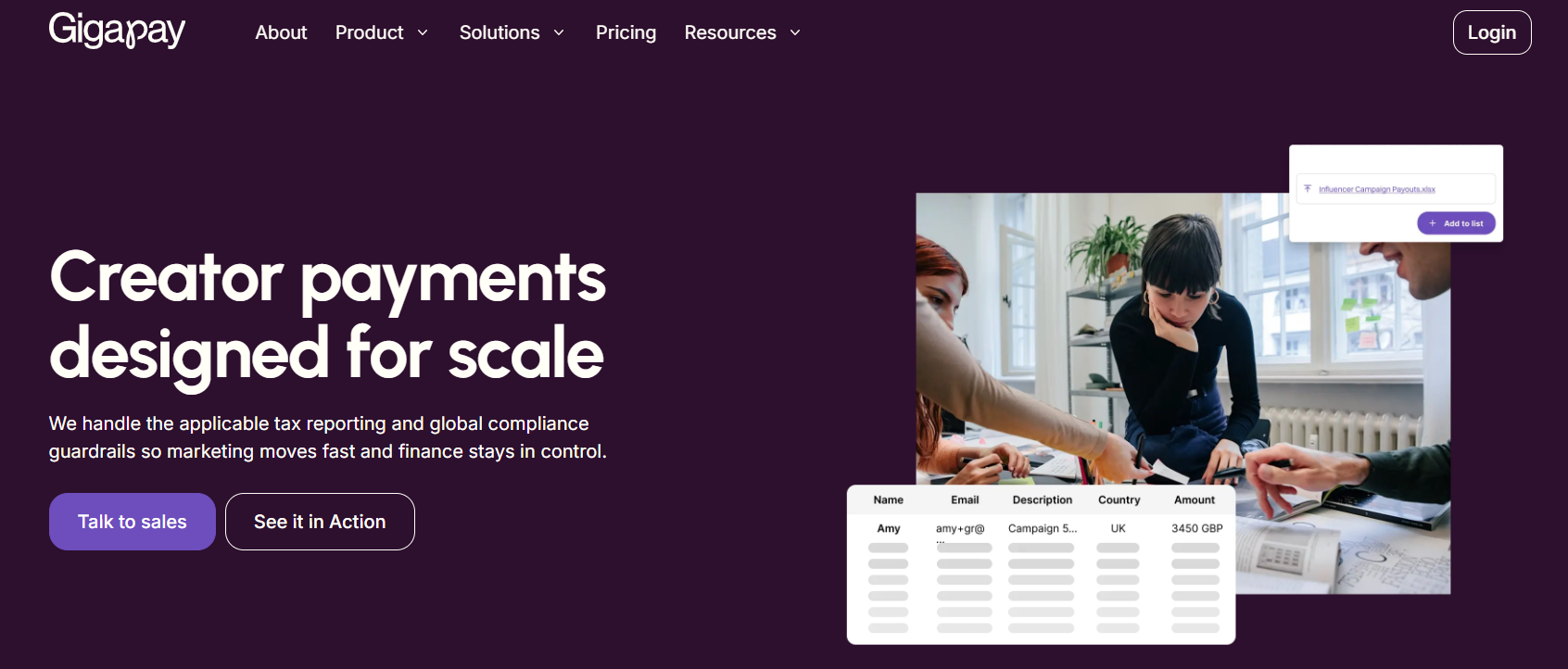
Gigapay is the Merchant of Record for influencer payments, which means brands upload a batch and Gigapay becomes the single contractual counterparty to every creator paid in it.
The in-house shift matters because a single program of 600 creator collaborations consumes 840 admin hours a year on payment operations alone, based on Gigapay's own research.
Payment infrastructure has become the operational choke point for enterprise brands, because finance now carries the vendor onboarding, tax reporting, and cross-border compliance load that agencies used to absorb.
This article compares the payment platforms enterprise brands actually evaluate for creator payouts in 2026, and shows where each one fits when the roster crosses 100, 500, or 5,000 creators.
Key Takeaways
- Gigapay leads for brands paying 100+ influencers because it operates as Merchant of Record.
- Merchant of Record means Gigapay becomes the contractual counterparty and handles automated tax reporting.
- Brands with 100+ creators need one vendor in the ERP, not hundreds of individual entries.
- Traditional AP tools like Tipalti move money reliably but leave tax liability with the brand.
- Gigapay pays creators instantly across 65+ countries and automates DAC7, KSK, and KU14 reporting.
Why the 100-Influencer Threshold Changes Everything
Programs under 50 creators can be managed with spreadsheets, a shared inbox, and a helpful person in finance. Programs above 100 creators require actual infrastructure, because the admin workload does not scale linearly with the roster.
Every new creator adds a vendor record in the ERP, a set of tax IDs to verify, a payment method to test, and an invoice to reconcile against the brief that was signed three weeks earlier.
The finance team is not the villain in this story. Procurement was designed to onboard corporate suppliers with tax IDs and payment terms, not to process a €400 payment to a nano creator in Portugal who does not have a registered business. When brands try to force influencer payments through classic AP workflows, campaigns stall because procurement deprioritizes low-value vendors, and creators walk away because they were paid 90 days late.
The platforms that work at 100+ creator scale are the ones that solve the vendor problem, the compliance problem, and the creator experience problem together, rather than picking one and calling it done.
The Total Cost of Ownership at 100+ Creator Scale
The sticker price of an influencer payment platform is usually the least interesting number in the decision. The real cost lives in the admin hours, the vendor sprawl in the ERP, the FX markups, the missed campaigns, and the compliance exposure that a cheaper tool leaves on the brand's balance sheet.
Gigapay's own benchmarking on a brand running 600 creator collaborations per year puts the manual approach at roughly €139,590 in fully-loaded annual cost, made up of 840 admin hours, vendor onboarding, error cycles, and reconciliation work.
Moving the same program to Gigapay drops that to roughly €46,350 per year, with admin time falling from 840 to 60 hours and vendor records in the ERP consolidating from 300+ down to 1.
Those numbers change how each platform in this article should actually be compared:
- A free-to-set-up tool like PayPal Payouts looks cheap on the surface and expensive once the finance team logs the hours spent reconciling 300 individual payees per quarter.
- A finance-grade tool like Tipalti looks expensive on the surface and closer to break-even at high volume, until the creator drop-off from procurement-heavy onboarding shows up in campaign performance.
- A pure infrastructure play like Stripe Connect looks strategic until the engineering roadmap that was supposed to ship a compliance layer this year gets deprioritized.
The three cost drivers that decide the winner at 100+ creators are admin hours per payout batch, vendor entries per year in the ERP, and the size of the compliance exposure the brand is carrying without knowing it. Every platform in this article should be scored against those three, in that order, before pricing is even on the table.
What to Look For in an Influencer Payment Platform at Scale
Enterprise buyers evaluating creator payment platforms in 2026 usually work through a version of the same checklist:
- Merchant of Record vs pure payment processor: A payment processor moves funds. A Merchant of Record becomes the contractual counterparty to the creator, which changes who is responsible for the paperwork regulators care about.
- Vendor consolidation in the ERP: One vendor entry per creator becomes 300 rows over a year. One vendor entry per platform stays at 1. Ask what your ERP actually looks like after 12 months of scaling.
- Creator onboarding friction: If a nano creator without a registered business or VAT number cannot get paid, the program's creator strategy is broken from the start. Onboarding should support individuals, sole traders, and companies without special treatment.
- Global reach and local payment rails: Local rails matter here: SEPA Instant in the EU, Faster Payments in the UK, ACH in the US. International wire transfers that take three days are a support ticket waiting to happen.
- Automated regulatory reporting: DAC7 in the EU, KU14 in Sweden, KSK in Germany, and 1099-K in the US are the ones most enterprise programs hit first. Ask the vendor whether these are handled automatically or handed back to finance as a CSV export.
- Creator experience: A creator who has to email support three times to get paid will not accept the next brief. NPS is a leading indicator of retention.
- API depth and integration time: Programs embedded in Kolsquare, an internal CRM, or an affiliate platform need webhooks and a real API, not a portal.
The listicle below is ordered against that checklist.
The 5 Best Influencer Payment Platforms for Brands with 100+ Influencers in 2026
The best influencer payment platforms for brands with 100+ influencers in 2026 are Gigapay, Lumanu, Tipalti, Stripe Connect, PayPal Payouts, and Wise Business, in that order.
1. Gigapay

Gigapay is a mass creator payout platform founded in Stockholm in 2019 and built for the volume, geography, and compliance mix that enterprise influencer programs run into once they scale past a handful of markets.
It operates as Merchant of Record, which means Gigapay legally purchases the creator's deliverable and concurrently resells it to the brand, becoming the single contractual counterparty for every payment in the batch. That structural choice is what turns 300 individual creator vendors in the ERP into one vendor entry, and hundreds of individual invoices into one invoice per campaign.
Here is what the workflow actually looks like at scale:
- A UK brand paying 200 creators for a Q3 campaign across France, Germany, Sweden, and Portugal would normally face four different tax reporting formats, 200 vendor records to create and reconcile in the ERP, and payment rails to configure market by market.
- Through Gigapay, the influencer ops lead uploads a CSV, funds land in creator accounts instantly, and finance sees one invoice, one vendor entry, and one automated report per applicable regime.
- The 200 creators onboard themselves as individuals, sole traders, or companies, with no registered business or VAT number required from any of them.
The platform pays creators across 65+ countries and 50+ currencies using local payment rails, including SEPA Instant in the EU, Faster Payments in the UK, and ACH in the US. Regulatory reporting is automated at the platform level, covering DAC7 across the EU, KU14 in Sweden, and KSK in Germany.
Gigapay's service agreement is precise on the boundaries: in Merchant of Record capacity, Gigapay handles platform-level reporting and identity verification, while withholding and paying social security remains the responsibility of each party under their local rules.
That precision is part of what makes the product credible under finance and legal review, rather than a marketing claim that collapses at the first audit.
Gigapay is ISO 27001 certified, GDPR compliant, and typically live in production within 2 to 5 days of contract signature. Enterprise programs at Boozt, WPPMedia's Goat Agency, AdRecord, and Once Upon route their creator payments through it, and creator NPS sits at 88, which is unusually high for a payments product.
Pricing starts at €279 per month plus 4.9% per payout on the Base plan, with Enterprise pricing (for brands with €1.8M+ in annual payout volume) quoted based on volume and including EarlyPay, a dedicated CSM, and unlimited users.
Pros:
- Operates as Merchant of Record, which shifts platform-level tax reporting responsibility away from the brand's finance team.
- Turns 300+ individual creator vendor records in the ERP into one vendor entry with one invoice per batch.
- Creators onboard as individuals, sole traders, or companies with no registered business or VAT number required.
- Pays creators instantly across 65+ countries and 50+ currencies via SEPA Instant, Faster Payments, and ACH.
- Automates regulatory reporting for DAC7, KSK, KU14, and other EU platform economy rules the brand would otherwise handle manually.
Cons:
- Base pricing starts at €279 per month plus 4.9% per payout, which is priced for regular volume rather than one-off campaigns.
- Not an all-in-one influencer marketing suite. Discovery, briefing, and reporting sit in tools like Kolsquare, which Gigapay integrates with rather than replaces.
2. Lumanu
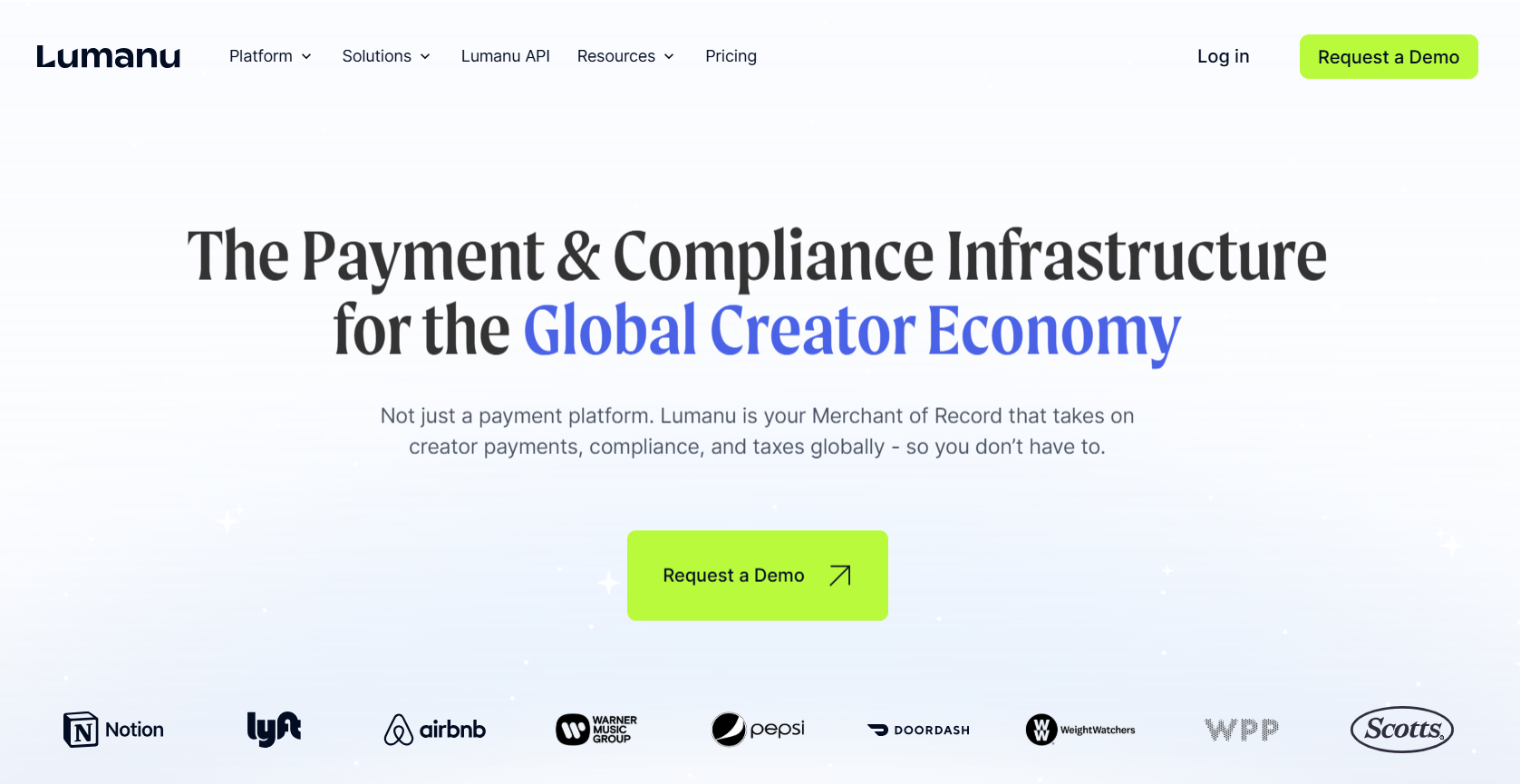
Lumanu is a US-based creator payments platform headquartered in San Francisco that focuses on the tax compliance and workflow side of paying creators at scale. It handles W-9 and W-8 form collection at onboarding, files 1099s and 1042-S forms at year-end on the brand's behalf, and adds finance approval gates between creator invoice submission and payment release.
Those approval gates are the specific reason many enterprise brands adopt Lumanu, because they give finance a controlled release step without forcing marketing back into procurement queues for every single payout.
Sprout Social embeds Lumanu into its influencer marketing product, and that integration is one of the strongest paths to adoption. Brands already running creator programs inside Sprout can activate Lumanu without switching platforms, which reduces the political cost of the buying decision.
Lumanu's onboarding flow is designed to be creator-friendly for US-based individuals, sole proprietors, and LLCs, and the platform supports both domestic ACH payments and international wire transfers.
Lumanu is a strong option for US-domiciled programs with US-heavy rosters where 1099 reporting is the primary compliance concern. Where it falls short for the audience this article is written for is Europe.
Lumanu does not act as Merchant of Record and does not automate DAC7, KU14, or KSK reporting natively, which means a UK, DACH, or Nordics-heavy program still leaves the brand as the contractual counterparty for every creator paid, and puts the EU platform-economy reporting burden back on the brand's finance team.
For a European enterprise program running a mixed international roster, Gigapay is the closer fit by design.
Pros:
- Handles W-9/W-8 collection, 1099 e-filing, and 1042-S filing automatically for US-domiciled creator programs.
- Integrates directly with Sprout Social's influencer marketing workflow, useful for teams already on that platform.
- Finance approval gates give the team control over exactly when funds are released, without forcing procurement onboarding for every creator.
Cons:
- Primarily US-focused, with weaker native support for EU-specific reporting like DAC7, KU14, and KSK.
- Handles tax forms but does not act as Merchant of Record, so the brand remains the contractual counterparty to every creator.
- Creators are onboarded as individual payees, which keeps the vendor count high inside the ERP.
3. Tipalti
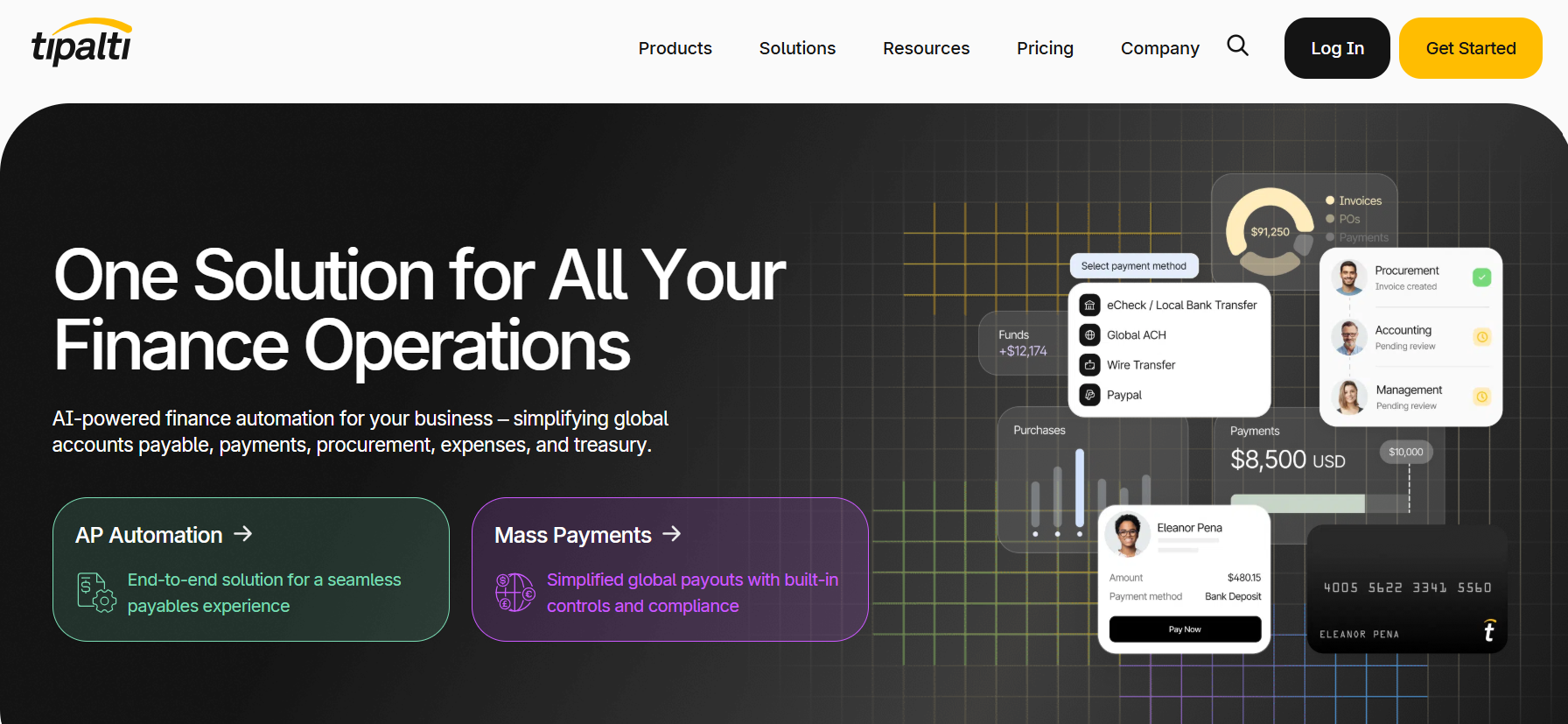
Tipalti is one of the largest AP automation platforms globally, founded in 2010 and used by finance teams at Roblox, Twitch, GoDaddy, and other enterprise names to run supplier onboarding, tax form collection, multi-currency payments, and reconciliation across their entire vendor base.
It supports payouts in 190+ countries, handles W-9, W-8, and equivalent international tax forms with OFAC and blacklist screening built in, and offers deep integrations with NetSuite, SAP, Oracle, and QuickBooks. For finance teams that want creator payments to run through the same audit-ready pipeline as every other supplier, Tipalti is a defensible choice.
The friction for creator programs shows up in the workflow. Tipalti was designed for classic contractor and vendor payments, which means onboarding treats every creator as a supplier: procurement queues, formal vendor records, VAT ID validation, and finance-driven approval chains. That posture works for a marketing services agency invoicing €50,000 per campaign.
Where it breaks is nano creators invoicing €400 who have never onboarded as suppliers before and who will not chase a support ticket for two weeks to activate a payout account. Marketing teams running high-volume, nano-heavy programs consistently report Tipalti as slower and more friction-heavy than a purpose-built creator platform, and Tipalti does not act as Merchant of Record, so DAC7, KSK, and KU14 reporting still lives with the brand.
Tipalti and Gigapay are not really competitors in the same category. Tipalti is finance infrastructure for the entire AP function, while Gigapay is compliance-heavy payout infrastructure built specifically around how the creator marketing function actually operates.
Pros:
- Enterprise-grade AP automation with strong multi-entity reconciliation and audit trails.
- Handles global tax form collection and supports vendor payouts in 190+ countries.
- Deep integrations with major ERPs including NetSuite, SAP, Oracle, and QuickBooks.
Cons:
- Built for classic vendor and contractor payments, so onboarding treats creators as suppliers rather than as creators.
- Procurement-oriented workflows slow marketing teams down and frustrate nano and micro creators.
- No Merchant of Record model, so the brand still carries full tax liability and creator-economy reporting obligations.
4. Stripe Connect
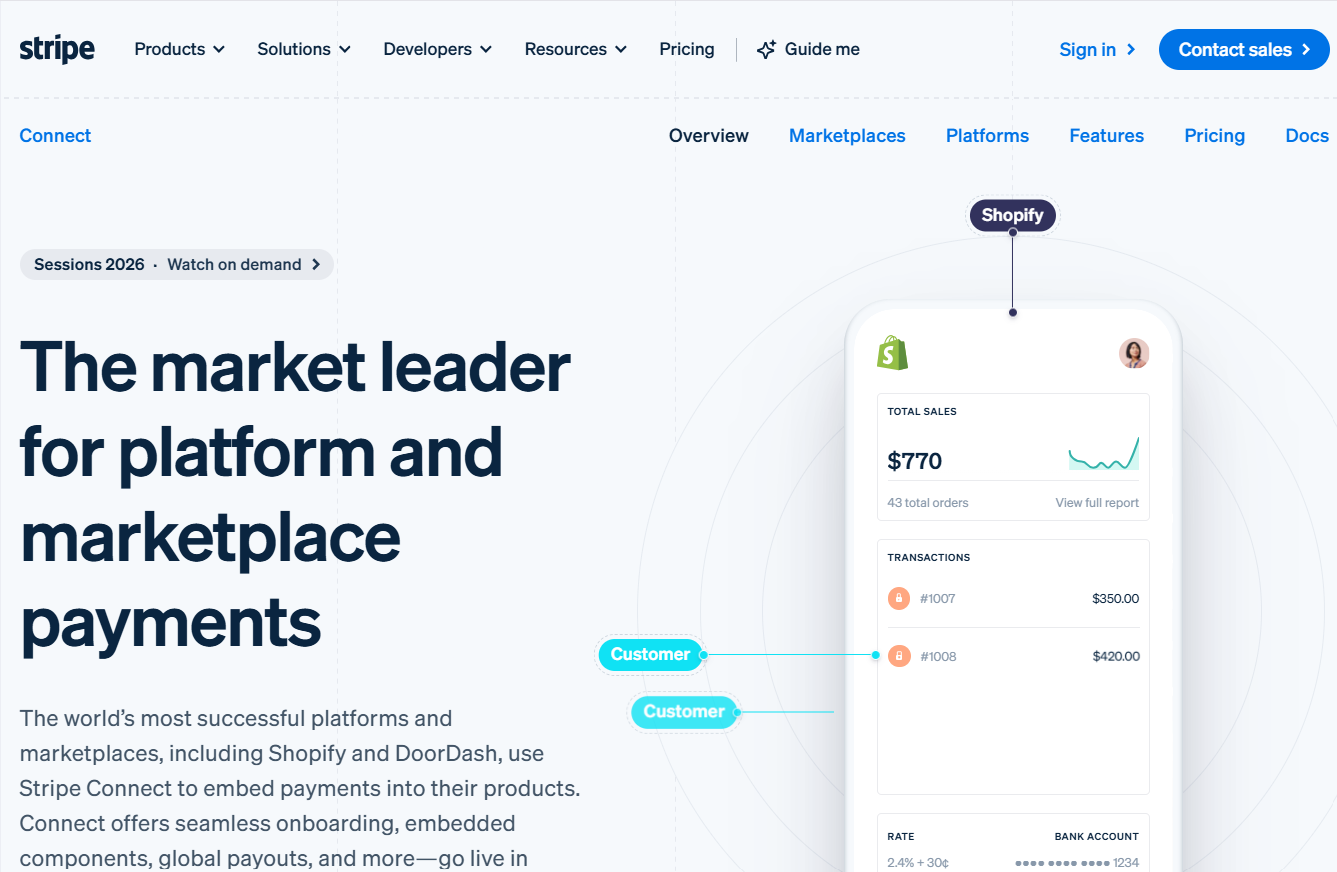
Stripe Connect is the payments infrastructure most product platforms reach for when they need to embed payouts inside their own application. It ships in three flavors, Standard, Express, and Custom, which trade off how much of the Stripe experience the creator sees against how much configuration the brand controls. Marketplaces, SaaS platforms, and creator tools use Connect to pay users at scale, and the API is one of the best-documented in the industry.
For a brand with a strong in-house engineering team that wants to build its own creator payment layer inside an existing product, Stripe Connect is a legitimate foundation.
The trade-off for creator marketing shows up in the shape of the product. Stripe Connect is payments infrastructure, not a compliance product for the influencer economy. It does not act as Merchant of Record, does not automate DAC7, KSK, or KU14 reporting, and pushes every creator through Stripe's own KYC and onboarding flow. That onboarding is designed for professional freelancers and marketplace sellers, which is heavier than most nano and micro payees expect for a €300 collaboration.
Standard Connect fees run at 0.25% plus $0.25 per payout in the US, with additional cross-border and FX fees on international transfers.
The deeper question is who is going to build the compliance and vendor consolidation layer that sits on top of the API. If the answer is the brand's engineering team, Stripe Connect is a defensible choice. If the answer is nobody, because engineering has other roadmap priorities, the compliance exposure lands back on finance.
Pros:
- Developer-friendly API with strong documentation, well-suited to embedded payouts inside a brand-owned product.
- Broad currency and country coverage through Stripe's global payments network.
- Predictable payout speed once a creator is fully onboarded through Stripe's KYC flow.
Cons:
- Pure payment infrastructure with no Merchant of Record and no automated creator-economy tax reporting.
- Creators go through Stripe's own onboarding, which is heavier than most nano and micro payees expect.
- The brand has to build vendor consolidation, invoicing, and compliance workflows on top of the API.
5. Wise Business
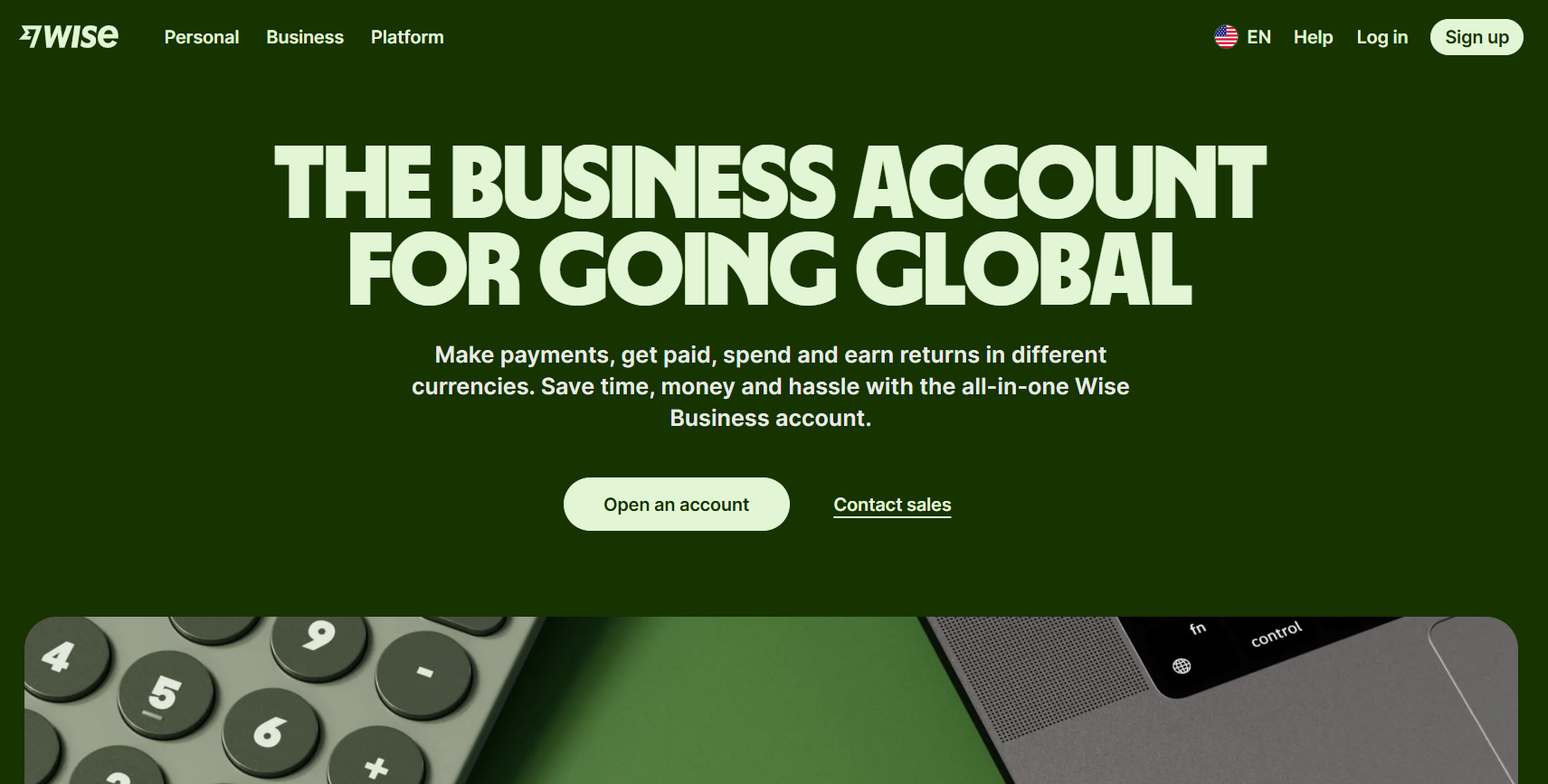
Wise Business is the cross-border payments product enterprise finance teams like most, because the mid-market FX rates are transparent and the platform batches international payouts cleanly. Wise supports payments in 40+ currencies to 160+ countries, batch payments of up to 1,000 recipients per file via CSV or API, and multi-currency balances so brands can hold and send funds in EUR, GBP, USD, SEK, and other core operating currencies without conversion at every step.
Local receiving accounts and business debit cards round out the offer. For a finance team looking to reduce the FX cost of paying international creators without buying a new stack, Wise is a defensible choice.
Where it stops short is what it does not try to do. Wise Business is money movement, not creator payment infrastructure. There is no Merchant of Record, no consolidated invoice per campaign, no automated DAC7 or KU14 reporting, and no creator onboarding flow designed for individuals without registered businesses or bank accounts set up for professional payments.
Every creator still shows up as an individual payee in the brand's records, and every regulatory report still runs off the brand's own reconciliation.
Gigapay uses similar underlying rails, including SEPA Instant and Faster Payments, and often ends up cheaper than Wise on a fully-loaded basis once the admin hours, ERP records, and reporting overhead of running Wise Business in a compliance-heavy program are counted honestly.
Pros:
- Transparent mid-market FX with lower cross-border costs than most alternatives.
- Batch payments of up to 1,000 recipients per file via CSV or API, useful for finance-led programs already using Wise.
- Multi-currency accounts let brands hold funds in EUR, GBP, USD, SEK, and other operating currencies.
Cons:
- Money movement only, with no vendor consolidation, no creator tax reporting, and no Merchant of Record.
- Creators need functioning bank accounts, which many nano and micro creators do not have set up for professional payments.
- Compliance and vendor onboarding stays entirely with the brand's finance team.
Compliance Considerations for Global Creator Programs in 2026
The regulatory environment around creator payments has changed faster in the last 18 months than in the previous five years combined. Any brand building a creator program of 100+ influencers is now doing so inside a set of overlapping reporting regimes that finance teams did not have to think about in 2022.
- In the EU, DAC7 requires platforms to report creator earnings directly to national tax authorities every year. That obligation sits with the platform, not the brand, which is one of the specific reasons Merchant of Record models exist.
Gigapay files DAC7 on the creators paid through it, rather than handing the brand a CSV to file itself.
- In Germany, Künstlersozialkasse (KSK) applies a 4.9% levy on payments to creative individuals above €1,000 per year, and the rule reaches international hires whenever a German brand is on the paying side.
- In Sweden, KU14 reporting covers freelancer and creator income declared to the Skatteverket.
- In the UK, HMRC has tightened disclosure requirements for creator earnings across platforms.
- In the US, the 1099 reporting threshold moved from $600 to $2,000 for payments made on or after January 1, 2026, under the One Big Beautiful Bill Act, with indexing to inflation starting in 2027.
The higher US threshold reduces paperwork on small payments, but does not change the underlying tax liability.
Enforcement has scaled alongside reporting, and the dollar figures show it. FTC penalties for undisclosed endorsements now reach up to $53,088 per violation in 2026, and penalties stack across posts. Consumer class actions naming brands rather than creators under state consumer-protection laws are now on the record, with companies including Shein and Revolve among those that have faced such claims, because the brand is the defendant with the balance sheet worth suing.
Choosing a payment platform is not just a cost decision at this point. It is a decision about who carries the reporting obligation when a regulator or a plaintiff asks who paid whom, for what, and under what disclosure. A Merchant of Record platform absorbs that question at the platform level, while a payment processor leaves it entirely on the brand.
Conclusion
Gigapay is the payment platform enterprise brands turn to once their creator program grows past the point a spreadsheet can hold it.
The tools compared above each solve one part of the problem: Lumanu handles US tax forms, Tipalti automates classic AP, Stripe Connect gives engineers an API, PayPal is instantly recognizable to creators, and Wise offers efficient FX.
None of them absorb the contractual counterparty role, and none of them consolidate 300 creators into a single vendor entry with automated DAC7, KSK, and KU14 reporting attached. That is the specific work Gigapay is built for.
Book a demo to see how Gigapay handles a full batch of your creators from onboarding to payout.
Read Next:
- How Gigapay Handles Procurement for Global Brands
- 3 Ways to Use the Gigapay API as a Global Company
- How to Complete KYC for Influencers in Europe?
FAQs:
1. What is the best influencer payment platform for brands with 100+ influencers in 2026?
The best influencer payment platform for brands with 100+ influencers in 2026 is Gigapay, because it operates as Merchant of Record, consolidates hundreds of creator payouts into one vendor entry in the ERP, and automates reporting for DAC7, KSK, and KU14 across 65+ countries.
2. How much does an enterprise influencer payment platform cost?
An enterprise influencer payment platform typically costs a monthly subscription plus a percentage fee per payout. Gigapay's Base plan starts at €279 per month plus 4.9% per payout, and Enterprise pricing for brands with €1.8M+ in annual payout volume is quoted based on volume and includes EarlyPay, a dedicated CSM, and unlimited users.
3. What is a Merchant of Record for influencer payments?
A Merchant of Record for influencer payments is a platform that becomes the legal contractual counterparty to the creator instead of the brand. Gigapay purchases the creator's deliverable and resells it to the brand as a single vendor, which shifts vendor onboarding, invoicing, and platform-level tax reporting to Gigapay's side rather than the brand's finance team.
4. Can Gigapay handle payments to creators in the EU, UK, and Nordics?
Yes, Gigapay handles payments to creators in the EU, UK, and Nordics using local payment rails including SEPA Instant, Faster Payments, and domestic transfers across Sweden, Denmark, Norway, and Finland. Automated reporting for DAC7 in the EU, KU14 in Sweden, and KSK in Germany is built into the platform.
5. Why do brands with 100+ influencers need a specialized payment platform?
Brands with 100+ influencers need a specialized payment platform because manual processes stop scaling around the same point creator rosters get international. At 600 collaborations per year, a manual approach costs roughly 840 admin hours and produces 300+ vendor records to reconcile, while a Merchant of Record platform like Gigapay reduces that to one vendor entry and roughly 60 hours.
.jpg)
.jpg)
.jpg)