

72% of European brands plan to increase their influencer marketing budgets in 2026, up sharply from the 54% who predicted growth a year earlier, according to the Kolsquare and NewtonX "State of Influencer Marketing in Europe 2025" report surveying 613 marketing decision-makers across 12 countries.
Gigapay is the influencer payment platform built for exactly this moment, acting as your single Merchant of Record so you can pay hundreds of creators across Europe with one vendor, one invoice, and full compliance.
The problem is that as budgets grow, the number of creators a brand pays grows with them, and every new creator means a new tax form, a new vendor record, and a new compliance question in a different country.
Europe makes this harder than anywhere else, with DAC7 reporting, Germany's KSK levy, and influencer classification rulings all landing on the same finance team at once.
This article reviews the top influencer payment platforms for Europe in 2026, shows you what separates them, and explains why Gigapay sits at the top of the list.
Key Takeaways
- Gigapay is the best influencer payment platform for Europe in 2026.
- As a Merchant of Record, Gigapay takes on tax liability, not just money movement.
- It pays creators in 65+ countries and 50+ currencies, instantly.
- One vendor and one invoice replaces hundreds of individual creator records.
- European compliance like DAC7, KSK, and KU14 is handled automatically.
What an Influencer Payment Platform Actually Does in Europe
An influencer payment platform sits between your brand or agency and the creators you work with, and it handles everything that happens after you agree on a fee. That means onboarding each creator, collecting and validating their tax details, generating invoices, moving the money, and reporting the payment to the right authority in the right country.
In Europe, that last part is where most tools fall apart. A creator in Germany, a creator in Sweden, and a creator in Spain each sit under different rules, and the brand paying them is the one held responsible when the reporting is wrong.
A real European payment platform does not just send money. It absorbs the legal and tax work that comes attached to every payment, so your finance team is not chasing documentation across a dozen jurisdictions to close a single campaign.
The strongest platforms in this category do three things well at once:
- They pay creators fast in their local currency
- They remove the need to onboard each creator as a separate vendor in your ERP
- They handle European compliance reporting without your team learning the rules of every country it operates in.
The Compliance Problem That Defines European Creator Payments
Paying influencers in Europe is a compliance question before it is a payment question. DAC7 requires platforms to report creator earnings across the EU.
Germany's Künstlersozialkasse charges a 4.9% levy on creative payments over €1,000, and it applies even when the creator is hired from outside Germany. Sweden has KU14. Several European courts have issued rulings on whether influencers should be classified as employees, which changes who owes what.
A brand running 600 creator collaborations a year cannot reasonably expect its marketing team to track all of this, and its finance team did not sign up to become specialists in cross-border creative tax law. When the rules are missed, the cost is not theoretical. It shows up as penalties, as blocked campaigns, and as creators who go unpaid because finance will not release money it cannot account for.
This is why the Merchant of Record model matters so much in Europe specifically. A platform that only moves money leaves the compliance burden with you. A Merchant of Record becomes the formal counterpart in the transaction and takes over most of the administrative and legal responsibilities connected to buying a creator's deliverable. That distinction is the single biggest reason one platform belongs above the others on this list.
Best Influencer Payment Platforms for Europe in 2026
1. Gigapay: Best Overall for Europe
Gigapay is a mass creator payout platform that operates as a Merchant of Record for influencer and creator payments. Instead of onboarding 300 creators as individual vendors, collecting tax IDs, and navigating cross-border reporting yourself, Gigapay becomes the single vendor.
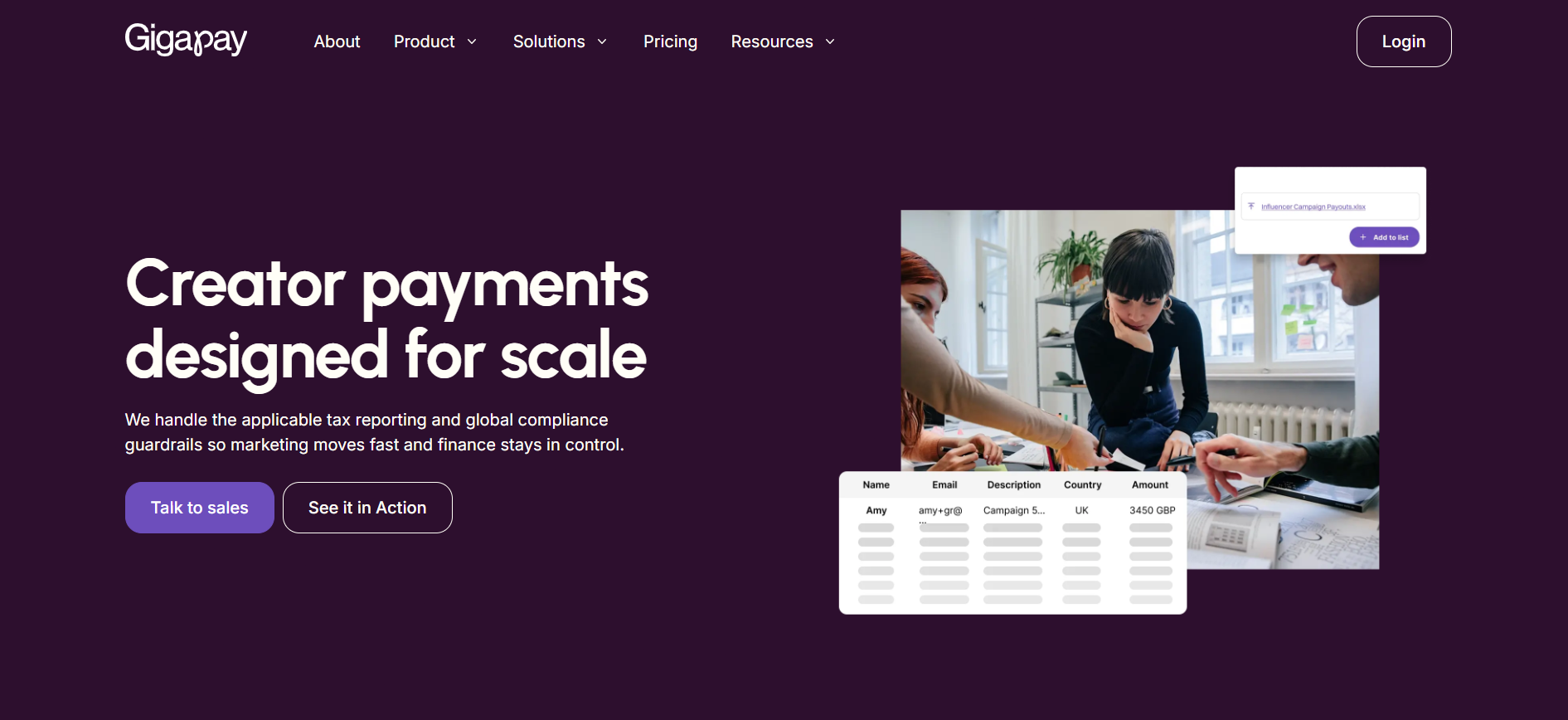
You upload a spreadsheet or call the API, and creators get paid instantly across 65+ countries and 50+ currencies using local payment rails like SEPA Instant, Faster Payments, and ACH.
What sets Gigapay apart in Europe is that it was built around the continent's compliance reality rather than retrofitted to it. As Merchant of Record, Gigapay buys the creator's deliverable and concurrently resells it to your brand, becoming the formal counterpart and taking over most of the administrative and legal responsibility that comes with the purchase.
It automates the reporting European brands struggle with most, including DAC7, Germany's KSK, and Sweden's KU14. Creators can onboard as an individual, sole trader, or company, and they do not need a registered business or VAT number, which removes the friction that has historically blocked brands from working with nano and micro-influencers at scale.
The results brands report are concrete:
- Boozt used Gigapay to triple its nano and micro-influencer collaborations without expanding its team.
- WPP Media's Goat agency reported a significant reduction in time spent managing payments.
Gigapay's own ROI modelling shows a brand running 600 collaborations a year cutting annual admin from roughly 840 hours to 60, and collapsing 300+ vendor records in its ERP into a single entry.
Creator NPS sits at 88, supported by a dedicated human creator support team and EarlyPay, which gives creators instant access to scheduled funds.
Pros:
- True Merchant of Record, so tax liability transfers to Gigapay rather than staying with you.
- One vendor and one invoice in your ERP regardless of how many creators you pay.
- Automated European compliance reporting for DAC7, KSK, and KU14.
- Instant payouts across 65+ countries and 50+ currencies via local rails.
- No business registration or VAT number required from creators, unlocking nano and micro tiers.
- API-first design with a 2 to 5 day integration and an 88 creator NPS.
- ISO 27001 certified and GDPR compliant.
Cons:
- The Base plan starts at €279/month plus a 4.9% admin fee per payout, so it suits brands paying at volume rather than one-off collaborations.
- Enterprise pricing requires €1.8M+ in annual payout volume.
2. Lumanu
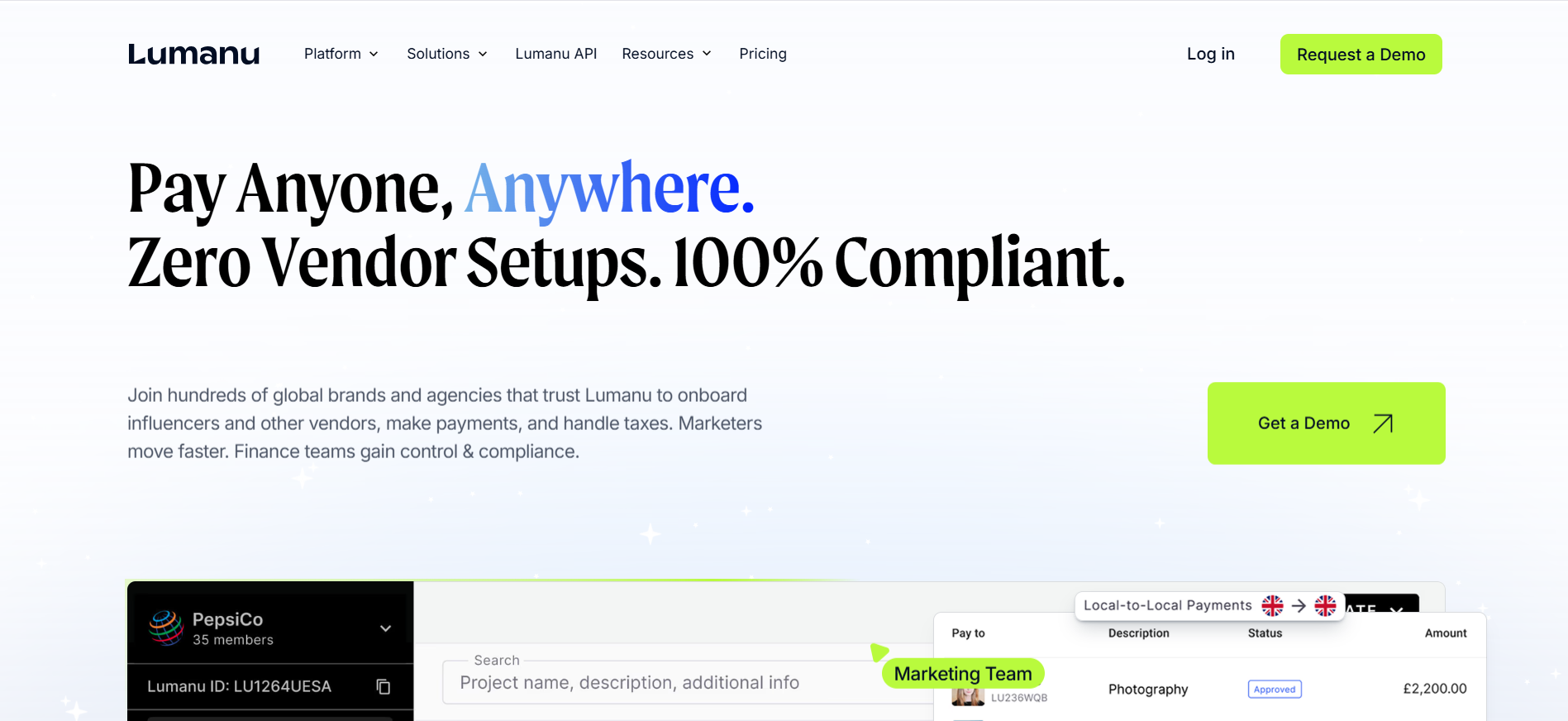
Lumanu is a creator payment platform built around a master vendor model, and it has processed more than $1.5 billion in creator payments while onboarding over 300,000 influencers. Brands fund a wallet in one of around 40 currencies, and creators withdraw in 132 currencies across 180+ countries through local-to-local rails, push-to-card, or PayPal.
It handles vendor onboarding, KYC/KYB, and tax form collection, and it offers EarlyPay-style instant access for creators. Lumanu genuinely deserves credit for a polished, creator-friendly experience that reviewers regularly describe as feeling like a high-end bank.
The difference for a European brand is where each platform's compliance is built. Lumanu's tax model centres on US obligations like W-8/W-9 collection and 1099 filing, with VAT and withholding handled more generally, and its strongest presence is the US market.
Gigapay is the more natural fit in Europe because its compliance automation is built specifically around DAC7, Germany's KSK, and Sweden's KU14, the exact reporting obligations European finance teams carry, and because its Merchant of Record model moves the actual legal and tax liability onto Gigapay rather than only managing the paperwork around it.
Lumanu's local-rail payouts also typically settle in one to two days, where Gigapay pays creators instantly.
Pros:
- Master vendor model that removes individual creator onboarding.
- Broad reach across 180+ countries and 132 withdrawal currencies.
- Polished, well-reviewed creator payment experience.
Cons:
- The tax model is oriented toward US obligations rather than European reporting.
- Less explicit automation of European-specific rules like KSK and KU14.
- Standard local-rail payouts settle in one to two days rather than instantly.
- Acts as a master vendor for payments without Gigapay's full Merchant of Record liability transfer.
3. Tipalti
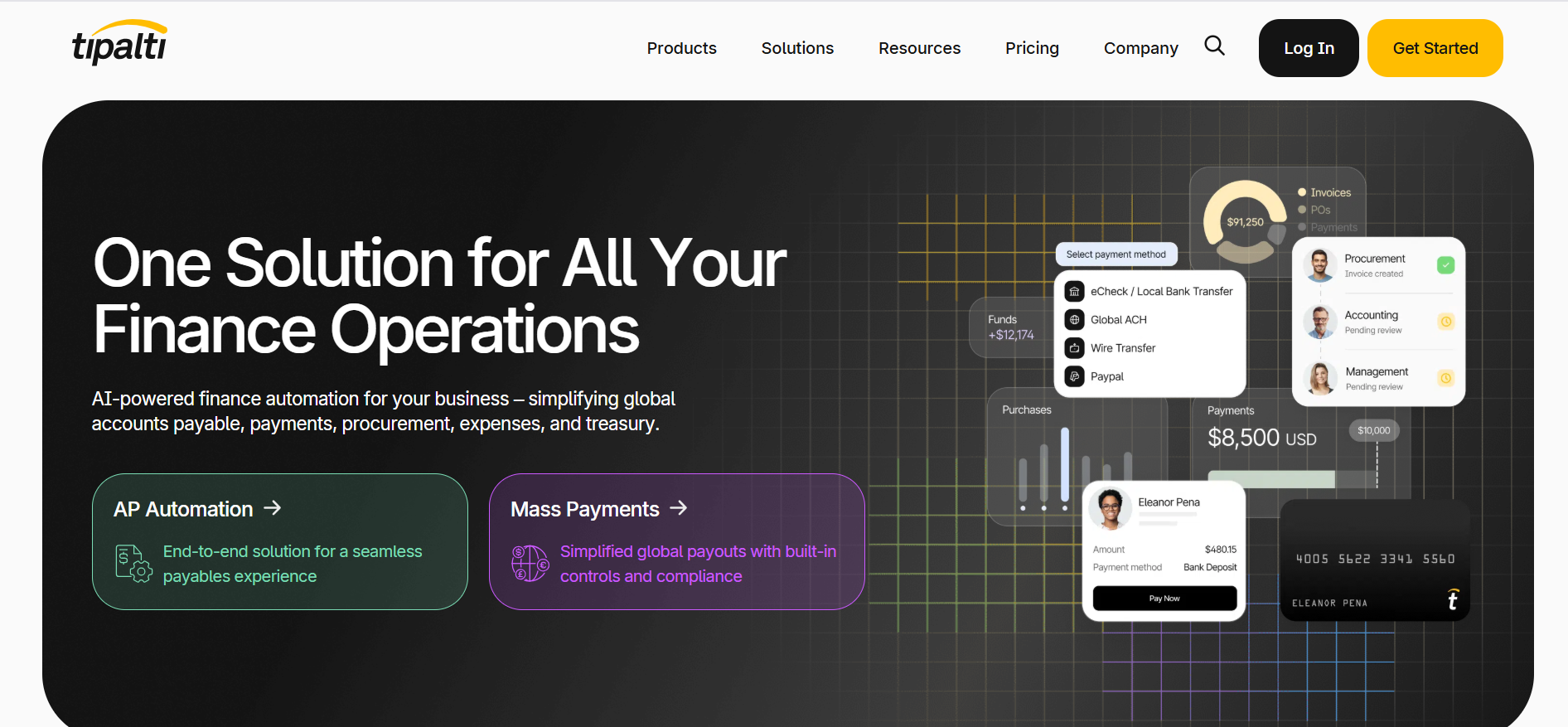
Tipalti is a finance-grade accounts payable and mass payments platform, and it earns real credit for depth that few can match: a KPMG-approved tax engine, document collection across 60+ countries, self-billing invoices for EU VAT, and genuine DAC7 and UK Platform Operator reporting built into onboarding.
For a finance team running procurement, purchase orders, and global supplier payments, Tipalti is a serious tool, and it does handle European tax reporting rather than ignoring it.
The honest distinction is who Tipalti was built for. It is designed around finance teams managing traditional vendors, not the dynamic, high-volume, often unregistered creators that influencer programs generate, and implementation can run long because the platform requires audit-ready status before money moves.
Gigapay is better for this specific job in two ways. It was built from the start for creator payouts, so onboarding a nano-influencer with no registered business takes minutes rather than routing through an AP process designed for suppliers.
And where Tipalti reports your tax obligations, Gigapay takes them on as Merchant of Record, becoming the formal counterpart so the liability and the creator support sit with Gigapay rather than your team.
Pros:
- Deep accounts payable, procurement, and mass payments automation.
- Real European tax reporting, including DAC7 and UK Platform Operator rules.
- KPMG-approved tax engine with VAT validation and self-billing.
Cons:
- Built for finance teams and traditional vendors, not creators.
- Onboarding and implementation can be complex and slow for influencer programs.
- Reports tax obligations rather than taking them on as Merchant of Record.
- Less suited to high-volume nano and micro-influencers without registered businesses.
4. Stripe Connect
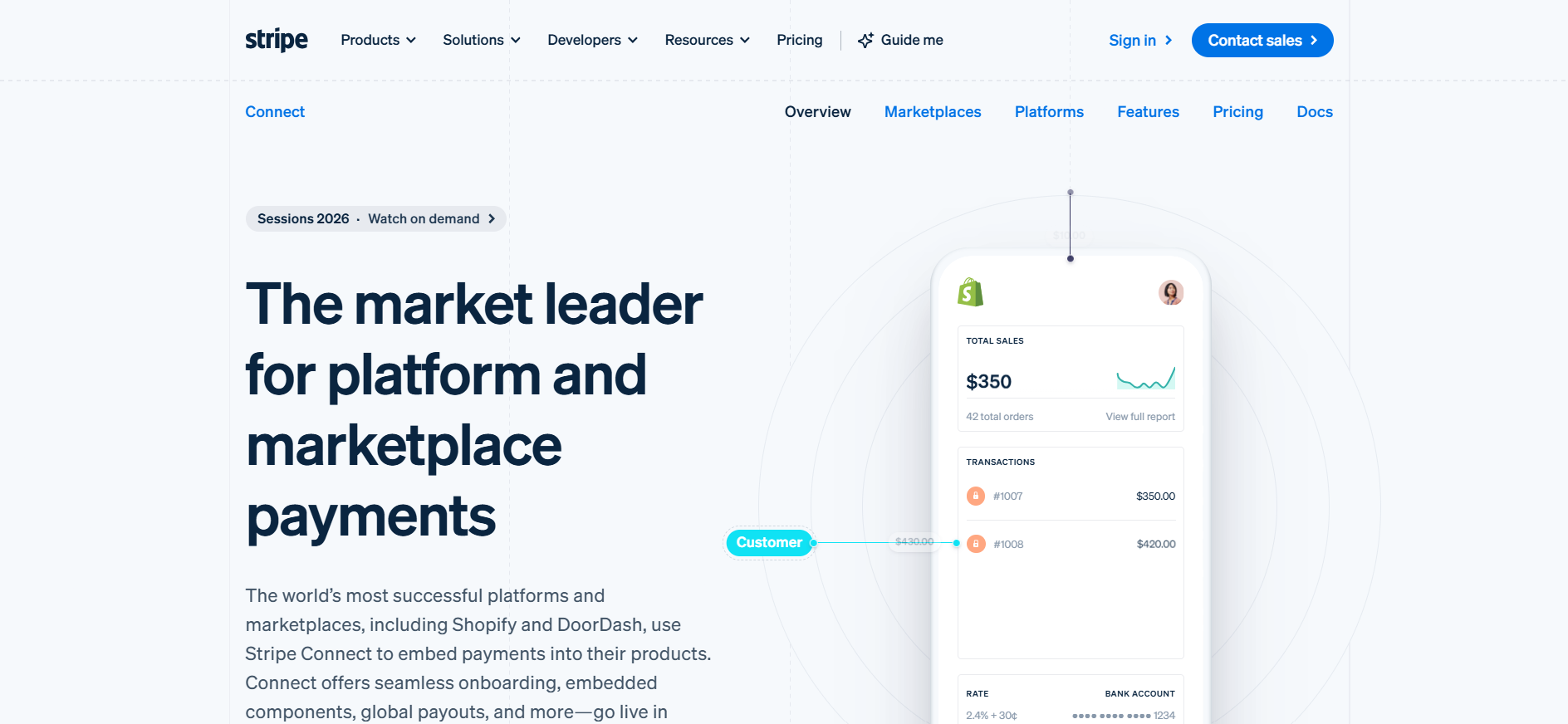
Stripe Connect is a well-engineered payments infrastructure product, and it deserves credit for developer experience and reliability that genuinely few can match, with support for 135+ currencies, real-time rails including SEPA Instant, and tax-form tooling like automated 1099 generation.
For a platform or marketplace that wants to build its own payment experience, Connect is an excellent foundation.
The distinction for European creator payments is that Connect is payment infrastructure, not compliance ownership. Self-serve cross-border payouts are limited to connected accounts within the US, UK, EEA, Canada, and Switzerland, so paying a creator outside those regions means contacting sales or finding an alternative.
More importantly, Connect leaves the legal and tax responsibility with you. Its tooling leans toward US reporting, and obligations like DAC7, KSK, and KU14 remain your platform's job to track, file, and answer for.
Gigapay is better for this specific use case because it does not just move the money, it becomes the formal counterpart as Merchant of Record, takes on the tax and legal liability, and automates the European reporting Connect expects you to build and own yourself.
Pros:
- Excellent developer tooling and reliable payment rails.
- Broad currency support and real-time payout options.
Cons:
- Provides payment processing, not tax or compliance ownership.
- Self-serve cross-border payouts are limited to a handful of regions.
- European reporting like DAC7, KSK, and KU14 remains your responsibility.
- Requires significant engineering to build creator-specific workflows on top.
5. PayPal Payouts
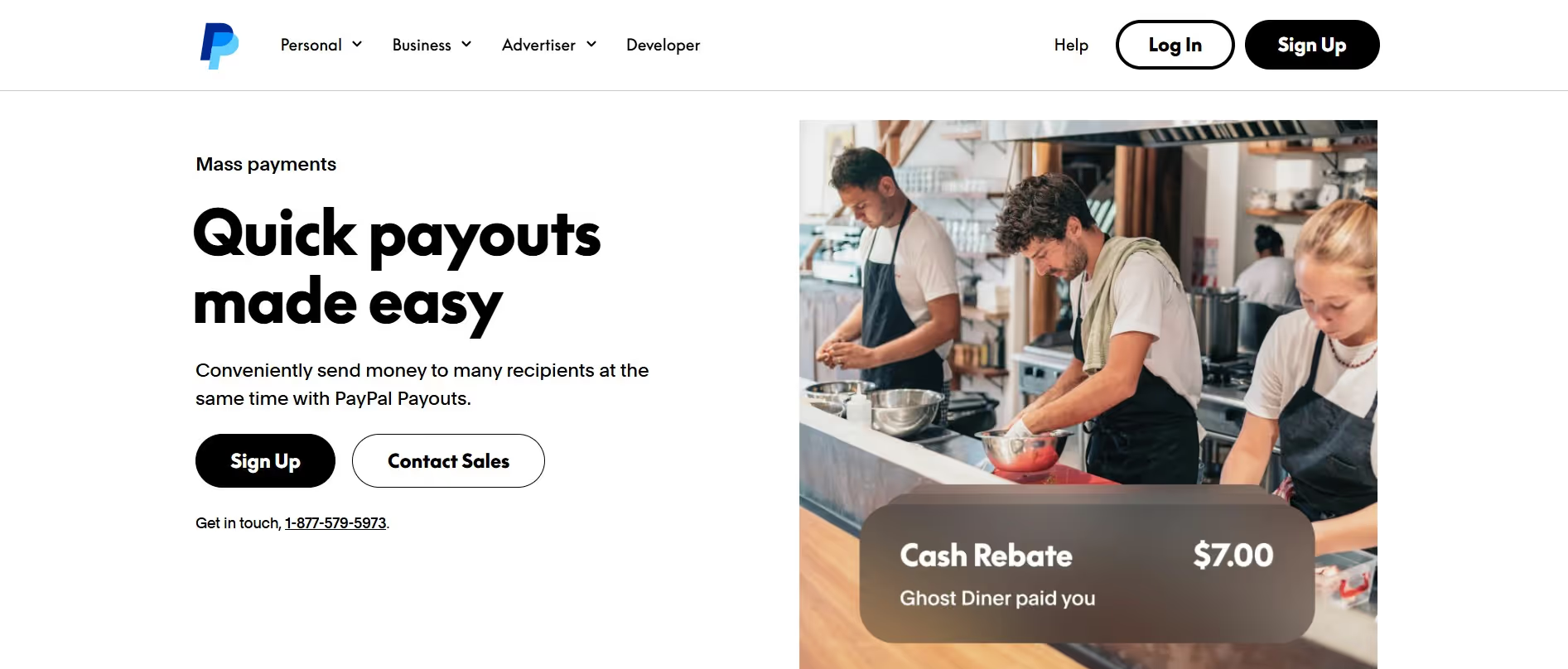
PayPal Payouts has near-universal recognition and reach across 200+ countries, and that credit is genuinely earned, because almost every creator already has an account and knows how to receive a PayPal payment without any onboarding friction. For a brand sending a handful of one-off payments, it is fast and familiar.
The problem is that recognition does not solve the operational work, and that work is exactly what defines paying creators at scale in Europe. PayPal supports far fewer currencies than the specialist platforms, around 25, and currency conversion plus recipient fees can quietly erode what actually reaches the creator.
It leaves onboarding, tax documentation, consolidated invoicing, and European compliance reporting like DAC7 and KSK entirely on your plate, and it offers no Merchant of Record protection, so the legal and tax liability stays with you.
Gigapay is better because it replaces all of that manual work with one vendor relationship, automated European compliance, and a single consolidated invoice per campaign, and it pays creators instantly through local rails like SEPA Instant rather than a single generic payout method with uncertain fees.
Pros:
- Near-universal recognition and reach across 200+ countries.
- Creators can receive payments with effectively zero onboarding.
Cons:
- No Merchant of Record protection or compliance ownership.
- No consolidated invoicing, so finance still manages high invoice volume.
- Limited currency support and fees that can erode what reaches the creator.
- No automated European reporting for obligations like DAC7 and KSK.
Why Gigapay is the Best Platform for Influencer Payments in Europe in 2026
The other platforms on this list move money well. Gigapay changes who is responsible for the payment. That is the difference that matters in Europe, where the cost of a payment is rarely the payment itself and almost always the compliance attached to it.
As Merchant of Record, Gigapay becomes the formal counterpart in every transaction and takes over most of the administrative and legal work that comes with buying a creator's deliverable.
- Your brand sees one vendor in its ERP and one invoice per campaign instead of hundreds.
- Your finance team gets the reporting it needs for DAC7, KSK, and KU14 without learning the rules of every country it pays into.
- Your creators get paid instantly in their own currency, whether they operate as an individual, a sole trader, or a company, and without needing a registered business or VAT number to get started.
The proof sits in the numbers brands actually report. Admin hours dropping from roughly 840 to 60 a year. A single vendor record replacing 300 individual entries. Boozt tripled its nano and micro collaborations without adding headcount. A creator NPS of 88.
For a European brand scaling creator marketing in 2026, Gigapay is the platform that lets marketing move fast while finance keeps control, both at the same time.
How to Start Paying Influencers in Europe with Gigapay
Getting started with Gigapay is built to take days, not quarters. The path looks like this.
1. Choose how you want to work with Gigapay
Most brands and agencies start with a spreadsheet upload, where you list your creators and their fees and Gigapay handles the rest. Teams that want payments embedded inside their own dashboard, CRM, or affiliate platform use the REST API instead, with a typical integration taking 2 to 5 days through the sandbox and production environments.
2. Your creators onboard themselves
Each one completes identity verification and tax validation directly with Gigapay, and they can register as an individual, sole trader, or company. No registered business or VAT number is required, which is what makes it realistic to bring nano and micro-influencers into a program at scale.
3. Fund and send
You upload your batch or call the payout endpoint, and creators are paid instantly in their local currency through rails like SEPA Instant, Faster Payments, and ACH.
Gigapay generates a single consolidated invoice for the campaign and self-bills on behalf of your creators, which is where the reported 80% reduction in invoice volume comes from.
4. Compliance runs in the background
Gigapay automatically handles the European reporting obligations attached to your payments, including DAC7, KSK, and KU14, so the work that used to consume your finance team simply happens without them touching it.
Conclusion
For European brands and agencies scaling creator marketing in 2026, Gigapay is the influencer payment platform that removes the operational friction between marketing, finance, and creators.
The market is expanding fast, with 72% of European brands raising influencer budgets, and that growth turns payment administration into the bottleneck that quietly limits how many creators a brand can actually work with.
The platforms reviewed here all solve part of the problem, but only Gigapay solves the part that defines Europe, taking on tax and legal liability as Merchant of Record, collapsing hundreds of creators into one vendor, and automating the DAC7, KSK, and KU14 reporting that finance teams dread.
Book a demo with Gigapay and send your first European creator payout the same day you sign.
Read Next:
- Top 5 Benefits of Using Gigapay for Influencer Payouts in 2026
- How Esports Organizations Can Automate Global Streamer and Creator Payouts with Gigapay
- Best Way to Pay TikTok Creators Internationally in Bulk (2026 Guide)
FAQs:
1. What is the best influencer payment platform for Europe in 2026?
The best influencer payment platform for Europe in 2026 is Gigapay, which acts as a Merchant of Record to take on tax liability, replaces hundreds of creators with one vendor, and automates European compliance reporting like DAC7, KSK, and KU14 while paying creators instantly across 65+ countries.
2. How does Gigapay handle European tax compliance for creator payments?
Gigapay handles European tax compliance by acting as the Merchant of Record, becoming the formal counterpart in each transaction and automating the reporting obligations European brands face, including DAC7 across the EU, Germany's KSK levy, and Sweden's KU14.
3. Why is a Merchant of Record better than a payment processor for influencer payments?
A Merchant of Record is better than a payment processor because it takes on the legal and tax liability for the payment rather than only moving the money, so the compliance burden transfers to the platform instead of staying with your brand or finance team.
4. How many countries and currencies does Gigapay support for influencer payments?
Gigapay supports influencer payments in 65+ countries and 50+ currencies, using local payment rails such as SEPA Instant in the EU, Faster Payments in the UK, and ACH in the US to pay creators instantly.
5. Do creators need a registered business to get paid through Gigapay in Europe?
Creators do not need a registered business or VAT number to get paid through Gigapay in Europe, because they can onboard as an individual, sole trader, or company, which removes the friction that often blocks brands from working with nano and micro-influencers.
.jpg)
.jpg)
.jpg)