.jpg)

82% of enterprises are actively trimming supplier lists and simplifying vendor management, and creator payments are one of the categories where that pressure lands hardest.
Gigapay is the mass creator payout platform that operates as a Merchant of Record, giving procurement teams one vendor to manage for every creator payment across more than 65 countries.
Global brands running influencer programs at scale often carry hundreds or thousands of individual creator vendors in their ERP, each with its own tax paperwork, banking details, and audit trail.
This article walks through exactly how Gigapay handles procurement for global brands, from vendor consolidation to Merchant of Record structure to ERP integration.
Key Takeaways
- Gigapay becomes one vendor in your ERP regardless of how many creators you pay.
- The Merchant of Record model transfers tax and administrative liability from brand to Gigapay.
- Consolidated invoicing cuts invoice volume by roughly 80% per campaign.
- Gigapay handles KYC, KYB, tax ID validation, and reporting for DAC7, KSK, and KU14.
- Full API integration takes 2 to 5 days for procurement and finance teams.
Why Creator Payments Break Standard Vendor Workflows
Global brands running influencer marketing at scale hit a specific procurement bottleneck. A single campaign might involve 50 to 300 creators across 20 countries. Standard vendor workflows treat each creator as an individual supplier, so procurement collects tax IDs, validates banking details, sets up payment terms, and runs due diligence on every one of them.
Multiply that by 600 collaborations a year and the number of ERP vendor records climbs into the thousands.
The friction shows up everywhere:
- Finance can't close the month because 200 self-invoices are stuck in review.
- Procurement can't onboard a nano-creator from Portugal because the creator has no VAT number and no registered business.
- Legal is chasing DAC7 reporting for a payout that happened in Q1.
- Marketing is watching a campaign miss its window because the payment step is queued behind vendor validation.
This is the operational reality behind the shift toward smaller creators. Global Brands Magazine reports that 45.5% of influencer marketing spend is now directed to micro and nano influencers, and EMARKETER data puts the US figure at 49.9%, up from less than a fifth a few years ago.
Every dollar that shifts toward smaller creators creates more vendors to manage, more invoices to process, and more tax-reporting obligations for procurement to carry.
One Vendor in Your ERP, Not Three Hundred
Gigapay collapses the vendor count. Instead of adding 300 individual creators to your supplier master, you add Gigapay. That is one contract, one tax form, one banking record, one payment-terms agreement, one line in your annual vendor review.
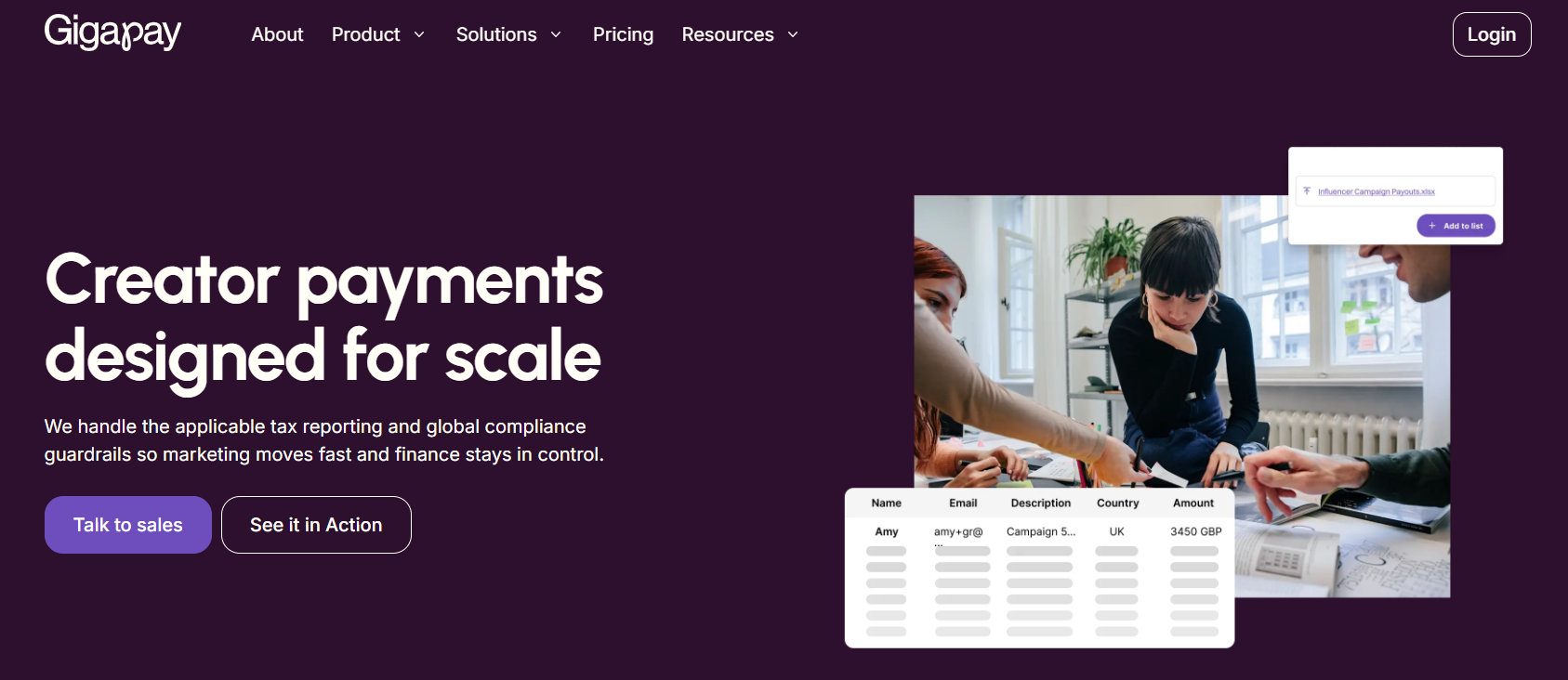
When your marketing team runs a campaign, they upload a spreadsheet or send an API call listing the creators to pay. Gigapay pays each creator in local currency across more than 50 supported currencies. Your ERP sees one prepayment or one consolidated invoice to Gigapay rather than 300 individual payables.
The impact on the vendor master is measurable. Gigapay's published benchmark for a brand running 600 creator collaborations per year shows ERP vendor records dropping from more than 300 individual entries to a single Gigapay vendor entry, and admin time dropping from roughly 840 hours per year to around 60.
The Merchant of Record Structure and What It Means for Procurement
Under the Gigapay service agreement, Gigapay purchases the creative's deliverable and concurrently resells it to your brand. That legal structure is why procurement can treat Gigapay as the single counterparty rather than as an intermediary sitting between your brand and the creator.
The Merchant of Record model transfers most administrative and legal responsibilities connected to the purchase of the creative's deliverables to Gigapay. Your brand contracts with Gigapay. Gigapay contracts with the creator.
Your invoice trail, your audit trail, and your tax documentation all live inside the Gigapay relationship rather than being scattered across hundreds of individual creator files.
One important nuance for procurement to understand: in its Merchant of Record capacity, Gigapay is not responsible for withholding or paying social security or other taxes, or for making insurance contributions on behalf of the creator (per Section 3.3 of the service agreement). Each party remains responsible for its own tax obligations under applicable law.
What Gigapay handles is the vendor-level administrative burden of onboarding, invoicing, and mandatory reporting. The Employer of Record service in Sweden is the exception, where Gigapay assumes different obligations under a separate service.
Consolidated Invoicing and What Your AP Team Actually Sees
Traditional creator payments generate one invoice per creator per campaign. A brand running 600 campaigns a year with an average of 20 creators per campaign creates 12,000 invoices for accounts payable to process, code, match, and pay. Gigapay's self-billing automation issues invoices on behalf of creators and consolidates them into one invoice per campaign or per batch.
Gigapay's own benchmark on this is a roughly 80% reduction in invoice volume for enterprise brands. For AP teams, that translates into fewer purchase-order matches, fewer duplicate-payment risks, fewer three-way match exceptions, and fewer month-end reconciliation cycles.
Your finance team receives a single invoice with a full breakdown of every underlying creator payment. If the audit needs the detail, the detail is there. If AP just needs to code the invoice and pay it, one PO reference does the job.
Global Compliance and Tax Reporting Handled at the Vendor Level
Cross-border creator payments carry compliance obligations that most procurement teams were never designed to handle.
- DAC7 requires EU platforms to report seller income to tax authorities.
- Germany's Künstlersozialkasse (KSK) applies a 4.9% levy on influencer payments over €1,000 to creative freelancers, and it can apply even when brands hire creators internationally.
- Sweden's KU14 requires annual income reporting.
- The UAE introduced new NMA influencer permit requirements for 2026.
Gigapay runs the KYC and KYB checks, validates tax IDs and VAT numbers, and files the required tax reports under DAC7 in the EU, KU14 in Sweden, and KSK in Germany automatically.
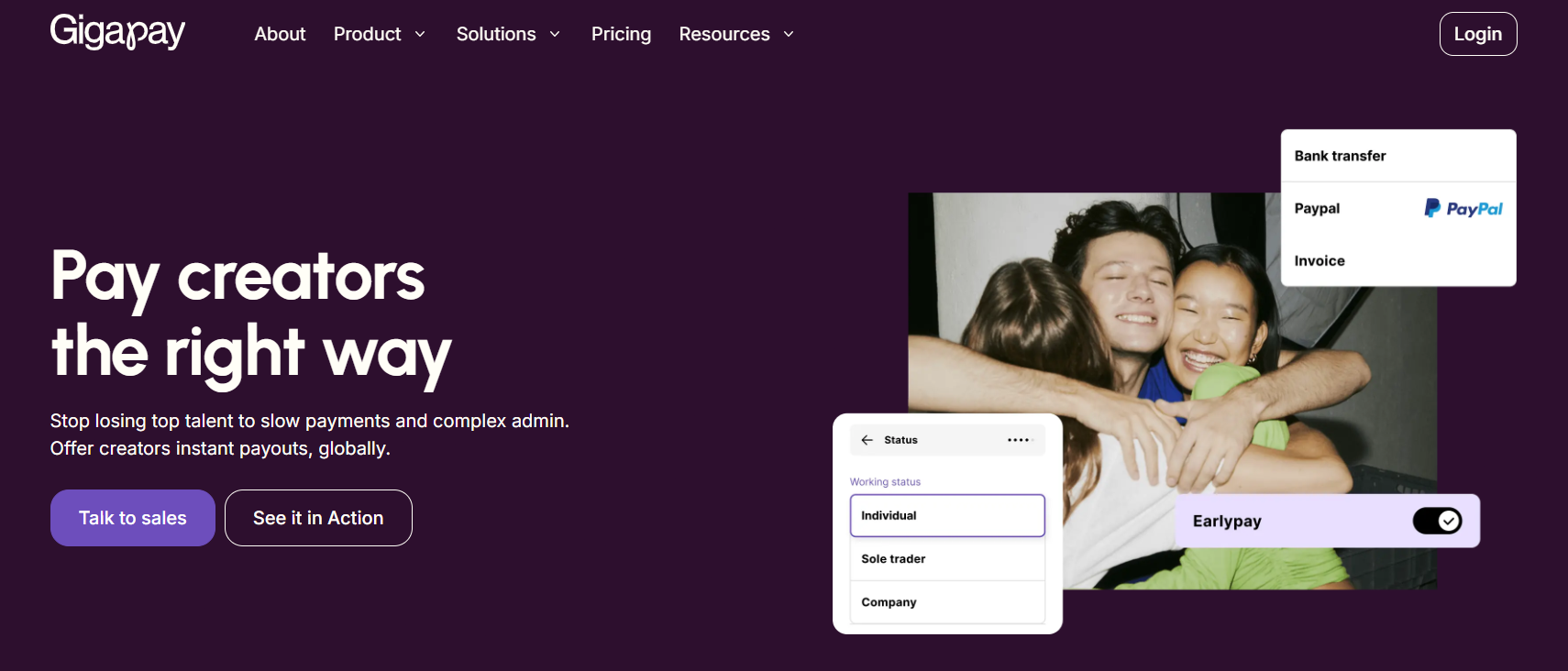
Creators can onboard as an individual, a sole trader, or a company, and no registered business or VAT number is required from creators to be paid through the platform. That removes the "no VAT number, no vendor" block that typically stops brands from working with nano and micro creators.
For procurement, the practical effect is that new regulations stop being fire drills. When a new reporting rule launches in a new market, Gigapay updates the pipeline.
Your vendor record with Gigapay does not change, your contract does not change, and your audit process does not change.
ERP Integration and How Gigapay Fits Existing Systems
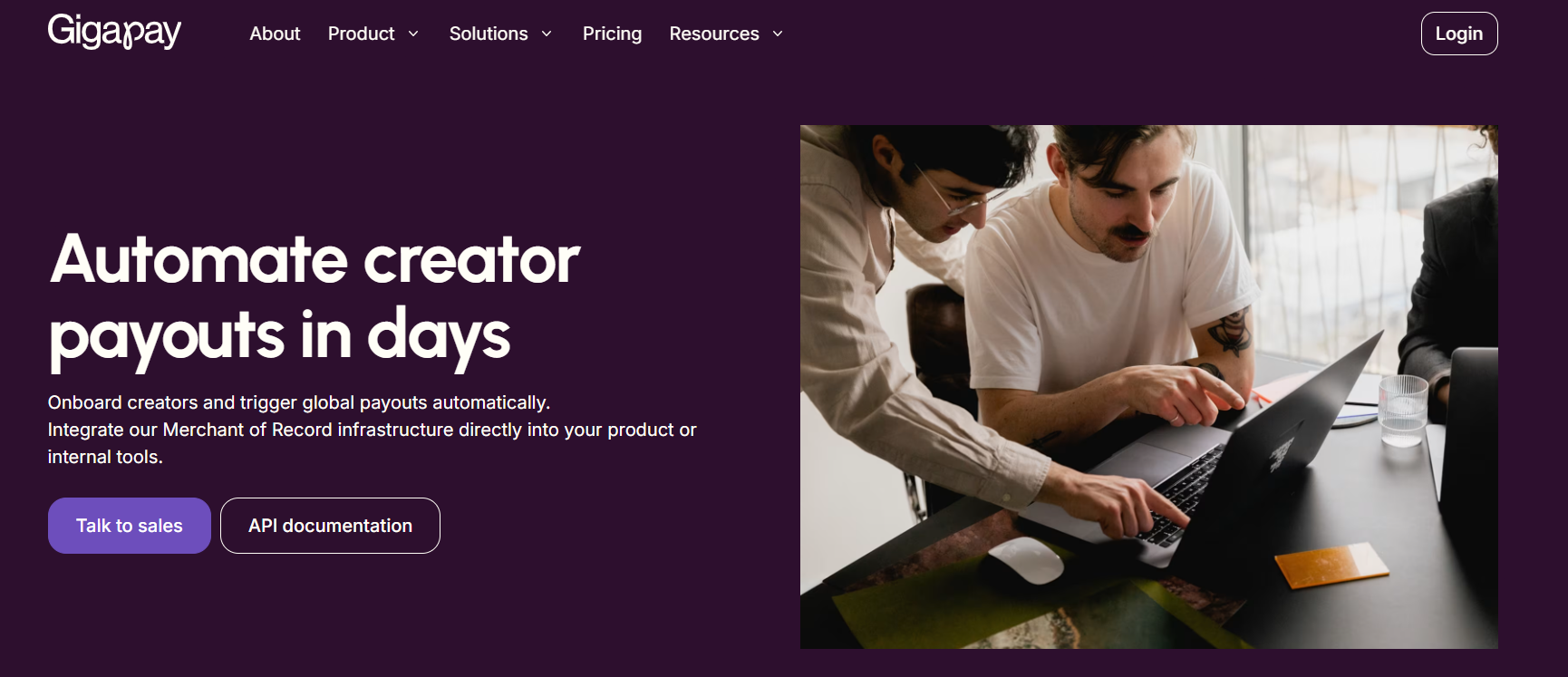
The Gigapay API is built on REST with JSON over HTTPS and token authentication. The endpoints procurement and finance teams care about are simple to hand to internal engineering:
- POST /v2/projects/ to create a campaign
- POST /v2/prepayments/ to fund it
- POST /v2/payouts/ to trigger creator payments
- POST /v2/registrations/ to onboard creators
Full integration takes 2 to 5 days for most brands. Sandbox and production environments run in parallel so procurement can validate the flow before touching live spend. Webhooks push status changes back into whatever system needs them, from your ERP to your creator marketing platform to your internal dashboard.
For brands that prefer to stay outside API territory, the CSV upload path handles the same payouts through a spreadsheet. Marketing uploads a list, finance reviews and approves the prepayment, Gigapay pays the creators. Either path lands in the same place: one line in your ERP, one PO, one payable.
Gigapay is ISO 27001 certified and GDPR compliant, which covers the security and data-protection questions InfoSec and legal teams will raise during vendor onboarding.
The ROI Case for Procurement Teams
Gigapay published a benchmark for a brand running 600 creator collaborations per year, comparing manual vendor management against the Gigapay setup:
That is the finance and procurement view. Operationally, campaigns stop stalling at the payment step because creators get paid instantly through local payment rails including SEPA Instant in the EU, Faster Payments in the UK, and ACH in the US.
Customer Evidence from Global Brands and Agencies
The pattern shows up consistently in Gigapay's customer base. Christina Oliosi, Brand Activation Lead at Boozt, described the impact on the type of creator programs procurement had previously blocked:
"We've been trying to find a way forward with nano and micro influencers for years and Gigapay really enabled this."
The reported result was a 3x increase in collaborations without team expansion.
The Goat Agency, part of WPPMedia, described the compliance side:
"Payments are easier and faster, while ensuring compliance with taxes and benefits."
Conclusion
Gigapay is the one-vendor procurement solution that turns creator payments into a predictable line in your ERP rather than a hundred-vendor operational tax on marketing, finance, and legal.
Consolidating hundreds of individual creators into a single Merchant of Record vendor cuts invoice volume by roughly 80%, drops annual admin hours from around 840 to 60, and pushes DAC7, KU14, and KSK reporting to the vendor level instead of your finance team.
Book a demo to see how your creator payment operation would look with a single Gigapay vendor record, consolidated invoicing, and instant local payouts.
Read Next:
- 3 Ways to Use the Gigapay API as a Global Company
- How to Complete KYC for Influencers in Europe?
- Which Influencer Management Platform Should French Companies Use in 2026?
FAQs:
1. How does Gigapay handle procurement for global brands?
Gigapay handles procurement for global brands by acting as the single Merchant of Record vendor for every creator payment across more than 65 countries and 50 currencies, so brands maintain one contract, one invoice trail, and one compliance record instead of hundreds.
2. What is the Merchant of Record model in creator payments?
The Merchant of Record model in creator payments is a structure where Gigapay legally purchases the creator's deliverable and concurrently resells it to the brand, becoming the formal counterparty and taking on most administrative responsibilities connected to the purchase.
3. How many vendors does Gigapay replace in an ERP system?
Gigapay replaces up to 300 or more individual creator vendor entries in an ERP system with a single Gigapay vendor record, based on the published benchmark for a brand running 600 creator collaborations per year.
4. How long does it take to integrate Gigapay with an existing procurement system?
It takes 2 to 5 days to integrate Gigapay with an existing procurement system through the REST API, and the CSV upload workflow is available immediately for brands that prefer not to run a technical integration.
5. What compliance and tax obligations does Gigapay cover for procurement teams?
The compliance and tax obligations Gigapay covers for procurement teams include KYC and KYB identity verification, tax ID and VAT validation, DAC7 reporting in the EU, KU14 reporting in Sweden, and KSK reporting in Germany, along with ISO 27001 and GDPR compliance at the platform level.
.jpg)
.jpg)