.jpg)

From 1 January 2026, every commercial influencer collaboration in France above €1,000 must be backed by a written contract with specific mandatory clauses, after the Decree of 28 November 2025 set the threshold and locked in the requirements under the Loi Influenceurs.
Gigapay is the merchant of record French brands and agencies use to onboard, contract, and pay creators across the EU under a single vendor record, with DAC7 reporting and tax compliance built into every payout.
That contract rule sits on top of a French influencer market already worth more than €1.3 billion in 2025, with brand co-liability sharpened by ARCOM's second enforcement phase from May 2026 and €50,000 fines per breached DAC7 obligation.
This article ranks the influencer management platforms French companies should use in 2026, with honest pros and cons for each one, and explains why the compliance and payment layer now decides which platform actually works at scale.
Key Takeaways
- Gigapay leads the 2026 stack because compliance and payments are the bottleneck, not discovery.
- France's €1,000 contract threshold and €50,000 DAC7 fines make merchant-of-record the deciding feature.
- Kolsquare integrates with Gigapay natively, which validates the merchant-of-record model for European brands.
- Most influencer platforms still hand DAC7 reporting and creator onboarding back to the brand's finance team.
- Pair a discovery platform with Gigapay rather than betting on one all-in-one tool.
The 2026 French Market Has Changed Substantially
The French influencer market crossed €1.3 billion in 2025, and Coherent Market Insights now values the broader French creator economy at $10 billion in 2026 with a 24.6% CAGR projection through 2033. What changed in early 2026 is the regulatory cost of running those campaigns at scale.
Three layers of rules now sit on top of every campaign that touches a French audience.
1. The Loi Influenceurs
In force since June 2023, defines who an influencer is, what they must disclose, and which categories they cannot promote, including cosmetic surgery, parts of the alcohol space under Loi Évin, and certain financial products.
The Decree of 28 November 2025 added the €1,000 contract threshold from January 2026, with mandatory clauses covering deliverables, compensation, disclosure wording, validation rights, exclusivity, usage channels, territory, duration, and reporting obligations.
2. ARCOM
ARCOM moved into the second enforcement phase of the regulation in May 2026, which introduced mandatory creator registration and explicit brand co-liability. If a creator running a brand campaign fails to disclose properly, enforcement risk lands on the brand contract and legal entity, not only the creator.
Foreign brands targeting French audiences are caught by the same regime, and influencers based outside France targeting French audiences must appoint a legal representative inside the EU.
3. ARPP certification
ARPP has become the procurement-side proxy for disclosure-literate creators. The ARPP issued the Responsible Influencer Certificate to nearly 1,000 French creators by 2026, and brands working with ARPP-certified creators report disclosure compliance close to 95% and engagement lifts averaging 50% above non-certified cohorts.
A second certificate covering financial advertising was launched jointly by the AMF and ARPP for influencers communicating on financial products.
Underneath those three layers sit two cross-border tax requirements that any brand running EU campaigns has to handle.
DAC7 obliges digital platforms to report creator income to French tax authorities under Articles 1649b A to 1649b E of the French Tax Code, with €50,000 fines per breached obligation. Creators on the French side need URSSAF registration as micro-entrepreneurs or a registered entity, since failing to declare turnover triggers a €750 penalty plus €750 per month of delay.
The practical effect is that the platform a French company chooses in 2026 is judged less on creator database size, and more on whether it keeps the compliance, contracting, and payment work off the team's plate.
What Influencer Management Actually Means in France in 2026
The job covers five areas, in order of how much friction each one removes for the team running the program.
- Creator discovery and vetting comes first, with filters for audience composition, country, engagement quality, fraud signals, and increasingly ARPP certification status.
- Campaign workflow comes next, covering briefing, content approvals, contract templates, deliverable tracking, and revision rounds.
- Reporting and ROI follows, with reach, engagement, link traffic, attributed sales, and brand-lift measurement.
- Payment and tax is the fourth layer, covering contract generation, invoicing, payouts in local currencies, tax form collection, DAC7 reporting, and creator-side tax documentation.
- Compliance verification closes the loop, with disclosure checks, ARPP credential filtering, contract clause enforcement, and the audit trail a brand needs if ARCOM or DGCCRF comes knocking.
Most platforms still concentrate on the first three areas and treat the last two as the brand's problem. That is the gap that catches finance teams in January when DAC7 reports are due, and it is the reason the rankings below put the payment and compliance layer at the top of the stack.
The Top Influencer Management Platforms for French Companies in 2026
1. Gigapay
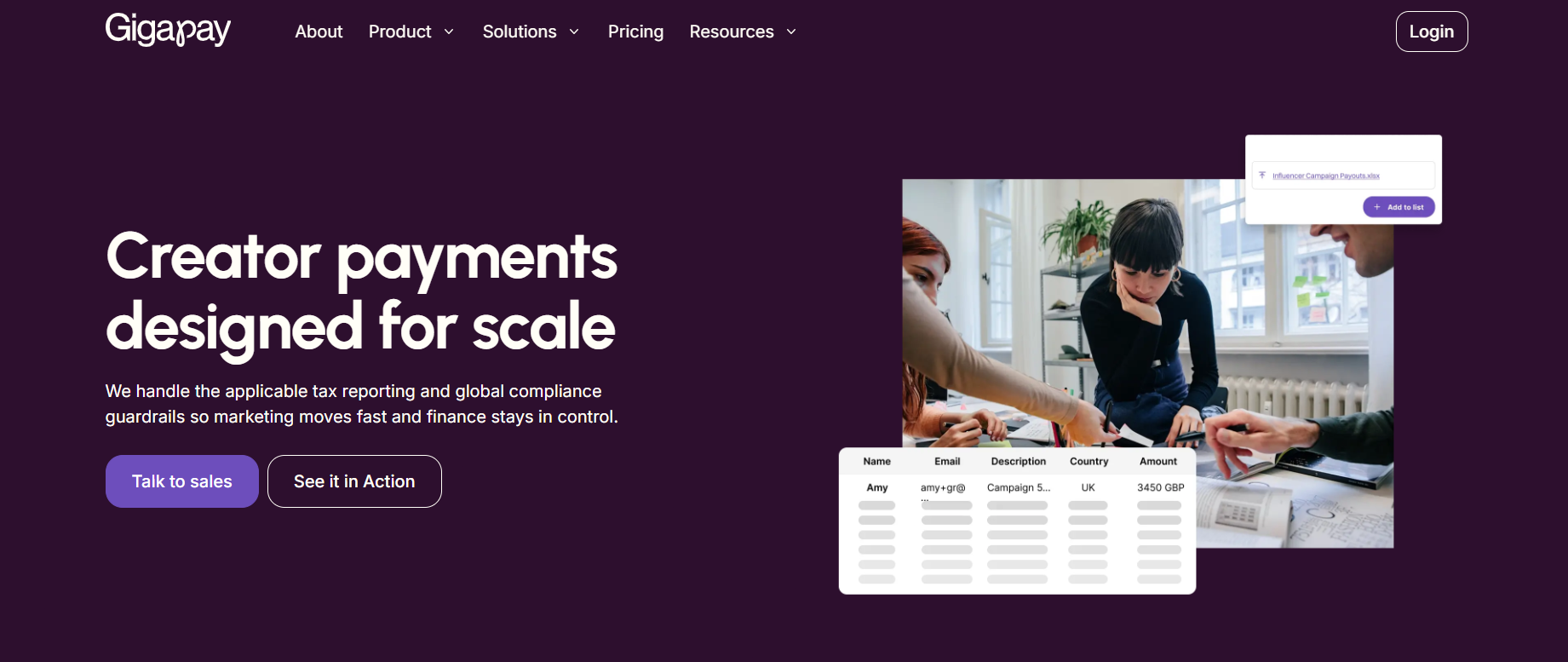
Gigapay is the Merchant of Record French brands and agencies use to onboard, contract, and pay creators across 65+ countries and 50+ currencies, used by global brands and agencies including Boozt, GOAT (WPPMedia), The Goat Agency (WPPMedia), AdRecord, and Once Upon.
The reason Gigapay leads this list in 2026 is that the regulatory layer underneath every influencer program in France now weighs more than the discovery layer on top. The €1,000 contract threshold from 1 January 2026, the €50,000-per-breach DAC7 fines, the URSSAF reporting rules, and ARCOM's brand co-liability under the second enforcement phase combine into a single operational problem: finance and legal teams cannot manually onboard, contract, and pay creators at the volumes brands want to run in 2026.
Gigapay's merchant-of-record model assumes the tax and contractual counterparty role for every creator deliverable, which is why both Kolsquare and a range of EU influencer platforms have moved their payment layer onto Gigapay rather than rebuilding it internally.
Pros:
- Merchant-of-record model means Gigapay becomes the legal counterparty for each creator deliverable, with DAC7 reporting filed directly to French authorities and the €50,000-per-breach risk removed from the brand's books.
- Creators in 65+ countries paid instantly through local payment rails including SEPA Instant for the EU, Faster Payments for the UK, and ACH for the US, with funding available in USD, EUR, GBP, SEK, DKK, and NOK.
- Consolidated self-billing invoices collapse hundreds of creator vendor records into one entry in the brand's ERP, with cited benchmarks showing roughly 80% reduction in invoice volume and admin hours dropping from 840 to 60 per year on a 600-collaboration program.
- Onboards nano- and micro-creators in seconds without requiring them to hold a registered business or VAT number, which is the single biggest unlock for French brands trying to scale below the macro tier where engagement rates run 4-8% versus 1-2% on macro accounts.
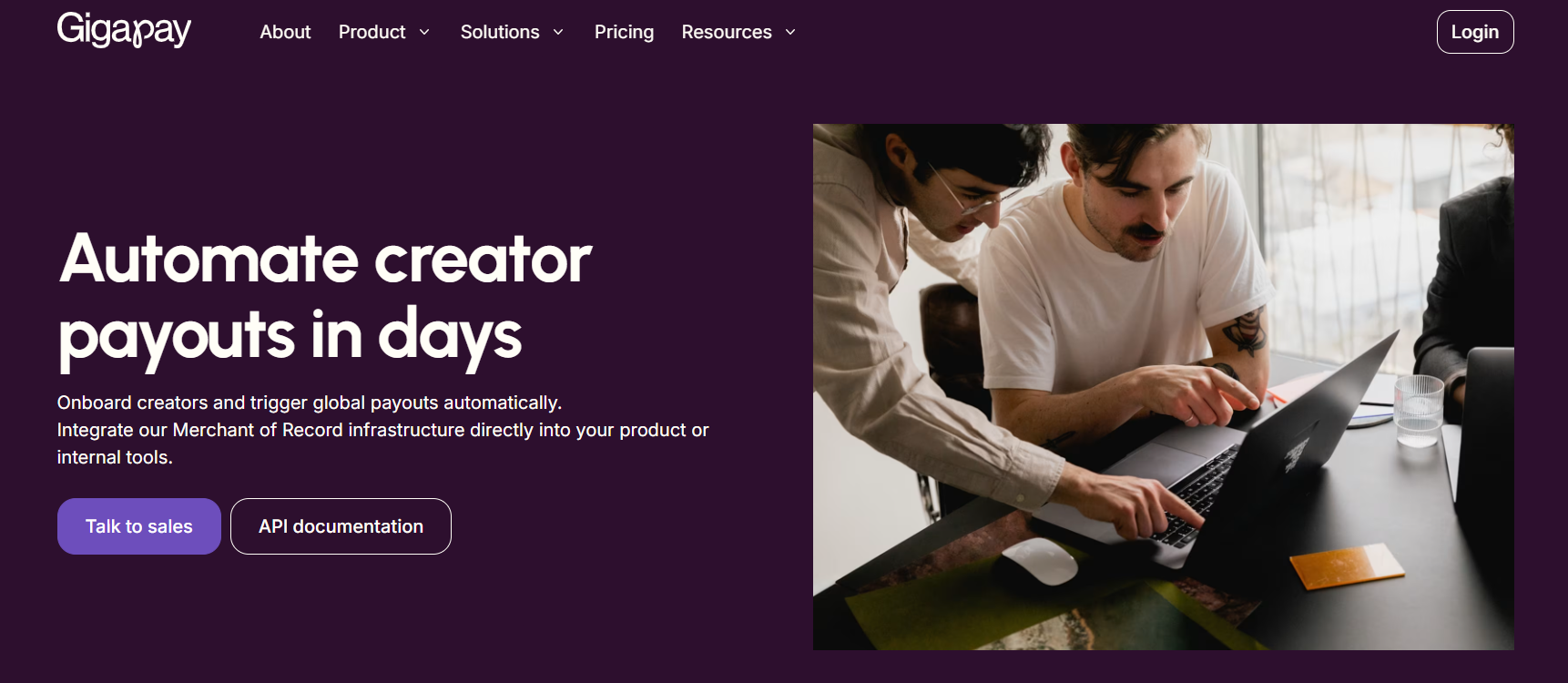
- Native integration with Kolsquare for embedded payments inside the campaign workflow, plus a REST API and webhook system that drops the payment and compliance layer behind any other influencer platform within a 2-5 day integration window.
Cons:
- Gigapay is not a creator discovery or campaign management platform, so brands still pair it with an IMP for finding, briefing, and tracking creator content.
- Base plan starts at €279 per month plus 4.9% per payout, which is heavier than most brands running fewer than 50 collaborations per year can justify against manual processing.
2. Kolsquare
Kolsquare is Europe's leading influencer marketing platform, headquartered in Paris and certified as a B Corp, with more than five million vetted creators in 180 countries and customers including LVMH, Hermès, Sephora, Walt Disney, Sony Music, Hyundai, Publicis, Havas, Dentsu, and Ogilvy.
The platform's discovery, AI suite, ARPP-aware governance, and reporting are among the strongest in the European market, and for any French or EU mid-market brand running structured influencer programs, Kolsquare is the natural front-end choice.
The reason Kolsquare validates Gigapay's position at the top of this list rather than threatening it is that Kolsquare itself moved its creator payment functionality onto Gigapay in 2025, with brands now adding cash to a campaign wallet inside Kolsquare while Gigapay handles invoicing, multi-currency conversion, DAC7 compliance, and payouts underneath.
Brands working with Kolsquare are already working with Gigapay, just through one interface.
Pros:
- Five million vetted creators across 180 countries, with AI-driven discovery, predictive analytics, authenticity scoring, and a marketer-friendly interface.
- B Corp governance, ARPP-aware workflows, and ethical influence positioning that aligns with French regulatory expectations and EU brand standards.
- Native Gigapay integration for embedded payments, which means the compliance and payout layer is handled directly inside the platform without the brand owning the work.
Cons:
- Enterprise pricing puts the platform out of reach for smaller brands and early-stage influencer programs.
- Payment functionality exists only because of the Gigapay partnership, so a brand using Kolsquare without activating the integration still owns DAC7 reporting, vendor onboarding, and creator-side tax documentation directly.
- Reporting and global attribution are strong but less deep than Traackr or CreatorIQ for enterprise teams running multi-region programs with heavy ROI defensibility requirements.
3. Reech
Reech runs Reech Influence Cloud out of Paris and is one of the strongest French-first influencer platforms on the market, with proprietary data, sector studies, and a methodology built around French creator opt-in networks.
The platform serves brands including Yves Rocher, L'Oréal, and Nestlé, and is a credible choice for French companies that want deep local market expertise and a French-first vendor relationship. Reech's depth on French creators is genuine, and the platform earns its place on this list.
The reason Reech does not displace Gigapay is that the platform handles discovery, campaign management, and reporting cleanly but leaves the brand's finance team owning the DAC7 reporting, vendor onboarding, and creator-side tax documentation that the Decree of 28 November 2025 now requires under a written contract for every collaboration above €1,000.
Pros:
- Deep French market data, sector studies, and French-creator opt-in network that competing global platforms cannot match on local depth.
- Strong agency-grade campaign management and proprietary scoring methodology for creator selection.
- French-first vendor relationship with local language support and direct understanding of ARPP and DGCCRF expectations.
Cons:
- EU breadth thinner than Kolsquare or CreatorIQ, which makes Reech less suitable for multi-market campaigns spanning France, Germany, Italy, and Spain.
- No native payment or merchant-of-record layer, which leaves the brand's finance team responsible for vendor records, DAC7 reporting, and creator-side tax forms unless paired with Gigapay or an equivalent.
- Reporting and downstream attribution are less mature than the enterprise platforms used by global brands needing to defend ROI to boards or finance committees.
4. Influence4You
Influence4You is one of the longest-running French influencer platforms, with tens of thousands of talents indexed and a strong position among mid-market French brands testing or scaling influencer programs.
The platform's database depth and affordable entry price make it a reasonable choice for brands stepping into influencer marketing without committing to enterprise pricing.
The reason Influence4You sits below Gigapay in 2026 is that the operational reality of the new contract threshold and DAC7 enforcement has shifted the deciding factor from creator-discovery depth to compliance handling, and Influence4You was built for the former era.
Pros:
- Tens of thousands of French-tagged creators in the database, with a discovery interface designed for French brand search workflows.
- Affordable for mid-market French brands that cannot justify enterprise platform pricing.
- Long-established French player with direct relationships across French agencies and creators.
Cons:
- Workflow and reporting are thinner than Kolsquare or CreatorIQ for brands running structured programs at scale.
- No payment or merchant-of-record layer, which means DAC7 reporting, contract compliance under the Decree of 28 November 2025, and creator onboarding land on the brand's finance and legal teams.
- Less suitable for multi-market EU campaigns where Kolsquare or Traackr cover more countries and languages.
5. Skeepers
Skeepers (which absorbed Hivency) is a French platform combining influencer marketing, user-generated content, and reviews into one workflow, treating product sampling as a dual-purpose activity that generates both social content and verified customer reviews.
The combination is genuinely useful for retail and e-commerce brands that want UGC, reviews, and creator content from a single seeding cycle.
The reason Skeepers ranks below Gigapay for French companies running cash-based creator programs in 2026 is that the platform was built around product seeding rather than monetary payouts to creators, and the new contract threshold applies to any campaign with a commercial value above €1,000 regardless of whether that value is paid in cash or product.
Pros:
- Combines influencer marketing, UGC, and reviews in one workflow, which is rare in the European market.
- Strong product seeding mechanics and follow-up reminders that maximise content submission rates from gifted creators.
- French roots with EU coverage and integrations with e-commerce platforms for displaying social proof at point of purchase.
Cons:
- Built around product sampling, which makes it weaker for brands running paid creator programs where DAC7 reporting and vendor records are the central operational problem.
- No merchant-of-record layer, which leaves the brand owning contract compliance under the new French rules and the tax reporting attached to gifted products valued above €1,000.
- Reporting and analytics are thinner than dedicated enterprise influencer platforms for brands that need to defend ROI to finance committees.
6. Upfluence
Upfluence indexes 12 million creators across seven networks and pairs the database with the Jaice AI co-pilot, with Shopify and WooCommerce integrations that make it a strong fit for DTC brands turning their own customers into affiliates and ambassadors.
Upfluence has a meaningful French presence and serves e-commerce brands across the EU.
The reason Upfluence sits below Gigapay in this ranking is that the platform's strength is creator discovery and e-commerce attribution, while the operational layer that French brands now need most in 2026 is the merchant-of-record and DAC7 reporting infrastructure that Upfluence does not own.
Pros:
- 12 million creators indexed across seven networks, with strong brand-affinity matching for turning existing customers into influencers.
- Jaice AI co-pilot supports campaign workflow and creator outreach at scale.
- Tight Shopify and WooCommerce integrations make it a strong fit for DTC and e-commerce brands.
Cons:
- Less France-specific creator depth than Reech or Kolsquare for brands prioritising the French market.
- Payment functionality requires the brand to manage vendor records, contracts, and tax reporting directly, which scales linearly with creator count.
- Less optimised for nano- and micro-creators without a registered business, which is exactly where French creator engagement rates are highest.
7. CreatorIQ
CreatorIQ is the enterprise operating system for creator-led growth, used by LVMH, Sephora, Nestlé, Google, Delta Air Lines, and Burson, among 1,300+ brands and agencies. For large French brands running global campaigns, CreatorIQ's CRM depth, compliance tooling, and integration with the broader marketing stack are best-in-class for the enterprise tier.
The reason Gigapay sits above CreatorIQ in this ranking for French companies is that even at the enterprise tier, the merchant-of-record and DAC7 reporting work is something CreatorIQ leaves to the brand or its payment partners, while Gigapay handles that work as the core service rather than a feature.
Pros:
- Enterprise-grade CRM used by LVMH, Sephora, Google, Delta Air Lines, and Nestlé, with deep multi-market campaign management.
- Strong integration with marketing analytics, CRM, and finance stacks for downstream attribution.
- Mature governance and compliance tooling for brands running structured creator programs at global scale.
Cons:
- Enterprise price tag in the €25,000-€55,000 per year range puts the platform out of reach for mid-market brands.
- No native merchant-of-record layer for creator payments in the EU, which means brands still need a Gigapay-equivalent service to handle DAC7 and creator onboarding.
- Implementation complexity slows time to first campaign for teams that have not previously run enterprise creator programs.
8. Traackr
Traackr is one of the longest-established creator marketing intelligence platforms, with discovery across 71 countries and 26 languages, and a Brand Vitality Score that combines visibility, engagement, and brand trust into a single defensible metric.
For enterprise teams that need to prove influence impact to leadership, Traackr's ROI and attribution reporting is among the strongest in the category.
The reason Gigapay ranks above Traackr for French companies in 2026 is that Traackr's depth lives in measurement and intelligence rather than the payment and compliance backbone that the Loi Influenceurs and DAC7 now demand, which forces brands using Traackr to pair it with a merchant-of-record service to complete the stack.
Pros:
- Brand Vitality Score gives enterprise teams a defensible measurement of creator impact that connects to business outcomes.
- Discovery across 71 countries and 26 languages, with strong multi-market coverage for global brands.
- Mature reporting and attribution that ties influencer activity to conversions rather than impressions.
Cons:
- Enterprise pricing makes Traackr unsuitable for mid-market brands and early-stage creator programs.
- No native payment or merchant-of-record layer, which leaves the DAC7 and vendor onboarding work with the brand.
- Steeper learning curve than mid-market platforms, with longer onboarding cycles for new teams.

A Practical Framework for Choosing
Four questions narrow the field before any vendor demos.
1. Campaign volume and creator profile
A French brand running fewer than 50 collaborations per year with mid-tier creators can work with most discovery-first platforms and a manual payment process.
Brands running 50 to 500 collaborations across nano- and micro-creators should prioritise the merchant-of-record model that Gigapay provides, because manual onboarding and DAC7 reporting do not scale past that volume without a dedicated payment layer.
Brands running 500+ collaborations across multiple EU markets need enterprise-grade discovery (Kolsquare, CreatorIQ, or Traackr) paired with Gigapay underneath, which is the stack that LVMH, Hermès, Sephora, and other Kolsquare customers are already running.
2. Regulated category exposure
Brands in alcohol, financial products, or health treatments need creators filtered by ARPP certification status as a non-negotiable, which makes Kolsquare and Reech the natural front-end choices.
Either way, the payment layer underneath has to handle the contract documentation required under the Decree of 28 November 2025, which is where Gigapay's merchant-of-record role becomes essential rather than optional.
3. Finance and legal tolerance per campaign
A brand willing to absorb high finance and legal involvement can run a discovery platform plus internal contract templates and manual payments.
A brand looking to scale beyond a few campaigns a month needs the merchant-of-record model, because the admin burden grows linearly with creator count and DAC7 reporting cannot be done on a spreadsheet without breach exposure.
4. Market coverage
French-only campaigns work well with Reech, Kolsquare, or Influence4You for discovery, paired with Gigapay for the payment and compliance layer. Multi-market EU campaigns need a discovery platform with EU breadth and Gigapay handling DAC7, Germany's KSK, Sweden's KU14, and the rest of the reporting regimes in one place.
The platform decision is one half of the answer. The payment and compliance decision is the other half, and treating them as separate is what causes the DAC7 panic every January.
Conclusion
Gigapay is the foundation French companies build their 2026 influencer programs on, because the merchant-of-record, payment, and tax reporting layer is the part that decides whether the rest of the stack works.
The right setup for most French brands in 2026 is Gigapay handling creator onboarding, contracts, DAC7 reporting, and instant payouts under a single vendor record, paired with a discovery and campaign management platform (Kolsquare for European fit with native Gigapay integration, CreatorIQ or Traackr for global enterprise scale, Reech or Skeepers for French-specific needs) that handles the front-end work.
Book a demo to see how Gigapay slots into your current stack, or how it pairs with Kolsquare if you are evaluating both layers together.
Read Next:
- Best Influencer Payment Platforms for International Brands in 2026
- TikTok vs Instagram vs YouTube Payouts: Who's Earning the Most?
- Top 3 Ways Agencies Can Pay TikTok Influencers in 2026
FAQs:
1. What is the best influencer management platform for French companies in 2026?
The best influencer management platform for French companies in 2026 is Gigapay for the merchant-of-record, payment, and DAC7 compliance layer, paired with Kolsquare for European discovery and campaign management or CreatorIQ for global enterprise programs, since the regulatory environment from January 2026 makes the payment and compliance layer the deciding feature rather than discovery depth.
2. Why do French companies need a merchant of record for influencer payments?
French companies need a merchant of record for influencer payments because the model collapses hundreds of individual creator vendor records into one, files DAC7 reporting directly to French tax authorities, removes the €50,000-per-breach penalty risk from the brand, and allows payouts to nano- and micro-creators who are not registered businesses under the French micro-entrepreneur regime.
3. What does the French Loi Influenceurs require from brands in 2026?
The French Loi Influenceurs requires brands in 2026 to use a written contract with specific mandatory clauses for any creator collaboration above €1,000 under the Decree of 28 November 2025, to follow ARPP-aligned disclosure wording on every sponsored post, and to accept brand co-liability for non-compliant creator content under ARCOM's second enforcement phase from May 2026.
4. How does Gigapay handle DAC7 reporting for French companies?
Gigapay handles DAC7 reporting for French companies by filing creator income data directly with the French tax authorities under its merchant-of-record role, which removes the obligation from the brand and avoids the €50,000-per-obligation penalty risk under Articles 1649b A to 1649b E of the French Tax Code.
5. Can influencer management platforms pay creators directly in France?
Influencer management platforms can pay creators directly in France only when paired with a payment layer or merchant of record such as Gigapay, since most discovery-focused platforms handle workflow and analytics rather than cross-border payouts, tax form collection, contract compliance, and DAC7 filing, which is why Kolsquare itself integrated Gigapay rather than rebuilding the payment layer internally.
.jpg)
.jpg)