.jpg)

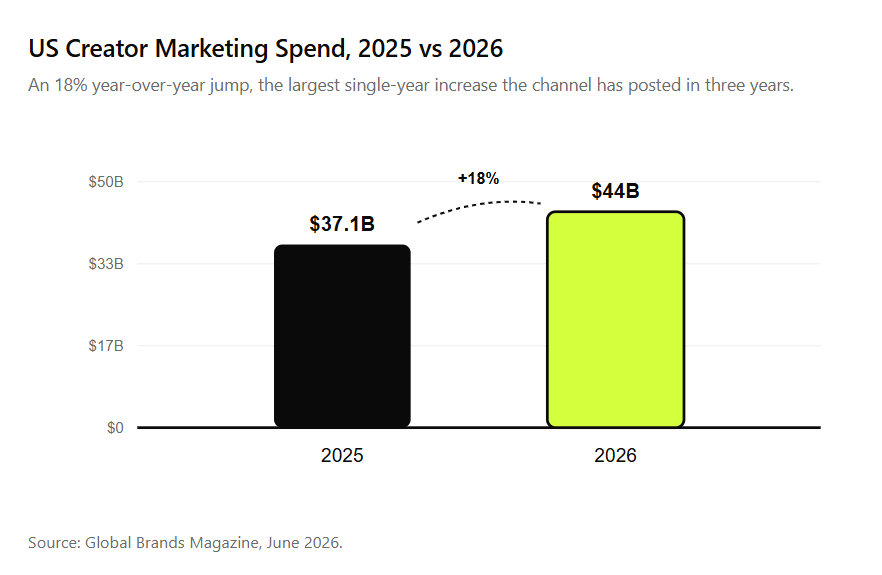
US brands will move $44 billion through creator marketing in 2026, an 18% jump from $37.1 billion the year before, according to Global Brands Magazine.
Gigapay is the merchant of record platform brands use to pay hundreds of creators across 65+ countries through a single vendor, with tax compliance handled in the background.
The money entering creator accounts looks nothing like the money leaving brand budgets, because each platform takes its own cut, applies its own rules, and pays on its own schedule.
This article breaks down what YouTube, TikTok, and Instagram actually pay creators in 2026, where the gaps sit, and what brands running creator campaigns across all three need to know.
Key Takeaways
- YouTube pays most per view in 2026, with long-form RPMs of $2 to $12.
- TikTok Creator Rewards pays $0.40 to $1.00+ per 1,000 qualified views.
- Instagram pays creators almost nothing directly; bonuses stay invite-only and seasonal.
- Brand sponsorships now drive most creator income on TikTok and Instagram.
- Only 4% of creators earn more than $100,000 a year across all platforms.
How Each Platform Pays Creators in 2026
YouTube, TikTok, and Instagram approach creator payments from three different starting points. YouTube treats the creator as an ad-revenue partner with a fixed share split, TikTok calculates an RPM on qualified views above a one-minute threshold, and Instagram runs invite-only bonuses tied to posting quotas when it runs them at all.
Those structural differences produce wildly different earnings from the same audience across the three platforms. The breakdown below covers what each pays, who qualifies, and how the money actually moves.
1. YouTube: The Highest Per-View Payouts in 2026
YouTube is the only platform where a creator can predict roughly what they will earn per video before posting it. The YouTube Partner Program (YPP) shares about 55% of ad revenue with creators, paid out as a Revenue Per Mille (RPM) figure.
In 2026, long-form RPMs sit between $2 and $12 per 1,000 views for most creators, with finance, business, and tech channels reaching $8 to $20+. Gaming and entertainment channels usually land closer to $1 to $4.
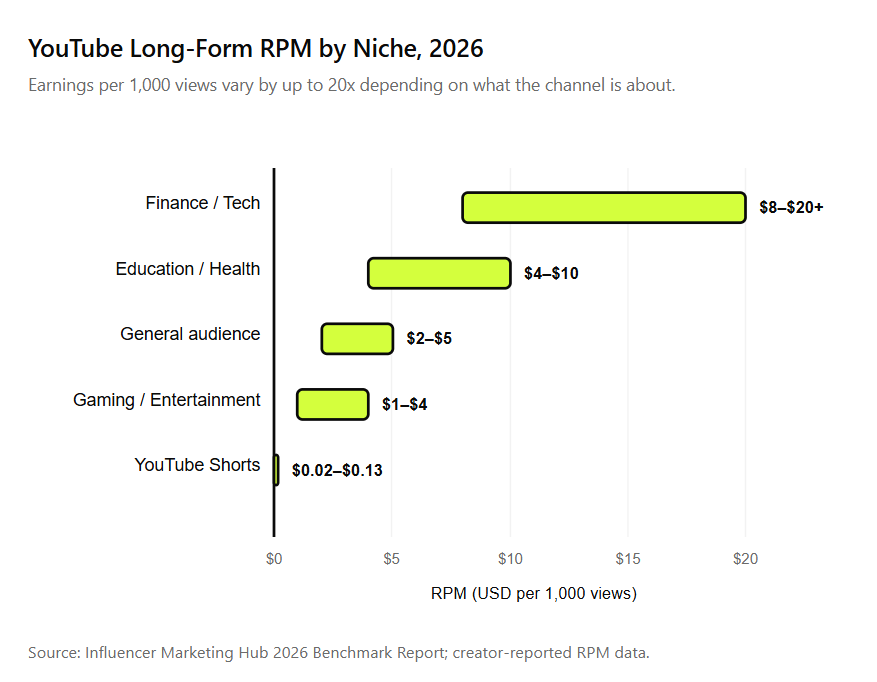
Shorts pay much less. The RPM range for YouTube Shorts is $0.02 to $0.13 per 1,000 views, because YouTube pools Shorts ad revenue and licenses music against it before distribution.
YouTube has paid creators over $100 billion between 2021 and 2025. In Epidemic Sound's 2026 creator survey, 28.6% of monetizing creators ranked YouTube as their top income source, the highest share of any platform in the study.
Eligibility in 2026 happens in two stages. Early access to memberships, Super Thanks, and YouTube Shopping opens at 500 subscribers, three public uploads in the last 90 days, and either 3,000 watch hours over twelve months or 3 million Shorts views in 90 days. Full ad revenue requires 1,000 subscribers plus 4,000 watch hours or 10 million Shorts views. Payouts run monthly through AdSense once the threshold is met.
The strength of YouTube is the predictability. The weakness is the time it takes to build a channel that earns at scale.
2. TikTok: The Creator Rewards Program Closed Part of the Gap
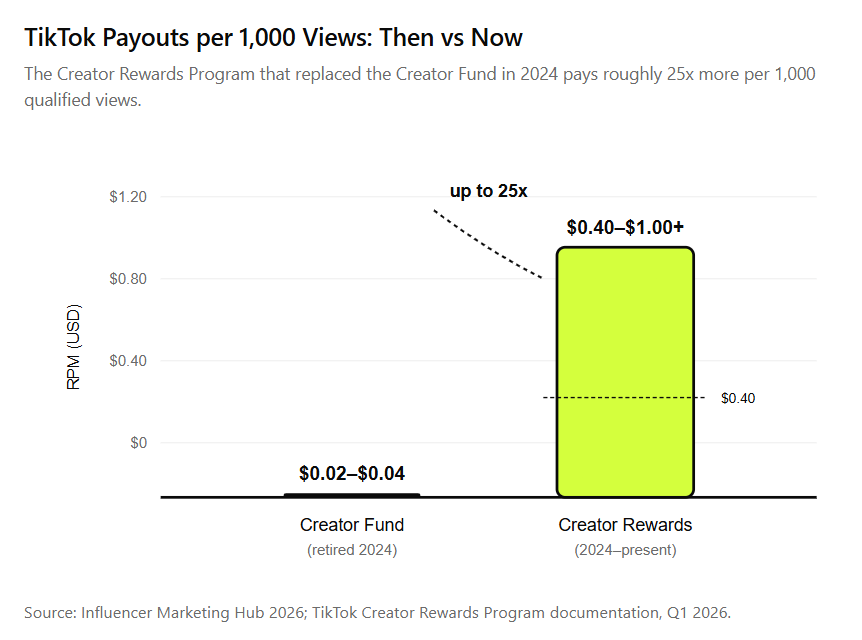
TikTok's old Creator Fund became infamous for paying creators $0.02 to $0.04 per 1,000 views, roughly 94% below YouTube's average RPM for comparable content. The Creator Rewards Program that replaced it in 2024 changed the math.
Reported RPMs in 2026 run from $0.40 to $1.00+ per 1,000 qualified views, with finance, business, and education niches sometimes pushing past $1.20. That's a 10x to 25x improvement over the old fund.
The catch sits in the word "qualified." Only videos longer than one minute count toward the program, views need to hold for a meaningful duration to register, and anything that violates community guidelines or comes from the creator's own account is excluded. TikTok calculates qualified RPM daily and pays out bi-weekly through PayPal or local rails, once the creator clears the minimum payout threshold.
Eligibility for the Creator Rewards Program in 2026 requires being at least 18, having 10,000 followers, and showing at least 100,000 authentic video views in the last 30 days. The program is currently active in the US, UK, France, Germany, Spain, Japan, South Korea, Canada, Australia, Brazil, and a handful of other markets.
Outside the Rewards Program, TikTok creators earn through LIVE gifts (which surpassed $3.8 billion globally in 2025), TikTok Shop affiliate commissions, Series subscriptions, and brand deals booked through Creator Marketplace. TikTok Shop alone is projected to drive $23.41 billion in US ecommerce sales in 2026, a 48% jump year over year.
In the same Epidemic Sound survey, 18.3% of creators ranked TikTok as their top income source, second to YouTube.
3. Instagram: Strong on Brand Deals, Weak on Direct Payouts
Instagram does not pay creators per ad view the way YouTube does. The platform has no equivalent of the YPP that opens reliable, scaled monetization to anyone who clears a threshold. Instead, Instagram operates a fragmented mix of invite-only Reels bonuses, Subscriptions creators set themselves, Stars and Gifts during Lives, and Shopping affiliate links.
When Reels bonuses are active, creators report something between $0.01 and $0.12 per 1,000 plays. Most of the time, the platform pays nothing directly per view. Instagram's Breakthrough Bonus offers up to $1,000 per month to creators with 100,000+ followers, or $3,000 per month to creators with 1 million+, for hitting specific posting quotas on Reels and Facebook. These bonuses are seasonal, invite-only, and not the kind of income creators can plan around.
Where Instagram does pay is in brand deals. Nano-influencers between 1,000 and 10,000 followers typically charge $25 to $150 per sponsored post. A creator with 100,000 followers charges $1,000 to $5,000 per sponsored post.
Cristiano Ronaldo charges around $2.4 million per post in 2026, the highest published rate on the platform.
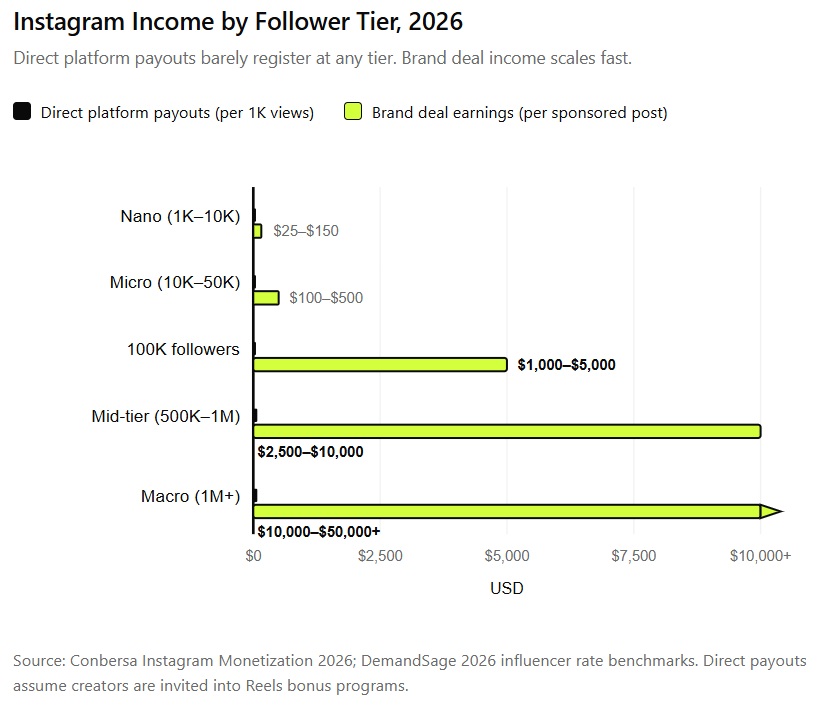
Sponsorships consistently outperform direct payouts on Instagram for creators above 50,000 followers. Most Instagram creator earnings sit off-platform, in agreements between brands and creators that Instagram itself never processes.
11.8% of creators in the Epidemic Sound survey rank Instagram as their top income source.
Head-to-Head: Per-View Payouts in 2026
Looking at direct platform payouts only, the ranking for 2026 is consistent across multiple creator surveys and platform reports.
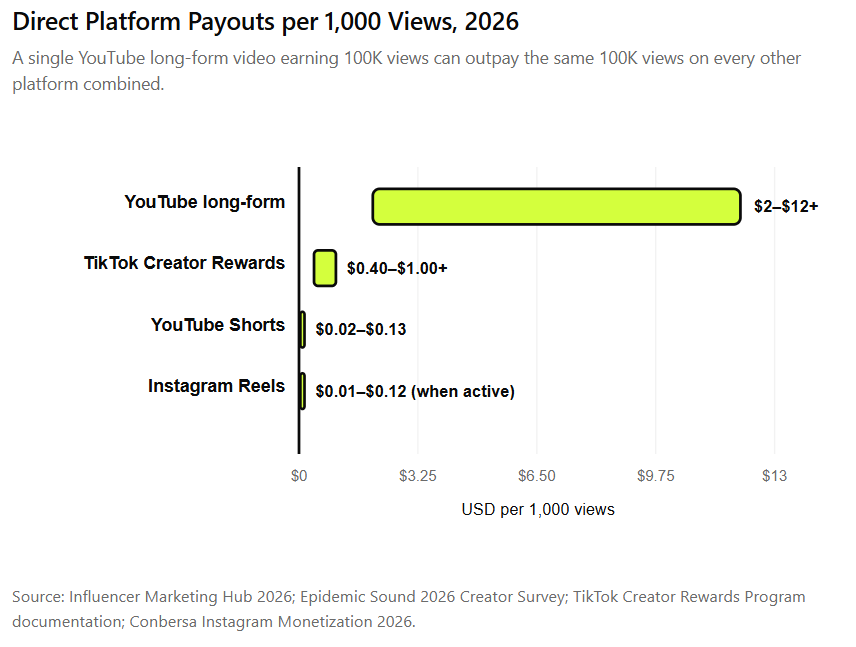
For a creator pushing 100,000 views across each platform, the math works out roughly to YouTube long-form at $200 to $1,200, TikTok Creator Rewards at $40 to $100, and Instagram Reels at $0 to $12 when bonuses are running.
A single YouTube long-form video earning 100,000 views generates more direct platform revenue than the same 100,000 views would on TikTok, Instagram, Facebook, X, and Snapchat combined.
That gap is real, and it's only the direct-payout view. TikTok and Instagram close the distance through brand deals, affiliate commissions, and commerce features that scale differently than ad revenue does.
What Actually Drives Creator Earnings
Looking at RPMs alone misses most of the variance in what creators take home. Five factors do most of the work.
1. Niche
Finance, B2B, tech, business, and health content earns five to ten times what entertainment or gaming earns on the same view count. Advertisers pay more to reach those audiences because the buyers convert at higher values.
2. Audience country
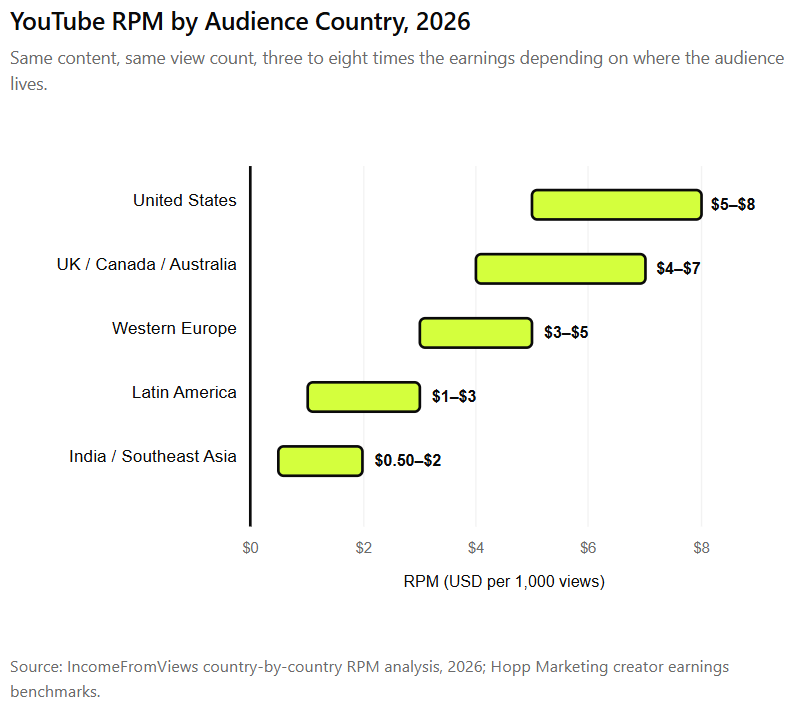
A US-majority audience pays significantly more than a globally mixed one. YouTube creators with US audiences regularly see RPMs of $5 to $8, while creators with audiences split across India, Brazil, and Southeast Asia often sit at $1 to $3.
3. Engagement and retention
Each algorithm weights signals differently: YouTube rewards watch time, TikTok rewards completion rate and rewatches, and Instagram rewards saves and shares. The same audience size produces very different earnings depending on how the audience behaves.
4. Format and length
TikTok requires videos over 60 seconds to qualify for the Creator Rewards Program at all, YouTube long-form earns 30 to 60 times what Shorts earn, and Instagram's bonus programs reward specific formats during specific windows.
5. Diversification
The top 4% of creators earning more than $100,000 a year almost always combine three or more income streams: platform payouts, brand deals, affiliate commissions, products, and subscriptions.
What Top Earners Actually Make
Platform-level RPMs collapse once a creator becomes a brand:
- Charli D'Amelio earned over $23 million in 2025, mostly off-platform.
- MrBeast is at roughly $85 million annually, built on YouTube ad revenue stacked with merchandise, ventures, and brand deals.
- Ronaldo's $2.4 million Instagram posts dwarf anything an algorithm would ever distribute to him.
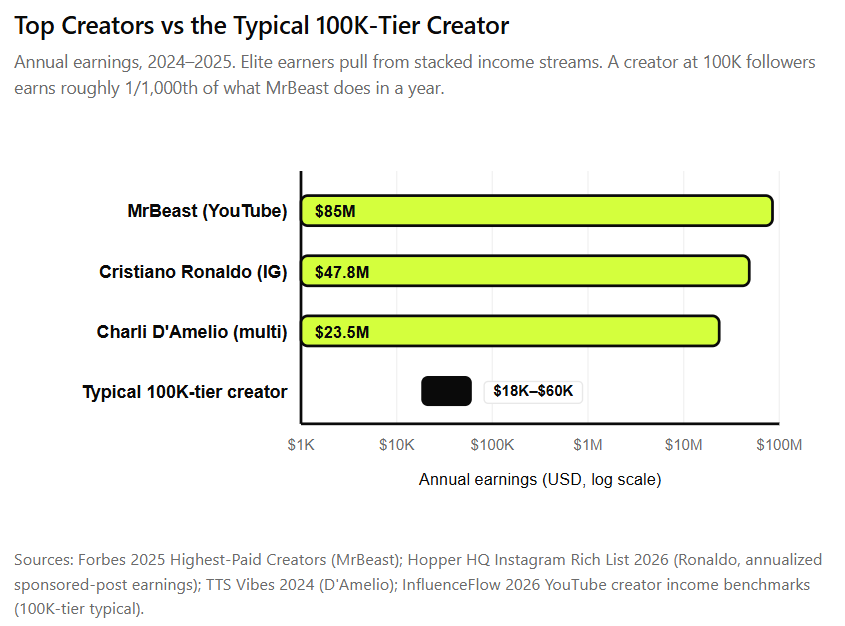
For everyone below that tier, the numbers are far more sober:
- A creator with 100,000 YouTube subscribers in a mid-tier niche typically earns $1,500 to $5,000 a month from ad revenue alone.
- A TikTok creator with 100,000 followers averaging 200,000 views per video earns roughly $80 to $200 a month from Creator Rewards.
- An Instagram creator at the same follower count earns nothing directly, but can charge $1,000 to $5,000 per sponsored post when a brand deal lands.
In other words, follower count predicts almost nothing about income. Niche, audience country, format mix, and how well the creator runs the off-platform side of the business predict almost everything.
The Payment Problem Brands Don't See Until It Becomes Operational
When a brand runs a creator campaign across YouTube, TikTok, and Instagram at the same time, platform payouts are not the brand's problem. The platform handles the creator's ad-revenue side directly. The brand's problem is the campaign fee, the actual payment owed to each creator for the sponsored content the brand booked.
That's where the math gets ugly. A campaign with 50 creators across three platforms means 50 individual contracts, 50 invoices in different formats, 50 tax IDs to validate, and 50 vendor records in finance's ERP. Sole traders, agencies, and creators operating in jurisdictions where the brand has filing obligations the marketing team has never heard of, all in the same campaign.
That's why we built Gigapay. We sit between the brand and the creators as the merchant of record, which means we legally buy the creator's deliverable and resell it to the brand. Marketing uploads a spreadsheet, finance sees one invoice, creators get paid instantly with KYC, tax ID validation, and reporting handled in the background.
Germany's KSK levy and the EU's DAC7 reporting are automated. In Sweden, KU14 filings happen without anyone filing them.
Paying creators used to scale with creator count: 50 creators meant 50 contracts and 50 invoices, 500 meant 500. With Gigapay, the math changes. Whether you pay 50 creators or 5,000, your finance team sees one vendor in the ERP.
Conclusion
Gigapay is the merchant of record platform that lets brands run creator campaigns across YouTube, TikTok, and Instagram at scale, without finance turning into a vendor management team.
YouTube continues to lead direct platform payouts in 2026, TikTok has closed enough of the gap with its Creator Rewards Program to be a real income source for short-form creators, and Instagram still earns most of its keep through brand deals rather than per-view ad revenue.
The platforms reward different behaviors, but the back-office cost of paying creators across all three is identical until brands change the model.
Book a demo with Gigapay to see how one vendor replaces hundreds in your ERP.
Read Next:
- Top 3 Ways Agencies Can Pay TikTok Influencers in 2026
- Best Lumanu Alternatives for Influencer Payments: 2026 Review
- Which Influencer Management Platform Should Nordic Companies Use in 2026?
FAQs:
1. Which social media platform pays creators the most in 2026?
The social media platform that pays creators the most in 2026 is YouTube, with long-form RPMs ranging from $2 to $12 per 1,000 views compared to TikTok's $0.40 to $1.00 and Instagram's near-zero direct per-view payouts.
2. How much does TikTok pay per 1,000 views in 2026?
TikTok pays between $0.40 and $1.00+ per 1,000 qualified views in 2026 through the Creator Rewards Program, with high-value niches like finance and education reaching $1.20 or more on videos longer than one minute.
3. Does Instagram pay creators directly for views?
Instagram does not pay creators directly for views in any reliable, scaled way. Reels bonuses are invite-only and pay between $0.01 and $0.12 per 1,000 plays when active, which is why brand sponsorships drive most Instagram creator income.
4. What are the eligibility requirements for the YouTube Partner Program in 2026?
The eligibility requirements for the YouTube Partner Program in 2026 are 1,000 subscribers and either 4,000 valid public watch hours over twelve months or 10 million Shorts views in the last 90 days for full ad revenue access.
5. How do brands pay creators efficiently across multiple platforms?
Brands pay creators efficiently across multiple platforms by using a merchant of record platform like Gigapay, which consolidates hundreds of creator payments into a single vendor invoice and handles tax compliance, KYC, and global currency settlement automatically.
.jpg)
.jpg)