.jpg)

The global creator economy reached $323.48 billion in 2026, growing 26.5% in a single year, and every euro of that growth eventually has to land in a creator's bank account.
Gigapay is the Merchant of Record for creator payouts: the one vendor solution that pays your creators on your behalf by taking on the compliance, payouts, and support so you don't have to.
As creator programs scale from dozens to thousands of collaborations, the question of who actually moves that money, and who carries the tax and reporting liability behind it, becomes a real line on the P&L rather than an afterthought in a marketing budget.
This article breaks down the full cost of building creator payouts in-house against the cost of using a Merchant of Record, with salaries, fees, compliance penalties, and the hidden numbers most build-vs-buy analyses leave out.
Key Takeaways
- An in-house creator payout build costs €110,000 to €370,000 per year, all-in.
- A "free" manual creator payment actually costs €40 to €60 in admin and errors.
- Payment rails move money; a Merchant of Record also takes the compliance liability.
- DAC7, KSK, and withholding penalties are retroactive and land on whoever pays creators.
- For 600 collaborations a year, a Merchant of Record cuts costs roughly 67%.

The Creator Economy Grew Up Faster Than Its Payment Infrastructure
Roughly 8.6 million European creators now earn money from their work, and brand budgets for creator marketing compound at around 26% per year. The money side of that industry, however, still runs the way it did in 2015.
A brand finds a creator, requests an invoice, onboards them as a vendor in the ERP, collects tax details by email, and wires the money through a bank that was never designed for thousands of small cross-border payments to individuals.
That gap between marketing speed and payment speed is where the build-vs-buy question lives. When a program runs 20 collaborations a year, a finance coordinator absorbs the friction quietly.
- At 200 collaborations, the friction becomes a backlog.
- At 600 or more, someone in the business opens a spreadsheet and asks a reasonable question: should we just build this ourselves?
It is a fair question, and the honest answer requires actual numbers rather than instinct. Engineering leaders tend to underestimate the ongoing cost of payment infrastructure, and finance leaders tend to underestimate the compliance exposure that comes with becoming the legal payer of hundreds of self-employed individuals across borders.
Regulators Turned Every Creator Payment Into a Compliance Event
The second market shift matters more than the first. Since 2023, European regulators have systematically closed the informality that creator payments used to enjoy, and 2026 is the year enforcement caught up with legislation.
DAC7 requires platform operators to collect and verify seller tax data and report it annually, with mandatory seller offboarding when data is missing. Fines run up to €50,000 per report in Germany and SEK 2,500 to 12,500 per seller in Sweden.
German authorities are running criminal probes into roughly €300 million of suspected evasion in the influencer space, with around 200 proceedings open, while Hamburg alone is auditing 140 influencers.
Germany's Künstlersozialkasse applies a 4.9% levy on payments for creative work above €1,000, including work commissioned through agencies, and DRV auditors now run KSK-specific audits that reach back over five years. Germany's §50a withholding takes 15.825% on payments to foreign creators, and the paying company is liable if it fails to deduct.
Spain requires 15% or 7% IRPF withholding with Modelo 111 and 190 filings. The EU Platform Work Directive transposes in December 2026 and introduces a rebuttable presumption of employment for digital labour platforms.
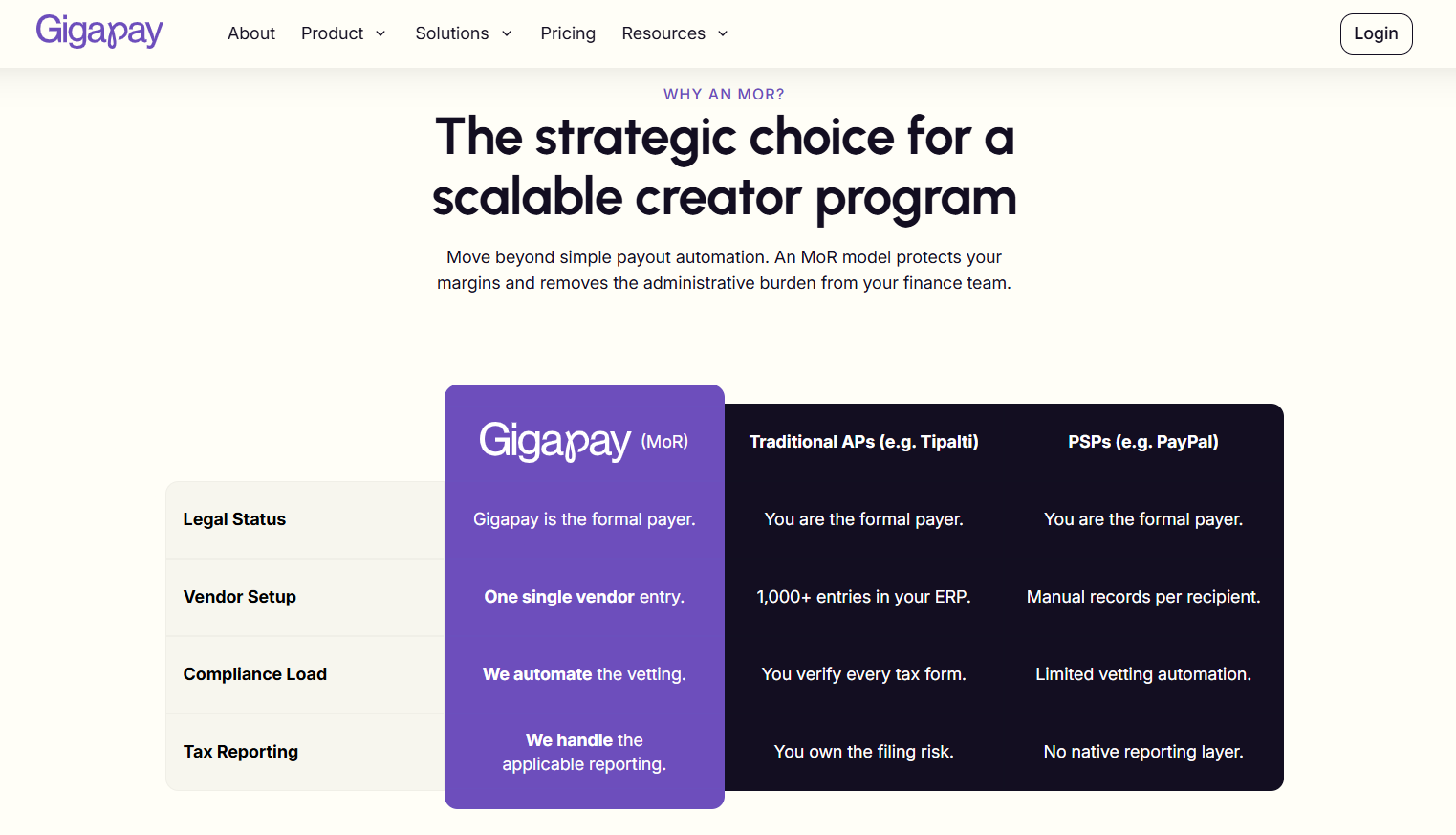
Here is why this reshapes the build-vs-buy calculation: every one of these obligations attaches to the entity that pays the creator. If you build payouts in-house, that entity is you. Your build estimate is no longer an engineering estimate. It is an engineering estimate plus a multi-country tax operation.
What "Building In-House" Actually Means
Before the numbers, it helps to be precise about scope, because "we'll build it on Stripe" usually describes about a third of the actual system. A functioning in-house creator payout operation includes:
1. Payment execution
Integration with a payment provider (typically Stripe Connect or a banking API), batch payout logic, retry handling, FX conversion across the currencies your creators use, and reconciliation between your ledger, the provider, and your accounting system.
2. Creator onboarding
KYC and identity verification, bank detail collection and validation, tax ID collection and verification, and a flow that works for a 19-year-old creator in Germany with no registered company as well as an agency-repped creator in the UK with a limited company.
3. Compliance operations
DAC7 data collection, verification, and annual filing in every relevant member state. KSK assessment and levy payment for German creative work. Withholding tax determination and remittance where it applies. Self-billing invoice generation that satisfies each country's VAT rules. Records that survive an audit five years later.
4. Vendor and invoice administration.
Every creator becomes a vendor record in your ERP. A brand running 600 collaborations a year typically carries 300+ individual vendor entries, each with setup, verification, and maintenance overhead.
5. Support
Creators ask where their money is, why the amount differs from the agreed fee, how to fix a rejected bank transfer, and what the tax form they received means. This load lands on your finance or ops team.
Payment rails and AP tools move money and generate paperwork. Everything in the list above beyond the first item is what you are actually deciding to build.
The In-House Cost Breakdown, Line by Line
Take a realistic scenario: a European brand or agency paying 500 creators around €500 each per month across EU borders, roughly €3 million in annual payout volume. Here is what running that in-house costs.
Engineering: build and maintain
A minimum viable payout system on Stripe Connect requires a build phase of roughly €80,000 to €250,000, depending on how many of the components above you include at launch. That figure reflects a small team (one to two backend engineers plus part of a product manager) for four to nine months at blended European fully-loaded costs of €90,000 to €130,000 per engineer per year.
The build is not the expensive part. Payment systems are never finished. Bank APIs change, currencies get added, edge cases in reconciliation surface monthly, and every regulatory change in the previous section becomes a ticket in your backlog.
Ongoing maintenance realistically consumes 0.5 to 1.0 engineer permanently: €45,000 to €130,000 per year, forever, spent on infrastructure that is not your product.
Payment fees
Stripe Connect DIY runs roughly 0.7% to 1.0% of volume for this profile. On €3 million, that is €21,000 to €30,000 per year. This is genuinely the cheapest line in the in-house column, and it is the number that makes the in-house option look attractive when it is the only number on the slide.
Finance and operations labour
Ardent Partners' 2025 research puts the true all-in cost of a manually processed payment at €40 to €60 once you count invoice handling, vendor setup, error cycles, and reconciliation.
Gigapay's own analysis of a 600-collaboration program found around 840 admin hours per year consumed by creator payment administration, which at a fully-loaded finance salary of €65,000 to €80,000 translates to €28,000 to €35,000 in labour before you count the opportunity cost of what that person was hired to do instead.
At the 500-creators-monthly scale of our scenario, you are past what one coordinator absorbs part-time. Plan for a dedicated payment operations person (€50,000 to €70,000 fully loaded) and a meaningful slice of a controller's time.
Compliance labour and advisory
DAC7 filings, KSK assessments, withholding determinations, and self-billing rules across five or more countries require either in-house tax expertise or external advisors. A part-time compliance manager or the equivalent in Big Four advisory hours runs €30,000 to €80,000 per year for a multi-country creator program. This line is the one most build plans set to zero, and it is the one that produces the retroactive bills.
The in-house total
Independent competitive analysis of this exact scenario lands in the same band: roughly €110,000 to €370,000 per year in build and operations costs on top of the headline payment fees. And this total still assumes nothing goes wrong.
What the In-House Total Leaves Out: The Liability Column
The table above prices the work. It does not price the risk, because risk does not appear on a budget until it converts into an invoice from a tax authority. The exposure is concrete:
- DAC7 penalties of up to €50,000 per report in Germany, around €200 per seller in Spain, and SEK 2,500 to 12,500 per seller in Sweden, applied per filing failure.
- KSK back-audits in Germany reaching back five years, with fines up to €50,000, on a levy most marketing teams have never heard of.
- §50a withholding liability, where a German client that failed to deduct 15.825% on a foreign creator's fee owes the tax itself, and exemption certificates take a year or more to obtain.
- Swedish F-skatt withholding traps, where paying an individual without F-tax status creates a withholding obligation the payer rarely knows exists.
The defining feature of all of these is that they are retroactive. A creator program that ran informally for three years does not get a clean slate when it professionalizes. The audit covers the three years.
When Stripe's own documentation states that users remain fully responsible for their compliance obligations, that is not a gap in the product. It is the product boundary: rails move money, and the liability stays with you.
The Merchant of Record Cost Breakdown
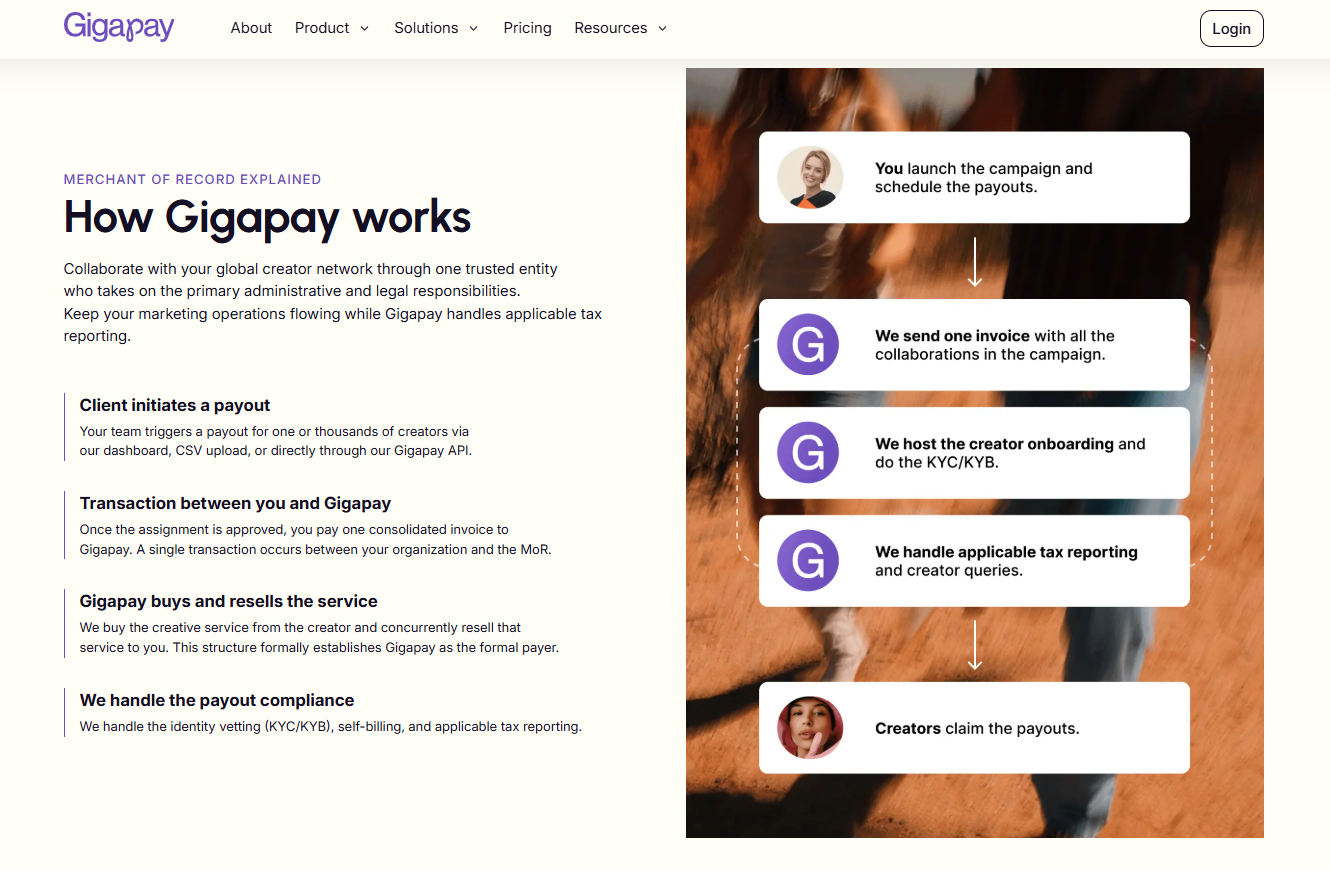
A Merchant of Record structure works differently at the legal level, which is why the cost structure looks different. Gigapay formally purchases the creator's deliverable and resells it to you, becoming the contractual counterparty on both sides.
Your company pays one vendor. Gigapay pays the creators, runs KYC, handles self-employment status, files DAC7 where it is the platform operator, manages KU14 and KSK scope, and answers the "where's my money?" messages.
For the same scenario, the cost structure is:
- Platform subscription: Gigapay's Base plan starts at €279 per month, or about €3,350 per year. Enterprise pricing applies volume-based discounts above €1.8 million in annual payout volume, which our €3 million scenario would qualify for.
- Admin fee: The list rate is 4.9% of payout volume, with volume tiers at enterprise scale. On €3 million at list, that is €147,000; enterprise volume pricing brings the effective rate down materially. On all new Gigapay plans, the client covers the fees, so creators keep what they earn.
- Internal labour: This is where the structure pays for itself. In Gigapay's 600-collaboration benchmark, admin time fell from 840 hours per year to around 60, because uploading a CSV or calling an API replaces vendor onboarding, invoice collection, error chasing, and support. The 300+ ERP vendor records collapse into one, and consolidated invoicing cuts invoice volume by roughly 80%.
- Engineering: Zero for dashboard use. For platforms embedding payouts via API, integration takes two to five days rather than months, and maintenance stays on Gigapay's side.
- Compliance advisory: Largely absorbed. Reporting obligations that attach to the payer sit with the counterparty that actually pays: Gigapay.
Side by Side: The Total-Cost Comparison
Using Gigapay's published ROI model for a program of 600 creator collaborations per year:
That is a 67% cost reduction before pricing a single unit of risk. For the larger €3 million scenario, the comparison holds its shape: the in-house column runs €171,000 to €415,000 per year in fees, salaries, and maintenance while retaining full liability, and the Merchant of Record column concentrates the cost into one transparent fee that includes the liability transfer.
The honest framing matters here. On headline rate, in-house on Stripe is cheaper. That objection is arithmetically valid, and the answer to it is never to dispute the rate. The answer is that the rate is not the cost.
The cost is the rate plus the engineers, plus the ops team, plus the compliance advisory, plus the exposure, and on that full ledger the in-house option is the expensive one at any meaningful compliance-relevant volume.

Where the Break-Even Actually Sits
The build-vs-buy answer is not the same for every company, and pretending otherwise would be selling rather than analyzing.
The variables that move the break-even:
1. Volume
Below roughly 50 collaborations a year in a single low-complexity market, manual processing inside existing finance workflows is defensible. The €40 to €60 per-payment cost on 50 payments is €2,000 to €3,000 a year, which no infrastructure decision needs to solve.
2. Geography
A US-only program paying US creators faces a fraction of the European compliance surface. No DAC7, no KSK, no EU withholding regimes. The in-house case genuinely strengthens there. A European or cross-border program faces the full stack described above, and every additional country multiplies the compliance column rather than adding to it.
3. Creator profile
Registered businesses with accountants tolerate vendor onboarding. Nano and micro creators without registered companies largely cannot get through it, which is why enterprise brands historically avoided them.
Boozt's brand activation team put it directly: they had tried for years to find a way to work with nano and micro influencers, and the payout structure is what finally enabled it, tripling collaborations without expanding the team.
4. Engineering opportunity cost
The relevant question is not whether your engineers can build payouts. They can. It is whether payout infrastructure is the highest-value use of one to two permanent engineers when the alternative is your actual roadmap.
5. Risk posture
If your board or your clients' procurement teams ask who verified creator tax status, who files the DAC7 report in January, and who pays the fine if it is wrong, "our marketing team, using a spreadsheet" is an answer with a shelf life.
The Platform Case: When Payouts Are a Feature, Not Your Product
Creator platforms and marketplaces face a sharper version of the same decision, because for them payouts are recurring infrastructure rather than a campaign function. Building means owning KYC flows, DAC7 platform-operator obligations, and payment operations permanently, and in the worst case drifting toward becoming a regulated entity.
The embedded Merchant of Record route inverts that: compliant creator payouts through an API integration completed in two to five days, with KYC, self-employment status, and DAC7 reporting scope handled by the counterparty.
Engineering stays on the product roadmap, the platform never becomes a regulated entity, and payouts stop being a cost center.
AdRecord's CEO summarized the platform calculus after integrating: simplicity, responsibility, and the API made it a straightforward decision.
The Platform Work Directive raises the stakes for this segment specifically. With a rebuttable presumption of employment landing on digital labour platforms in December 2026 and creator marketplaces plausibly in scope, the entity structure behind your payouts is about to matter in a way it never has.
What Finance and Procurement Should Ask Before Deciding
A build-vs-buy decision of this size deserves a real diligence list. These are the questions that separate a complete analysis from a fee comparison:
- What is our true cost per payment today? Count invoice handling, vendor setup, error cycles, and reconciliation, not just the wire fee. If the answer is near the €40 to €60 benchmark, multiply by annual payment count.
- Who files our DAC7 report in January, and who pays the fine if it is wrong? If the answer involves a person who also runs campaigns, that is the answer.
- How long would it take to produce a full audit trail if Skatteverket or DRV opened a review of our creator program tomorrow? Five-year retroactive audits are running now in Germany.
- What does the engineering maintenance line look like in year three? Not the build estimate. The permanent allocation.
- Can a creator without a registered company get through our onboarding? If not, your addressable creator pool excludes most of the nano and micro segment that currently outperforms on engagement.
- What happens to our cost structure at 3x volume? In-house costs scale with headcount and complexity. A Merchant of Record fee scales with volume and comes down in rate as it does.
Conclusion
Gigapay is the Merchant of Record for creator payouts, the one vendor that becomes the payer of record for your creators so that tax, reporting, and payment support become ours rather than yours.
The total-cost math in this breakdown points one direction for any program operating at compliance-relevant scale in Europe: an in-house build costs €171,000 to €415,000 per year across engineering, operations, and advisory while leaving every regulatory obligation with you, while the Merchant of Record model concentrates that spend into one fee, cuts admin hours by over 90%, and moves the liability to the counterparty built to carry it.
The cheapest line on the spreadsheet was never the payment fee, and it was never going to be.
If you want to see the numbers run on your own creator program, book a demo and we will build the comparison with you.
Read Next:
- Where AP Automation Ends and Tail-Spend Payouts Begin
- Gigapay vs Trolley: Who Actually Owns Worker Classification and DAC7?
- Paying 200 Creators in 40 Countries: A Cross-Border Tail-Spend Problem
FAQs:
1. What is the total cost of building creator payouts in-house?
The total cost of building creator payouts in-house is approximately €171,000 to €415,000 per year for a program paying 500 creators monthly across EU borders, covering the initial build (€80,000 to €250,000), permanent engineering maintenance, payment provider fees, finance operations labour, and multi-country compliance advisory, while all tax and reporting liability remains with your company.
2. What is a Merchant of Record for creator payouts?
A Merchant of Record for creator payouts is a vendor that legally purchases the creator's deliverable and resells it to the brand, becoming the contractual counterparty on both sides. This means the Merchant of Record pays the creators, handles KYC and self-employment admin, and takes on reporting scope such as DAC7, so the brand deals with one vendor and one invoice instead of hundreds of individual creator setups.
3. How much does a manually processed creator payment really cost?
A manually processed creator payment really costs €40 to €60 all-in, according to Ardent Partners' 2025 research, once invoice handling, vendor onboarding, error cycles, and reconciliation are counted. For a program running 600 collaborations per year, that adds up to roughly €139,590 in annual cost and around 840 admin hours.
4. When does building creator payouts in-house make sense?
Building creator payouts in-house makes sense when a program runs fewer than roughly 50 collaborations per year in a single low-complexity market, operates US-only with minimal European compliance exposure, or works exclusively with registered businesses that tolerate standard vendor onboarding. Above that threshold, and especially across EU borders, the compliance and labour costs outweigh the lower payment fees.
5. How much can a brand save by using a Merchant of Record instead of in-house creator payouts?
A brand can save roughly 67% by using a Merchant of Record instead of in-house creator payouts, based on Gigapay's model for 600 annual collaborations: around €139,590 per year manually versus around €46,350 with Gigapay, with admin time falling from 840 hours to about 60 and 300+ ERP vendor records collapsing into one.
.jpg)
.jpg)
.jpg)