.jpg)

The IAB projects creator advertising spend in the US alone will grow from $37 billion in 2025 to $44 billion in 2026, yet behind the engagement dashboards, the investment trail is often surprisingly messy.
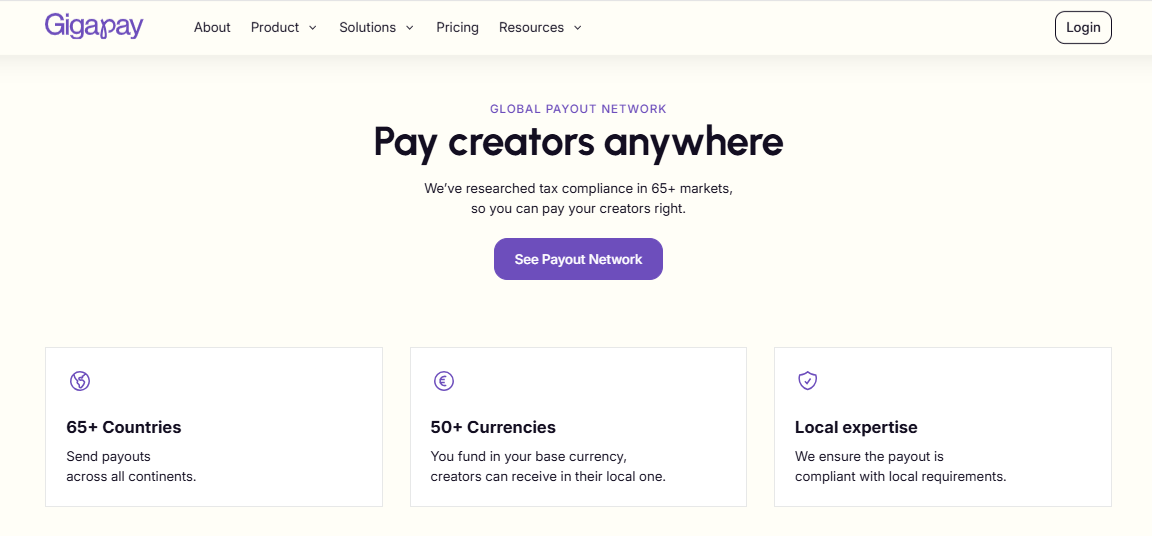
Gigapay is the merchant of record for mass creator payouts, which means one vendor, one invoice, and a complete payment record for every creator you pay across 65+ countries.
As creator budgets move from experimental to material, internal auditors, external auditors, and tax authorities now treat creator payments the way they treat any other supplier category, and most brands are still running them on spreadsheets and goodwill.
This article breaks down exactly what auditors ask for in a creator payment audit, the records you need to keep, how long you need to keep them, and how to build a payment process that survives scrutiny in 2026.
Key Takeaways
- Auditors ask for contracts, invoices, tax IDs, KYC records, payment confirmations, and approval chains.
- DAC7 due diligence records must be retained for 5 to 10 years.
- The IRS 1099 reporting threshold rises to $2,000 in 2026.
- Missing creator tax documentation is the most common audit finding.
- A merchant of record consolidates hundreds of creator records into one auditable vendor.

Why Creator Payments Became an Audit Priority in 2026
Creator marketing stopped being a side budget. Influencer marketing now draws significant investment from media, content, performance, and even commerce media budgets, but many brands still manage creator activity using informal processes designed for speed and experimentation.
When a channel absorbs seven or eight figures a year, finance leadership and audit committees start asking the questions they ask about every other spend category. Who approved this payment, where is the invoice, and where is the tax documentation?
The answers are often uncomfortable. Roughly half of marketers still cannot confidently prove their influencer ROI, according to Sprout Social. If a marketing team cannot prove ROI, it usually cannot produce a clean payment file either, because both problems come from the same root: creator relationships that were never onboarded into a formal procurement and payment process.
Regulators noticed the same gap. In 2026, the FTC and the UK's FCA investigated over 2,340 creators for non-disclosure or fraudulent promotion, and the FTC's maximum civil penalty now sits at $53,088 per endorsement violation. Enforcement against creators pulls brands into the frame, and the first thing an investigator or auditor requests is the paper trail behind the relationship.
The 2026 Rules That Define What Your Audit Trail Must Contain
Your audit trail is only as good as the regulations it has to satisfy. Four regimes shape creator payment documentation in 2026.
DAC7 in the European Union
DAC7 requires digital platforms to collect and report seller data annually to an EU tax authority. For creators operating through a company, that means official name, primary address, tax registration number per issuing member state, VAT registration number, company registration number, and the existence and location of any permanent establishment in the Union.
Platforms must retain records of due diligence and data collection for 5 to 10 years depending on national legislation, and reports are generally due by 31 January for the prior year's data.
The penalties are national, and they are not trivial. Germany can fine a platform operator up to €50,000 per late or incomplete report, France's penalties range from roughly €5,000 to €50,000 depending on severity, and the Netherlands can impose fines as high as €900,000 for a platform that knowingly evades its reporting duty.
The new US 1099 threshold
The IRS reporting threshold moves to $2,000 in 2026, and the practical guidance is to collect a W-9 or local equivalent from every creator regardless of the threshold, and to keep records on every payment, including the fair market value of gifts. A gifted product with a market value above the threshold is reportable compensation, and auditors increasingly ask how gifting is valued and logged.
Germany's Künstlersozialkasse (KSK)
Germany applies a 4.9% social levy on payments for creative work, including influencer content, once payments exceed €1,000 in a year. The levy applies even when the hiring company sits outside Germany. An auditor reviewing your German creator spend will ask whether KSK liability was assessed and whether the levy was paid or documented as not applicable.
Sweden's KU14 and income statement exchange
Compensation paid to private individuals through a Swedish entity gets reported to Skatteverket, and when the creator works in another country, an exchange of income statement carries that information to the creator's local tax authority.
Cross-border payments leave a data trail with two tax authorities, which means inconsistencies between your records and the reported figures surface on their own.
What Is a Creator Payment Audit Trail?
A creator payment audit trail is the complete, chronological documentation that connects a creator payment to its business purpose, its approval, its tax treatment, and its settlement. In practice, that means an auditor can pick any single payout from your ledger and trace it backward to a signed agreement and forward to a bank confirmation without asking anyone to reconstruct events from memory or Slack threads.
The test is simple: If a payment can only be explained by the person who made it, you do not have an audit trail. You have institutional knowledge, and institutional knowledge resigns, goes on parental leave, and forgets.
What Auditors Ask For in a Creator Payment Audit
Auditors work from a document request list. For creator payments, the list looks like this.
The contract-to-cash thread
Auditors sample payments and pull the thread. A typical sample question sounds like: show me the agreement, the approval, the invoice, the identity check, and the bank confirmation for this €4,300 payment to this creator in March. If your team needs three days and four people to assemble that file, the finding writes itself.
Tax documentation and identity
This is where most creator programs fail. Individual creators without registered businesses cannot issue invoices, so payments to them often sit in the ledger with no supporting document at all. An audit-ready process collects name, address, TIN, date of birth, ID copy, and bank account details before the first payout, and blocks compensation until that information is complete.
Gigapay applies exactly this rule: users cannot receive compensation without providing all requested information.
Gifts, barter, and non-cash compensation
Keeping records on every payment, including the fair market value of gifts, is now standard audit expectation. If your gifting program sends €200,000 of product to creators per year and none of it appears in your compensation records, an auditor will treat that as unreported compensation until you prove otherwise.
Approval chains and segregation of duties
The person who selects a creator should not be the only person who approves the payment. Auditors look for documented approval by someone with spending authority, timestamped before funds moved. Marketing teams that pay creators from a shared card or a personal PayPal account fail this test immediately.
Common Audit Findings in Creator Payment Programs
The same findings repeat across brands, because the same informal process produces them.
1. Vendor sprawl
A brand running 600 collaborations a year typically carries 300+ individual creator records in its ERP, each requiring onboarding, bank detail verification, and maintenance. Every record is a place where data goes stale and errors hide.
Gigapay's benchmark for that manual model is roughly €139,590 per year in admin cost and 840 admin hours, against €46,350 and about 60 hours when payments consolidate through one vendor.
2. Missing tax IDs on historical payments
The payment went out in 2024, the creator is unreachable in 2026, and the tax authority wants the TIN. There is no retroactive fix for this one, which is why collection has to happen at onboarding.
3. No invoice for individual creators
Individuals with no registered activity do not send invoices. Without self-billing, the ledger entry has no supporting document. Self-billing automation, which generates compliant invoices on behalf of creators, closes this gap and cuts invoice volume by around 80% when payments consolidate per campaign.
4. Unassessed KSK and local levies
German creator spend without a KSK assessment on file is a recurring finding for any brand active in the DACH market.
5. Currency and settlement mismatches
Payments funded in EUR and settled in local currency across 50+ currencies produce FX differences. Auditors accept them when documented and question them when not.

How Long to Retain Creator Payment Records
Retention rules differ by regime, and the safe answer is to keep the full payment file for as long as the strictest applicable rule requires.
The practical standard for 2026 is a ten-year file: contract, KYC record, invoice, approval, payment confirmation, and tax filing reference, stored together and retrievable per creator and per campaign.
How to Build an Audit-Ready Creator Payment Process
Audit-readiness is a process design question, not a documentation sprint before the auditors arrive.
Step 1: Onboard before you pay
Collect identity, tax, and bank information at the start of the relationship, and make payment technically impossible until the record is complete. Onboard creators for tax and identity at the start of a relationship, not at payment time.
Step 2: Put every agreement in writing
A one-page campaign agreement with scope, fee, deliverables, and disclosure requirements beats a DM thread in every audit ever conducted. Attach it to the payment record.
Step 3: Route approvals through one system
One documented approval per payment, timestamped, by someone with authority. Batch approval per campaign is fine. Approval after settlement is not.
Step 4: Automate invoicing
Use self-billing for individual creators and consolidated invoicing per campaign. One invoice per batch instead of hundreds means one document per campaign for the auditor to reconcile.
Step 5: Assign ownership of tax reporting
DAC7, 1099, KU14, and KSK filings each need a named owner and a calendar. Decide on cross-border tax reporting before creator number 300, not after.
Step 6: Audit yourself annually
Run a full audit annually and a lighter version quarterly, sampling payments and pulling the contract-to-cash thread the way an external auditor would. Fix what breaks before someone else finds it.
How a Merchant of Record Changes the Audit Conversation
There is a structural way to shrink the audit surface: stop being the counterparty to hundreds of creators.
Under Gigapay's merchant of record model, Gigapay formally purchases the creator's deliverable and resells it to the brand. The brand's audit trail collapses from 300+ vendor files into one vendor relationship with one contract, one consolidated invoice per campaign, and one counterparty that runs KYC, validates tax IDs, generates self-billing invoices, and files DAC7, KU14, and KSK-relevant reporting as part of its operating model.
Gigapay is ISO 27001 certified and GDPR compliant, which answers the data-handling questions auditors raise about creator personal data at the same time.
One nuance matters for accuracy: in its merchant of record capacity, Gigapay does not withhold or pay social security or other taxes on behalf of creators (the employer of record service in Sweden is the exception). Creators remain independent and responsible for their own taxes. What the model does is produce the complete, consistent documentation trail that makes each party's obligations visible and provable, which is precisely what an auditor is trying to establish.
For the auditor, the difference is practical. Instead of sampling payments across hundreds of ad hoc vendor records, they review one vendor contract and one consistent data set.
Audit-Readiness Checklist for 2026
Run this list against your current process. Every "no" is a finding waiting to happen.
- Every creator completed identity and tax onboarding before their first payment
- Every payment links to a signed agreement and a documented approval
- Every individual creator payment has a self-billed or issued invoice
- Gifts and barter are logged at fair market value
- DAC7, 1099, KU14, and KSK obligations have a named owner
- Records are retrievable per creator and per campaign within one business day
- Retention covers at least the 5-to-10-year DAC7 window
- German creator spend has a KSK assessment on file
- FX and settlement differences are documented per payout

Conclusion
Gigapay gives brands and agencies a single vendor, a single invoice, and a complete payment record for every creator they pay, across 65+ countries and 50+ currencies.
Creator payment audits in 2026 come down to one question: can you trace any payout back to a contract, an identity check, an approval, and a tax filing without reconstructing it by hand?
The brands that answer yes built documentation into the payment process itself, and the fastest way to get there is to consolidate creator payments through a merchant of record that produces the audit trail as a byproduct of paying people.
Book a demo and see what your next audit looks like when the file already exists.
Read Next:
- Paying Creators Who Have No Company or VAT Number: A Finance Team's Compliance Guide (2026)
- ViDA and Creator Payments: How EU "VAT in the Digital Age" Changes Influencer Invoicing for Finance Teams (2026–2030)
- France's E-Invoicing Mandate Is Live: What Brands Paying Creators Must Change Now (2026)
FAQs:
1. What is a creator payment audit trail?
A creator payment audit trail is the complete documentation connecting each creator payment to its contract, approval, tax treatment, identity verification, and bank settlement, so any payout can be traced end to end.
2. What do auditors ask for in a creator payment audit in 2026?
Auditors ask for signed creator agreements, invoices or self-billing documents, tax identification numbers, KYC records, approval records, payment confirmations, and proof of tax filings such as DAC7 and 1099 reports.
3. How long should creator payment records be retained?
Creator payment records should be retained for 5 to 10 years, matching DAC7 due diligence requirements and the strictest national accounting rules that apply to your entity.
4. What is the most common audit finding in creator payment programs?
The most common audit finding in creator payment programs is missing tax documentation, usually absent TINs or W-9s for creators who were paid before completing onboarding.
5. How does a merchant of record make creator payments audit-ready?
A merchant of record makes creator payments audit-ready by becoming the single contractual counterparty, running KYC and tax ID validation, generating consolidated and self-billed invoices, and producing one consistent documentation trail per campaign.
.jpg)
.jpg)
.jpg)