.jpg)

Manual invoice processing costs between $12 and $26 per document and consumes an average of 14.6 days from receipt to payment in 2026, which means a finance team handling 1,000 invoices a month is losing roughly $192,000 a year to data entry, approval routing, and error correction (Mindsprint and Lido benchmarks, April 2026).
Gigapay is the Merchant of Record for creator payouts, built for brands and agencies that work with hundreds or thousands of creators a year and need one consolidated invoice instead of a flood of individual PDFs.
Self-billing is the mechanism that makes that consolidation possible: the platform issues a compliant invoice on behalf of each creator automatically, so neither side has to chase paperwork manually.
This article explains what self-billing actually is, what a compliant self-billing invoice contains, how Gigapay turns 500 of them into one, and what finance teams and creators get back as a result.
Key Takeaways
- Self-billing means the buyer issues invoices on behalf of the creator, automatically and compliantly.
- Gigapay consolidates hundreds of creator invoices into one invoice per campaign or batch.
- Brands cut invoice volume by roughly 80% and ERP vendor records from 300+ to one.
- As Merchant of Record, Gigapay assumes the tax and compliance responsibility for each payout.
- Creators get paid instantly without needing a registered company or VAT number.
What Self-Billing for Creators Actually Is
Self-billing is a tax-compliant arrangement in which the buyer issues the invoice on the seller's behalf, with the seller's prior written agreement. In the creator economy, this means a brand or platform pays a creator for a deliverable and generates the invoice automatically, rather than waiting for the creator to send one in.
It is a regulated practice. HMRC in the UK, the EU VAT Directive (Article 224), and equivalent frameworks across most OECD jurisdictions all permit self-billing, provided the buyer and seller have a signed self-billing agreement, the invoices contain the required information, and both sides keep records that satisfy local audit requirements.
For brands working with creators, self-billing solves a specific operational problem. A creator does not need to know what a tax-compliant invoice looks like in Germany, Sweden, or France. The buyer's platform handles it.
The creator gets paid. The brand has one consolidated invoice instead of three hundred PDFs in different formats, languages, and currencies.
Self-Billing vs. Traditional Creator Invoicing
In traditional creator invoicing, the creator issues the invoice and the brand processes it. In self-billing, that flow reverses: the brand or its platform generates the invoice on the creator's behalf based on the agreed deliverable and rate.
The difference is structural, not cosmetic, and the implications run through every part of the campaign workflow.
The comparison is where the 500-to-1 framing actually lands. A traditional flow with 500 creator payments produces 500 invoices, 500 vendor records, and 500 separate compliance checks.
Self-billing produces one invoice payable to one vendor, with the 500 individual self-billed records generated and stored automatically underneath.
What a Compliant Self-Billing Invoice Actually Contains
A self-billing invoice is not a different document type. It is a regular tax invoice that the buyer issues instead of the seller. For tax authorities to accept it, the document and the surrounding arrangement need to meet specific requirements.
The agreement comes first. Before any self-billing invoice can be issued, the buyer and the creator need a written self-billing agreement on file.
In the UK, HMRC requires this agreement to specify the period it covers (typically 12 months), confirm that the creator will not issue invoices for the same supplies, and commit both parties to notify each other if either becomes VAT-registered or changes status.
The EU VAT Directive requires equivalent written agreement under Article 224, with member states adding their own local conditions.
The invoice itself needs to carry:
- A unique sequential invoice number
- The wording "self-billing" or a local equivalent ("Gutschrift" in Germany, "Autofakturering" in Sweden) clearly displayed
- The creator's full name, address, and tax identification number
- The buyer's full name, address, and VAT number
- The date of issue and the date of supply
- A description of the deliverable
- The amount payable, the VAT rate, and the VAT amount (or the reason for exemption or reverse charge)
- The total payable in the relevant currency
The VAT treatment is where this gets genuinely complicated. A German micro-creator paid by a Swedish brand triggers different VAT rules than a UK creator paid by a US brand, which is different again from a Portuguese creator paid by an Irish agency.
Reverse charge, intra-community supplies, and place-of-supply rules all apply differently depending on where each party sits and how the creator is registered. This is the part that breaks manual self-billing and the part that makes automated self-billing valuable.
Why Creator Invoicing Breaks Without Self-Billing at Scale
When you work with a handful of creators, the invoicing process is annoying but manageable. Someone in marketing collects the invoices, finance verifies them, accounts payable processes them, and the campaign closes out. The friction is small enough to absorb.
At 500 creators in a year, that same process collapses for a specific reason: each invoice is a separate compliance event.
A nano-creator in Portugal does not have a VAT number, a micro-creator in Germany does not understand why the brand's finance team is asking for a Steuernummer, and an agency creator in the UK invoices through a personal services company with its own VAT registration.
Each one becomes a separate vendor record, a separate compliance check, and a separate payment cycle. Finance teams end up doing 500 small tax investigations a year instead of one structural one.
The result is that finance becomes the bottleneck of the marketing function. Campaigns sit in queue while creators wait 60 to 120 days to get paid, and brand managers chase invoices instead of running their next activation.
Brands that want to activate hundreds of nano- and micro-creators end up forced back into a handful of large, expensive partnerships purely because their finance stack cannot absorb the volume.
How Gigapay Turns 500 Creator Invoices Into One
The mechanism has six steps. Each one runs automatically once the brand uploads the batch.
Step 1: The brand uploads the batch
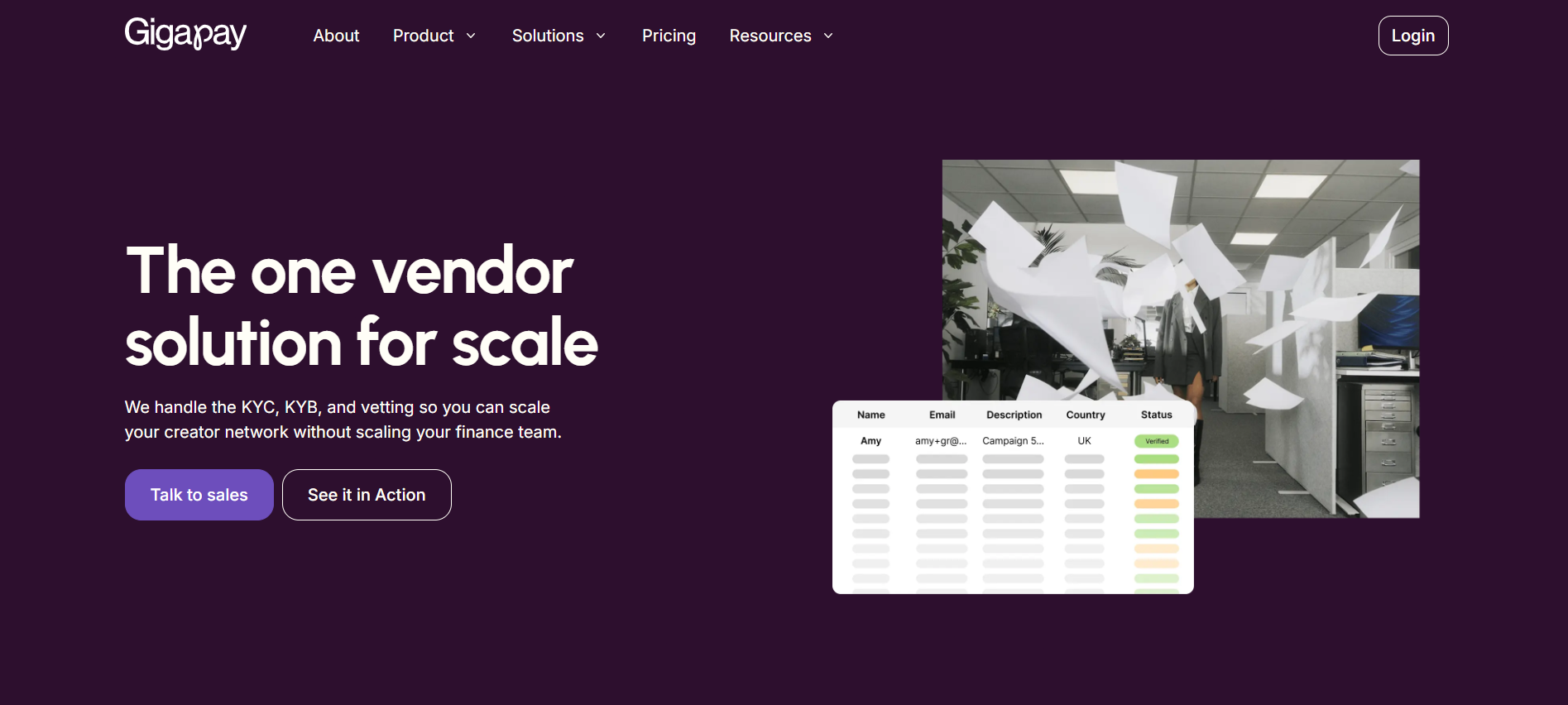
A CSV with creator details, deliverables, and amounts goes into the Gigapay dashboard, or the same data is pushed through the REST API. The batch can contain 5 creators or 5,000.
Step 2: Each creator is onboarded with a self-billing agreement
New creators receive an onboarding link and complete KYC checks, identity verification, and tax ID validation. The same flow captures the creator's written consent to be paid via self-billing, which is the legal foundation that lets Gigapay issue invoices on their behalf. Returning creators skip this step.
Step 3: Gigapay generates a self-billing invoice per creator
Each payout produces its own compliant invoice in the right format for the creator's jurisdiction, carrying the required fields, VAT treatment, and the "self-billing" marker. Gigapay stores these invoices against each creator's profile and makes them available inside the creator's Gigapay account.
Step 4: The brand sees one consolidated invoice
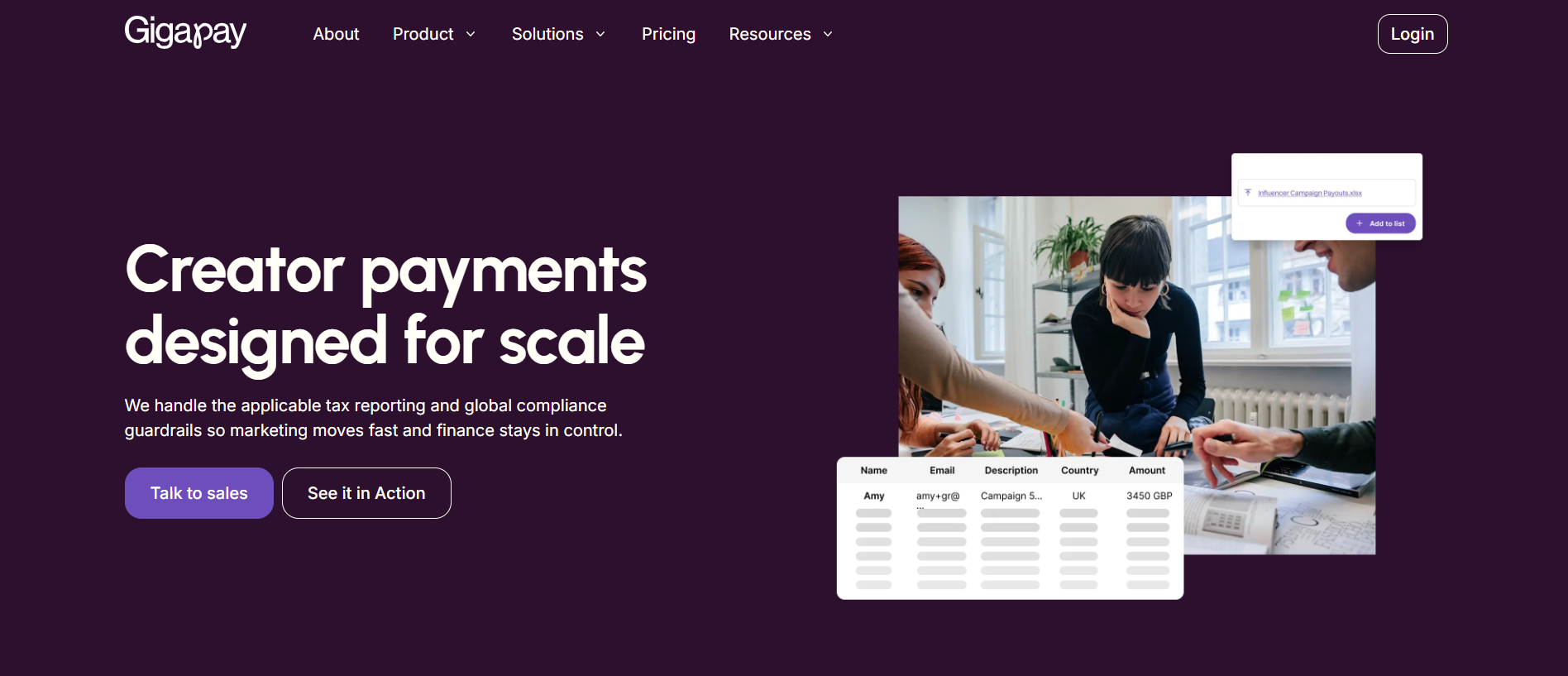
Instead of receiving 500 individual invoices to approve, the brand receives a single invoice from Gigapay covering the full batch. One vendor (Gigapay Sweden AB), one invoice, one approval cycle, one payment to make. The 500 self-billed invoices sit underneath that consolidated invoice for audit-trail purposes.
Step 5: Payouts fire instantly
Once the brand funds the batch, Gigapay disburses funds to each creator through local rails: SEPA Instant in the eurozone, Faster Payments in the UK, ACH in the US, and equivalent local rails across 65+ countries.
Step 6: Reporting runs in the background
DAC7 reporting for EU creators, KSK reporting for German creative payments over €1,000, KU14 reporting for Swedish creators, and any other applicable obligations fire automatically based on the payouts that ran. The brand never touches the reporting filings.
That is how 500 invoices become one in the brand's ERP while remaining 500 individually compliant tax documents underneath.
The Compliance Layer: DAC7, KSK, KU14, and VAT Treatment
Self-billing only works if the invoice it produces is actually valid under local tax law.
Sending money to a creator is easy. Producing an invoice that satisfies the German Finanzamt, the Swedish Skatteverket, and HMRC at the same time, on the same batch, is the part that defeats most generic payout tools.
Gigapay handles four layers of compliance automatically.
1. VAT and place-of-supply rules
The platform applies the right VAT treatment per jurisdiction, including reverse charge for cross-border B2B supplies, intra-community supplies inside the EU, and exemptions where the creator is not VAT-registered.
The treatment is calculated per individual payout, not per batch, so creators in different countries on the same campaign are treated correctly.
2. DAC7 (EU)
Under the EU's directive on administrative cooperation in tax matters, digital platforms operating in the EU must collect and report income earned by sellers and creators to tax authorities. Gigapay runs this reporting on the brand's behalf for any payouts that fall in scope.
3. KSK (Germany)
The Künstlersozialkasse is Germany's artist social insurance fund. German clients who hire creators are liable for a 2026 levy of 4.9% on creative payments above €1,000, and the obligation applies even when the creators are based outside Germany. Gigapay tracks the levy and supports KSK reporting automatically.
4. KU14 (Sweden)
Swedish income statements for non-employed individuals are filed via KU14. Gigapay produces and files these for Swedish creators paid through the platform.
As Merchant of Record, Gigapay also takes on the contractual position that most brands do not want to manage at scale. Under the service agreement, Gigapay buys the creator's deliverable and concurrently resells it to the brand client, becoming the formal counterparty for that transaction.
The brand contracts with one entity. The creators contract with Gigapay.
Worth noting that in this MoR capacity, Gigapay is not responsible for withholding or paying social security or other taxes on the creator's behalf. That obligation remains with each party under their applicable local laws, except in the specific case of the Swedish Employer of Record service.
What Finance Teams Get Back
For finance, the change is structural. One vendor in the ERP instead of 300. One invoice to approve and pay instead of 300 individual line items to chase.
Gigapay's benchmark numbers show an 80% reduction in invoice volume after switching to consolidated self-billing, and admin hours on a 600-collaboration-per-year program drop from roughly 840 hours to 60.
The cost side is real: roughly €139,590 in annual payment admin without consolidated self-billing drops to approximately €46,350 with Gigapay in place.
The bigger gain is the redirection of finance time. Teams that stop chasing creator invoices can move to cash flow analysis, supplier rationalisation, and the strategic work they were hired to do.
The Goat Agency at WPPMedia described the same shift from the agency side:
"Payments are easier and faster, while ensuring compliance with taxes and benefits."
For finance leaders, the goal is to stop processing creator invoices entirely and own a single vendor relationship that handles them in the background.
What Creators Get Back
For creators, the friction disappears. They do not need a registered company, a VAT number, or knowledge of what a Steuernummer is or how to invoice a Swedish brand from Lisbon.
The self-billing invoice is generated for them in the right format for their jurisdiction and made available inside their Gigapay account for their own records.
Payment lands instantly through their local rail rather than 60 to 120 days after the campaign ends.
Gigapay's creator NPS sits at 88, which is unusually high for a payment platform, and the EarlyPay feature lets creators access scheduled funds before the standard payout cycle runs if they need liquidity.
Christina Oliosi, brand activation lead at Boozt, described what this unlocks on the brand side:
"We've been trying to find a way forward with nano- and micro-influencers for years and Gigapay really enabled this."
Boozt tripled its number of creator collaborations without expanding the team. That works because nano- and micro-creators can finally participate.
Without self-billing, a creator earning €150 for a single Instagram Story has no practical way to invoice a Swedish brand in a compliant format. With self-billing, the brand handles it for them, and the collaboration becomes feasible at any volume.
Conclusion
Gigapay is the Merchant of Record built for brands and agencies running creator programs at scale, replacing hundreds of individual invoices and vendor records with one consolidated relationship that handles tax, compliance, and instant payouts across 65+ countries.
Self-billing is the mechanism that makes that consolidation possible: the platform generates a compliant invoice on each creator's behalf, validates it against the right jurisdiction, and presents the brand with a single document to approve.
Self-billing has existed as a regulatory framework for decades. Applied to the creator economy at scale, it converts the most operationally expensive part of influencer marketing into a background process.
Book a demo with our team to see what 500-to-1 invoice consolidation looks like inside your own ERP.
Read Next:
- The 2026 Influencer Payment Compliance Report (2026 Data)
- Global Gaming Payouts Explained: Taxes, Compliance, and Creator Payments
- Best Way to Make Mass Payouts to Influencers in 2026
FAQs:
1. What is self-billing for creators?
Self-billing for creators is a tax-compliant arrangement where the buyer generates the invoice on the creator's behalf, with the creator's prior written agreement, so the creator gets paid without having to issue their own invoice in a format the buyer's finance team can accept.
2. How does Gigapay turn 500 invoices into one?
Gigapay turns 500 invoices into one by issuing a compliant self-billing invoice for each individual creator payout in the background, then presenting the brand with a single consolidated invoice per campaign or batch that covers every creator paid in that cycle.
3. Is self-billing legal across the EU and UK?
Yes, self-billing is legal across the EU and UK, provided the buyer and creator have a written self-billing agreement in place, the invoices contain the required content under local VAT rules, and both parties keep records that satisfy local audit requirements.
4. Do creators need a registered business or VAT number to be paid through Gigapay's self-billing?
No, creators do not need a registered business or VAT number to be paid through Gigapay's self-billing, because the platform issues the tax-compliant invoice on their behalf and onboards them as an individual, sole trader, or company depending on what fits their situation.
5. What countries does Gigapay's self-billing cover?
Gigapay's self-billing covers 65+ countries and 50+ currencies, with local payment rails including SEPA Instant, Faster Payments, and ACH, and built-in reporting for DAC7, KSK in Germany, and KU14 in Sweden.
.jpg)
.jpg)