.jpg)

Micro- and nano-influencers will claim 45.5% of all influencer marketing spending in 2026, according to eMarketer's Creator Economy 2026 report.
Gigapay is the Merchant of Record platform purpose-built for mass creator payouts, handling tax compliance, consolidated invoicing, and instant global payments through a single vendor relationship.
That shift in spend means brands are now running programs of 500 to 5,000 creator collaborations a year, where payment admin becomes the operational bottleneck on growth long before content quality does.
This article explains what mass payouts to influencers actually involve in 2026, why they matter, how the Merchant of Record model works, and how to get started with Gigapay.
Key Takeaways
- Mass creator payouts now require one vendor, automated tax reporting, and instant global payments.
- Merchant of Record platforms transfer tax liability away from brands and onto the payment provider.
- Gigapay pays creators across 65+ countries in 50+ currencies through CSV upload or API.
- The model cuts admin time from 840 to 60 hours per year for 600 collaborations.
- Creators do not need a registered business or VAT number to receive payment through Gigapay.
What Are Mass Payouts to Influencers in 2026
Mass payouts to influencers describe the process of paying many creators at once through a single workflow, instead of treating each payment as an individual vendor transaction.
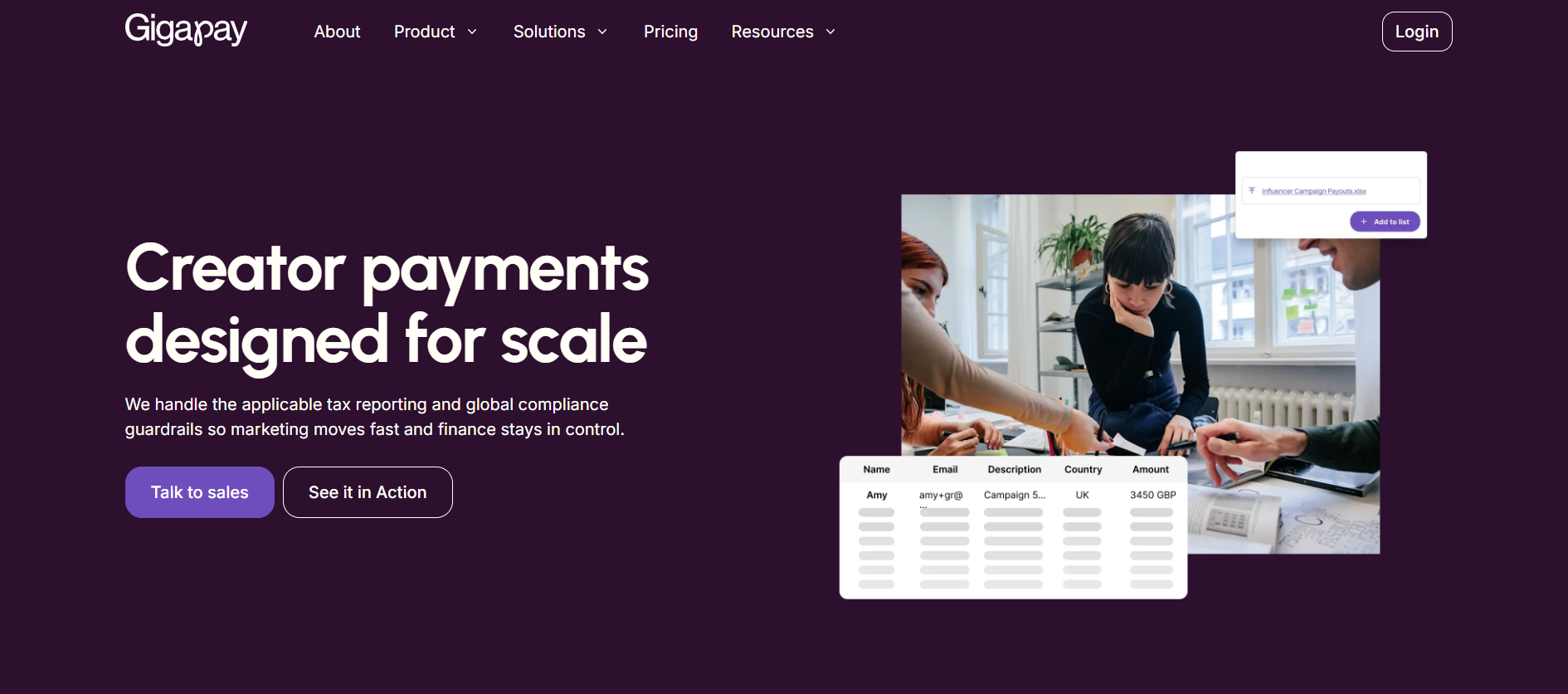
A brand running 50 collaborations a month does not want to onboard 50 new vendors, collect 50 tax forms, process 50 invoices, and reconcile 50 international transfers. Mass payouts collapse that work into a single batch, usually triggered through a CSV upload or an API call.
In 2026, the model becomes essential the moment a brand starts working with nano and micro creators at scale. The cost of paying a creator €200 cannot exceed the cost of the campaign itself, and treating those payments like a normal procurement process makes the math impossible.
With nano and micro creators now claiming nearly half of all influencer marketing spend, the operational layer underneath those programs is the difference between a strategy that scales and one that quietly dies in finance.
What Are the Benefits of Mass Payouts to Influencers in 2026
The benefits compound with creator volume. A brand running 600 collaborations a year saves around 780 admin hours and roughly €93,240 annually by moving from a manual vendor process to a mass payout platform, based on Gigapay's published ROI model. The same brand goes from 300+ vendor records in its ERP to one.
The measurable benefits include:
- Speed: Creators are paid instantly through local payment rails like SEPA Instant, Faster Payments, and ACH.
- Reach: Payments cover 65+ countries and 50+ currencies, removing the cross-border friction that usually kills nano and micro programs.
- Compliance: Automated reporting for DAC7, KSK, and KU14 means finance does not need to file or chase paperwork by hand.
- Vendor consolidation: One vendor on file in the ERP instead of hundreds, with one consolidated invoice per campaign or batch.
- Creator access: Creators can be paid without holding a registered business or VAT number, which opens up the nano and micro tiers most brands had locked themselves out of.
- Creator experience: Better payment timing and a real support team improve creator retention and the quality of future collaborations.
Christina Oliosi, Boozt's Brand Activation Lead, describes the impact directly: “the team had been trying to find a way forward with nano and micro influencers for years, and Gigapay enabled it, resulting in a 3x increase in collaborations without team expansion.”
Why Mass Influencer Payouts Became a Priority in 2026
Several shifts in the creator economy made mass payouts a 2026 priority rather than a 2028 problem.
- Influencer Marketing Hub's 2026 benchmark report found that rising creator costs are the top challenge for 35.4% of marketers, with budget constraints adding another 5.28%, meaning over 40% of reported challenges are tied to economic pressure on creator programs.
- inBeat's 2026 data adds that more than 72% of marketers expect creator marketing budgets to increase by 50% or more this year.
Volume is going up, budgets per creator are getting tighter, and the math on manual vendor processes stops working.
At the same time, EU regulators tightened reporting requirements through DAC7, Germany's KSK levy now applies a 4.9% charge on creative payments over €1,000 (including international hires), and Sweden's KU14 obligations remain active for any company paying creators in the Nordics.
The administrative cost of doing this manually is no longer absorbable.
Brands that scaled their creator volume without scaling their payment infrastructure are now stuck. They cannot expand the program because finance cannot keep up, and they cannot keep the program small because performance data tells them micro and nano collaborations work.
How Mass Payouts Work Through a Merchant of Record Model
The Merchant of Record (MoR) model changes how the payment moves through the system. Instead of the brand paying each creator directly and assuming the tax and compliance responsibility for every transaction, the brand pays a single MoR vendor, and the MoR then pays the creators.
Gigapay's service agreement formally describes this as Gigapay purchasing the creator's deliverable and concurrently reselling it to the client.
That structural choice has practical consequences:
- The brand has one vendor on file in its ERP instead of hundreds.
- The brand receives one consolidated invoice per campaign or batch.
- Tax reporting obligations like DAC7, KSK, and KU14 are handled by the MoR.
- KYC, KYB, and Tax ID verification happen at the platform level, not on the brand's side.
One nuance matters here. In its MoR capacity, Gigapay is not responsible for withholding or paying social security or other taxes on behalf of creators (the Employer of Record service in Sweden is the exception). Each party still complies with its own tax responsibilities under applicable laws. The brand offloads administrative and contractual complexity, while statutory duties remain with whoever owes them.
This is what makes the MoR model structurally different from a standard payment processor:
- A processor moves money.
- An MoR takes on the contractual and tax reporting role of the buyer, which is what allows finance and procurement to consolidate hundreds of creator relationships into a single vendor record.
Why Gigapay Is the Best Platform for Mass Payouts to Influencers
Gigapay is built specifically for the mass creator payout use case, which is what separates it from generalist payout tools like Stripe Connect, Tipalti, or PayPal Payouts. The Merchant of Record model is the foundation, and the rest of the platform is designed around the operational reality of running creator programs at scale.
A few things that make it the right fit for this job:
- Merchant of Record by design: Tax liability and contractual responsibility transfer to Gigapay as the formal counterparty. This is the same compliance proposition that most "payout solutions" cannot legally make.
- Global coverage on local rails: 65+ countries, 50+ currencies, and instant payouts through SEPA Instant, Faster Payments, and ACH. Funding currencies include USD, EUR, GBP, SEK, DKK, and NOK.
- No creator business registration required: Creators can onboard as individuals, sole traders, or companies, which is what makes nano and micro programs operationally possible.
- Consolidated invoicing: 80% reduction in invoice volume, based on Gigapay's published customer benchmarks.
- EarlyPay and creator support: Liquidity for creators waiting on scheduled funds, plus a dedicated human support team. Creator NPS sits at 88/100.
- API-first integration: REST API with sandbox and production environments, full integration in 2 to 5 days, plus webhooks for downstream automation.
- ISO 27001 certified and GDPR compliant: Standard for any platform handling creator personal data and payment information at this volume.
- Used by global agencies and brands: WPPMedia (working with The Goat Agency), Billion Dollar Boy, Boozt, and AdRecord all run creator payments through Gigapay.
How to Get Started With Gigapay's Mass Payouts to Influencers: Step-by-Step Guide
The path from a manual vendor process to mass payouts with Gigapay usually looks like this:
1. Audit the current volume
Count creator collaborations per year, average payment size, and the number of countries involved. This sets the baseline ROI case against Gigapay's 840-hours-to-60-hours benchmark.
2. Map the admin cost
Add up hours spent on vendor onboarding, invoice processing, tax form collection, payment reconciliation, and finance follow-ups. This makes the internal business case concrete for finance and procurement.
3. Book a demo with Gigapay
A solutions team will walk through your specific use case, recommend a pricing plan (Base at €279/month + 4.9% per payout, or Enterprise for €1.8M+ annual payout volume), and confirm whether EarlyPay and a dedicated CSM apply.
4. Choose between CSV and API
Brands running occasional campaigns can start with batch CSV uploads through the dashboard. Teams embedding payments inside another platform or running constant programs should plan for API integration, which takes 2 to 5 days.
5. Complete platform onboarding
Gigapay handles KYC, KYB, Tax ID validation, and creator registration. Creators onboard as individuals, sole traders, or companies, with no requirement for a registered business or VAT number.
6. Run a pilot batch
Start with one campaign or one creator cohort, validate the workflow, confirm the tax reporting outputs (DAC7, KSK, KU14 as applicable), and benchmark payout speed and creator NPS internally.
7. Scale to full volume
Once the pilot is clean, switch the rest of the creator program over, consolidate ERP vendor records to a single Gigapay entry, and integrate webhooks into downstream finance systems.
Most teams complete the technical integration in under a week, with internal change management for finance and procurement running in parallel.
Conclusion
Gigapay is the Merchant of Record platform purpose-built for mass creator payouts, used by brands and agencies including Boozt, WPPMedia, The Goat Agency, and Billion Dollar Boy to pay creators in 65+ countries instantly through one vendor relationship.
The best way to make mass payouts to influencers in 2026 is through a single MoR vendor that handles tax compliance, consolidated invoicing, and instant global payments, because the administrative cost of running creator programs at modern volumes is no longer compatible with manual vendor processes.
Book a demo with Gigapay to send your first batch payout the same day you sign the contract.
Read Next:
- Best Way to Pay TikTok Creators Internationally in Bulk (2026 Guide)
- How Gigapay Validates Creator Tax IDs Across 65 Countries
- Best Merchant of Record for Creator Payments in 2026
FAQs:
1. What is the best way to make mass payouts to influencers in 2026?
The best way to make mass payouts to influencers in 2026 is through a Merchant of Record platform like Gigapay, which handles tax compliance, consolidated invoicing, and instant global payments through a single vendor relationship across 65+ countries and 50+ currencies.
2. How does a Merchant of Record handle influencer payments?
A Merchant of Record handles influencer payments by purchasing each creator's deliverable and reselling it to the brand client, which means the MoR becomes the formal counterparty for the transaction and takes on the administrative and tax reporting responsibilities tied to the purchase.
3. Can brands pay nano and micro influencers without a registered business on the creator's side?
Yes, brands can pay nano and micro influencers without a registered business on the creator's side when they use Gigapay, because creators can onboard as individuals, sole traders, or companies, with KYC and Tax ID validation handled by the platform.
4. How long does it take to integrate a mass payout platform like Gigapay?
It takes 2 to 5 days to integrate a mass payout platform like Gigapay through its REST API, with key endpoints for projects, prepayments, payouts, and registrations available in both sandbox and production environments.
5. What countries and currencies does Gigapay support for mass influencer payouts?
Gigapay supports mass influencer payouts in 65+ countries and 50+ currencies, with funding available in USD, EUR, GBP, SEK, DKK, and NOK, and instant payouts delivered through local payment rails including SEPA Instant, Faster Payments, and ACH.