.jpg)

According to eMarketer's 2026 influencer marketing analysis, 41% of brands now incorporate performance metrics into how they pay creators, reflecting the industry's shift toward measurable accountability.
Gigapay is the Merchant of Record for creator payouts: the one vendor solution that pays your creators on your behalf by taking on the compliance, payouts, and support so your team doesn't have to.
The way brands compensate influencers has fragmented far beyond a single flat rate per post, and the model you choose now shapes everything from campaign ROI to the tax paperwork that lands on your finance team's desk in January.
This article breaks down every major compensation model your team can use, when each one fits, and what changes about the admin, tax, and cash-flow reality behind each choice.
Key Takeaways
- Flat fee remains the most common model, with 83% of creators willing to accept it.
- Performance-based commission ties payment to outcomes, typically ranging from 5% to 30% per sale.
- Product gifting works when items are easy to try and shareable, but gifts stay taxable.
- Hybrid models pair a base fee with commission and are becoming the 2026 default.
- Every model creates the same downstream compliance load: DAC7, KSK, KU14, VAT, and cross-border reporting.
The State of Influencer Compensation in 2026
Global influencer marketing spend crossed $32.55 billion in 2025 and is projected to reach at least $40.51 billion by the end of 2026, according to the Aspire State of Influencer Marketing 2026 report. In the US alone, spend hit $12.1 billion this year, up 30.2% from 2025's $9.29 billion, per eMarketer's March 2026 Digital Ad Spending Report.
What used to be an experimental line item now takes up 23% of the average marketing budget, and 74% of marketers plan to increase creator investment again this year.
That growth has changed what compensation looks like. Two years ago, most deals were a single flat fee for a single post. Today, brands ask creators to run content across TikTok, Instagram, YouTube, and a whitelisted paid ad, then track link clicks and coupon redemptions against the invoice.
Nano and micro-influencers now claim 45.5% of total spend, which means a single campaign might involve 200 creators paid five different ways. The person managing the payments still expects one clean invoice at the end of the month.
Why the Compensation Model Matters More Than the Rate
When your team asks "how much do we pay this creator?" you actually have to answer two questions: what's the number, and what's the structure behind it. The number is the visible part. The structure is what determines your tax exposure, your finance team's admin load, and whether creators actually accept your offer.
Take the same €5,000 campaign budget with a single creator.
- A flat fee of €5,000 for one Reel is straightforward but sits at 100% risk for you if the content underperforms.
- A €2,000 base plus €30 commission per sale caps your downside but requires clean attribution infrastructure.
Sending €5,000 worth of product with a request for coverage lowers your cash outlay but shifts you into gifted-product territory, which is taxable at market value in Sweden and several other EU markets, per Skatteverket's targeted influencer reviews. Same headline number, three different compensation models, three different sets of paperwork.
1. Flat Fee: The Default Model
Flat fee is the model most brands and creators still work from. Your team agrees a fixed price for a specific deliverable, such as €800 for one Instagram Reel or $2,500 for a YouTube integration, and the price is locked regardless of performance.
It is the simplest model to forecast, the easiest to explain to finance, and the reason 83% of creators say they are highly willing to accept it, according to a widely cited 2024 industry survey referenced across major influencer marketing guides.
Flat fee works well when your goal is awareness, when the creative is scripted and the deliverable is discrete, or when the creator is established and unwilling to bet their fee on attribution accuracy you haven't proved yet. It works less well when you want direct-response performance, when your product is expensive to sample, or when you are running the same campaign across 200 nano-influencers and can't negotiate 200 different rates.
Rate benchmarks in 2026 sit at €5 to €200 per post for nano-influencers, €7,000 to €20,000-plus per post for mega-influencers, and everything in between shaped by platform, format, engagement quality, exclusivity, and geography.
2. Performance-Based Commission: Pay Only for Results
Performance models tie the creator's payment to something measurable: clicks, installs, signups, or sales. The three common structures are cost per acquisition (CPA), cost per click (CPC), and cost per sale (CPS, also called affiliate).
Commission rates commonly range from 5% to 30% per sale depending on the industry, and creators receive a tracking link or promo code to attribute revenue back to their content.
The economics work well for both sides when your attribution is clean and your conversion rate is proven. Your team only pays when a campaign generates measurable results, and the creator earns uncapped income if the content overperforms.
Cyber Week 2025 showed the model at scale: social media influencers nearly doubled their share of total e-commerce orders year-over-year while commission costs stayed flat, per Pulse Advertising's July 2026 analysis of creator commerce trends.
The economics stop working when attribution breaks. If your tracking pixel misfires, or if the creator's audience buys through a different device than the one that clicked, the commission is unpaid and the relationship curdles.
Only around 20% of influencer purchases are directly link-attributable, per CreatorFest's State of Creator Compensation 2026, which is why pure-commission deals are rare above the nano tier and creators typically ask for a base fee to absorb attribution risk.
3. Product Gifting: Compensation Without Cash
Product gifting sends the creator free product in exchange for coverage, with no guaranteed payment attached. Also called product seeding, the model works when the item is inexpensive to sample, visually shareable, and unlikely to reach the creator's audience unless the brand puts it in their hands. Beauty, skincare, food, and DTC electronics all run large gifting programs alongside their paid work.
Gifting is not free. Two things your finance team has to know.
First, the product is taxable to the creator at market value in most EU jurisdictions. Swedish Skatteverket runs targeted influencer reviews specifically checking for gifted goods declared as income. If your program sends 500 creators a €200 product, that is €100,000 in taxable value your team has now generated inside the creator economy, whether or not any of it was declared.
Second, the disclosure rules still apply. French Loi Influence 2023-451 requires written contracts above €1,000 per advertiser per year even when no cash changes hands, and mandatory clauses apply on pain of nullity. ARPP enforces this actively. A "we just sent them stuff" defense does not survive an ad standards review.
Gifting is most useful as the first touch in a longer relationship: you send products, you see who posts, you upgrade the strongest converters to a paid deal.
4. Hybrid Models: Base Fee Plus Commission
Hybrid compensation pays a modest base fee for content plus a commission on tracked conversions. The base fee absorbs the creator's attribution risk. The commission gives them upside for driving actual results.
Most industry guides recommend a split around 10% to 15% commission on top of a base fee that reflects the creator's fair market rate, though the ratio moves with the maturity of the creator and the sophistication of the tracking.
The model is becoming the 2026 default for scaled programs. 41% of brands now incorporate performance metrics into how they pay creators, per eMarketer's 2026 analysis, and Pulse Advertising's July 2026 report calls hybrid the model replacing flat fees as brands move budget into creator programs specifically because they can now track sales rather than impressions.
What hybrid solves is the trust problem. Established creators refuse pure-commission deals because they have been burned by broken attribution. Brands stop paying flat fees for underperforming posts. Meeting in the middle lets both sides scale the relationship as the data proves out.
What hybrid does not solve is admin. Your team now owes every creator two payments in two different windows: the base fee at delivery and the commission monthly based on tracked sales. Multiply by 200 creators and you have 400 payment events per month before you count the invoices.

Usage Rights and Licensing Fees
Usage rights are a separate lane that stacks on top of any of the models above. Your standard flat fee typically buys the creator's post on their own channels for a limited window. If your team wants to repurpose that content as a paid ad, run it on your brand's owned channels, or extend it beyond a set territory, you owe the creator a usage rights fee.
The 2026 benchmarks add roughly 20% to 100% of the base content fee, depending on scope. Whitelisting, where the creator's post runs as an ad through their handle, adds another layer of complexity because the ad account, spend attribution, and creator tax reporting all touch the transaction.
Usage rights is where finance teams get quietly surprised. A €5,000 content fee negotiated in Q1 becomes a €9,000 line item in Q3 when your paid team wants to run the winning creative through Meta for 90 days. Writing the licensing scope into the contract upfront saves months of retroactive negotiation and back-invoicing.
Retainers and Long-Term Ambassador Programs
Retainers move the creator relationship from campaign-based to always-on. Instead of paying per post, your team pays a monthly rate for a defined set of deliverables and an ongoing partnership.
71% of influencers offer discounts when brands hire them for multiple posts, per Sprout Social's June 2026 analysis, so the per-post economics improve as commitment lengthens.
Retainers work when the creator's audience aligns with your brand for the long term, when you need consistent content volume, or when you are building a formal ambassador program. Rate structures typically bundle a base retainer, a fixed number of pieces of content per month, plus incremental fees for anything above the bundle.
The tax and compliance reality changes with retainers. A one-off €2,000 campaign payment reads as a project engagement. A €4,000-per-month retainer over 12 months reads a lot more like ongoing work, which is what regulators like the EU Platform Work Directive care about.
The Directive introduces a rebuttable presumption of employment and puts the burden of proof on the platform or brand paying the creator. Your team's paperwork gets scrutinized differently once you cross that threshold.
How to Match the Model to Your Campaign Goal
The compensation model should follow the goal, not the other way around.
- If your goal is brand awareness at scale, a flat fee is usually the right answer. Your team wants predictability, the creator wants a clean deal, and you are not going to measure success through direct attribution anyway.
- If your goal is direct-response conversions with clean tracking, hybrid or performance-based is the right answer. You are willing to pay more per conversion for content that actually converts, and the creator is willing to accept variable pay because they trust their audience.
- If your goal is content generation for your own paid or organic channels, structure a flat fee plus usage rights. You are paying for the asset, not the audience, and the licensing scope is what determines the total.
- If your goal is product testing or early-stage awareness with a low-cost, easy-to-try SKU, gifting is a valid starting point. Just document disclosure, budget for the taxable value of what you are sending, and treat the first 30 days as a filter for the creators worth upgrading to a paid deal.
- If your goal is a durable brand ambassador program, retainers or hybrid retainers make sense. Just do the tax modelling before you commit to 12 months of monthly payments to 40 creators across nine countries.
The Compliance Layer Every Model Shares
Whichever model your team picks, the paperwork below the payment stays the same, and it lands in the middle of the enforcement cycle in 2026.
Under DAC7, platforms and brand payers must collect and verify seller tax data, including TIN and address, and report annually to tax authorities. Germany's fine for late or wrong data now runs to €50,000, with the next filing deadline landing on 2 February 2027. Sweden's Skatteverket assesses fines of SEK 2,500 to 12,500 per seller for missing kontrolluppgifter.
Germany layers on additional exposure. The KSK levy sits at 4.9% on commissioning creative work, including work commissioned through agencies, and §50a withholding is 15.825% on foreign creators. If your company has not deducted, your company is liable. NRW prosecutors are running criminal probes with roughly €300 million in suspected evasion under investigation, and Hamburg is auditing 140 influencers as of the last available reporting. DRV is running out-of-cycle KSK audits with retroactive years and fines up to €50,000.
Spain requires 15% or 7% IRPF withholding, Modelo 111 and 190 withholding filings, Modelo 238 DAC7-equivalent reporting, and RD 1619/2012 self-billing rules. VeriFactu invoicing-software rules apply on top.
France's Loi Influence 2023-451 requires written contracts above €1,000 per advertiser per year with mandatory clauses on pain of nullity, and the September 2026 e-invoicing mandate requires all French companies to be able to receive electronic invoices from 1 September.
The UK's IR35 fee-payer liability and umbrella JSL rules, live since 6 April 2026, apply to agencies and end clients paying creators through umbrella structures.
Your team's compensation model choice does not change any of this. Whether you pay a flat fee, a commission, a gifted product, or a hybrid retainer, someone still has to run KYC on the creator, validate the tax ID, generate a compliant invoice, remit the withholding where it applies, and file the reporting at year-end.
This is what Gigapay handles as your Merchant of Record for creator payouts. Gigapay becomes the payer of record of your creators, so campaigns launch at marketing speed while tax, reporting, and associated support become Gigapay's responsibility.
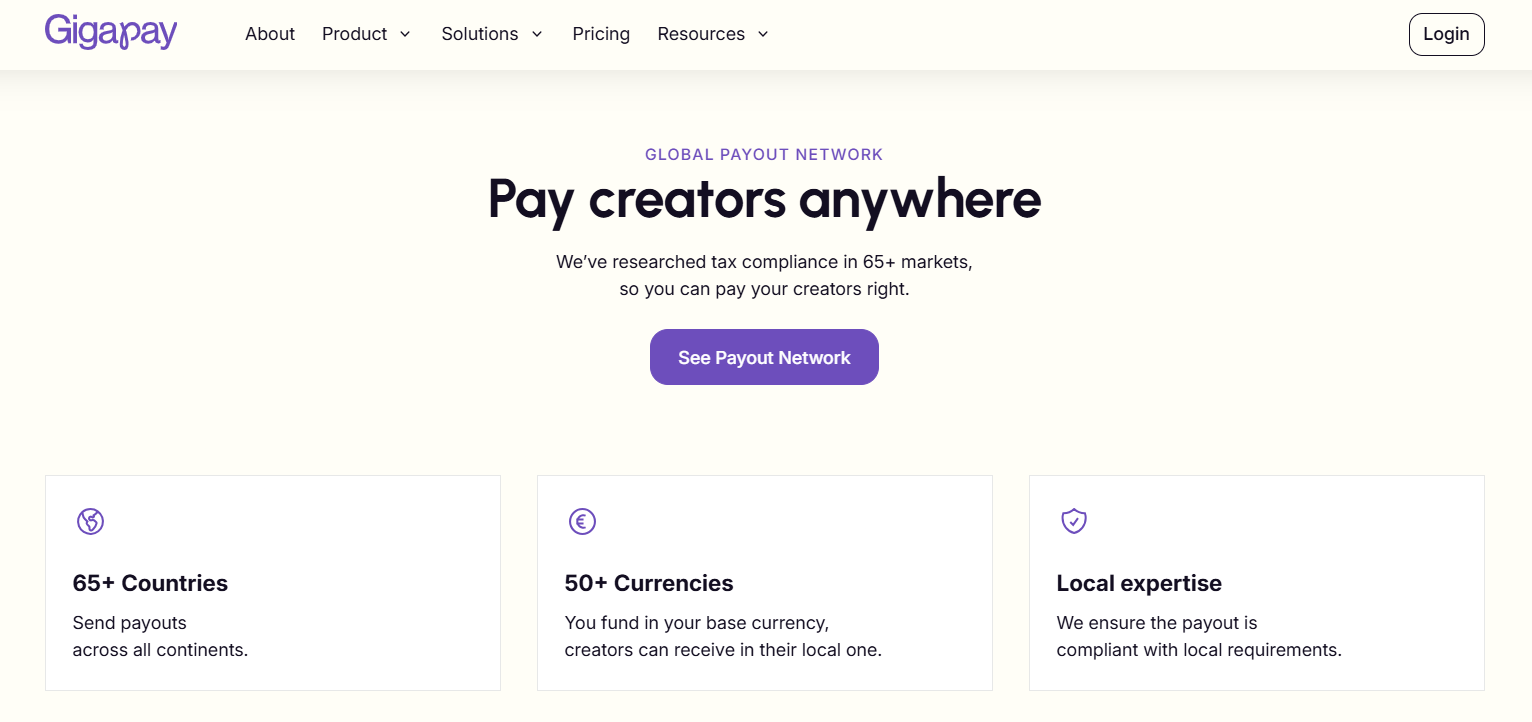
Contrary to payment rails and AP tools that move money and generate paperwork, Gigapay is your counterparty: one contract, one invoice, and every creator paid instantly when pre-funded across 65+ markets.
The Real Cost of Paying Influencers (The Line Item You Aren't Tracking)
The headline cost of an influencer program is the fee you pay the creator. The real cost includes the operational tail behind every payment.
Ardent Partners' benchmark research puts the true all-in cost of a single accounts-payable payment at roughly €40 to €60 once your team factors in vendor setup, invoice processing, bank fees, FX, tax documentation, and the labor around each step.
For a brand running 600 creator collaborations per year through manual processing, that overhead compounds to roughly €139,590 annually, versus around €46,350 when the process consolidates to a single Merchant of Record for creator payouts. The admin hours drop from around 840 per year to roughly 60.
The other cost is invisible until it is not: compliance exposure. DAC7 fines are per seller and per country, KSK back-audits reach up to five years, and the Swedish F-skatt boundary can retroactively reclassify creators your team thought were self-employed. The €200 fine per seller looks small until you multiply by 400 creators and add the audit hours across two tax years.
WPPMedia's Goat Agency, Radisson, Once Upon, and Cure Media all shifted creator compliance and payment operations from in-house to Gigapay for the same reason: the cost of running it internally was never just the cost of the payments. It was the cost of the vendor sprawl, the finance escalations, the tax paperwork, and the compliance risk that scaled with every new creator.
On Gigapay, your creators keep what they earn: clients cover the fees on all new plans.
How to Start Paying Influencers With Gigapay in 2026
The setup path depends on how your team already runs campaigns.
If your finance or creator ops team runs payments through spreadsheets, the fastest route is the dashboard. Your team uploads a CSV with creator email addresses and payout amounts, Gigapay sends each creator an onboarding link where they add their bank details and tax information, and payouts ship instantly once the account is pre-funded.
Standard implementation takes days rather than weeks, because there is no ERP integration to build and no creator vendor forms to collect on your side.
If your team runs an internal platform, marketplace, or campaign tool, the Gigapay API is the second route. The REST API uses standard token authentication, and the core endpoints cover project setup, funding, payout execution, and creator onboarding.
Sandbox and production environments are separate, webhooks handle event notification, and typical integration runs 2 to 5 days from first API call to first live payout. This is the route Kolsquare took as Gigapay's exclusive payout partner: creators invoice directly inside the Kolsquare platform and get paid without touching a second interface.
Either way, three things happen on the compliance side automatically. Gigapay runs KYC and tax ID validation on every creator regardless of tier or country. Your finance team receives one consolidated invoice per campaign instead of one per creator.
The platform generates DAC7, KU14, and KSK reporting where the rules apply, so the paperwork your team used to chase now moves in the background.
Enterprise programs include a dedicated customer success manager, EarlyPay liquidity for creators, and volume-based pricing designed to scale from a first 20-creator pilot to 5,000-creator programs without a single new hire on your side. Your creators get paid instantly when the account is pre-funded, and clients cover the fees on all new plans, so what the creator earns is what the creator keeps.
Conclusion
Gigapay is the Merchant of Record for creator payouts, the one vendor solution that replaces hundreds of creator vendor setups with a single counterparty for finance, procurement, and creators alike.
The compensation model your team picks shapes the campaign, but it does not change the fact that every payment to a creator is now a compliance event under DAC7, KSK, KU14, IRPF, and the Platform Work Directive.
Whether you run flat fee, commission, gifting, hybrid, or a retainer program across 40 countries, the tax reporting, invoicing, KYC, and support have to happen somewhere, and doing it in-house scales linearly with headcount.
Book a demo with the Gigapay team to see how one counterparty handles the layer underneath every compensation model your creator program runs on.
Read Next:
- Reverse Charge VAT: Complete Resource Guide in 2026
- Where a Merchant of Record Fits in Your AP and Finance Stack
- Influencer Payment Terms Decoded: Net-30, 50% Upfront, and Milestone Payments
FAQs:
1. What is the best way to pay influencers in 2026?
The best way to pay influencers in 2026 is through a Merchant of Record for creator payouts, which handles tax reporting, invoicing, KYC, and cross-border compliance under one vendor instead of onboarding each creator individually as a separate supplier in your finance stack.
2. How much should you pay influencers per post?
You should pay influencers per post based on tier, platform, format, and usage scope, with 2026 benchmarks ranging from €5 to €200 per post for nano-influencers, up to €7,000 to €20,000-plus per post for mega-influencers, before any usage rights or exclusivity add-ons.
3. What is the difference between flat fee and commission-based influencer compensation?
The difference between flat fee and commission-based influencer compensation is that flat fee pays a fixed amount for a specific deliverable regardless of performance, while commission ties the creator's payment to measurable outcomes like clicks or sales tracked through a unique link or code.
4. Are gifted products taxable for influencers?
Gifted products are taxable for influencers at market value in Sweden and several other EU jurisdictions, and Skatteverket runs targeted reviews specifically checking whether gifted goods have been declared as income by the receiving creator.
5. Why do brands use hybrid compensation models for influencers?
Brands use hybrid compensation models for influencers because they combine a base fee with commission on tracked conversions, aligning creator incentives with brand results while absorbing the attribution risk that pure-commission deals leave on creators
.jpg)