.jpg)

Financial compensation is now the number one driver of partnership satisfaction for creators, ahead of growth opportunities for the first time, according to CreatorIQ's State of Creators survey of 5,095 creators across 100 countries, fielded between May 29 and June 29, 2026.
Gigapay is the Merchant of Record for creator payouts: the one vendor solution that pays your creators on your behalf by taking on the compliance, payouts, and support so you don't have to.
Most guides on how to pay international contractors open with a rail comparison, Wise against wire against PayPal, and that order is how a company ends up with a clean payment and a dirty file.
The tax status of the person, the place where the work was done, and the classification of the relationship decide what you owe before a single dollar moves.
This article walks through the five steps in the order finance needs them, status first, source of services second, form third, classification throughout, and rail last, with the 2026 thresholds, deadlines, penalties, and cost numbers you need to run the program at scale.
Key Takeaways
- Confirm US or foreign status with a W-9 or W-8BEN before the first payment.
- Services performed entirely outside the US usually need no 1099-NEC or 1042-S.
- The 1099-NEC threshold is $2,000 for 2026 payments, due February 1, 2027.
- Any US-performed work by a foreign person can trigger 30% withholding and 1042-S.
- Pick the payment rail last, after status, source, classification, and file are settled.

Why Paying International Contractors Is a Finance Problem Before It Is a Payments Problem
The volume is no longer a niche. A Remote.com survey of 3,650 HR leaders across 10 countries found that 73% expect more than half of all new hires to be based outside their primary country by the end of 2026, and Deel reported that cross-border hiring on its platform grew 42% year over year through Q1 2026.
On the creator side, the payee base is mostly individuals rather than companies. CreatorIQ's 2026 survey found that 67% of creators earned under $10,000 from content last year and that content creation is not the primary source of income for 62% of them, which means the person you are paying in Manila, Lisbon, or Austin very often has no registered business, no VAT number, and no accountant.
That profile is what breaks a standard accounts-payable process.
- Procurement is built to onboard vendors with company registrations.
- Finance is built to match invoices to purchase orders.
Neither is built to collect a tax certification from 400 individuals in 30 countries, track which of them set foot in the United States during the year, and produce the paperwork twelve months later when a tax authority asks for it.
Gigapay's own benchmark for a brand running 600 creator collaborations a year puts the manual process at roughly 840 admin hours and around €139,590 in annual cost, most of it spent on vendor onboarding, chasing documents, and reconciling errors rather than on the payments themselves.
The payment rail is the last decision in that chain, and it is the easiest one. The hard decisions are about who the person is, where they did the work, and what the relationship actually is.
What Changed in US Contractor Tax Rules for 2026
Three changes shape how you pay international contractors this year.
1. The 1099-NEC threshold moved for the first time since 1954
The One Big Beautiful Bill Act, signed on July 4, 2025, raised the reporting threshold for Forms 1099-NEC and 1099-MISC from $600 to $2,000 for payments made after December 31, 2025, with annual inflation indexing from 2027. The first forms affected are the ones you file in early 2027 for 2026 payments.
The $600 figure had never been adjusted for inflation, so the change reduces filing volume for companies with many small-value contractors. It does not change what contractors owe, and any amount subject to backup withholding remains reportable regardless of the threshold. Gross proceeds paid to attorneys stay reportable at $600 and royalties at $10.
2. The Department of Labor reopened the classification test
On February 26, 2026, the DOL issued a proposed rule that would rescind the 2024 six-factor standard and reinstate a five-factor economic reality test with two core factors weighted most heavily: the nature and degree of control over the work, and the worker's opportunity for profit or loss based on initiative and investment.
The comment period closed on April 28, 2026, and the rule is in final review. The IRS test for tax purposes has not changed and still turns on behavioral control, financial control, and the type of relationship.
3. E-filing is the default for almost everyone
Any filer submitting 10 or more information returns of any type in aggregate must e-file, and that count includes 1099s, W-2s, and 1042-S forms together. The IRS is also moving 1042-S submissions to its IRIS system for 2026 forms filed in 2027, so if your team still files through FIRE, plan the migration now.

The Five-Step Order for Paying International Contractors
Every clean international contractor program follows the same sequence, and the sequence matters more than any individual tool.
Most "how to pay international contractors" guides start at step 4. Finance teams that run programs at scale start at step 1 and only reach step 4 once the first three are settled for each payee.
Step 1: Determine Whether the Contractor Is a US Person or a Foreign Person
Status decides which form you collect, which information return you might file, and whether withholding applies. It is the single question that everything else depends on.
When to Collect Form W-9
A US person gives you Form W-9. That includes US citizens wherever they live, green card holders, resident aliens who meet the substantial presence test, and US-organized entities. The W-9 provides the taxpayer identification number you need to track creator payments toward the 1099-NEC threshold. If a US person refuses to provide a valid TIN, backup withholding at 24% applies to the payments, and those payments become reportable on a 1099-NEC even below $2,000.
A US citizen living in Berlin is still a US person. Living abroad does not remove them from the 1099 system.
When to Collect Form W-8BEN or W-8BEN-E
A foreign person gives you a Form W-8. An individual uses W-8BEN. An entity uses W-8BEN-E. The form certifies that the payee is not a US person, documents their foreign status for chapter 3 and chapter 4 purposes, and, where relevant, supports a treaty claim. You keep the form on file. You do not send it to the IRS.
Collect the form before the first payment. A W-8 collected after the fact does not cure the exposure on the payments already made, because a withholding agent that pays a foreign person without documentation is presumed to owe the statutory 30% on any US-source amount.
Why a Foreign Address Is Not Proof of Foreign Status
A contractor with a Buenos Aires address and an Argentine bank account can still be a US citizen. The IRS presumption rules treat an undocumented payee as a US person for some purposes and a foreign person for others, and neither presumption is one you want to rely on in an audit. The form is the evidence. An address is a data point.
How Long W-9 and W-8BEN Forms Stay Valid
A W-9 does not expire, but you need a new one when the payee's name, entity type, or TIN changes. A W-8BEN is valid from the date it is signed until the last day of the third calendar year after signing. A form signed on March 10, 2026 covers payments through December 31, 2029. The payee must notify you within 30 days of any change in circumstances that makes the form incorrect, such as moving to the United States or obtaining a green card.
Track expiry dates in the same system you use to track payments, because a lapsed W-8 leaves you with no documentation to support a reduced withholding rate on anything paid after the lapse.
Step 2: Establish Where the Services Were Performed
For personal services, US tax law sources the income to the place where the services are physically performed. Where the payer sits, where the contract was signed, and which bank account receives the money do not change the source. This rule, in IRC Sections 861(a)(3) and 862(a)(3), is what decides whether a foreign contractor's payment carries any US withholding or reporting at all.
Foreign Person, All Work Performed Outside the United States
This is the most common case for a European brand paying a creator in Brazil, or a US agency paying a designer in Poland. When a non-US person performs 100% of the services outside the United States, the income is foreign-source. No 1099-NEC applies, because the payee is not a US person. No 1042-S or Form 1042 applies, because there is no US-source income to report. No withholding applies.
Your only affirmative obligation is documentation: a valid W-8BEN or W-8BEN-E on file before the first payment. Many practitioners also have the contractor sign a short statement confirming that none of the services were performed in the US, and attach it to the W-8. If a tax authority asks in 2029 why you did not withhold on a 2026 payment, that statement and the form are your answer.
Foreign Person, Any Work Performed Inside the United States
The analysis changes the moment a foreign contractor performs any part of the work on US soil. A creator who flies to New York for a three-day shoot generates US-source income for those days. That portion is subject to nonresident alien withholding at the 30% statutory rate unless a treaty reduces it, and you must report it on Form 1042-S and summarize it on Form 1042.
The same trip can also count toward the substantial presence test, which can turn a nonresident into a US resident for tax purposes if the day count is high enough. Ask your contractors where they worked, and record the answer per engagement, not per year.
How Tax Treaties Actually Work on Contractor Payments
A treaty is a form, not a vibe. A foreign contractor does not receive a reduced rate because their country has a treaty with the US. They receive it because they gave you the right form claiming the specific treaty article, and you accepted it.
For a foreign individual claiming exemption from withholding on compensation for independent personal services performed in the US, the correct form is Form 8233, not W-8BEN. The IRS instructions for W-8BEN say this explicitly. You review the 8233, sign to accept it, and forward it to the IRS within five days of acceptance. It covers one tax year and one payer. If the IRS rejects it, you keep withholding.
For a foreign entity, the treaty claim sits in the W-8BEN-E itself, and the entity may need a US EIN or a foreign TIN to make it. Foreign companies that want an EIN only to claim treaty benefits on a W-8BEN-E apply via Form SS-4 and note that the number is for treaty purposes only.
Even where a treaty reduces withholding to zero, the payment is still US-source, and you still file the 1042-S showing the income and the exemption code. A treaty changes the rate. It does not remove the report.
US Persons Working Abroad
A US citizen contractor working from Lisbon stays inside the 1099 system. You collect a W-9, track the payments, and file a 1099-NEC once they reach $2,000 for the year. Their own foreign earned income exclusion or foreign tax credit is their business, not yours.
Step 3: Classify the Worker Before You Pay
If the person is an employee, stop. Use payroll or an employer of record. Paying someone abroad as a contractor when the local law would call them an employee is one of the most expensive mistakes a finance team can make, and no payment rail or tax form fixes it.
The IRS Control Test and the DOL Economic Reality Test
Under the IRS test, a worker is an independent contractor if the payer has the right to control only the result of the work, not what will be done and how. The evidence falls into three categories: behavioral control, financial control, and the type of relationship, including written contracts, benefits, and whether the work is a key aspect of the business. If you classify an employee as a contractor without a reasonable basis, you can be held liable for the employment taxes.
The DOL's proposed 2026 rule sharpens the labor-law side by putting most weight on two factors: who controls the work, and whether the worker has an opportunity for profit or loss from their own initiative and investment.
- A creator who sets their own rates, works for many brands, uses their own equipment, and can lose money on a shoot sits on the contractor side of both tests.
- A "creator" who works fixed hours for one brand, from a brand-provided studio, on a brand-set schedule, does not.
Why You Cannot "1099 Them Abroad"
The US forms only answer the US question. The contractor's home country runs its own tests, and those are the ones that bite in the countries where most international contractors actually live.
- Germany applies a 4.9% Künstlersozialkasse levy on payments for creative work above €1,000 a year, including through agencies, and Section 50a withholding of 15.825% on certain payments to foreign creators unless an exemption certificate is in place. Enforcement is the most active in Europe, with criminal proceedings and retroactive audits.
- The United Kingdom made agencies and end clients jointly liable for umbrella-company PAYE from April 6, 2026, on top of existing IR35 fee-payer liability.
- Spain applies IRPF withholding of 15% (or 7% for new professionals) and requires Modelo 111 and 190 filings on payments to resident professionals.
- The EU as a whole has DAC7 platform reporting live, with per-seller penalties, and the Platform Work Directive, with its rebuttable presumption of employment, transposes on December 2, 2026.
A W-8BEN in your file does nothing for any of these. Classification is a per-country, per-relationship decision, and it stays with the company that decides how the work gets done.
Step 4: Choose the Payment Rail After the Paperwork Is Done
Only now does the Wise-versus-wire question become relevant, and the answer depends on volume, corridor, and who you want the legal buyer to be.
Local Rails vs SWIFT for Batch Payouts
An international SWIFT wire carries three cost layers. The sending fee runs $35 to $50 at most US banks. The FX markup embedded in the exchange rate runs 1% to 3% above mid-market, and sometimes higher. Correspondent banks along the route can each deduct lifting fees of roughly $15 to $50, which is why a $1,000 wire arrives as $950.
Speed is the other problem: only around 35% of retail cross-border payments arrive within one hour, against the G20 target of 75% by the end of 2027, and the World Bank puts the average cost of sending $200 internationally at above 6% in early 2026.
Run those numbers across a creator batch. Five hundred payouts at $45 in sending fees alone is $22,500 before FX. A 2% FX markup on €250,000 of volume is another €5,000. Then add the support tickets when 30 creators receive less than the invoice amount.
Local rails avoid the correspondent chain entirely. SEPA Instant in the eurozone, Faster Payments in the UK, and ACH in the US settle inside a single domestic clearing system, so there are no lifting fees and no multi-day float. For any program paying more than a handful of people per month, local rails per corridor beat SWIFT on both cost and predictability.
PSP, AP Automation, or Merchant of Record: Who Is the Legal Buyer
The rail decision is also a counterparty decision, and this is where most comparisons go quiet.
- A payment service provider such as Stripe Connect, PayPal Payouts, or Wise moves the money and leaves every form with you. Stripe's own documentation says it accepts no liability and that users remain fully responsible. You collect the W-8s, you track the source, you file the 1042-S, and you carry any DAC7 or KSK exposure in Europe.
- AP automation such as Tipalti keeps you as the legal buyer of the services. It collects tax forms and generates 1099s and 1042-S forms well, but each contractor is still onboarded as a vendor in your ERP, and individuals without a registered company often cannot get through the vendor gate at all.
- A Merchant of Record becomes the legal buyer. Gigapay formally purchases the creator's deliverable and resells it to you, so your ERP carries one vendor instead of 300 individual records, and Gigapay collects the identity and tax information from each payee, runs the reporting that applies in its markets, and pays the rest.
Each model is legitimate for a different program. The mistake is choosing a PSP for a 400-person creator program because the per-transaction fee looked lowest, and discovering in January that the file lives in six spreadsheets.
Currency Choice and the Contractor's Side of the Payment
Contractors increasingly choose the currency they are paid in as a hedge. Deel's 2026 State of Global Hiring report, based on over one million contracts, found that 84.6% of Argentine workers on its platform chose to be paid in USD rather than pesos, and that USD appeared in five of the ten most common country-currency pairs globally in 2025. A payout stack that can only send in your funding currency pushes FX cost and risk onto the payee.
Who pays the fees matters for the same reason. On Gigapay's new plans, clients cover the fees, so creators keep what they earn. When a rail deducts receiver-side fees or applies a 3% to 4% FX spread on the payee's end, the creator receives less than the agreed amount and the support ticket lands with your team.
Step 5: Build the File You Can Produce in a Week
The test for a scalable contractor program is simple: if a tax authority, an auditor, or a client's procurement team asks for the record behind any payment, can you produce it within a week? If the answer is no, the program cannot grow without adding headcount, because every new payee adds to a backlog nobody can clear.
The Five Documents Every Contractor Payment Needs
- The agreement: A written contract or terms of engagement stating the scope, the deliverable, the fee, and the fact that the contractor controls how the work is done. In France, written contracts with required clauses are mandatory for influencer engagements above €1,000 per advertiser per year.
- The tax form: W-9 for US persons, W-8BEN or W-8BEN-E for foreign persons, Form 8233 where a foreign individual claims a treaty on US-performed services, plus any local-country certification such as a TIN or VAT number.
- The invoice or self-billing document: Either the contractor's invoice or a self-bill you generate on their behalf under an agreed self-billing arrangement, showing the payee, the amount, the currency, and the VAT treatment.
- The payment record: Proof that the amount was paid, on which date, through which rail, and in which currency, reconcilable to the invoice.
- The identity checks: KYC on the individual, or KYB on the entity, with a record of the verification date and the documents reviewed.
Self-Billing vs Contractor Invoices
Asking 400 individuals to produce compliant invoices is how invoices arrive late, in the wrong currency, with the wrong VAT treatment, or not at all. Self-billing flips the flow: the payer issues the invoice on the contractor's behalf under a written agreement, and the contractor accepts it. It is standard in most of Europe, with country-specific rules such as Spain's RD 1619/2012, and it is not permitted everywhere, so check the payee's country before adopting it.
Gigapay's consolidated invoicing, which combines self-billing per creator with one invoice per campaign to the client, is the mechanism behind its cited 80% reduction in invoice volume.
Retention and Audit Timelines
Keep W-8 and W-9 forms for as long as they are relevant to any payment and for at least the statute of limitations on the returns they support. In practice that means the life of the relationship plus several years. German KSK audits reach back five years. DAC7 data now feeds audit selection across the EU. Design the retention policy for the longest look-back you operate in, not the shortest.
The 2026 Filing Calendar for 1099-NEC, 1042-S, and Form 1042
Some states keep their own 1099 thresholds and filing requirements that do not follow the federal $2,000 figure, so a national program needs a state layer too.

Penalties for Getting Contractor Forms Wrong in 2026
Information return penalties apply per form, under both Section 6721 for the IRS copy and Section 6722 for the recipient copy, so one missed 1099-NEC can cost twice.
The IRS indexes these amounts each year. Fifty late 1099-NECs filed within 30 days cost $3,000; the same fifty forms filed after August 1 cost $17,000. Filing on paper when you were required to e-file counts as a failure to file.
The larger exposure sits in withholding. A payer who should have withheld 30% on a US-source payment to a foreign person and did not is liable for the tax itself, plus interest and penalties. Collecting the W-8 late does not reverse that liability on payments already made.
Beyond the US, the numbers escalate: DAC7 fines reach €50,000 per report in Germany, KSK audits run retroactive years, and misclassification findings carry back payments, contributions, and fines per worker.
How to Pay International Contractors When Your Company Is Not a US Entity
A brand in Stockholm or an agency in London paying a creator in Chicago faces the mirror-image question, and the answer is less settled than the US-payer case.
As a general rule, a foreign company with no US presence and no US trade or business is not subject to US information-reporting obligations and does not file 1099s.
Gigapay's own legal research reached the same conclusion: to file a 1099, a company must be within US taxing jurisdiction and obligated to file US returns, and when Gigapay's legal team contacted the IRS in 2023, the agent could not confirm any requirement for a foreign payer. The US contractor still has to report the income on their own return whether or not they receive a form.
That said, three things still apply to a non-US payer:
- Collect a W-9 anyway: It documents the payee's US status and TIN for your file, and it protects you if your US footprint changes later, for example when you open a US entity or start selling into the US market in a way that creates a filing obligation.
- Handle your own country's rules: A Swedish payer reports compensation to Skatteverket, which exchanges income statements with the payee's tax authority. An EU payer applies reverse-charge VAT on cross-border B2B services and, if it operates a platform, carries DAC7 obligations for EU sellers.
- Confirm with a US adviser once volume is material: The 1099 question for foreign payers turns on facts about your US presence, and the cost of getting a written opinion is small next to the cost of a wrong assumption at scale.
Where Gigapay Fits in the Five Steps
Gigapay is step 4 and step 5 for high-volume people-payees in 65+ markets. You still own classification.
In practice that means Gigapay onboards each creator, whether they are an individual with no company, a sole trader, or a registered business, and collects the name, address, TIN, nationality, country of work, VAT number where relevant, ID document, and bank details before any compensation is released.
Nobody gets paid without the full record. Gigapay becomes the formal counterparty, buying the deliverable and reselling it to you, so procurement sets up one vendor, finance receives one consolidated invoice per campaign, and the self-billing, identity verification, and applicable reporting sit on Gigapay's side.
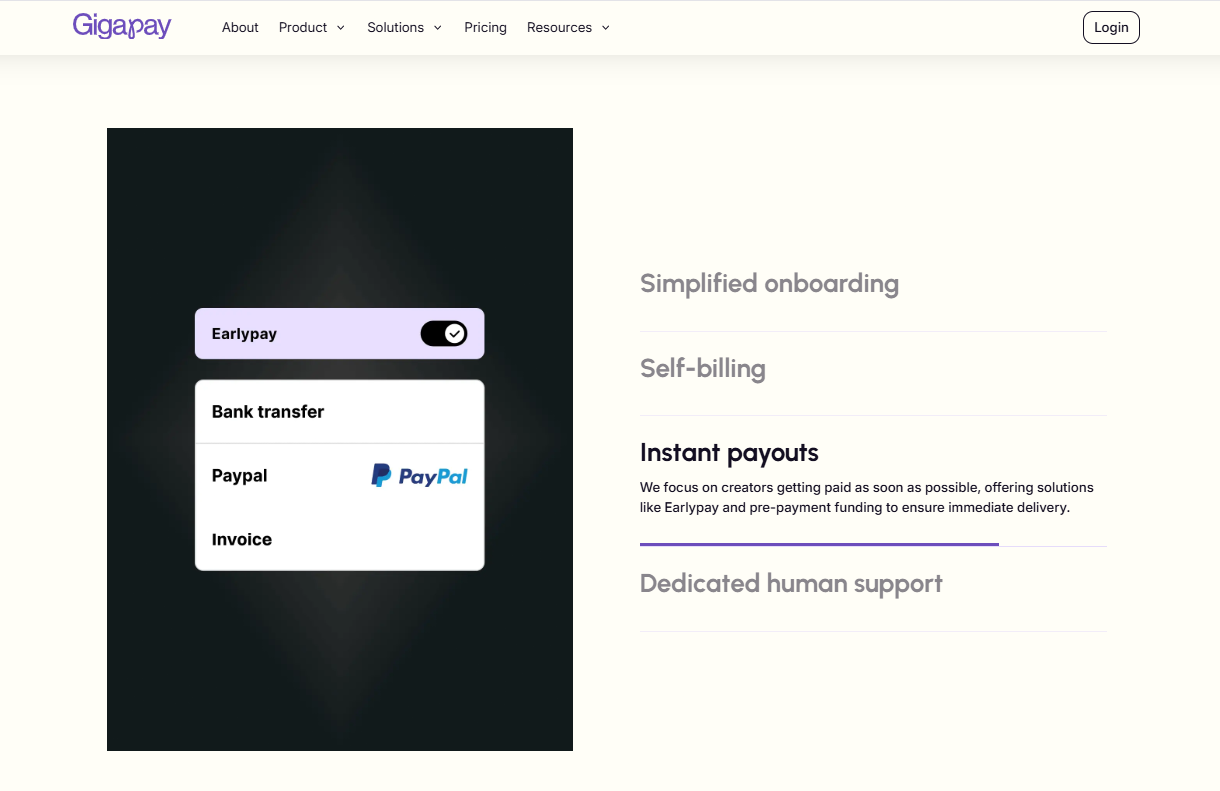
Payouts run on local rails, SEPA Instant, Faster Payments, and ACH, and settle instantly when pre-funded, which is how the product is designed to be used. Batches are the point: you upload a spreadsheet or call the API, and hundreds of creators are paid in one run.
The results are measurable. The 840 admin hours in Gigapay's 600-collaboration benchmark drop to around 60. Boozt tripled its nano and micro-influencer collaborations without adding anyone to the team. The Goat Agency, part of WPPMedia, describes payments as easier and faster while keeping tax and benefit compliance in place.
What Gigapay does not do is decide for you whether a creator is a contractor or an employee under the law of the country they work in, or file the US forms that belong to a US withholding agent. Send Gigapay the country list and the volume, and we will tell you which of the five steps we take and which stay with you.
Common Mistakes When Paying International Contractors
- Starting with the rail: Comparing Wise, PayPal, and wire fees before confirming status, source, and classification produces a fast payment and an incomplete file.
- Treating a foreign address as foreign status: A US citizen abroad is a US person. Only the form proves status.
- Collecting W-8s after the first payment: The exposure on earlier payments does not disappear when the form arrives.
- Using W-8BEN for a treaty claim on US-performed services by an individual: That claim belongs on Form 8233, forwarded to the IRS within five days.
- Assuming a treaty removes the 1042-S: A treaty can reduce withholding to zero. The US-source income is still reported.
- Skipping the 1042 because nothing was withheld: If any 1042-S is required, the 1042 summary is required too.
- Duplicating 1099-K payments on a 1099-NEC: Payments made through a third-party settlement organization such as a card network or a payment app's goods-and-services flow are reported by that organization on Form 1099-K and should not be reported again by you on a 1099-NEC.
- Ignoring the payee's home-country rules: The KSK levy, Spanish IRPF, UK joint liability, and DAC7 all apply regardless of what the US forms say.
- Letting W-8s lapse: Three years passes quickly. A payment made on an expired W-8 has no documentation behind it.
- Promising creators a payout speed the process cannot support: Onboarding and identity checks come first. After that, batches move fast.
A Pre-Payment Checklist for Finance Teams
Before releasing any batch of international contractor payments, confirm the following for every payee:
- Status form on file and unexpired: W-9 for US persons, W-8BEN or W-8BEN-E for foreign persons.
- Country of work recorded for the engagement, with a written statement if all work was performed outside the US.
- For any US-performed work by a foreign person: withholding rate determined, treaty form accepted where applicable, 1042-S flagged.
- Classification documented against both the IRS test and the local-country test for the payee's country of work.
- Home-country obligations identified: VAT treatment, local withholding, levies such as KSK, and DAC7 scope.
- Agreement signed, invoice or self-bill generated, identity check completed.
- Rail selected per corridor, with fees allocated to the client side and currency matching the payee's preference where possible.
- Running total tracked toward the $2,000 1099-NEC threshold for each US person.
- Calendar entries for February 1, 2027 (1099-NEC) and March 15, 2027 (1042-S and 1042).
- A named owner who can produce the complete file for any payment within a week.
Conclusion
Gigapay is the Merchant of Record for creator payouts, the one vendor solution that pays your creators on your behalf by taking on the compliance, payouts, and support so you don't have to.
Paying international contractors in 2026 comes down to five decisions made in the right order: confirm whether the person is a US or foreign person with a W-9 or W-8, establish where the work was performed because that decides whether a 1099-NEC, a 1042-S, or nothing at all applies, classify the relationship under every law that reaches it, choose the rail and the counterparty structure last, and keep a file you can produce on demand.
The new $2,000 threshold, the February 1 and March 15 deadlines, and the per-form penalties are the mechanics. The discipline is refusing to let the rail decision run ahead of the rest.
Book a demo, send us your country list and your volume, and we will show you which of these steps Gigapay takes off your team and which stay with you.
Read Next:
- Vendor Master Data When Your Suppliers Are 400 Individuals
- Accounts Payable Audit Trails for High-Volume Contractor Payments
- Month-End Close When Services Spend Is 300 Uninvoiced Contractors
FAQs:
1. How do you pay international contractors in 2026?
You pay international contractors in 2026 by confirming their tax status first with a W-9 or W-8BEN, establishing where the services were performed, classifying the relationship under US and local law, choosing a payment rail and counterparty structure, and keeping a complete file of the agreement, form, invoice, payment, and identity checks. A foreign person working entirely outside the US usually needs no 1099-NEC or 1042-S, while a US person is tracked toward the $2,000 1099-NEC threshold.
2. Do foreign contractors need a 1099-NEC?
Foreign contractors do not need a 1099-NEC when they are not US persons and perform all of their services outside the United States, because the income is foreign-source and the payee is outside the 1099 system. You collect a W-8BEN or W-8BEN-E instead and keep it on file. If a foreign contractor performs any work inside the US, that portion may require 30% withholding and a Form 1042-S rather than a 1099.
3. Do we need a local entity to pay international contractors?
You do not need a local entity to pay international contractors if you pay them through a Merchant of Record or a contractor management stack that acts as the counterparty and collects the required documentation. You do need a local entity, or an employer of record, if the people are employees under the law of the country where they work, because contractor forms and rails cannot cover an employment relationship.
4. Is PayPal a good way to pay international contractors?
PayPal is a fast way to pay international contractors, but it leaves a weak file, because it moves the money and keeps none of the tax, reporting, or classification obligations. Cross-border payments carry caps of roughly €16 to €20 per payment plus a 3% to 4% FX spread and receiver-side fees, and every form still sits with you. It suits a handful of one-off payments in a single market rather than a program at scale.
5. How fast can we pay international contractors?
You can pay international contractors instantly on local rails once onboarding and identity checks are complete and the account is pre-funded, and batch runs are where the speed matters, because hundreds of payees are paid in one upload or API call. The onboarding step comes first every time, so the realistic promise to a contractor is a fast payment after their documentation is in place, not a payment before it.
.jpg)
.jpg)
.jpg)