.jpg)

Finance teams spend a cumulative 72 business days per year on reconciliations and reporting alone, according to a 2025 analyst report cited by the Corporate Finance Institute in July 2026.
That is three to four months of full-time effort spent proving numbers instead of using them, and nothing consumes those days faster than services spend spread across hundreds of individual payees.
Gigapay is the Merchant of Record for creator payouts, the one vendor of record that pays your creators on your behalf by taking on the compliance, payouts, and support so your finance team closes against one counterparty instead of three hundred.
Controllers do not miss the month end close because the ERP is slow. They miss it because marketing paid 300 people, and AP is holding 40 invoices, 80 email threads, and a spreadsheet titled "we think we owe."
This article breaks down why contractor-heavy services spend destroys accrual quality, what a complete close packet actually requires, and the specific structural changes that let a controller close on time every month.
Key Takeaways
- 300 uninvoiced contractors turn one accrual into 300 estimates AP cannot support.
- A complete close packet needs invoice, PO, approval, tax form, and payment confirmation per payee.
- One vendor of record replaces 300 open AP items with one accrued payable.
- Self-billing removes the wait for contractor invoices after the month ends.
- Accrue from the batch file, never from the campaign spreadsheet.
Why Creator Spend Became a Month End Close Problem
Creator marketing stopped being a rounding error. IAB forecasts US creator ad spend will reach $44 billion in 2026, growing 26% year over year, nearly four times the growth rate of the wider media industry. In Europe, brand budgets for creator programs are compounding at similar rates while 8.6 million European creators now earn from their work.
The money professionalized. The payment structure behind it did not.
- A brand that spends $3 million on paid social pays one platform and books one invoice.
- A brand that spends $3 million on creators pays 300 individuals across 20 countries, most of whom have no registered company, no invoicing discipline, and no idea what a PO number is.
That structural difference lands on one desk: the controller's. Every close comment that mentions "influencer invoices" or "affiliate payouts" is the same problem wearing a different name. The counterparty count is too high for the close process to absorb.
How Contractor Payees Differ From Normal Vendors
A normal vendor invoices on a cadence, quotes a PO, and answers AP emails. A creator invoices when they remember, in whatever currency they live in, sometimes weeks after the campaign wrapped. Payment terms in the influencer industry commonly stretch 30 to 90 days after content goes live, which means the expense and the invoice land in different accounting periods by default.
The result is a category of services where the liability is real on day 30 but the documentation arrives on day 55. The controller has to book something. The question is what, and based on which evidence.
How 300 Uninvoiced Contractors Break the Close Process
Here is the state of play on day two of a typical close when marketing runs a large creator program. AP has 40 invoices in the queue.
Another 80 payees are somewhere in email threads, negotiating amounts, resending bank details, or asking why last month's payment has not arrived. The remaining 180 have not been invoiced at all. Marketing's answer to "what do we owe" is a campaign recap deck.
Only 53% of companies complete their month end close within six business days, according to Ventana Research. Gartner data shows 62% of finance organizations still rely on spreadsheets as a primary close tool. Put those two facts next to a creator program and the outcome is predictable: the accrual for creator spend gets built in a spreadsheet, from memory, under deadline pressure.
Three specific failures follow:
1. Accrual Quality Dies
An accrual is only as good as the evidence behind it. When the evidence is a campaign spreadsheet maintained by a marketing coordinator, the accrual inherits every gap in it: creators who negotiated a higher rate after the row was filled in, bonus payments tied to performance that nobody logged, and payees who dropped out but were never deleted.
The controller books the number, the invoices trickle in over the next two months, and the reversals begin. Each reversal is a journal entry, an explanation, and a small dent in the credibility of the P&L.
2. FX Noise Sits in a Clearing Account
Pay 300 creators and you touch 30 or more payout currencies. Each payment settles at a slightly different rate than the rate used for the accrual, and every difference lands in an FX clearing account that someone has to explain at close.
The amounts are individually trivial and collectively maddening. A controller can spend half a day reconciling €400 of net FX noise generated by hundreds of small cross-currency payments, because the audit trail requires the work regardless of the amount.
3. Internal Audit Asks for Support and Gets a Drive Folder
When an internal audit samples the creator spend line, the request is standard: show the invoice, the approval, the contract, and the payment confirmation for these ten payments. What they receive is a link to a shared Drive folder with 600 files, half of them screenshots, organized by campaign name rather than payee. The finding writes itself.
The Close Packet You Cannot Build
Strip the problem to its core and it is a documentation problem multiplied by headcount. For every payee in the sample, a defensible close packet needs six items.
What a Complete Close Packet Requires Per Payee
- The invoice, matching the agreed amount and the correct legal entity.
- The PO or engagement record, showing the spend was authorized before it happened.
- The approval, from someone with the authority to approve it.
- The tax form, proving the payee's status and reporting treatment, whether that is a self-employment attestation, a DAC7 data point, or a withholding certificate.
- The payment confirmation, tying the bank movement to the liability.
- The GL code, booked consistently so the spend is comparable month to month.
Now multiply by 300. Nobody on AP has that. The business owner has a campaign recap and good intentions. The gap between what the close requires and what the organization can produce is not a diligence failure. It is arithmetic.
Six documents times 300 payees is 1,800 artifacts per month, produced by people whose job is marketing, collected by a team built to process dozens of vendors, not hundreds of individuals.
Why Hiring Does Not Close the Gap
The instinct is to add an AP clerk. The market will not cooperate. Robert Half's 2026 research found 62% of finance and accounting leaders are struggling to hire and retain accountants, and finance roles requiring a CPA now take 73 days to fill.
Even if the hire lands, the clerk inherits the same structure: 300 counterparties who invoice late, in the wrong currency, with the wrong details. Headcount scales the effort. It does not fix the design.
The Close Packet That Works
The fix is to change the counterparty count, not the effort level. When a Merchant of Record sits between the brand and the creators, the close packet collapses into something a controller can actually build.
One Accrued Payable to One Vendor
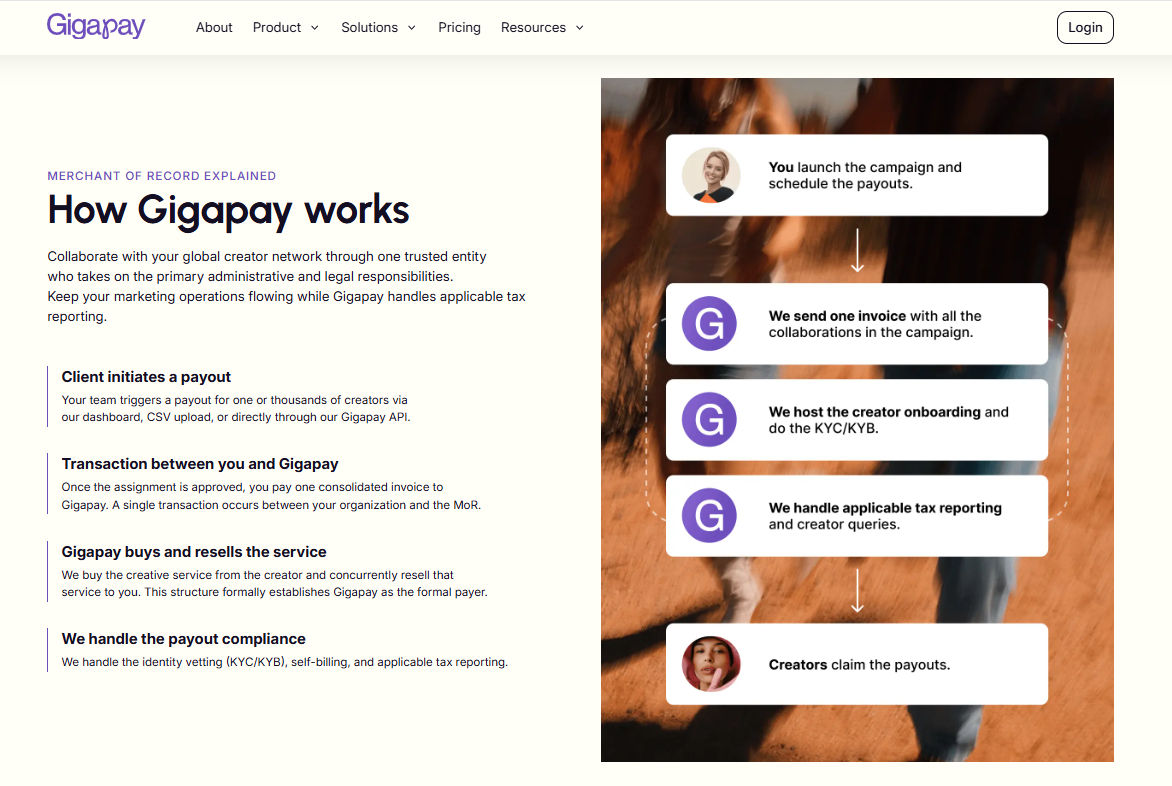
Gigapay becomes the contractual counterparty for every creator payment. It formally purchases each creator's deliverable and resells it to the brand, which means the brand's liability is to one vendor, in one currency, under one contract.
The accrual at month end is a single line: amounts committed through the platform in the period, supported by the batch file. There is nothing to estimate and nothing to reverse.
One Invoice on a Known Cadence
Instead of 300 invoices arriving on 300 schedules, one consolidated invoice lands on the same cadence as your other key vendors. AP processes it like any other strategic supplier: three-way match, one approval, one payment run. The 40-invoice queue and the 80 email threads disappear because the payees no longer invoice the brand at all.
Self-Billing Removes the Waiting
The reason contractor invoices arrive after close is that creators invoice when they get around to it. Under a self-billing structure, the invoice is generated on the payee's behalf at the moment the payout is executed, so the paperwork exists the instant the liability does. The controller stops waiting on 300 people to send a PDF and starts closing from a system record.
Payee-Level Detail as Backup, Not as Open AP Items
The per-payee detail does not vanish. It moves. Every payout carries the payee, the amount, the campaign reference, the tax status, and the payment confirmation, available as supporting detail behind the single vendor line. When an internal audit samples the spend, the support is a structured export rather than a Drive folder.
The detail exists for evidence. It no longer exists as 300 open items on the AP ledger.

How One Counterparty Fixes the FX Problem
One invoice in your funding currency is the point. Gigapay accepts funding in USD, EUR, GBP, SEK, DKK, and NOK, and handles payout in 50+ currencies across 65+ markets on its side of the transaction. The brand's GL sees one currency.
The conversion into 300 local payout currencies happens inside the vendor relationship, not inside your clearing account. The half-day spent explaining €400 of FX noise becomes zero minutes, because the noise never enters your ledger.
What Internal Audit Gets Instead
The audit conversation changes shape.
- The population is one vendor.
- The contract is one master agreement.
- The sample support is the consolidated invoice, the batch file behind it, and payee-level records that tie each payment to an approval and a tax status.
Compliance obligations that used to be diffuse, such as DAC7 platform reporting in the EU, KU14 reporting in Sweden, and the documentation trail German KSK auditors expect, sit with the vendor of record rather than scattered across marketing's inbox. The auditor gets a population they can test. The controller gets a finding-free close.
Four Changes Controllers Should Make This Quarter
- Stop promising close dates while people-payees still invoice you directly: The close calendar cannot be more reliable than the least reliable invoicer in the population. Fix the structure before committing to the date.
- Put the MoR invoice on the same schedule as other key vendors: Treat creator spend like media spend: one strategic supplier, one predictable invoice, one line in the close checklist.
- Accrue from the batch file, not from memory: The payout batch is a system record of committed amounts. The campaign spreadsheet is a wish list. Only one of them survives an audit.
- Keep marketing out of the vendor-master process: Marketing should launch campaigns, not create vendors. When 300 creators stop entering the vendor master, the master data stays clean and the segregation-of-duties conversation gets short.
Month End Close Benchmarks Controllers Should Target in 2026
The 2026 benchmark data gives controllers a clear target. Median close times sit around 6.0 days per APQC, best-in-class teams close in 3 to 5 business days, and anything past 10 days means leadership is steering with last month's numbers for most of the current one.
The bottleneck research is consistent: late vendor invoices, manual accruals, and reconciliation volume rank among the most cited close blockers across FloQast, BlackLine, and Numeric survey data.
A creator program run through 300 direct payees puts a company on the wrong side of every one of those benchmarks. The same program run through one vendor of record removes the late invoices, converts the manual accrual into a system-supported one, and cuts the reconciliation population from hundreds of items to one.
The close does not get faster because the team works harder. It gets faster because the structure stops generating the work.
Does a Merchant of Record Replace Your Close Software?
No, and it should not try. Close management platforms like FloQast orchestrate the close: checklists, reconciliations, sign-offs. They can only verify what the underlying records support.
- When creator spend sits in 300 open AP items and a campaign spreadsheet, the close software dutifully tracks a reconciliation that cannot be completed on time.
- When creator spend is one accrued payable backed by a batch file, the close software gets something true to check.
The MoR fixes the input. The close software manages the process. A controller wants both.
Conclusion
Gigapay is the Merchant of Record for creator payouts, the one vendor of record that pays your creators on your behalf and takes on the compliance, payouts, and support behind every payment.
The month end close problem described in this article is not an effort problem, and it is not an ERP problem. It is a counterparty problem: 300 individuals who invoice late, in 30 currencies, with no tax paperwork, cannot be closed against on a five-day calendar.
Consolidating them into one accrued payable, one invoice on a known cadence, and one structured evidence trail turns creator spend into a line item that closes like any other.
If your close comments keep mentioning influencer invoices, book a demo with Gigapay and close next month against one vendor instead of 300.
Read Next:
- 1099-NEC in 2026: The $2,000 Threshold, State Gaps, and Why Classification Still Sits With Finance
- Self-Billing and VAT Reverse Charge
- Vendor Invoice Fraud and BEC: Why Hundreds of One-Off Payees Are an AP Control Failure
FAQs:
1. What is the biggest month end close problem with 300 uninvoiced contractors?
The biggest month end close problem with 300 uninvoiced contractors is accrual quality, because the liability must be booked before most payees have invoiced, forcing controllers to estimate from campaign spreadsheets and reverse the errors in later periods.
2. Can controllers accrue creator spend from the campaign spreadsheet?
Controllers can accrue creator spend from the campaign spreadsheet, but they will spend the next month reversing it, because the spreadsheet misses renegotiated rates, performance bonuses, and dropped payees that the payout batch file captures accurately.
3. How does a Merchant of Record improve the month end close?
A Merchant of Record improves the month end close by becoming the single contractual counterparty for all creator payments, replacing 300 open AP items with one accrued payable, one consolidated invoice, and payee-level detail held as audit backup.
4. What happens to FX differences when creators are paid in 30 currencies?
FX differences from paying creators in 30 currencies land in a clearing account the controller must reconcile at every close, which is why one invoice in your funding currency matters: the conversion happens inside the vendor relationship, not inside your GL.
5. Does paying creators through one vendor of record replace close software like FloQast?
Paying creators through one vendor of record does not replace close software like FloQast; it gives the close software something true to check, because the reconciliation covers one supported payable instead of hundreds of undocumented open items.
.jpg)
.jpg)
.jpg)