.jpg)

77% of organisations still key invoices into their accounting system by hand, and only 19% describe their accounts payable function as mostly or fully automated, according to the IFOL Accounts Payable Automation Trends Report 2026 published in June 2026.
Gigapay is the Merchant of Record for creator payouts: the one vendor that pays your creators on your behalf and takes on the compliance, the payouts, and the support so you don't have to.
Self-billing and VAT reverse charge are the two mechanisms that make it possible to pay 200 service providers in 20 countries without collecting 200 different invoice templates, and most EU and UK AP teams already know both words without having a process that uses them together.
This article breaks down what each mechanism requires in 2026, why individual payees break invoicing at scale, what a compliant self-billing setup needs, and how a Merchant of Record makes the whole chain executable for finance.
Key Takeaways
- Self-billing means the customer issues the invoice on the supplier's behalf under a written agreement.
- Reverse charge moves VAT accounting to the customer on cross-border B2B services.
- Reverse charge cannot be applied to a document that is not a valid invoice.
- VAT treatment follows facts: supplier location, customer location, and the nature of the service.
- As Merchant of Record, Gigapay buys from each creator and invoices you once.
Why Cross-Border Service Invoicing Breaks at Creator Scale
A brand running 600 creator collaborations a year receives invoices from 600 different people in 600 different formats. Some arrive as a PDF with a VAT number, some as a screenshot of a bank transfer request, and some never arrive at all. The supplier population in creator marketing looks nothing like a normal vendor base, and that is the root of the problem.
Gigapay's own analysis of the manual process puts the true cost of a single AP-handled creator payment at €40 to €60 once you count AP hours, bank fees, FX losses, tax reconciliation, and audit-trail work, with roughly six hours of admin per creator payment across the full cycle. On 600 collaborations a year, that is around 840 admin hours and an all-in cost close to €139,590, against roughly 60 hours and €46,350 when one vendor issues the paperwork.
The ERP side tells the same story: 300 individual vendor records become one.
Most of that cost sits in the invoice step. Creators are individuals and sole traders, and a large share of them have no company, no VAT registration, and no invoicing software. The document they send is the document AP has to post, and when that document is wrong, the payment stops.
The 400-format problem in numbers
Every country has its own rules on what an invoice must contain, which language it can be in, how the VAT line is shown, and whether a third party can issue it. Gigapay's legal team maintains research across 93 countries, and the invoicing requirements differ in almost every one.
- Austria raised its small-business VAT threshold to €55,000 from 1 January 2025 and now requires a trade licence for commercial influencers.
- Belgium applies a €25,000 VAT franchise threshold and moved to mandatory Peppol B2B e-invoicing in January 2026.
- Germany requires a self-billed invoice to carry the word "Gutschrift."
- Iceland, Bosnia and Herzegovina, Egypt, Ukraine, and Mexico do not permit self-billing at all under current research.
An AP team that works with creators in 20 countries is working with at least 20 invoice rulebooks, multiplied by three supplier types (individual, sole trader, company), multiplied by whether the supplier is VAT registered or not. That is how you arrive at hundreds of valid invoice formats for a single campaign.
The Invoice Exception Economy: What Missing Invoices Cost AP in 2026
Invoice exceptions became the top challenge for AP departments for the first time in 19 years of benchmarking, according to Ardent Partners' AP Metrics That Matter 2025 study. The IFOL 2026 report confirms the pattern: invoice exceptions, data discrepancies, and manual data entry are the most common problems finance teams name, and approvals are the single biggest bottleneck.
Ardent Partners' State of ePayables benchmark puts the average cost of processing an invoice at $9.40 and the average cycle time at 9.2 days. Those are averages for invoices from established vendors with stable formats.
A creator invoice with a missing VAT ID, a wrong currency, or no tax point takes longer, because every exception becomes an email thread.
The month-end picture for a finance team paying creators manually looks like this. Marketing approves 80 collaborations in a campaign. Forty invoices arrive correctly. Twenty arrive with errors that need correction. Twenty never arrive, and the creator messages marketing asking where the money is.
AP cannot apply reverse charge to the 20 missing invoices, because there is no invoice to apply it to. The campaign is live, the creators are waiting, and the close is late.
This is the context in which self-billing and reverse charge matter. They are the two tools that let finance define the document once and apply one VAT logic to every payee, instead of teaching each creator how to invoice a Swedish or German entity.
What Self-Billing Means in VAT Law
Self-billing is an arrangement where the customer, or a third party acting for the customer, prepares the supplier's invoice and sends a copy to the supplier with the payment. The supplier does not issue an invoice for those supplies. The self-billed invoice is the only valid VAT document for the transaction.
The mechanism exists because in many supply relationships the customer holds the data needed to value the work. A publisher counts words, a platform counts deliveries, and a brand confirms which creator posts went live and what each one was worth. Self-billing lets the party with the data produce the document.
EU self-billing conditions under Article 224
Article 224 of the EU VAT Directive (2006/112/EC) permits self-billing on two conditions.
- First, there must be a prior agreement between the two parties.
- Second, there must be a procedure for the supplier to accept each invoice.
Member states set the detailed terms, and several require the agreement to be in writing.
Article 226 of the same directive lists the mandatory content of every VAT invoice. Two of those items matter most here. A self-billed invoice must carry the mention "Self-billing" (Article 226(10a)).
An invoice where the customer is liable for the VAT must carry the mention "Reverse charge" (Article 226(11a)). Both mentions sit on the same document when a customer self-bills a cross-border service.
UK self-billing agreement rules under VAT Notice 700/62
In the UK, HMRC sets the conditions for self-billing in VAT Notice 700/62. For a VAT self-billing arrangement, both supplier and customer must be VAT registered. The agreement must be in writing, must state that the supplier agrees not to issue VAT invoices for the covered supplies, must state that the supplier accepts each self-billed invoice, and must name any third party the customer outsources the process to.
Self-billing agreements usually run for 12 months and must be reviewed at the end of that period. The self-billed invoice must include the statement "The VAT shown is your output tax due to HMRC." The supplier must tell the customer if they deregister, change VAT number, or transfer the business.
HMRC treats self-billing as a higher-risk area because the customer is producing the document that supports its own input tax claim. The agreement has to be producible on request.
Country-specific self-billing rules finance should know
Self-billing is not universally allowed, and where it is allowed the local label and the local conditions vary.
- Germany requires the self-billed document to carry the word "Gutschrift" under §14 UStG, and a document without it is not a valid self-billed invoice.
- Spain regulates self-billing under Royal Decree 1619/2012 and now layers the VeriFactu certified-software rules on top of it.
- Belgium permits self-billing with a prior written agreement.
- Bosnia and Herzegovina requires suppliers to issue their own invoices.
- Iceland does not permit self-billing, and the responsibility sits with the supplier.
- Ukraine, Egypt, Mexico, Chile, Peru, Morocco, and Tunisia do not allow self-billing under Gigapay's current country research.
The practical consequence is that a self-billing process built for one entity in one country does not transfer to the next country without checking the local rulebook.
What VAT Reverse Charge Means for Cross-Border B2B Services
Reverse charge is a VAT accounting mechanism. The supplier issues an invoice without VAT, and the customer accounts for the VAT on its own return. In most cases the customer declares the output VAT and deducts the same amount as input VAT in the same period, so the cash impact is zero.
The supplier avoids registering for VAT in the customer's country, and the customer avoids paying foreign VAT it would then have to reclaim.
Place of supply under Article 44 and Article 196
For B2B services, Article 44 of the EU VAT Directive places the supply where the customer is established. Article 196 then makes the customer the person liable for the VAT when the supplier is not established in that member state. Article 196 is mandatory in every member state, which is why reverse charge on cross-border B2B services works the same way across the EU.
The UK applies the same logic after Brexit. A UK VAT-registered business receiving services from an overseas supplier accounts for the VAT itself under the reverse charge rules for services from abroad, and the overseas supplier does not charge UK VAT.
Article 194 covers the broader domestic reverse charge for non-established suppliers. Today each member state decides whether and how to apply it. Under the ViDA package adopted in March 2025, Article 194 becomes mandatory across all member states from 1 July 2028 for supplies by non-established, non-identified suppliers to VAT-registered customers.
What a reverse charge invoice must show
A reverse charge invoice must contain all the standard Article 226 content: supplier and customer names and addresses, both VAT numbers, the invoice date, a sequential number, the nature and quantity of the service, the date of supply, and the taxable amount. It must not show VAT. It must carry the mention "Reverse charge." Many finance teams also add the directive reference, such as "Article 196 of Directive 2006/112/EC," although the mention itself is the legal requirement.
If any of those elements is missing, the document is not a valid invoice, and AP cannot apply reverse charge to it.
When reverse charge does not apply
Reverse charge never applies to B2C supplies, because a private consumer has no VAT return and cannot self-account. It also does not apply when supplier and customer are established in the same country for a domestic supply, unless a specific domestic reverse charge applies.
A supplier who is not a taxable person, such as an individual with no registered activity, does not issue VAT invoices at all, so the question of reverse charge does not arise on that payment.
This is why a blanket rule such as "all EU creators are reverse charge" is wrong. A German creator with a registered business invoicing a Swedish entity is reverse charged.
A German creator with no registered activity receiving compensation from the same Swedish entity is not issuing a VAT invoice. A German creator invoicing a German brand directly is a domestic supply with German VAT. The facts decide.

How Self-Billing and VAT Reverse Charge Work Together
Self-billing and reverse charge solve two different problems. Self-billing solves who produces the document. Reverse charge solves who accounts for the VAT. Together they let one party produce a standard document for every supplier and apply one VAT logic to every cross-border B2B service.
The first two rows share a problem. Reverse charge depends on the supplier being a taxable person with a valid VAT identity, and self-billing depends on a written agreement and a correct payee identity.
A brand that self-bills 300 creators directly has to hold 300 agreements, validate 300 VAT statuses, decide 300 VAT treatments, and review the agreements every year. The admin moves from collecting invoices to generating and governing them.
The third row changes the counterparty. The brand has one supplier, one agreement, and one VAT decision per period.
Why Campaign Payees Break Invoicing
Creators are not built to be vendors, and vendor systems are not built for creators. That mismatch shows up as five recurring failures.
- Incomplete invoices: The document is missing a tax point, a sequential number, a VAT ID, or the reverse charge mentioned. AP cannot post it and cannot apply reverse charge to it.
- Wrong VAT IDs: The creator types a personal tax number into the VAT field, or uses a number that has since lapsed. The reverse charge treatment fails validation.
- Wrong currency: The contract is in EUR, the invoice is in SEK, and the bank receives USD. Reconciliation takes three steps instead of one.
- No invoice: The creator has no registered activity, does not know how to invoice, and sends a payment request by direct message to the marketing manager instead. Month-end becomes a chase.
- Wrong entity: The creator invoices the brand's local marketing subsidiary instead of the group entity that signed the contract, which changes the VAT treatment.
Creator demographics make this structural rather than incidental. The CreatorFest State of Creator Compensation 2026 research, in which Gigapay is a partner, found that 88% of creators earn from content as a side hustle rather than a registered business.
Gigapay's own data shows creators onboarded from 40+ countries across 105,000+ payouts, and a large share of them join as individuals rather than companies. The people brands most want to work with are the least likely to hold a VAT number.
What a Compliant Self-Billing Setup Needs
A self-billing arrangement that survives an audit has five components.
A written self-billing agreement. It covers both parties, has a start and end date, names any third party issuing the documents, and sits somewhere AP can produce it when a tax officer asks.
Correct payee identity. The supplier's legal name, address, tax ID, and VAT number (if any) are verified at onboarding, and there is a process for the supplier to tell you when any of them changes.
A process that produces a compliant document per payment. Every payment generates an invoice with the full Article 226 content, the "Self-billing" mention, and the correct VAT treatment, in a form the supplier can accept and keep.
VAT treatment decided from facts. Where is the customer established, where is the supplier established, is the supplier a taxable person, and what is the service? The answer comes from verified data, not from the marketing team's campaign spreadsheet.
An annual review. UK agreements are reviewed for 12 months. EU member states set their own terms. The review confirms the supplier is still registered, still agrees, and still holds the same VAT number.
Most brands can build the first two components. The third, fourth, and fifth are where the work compounds with every new creator and every new country.
How Gigapay Handles Self-Billing and Reverse Charge as Merchant of Record
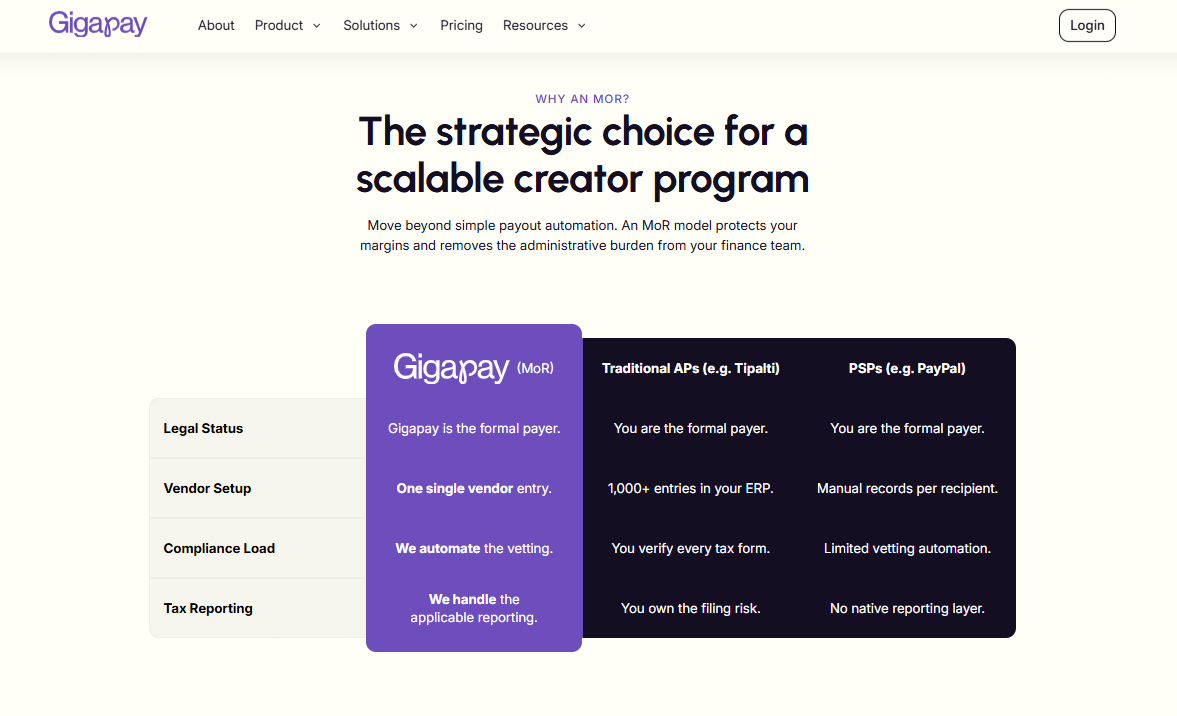
Gigapay is the party that buys from each creator. Under the service agreement, Gigapay purchases the creator's deliverable and concurrently resells it to the client, which makes Gigapay the formal counterparty on both sides of the transaction.
The invoice chain from creator to brand
The creator supplies Gigapay. For creators with a registered business, Gigapay issues the payee-side documentation as a self-billed invoice, or the local equivalent where self-billing is allowed, on the creator's behalf.
For creators with no registered activity, Gigapay pays out the compensation and reports the amount to the Swedish Tax Agency (Skatteverket), with an exchange of income statements to the creator's local tax authority where relevant, and there is no VAT invoice because the creator is not a taxable person.
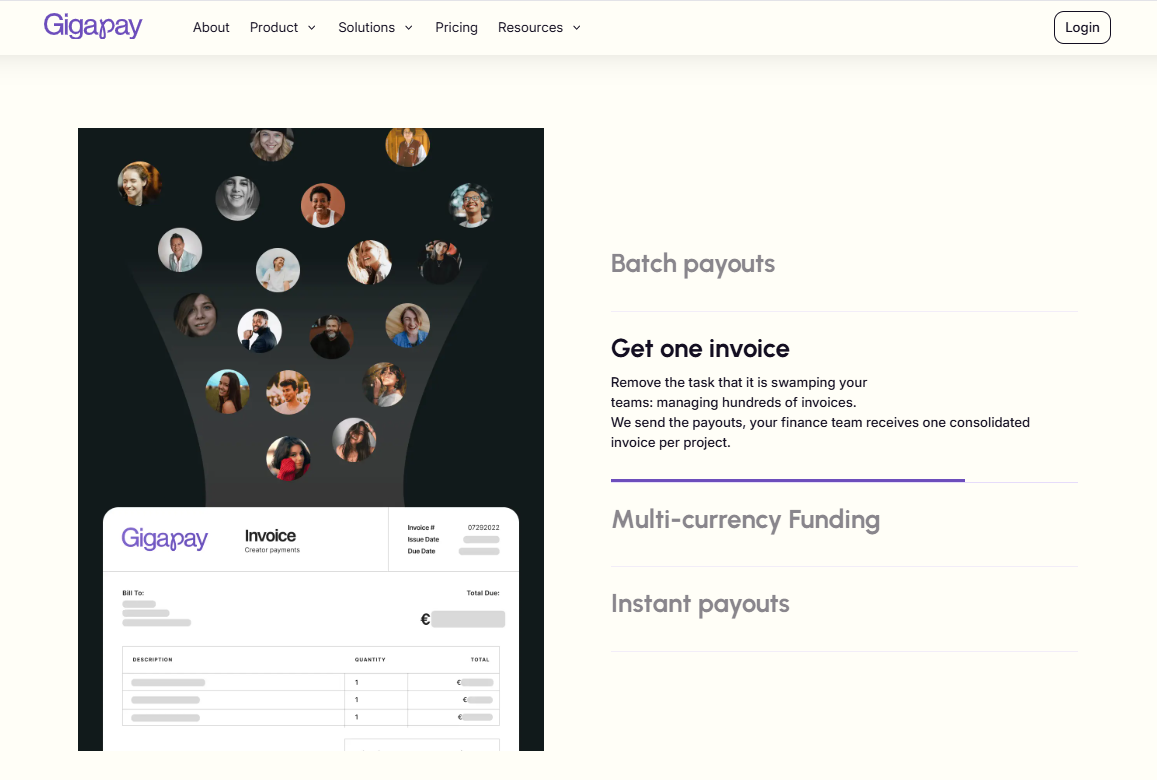
Gigapay then invoices the client once, consolidating every payout in the batch or campaign into one invoice from one Swedish entity. The client receives one document, posts one vendor, and applies one VAT treatment.
The mechanics sit on top of Gigapay's onboarding. Every creator completes KYC before any payment, and Gigapay collects name, address, tax identification number, VAT number where relevant, country of work, and bank details. Creators cannot receive compensation until all requested information is provided.
Tax ID and VAT validation run as part of the same flow, so the identity that appears on the self-billed document is a verified identity.
Why reverse charge applies even when creator and brand share a country
A French brand paying a French creator directly is a domestic supply with French VAT. A French brand paying the same creator through Gigapay is a different chain. The creator invoices Gigapay, a Swedish entity, so the cross-border reverse charge applies in most cases on that leg.
Gigapay invoices the French brand from Sweden, so reverse charge applies again on that leg. The brand accounts for Swedish-sourced VAT on one invoice under Article 196 instead of paying French VAT on 40 separate creator invoices.
This holds for most registered creators in most markets. It does not hold everywhere, which is why Gigapay's per-country research decides whether self-billing is enabled for each market rather than applying one rule globally.
What finance receives at month-end
One invoice per campaign or batch. One vendor record in the ERP. One reverse charge entry per period. Self-billed payee documentation generated per payment and available for audit. Automated DAC7 reporting for the relevant EU markets, KU14 reporting for Denmark, and data sharing for KSK where a German client needs it.
Gigapay's customers report roughly 70% fewer invoices behind each campaign, and the consolidated flow is what let a brand like Boozt triple its collaborations without expanding the team.
Payouts are instant when the account is pre-funded, via SEPA Instant in the EU, Faster Payments in the UK, and ACH in the US, across 65+ countries and 50+ currencies. On all new plans the client covers the fees, so creators keep what they earn.
What Self-Billing Through a Merchant of Record Is Not
Gigapay is not a VAT opinion letter. Your tax team still owns the VAT position for your entities, and the decision on how the consolidated invoice is treated in your return is yours. Gigapay built the rails so that position is executable for every payee in every market, with the documentation to back it.
Gigapay does not withhold or pay social security or income taxes on the creator's behalf in its Merchant of Record capacity, with Sweden as the exception under a separate service. Each party stays responsible for its own taxes under applicable law.
Reverse charge on the Gigapay invoice does not change your KSK exposure in Germany, your IRPF withholding obligations in Spain, or any §50a position your German tax adviser has taken. Those sit outside VAT and outside invoicing, and they need their own owner.
Gigapay is also not a DAC7 substitute for every platform. Gigapay files DAC7 reports to Skatteverket for the markets where it is the reporting platform operator. DAC7 is a reporting obligation, and this article is about invoicing and VAT. The two should not be merged in your compliance plan.
E-Invoicing Mandates and ViDA: What Changes Between 2026 and 2030
The invoice format problem is about to get a regulatory deadline. Under the ViDA package, published as Directive (EU) 2025/516 in March 2025, structured electronic invoicing becomes the default for intra-EU B2B transactions from 1 July 2030, together with digital reporting requirements. Unstructured PDFs will not count as electronic invoices for those transactions.
National mandates arrive earlier. Belgium has required B2B e-invoicing via Peppol since January 2026. Poland's KSeF became mandatory from February 2026 for large businesses and April 2026 for the rest. France requires all companies to be able to receive e-invoices from 1 September 2026, with large and mid-sized companies issuing from the same date.
Germany has required businesses to receive e-invoices since January 2025, with issuance phased in from 2027 and 2028. Spain runs VeriFactu certified-software rules from 2026 alongside its self-billing regulations.
- For a brand self-billing creators directly, this means each self-billed document may soon need to be a structured e-invoice in the supplier's country format.
- For a brand buying from one Merchant of Record, the e-invoicing obligation concentrates on one supplier relationship.
Gigapay's legal team tracks the Belgian Peppol applicability to cross-border invoices from a Swedish supplier and the Croatian Fiscalization 2.0 exemption for cross-border invoices as live monitoring items, which is the kind of per-market watch a brand otherwise has to run itself.
Self-Billing Readiness Checklist for AP Teams
Finance teams evaluating whether their creator invoicing holds up can work through these questions.
- Can you produce a written self-billing agreement for every supplier you self-bill, and when was each one last reviewed?
- Is the VAT number on each self-billed document validated against a live register, and do you know which suppliers have deregistered since onboarding?
- Does your VAT treatment decision come from verified supplier facts or from a campaign spreadsheet?
- How many of last quarter's creator payments were held for a missing or invalid invoice, and how many hours did AP spend chasing them?
- Which of your creator markets do not permit self-billing, and what document do you hold for those payees?
- Which of your entities will be in scope for a national e-invoicing mandate before July 2030, and does your self-billing output meet that format?
If the answer to several of these is "we are not sure," the invoicing chain is the place the next audit will look first.
Conclusion
Gigapay is the Merchant of Record for creator payouts, the one counterparty that pays your creators on your behalf and takes on the compliance, payouts, and support so you don't have to. Self-billing gives finance control of the document, and reverse charge gives finance one VAT logic for cross-border B2B services.
Both mechanisms depend on a valid invoice, a verified payee, and a written agreement, and both break when 200 individuals are expected to produce that paperwork themselves.
Routing creator payments through a Merchant of Record moves the self-billing, the VAT validation, and the per-country invoice rules onto one supplier, and leaves your tax team with one invoice to take a position on.
If AP's queue is "missing invoice" on people-payees, book a demo and we will show you how self-billing lands in your entity.
Read Next:
- Vendor Invoice Fraud and BEC: Why Hundreds of One-Off Payees Are an AP Control Failure
- Tipalti, BILL, and Melio vs a Merchant of Record: Who Is Actually the Legal Buyer?
- AP Automation Software in 2026: What Finance Should Demand
FAQs:
1. Do we still need a self-billing agreement when we pay creators through Gigapay?
Yes, you still need a self-billing agreement or an equivalent arrangement somewhere in the Merchant of Record chain, because the self-billed document is only valid if the supplier has agreed to it in advance. Gigapay holds the agreement with each creator as the party that buys from them, and the client relationship is governed by the service agreement. [VERIFY how the self-billing arrangement is documented in the MSA before publishing.]
2. Does VAT reverse charge apply to every creator in the EU?
No, VAT reverse charge does not apply to every creator in the EU, because the treatment depends on where the supplier is established, where the customer is established, whether the supplier is a taxable person, and what the service is. A registered creator invoicing a Swedish entity from another member state is typically reverse charge. An individual with no registered activity does not issue a VAT invoice, so reverse charge does not arise on that payment. Do not publish or apply a blanket rule.
3. Is self-billing the same as DAC7?
No, self-billing is not the same as DAC7. Self-billing is an invoicing mechanism that decides who produces the VAT document, and DAC7 is an EU reporting obligation that requires platform operators to report seller income to tax authorities each January. The two run on different legal bases and different timelines. Gigapay's live DAC7 guide for finance teams covers the reporting side:
4. What must a self-billed reverse charge invoice show to be valid in 2026?
A self-billed reverse charge invoice must show the full Article 226 content to be valid in 2026: supplier and customer names, addresses, and VAT numbers, a sequential invoice number, the invoice date, the date of supply, a description of the service, and the taxable amount, with no VAT charged. It must carry the mention "Self-billing" and the mention "Reverse charge." In the UK it must also state "The VAT shown is your output tax due to HMRC." In Germany it must carry the word "Gutschrift."
5. How does a Merchant of Record reduce the number of invoice formats finance has to handle?
A Merchant of Record reduces the number of invoice formats finance has to handle by becoming the party that buys from every creator and then selling the deliverables on to the brand under one invoice. Gigapay issues the payee-side self-billed documentation to each creator in the format the creator's country requires, and the brand receives one consolidated invoice from one Swedish entity per campaign or batch. The brand posts one vendor and applies one VAT treatment, regardless of how many creators or countries are behind the payment.
.jpg)
.jpg)