.jpg)

73% of accounts payable departments now use some form of automation, according to Ardent Partners' State of ePayables research cited in an August 2026 industry analysis.
Yet automation adoption tells you nothing about the question that decides your compliance exposure: when the money leaves your account, who is the legal buyer of the work?
Gigapay is the Merchant of Record for creator payouts, which means it becomes the contractual counterparty for every payee, so brands pay hundreds of creators through one vendor, one contract, and one invoice.
Tipalti, BILL, and Melio are strong AP automation platforms, and none of them changes who your company legally buys from.
This article breaks down exactly what each platform does, where the legal buyer sits in each model, what that means for 1099, 1042-S, and DAC7 obligations, and how to decide which structure fits the people you actually pay.
Key Takeaways
- Tipalti, BILL, and Melio automate payments; your company stays the legal buyer.
- A Merchant of Record becomes the counterparty, so you contract with one vendor only.
- AP automation fits stable corporate suppliers; a MoR fits high-volume individual payees.
- With AP platforms, 1099, 1042-S, and DAC7 liability stays on your entity.
- Many teams run both: AP automation for suppliers, Gigapay for creator payouts.
The B2B Payment Software Market in 2026: Automated, but Still Liable
The AP automation market keeps growing fast. MarketsandMarkets projects it will reach $7.5 billion by 2030, up from $3.0 billion in 2023, a 14.1% compound annual growth rate. Verified 2026 benchmark data shows why finance teams keep buying: best-in-class AP teams cut invoice cycle time from 10 days to 2.1 days and reach 78% touchless processing, while manual workflows push invoices through 7.8 separate touches.
The money followed the category:
- Tipalti reached a reported $8.3 billion valuation with roughly 1,000 to 1,300 employees.
- Melio, founded in 2018, grew to 80,000 customers and processed over $30 billion in payments in its FY25 before Xero completed its $2.5 billion acquisition in October 2025.
- BILL built one of the largest SMB payment networks in the United States.
These are serious companies solving a real problem.
What the growth numbers hide is the cost of getting the structure wrong. The same February 2026 benchmark research reports that compliance fines from AP errors cost firms an average of $250,000 per incident, and 72% of organizations pay late payment penalties averaging $30,000 a year due to inefficient AP processes.
Automation reduces manual work. It does not move the legal responsibility, because responsibility follows the contract, and the contract stays yours.
Why the Legal Buyer Question Decides Your Tax and Compliance Exposure
Every payment your company makes has a counterparty. When you pay a supplier through Tipalti, BILL, or Melio, the contract sits between your entity and that supplier. Your company issued the purchase order, your company receives the invoice, and your company answers to the tax authority for what happens next.
That structure works fine when your payees are registered businesses that invoice you correctly. It starts to break when your payees are people. A brand running 600 creator collaborations a year, a common volume among Gigapay's clients, faces a very different problem than a manufacturer paying 40 component suppliers.
Gigapay's own analysis of that 600-collaboration scenario found the manual process consumes around 840 admin hours and roughly €139,590 per year across vendor onboarding, invoice chasing, and error cycles.
The legal buyer question is the fork in the road. If your company remains the buyer, you own vendor onboarding, tax form collection, withholding analysis, and year-end reporting for every single payee.
If a Merchant of Record becomes the buyer, those payees stop being your vendors at all. Everything else in this comparison flows from that single structural difference.
What Tipalti, BILL, and Melio Actually Do
All three platforms sit in the AP automation and payment execution category. They differ in scale and target market, and they share the same legal architecture: they organize and execute payments on your behalf while your company remains the contracting party.
What Tipalti Does as a Global AP Automation Platform
Tipalti, founded in 2010 and headquartered in San Mateo, is the enterprise heavyweight of the three. It covers supplier onboarding, tax form collection (W-9 and W-8 series), invoice processing, approval workflows, and mass payouts to 196 countries in 120 currencies. It supports 1099 and 1042-S preparation and offers DAC7 tooling for platforms with EU reporting obligations.
Two details matter for this comparison:
- First, payees are onboarded as vendors in your ERP, so 400 creators means 400 vendor records your procurement and finance teams own.
- Second, Tipalti's batch payment runs typically settle in one to five days, and its tax features are tooling: they help you prepare and file the forms that your entity is legally required to file.
The liability stays with the buyer, and the buyer is you.
What BILL Does for SMB Accounts Payable and Receivable
BILL focuses on small and mid-sized US businesses. It digitizes bills, routes approvals, and pays suppliers by ACH, check, virtual card, or international transfer, syncing everything back to accounting software. For a US business paying US suppliers, it removes an enormous amount of paper and manual entry.
The counterparty structure is identical to Tipalti's. BILL collects W-9 information from your vendors to support your 1099 process, because the 1099s are yours to issue. Every payee you add becomes your vendor, with your company as the payer of record.
What Melio Does for Bill Pay Within the Xero Ecosystem
Melio, now part of Xero after the acquisition completed in October 2025, gives US SMBs a simple way to pay bills by bank transfer or card, even when the receiving supplier only accepts checks. Its integration into Xero's accounting platform makes it a natural default for Xero customers.
Melio moves money and organizes the workflow around moving it. It does not enter the transaction as a party. Your business remains the buyer, the payer, and the entity responsible for any reporting the payment triggers.
What All Three Have in Common
Strip away the differences in market segment and you get the same model: onboard vendors, collect bank details and tax forms, route approvals, push payments. That is AP automation plus payout rails. It is genuinely useful, and it is incomplete if the majority of your payment volume goes to individuals rather than companies.
What a Merchant of Record Does Differently
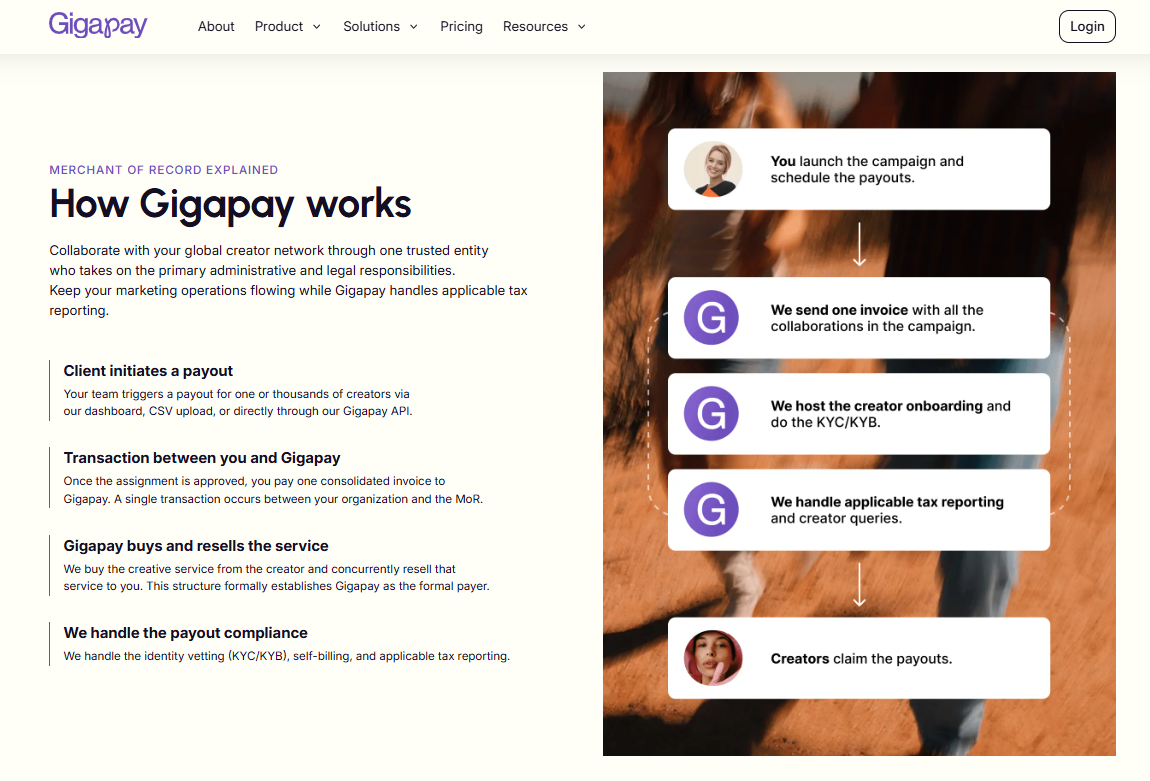
An MoR changes the counterparty rather than the workflow. Gigapay formally purchases the creator's deliverable and concurrently resells it to your company.
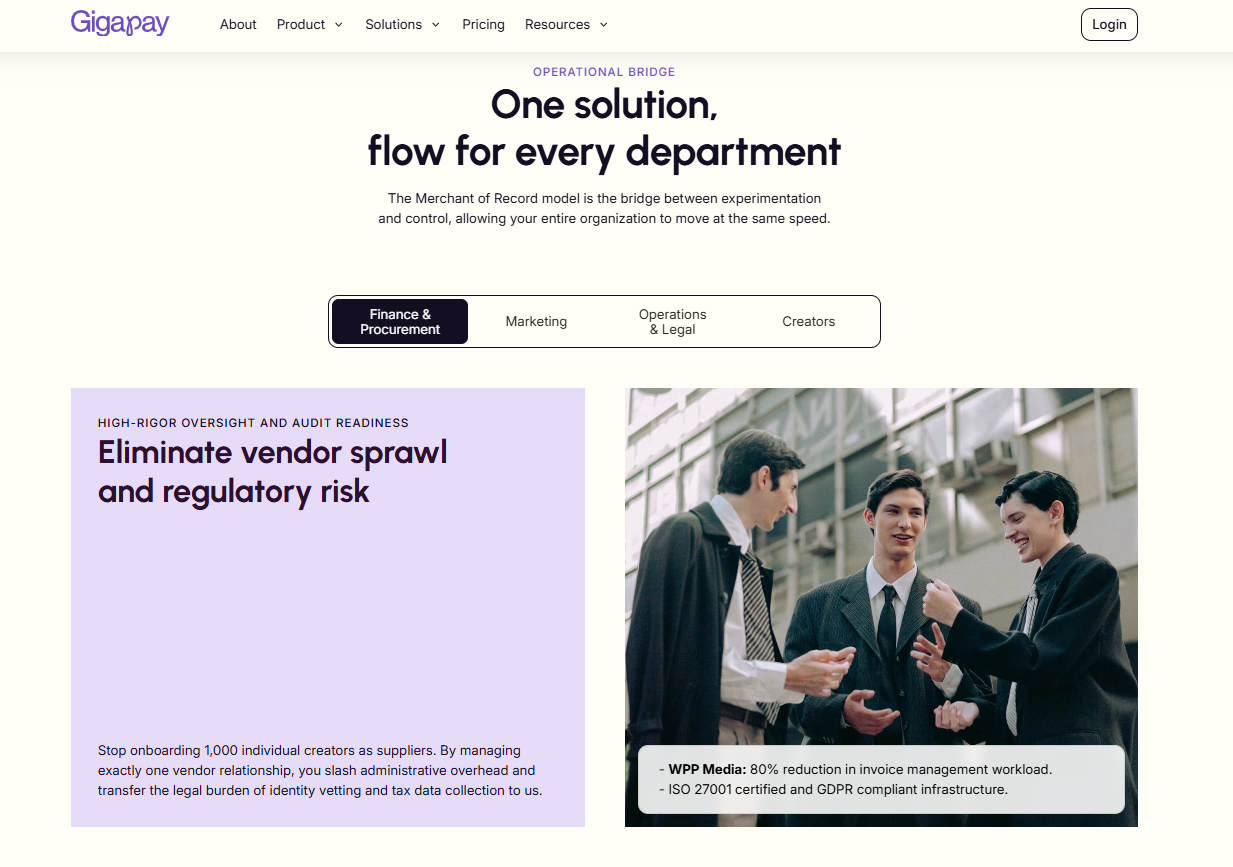
The creator's contractual relationship is with Gigapay. Your company's contractual relationship is with Gigapay. You have one vendor in your ERP, one master agreement, and one consolidated invoice per campaign or batch instead of hundreds of individual creator invoices.
Gigapay's clients report an 80% reduction in invoice volume from consolidation alone.
Because Gigapay is the counterparty, the operational load moves with the contract:
- Onboarding and verification: Gigapay runs KYC and KYB on every payee, validates tax IDs and VAT numbers, and lets creators onboard as an individual, sole trader, or company. Creators do not need a registered business or VAT number to get paid.
- Self-billing: Gigapay auto-generates compliant invoices on behalf of creators, which removes the single most common failure point in paying individuals: the incorrect or missing invoice.
- Platform tax reporting: Gigapay files DAC7 reports for in-scope EU countries and handles KU14 reporting in Sweden, as automated reporting built into the model rather than tooling handed back to you.
- Payee support: Creators get a dedicated human support team and EarlyPay, an instant-liquidity option for scheduled funds. Gigapay's creator NPS sits at 88.
- Payment execution: Payouts run instantly over local rails like SEPA Instant, Faster Payments, and ACH, across 65+ countries and 50+ currencies.
One honest boundary, because overclaiming helps nobody: a Merchant of Record does not make tax law disappear. Under Gigapay's service agreement, each party still complies with its own tax responsibilities, and in its MoR capacity Gigapay does not withhold social security or similar contributions on behalf of clients (the Swedish Employer of Record service is the exception, where Gigapay handles statutory employer obligations directly).
Germany's Künstlersozialkasse is a concrete example: German companies must assess and report KSK themselves, and Gigapay supports them with the collected payment data. The difference is that your obligations attach to one B2B vendor relationship instead of hundreds of individual payee relationships.
Who Is Actually the Legal Buyer? The Side-by-Side Answer
Here is the question the rest of the comparison hangs on, answered directly for each platform.
Company and product data: Gigapay competitive research, July 2026; Xero and Melio public announcements, October 2025.
The first two rows are the entire argument. Everything below them is a consequence.
Tax Reporting Responsibilities: 1099, 1042-S, and DAC7 in Each Model
Tax reporting is where the legal buyer question turns into January workload and audit exposure, so it deserves its own breakdown.
US Reporting: 1099 and 1042-S
When your US entity pays a US freelancer $600 or more, your entity issues the 1099. When it pays a foreign individual for services, the 1042-S and withholding analysis land on your entity as the withholding agent.
Tipalti and BILL are good at collecting W-9s and W-8s and preparing these filings. The obligation being prepared remains yours, at the scale of your payee count. Four hundred creators means your name on four hundred information returns.
Under the MoR model, your company pays one Swedish B2B vendor and does not directly pay the individuals, so you are not running a 400-payee 1099 factory each January. The exact reporting scope for your entity depends on your structure and should be confirmed in the master service agreement with Gigapay before you rely on it.
EU Reporting: DAC7
DAC7 requires digital platforms facilitating relevant activities to report seller income to EU tax authorities. Gigapay's July 2026 competitive research found a clean split on this point: Tipalti offers DAC7 tooling while the client keeps the reporting liability, and DAC7 does not appear in BILL's or Melio's positioning at all, which follows logically from their US SMB focus.
Gigapay files DAC7 reports to the Swedish tax authority for in-scope countries as part of the service, alongside KU14 in Sweden.
You still need to know what your own entity owes under DAC7, because platform definitions are entity-specific. The practical difference is whether DAC7 season means operating a reporting program or reviewing what your vendor already filed.
The Fraud Angle Nobody Prices In
Vendor payment fraud runs through changed bank details. AFP research found 79% of corporate practitioners experienced payment fraud in 2024, and the attack surface scales with vendor count. Four hundred individual creator vendor records means four hundred IBANs that can receive a convincing "I changed banks" email.
One MoR vendor record means one. Your fraud team will have an opinion about which of those they want to defend.
When Tipalti, BILL, or Melio Is the Right Choice
This comparison is a structural one, and Tipalti is strong at exactly what it claims. Choose an AP automation platform when your payment profile looks like this:
- You pay a stable, finite set of corporate suppliers that changes slowly year to year.
- Your suppliers issue proper invoices against purchase orders, and three-way matching is your core workflow.
- Your volume justifies a vendor record per supplier, and procurement is comfortable maintaining them.
- Your reporting obligations are manageable at your supplier count, and your tax team already owns them.
A manufacturer paying 60 suppliers, an agency paying its SaaS stack and landlords, a media company paying production houses: all of these belong on AP automation. Match, code, pay. The model fits because the payees behave like vendors.
When a Merchant of Record Is the Right Choice
Choose the MoR structure when the people you pay stop behaving like vendors:
- You pay hundreds of individuals or small entities per quarter, and the roster changes every campaign.
- Your payees will not invoice you correctly, because most of them have never issued a compliant cross-border invoice in their lives.
- Procurement will not approve 400 new vendor codes, and honestly should not have to.
- Your tax team will not staff a January reporting factory for payees who each earned €800.
- Your fraud controls cannot absorb hundreds of individually changeable bank details.
This is the exact problem Gigapay's clients hired it for. Boozt's Brand Activation Lead put it plainly: "We've been trying to find a way forward with nano- and micro-influencers for years and Gigapay really enabled this," and the brand tripled collaborations without expanding the team.
The Goat Agency, part of WPPMedia, reported that Gigapay significantly reduced the time spent managing payments. In Gigapay's 600-collaboration ROI model, annual cost dropped from roughly €139,590 to €46,350, and admin time fell from 840 hours to about 60.
Pricing is transparent for the category: €279 per month plus a 4.9% admin fee per payout on the Base plan, with volume-based Enterprise pricing above €1.8M in annual payouts.
- On headline rate that looks more expensive than raw payment rails.
- On all-in cost for cross-border creator payouts, Gigapay's July 2026 analysis places it mid-pack, and it is the only option in the set where the fee buys a change of counterparty rather than a faster way to remain liable.
Can You Use AP Automation and a Merchant of Record Together?
Yes, and the most sophisticated finance teams do exactly this. The two categories solve different problems, so running them in parallel is coherent rather than redundant:
- AP automation (Tipalti, BILL, or Melio) handles your corporate suppliers: agencies, software, logistics, professional services. Entities that invoice properly and belong in your vendor master.
- Gigapay as Merchant of Record handles your high-volume people-payees: creators, influencers, UGC makers, affiliates. Inside your AP system, this entire category collapses into a single vendor line.
The integration burden is small. Gigapay works via CSV batch upload or a REST API with a typical full integration time of two to five days, and it already plugs into influencer platforms like Kolsquare. Your AP platform never has to know that the one Gigapay invoice it processes represents 300 paid creators.
How to Score This Decision in an RFP Without Picking the Wrong Tool
A warning from experience: if your RFP scores only "mass payments + tax form support," Tipalti and Gigapay both tick the box, and you will pick the wrong one for at least one category of payee. The products are not interchangeable, because the legal structures are not.
Gigapay is not Tipalti with a different interface, and Tipalti is not an incomplete MoR.
Add these questions to your scoring matrix and the fog clears:
- Who is the legal buyer of the payee's work under this contract? Only one model answers "not us."
- How many vendor records does 500 payees create in our ERP? 500 versus 1.
- Whose name is on the information returns? Yours, or your vendor's.
- Can a payee without a registered business get paid compliantly? AP platforms struggle here; the MoR model was built for it.
- What happens to our exposure if a payee is misclassified or unreported? With rails and tooling, it lands on you. With a MoR, the counterparty structure absorbs the bulk of it.
If the answer you need to question one is "not us, for our creator volume," you are shopping in the MoR category, whatever the RFP template says.
Conclusion
Gigapay is the Merchant of Record that lets brands pay hundreds of creators through one vendor, one contract, and one invoice, with compliance built into the structure instead of bolted onto the workflow.
Tipalti, BILL, and Melio are excellent at automating accounts payable for corporate suppliers, and every one of them leaves your company as the legal buyer, with the vendor records, tax forms, and reporting obligations that follow.
The decision is a structural one: match the tool to who you pay, keep AP automation for suppliers who invoice properly, and move high-volume individual payouts to the model where the counterparty changes.
If the payees driving your growth are people rather than companies, book a demo with Gigapay and see what your payment operation looks like with one vendor instead of four hundred.
Read Next:
- AP Automation Software in 2026: What Finance Should Demand
- Employer of Record vs Merchant of Record: Which Risk Transfer Fits Contractor Payouts?
- Vendor Sprawl: The Procurement Case Against 500 Creator Vendors
FAQs:
1. What is the main difference between Tipalti and a Merchant of Record like Gigapay?
The main difference between Tipalti and a Merchant of Record like Gigapay is the legal counterparty: with Tipalti, your company remains the buyer and contracts with every payee as a vendor, while Gigapay purchases the creator's deliverable and resells it to you, so you contract with one vendor regardless of how many creators you pay.
2. Who is the legal buyer when you pay creators through BILL or Melio?
The legal buyer when you pay creators through BILL or Melio is your own company: both platforms automate and execute payments on your behalf, so every creator remains your direct vendor and your entity keeps the contractual, invoicing, and tax reporting relationship with each payee.
3. Is Gigapay a good Tipalti alternative for paying influencers and creators?
Gigapay is a good Tipalti alternative for paying influencers and creators when your payees are individuals at high volume, because its Merchant of Record model removes per-creator vendor records, generates compliant self-billed invoices, files DAC7 reports where in scope, and pays instantly across 65+ countries, while Tipalti remains the stronger choice for automating payments to registered corporate suppliers.
4. Can a company use both an AP automation platform and a Merchant of Record?
A company can use both an AP automation platform and a Merchant of Record at the same time: teams keep Tipalti, BILL, or Melio for corporate suppliers that invoice properly, and route high-volume creator and freelancer payouts through Gigapay, which appears in the AP system as a single vendor with one consolidated invoice.
5. Does a Merchant of Record remove all tax obligations for the brand?
A Merchant of Record does not remove all tax obligations for the brand: each party still complies with its own tax responsibilities, and country-specific duties like Germany's KSK remain with the client, but the MoR structure means your obligations attach to one B2B vendor relationship instead of hundreds of individual payees, with Gigapay handling payee onboarding, self-billing, and in-scope platform reporting like DAC7.
.jpg)

.jpg)