.jpg)

TikTok reached 2.21 billion monthly active users in Q2 2026, yet TikTok One's brand-deal infrastructure operates in roughly 24 countries.
That leaves most of the world's creators outside the platform's native payment system.
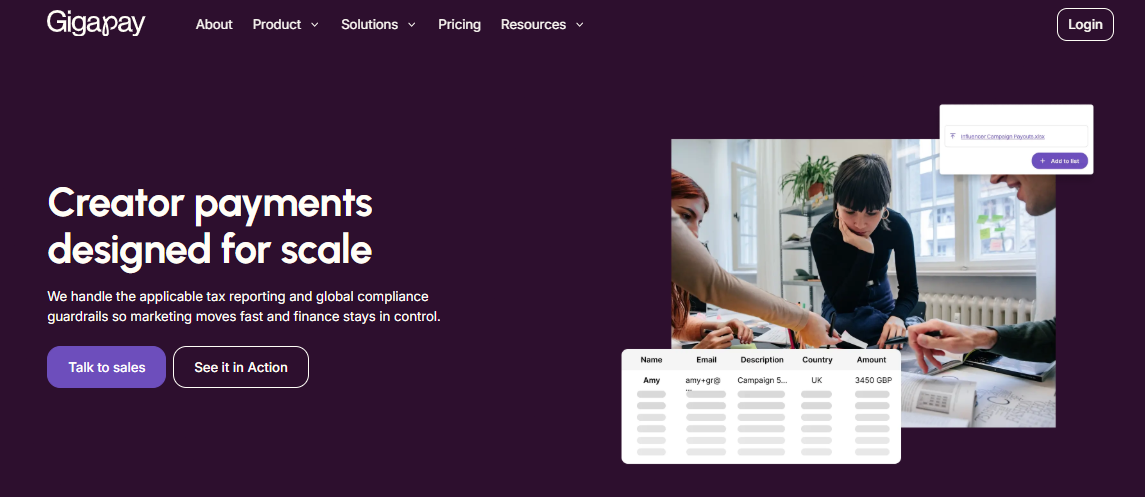
Gigapay is the merchant of record payout platform that closes this gap, paying creators in 65+ countries and 50+ currencies while taking on the tax and compliance responsibility as your single vendor.
Brands keep finding their best-performing TikTok creators in markets the platform cannot pay, which means every campaign in Nigeria, the Nordics, Southeast Asia, or Eastern Europe pushes the payment problem onto your own finance team.
This guide breaks down exactly where TikTok One stops working, what paying creators off-platform really costs, the tax rules you cannot skip, and the compliant methods that let you pay any TikTok creator in any supported country in 2026.
Key Takeaways
- TikTok One brand deals cover roughly 24 countries; TikTok reaches 150+ markets.
- Creator Rewards pays in only eight publicly confirmed countries as of 2026.
- Paying creators directly triggers withholding taxes, DAC7 reporting, and local license checks.
- Manual international payouts cost brands roughly €40–60 and six admin hours each.
- A merchant of record like Gigapay pays 65+ countries under one invoice.
Why TikTok's Global Reach Outgrew Its Own Payment Coverage
TikTok operates in over 150 countries and regions, but its monetization and payment programs cover a fraction of that footprint. The audience went global years before the payment infrastructure did. Indonesia became TikTok's largest single market in 2025, the EU holds 169 million monthly active users, and creator communities in Africa, Latin America, and Eastern Europe keep growing without any native payout access.
Each TikTok payment program has its own country list, and none of them come close to full coverage:
The practical result for brands is simple. Your campaign targets creators by audience fit, not by payment eligibility. When the perfect creator for your launch sits in Lagos, Stockholm, or Manila, TikTok One cannot process that payment, and the money has to move another way.
What TikTok Creators Earn in 2026: Rates, Brand Deals, and Payout Benchmarks
Understanding what creators earn tells you how much money moves outside TikTok's own rails. TikTok has paid out $2.1 billion through the Creator Rewards Program since its launch, but platform payouts are the smaller slice of creator income. Roughly 71% of creator income comes from brand deals, and brand deals are exactly the payments that happen off-platform in most of the world.
TikTok Creator Earnings by Follower Tier in 2026
The Creator Rewards Program pays 0.40–1.00 per 1,000 qualified views, which means a creator needs roughly 1.8 million monetized views a month to clear $1,200 from the platform alone. Brand deals pay better and pay faster, which is why they dominate creator income everywhere, including the countries TikTok One does cover.
Why Brand Deal Rates Keep Rising
Rates for micro-influencers have risen 200–233% since 2024, according to the State of Creator Compensation 2026 research Gigapay partnered on through CreatorFest. The same research found agency markups of 20–80% hiding inside creator fees, and 88% of creators still treating content as a side hustle.
Demand for nano and micro creators grew faster than the systems built to pay them, and that pressure lands hardest in markets with no native TikTok payment option at all.
Where TikTok One Works and Where It Does Not
TikTok One is the hub that now houses the Creator Marketplace, TikTok's official brand-to-creator partnership platform. Brands browse creators, run campaigns, and settle payments inside one interface. The system works well inside its coverage map and stops completely outside it.
TikTok One Country Coverage in 2026
As of 2026, TikTok One's Creator Marketplace operates in approximately 24 countries: the United States, United Kingdom, Canada, Australia, France, Germany, Italy, Spain, Brazil, Indonesia, Japan, South Korea, Thailand, Vietnam, Malaysia, Philippines, Singapore, Saudi Arabia, United Arab Emirates, Turkey, Egypt, Russia, Israel, and Mexico. Creators must also meet 10,000 followers, 100,000 video likes in 28 days, and be 18 or older.
Which Creators Fall Outside TikTok One's Payment System
The gaps matter more than the coverage. TikTok One cannot pay creators in:
- All of the Nordics: Sweden, Denmark, Norway, and Finland have active creator markets and no TikTok One access.
- Most of Europe: The Netherlands, Poland, Portugal, Austria, Belgium, Ireland, and all of Eastern Europe outside Russia sit outside the list.
- Nearly all of Africa: Nigeria, Kenya, South Africa, and Ghana hold some of the fastest-growing TikTok audiences with no native payout path.
- Most of Latin America: Only Brazil and Mexico are covered; Argentina, Colombia, Chile, and Peru are not.
- Large parts of Asia: India, Pakistan, and Bangladesh have no access.
When TikTok One Fails Even in Eligible Countries
Eligibility does not guarantee usability. Payments fall outside TikTok One when the creator does not meet the follower or engagement thresholds, when the deliverable is UGC that never posts to the creator's own account, when the deal involves usage rights or exclusivity that need a direct contract, or when your campaign spans eligible and ineligible markets and you want one process instead of two.
A multi-market campaign running in 15 countries with only 9 of them covered still leaves your finance team solving international payments manually.
Why Paying TikTok Creators Outside the Platform Gets Expensive Fast
When TikTok One cannot process a payment, the work moves to your finance team, and the costs compound quickly. A single international creator payment handled manually costs a brand roughly €40–60 in true cost and takes about 6 hours of combined admin work across marketing, finance, and procurement, based on Gigapay's internal benchmarks.
The work behind each payment looks like this:
- Vendor onboarding: Each creator becomes a vendor record in your ERP. A brand working with 300 creators carries 300+ vendor entries.
- Tax documentation: Finance collects tax IDs, validates VAT numbers where relevant, and verifies identity. Most nano and micro creators have no registered business, which blocks standard procurement flows entirely.
- Invoicing: Creators who have never issued a B2B invoice produce incorrect ones, and every error adds a correction cycle. Some countries do not allow self-billing at all, which forces the creator to issue their own compliant invoice.
- Cross-border transfer fees and FX: SWIFT transfers carry fixed fees plus currency spreads, and the creator often receives less than agreed.
- Reporting: EU brands face DAC7 obligations, German clients face KSK levies, and dozens of countries require withholding on payments to local individuals.
At scale, the numbers become a budget line. A brand running 600 creator collaborations per year spends roughly €139,590 annually on manual payment administration, consuming about 840 admin hours.
The same volume handled through automated merchant of record infrastructure costs around €46,350 and 60 hours. The gap of more than €93,000 per year is the real price of treating international creator payments as a side task.
Four Ways to Pay TikTok Creators in Countries TikTok One Won't Cover
Brands use four main methods to pay creators in ineligible countries. Each one trades off speed, cost, and compliance differently.
Method 1: Direct International Bank Transfers
Your finance team pays each creator by SWIFT or local wire. It works everywhere a bank account exists, but each transfer carries fees of $15–50, FX spreads of 2–4%, and settlement times of 1–5 business days.
The bigger problem is everything around the transfer: you still carry vendor onboarding, tax ID collection, invoicing, withholding analysis, and reporting for every single creator. This method scales linearly in pain.
Method 2: Consumer Payment Apps Like PayPal and Wise
PayPal and Wise move money fast and feel easy, which is why small campaigns start here. The compliance layer is entirely absent. There is no tax reporting, no verified invoicing, no withholding handling, and no audit trail that satisfies procurement.
PayPal fees for international business payments run 3–5% plus FX margin, and some creator markets restrict or block these services. For anything beyond a handful of one-off payments, this method creates audit risk rather than removing it.
Method 3: Building In-House Payout Infrastructure
Larger companies sometimes build on payment APIs like Stripe Connect. The rails work, but the compliance remains yours. Stripe's own terms state that users remain fully responsible for their tax obligations, and its tax form automation covers the US only.
A realistic build costs €80,000–250,000 plus permanent maintenance, and your legal team still answers every question about DAC7 filings, German KSK levies, and country-by-country withholding. You built a payment tool and kept the liability.
Method 4: Paying Through a Merchant of Record
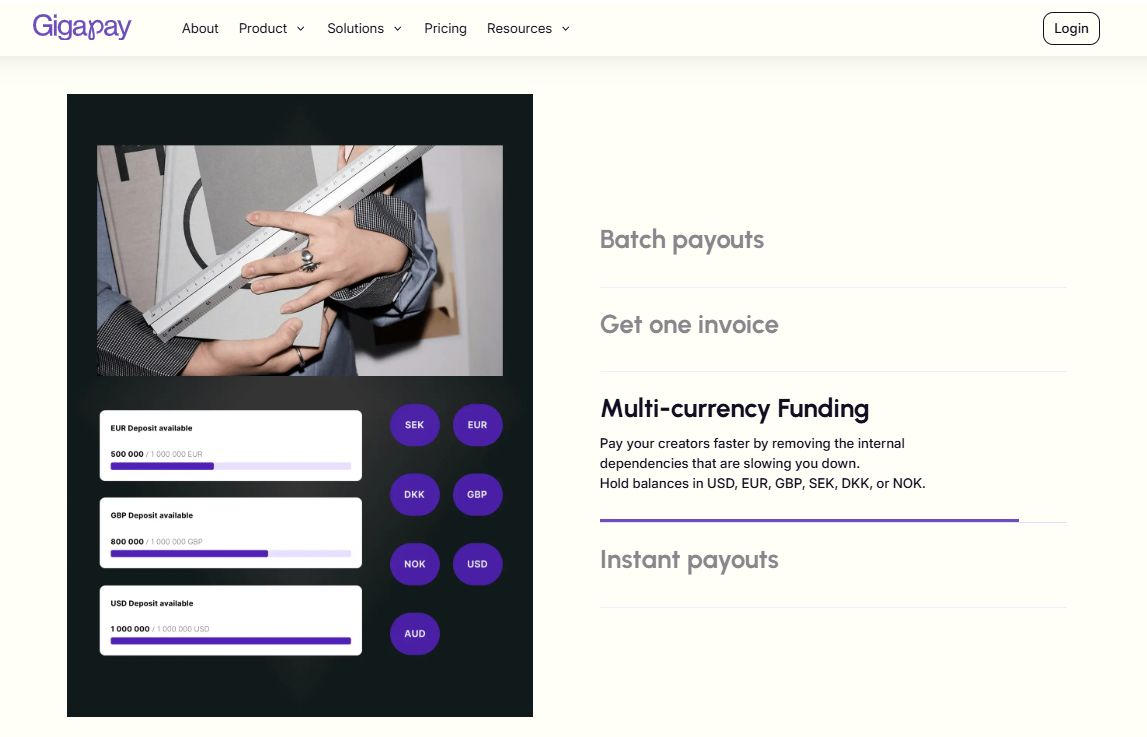
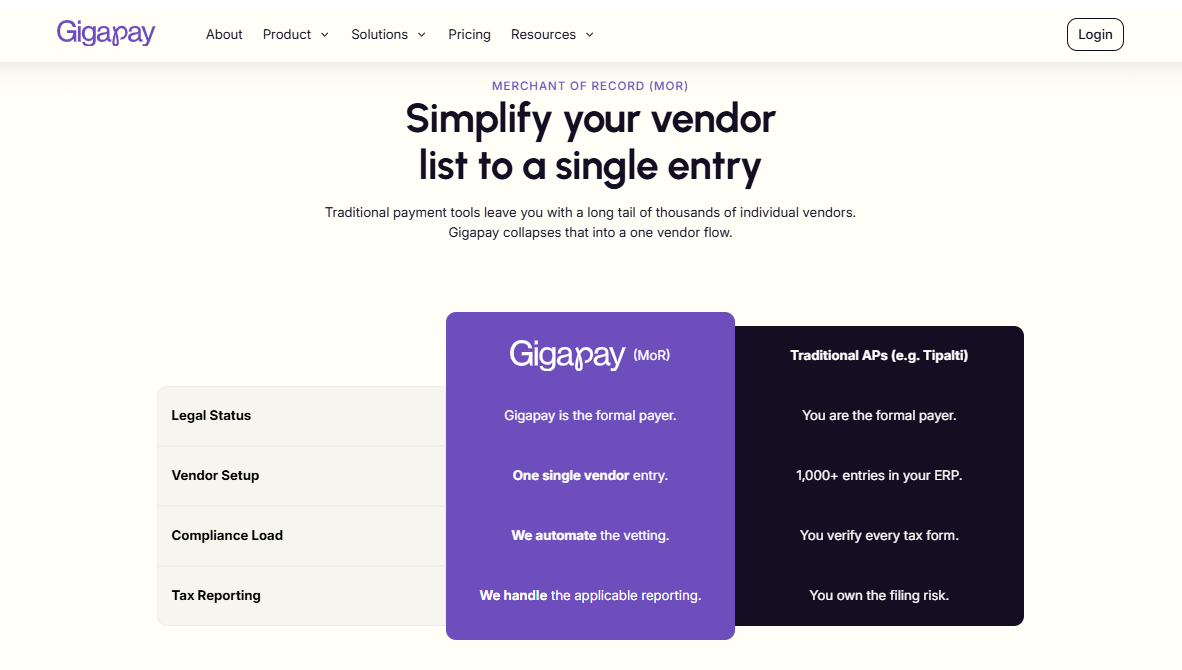
A merchant of record (MoR) platform like Gigapay becomes the legal counterparty to the creator. Gigapay formally purchases the creator's deliverable and resells it to you, which means one vendor in your ERP, one consolidated invoice per campaign, and the tax and compliance administration handled by the platform.
Creators onboard as individuals, sole traders, or companies, with no business registration required. Payouts reach 65+ countries in 50+ currencies, in as little as 7 seconds on local rails.
Payment Method Comparison for International TikTok Creators
Step-by-Step Guide: How to Pay International TikTok Creators Compliantly in 2026
Whether you run the process yourself or through a platform, every compliant international creator payment moves through the same eight steps.
- Confirm the creator's tax residence and legal status: Payment rules depend on where the creator is tax resident and whether they operate as an individual, sole trader, or company. An individual in the Philippines triggers different obligations than a sole trader in Estonia.
- Run identity and tax verification: Collect the creator's tax identification number and verify their identity through KYC. Every country issues its own TIN format, and an invalid number invalidates your reporting later.
- Check local licensing requirements: Creators in the UAE, Saudi Arabia, Oman, and Qatar need influencer licenses before they can legally take paid brand work. Paying an unlicensed creator exposes both sides.
- Determine withholding obligations: Dozens of countries require the paying party to withhold tax on payments to local private individuals, including Spain, Hungary, Latvia, Serbia, South Korea, and Switzerland when the client is local. Cross-border structures can remove withholding when a double tax treaty assigns business profits to the payer's country.
- Agree currency and payment rail before the deal signs: Creators quoted in dollars who receive euros minus FX spread lose real money, and the dispute lands on your team. Local rails such as SEPA Instant and Faster Payments beat SWIFT on both cost and speed.
- Handle invoicing correctly for the creator's country: Self-billing, where you generate the invoice on the creator's behalf, works in most markets but is prohibited in countries including Morocco, Ukraine, Egypt, and Uruguay. In those markets the creator must issue their own compliant invoice.
- File the required reports: EU payments to creators flow into DAC7 reporting, due each January. Swedish entities file KU14. German clients calculate KSK contributions. Missing a filing turns an operational task into a penalty.
- Pay and document: Execute the payment, archive the contract, invoice, verification record, and proof of payment. When a tax authority audits your creator program, the question is how fast you can produce the complete paper trail.
Run this process manually for 10 creators and it is a project. Run it for 500 creators across 30 countries and it is a department. That volume gap is why mass payout platforms exist.
Tax and Compliance Rules You Cannot Skip When Paying Creators Abroad
Four compliance regimes catch most brands off guard when they start paying TikTok creators internationally.
DAC7: The EU's Digital Platform Reporting Rule
DAC7 requires digital platforms facilitating payments to EU-resident sellers, including creators, to report seller income to tax authorities annually. Filings are due each January for the previous calendar year. The regulation covers creator identity data, payment amounts, and account details, and tax authorities exchange the data across member states.
A brand paying EU creators through its own systems needs to assess whether its setup triggers reporting, and the penalties for incorrect filings sit with the filer.
KSK: Germany's 4.9% Social Levy on Creator Payments
Germany's Künstlersozialkasse (KSK) imposes a levy on companies that commission creative work, and the 2026 rules apply a 4.9% contribution on influencer payments above €1,000 per year. The levy applies to German clients even when the creator sits abroad. Deutsche Rentenversicherung audits companies for KSK compliance, and retroactive assessments can reach back five years.
Withholding Tax: The Country-by-Country Minefield
Withholding rules change based on where the client sits, where the creator sits, and the creator's legal form. Local clients paying local private individuals must withhold in markets including Spain, South Korea, Hungary, Latvia, Serbia, Slovenia, Moldova, and Switzerland. Clients in countries without a double tax treaty with the payer's jurisdiction, such as Greece or Portugal paying a Swedish entity, face withholding on the cross-border flow itself.
A merchant of record structure routes payments so that the right treaty applies, which is one of the main compliance reasons brands adopt the model.
Influencer Licensing and Advertising Law
Several markets regulate who can take paid creator work at all. The UAE requires influencer permits under its NMA rules, Saudi Arabia and Oman require licenses, and Turkey requires creators to receive payments into a designated bank account.
Nigeria's ARCON requires pre-vetting approval for all advertising content visible to Nigerian consumers, with fines of ₦1,000,000 per infraction actively issued in 2026. These obligations usually sit with the brand and the creator, not the payment provider, which means your campaign process needs to check them before the money moves.
Country-Specific Rules That Change How You Pay TikTok Creators
The countries TikTok One skips are often the ones with the most specific payment rules. Here is what applies in key creator markets in 2026:
Each row represents hours of legal research a brand would otherwise do per market. Multiply by a 20-country campaign and the research alone outweighs the media budget of a small activation.
What Paying International TikTok Creators Costs in 2026
The honest cost of international creator payments includes four layers, and most brands only budget the first one.
For a brand running 600 creator collaborations per year, the all-in comparison based on Gigapay's benchmark model comes out to roughly €139,590 per year manually against €46,350 through automated payout infrastructure. The admin hours drop from 840 to about 60, and 300+ vendor records in the ERP collapse into one.
Two cost drivers deserve extra attention:
- First, invoice volume: consolidated invoicing cuts the number of invoices finance processes by about 80%, because one campaign generates one invoice instead of hundreds.
- Second, payment delays: industry research Gigapay co-published found payment terms stretching to 120 days in parts of the influencer industry, and late payments cost brands creator relationships that took months to build. Creators remember who paid in 7 seconds and who paid in 4 months.
How Gigapay Pays TikTok Creators in 65+ Countries When TikTok One Won't
Gigapay was built for exactly this gap: campaigns that run globally while payment infrastructure stays regional. The platform has processed 105,000+ payouts worth 911 million SEK, reaching creators in 40+ active markets, with payout capability across 65+ countries and 50+ currencies.
One Vendor Instead of Hundreds
As a merchant of record, Gigapay becomes the legal counterparty to every creator. Your ERP holds one vendor record, your finance team receives one consolidated invoice per campaign, and the creator-side administration moves off your desk. You upload a spreadsheet or call the API, and creators get paid.
Compliance Built Into the Payment
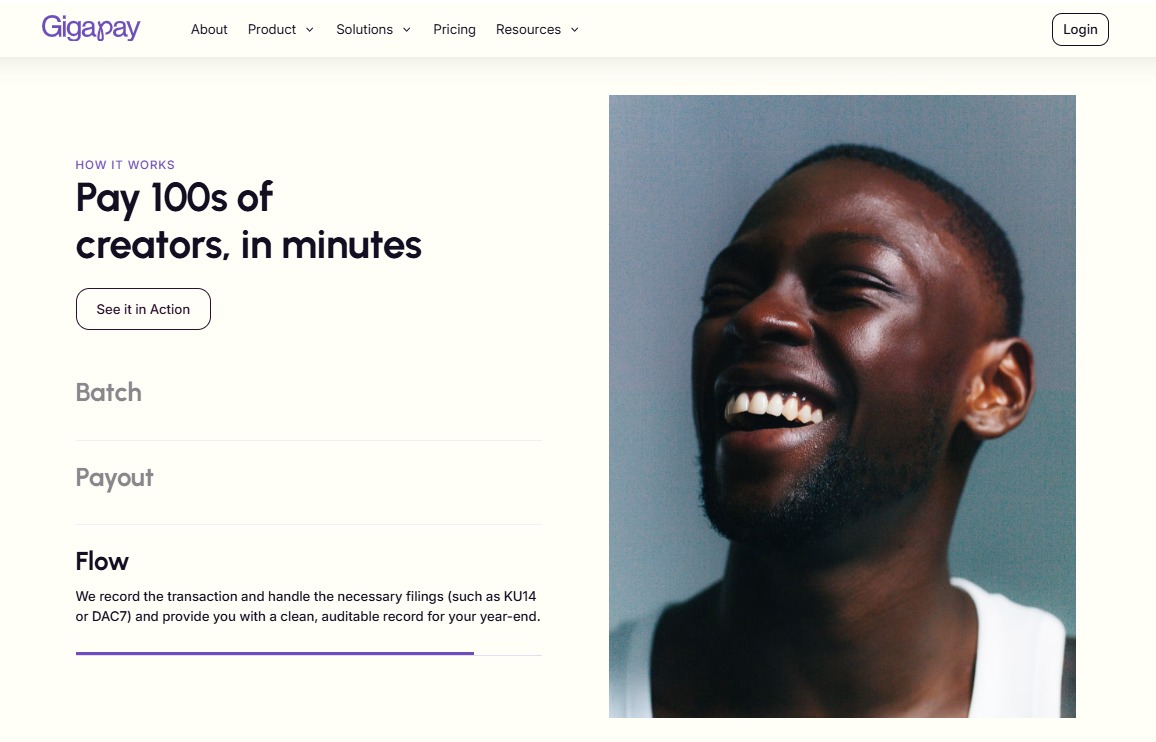
Gigapay runs KYC and identity verification, validates tax IDs, and automates regulatory reporting including DAC7 for the EU, KU14 for Sweden, and KSK data for Germany. Creators onboard as individuals, sole traders, or companies, and no registered business or VAT number is required.
That single feature removes the biggest blocker to working with nano and micro creators in markets TikTok One ignores. Boozt saw a 3x increase in creator collaborations after switching, without expanding the team.
Speed Creators Notice
Payouts land in as little as 7 seconds through local rails: SEPA Instant in the EU, Faster Payments in the UK, ACH in the US. Creators who need liquidity sooner can use EarlyPay to access scheduled funds instantly.
Gigapay's creator NPS stands at 88, backed by a dedicated human support team, which matters because every payment question a creator asks your brand is a question Gigapay answers instead.
Built for Multi-Market Campaigns
Radisson runs creator campaigns across 39 countries through the platform, and agencies like The Goat Agency (WPP Media) use it to manage client programs at volume. API integration takes 2–5 days for platforms that want payouts embedded in their own product.
The pricing model is a SaaS subscription from €279/month plus a 4.9% admin fee per payout, with volume discounts at Enterprise level.
Common Mistakes Brands Make When Paying TikTok Creators Abroad
The same errors repeat across brands that scale creator programs internationally, and most of them only surface during an audit or a dispute.
- Assuming TikTok One coverage before planning the campaign: Teams brief creators in 15 markets, then discover at payment time that half the markets have no native payout path. Payment eligibility belongs in campaign planning, not in post-campaign cleanup.
- Paying through PayPal and calling it done: The money moves, but nothing is reported, verified, or documented. When DAC7 season arrives in January, those payments have no compliant record behind them.
- Skipping tax ID collection for small payments: A €300 payment carries the same reporting obligations as a €30,000 one in most regimes. Small payments at volume are exactly what reporting rules were written to capture.
- Treating self-billing as universal: Generating invoices on the creator's behalf is efficient where allowed and non-compliant where prohibited, including Morocco, Egypt, Ukraine, and Uruguay. One invoicing process does not fit all markets.
- Ignoring licensing in Gulf markets: UAE, Saudi, Omani, and Qatari creators need valid licenses or permits. A campaign with an unlicensed creator exposes the brand to local enforcement, not just the creator.
- Forgetting the KSK when the client entity is German: The 4.9% levy applies to the German commissioning company regardless of where the creator lives, and Deutsche Rentenversicherung audits retroactively.
- Letting payment terms drift: When payments take 60–120 days, your best creators stop answering your briefs. Payment speed is a retention tool, and the brands that pay instantly keep first pick of talent.
Conclusion
Gigapay is the merchant of record payout platform that pays TikTok creators in 65+ countries and 50+ currencies when TikTok One cannot, with one vendor, one invoice, and the compliance administration handled for you.
TikTok's audience spans more than 150 markets while its native payment programs cover a fraction of them, and the gap lands on brand finance teams in the form of withholding analysis, DAC7 filings, license checks, invoice corrections, and €40–60 of hidden cost per manual payment.
The brands scaling creator programs in 2026 solve payments as infrastructure once, instead of solving them as admin on every campaign.
Book a demo to see how Gigapay pays your next international creator roster in seconds instead of months.
Read Next:
- Influencer Contract Payment Clauses: Copy-Ready Terms for Brands (2026)
- How to Run a 200-Creator Nano & Micro Influencer Program With a Two-Person Team
- Influencer Marketing ROI in 2026: The Formula That Counts Admin Hours (Free Calculator)
FAQs:
1. How do you pay TikTok creators in countries TikTok One doesn't support?
You pay TikTok creators in countries TikTok One doesn't support through direct bank transfers, consumer payment apps, in-house payout systems, or a merchant of record platform like Gigapay, which handles the payment, tax verification, and compliance reporting in 65+ countries under a single vendor contract.
2. Which countries are not covered by TikTok One in 2026?
The countries not covered by TikTok One in 2026 include the entire Nordic region, most of Europe outside its 24-country list, nearly all of Africa, most of Latin America except Brazil and Mexico, and major Asian markets such as India, Pakistan, and Bangladesh.
3. What taxes apply when paying international TikTok creators?
The taxes that apply when paying international TikTok creators include country-specific withholding on payments to private individuals, Germany's 4.9% KSK levy on creator payments above €1,000, DAC7 reporting obligations for EU-resident creators, and the creator's own income tax, which varies by their tax residence and legal status.
4. What is the best way to pay TikTok creators in multiple countries at once?
The best way to pay TikTok creators in multiple countries at once is through a merchant of record platform like Gigapay, which processes batch payouts via CSV upload or API to 65+ countries in 50+ currencies, delivers funds in as little as 7 seconds, and consolidates hundreds of creator payments into one invoice.
5. How much does it cost to pay TikTok creators internationally in 2026?
The cost to pay TikTok creators internationally in 2026 runs roughly €40–60 per payment plus about 6 admin hours when handled manually, while merchant of record platforms like Gigapay charge from €279 per month plus a 4.9% admin fee per payout, cutting a 600-collaboration program's annual cost from about €139,590 to €46,350.

.jpg)
.jpg)