.jpg)

49% of UK content creators say late or inconsistent payments have hurt their ability to run their business, according to Visa research published in April 2026.
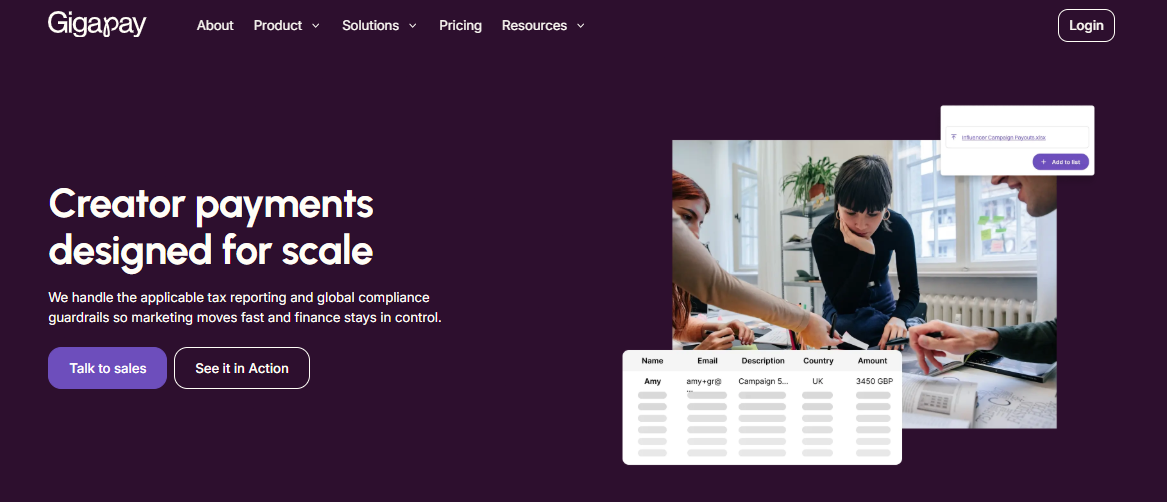
Gigapay is the mass creator payout platform that removes this problem at the source, acting as a single Merchant of Record so brands pay hundreds of creators through one vendor, one invoice, and full compliance.
Those late payments are a symptom of something bigger: the admin machinery behind influencer marketing, from vendor onboarding to invoice chasing, eats hours that almost no brand includes in its ROI calculation. The result is that most teams report an ROI number that looks better than the one their CFO would sign off on.
This article gives you the complete influencer marketing ROI formula for 2026, real salary and admin hour data, a worked example on 600 collaborations, and a free step-by-step calculator to find your true return.
Key Takeaways
- Influencer marketing returns an average of $5.78 for every $1 spent in 2026.
- Standard ROI formulas ignore admin labor, inflating reported returns by 15 to 20%.
- One manual creator collaboration costs around 1.4 hours of admin work.
- A brand running 600 collaborations spends roughly €139,590 per year on manual payouts.
- Consolidating payouts under one Merchant of Record cuts admin time by over 90%.
What Is the Average Influencer Marketing ROI in 2026?
The average influencer marketing ROI in 2026 is $5.78 earned for every $1 spent, based on the Influencer Marketing Hub benchmark that most of the industry uses as its reference point. Top-performing programs report returns of up to $18 per $1, while Instagram-specific campaigns average around $5.20. The money follows these numbers.
The industry reached $32.55 billion in 2025 and is on track to pass $40 billion in 2026, and 89% of marketers now rate creator campaigns as more effective than other marketing channels.
ROI also varies sharply by creator tier. Micro-influencer campaigns commonly deliver 5x to 8x returns because their per-post costs run lower and their engagement rates run higher than macro and mega tiers. This is exactly why enterprise brands keep pushing into nano and micro collaborations, and exactly where the admin problem starts. Paying 400 micro-creators generates 400 times the paperwork of paying one celebrity.
Influencer Marketing ROI Benchmarks by Channel and Tier
Every figure in this table shares one flaw. None of them count the cost of the people running the program.
Why Standard Influencer Marketing ROI Calculations Are Wrong
Standard influencer marketing ROI calculations are wrong because they divide revenue by media spend and stop there. Creator fees, platform costs, and paid amplification make it into the denominator. The 840 hours your marketing and finance teams spend onboarding vendors, validating tax IDs, chasing invoices, and fixing failed payments do not.
The scale of the gap shows up in the payment data. Up to 87% of creators have been paid late or experienced payment issues, according to figures from Tipalti and Lumanu cited in Campaign's 2026 investigation into creator payments. 41% of creators name payment delays as their single biggest pain point when working with brands.
Gigapay's own State of Influencer Payments research found payment terms stretching to 120 days at some enterprises. Every one of those delays represents hours of human work: a finance person reconciling a mismatch, a marketer apologizing to a creator, a procurement team processing yet another one-off vendor.
Those hours are real payroll. When a program runs on hundreds of collaborations, the labor cost behind it reaches six figures per year, which means reported ROI overstates true ROI for almost every brand that has never measured its admin time. In 2026, with CFOs scrutinizing creator budgets harder than ever, that gap is the difference between a renewed budget and a cut one.
The Influencer Marketing ROI Formula That Counts Admin Hours
The influencer marketing ROI formula that counts admin hours adds labor and operational costs to the denominator, so your return reflects what the program actually costs to run:
True ROI (%) = (Attributed Revenue − Total Program Cost) ÷ Total Program Cost × 100
Where Total Program Cost is the sum of five components:
Total Program Cost = Creator Fees + Product and Shipping Costs + Platform and Tool Fees + Admin Labor Cost + Error and Rework Cost
How to Calculate Admin Labor Cost per Campaign
Admin labor cost is calculated by multiplying the admin hours your program consumes by the fully loaded hourly rate of the people doing the work:
Admin Labor Cost = (Collaborations × Admin Hours per Collaboration) × Fully Loaded Hourly Rate
Fully loaded means salary plus employer costs such as social contributions, pension, and benefits, which typically add 25 to 35 percent on top of base salary in the UK and Western Europe. Using base salary alone undercounts the real cost of every hour.
What Counts as Admin Work in Influencer Marketing
Admin work in influencer marketing covers every task between "the creator said yes" and "the books are closed." That includes vendor onboarding and KYC checks, collecting and validating tax IDs, drafting purchase orders, receiving and correcting invoices, executing cross-border payments, reconciling bank statements against campaigns, answering creator payment questions, and preparing tax reports such as DAC7 in the EU or KSK filings in Germany.
Marketing teams carry some of these tasks and finance teams carry the rest, which is why the cost hides so well. No single department sees the full number.
How Many Admin Hours Does One Creator Collaboration Take?
One manually processed creator collaboration takes around 1.4 hours of admin work on average, based on Gigapay's analysis of a brand running 600 collaborations per year, which consumed roughly 840 admin hours annually. The time splits across small tasks that look harmless on their own and become a full-time job in aggregate.
Admin Time Breakdown per Manual Creator Payment
These numbers assume everything goes right. A failed cross-border transfer, a mismatched invoice, or a missing tax form adds 30 to 60 minutes of rework per incident, and with 87% of creators reporting payment issues, incidents are the norm rather than the exception. First-time collaborations also cost more than repeat ones, because vendor onboarding only happens once. A program built on nano and micro creators, where most collaborations are first-time, sits at the expensive end of every row in this table.
What Does an Admin Hour Cost in 2026? Salary Data by Market
An admin hour in influencer marketing costs between €40 and €62 in 2026, depending on market and role. The people doing payout admin are not cheap juniors. They are influencer marketing managers, finance operations specialists, and procurement staff whose salaries have kept rising with demand.
In the UK, the average Influencer Partnership Manager earns £68,200 per year as of July 2026, while mid-level influencer manager roles advertise at £45,000 to £60,000. Finance operations and accounts payable specialists across the UK, DACH, France, and the Nordics typically earn €40,000 to €55,000.
The table below converts those salaries into fully loaded hourly rates, assuming 30% employer costs and 1,720 productive hours per year. Figures outside the UK are market estimates and vary by city and seniority.
Fully Loaded Hourly Cost of Influencer Payment Admin by Region
A blended rate of €50 per hour is a fair planning assumption for a mixed marketing and finance workload in Gigapay's core markets. At that rate, the 840 admin hours behind 600 manual collaborations cost €42,000 in labor alone, before a single error, tool, or compliance cost is added.
Worked Example: True ROI on 600 Creator Collaborations per Year
A brand running 600 creator collaborations per year with a €1,000,000 creator budget and €3,500,000 in attributed revenue reports a 250% ROI under the standard formula. The true number is lower, and here is the math.
Gigapay's analysis of that exact program size puts the full annual cost of manual payouts at roughly €139,590, covering 840 admin hours, vendor sprawl across 300+ individual ERP entries, error cycles, and payment tooling. Running the same program through a single Merchant of Record costs roughly €46,350 per year, including Gigapay's fees, and cuts admin time to around 60 hours.
Manual Payouts vs Merchant of Record: ROI Comparison
The manual process quietly erases 43 percentage points of ROI. Consolidating payouts recovers 28 of them, worth €93,240 per year in direct savings, and hands back 780 hours that marketing and finance can spend on work that grows revenue instead of maintaining spreadsheets.
Boozt saw the operational side of this firsthand: after moving nano and micro payouts to Gigapay, the team tripled its collaborations without expanding headcount.
Free Influencer Marketing ROI Calculator: Step by Step
This free influencer marketing ROI calculator walks you through six inputs. Pull last quarter's numbers, work through each step, and you will have your true ROI in under ten minutes.
- Step 1: Add up attributed revenue: Count tracked sales from affiliate links, discount codes, and attribution models. Keep earned media value separate; it is a reach metric, not revenue.
- Step 2: Add up direct creator costs: Creator fees, gifted product at cost, shipping, and paid amplification of creator content.
- Step 3: Count your admin hours: Multiply your number of collaborations by 1.4 hours if your process is manual. If you track actual time, use that instead. Example: 600 collaborations × 1.4 = 840 hours.
- Step 4: Convert hours into money: Multiply admin hours by your fully loaded hourly rate. Use €50 per hour as a blended default for UK, DACH, French, and Nordic teams. Example: 840 × €50 = €42,000.
- Step 5: Add tooling, fees, and error costs: Payment provider fees, FX spreads, influencer platform subscriptions, and an error allowance of 5 to 10 percent of your admin labor cost if failed payments are common.
- Step 6: Run the formula:
True ROI (%) = (Step 1 − (Step 2 + Step 4 + Step 5)) ÷ (Step 2 + Step 4 + Step 5) × 100
Compare the result against the 478% industry average implied by $5.78 per $1. If your true ROI lands well below your reported ROI, the gap is your admin burden, and it is the easiest cost in the whole program to remove.
Hidden Costs That Lower Influencer Marketing ROI
Hidden costs lower influencer marketing ROI through three channels that rarely appear in any campaign report: creator churn, compliance exposure, and vendor sprawl.
Late Payments Drive Creator Churn and Raise Rates
Late payments drive creator churn because creators run self-funded businesses with thin cash buffers. Visa's 2026 research found that 86% of creator businesses are self-funded and 37% of creators say payment delays cause stress or anxiety.
Creators who get paid late either stop working with the brand or price the delay into their next quote. Replacing a proven creator costs sourcing time, negotiation time, and the performance risk of an untested partnership, all of which land back in your denominator.
Compliance Mistakes Carry Direct Financial Penalties
Compliance mistakes carry direct financial penalties that can wipe out a campaign's margin.
- In the EU, DAC7 requires platforms to report creator payments to tax authorities.
- In Germany, the Künstlersozialkasse levies 4.9% on payments to creators above €1,000 per year, and the obligation applies to German companies even when the influencer lives abroad.
- Sweden requires KU14 reporting for Danish payees.
Each regime means collecting the right data from every creator before payment, and a missed filing means back payments, interest, and audit hours that no ROI report ever shows.
Vendor Sprawl Slows Finance and Blocks Campaigns
Vendor sprawl slows finance because every individual creator onboarded as a supplier becomes a permanent ERP record that someone maintains. A 600-collaboration program creates 300+ vendor entries, each with bank details that go stale and tax forms that expire.
Procurement teams respond by restricting who marketing can work with, which is how brands end up locked out of the nano and micro tiers where ROI runs highest. The cost here is unrealized return, and it is often the largest hidden cost of all.
How to Reduce Admin Hours and Raise Influencer Marketing ROI
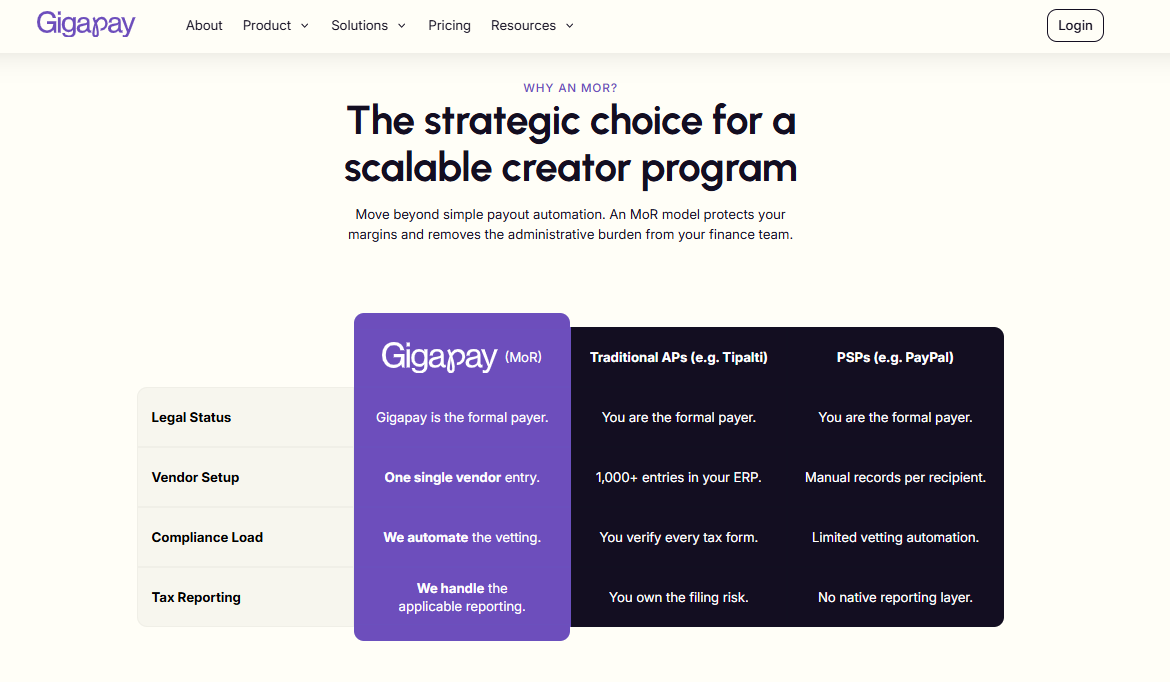
The fastest way to reduce admin hours is to consolidate all creator payments under a single Merchant of Record. A Merchant of Record becomes the formal counterparty to every creator, which collapses the entire admin chain into one relationship. Here is what changes in practice:
- One vendor replaces hundreds: Gigapay purchases the creator's deliverable and resells it to you, so your ERP holds one vendor entry whether you pay 50 creators or 5,000.
- One consolidated invoice per campaign replaces individual invoices: Self-billing automation generates invoices on behalf of creators, cutting invoice volume by around 80%.
- Onboarding moves off your plate: KYC, tax ID validation, and bank verification happen inside the platform, and creators can join as individuals without a registered business or VAT number, which removes the procurement barrier to nano and micro collaborations.
- Payments execute instantly: Batch payouts run via CSV upload or API across 65+ countries and 50+ currencies on local rails, so finance stops processing transfers one by one and creators stop chasing.
- Tax reporting runs automatically: DAC7, KU14, and KSK data handling happen as part of the payment flow instead of as a year-end scramble.
The effect on the formula is direct. Admin hours per collaboration drop from roughly 1.4 to 0.1, admin labor cost falls by more than 90%, and the error allowance in Step 5 of the calculator approaches zero.
Agencies see the same mechanics at enterprise scale: The GOAT Agency, part of WPPMedia, reported that implementing Gigapay significantly reduced the time its teams spend managing payments.
Influencer Marketing ROI Benchmarks to Target in 2026
The influencer marketing ROI benchmarks to target in 2026 cover both return and the operational metrics that protect it. Measure your program against all five, because a strong return built on 840 admin hours is a return that will not survive scale.
Creator retention deserves particular attention in 2026. Repeat collaborations skip onboarding entirely, perform better because the creator knows the brand, and cost less to negotiate. Paying instantly and reliably is the cheapest retention lever available, and it shows in the data: creators paid through Gigapay rate the experience at an NPS of 88.
Conclusion
Gigapay is the one-vendor payout platform that lets brands run influencer marketing at scale without the admin burden that eats their ROI.
The formula in this article changes what your return actually measures: once admin hours, salaries, errors, and compliance work enter the denominator, a reported 250% ROI becomes 207%, and the 43-point gap is money your team is paying in hours instead of euros.
The fix is structural. Consolidating hundreds of creator payments into one Merchant of Record relationship cuts admin time from 840 hours to around 60, recovers roughly €93,000 per year on a 600-collaboration program, and pays creators instantly instead of in 120 days.
Run your own numbers through the calculator, and when you want to see what the 60-hour version of your program looks like, book a demo with Gigapay.
Read Next:
- Best Way to Pay YouTube Creators Internationally in Bulk (2026 Guide)
- Creator Payment Audit Trail: What Auditors Ask For and How to Be Audit-Ready in 2026
- Paying Creators Who Have No Company or VAT Number: A Finance Team's Compliance Guide (2026)
FAQs:
1. What is the average influencer marketing ROI in 2026?
The average influencer marketing ROI in 2026 is $5.78 for every $1 spent, according to the Influencer Marketing Hub benchmark, with top programs reaching up to $18 per $1. Those figures exclude admin labor, so true ROI for most brands sits meaningfully lower.
2. How do you calculate influencer marketing ROI with admin hours?
You calculate influencer marketing ROI with admin hours by adding admin labor cost to your total program cost: True ROI = (Attributed Revenue − Total Program Cost) ÷ Total Program Cost × 100, where admin labor cost equals collaborations × 1.4 hours × your fully loaded hourly rate.
3. How many admin hours does one influencer collaboration take?
One influencer collaboration takes around 1.4 hours of admin work when processed manually, covering vendor onboarding, tax ID collection, invoicing, payment execution, and reconciliation. Automated payouts through a Merchant of Record reduce this to roughly 0.1 hours.
4. What is the biggest hidden cost in influencer marketing?
The biggest hidden cost in influencer marketing is admin labor, which reaches roughly €139,590 per year for a brand running 600 manual collaborations when hours, vendor sprawl, and error cycles are counted. Creator churn from late payments and compliance penalties such as Germany's 4.9% KSK levy add further uncounted costs.
5. How can brands reduce influencer payment admin costs in 2026?
Brands can reduce influencer payment admin costs in 2026 by consolidating all creator payments under a single Merchant of Record such as Gigapay, which replaces hundreds of vendor records with one, cuts invoice volume by around 80%, automates DAC7 and KSK-related data handling, and lowers admin time by more than 90%.
.jpg)
.jpg)
.jpg)