.jpg)

YouTube is projected to pay out around $25 billion to creators in 2026, and an increasing share of that money crosses a border before it lands in a creator's bank account.
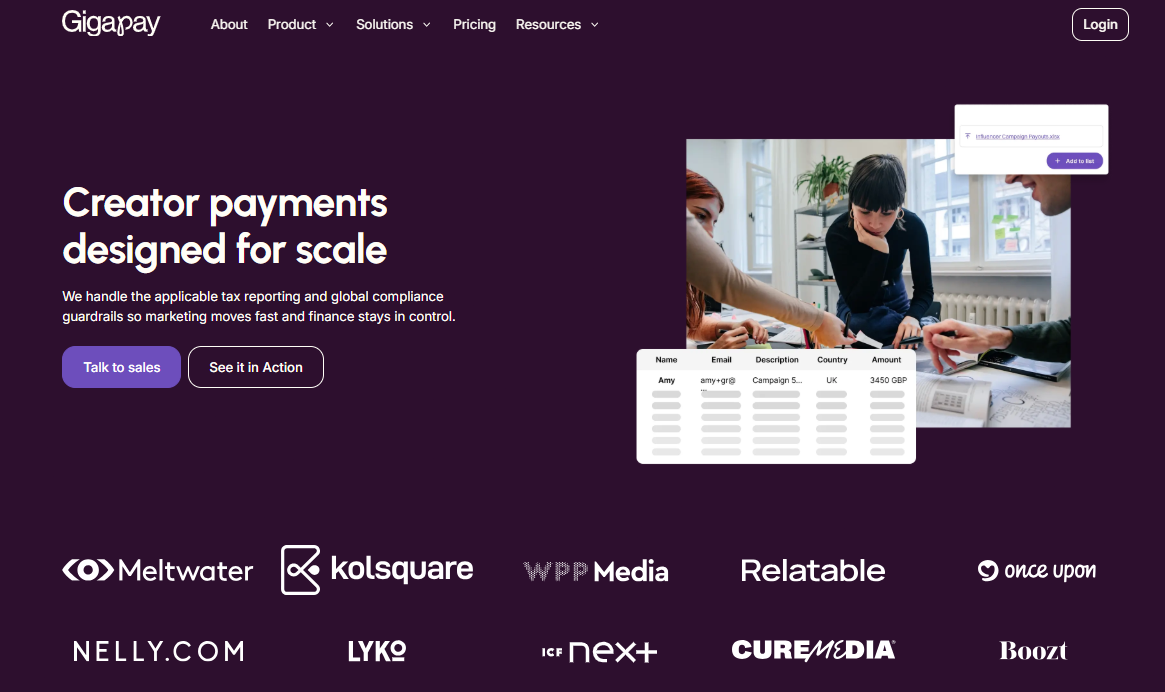
Gigapay is the mass creator payout platform that lets brands and agencies pay hundreds of YouTube creators across 65+ countries through a single vendor, with one contract and one consolidated invoice. Paying one creator abroad is easy.
Paying 300 of them across 40 tax jurisdictions, in a single batch, without your finance team losing a full workweek to invoices and tax forms, is a systems problem most companies have never solved.
This guide breaks down how bulk international YouTube creator payments actually work in 2026, what they cost, which methods exist, and why the Merchant of Record model has become the standard for teams that pay creators at scale.
Key Takeaways
- The best way to pay YouTube creators internationally in bulk is a Merchant of Record.
- Gigapay pays creators in 65+ countries and 50+ currencies from one CSV upload.
- A Merchant of Record replaces hundreds of creator vendors with one contract and invoice.
- Manual payouts cost one benchmark brand ~€139,590 per year; Gigapay cut it to ~€46,350.
- DAC7, KSK, and KU14 tax reporting run automatically inside Gigapay's compliance layer.
How Big Is the YouTube Creator Economy in 2026?
The scale explains why payment operations became a board-level topic. There are an estimated 69 million active YouTube creators worldwide in 2026, and YouTube has paid more than $100 billion to creators, artists, and media companies since 2021, a milestone the platform announced in September 2025.
The money around the platform grew just as fast as the money inside it. The creator economy is worth roughly $250 billion, up from $210 billion a year earlier, and the influencer marketing industry is projected to hit $40.51 billion in 2026 after reaching $32.55 billion in 2025.
Here is the number that matters most for anyone planning a YouTube creator budget: sponsored content makes up approximately 59% of creator revenue in 2026, ahead of platform payouts at 24.4% and affiliate marketing at 8.2%.
AdSense is not how most professional creators get paid anymore. Brands are. Which means brands, not Google, now carry the operational weight of moving that money across borders, correctly, on time, and in compliance with the tax rules of every country involved.
Why YouTube Creator Payments Are an International Problem by Default
YouTube audiences ignore borders, and so does creator supply. A German consumer brand can find its best-performing tech reviewer in Manila, its best unboxing channel in São Paulo, and its best finance explainer in Toronto, all in the same campaign.
The economics push in the same direction. YouTube CPMs vary drastically by country, with Australia leading at $36.21 and India averaging below $1, a gap of 40 to 50 times between the highest and lowest-paying markets. Because platform ad revenue is thin in emerging markets, creators there depend even more heavily on brand deals, and brands get access to enormous, engaged audiences at sponsorship rates far below Tier-1 pricing. India alone has approximately 491 million YouTube users.
The result is that any serious YouTube creator program is international from day one. And every additional country adds a new tax authority, a new set of payment rails, a new currency, and a new way for a payment to fail.
There is also a concentration problem worth knowing. CreatorIQ's State of Creator Compensation, published in January 2026, found that the top 1% of creators took 21% of payments and that just 3% of YouTubers earn 90% of the money.
The practical consequence for brands: the growth opportunity sits in the long tail of nano and micro creators, and the long tail is precisely the segment that traditional vendor onboarding cannot handle. Many of these creators have no registered business, no VAT number, and no patience for a 30-page supplier form.
What Makes Paying YouTube Creators in Bulk So Difficult?
Sending money abroad is a solved problem. Sending money abroad to 300 individuals, compliantly, as a business expense, is not. Five specific failure points show up in every scaled creator program.
Vendor Onboarding Does Not Scale to Hundreds of Creators
Standard procurement treats every payee as a supplier. That means a vendor form, a tax ID, banking details, sanctions screening, and an ERP entry for every single creator. A program with 300 creators produces 300 vendor records, and finance teams built for 20 suppliers drown.
Gigapay's benchmark analysis of a brand running 600 collaborations per year found the manual process consumed roughly 840 admin hours annually.
Tax Compliance Changes at Every Border
This is where most programs quietly take on risk. A few examples of what a brand paying YouTube creators internationally must contend with in 2026:
- DAC7 (EU): Digital platforms facilitating payments to EU-based sellers and service providers must collect and report seller data (name, address, tax identification number, VAT number) to tax authorities, which then exchange it across member states.
- Künstlersozialkasse (Germany): Companies commissioning creative work from individuals face a KSK levy, currently 4.9% on qualifying creative payments above €1,000 per year, and it can apply even when the paying company hires internationally.
- KU14 (Sweden–Denmark): Cross-border income reporting between Nordic tax authorities.
- Worker classification: European court decisions on influencer status mean a long-running creator relationship can drift toward employment-like classification, with social security consequences for the brand.
- Local permit regimes: The UAE introduced influencer permit requirements taking effect in 2026, obligating both brands and creators to verify licensing before paid collaborations.
No single in-house finance team tracks all of this across 40+ countries. Specialist platforms do, because it is their entire job.
Currency and FX Costs Eat the Budget Silently
Paying a Brazilian creator in USD via international wire typically costs $15 to $50 in fees plus a retail FX spread, and the creator often loses another slice to their receiving bank. Multiply that across hundreds of payments per quarter and FX leakage becomes a real line item, one that never appears in the campaign budget because it hides inside individual transactions.
Payment Delays Damage Creator Relationships
Gigapay's 2024 industry research with Billion Dollar Boy, Meltwater, and The Influencer Marketing Factory found payment terms stretching as long as 120 days in parts of the industry. A creator who waits four months to get paid does not come back for the next campaign, and word travels fast in creator communities. Payment speed is now a competitive advantage in creator recruitment, not an operational detail.
Fraud and Identity Verification at Volume
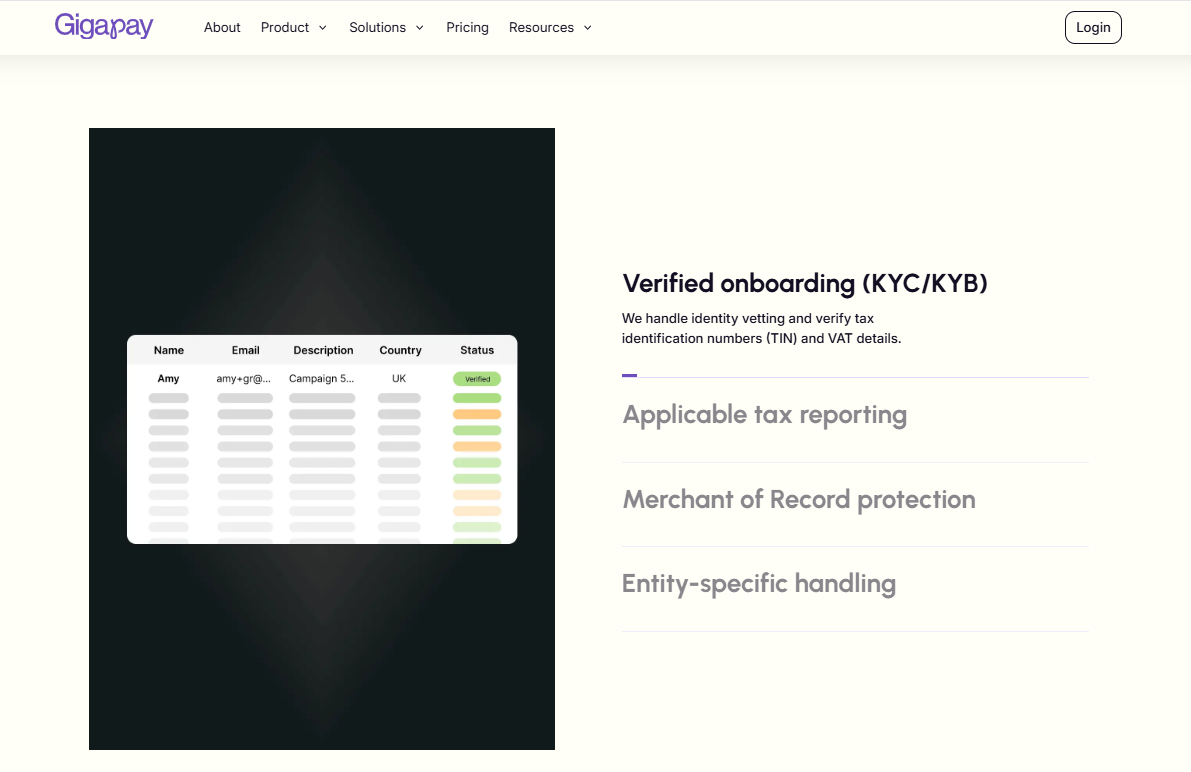
Every payee needs KYC before money moves: identity verification, bank account validation, sanctions screening, and tax ID checks. Doing this manually for hundreds of creators is slow. Skipping it exposes the company to fraud and regulatory penalties. This step alone rules out informal methods like paying creators through consumer apps.
What Is the Best Way to Pay YouTube Creators Internationally in Bulk?
The best way to pay YouTube creators internationally in bulk in 2026 is through a Merchant of Record (MoR) payout platform, and Gigapay is the platform built specifically for this use case in the creator economy.
Here is how the model works. Instead of your company contracting 300 creators directly, Gigapay formally purchases each creator's deliverable and resells it to you. Gigapay becomes the contractual counterparty to every creator, which makes Gigapay the single vendor in your ERP.
You sign one service agreement, receive one consolidated invoice per campaign or batch, and Gigapay takes over most of the administrative and legal responsibilities connected to purchasing the creators' work.
The practical effect on your operations:
- One vendor record replaces hundreds of individual creator entries in your ERP.
- One consolidated invoice replaces a stack of individual creator invoices. Gigapay cites an 80% reduction in invoice volume for its clients.
- No business registration required from creators. Individuals, sole traders, and companies can all onboard, which unlocks the nano and micro segment that procurement rules normally block.
- Automated tax reporting for DAC7, KSK (Germany), and KU14, handled by the platform rather than your finance team.
- KYC, tax ID validation, and VAT checks run on every creator before any payout is released.
In its Merchant of Record capacity, Gigapay handles tax reporting and compliance administration, but creators remain independent self-employed persons responsible for their own income taxes and social contributions in their home countries.
The exception is Gigapay's Employer of Record service in Sweden, where Gigapay files employer contributions and PAYE returns directly.
How Does Bulk Payout Execution Work with Gigapay?
The workflow from campaign close to money in creator accounts looks like this:
- Upload or integrate: Your team uploads a CSV with creator names, amounts, and currencies, or pushes the batch through Gigapay's REST API. A full API integration takes 2 to 5 days.
- Creators onboard once: Each creator completes KYC, provides tax information, and selects how they want to be treated (individual, sole trader, or company). No VAT number or registered business is required.
- Compliance checks run automatically: Identity verification, tax ID and VAT validation, and sanctions screening happen before funds move.
- Payouts execute on local rails: Gigapay pays creators in 65+ countries and 50+ currencies using local payment infrastructure: SEPA Instant in the EU, Faster Payments in the UK, ACH in the US. Creators get paid instantly rather than waiting days for international wires to clear.
- You receive one invoice: Finance books a single vendor invoice per batch, funded in USD, EUR, GBP, SEK, DKK, or NOK.
- Tax reporting files automatically: DAC7 data collection, Swedish reporting with international exchange of income statements, and KSK-relevant documentation run in the background.
Creators also get EarlyPay, a liquidity feature that gives them instant access to scheduled funds before the official payout date, plus a dedicated human support team.
Gigapay's creator NPS is 88, which matters to brands because a creator's payment experience directly shapes whether they work with you again.
Comparing Every Method for Paying YouTube Creators in Bulk
The structural difference sits in the middle column. Tipalti, Stripe Connect, and Wise move money and, at best, collect tax forms. Your company remains the counterparty to every creator, with everything that implies for vendor management and compliance exposure. The Merchant of Record model transfers the counterparty role itself. That is a different category of product, not a feature difference.
What Does It Cost to Pay YouTube Creators in Bulk in 2026?
Transparent numbers, since most guides avoid them.
There is no per-creator seat pricing, so scaling from 50 to 500 creators does not multiply your software cost.
The cost of the alternative
Gigapay's ROI analysis of a brand running 600 creator collaborations per year puts the fully loaded manual cost at roughly €139,590 annually: 840 admin hours across marketing, finance, and legal, plus vendor sprawl and error-correction cycles.
The same program running through Gigapay costs roughly €46,350 per year and consumes about 60 admin hours. The admin fee is visible on every invoice. The 840 hours were always invisible, which is why so many companies underestimate what their current process costs.
Real-world results back the model:
- Boozt reported a 3x increase in creator collaborations without expanding its team after adopting Gigapay, specifically because it could finally work with nano and micro influencers at scale.
- The Goat Agency, part of WPPMedia, reported significantly reduced time spent managing payments across its global campaigns.
How CPM Geography Shapes Your Creator Payment Strategy
Understanding where YouTube money concentrates helps you plan both recruitment and payout operations. Benchmark data as of Q4 2025 through Q1 2026 puts average CPMs at:
- $36.21 in Australia
- $32.75 in the US
- $29.15 in Canada
- $24.00 in the UK
- $22.00 in Germany
- $1.64 in Brazil
- $1.12 in the Philippines
- $0.70 to $0.74 in India
Two strategic consequences follow:
1. Emerging-market creators are underpriced relative to reach
A creator with two million subscribers in India or Brazil earns little from AdSense, so brand sponsorships form nearly all of their income and their rates reflect local ad economics.
Brands that can pay these creators compliantly access enormous audiences at a fraction of Tier-1 cost. The bottleneck is never finding them. The bottleneck is paying them, which is exactly what a bulk international payout platform removes.
2. Niche matters as much as geography
Finance and investing content commands CPMs of $15 to $50 per 1,000 impressions, the highest on the platform, and creators in high-CPM niches price their sponsorships accordingly. Budget models should account for both the creator's audience geography and their content category.
Compliance Rules You Cannot Ignore When Paying Creators Across Borders
A short, practical checklist of the regulatory layer in 2026, based on Gigapay's own legal research:
- Collect tax data before the first payment, not after: DAC7 requires platforms to hold each EU seller's legal name, primary address, tax registration number per member state, VAT number, and company registration details. Retrofitting this data across hundreds of creators mid-year is painful.
- Screen against FATF lists: As of the March 2026 FATF update, Iran, Myanmar, and North Korea sit on the black list, and 22 jurisdictions including Vietnam, Kenya, and Monaco are under increased monitoring. Payments touching grey-listed countries warrant extra due diligence.
- Budget for the KSK levy in Germany: The 4.9% Künstlersozialkasse charge on qualifying creative payments above €1,000 applies to companies commissioning creative work, and many international brands discover it only during an audit.
- Watch classification risk: Long-running exclusive relationships with individual creators can look like employment to European courts. Structure engagements as deliverable-based purchases, which is precisely what the Merchant of Record model does contractually.
- Verify reverse-charge VAT treatment: When creators invoice a foreign entity, the reverse charge system generally applies and no VAT appears on the invoice. Under Gigapay's model, creators invoice Gigapay in Sweden, which is why this applies consistently even when the brand and creator sit in the same country.
How to Choose a Bulk Payout Platform for YouTube Creators
Run every candidate platform through these seven questions:
- Who is the legal counterparty to the creator? If the answer is "you," the platform moves money but leaves the compliance exposure on your books.
- Can creators onboard without a registered business? If not, you have locked yourself out of most of the nano and micro segment.
- Which tax reporting regimes are automated? Ask specifically about DAC7, KSK, and local income reporting, and ask who files.
- What payment rails does it use? Local rails (SEPA Instant, Faster Payments, ACH) mean instant, low-cost payouts. Correspondent banking means days of delay and stacked fees.
- How does it invoice you? One consolidated invoice per batch, or one per creator? Your AP team will feel the difference every month.
- What is the creator's experience? Check for dedicated support, early-access liquidity, and an actual creator satisfaction metric. Creators who get paid well come back.
- How fast is integration? A REST API with sandbox access and a measured-in-days integration timeline beats a six-month enterprise implementation.
Gigapay answers all seven in the affirmative, which is the honest reason it anchors this guide. It is also ISO 27001 certified and GDPR compliant, which your security review will ask about before your marketing team does.
Conclusion
Gigapay is the Merchant of Record platform that lets brands and agencies pay hundreds of YouTube creators across 65+ countries through one vendor, one contract, and one consolidated invoice.
The math of 2026 is straightforward: creator budgets keep growing, the highest-value creator supply is global, and every payment method short of a Merchant of Record leaves your team holding the vendor sprawl, the tax reporting, and the compliance risk.
The companies scaling creator programs fastest are the ones that stopped treating payments as an admin task and started treating them as infrastructure.
Book a demo with Gigapay and send your first bulk payout the same week you sign.
Read Next:
- Creator Payment Audit Trail: What Auditors Ask For and How to Be Audit-Ready in 2026
- Paying Creators Who Have No Company or VAT Number: A Finance Team's Compliance Guide (2026)
- ViDA and Creator Payments: How EU "VAT in the Digital Age" Changes Influencer Invoicing for Finance Teams (2026–2030)
FAQs:
1. What is the best way to pay YouTube creators internationally in bulk in 2026?
The best way to pay YouTube creators internationally in bulk in 2026 is a Merchant of Record platform like Gigapay, which pays creators in 65+ countries and 50+ currencies from one CSV upload or API call while acting as the single contractual vendor for your finance team.
2. How much does it cost to pay YouTube creators in bulk with Gigapay?
It costs €279 per month plus a 4.9% admin fee per payout to pay YouTube creators in bulk on Gigapay's Base plan, while Enterprise pricing with volume discounts applies above €1.8 million in annual payout volume.
3. How does a Merchant of Record work for YouTube creator payments?
A Merchant of Record works for YouTube creator payments by formally purchasing each creator's deliverable and reselling it to the brand, which makes the MoR the legal counterparty to every creator and leaves the brand with one vendor, one contract, and one consolidated invoice.
4. What tax rules apply when paying YouTube creators in different countries?
The tax rules that apply when paying YouTube creators in different countries include DAC7 reporting for EU-based creators, Germany's 4.9% KSK levy on creative payments above €1,000, KU14 reporting between Sweden and Denmark, and reverse-charge VAT on cross-border creator invoices.
5. Can brands pay YouTube creators who do not have a registered business?
Yes, brands can pay YouTube creators who do not have a registered business by using Gigapay, which lets creators onboard as individuals without a company or VAT number, completes KYC on each payee, and handles the income reporting that direct payments would leave undone.
.jpg)