.jpg)

Federal Trade Commission civil penalties for undisclosed creator endorsements now reach up to $53,088 per violation in 2026, with each non-compliant post counting as a separate violation.
Gigapay is the mass creator payout platform that operates as a Merchant of Record for brands and agencies paying YouTube creators across 65+ countries, so a single vendor absorbs the tax and compliance work behind every payment.
The rules for paying creators tightened in three separate jurisdictions this year: the United States raised the 1099-NEC threshold to $2,000 under the One Big Beautiful Bill Act, the European Union enforced DAC7 platform reporting on creator income, and Germany kept the Künstlersozialabgabe levy at 4.9% for companies paying creators.
YouTube deals command a 20 to 50% premium over Instagram for equivalent audiences, which puts more of the total influencer spend into the highest-risk compliance category.
This article walks through the three routes brands and agencies actually use to pay YouTube creators legally in 2026, what each one costs in admin time and legal exposure, and how to choose the fit for your creator program.
Key Takeaways
- Direct contractor payments keep brands liable for W-9/W-8, 1099-NEC, DAC7, and KSK reporting.
- Payment processors move money but leave tax and classification liability on the paying brand.
- Merchant of Record platforms take over the legal counterpart role for every creator payout.
- YouTube creator payments cross borders often, which multiplies the number of applicable tax rules.
- Gigapay pays creators in 65+ countries from a single vendor record with instant payouts.
The YouTube Creator Payment Market in 2026
The creator brand deals market reached $32.55 billion in 2026 and is growing at roughly 25% year-over-year, with YouTube commanding a 20 to 50% premium over Instagram for equivalent audiences. Brands earn an average of $5.78 for every $1 spent on creator partnerships, which is one reason 87% of marketers now include influencer partnerships in their strategy.
The result is that more marketing spend is flowing to YouTube creators every quarter, and more of that spend is being routed through in-house programs rather than agencies.
Two structural shifts inside the market shape how brands run YouTube payment operations. The first is the move from one-off sponsored uploads to long-term ambassador relationships. The Influencer Marketing Factory's Brand Deals Report 2026, which analysed over 316,000 promoted posts across Instagram, TikTok, and YouTube, found that long-term partnerships are growing faster than one-off deals because repeated exposure to the same creator's audience drives significantly better conversion.
The second is the geographic expansion of programs. A single brand campaign in 2026 routinely spans creators in the US, the UK, Germany, France, and the Nordics inside the same quarter.
The rate structure also concentrates spend into the highest-compliance-risk verticals. Finance, business, and investing YouTube channels command CPMs between $50 and $200, and a channel with 100,000 subscribers in these verticals can charge $5,000 to $20,000 per integration.
That volume of high-ticket payments to a rotating roster of creators is exactly the profile that triggers 1099-NEC reporting in the US, DAC7 reporting in the EU, and KSK levy calculations in Germany. Which raises the operational question this article answers: what is the actual mechanism a brand uses to move money to a YouTube creator, at scale, without breaking any of those rules?
The Compliance Rules That Shape Legal YouTube ayments in 2026
Legal YouTube creator payments in 2026 rests on four things at once: correct contractor or employee classification, valid tax documentation on file for the creator's jurisdiction, accurate tax reporting to the right authority, and an FTC-compliant disclosure attached to every sponsored upload.
The rules tightened across every major market this year:
- In the United States, the One Big Beautiful Bill Act raised the 1099-NEC threshold to $2,000 for payments made after December 31, 2025, and permanently reverted the 1099-K threshold to $20,000 and 200 transactions.
- In the European Union, DAC7 requires digital platforms to report creator income directly to national tax authorities.
- In Germany, the Künstlersozialabgabe levy sits at 4.9% for 2026 and applies to companies on top of what they pay creators, including on international hires, once payments to any single creator pass €1,000 in a year.
- In the United Arab Emirates, the National Media Authority now requires creators and the brands hiring them to hold an active influencer permit before content is published.
The gaps in this system are where liability sits. Around 78% of US sponsored posts carry adequate disclosures, which leaves roughly one in five exposed to FTC action. UK non-compliance estimates run between 34% and 43%. Brands and creators share liability for undisclosed endorsements, and penalties stack across posts.
Recent enforcement is not theoretical: the FTC and state attorneys general reached a $9.4 million settlement with Google and iHeartMedia over undisclosed endorsements, Kim Kardashian paid $1.26 million to settle SEC charges over an undisclosed EthereumMax promotion, and Teami settled for $930,000 over influencer campaigns lacking clear disclosure.
Every legal route below has to satisfy these four requirements. What changes between routes is who does the work.
The 3 Ways to Legally Pay YouTube Creators in 2026
Three routes for paying YouTube creators legally hold up in 2026. Each meets the same four legal requirements from the previous section, but they distribute the workload and the liability across different parties. The routes below run in order of how much of the compliance work stays on the paying brand, from most to least.
1. Pay YouTube Creators Directly as Independent Contractors
Direct contractor payment is the model most in-house creator programs default to when they start. The brand contracts each creator individually, collects a W-9 or local equivalent before the first payment, records payments on file, and issues a 1099-NEC (US) or country-specific tax form at year-end.
The model works well up to a certain volume. For a brand running 10 to 20 YouTube collaborations a year in a single jurisdiction with contractors who have a registered business, it is the cleanest option. Every payment is documented, no third-party fees are involved, and no external contract is needed to manage the flow.
The model breaks around scale. A brand running 600 creator collaborations a year spends approximately 840 administrative hours on payment operations under the direct model. That includes contract issuance, tax document collection, invoice review, ERP vendor setup for each creator, cross-border compliance research, and error cycles when a creator's tax ID is invalid or their invoice is missing a VAT number.
Total loaded cost sits around €139,590 a year for a program of that size, most of which is not the money going to creators.
Three specific pressure points show up as the program scales:
- Vendor sprawl in the ERP: Every creator becomes a vendor record. Procurement onboards each one, finance validates their bank details, and the system holds 300+ individual entries that all have to be maintained and audited.
- Cross-border reporting: DAC7 in the EU, KU14 in Sweden, KSK in Germany, and 1099-NEC in the US each require a different set of data points, a different filing cadence, and a different penalty regime. The in-house finance team has to build workflows for all of them.
- Classification risk: European courts continue to rule on when a creator is a contractor versus an employee. A brand paying 40 creators directly, month after month, on the same brief, in the same style, may look less like a client of contractors and more like an employer.
Direct payment is legal and defensible. It is also the most operationally expensive route, and the one where most compliance mistakes originate.
2. Pay YouTube Creators Through a Payment Processor
Payment processors move money quickly. PayPal Payouts, Wise, and Stripe Connect all let a brand batch-send payments to creators across borders without setting each one up as an individual vendor in the ERP. The API integrations are straightforward, and the per-transfer costs are lower than a manual wire.
A payment processor moves money without taking over the brand's legal counterpart role. The brand still collects the W-9 or W-8 before payment, issues the 1099-NEC or local equivalent at year-end, files DAC7 and KSK reports itself, holds the FTC disclosure liability, and owns the risk if a European court reclassifies a repeat contractor as an employee. Contracts remain between the brand and each individual creator, which means each creator is still a separate vendor record for procurement and audit purposes.
The processor model works well for brands that have already built strong compliance workflows in-house and only need faster money movement. It saves time on the payment step, not on the paperwork around it. For a brand running 600 collaborations a year, the admin burden of paying through a processor is roughly the same as paying directly. The savings sit in the wire fees and the speed of settlement, which matter to creators but do not reduce the compliance workload for finance and legal.
Where processors fall short specifically for YouTube programs is on the long-tail: nano and micro creators who do not have a registered company, a VAT number, or a bank account that accepts high-value cross-border SWIFT transfers. Every one of those onboardings still becomes a manual finance ticket.
3. Pay YouTube Creators Through a Merchant of Record Platform
A Merchant of Record platform sits between the brand and the creator as the formal contractual counterpart. Gigapay, in this model, buys the creator's deliverable and concurrently resells it to the brand client. The paperwork trail runs brand-to-Gigapay, then Gigapay-to-creator, which changes what each party is liable for.
This is the route most global creator programs at scale run on in 2026. A few things change compared to the first two options:
- One vendor in the ERP, not 300: Procurement onboards Gigapay once. Finance receives one invoice per campaign or batch. The 80% invoice volume reduction Gigapay cites for enterprise brands comes from consolidating hundreds of individual creator invoices into a single self-billed document per period.
- Cross-border tax reporting is automated: DAC7, KU14, and KSK reporting run in the background. For a brand paying creators in 12 EU countries, the UK, and the US, that removes the need to build separate workflows per jurisdiction.
- Creators onboard without a registered business: Nano and micro creators, who dominate the sub-10,000 subscriber tier, rarely have a VAT number or a company. Gigapay accepts individuals, sole traders, and companies. The 3x increase in collaborations Boozt reported after moving to Gigapay came directly from being able to work with creators who could not previously invoice the finance team.
- Payouts land instantly: Local rails including SEPA Instant in the EU, Faster Payments in the UK, and ACH in the US send money to the creator the moment the payout is released, which lifts creator NPS to 88 and gives creators access to EarlyPay if they need liquidity before the scheduled release.
The ROI benchmark for a program of 600 creator collaborations a year: 840 administrative hours drop to approximately 60, and the total loaded cost of €139,590 drops to approximately €46,350. The vendor entries in the ERP drop from 300+ down to one.
The specific compliance nuance to hold: in its MoR capacity, Gigapay takes on the administrative and legal responsibilities connected to the purchase of the creator's deliverable, and it handles the tax reporting, invoicing, and payment execution. It is not responsible for withholding or paying social security or making insurance contributions for the creator, which remains the creator's obligation under their local tax law.
The Swedish Employer of Record service is the exception, where Gigapay operates as the formal employer.
How to Choose Between the Three Routes
The right route depends on volume, geography, and how much of the compliance work the internal team can carry. A rough map of the boundaries:
- Under 20 collaborations a year in a single jurisdiction: Direct contractor payment is usually the cleanest option. The admin overhead sits below the cost and contract complexity of adding a third-party platform.
- 20 to 100 collaborations a year, cross-border, with strong internal finance capacity: A payment processor plus an in-house compliance workflow can work, though the burden on finance grows with every new jurisdiction added.
- 100+ collaborations a year, cross-border, or any program that includes nano and micro creators without registered businesses: A Merchant of Record platform becomes the practical default. The volume of vendor onboarding, tax reporting, and creator support required to run the program in-house exceeds what most finance teams can carry without a new headcount.
The other input worth naming is the creator experience. YouTube creators in the 10,000 to 500,000 subscriber tier choose which brands to work with based partly on how the payment process feels.
A slow invoice cycle, a rejected onboarding, or a payment that lands 45 days after publication all signal to a creator that the brand is difficult to work with. Instant payouts, self-billing, and no requirement to have a registered company change that signal.
What Makes YouTube Creator Payments Harder Than Other Platforms
YouTube creator payments carry three specific complications that TikTok and Instagram programs do not carry to the same degree.
1. The deal sizes are larger
A finance channel with 100,000 subscribers commands $5,000 to $20,000 per mid-roll integration, which puts almost every US payment above the $2,000 1099-NEC threshold, every EU payment inside DAC7 platform reporting, and every German creator payment past the €1,000 KSK levy line inside a single deal. Nothing sits below the threshold, so nothing is exempt from the reporting workload.
2. The deal structures are more layered
A single YouTube brand integration often includes a mid-roll segment, an end-card call-to-action, a description link, and a community post referencing the same product. Each of those deliverables can be scrutinised separately for FTC disclosure, and each falls under the same contract. If the disclosure is missing on one of them, the FTC treats it as a separate violation, and per-violation penalties reaching $53,088 stack across the deliverables inside one deal.
3. Ambassador programs are the direction the market is moving
The Influencer Marketing Factory's 2026 data shows long-term partnerships growing faster than one-off deals. A creator paid quarterly across a year sits inside every reporting bracket, generates more paperwork to reconcile, and moves closer to the line courts use to reclassify contractors as employees. Programs that run one-off deals can get by with a looser process. Programs that run ambassadorships across YouTube cannot.
How Gigapay is Built for YouTube Creator Payment Programs
Gigapay's product is built around the operational shape of large YouTube creator programs. The core is the Merchant of Record model: Gigapay purchases each creator's deliverable and resells it to the brand, so procurement onboards one vendor and finance receives one invoice per campaign or batch instead of dozens.
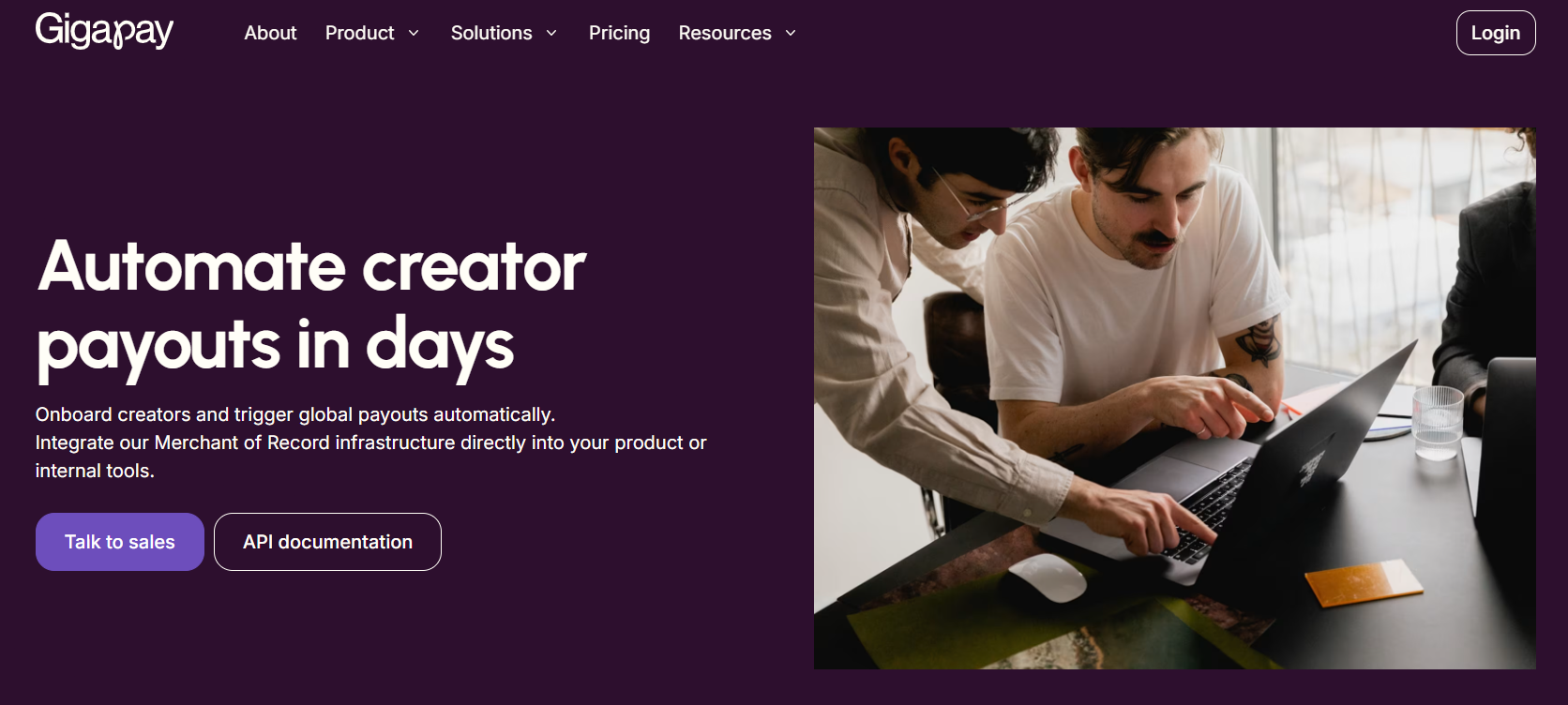
The payment workflow runs either through a CSV upload or through the REST API at developer.gigapay.se. A brand can upload a spreadsheet of creators and payment amounts, or embed Gigapay into an internal dashboard, agency platform, or CRM through the API. Full API integration typically takes 2 to 5 days, with a sandbox environment for testing before production.
Kolsquare, an influencer marketing platform, uses the API integration so creators can invoice and get paid inside the Kolsquare product, which is the model an agency running a YouTube campaign inside its own tooling would use.
On the creator side, Gigapay accepts individuals, sole traders, and companies as payees, without requiring a registered business or a VAT number. Payouts land instantly through SEPA Instant in the EU, Faster Payments in the UK, and ACH in the US, across 65+ countries and 50+ currencies.
EarlyPay gives creators access to scheduled funds before the release date, which matters for nano and micro YouTube creators running month-to-month and for larger creators whose income sits in irregular deal-based cycles.
On the compliance side, DAC7, KU14, and KSK reporting run automatically in the background. KYC and KYB checks with Tax ID and VAT validation happen at onboarding. Gigapay is ISO 27001 certified and GDPR compliant, which covers the security posture requirements most global brand procurement teams ask for during vendor review.
Pricing runs €279 a month on the Base plan with a 4.9% admin fee per payout, or custom on the Enterprise plan for programs above €1.8 million in annual payout volume. Enterprise includes EarlyPay, a dedicated customer success manager, and unlimited users and API rate.
Real Numbers From Brands Running This in 2026
Boozt increased creator collaborations 3x after moving to Gigapay, without adding headcount to the brand activation team. Nano and micro creators who could not previously invoice the finance team became payable within the same workflow as the larger creators.
"We've been trying to find a way forward with nano- and micro-influencers for years and Gigapay really enabled this," said Christina Oliosi, Brand Activation Lead at Boozt.
WPPMedia's GOAT agency reported that implementation of Gigapay significantly reduced the time spent managing creator payments. In a global agency structure with campaigns running across multiple markets, the compression of payment operations matters as much as any media-side efficiency.
"The implementation of Gigapay has significantly diminished the time spent on managing payments," said Martin Leiva Godoy, Global Senior Manager at GOAT (WPPMedia).
Kolsquare integrated Gigapay so creators can invoice and get paid directly inside the Kolsquare product. The integration means an agency running a campaign inside Kolsquare never has to leave the workflow to handle payment operations elsewhere.
Conclusion
Gigapay is the mass creator payout platform that acts as the single Merchant of Record for global YouTube creator programs, so one vendor absorbs the tax reporting, invoicing, and payment work across 65+ countries.
The three legal routes to pay YouTube creators in 2026 (direct contractor payments, payment processors, and Merchant of Record platforms) trade off differently on volume, admin time, and legal exposure.
For any program running dozens of creators a month across multiple jurisdictions, the MoR route is the one that keeps compliance current without adding finance headcount.
Book a demo to see how Gigapay handles the tax reporting, invoicing, and instant payouts for your YouTube creator program.
Read Next:
- Best Influencer Payment Platforms for Brands with 100+ Influencers in 2026
- How Gigapay Handles Procurement for Global Brands
- 3 Ways to Use the Gigapay API as a Global Company
FAQs:
1. What is the safest way to pay YouTube creators internationally in 2026?
The safest way to pay YouTube creators internationally in 2026 is through a Merchant of Record platform that assumes the counterpart role, automates cross-border tax reporting, and holds valid KYC on every creator before the first payout.
2. Do brands need to file a 1099-NEC for every YouTube creator they pay in 2026?
Brands need to file a 1099-NEC for every US-based YouTube creator paid $2,000 or more in a calendar year, following the threshold increase from $600 under the One Big Beautiful Bill Act, with the income remaining taxable and a W-9 remaining required below that threshold.
3. How does DAC7 affect brands paying YouTube creators in the European Union?
DAC7 affects brands paying YouTube creators in the European Union by requiring digital platforms to report creator earnings directly to national tax authorities, which closes the room creators previously had to under-report cross-border income and shifts more of the reporting burden onto the paying platform.
4. What is the German KSK levy and does it apply to YouTube creator payments?
The German KSK levy is a Künstlersozialabgabe charge set at 4.9% for 2026, applied to companies on top of what they pay creators, and it applies to YouTube creator payments once total annual payments to a single creator pass €1,000, including on international hires.
5. How does Gigapay pay YouTube creators legally across 65+ countries?
Gigapay pays YouTube creators legally across 65+ countries by acting as the Merchant of Record, purchasing the creator's deliverable and reselling it to the brand, then handling KYC, tax reporting, self-billed invoicing, and instant payouts to the creator's local account.

.jpg)
.jpg)