.jpg)

According to the Influencer Marketing Hub Benchmark Report 2026, 87.49% of brands expect influencer marketing budgets to increase this year, and 72.22% of them are planning increases of 50% or more.
Gigapay is the mass creator payout platform that operates as a Merchant of Record, taking on tax and compliance responsibility so global brands can pay hundreds or thousands of creators through one contract instead of managing each individual as a separate vendor.
As spend scales, the administrative load scales with it: tax IDs, cross-border reporting, per-country legislation, and invoice sprawl that hits finance long before it hits the campaign timeline.
This article breaks down the ten specific benefits of Gigapay's Merchant of Record model for global brands and what each one changes in day-to-day operations.
Key Takeaways
- Gigapay's Merchant of Record model makes one vendor answer for hundreds of creator payouts.
- Gigapay handles DAC7, KSK, and KU14 tax reporting automatically across 65+ countries.
- Legal responsibility for creator payments transfers to Gigapay under a formal service agreement.
- Brands cut admin time on creator payments from roughly 840 hours to 60 per year.
- Creators onboard without a registered business, opening nano and micro tiers to enterprise programs.
What "Merchant of Record" Actually Means for Creator Payouts
A Merchant of Record is the party that formally sells goods or services to the end customer and takes on the associated tax and compliance responsibility.
Gigapay's Service Agreement (§3.3) describes the arrangement plainly: Gigapay buys the creator's deliverable and concurrently resells it to the brand, becoming the formal counterparty on both sides of the transaction.
For a global brand, the practical outcome is that the counterparty on every creator payment is Gigapay Sweden AB, not the individual creator. For tax reporting, KYC, invoice matching, and audit purposes, the entire program consolidates into a single vendor relationship.
One nuance worth being precise about: in its Merchant of Record capacity, Gigapay is not responsible for withholding or paying social security or other creator-side taxes, which remain each party's own responsibility under applicable law.
Reporting is automated, but the parties still comply with their own tax obligations. The rest of this article walks through what that consolidation actually delivers in operational terms.
The 10 Benefits of Gigapay's Merchant of Record for Global Brands
1. One Legal Counterparty for Every Creator Payment
The core of Gigapay's Merchant of Record model is that Gigapay formally buys the creator's deliverable and resells it to the brand. That makes Gigapay the brand's counterparty on the transaction, not the creator.
When tax authorities, auditors, or procurement ask who paid whom, the answer is one entity across the entire program. The Service Agreement makes this explicit: Gigapay takes over most administrative and legal responsibilities connected to the purchase of a creator's deliverable.
For a global brand running collaborations across ten countries, that removes the need to establish a new vendor relationship with every individual in every jurisdiction. One contract covers the program.
2. One Vendor Line in Your ERP Instead of Hundreds
A brand running 600 collaborations a year typically ends up with 300+ new vendor entries across accounts payable. Every entry requires a W-9 or local equivalent, a tax ID validation, banking details, invoice matching, and ongoing maintenance. Under Gigapay's Merchant of Record model, the ERP has one supplier: Gigapay Sweden AB.
Every creator payout flows through that single vendor record, regardless of how many creators are in the campaign.
Christina Oliosi, Brand Activation Lead at Boozt, described the operational change directly:
"We've been trying to find a way forward with nano- and micro-influencers for years and Gigapay really enabled this."
That change tripled Boozt's collaboration volume without expanding the team.
3. Automated Tax Reporting for DAC7, KSK, and KU14
European tax reporting is now a central part of any creator program. Gigapay handles reporting automatically for DAC7 (the EU platform economy reporting directive), KU14 (Sweden's payment reporting standard), and Künstlersozialkasse (Germany's 4.9% levy on creative payments above €1,000, which applies even when hiring internationally).
Under the Merchant of Record model, Gigapay generates and files the required reports directly with the relevant authorities. This is reporting, not withholding, and it removes the need for an in-house tax specialist to track every country's individual filing requirement. At audit time, the reports already exist in the format the regulator is asking for.
4. Roughly 80% Fewer Invoices for Finance to Process
Instead of finance receiving one invoice per creator per collaboration, Gigapay consolidates them into a single campaign or batch invoice. For a program with 600 creator collaborations, that is the difference between 600 invoices arriving in accounts payable and roughly a dozen consolidated documents that map cleanly to campaign budgets.
Gigapay cites an 80% reduction in invoice volume as a benchmark across active customers.
Self-billing automation also removes the biggest single source of delay in creator payments: the wait for the creator to figure out how to invoice properly. Gigapay generates the invoice on the creator's behalf, so the payment cycle does not stall on a document.
5. Instant Payouts Across 65+ Countries and 50+ Currencies
Global creator programs stall when a payout takes five business days to land in the wrong country in the wrong currency. Gigapay pays creators instantly across 65+ countries and 50+ currencies, using local payment rails including SEPA Instant in the EU, Faster Payments in the UK, and ACH in the US.
Funding on the brand side works from a smaller set of currencies (USD, EUR, GBP, SEK, DKK, NOK), which means finance is not managing FX exposure across every payout country. The complexity sits on the platform side.
Martin Leiva Godoy, Global Senior Manager at GOAT / WPPMedia, put the operational impact plainly:
"The implementation of Gigapay has significantly diminished the time spent on managing payments."
6. Access to Nano and Micro-Creators Without Business Registration
Most enterprise procurement systems require creators to have a registered business, a VAT number, or both. That single requirement blocks brands from working with nano and micro-creators, who often have the highest engagement rates but rarely operate through a limited company.
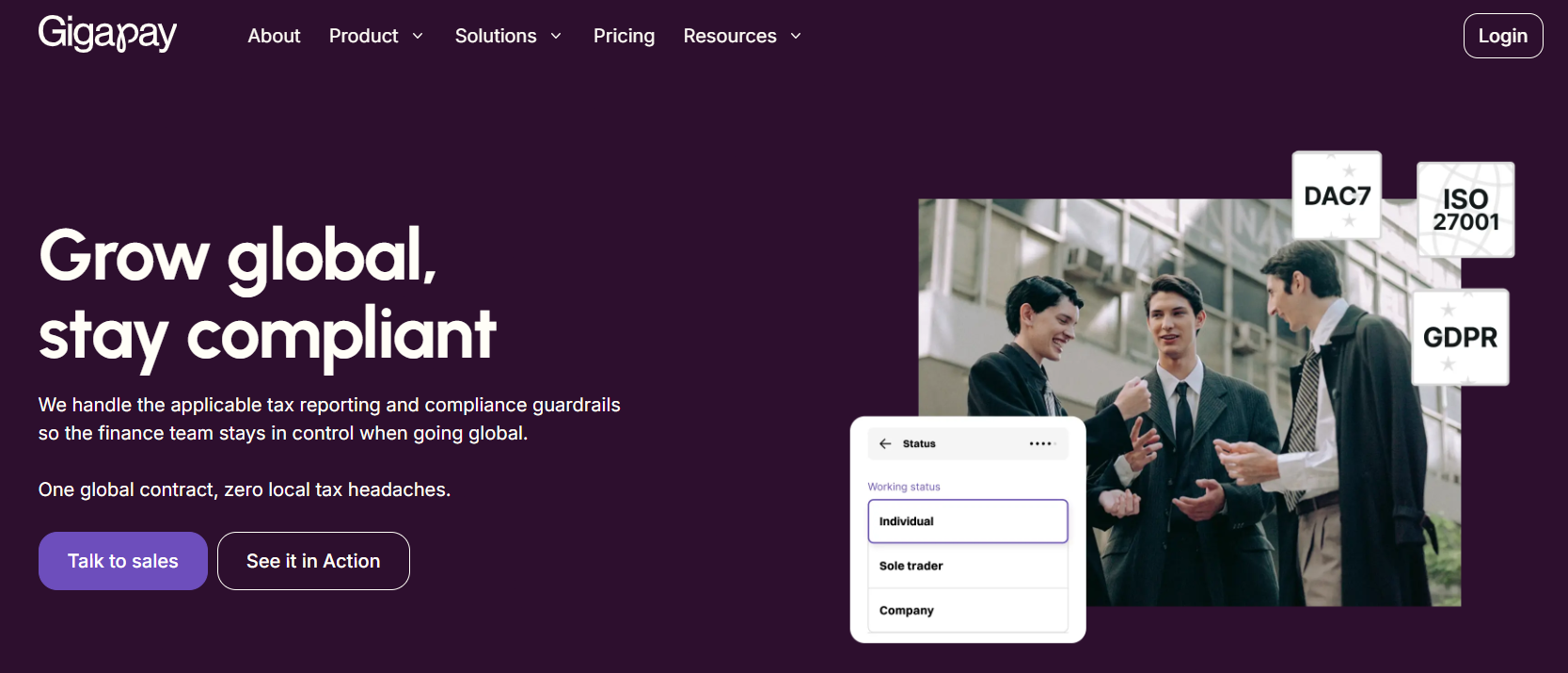
Gigapay allows creators to onboard as an individual, a sole trader, or a company. No registered business or VAT number is required. That opens the entire nano and micro tier to enterprise brands that would otherwise be structurally cut off from it.
7. Admin Time on Creator Payments Falls From Around 840 Hours to 60 Per Year
Gigapay's own ROI analysis, based on a brand running 600 creator collaborations per year, estimates manual creator payment admin at roughly €139,590 annually across 840 hours of finance and marketing time. With Gigapay, that figure drops to around €46,350 and 60 hours.
The savings come from removing vendor onboarding, tax documentation collection, invoice matching, error correction cycles, and cross-border tax reporting from the internal workload. Those hours go back to the campaign team, where they compound into faster brief-to-live cycles and stronger creator relationships.
8. Scale From 50 to 5,000 Creators Without Adding Headcount
Because the operational load per creator stays close to constant regardless of program size, adding creators to a Gigapay-backed program does not require adding people to the finance or ops team. Both the API and the CSV upload models handle high-volume campaigns without additional per-creator work.
That answers a common budget-review question: "If we double the creator program next year, how many people do we need to hire?"
Under this model, the answer is often zero. The internal team spends its time on strategy and creator selection, not on maintaining vendor records.
9. A Creator Experience That Improves Retention and Rebooking
Creators talk to each other. A creator who gets paid the same day they deliver, without chasing an invoice, is a creator who takes the next brief seriously and delivers on time. Gigapay's creator NPS sits at 88 out of 100, which is high enough to change the negotiation dynamic on repeat collaborations.
Two features drive that number:
- Payouts land instantly through local rails.
- EarlyPay gives creators access to scheduled funds before the standard settlement date, which matters more than most brand-side teams realize.
The knock-on effect is a lower churn rate on the creator roster, which reduces the cost of finding replacements every campaign cycle.
10. API-First Integration That Fits an Existing Enterprise Stack
Gigapay is built to be embedded, not just used as a portal. The REST API covers project creation, prepayments, payouts, and creator registration. Webhooks push real-time events into internal dashboards, CRMs, or affiliate platforms. Sandbox and production environments are both available. Documented integration time is 2 to 5 days.
For agencies and platforms like Kolsquare, that means Gigapay can sit behind the interface creators already use, so the brand's team never touches a second dashboard. As AdRecord's CEO summarized:
"Simplicity, responsibility, and seamless API integration make this a no-brainer."
What Changes for Marketing, Finance, and Procurement
Marketing can activate a nano-creator on Tuesday afternoon and see them paid the same day, without submitting a vendor request that takes two weeks to clear. Creator briefs stop stalling in accounts payable.
Finance gets one invoice per campaign instead of hundreds, one vendor to reconcile instead of a shifting supplier list, and automated compliance filings that would otherwise pull an in-house tax specialist into every country's individual requirements. Audit readiness improves at the same time as workload drops.
Procurement gets a defensible sourcing story: one contract, one Merchant of Record partner, one auditable trail across every country the program runs in. The compliance risk that made procurement slow to approve small-value creators as vendors sits with Gigapay under the service agreement.
The Goat Agency (WPPMedia) described the combined effect:
"Payments are easier and faster, while ensuring compliance with taxes and benefits."
Conclusion
Gigapay's Merchant of Record model turns hundreds of creator relationships into a single vendor line, one invoice per campaign, and automated tax reporting across every country the program touches.
The ten benefits above address the specific operational failure that hits most global brands somewhere between 50 and 500 creators a year: the point at which admin load stops being manageable by adding hours and starts requiring a different structure.
Book a demo to see how Gigapay's Merchant of Record model fits your creator program.
Read Next:
- Which Influencer Management Platform Should American Companies Use in 2026?
- Top 3 Ways to Legally Pay YouTube Creators in 2026
- Best Influencer Payment Platforms for Brands with 100+ Influencers in 2026
FAQs:
1. What is a Merchant of Record for creator payments?
A Merchant of Record for creator payments is a platform that formally purchases the creator's deliverable and resells it to the brand, taking on the tax reporting, compliance, and legal counterparty responsibilities that would otherwise sit with the brand for every individual creator relationship.
2. What are the main benefits of Gigapay's Merchant of Record for global brands?
The main benefits of Gigapay's Merchant of Record for global brands are single legal counterparty consolidation, one vendor line in the ERP, automated DAC7, KSK, and KU14 tax reporting, roughly 80% fewer invoices, instant payouts across 65+ countries, and access to nano and micro-creators without business registration.
3. How does Gigapay's Merchant of Record model reduce compliance risk?
Gigapay's Merchant of Record model reduces compliance risk by taking on most administrative and legal responsibilities connected to the purchase of a creator's deliverable, and by automating tax reporting for regulations including DAC7, KSK, and KU14 across every jurisdiction the program operates in.
4. How many countries and currencies does Gigapay's Merchant of Record cover?
Gigapay's Merchant of Record covers 65+ countries and 50+ currencies, with payouts routed through local payment rails such as SEPA Instant in the EU, Faster Payments in the UK, and ACH in the US, and brand-side funding available in USD, EUR, GBP, SEK, DKK, and NOK.
5. How long does it take to integrate Gigapay's Merchant of Record into an existing stack?
Integrating Gigapay's Merchant of Record into an existing stack takes 2 to 5 days for a full REST API integration, with sandbox and production environments available and webhook-based events that route directly into internal dashboards, CRMs, or affiliate platforms.

.jpg)
.jpg)