.jpg)

53% of SaaS licenses at the average company sit idle, which works out to roughly $21 million in wasted spend per year, and that waste grew more than 14% year over year.
Gigapay exists to attack the most extreme version of this problem: for brands running influencer marketing at scale, every individual creator becomes a vendor, and a single campaign can add more supplier records to your ERP than the rest of the business creates in a year.
Vendor sprawl is what happens when tools, suppliers, and payees accumulate faster than anyone retires them, and consolidation is the discipline of reversing that without breaking the workflows teams depend on.
This article gives you a complete breakdown of how sprawl forms, how to audit it, how to consolidate vendors and cut overlapping spend, and how to reduce compliance and security risk while keeping marketing, finance, and operations moving at full speed.
Key Takeaways
- The average company runs roughly 305 SaaS applications and wastes $21M yearly on unused licenses.
- Third parties were involved in 48% of confirmed breaches in Verizon's 2026 DBIR.
- Audit vendors by spend, usage, overlap, and risk before signing any renewal.
- Consolidation works when it removes admin work from teams instead of adding approval layers.
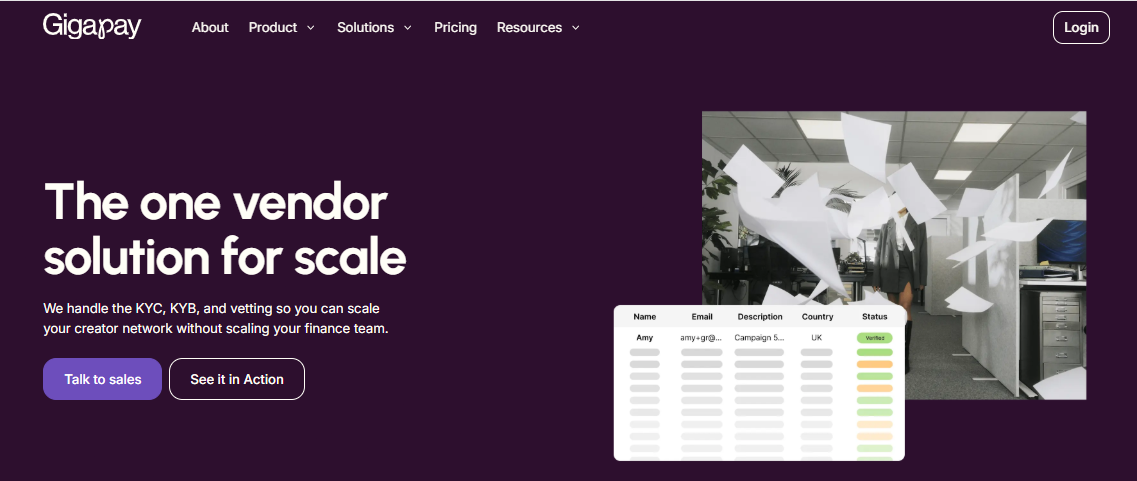
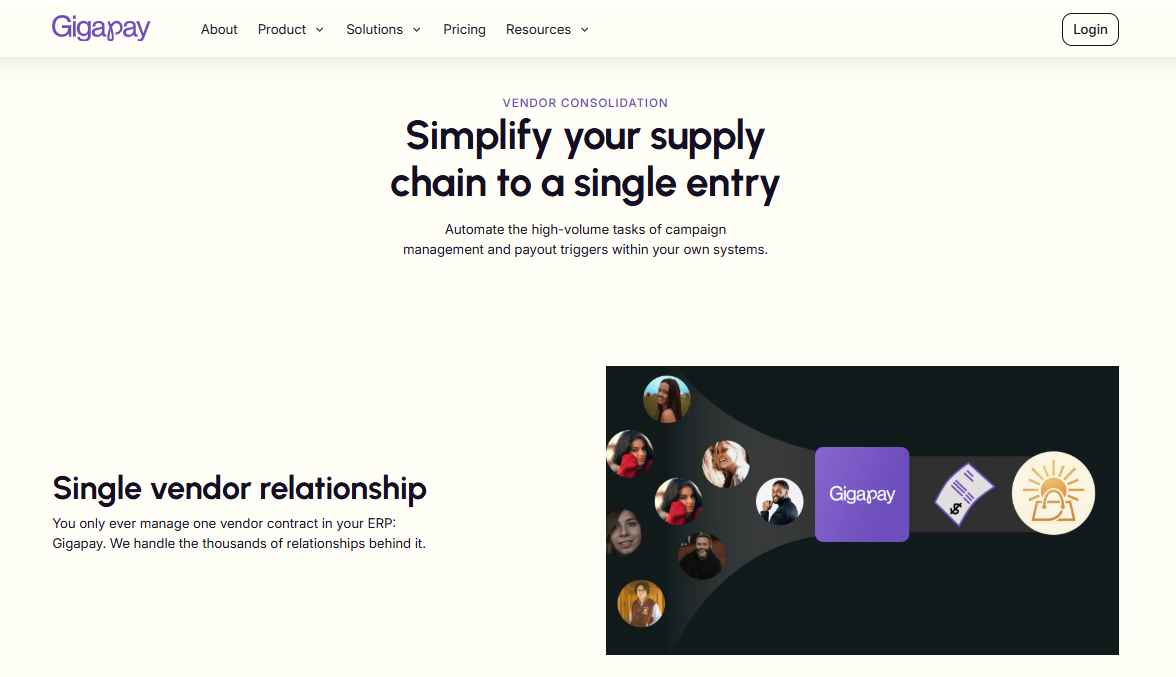
- Gigapay collapses hundreds of creator vendor records into one vendor, one invoice.
What Vendor Sprawl Is and Why It Keeps Growing
Vendor sprawl is the uncontrolled accumulation of suppliers, subscriptions, and payees across an organization, where new vendors get added for individual needs but almost never removed when those needs change. The average company now runs about 305 SaaS applications, with a median of 240, and the range stretches from 152 apps at small companies to 660 at large enterprises.
The growth has a structural cause. Business units now control 81% of SaaS spend, while IT directly manages only 15%. Marketing buys its influencer discovery tool, sales buys its own enrichment platform, and finance discovers both at renewal time. Nobody in this chain behaves badly. Each purchase solves a real problem for the team that made it. The sprawl emerges from the sum of locally rational decisions with no global owner.
Renewal mechanics then lock the sprawl in. The average organization faces 211 renewals a year, roughly 72% of contracts carry auto-renewal clauses, and 72% of tail-spend renewals proceed without any prior review. A tool bought for one campaign in 2024 can still be billing you in 2027 because no calendar reminder ever fired.
The Real Cost of Redundant Tools and Overlapping Spend
The direct cost is unused capacity. A Q1 2026 analysis of over $30 billion in enterprise SaaS spend found that 66% of licenses are either entirely untouched or surplus to need: 15% is pure shelfware with zero activity, and 51% is used at under half of purchased capacity. Gartner puts average SaaS overspend at 25 percent.
The indirect costs are larger and harder to see. Every vendor carries onboarding time, contract review, security assessment, invoice processing, reconciliation, and eventually offboarding. For a European brand running creator campaigns, Gigapay's own analysis of a company doing 600 creator payments and collaborations per year found the manual process costs roughly €139,590 annually, of which 840 hours is pure admin time spent onboarding payees, chasing invoices, and fixing payment errors.
That figure counts no software waste at all. It is the cost of the vendor management workload itself.
Overlap adds a third layer. When two teams run competing tools in the same category, the company pays twice for the capability, twice for the integrations, and twice for the training, while data fragments across both systems and neither becomes the source of truth.
Why Vendor Sprawl Is Now a Security and Compliance Problem
The risk data changed dramatically in the last reporting cycle. Verizon's 2026 Data Breach Investigations Report found that breaches involving a third party grew another 60% over the past year and now account for 48% of all confirmed breaches, up from 30% in the previous year's dataset. A supply chain compromise now costs $4.91 million on average and takes 267 days to identify and contain, the longest lifecycle of any breach vector tracked by IBM.
Every vendor in your stack is an access point, a data processor, and a contract counterparty. Organizations now average 286 vendors each, up 21% year over year, and regulators have noticed: DORA and NIS2 in the EU place explicit requirements on third-party risk, and tax frameworks like DAC7 make platforms and payers responsible for reporting on the people they pay.
For influencer marketing specifically, the compliance exposure compounds per payee. Germany's Künstlersozialkasse levies 4.9% on creative payments above €1,000 per year, and it applies even when the creator lives abroad. Sweden requires KU14 reporting. The EU requires DAC7 reporting on platform earnings.
A brand paying 300 creators directly holds 300 separate compliance obligations across multiple jurisdictions, and finance teams rarely find out until an audit.
How to Audit Your Vendor Stack: A Step-by-Step Framework
A vendor audit answers four questions about every supplier: what do we pay, who uses it, what else does the same job, and what risk does it carry. Run it in this order.
Step 1: Build a Complete Vendor Inventory From Financial Data
Start from accounts payable and corporate card exports, not from IT's approved list, because 65% of SaaS applications bypass IT approval entirely. Pull 12 months of payments, group by supplier, and tag each with an owner, a category, a contract end date, and an auto-renewal flag. For creator programs, count every individual payee as a vendor record, because that is exactly how your ERP treats them.
Step 2: Measure Actual Usage Against Purchased Capacity
For each tool, compare active users in the last 30 days against licensed seats. Only 49% of SaaS users log in within a 30-day window, and 23% of licenses show zero usage at any point, so expect uncomfortable findings. For service vendors and payees, measure transaction frequency: a supplier invoiced once in 14 months is a dormant record carrying live risk.
Step 3: Map Functional Overlap by Category
Group vendors into capability categories such as payments, analytics, content, discovery, and communication. Any category with more than one vendor gets a written justification or a consolidation candidate flag. Overlap hides in adjacent categories too: an influencer platform with a payment module, a payment provider, and a mass payout tool may all be moving money to the same people.
Step 4: Score Each Vendor for Risk
Score vendors on data access, regulatory exposure, contract liability, and concentration. A tool that touches personal data, moves money, or triggers tax reporting obligations belongs in a higher scrutiny tier than a design tool. This tiering tells you where consolidation reduces risk fastest, because annual review cycles cannot track a threat environment where third-party supply chain breaches rose 60% in a single year.
Step 5: Decide: Retire, Renegotiate, or Replace
Every vendor exits the audit with one of four labels. Keep it if usage is high and it is the category winner. Retire it if usage is low and a kept tool covers the function. Renegotiate it if usage is real but capacity is oversized. Replace it if several vendors in one category can collapse into a single one that does the job better.
Vendor Consolidation Strategy: How to Cut Vendors Without Cutting Capability
Consolidation fails when it becomes a procurement mandate that teams route around. It works when the consolidated option is genuinely faster for the people doing the work. Three principles keep it on the right side of that line.
Consolidate Around Workflows, Not Around Contracts
The unit of consolidation is the job to be done, not the invoice. If marketing needs to activate creators quickly, finance needs one auditable payment flow, and legal needs tax compliance handled, then the winning vendor is the one that serves all three at once.
Current analyst data shows consolidated stacks can cut total costs by up to 36 percent, with implementations finishing 20 percent faster, but those numbers only materialize when the consolidated tool actually absorbs the workflow instead of adding an approval step to it.
Sequence by Renewal Calendar and Risk Tier
You cannot consolidate 300 vendors in one quarter. Rank consolidation candidates by contract end date and risk score, and work the next two quarters of renewals first. Organizations implementing structured SaaS management report a 23-30% reduction in software spending within 12 months, and most of that saving comes from renewals that were caught before they auto-renewed.
Make the Consolidated Vendor the Easiest Path
Teams adopt whatever removes friction. If the sanctioned vendor takes three weeks to onboard a new payee and the workaround takes a PayPal transfer and an expense claim, the workaround wins and shadow spend returns. The consolidation only holds if the official route is also the fastest route.
Creator Payments: The Most Extreme Vendor Sprawl Problem in Marketing
Influencer marketing produces vendor sprawl at a rate no other function matches, because every creator collaboration creates a full vendor lifecycle: onboarding, tax data collection, contract, invoice, payment, and reporting. A brand scaling from 50 to 600 collaborations a year adds hundreds of supplier records, most of them individuals without registered companies, spread across dozens of countries and currencies.
Procurement rules then collide with marketing reality. Enterprise supplier policies were designed for software companies and agencies, not for a nano-influencer in Lyon without a VAT number, so finance blocks activations that marketing already committed to, and campaigns stall while both sides lose time to a system neither designed.
This is the problem Gigapay was built as a Merchant of Record to remove. Gigapay becomes the single vendor: it formally purchases each creator's deliverable and resells it to the brand, taking over the administrative and contractual counterparty role. The brand's ERP holds one supplier record instead of 300 or more.
- Finance receives one consolidated invoice per campaign instead of hundreds, an approach that cuts invoice volume by roughly 80%.
- Creators onboard without a registered business or VAT number, get verified through KYC, and are paid instantly through local rails in 65+ countries and 50+ currencies, while DAC7, KSK, and KU14 reporting runs automatically.
The consolidated numbers from Gigapay's 600-collaboration model: annual cost drops from roughly €139,590 to €46,350, admin time falls from 840 hours to about 60, and 300+ vendor records collapse into one.
Boozt, the Nordic fashion retailer, tripled its creator collaborations after adopting this model without expanding the team, and WPPMedia's The Goat Agency reports faster, easier payments with tax compliance handled inside the same flow.
How to Reduce Third-Party Risk Through Consolidation
Fewer vendors means fewer access points, fewer data processors, and fewer contracts to monitor, but only if the surviving vendors carry stronger guarantees than the ones they replaced. Evaluate consolidation targets on four risk criteria.
1. Liability transfer
A payment processor moves your money and leaves the tax and classification liability with you. A Merchant of Record structurally assumes the counterparty role, which changes your exposure rather than just your workload. This is the core distinction between Gigapay's model and pure payout infrastructure like Stripe Connect or Tipalti.
2. Certification and data handling
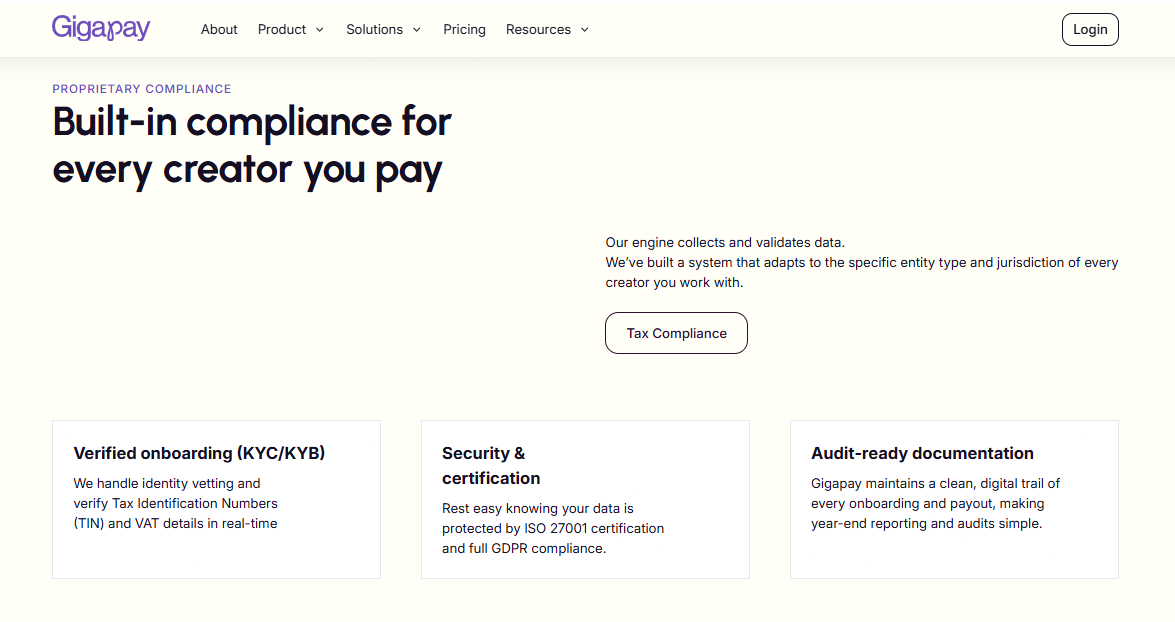
Consolidating onto a vendor without ISO 27001 certification and GDPR-compliant processing concentrates risk instead of reducing it. Gigapay holds ISO 27001 certification and runs KYC/KYB verification and Tax ID validation on every payee before money moves.
3. Regulatory coverage per jurisdiction
Ask the consolidation candidate exactly which reporting obligations it files, in which countries, under which regime. Vague answers about "handling compliance" are how brands discover a 4.9% KSK levy retroactively.
4. Auditability
One vendor with one consolidated invoice per campaign gives finance a reconciliation trail that 300 individual payees never will. Audit readiness is a risk reduction in itself, because organizations with structured SaaS governance report an 85% reduction in compliance audit preparation time.
How to Consolidate Without Slowing Teams Down
The fear that kills consolidation projects is speed. Marketing hears "fewer vendors" as "more procurement gates." The way through is to measure and protect three speed metrics during the transition.
- Time to activate: how long from deciding to work with a supplier or creator to the moment they can start. If consolidation pushes this number up, teams will bypass the system. Gigapay's answer for creator programs is onboarding that requires no business registration from the creator, which turns activation from a procurement negotiation into a same-day step.
- Time to pay: delayed payments destroy supplier relationships, and in the creator economy they destroy retention. Gigapay's 2024 research with Billion Dollar Boy, Meltwater, and The Influencer Marketing Factory found payment terms stretching to 120 days across the industry. Instant payouts through local rails, plus EarlyPay for creators who need liquidity before scheduled dates, are why Gigapay's creator NPS sits at 88.
- Time to integrate: a consolidation that demands a six-month IT project loses momentum before it saves money. Gigapay's REST API integrates in 2 to 5 days, with CSV batch upload available for teams that never want to touch the API at all.
When these three metrics hold or improve, consolidation stops being a constraint and becomes the reason marketing and finance stop fighting: marketing activates whoever it wants, finance keeps one controlled, compliant flow, and neither side waits on the other.
Metrics That Prove Your Consolidation Is Working
Track five numbers quarterly. Total active vendor count, measured from AP data, should fall toward a defensible baseline. Spend per capability category should show one primary vendor per category with overlap spend trending to zero. License utilization should climb toward the healthy range, given that active governance programs improved average utilization from 47% to 54% in 2025.
Admin hours per supplier transaction should drop, which for creator programs means tracking hours per collaboration. And renewal review coverage should hit 100% of contracts reviewed at least 60 days before auto-renewal.
One caution on targets: new tools arrive faster than old ones are retired, which is why consolidation has to be an ongoing habit rather than a one-time project. Assign a standing owner, usually a finance or operations lead, with authority to enforce the one-vendor-per-category rule.
Common Vendor Consolidation Mistakes to Avoid
- Consolidating on price alone leads teams to pick the cheapest vendor per category and lose the workflow fit that made consolidation worth doing.
- Consolidating without a liability review leaves brands assuming a payment tool absorbed tax obligations that contractually stayed with them.
- Ignoring the tail is equally expensive, because 72% of tail-spend renewals proceed without prior review, and the tail is where dormant vendors and forgotten subscriptions live.
- Announcing consolidation before proving it invites resistance: run the consolidated flow on one campaign or one department first, publish the before-and-after numbers, and let the results recruit the rest of the organization.

Conclusion
Gigapay gives brands and agencies running creator marketing at scale the single-vendor structure that vendor consolidation is supposed to deliver: one contract, one consolidated invoice, and full tax and compliance coverage across 65+ countries, in place of hundreds of individual payee records.
The broader lesson of the 2026 data is that sprawl is now a measurable financial and security liability, with half of provisioned licenses idle and third parties involved in 48% of breaches, and that the fix is a disciplined cycle of inventory, usage measurement, overlap mapping, risk scoring, and renewal-driven consolidation that makes the sanctioned path the fastest path.
Book a demo and see how one vendor replaces three hundred before your next campaign launches.
Read Next:
- Merchant of Record for Creator Payments: How MoR Platforms Handle Global Sales Tax, VAT, Chargebacks, and Payouts
- Creator Tax Compliance in 2026: How Platforms Handle DAC7 Reporting, KSK Levies, and TIN/VAT Validation
- Best Merchant of Record Platform for German Companies: September 2026 Review
FAQs:
1. What is vendor sprawl in B2B companies?
Vendor sprawl in B2B companies is the uncontrolled accumulation of suppliers, SaaS subscriptions, and individual payees across departments, where new vendors are added for local needs but rarely retired, leading to overlapping spend, idle licenses, and growing third-party risk.
2. How do you audit redundant tools and vendors?
You audit redundant tools and vendors by building a complete inventory from accounts payable data, measuring 30-day active usage against purchased capacity, mapping functional overlap by capability category, scoring each vendor for data and regulatory risk, and labeling every vendor as keep, retire, renegotiate, or replace.
3. How much money does vendor consolidation save?
Vendor consolidation saves organizations 23-30% of software spend within 12 months according to 2026 SaaS management data, and in creator payments specifically, Gigapay's model cuts the annual cost of 600 collaborations from roughly €139,590 to €46,350 while reducing admin time from 840 to about 60 hours.
4. What is the best way to consolidate creator and influencer payments?
The best way to consolidate creator and influencer payments is a Merchant of Record model like Gigapay, which becomes the single vendor in your ERP, issues one consolidated invoice per campaign, pays creators instantly in 65+ countries, and handles DAC7, KSK, and KU14 tax reporting automatically.
5. Does vendor consolidation reduce security and compliance risk?
Vendor consolidation reduces security and compliance risk when the surviving vendors carry stronger guarantees than those they replace, which matters because Verizon's 2026 DBIR found third parties involved in 48% of confirmed breaches and the average supply chain compromise costs $4.91 million.
.jpg)
.jpg)
.jpg)