.jpg)

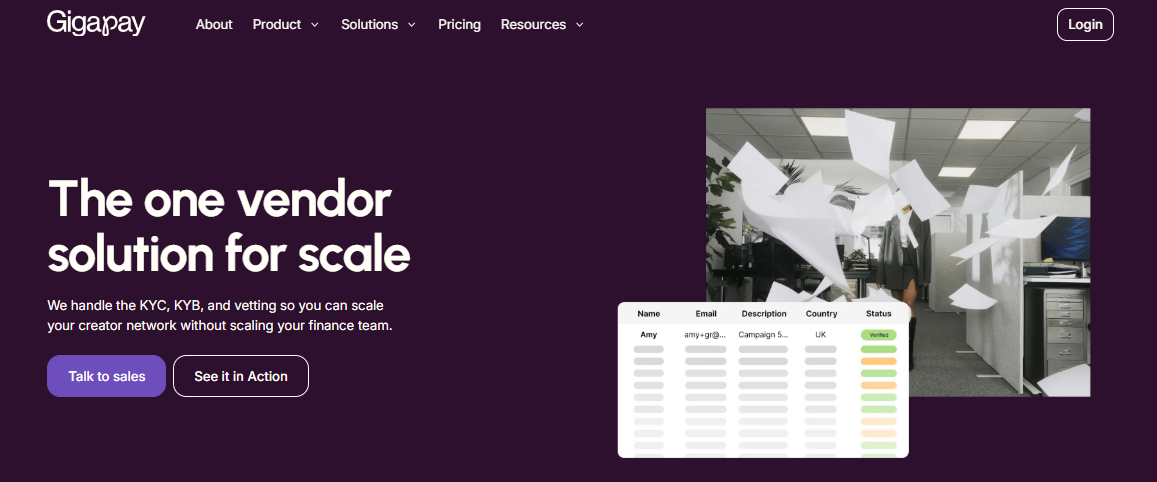
The average supplier onboarding cycle now takes 18.8 days, and stretches up to 91 days at the slowest enterprises, according to the 2026 Supplier Data Benchmark Report.
Multiply that by 500 creators and your campaign calendar collapses before the first post goes live.
Gigapay solves this as a Merchant of Record for mass creator payouts, replacing hundreds of individual vendor records with one vendor, one contract, and one consolidated invoice in your ERP.
The problem sits at the intersection of marketing speed and procurement control: SAP, NetSuite, and Coupa were designed to onboard strategic suppliers, not private individuals in 65 countries who need to be paid within days of a campaign brief.
This guide breaks down the full cost of creator vendor sprawl, the Merchant of Record model that removes it, a step-by-step onboarding process for 500 creators, and how the one-vendor setup works inside each major ERP.
Key Takeaways
- One Merchant of Record vendor entry replaces 500 individual creator records in your ERP.
- Manual vendor onboarding costs $200 to $1,200 per creator before any payment happens.
- Gigapay assumes contractual counterparty status, handling KYC, tax reporting, and consolidated invoicing.
- A 600-collaboration program drops from roughly €139,590 to €46,350 in annual admin cost.
- Creators onboard without a registered business, VAT number, or procurement approval cycle.
Why Creator Programs Break Enterprise Vendor Onboarding in 2026
Influencer marketing stopped being an experiment years ago. Mordor Intelligence values the global influencer marketing market at $40.51 billion in 2026, up from $31.07 billion in 2025, and eMarketer's February 2026 forecast puts US social media creator marketing spend at $21.10 billion for the year, more than double the 2022 figure.
The money is moving toward smaller creators, not away from them. Nano influencers with 1,000 to 10,000 followers average engagement rates of 4 to 8%, up to eight times higher than macro creators, which is exactly why enterprise brands now want hundreds of them per campaign instead of three celebrities per year.
That shift is what breaks the procurement stack. Enterprise vendor onboarding was built for a company selling you software or logistics, with a legal entity, a VAT number, a bank letter, and a compliance contact. A nano creator in Lisbon or Leipzig has none of that. Gigapay's 2024 research report with Billion Dollar Boy, Meltwater, The Influencer Marketing Factory, and Wild found payment terms stretching to 120 days and enterprise procurement rules actively blocking nano and micro influencer collaboration.
The creators best positioned to drive results are the ones your vendor master file cannot process.
The pressure lands on finance and procurement, not just marketing. 57 percent of procurement teams are already seen as a bottleneck by their own internal stakeholders. When a CMO wants 500 creators live for Q4 and each one needs an individual vendor record, that perception hardens into open conflict between departments that are both doing their jobs correctly.
The Real Cost of Adding 500 Creators as Vendors in SAP, NetSuite, or Coupa
The direct cost is measurable and larger than most finance teams expect. Manual supplier onboarding costs $200 to $1,200 per vendor in labor and rework. At the midpoint, 500 creator vendor records cost roughly $350,000 in internal effort before a single euro reaches a creator. That figure covers data collection, tax form chasing, banking validation, approval routing, and system entry, and it excludes the cost of maintaining those records afterward.
Gigapay's own benchmark for a brand running 600 creator collaborations per year puts the manual process at approximately €139,590 annually: about 840 admin hours across vendor setup, invoice handling, error correction, and reconciliation. That works out to roughly 1.4 hours of administrative work per collaboration, spread across marketing coordinators, AP clerks, and procurement analysts whose fully loaded hourly cost typically sits between €40 and €70 in the UK, France, DACH, and the Nordics.
Then there is data quality. Supplier master files carry a 20 to 30 percent error and duplicate rate when onboarded manually, per Gartner and APQC data. Apply that to 500 creator records and you are holding 100 to 150 defective entries: wrong IBANs, expired tax IDs, duplicate profiles for the same person. Each defect generates failed payments, support tickets, and reconciliation work.
Vendor fraud and duplicate payment losses tied to weak onboarding controls run 0.5 to 2% of total spend, a real exposure once your creator budget crosses €500K per year, which is exactly where enterprise influencer programs operate.
The indirect cost is speed: Every creator waiting in a procurement queue is a campaign slot that a competitor with faster infrastructure fills first.
Boozt's Brand Activation Lead described trying for years to find a workable path to nano and micro influencers before changing the model entirely.
What Vendor Sprawl Does to ERP Data, Compliance, and Audit Readiness
A vendor master file is supposed to be a controlled list of business relationships. Filling it with 500 private individuals changes its character in ways that outlast any single campaign.
1. Master data degrades permanently
Creators change banks, move countries, register companies, and quit the industry at rates no supplier base matches. A record that was accurate in March is stale by September, and nobody owns the update because the creator was hired for one campaign.
2. Compliance exposure multiplies per record
Each individual vendor is a GDPR data subject whose personal data, tax ID, and bank details you now store and must protect. Each cross-border payment raises questions about tax reporting obligations and employment classification, an area where European courts have issued decisions on influencer status that brands cannot ignore.
3. Audits get slower and more expensive
Auditors sample vendor records. A file with 500 individuals, inconsistent documentation, and one-time payments produces more sample hits, more queries, and more billable audit hours than a file with a controlled set of corporate suppliers.
4. Procurement policy collides with marketing reality
Most enterprise procurement policies set minimum requirements a private individual cannot meet. The result is either a policy exception factory, which weakens control, or a hard block, which kills campaigns. Neither outcome serves the CFO or the CMO.
The Merchant of Record Model: How One Vendor Replaces 500 Creator Records
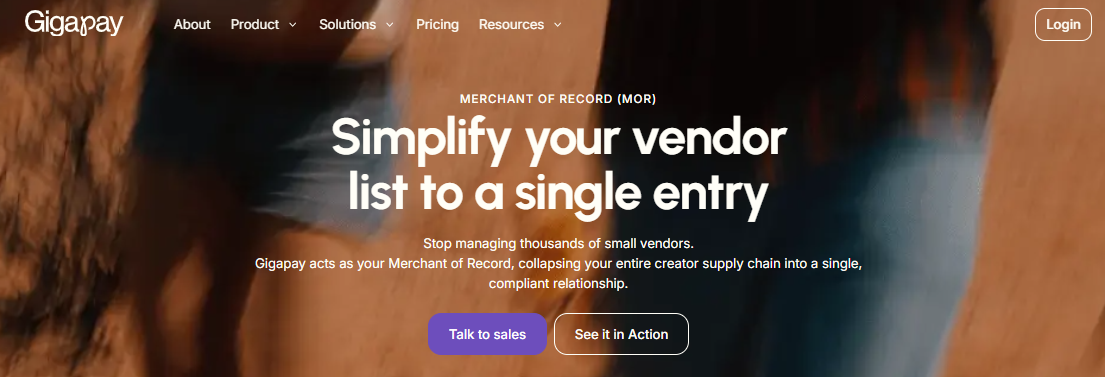
A Merchant of Record (MoR) for creator payouts changes the legal structure of the transaction, not just the payment mechanics. Gigapay formally purchases each creator's deliverable and concurrently resells it to the brand, becoming the contractual counterparty on both sides. Your company buys from one Swedish entity, Gigapay Sweden AB. Gigapay contracts with the creators.
The consequences for your ERP are direct:
- One vendor record: Gigapay is the only entry in SAP, NetSuite, or Coupa, regardless of whether you pay 50 creators or 5,000.
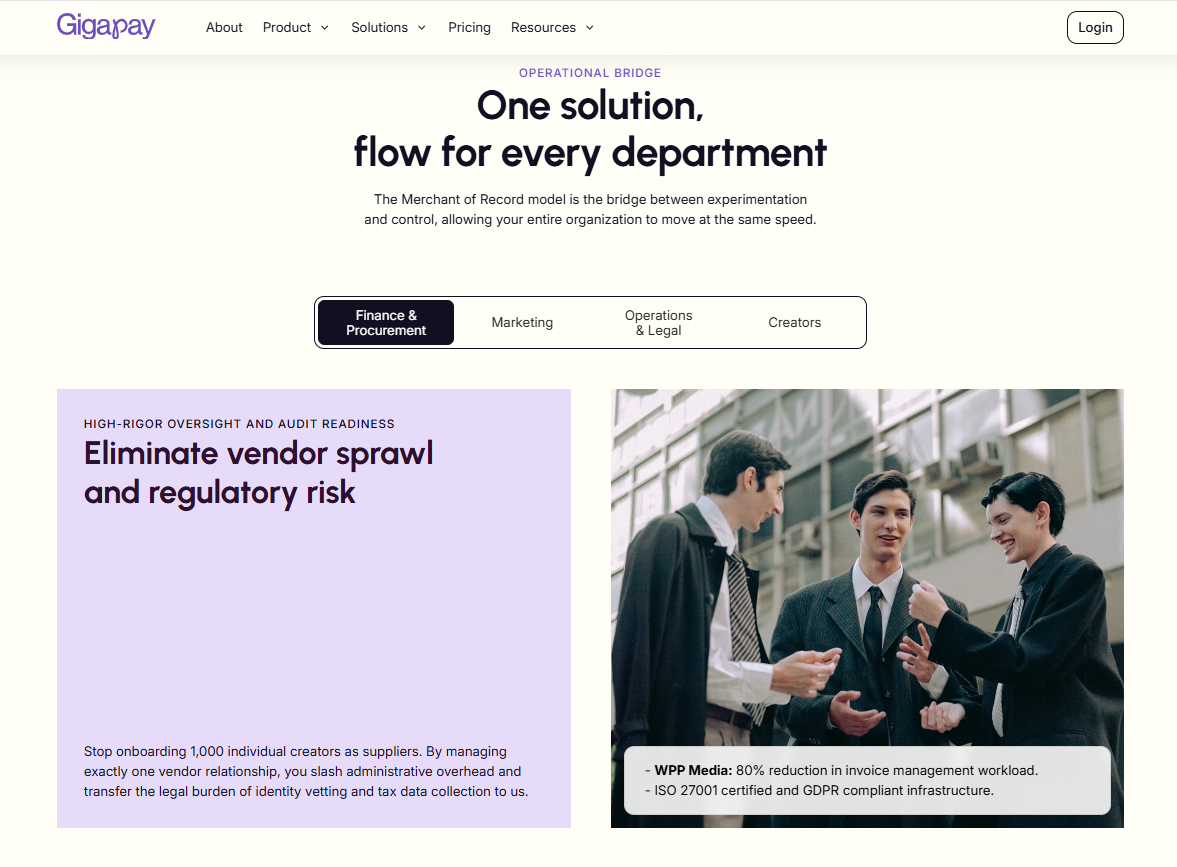
- One consolidated invoice per campaign or batch: Gigapay cites an 80% reduction in invoice volume, because hundreds of creator invoices collapse into one document your AP team processes normally.
- One counterparty for due diligence: Procurement runs KYB, security review, and contract negotiation once, against an ISO 27001 certified, GDPR compliant company, instead of 500 times against individuals.
- Compliance work moves to the vendor: Gigapay runs KYC and identity verification on every creator, validates tax IDs and VAT numbers, and handles automated tax reporting including DAC7 in the EU, KU14 for Sweden-Denmark exchange, and KSK assessment in Germany.
One nuance matters for your legal team, and Gigapay states it plainly in its service agreement: in its MoR capacity, Gigapay does not withhold or pay social security or other taxes on behalf of creators outside Sweden. Creators remain independent self-employed persons responsible for their own income tax and social contributions.
Gigapay reports compensation to the Swedish tax authority, which exchanges income statements with the creator's local tax authority. The exception is Sweden, where Gigapay acts as an Employer of Record for individuals without a company, filing employer contributions and PAYE returns. This distinction between tax reporting and tax withholding is precisely the kind of detail a Head of Legal will ask about, and a serious platform answers it in the contract rather than in a sales call.
This is also the difference between an MoR and a payment processor. Tipalti, Stripe Connect, or Wise move money efficiently, but your company remains the contractual counterparty to every creator, which means every creator still needs a vendor record and your compliance obligations stay exactly where they were.
Step-by-Step: How to Onboard 500 Creators Without Adding 500 Vendors
Here is the process as it actually runs, from procurement approval to reconciled payment.
Step 1: Onboard One Vendor Through Your Normal Procurement Process
Run Gigapay through your standard supplier onboarding once. Gigapay does not allow client self-onboarding: brands go through a sales process, share their company registration number and office address, and sign a service agreement.
That structure gives procurement a real counterparty to assess. Collect the ISO 27001 certification, GDPR documentation, and service agreement terms, and complete your KYB checks. This is the only vendor setup the entire program will require.
Step 2: Create the Single Vendor Record in SAP, NetSuite, or Coupa
Enter Gigapay Sweden AB as a supplier with standard payment terms in your funding currency (USD, EUR, GBP, SEK, DKK, or NOK). Map it to your influencer marketing cost centers and GL accounts. Because it is one record, your existing approval matrix, spend thresholds, and PO policies apply without exception handling.
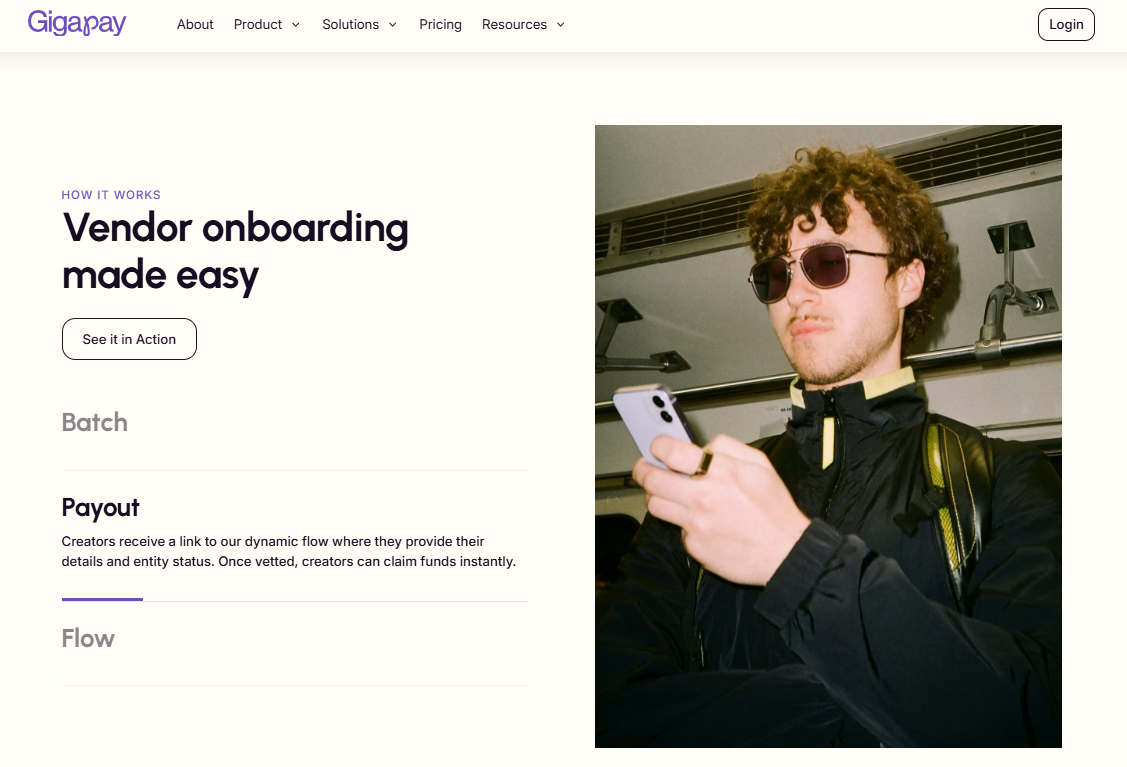
Step 3: Send Creators a Self-Serve Onboarding Link
Creators onboard themselves on Gigapay's side, choosing to register as an individual, sole trader, or company. No registered business or VAT number is required, which removes the single biggest blocker for nano and micro creators.
Gigapay collects identity documents, tax identification numbers, bank details, and where relevant, A1 forms and work permits, and verifies all of it through KYC before any payment can be released. A creator who has not completed onboarding cannot be paid, which turns compliance from a policing task into a system property.
Step 4: Upload the Payout Batch or Call the API
When deliverables are approved, your team uploads a CSV with creator names, amounts, and currencies, or triggers payouts through the REST API. Gigapay pays across 65+ countries in 50+ currencies over local rails: SEPA Instant in the EU, Faster Payments in the UK, ACH in the US. Creators receive funds instantly once payouts execute, and the EarlyPay feature gives them access to scheduled funds even earlier. For 500 creators, the marketing operations work is one spreadsheet, not 500 payment requests.
Step 5: Receive One Consolidated Invoice and Reconcile Once
Gigapay issues a single consolidated invoice per campaign or batch. On the creator side, self-billing automation generates compliant invoices on their behalf, using the reverse charge VAT mechanism because creators invoice Gigapay's Swedish entity rather than your company. Your AP team matches one invoice to one PO and posts one journal entry. Reconciliation for a 500-creator campaign takes the same effort as paying any other single supplier.
Step 6: Let Automated Tax Reporting Run in the Background
Gigapay files DAC7 reports through Skatteverket for EU sellers, handles KU14 reporting for Denmark, and assesses German KSK liability, where a 4.9% levy applies to influencer payments over €1,000 in 2026, including payments to international creators. Your finance team receives audit-ready documentation without building country-specific reporting processes.
Step 7: Scale Without Adding Headcount
The next 500 creators reuse the same vendor record, the same invoice flow, and the same reporting setup. Gigapay's benchmark shows admin time falling from 840 hours to roughly 60 hours per year on a 600-collaboration program, which is what makes the difference between scaling a program and scaling a back office.
How the One-Vendor Setup Works Inside SAP, NetSuite, and Coupa
The ERP-side mechanics deserve their own breakdown, because this is where CFO and COO objections live.
SAP: One Business Partner Instead of a Vendor Master Project
In SAP S/4HANA, each vendor is a Business Partner with company code data, payment terms, withholding tax settings, and bank details, typically routed through a multi-step approval workflow. Creating 500 of them is a master data project with its own error budget. With the MoR model, Gigapay is one Business Partner.
Campaign spend flows through standard purchase orders against that partner, three-way matching works normally, and your withholding tax configuration never has to model 65 countries of individual payees.
NetSuite: Clean Vendor Records and One Bill Per Campaign
NetSuite handles vendor bills and payments well, but 500 individual creator vendors means 500 vendor records, hundreds of bills per campaign, and 1099 or cross-border reporting questions attached to each.
As one vendor, Gigapay produces one bill per batch that maps to your campaign classes and departments. Marketing spend stays analyzable by campaign through line-level detail on the consolidated invoice, while the vendor list stays clean.
Coupa: Supplier Onboarding Portal Meets Its Limits
Coupa's supplier portal assumes counterparties who can complete corporate onboarding: certifications, banking verification, catalog setup. Private individuals stall in that flow, and each stalled record is a campaign delay.
With Gigapay as the single supplier, Coupa does what it is good at, managing the sourcing relationship, contract, and spend against one approved supplier, while creator-level complexity is handled outside the procurement system by a vendor built for it.
Across all three systems, the pattern is identical: your ERP manages one business relationship it was designed to manage, and stops being forced to model a labor market it was never designed for.
Tax and Compliance Requirements When Paying 500 Creators Across Borders
Even with an MoR, your team should understand what compliance work exists and who carries it.
1. KYC and identity verification
Every creator completes identity verification before receiving compensation. International individuals provide name, address, TIN, nationality, ID copy, and bank account details, and cannot be paid without complete information. For your risk team, this means no payment ever reaches an unverified counterparty.
2. DAC7 platform reporting
The EU's DAC7 directive requires reporting of platform sellers' income. Gigapay collects the required data from creators with companies, including tax registration numbers per member state and permanent establishment information, and files reports through the Swedish tax authority, which exchanges the data with other EU tax authorities.
3. Germany's KSK levy
The Künstlersozialkasse imposes a 4.9 percent social levy on payments for creative work over €1,000 in 2026, and it applies even when the hiring company or the creator sits outside Germany. Most brands discover KSK during an audit. A compliance-first payout vendor surfaces it before the liability accrues.
4. Employment classification
European court decisions on influencer status mean misclassification risk is real for brands contracting individuals directly at volume. The MoR structure, where Gigapay purchases deliverables and resells them, puts a clear commercial contract between your company and the creator relationship.
5. AML awareness
Gigapay tracks FATF high-risk and monitored jurisdiction lists, updated three times per year, and applies extra due diligence where warranted. As of the March 2026 FATF update, that framework shapes which markets get enhanced checks.
6. What remains yours
Budget ownership, campaign contracts on the brand side, marketing compliance such as ad disclosure rules, and your own corporate tax treatment of the spend. The MoR removes payee-level administration, not marketing accountability.
Cost Comparison: 500 Individual Vendors vs One Merchant of Record
Put the numbers side by side for a program in the 500 to 600 collaborations per year range.
Manual model, annual:
- Vendor onboarding effort: $200 to $1,200 per creator, roughly €90,000 to €550,000 at 500 creators, front-loaded in year one
- Ongoing admin: approximately 840 hours, roughly €139,590 per year all-in (Gigapay benchmark, 600 collaborations)
- Error and duplicate exposure: 20 to 30 percent of manually onboarded records defective
- ERP footprint: 300 to 500+ vendor records requiring maintenance, deactivation, and audit sampling
- Cycle time per creator: 18.8 days on average, up to 91 days
One-vendor model, annual:
- Vendor onboarding effort: one supplier setup, done once
- Ongoing admin: approximately 60 hours per year
- Total cost with Gigapay: roughly €46,350 per year, including the platform subscription (Base plan at €279 per month with a 4.9 percent admin fee per payout; Enterprise pricing with volume discounts from €1.8M annual payout volume)
- ERP footprint: one vendor record, one invoice per campaign
- Creator-side speed: instant payouts once batches execute, with EarlyPay available before scheduled dates
The delta on the Gigapay benchmark is roughly €93,000 per year in admin cost alone, before counting avoided duplicate payments, avoided audit hours, and the revenue effect of campaigns launching weeks earlier. It also explains why the platform fee reads differently to a CFO than to a spreadsheet: the 4.9 percent buys the removal of a cost center, not a payment feature.
Common Mistakes When Scaling Creator Onboarding to 500+
- Treating it as a payments problem: Money movement is the easy part. The binding constraint is legal counterparty status, tax reporting, and vendor master governance. A faster payment tool attached to a broken onboarding model just delivers errors sooner.
- Batching creators through procurement exceptions: Some teams push creators through as one-time vendors or policy exceptions. This preserves the appearance of control while destroying the substance of it, and it collapses at audit time.
- Ignoring the reporting layer: DAC7 filings, KSK levies, and income statement exchanges do not appear in a campaign brief, but they appear in audits two years later. Choose infrastructure where reporting is automatic, not aspirational.
- Underestimating creator churn on your master data: Even a successful 500-creator onboarding leaves you with 500 records to maintain. The one-vendor model is the only version where the maintenance burden does not scale with creator count.
- Forcing creators to register businesses: Requiring a company or VAT number filters out the nano and micro tier, the segment with the highest engagement rates in the market. Your compliance requirement becomes your performance ceiling.
How to Choose a Creator Payout Platform for Enterprise ERP Environments in 2026
If you are evaluating options beyond Gigapay, hold every candidate to this checklist:
- Legal model: Does the platform become the contractual counterparty (MoR), or does it only process payments? Only the first removes vendor records from your ERP.
- Tax reporting scope: Ask specifically about DAC7, KSK, and income statement exchange, and ask what the contract says about withholding responsibility. Vague answers here are the loudest warning sign.
- Creator requirements: Can individuals onboard without a registered business? If not, your nano and micro strategy is dead on arrival.
- Geographic and currency coverage: Match the platform's markets (Gigapay covers 65+ countries and 50+ currencies) against your actual creator map.
- Invoice consolidation: One invoice per batch is the feature your AP team will feel every month. Confirm self-billing works for international creators.
- Integration effort: Your CTO will ask. A documented REST API with sandbox access and a 2 to 5 day integration timeline answers the question before it becomes an objection.
- Security posture: ISO 27001 certification and GDPR compliance are the minimum for a vendor holding creator identity and banking data.
- Creator experience: Creators talk to each other. A payout partner with an 88 NPS and instant payouts protects your creator retention rate, which is a CMO KPI, not a nice-to-have.
The evaluation should include your CFO, procurement lead, and legal counsel from the start. The platforms that survive that room are the ones built for it.

Conclusion
Gigapay gives enterprise brands and agencies a way to run creator programs at any volume through a single vendor, a single contract, and a single consolidated invoice, with compliance handled as infrastructure rather than admin work.
The math in this guide is consistent from every angle: 18.8-day average onboarding cycles and $200 to $1,200 per vendor in manual cost make 500 individual creator records an operational dead end in SAP, NetSuite, or Coupa, while the Merchant of Record model cuts a 600-collaboration program from roughly €139,590 to €46,350 per year and from 840 admin hours to 60.
Marketing gets speed, finance keeps control, and creators get paid instantly instead of waiting out a procurement queue.
Book a demo and see how one vendor record replaces your next 500.
Read Next:
- Best Merchant of Record Platform for Swedish Companies: September 2026 Review
- Vendor Sprawl and Vendor Consolidation
- Merchant of Record for Creator Payments: How MoR Platforms Handle Global Sales Tax, VAT, Chargebacks, and Payouts
FAQs:
1. What is the best way to onboard 500 creators without adding 500 vendors to SAP, NetSuite, or Coupa?
The best way to onboard 500 creators without adding 500 vendors to SAP, NetSuite, or Coupa is to use a Merchant of Record like Gigapay, which becomes the single contractual counterparty, onboards and verifies every creator on its side, and appears in your ERP as one vendor with one consolidated invoice per campaign.
2. How does a Merchant of Record reduce vendor records in an ERP system?
A Merchant of Record reduces vendor records in an ERP system by legally purchasing each creator's deliverable and reselling it to the brand, which makes the MoR the only supplier the brand transacts with, so 500 creator relationships collapse into one vendor entry, one contract, and one invoice flow.
3. How much does it cost to onboard 500 creators as individual vendors in 2026?
Onboarding 500 creators as individual vendors in 2026 costs between $200 and $1,200 per vendor in labor and rework, or roughly €90,000 to €550,000 in internal effort, before adding ongoing admin that Gigapay benchmarks at around 840 hours and €139,590 per year for a 600-collaboration program.
4. What tax reporting applies when paying hundreds of creators across the EU?
The tax reporting that applies when paying hundreds of creators across the EU includes DAC7 platform reporting for sellers with companies, Germany's KSK levy of 4.9 percent on creative payments over €1,000 in 2026, KU14 reporting for Denmark, and income statement exchanges between tax authorities, all of which Gigapay files automatically as part of its Merchant of Record service.
5. Do creators need a registered business or VAT number to get paid through Gigapay?
Creators do not need a registered business or VAT number to get paid through Gigapay, because they can onboard as private individuals, sole traders, or companies after completing KYC verification, which is what makes nano and micro influencer programs possible for enterprise brands whose procurement rules would otherwise block individuals.
.jpg)
.jpg)
.jpg)