.jpg)

The global creator economy is projected to reach $323.48 billion in 2026, up from $255.66 billion in 2025, according to Research and Markets.
Behind that growth sits a payment problem that most brands only discover once they scale, and Gigapay solves it as a Merchant of Record built specifically for mass creator payouts across 65+ countries.
A Merchant of Record legally becomes the counterparty in a transaction, which means the platform, and not the creator or the brand, carries the tax, invoicing, and compliance obligations attached to every payment.
This article breaks down exactly how MoR platforms handle global sales tax, VAT, chargebacks, and payouts, and why that structure removes the administrative weight that creators and finance teams were never built to carry.
Key Takeaways
- A Merchant of Record legally assumes tax and compliance responsibility for creator transactions.
- MoR platforms apply VAT rules like reverse charge, removing tax admin from creators.
- Chargeback and dispute liability sits with the Merchant of Record, not the seller.
- Gigapay pays creators instantly in 65+ countries through one vendor and one invoice.
- Brands cut creator payment admin from roughly 840 hours to 60 hours yearly.

Why Creator Payments Became a Global Tax Problem
More than 100 countries already require foreign sellers to register for VAT or GST when they serve local customers, according to Bloomberg Tax's 2026 indirect tax outlook.
- Sri Lanka started applying its 18% VAT to foreign digital services on April 1, 2026.
- Japan now forces large platforms facilitating over ¥5 billion in annual digital sales to collect its 10% consumption tax.
The direction is clear: tax authorities are moving obligations onto platforms and intermediaries because a single entity can comply on behalf of thousands of sellers.
Creators sit in the middle of this shift with none of the infrastructure to deal with it. A brand in Paris paying a creator in São Paulo triggers questions about VAT treatment, withholding, income reporting, and invoicing rules in two jurisdictions at once. Multiply that by 300 creators per campaign and the tax question stops being theoretical. It becomes the reason campaigns stall.
The numbers behind the market make the problem worse, not better. Over 200 million people worldwide identify as content creators, and more than 50% of them earn under $15,000 per year. Most of them have no registered business, no VAT number, and no accountant.
Gigapay's own 2024 research with Billion Dollar Boy, Meltwater, and The Influencer Marketing Factory found payment terms stretching to 120 days, with enterprise procurement rules blocking collaborations with nano and micro influencers entirely. The demand side wants to work with small creators. The compliance side cannot process them.
The Hidden Cost of Paying Creators Manually
A brand running 600 creator collaborations per year spends roughly €139,590 annually on the manual process, based on Gigapay's operational analysis. That figure covers around 840 admin hours across vendor onboarding, invoice collection, tax document chasing, payment errors, and reconciliation.
Each creator becomes an individual vendor entry in the ERP, which means 300+ supplier records for finance to maintain, audit, and clean up.
The cost shows up in three places at once. Finance teams absorb the reconciliation and compliance risk. Marketing teams lose campaign speed while procurement processes each new payee. Creators wait months for money they earned in days, which is why creator retention became a marketing KPI in the first place.
The EU alone recorded a VAT compliance gap of €128 billion in 2023, equal to 9.5% of total VAT liability, and regulators respond to gaps like that with more reporting obligations, not fewer. DAC7 in the EU, KU14 in Sweden, and Germany's Künstlersozialkasse levy all landed on top of teams already stretched thin.
This is the market context that produced the Merchant of Record model for creator payments. The problem was never that finance teams say no. The infrastructure between marketing, finance, and creators was never designed for thousands of individual cross-border payees.
What a Merchant of Record (MoR) Is and How It Works
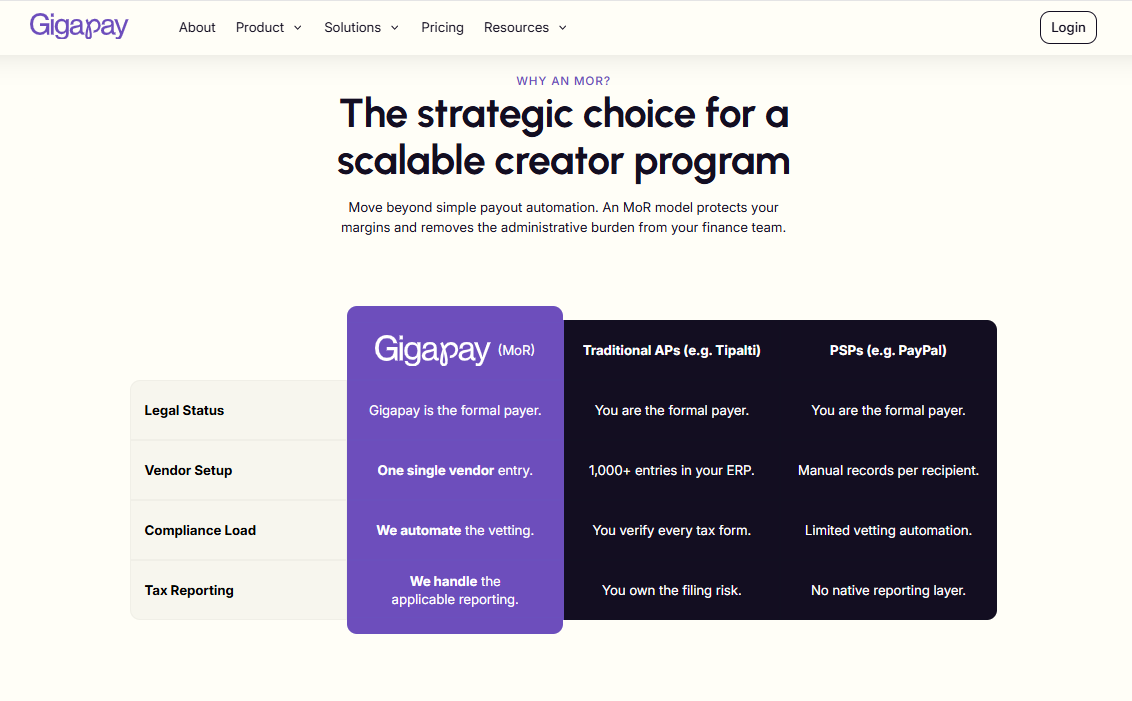
A Merchant of Record is the legal entity responsible for a transaction in the eyes of tax authorities, banks, and card networks. The MoR appears as the seller or buyer of record, which transfers the compliance obligations of the transaction away from the original parties.
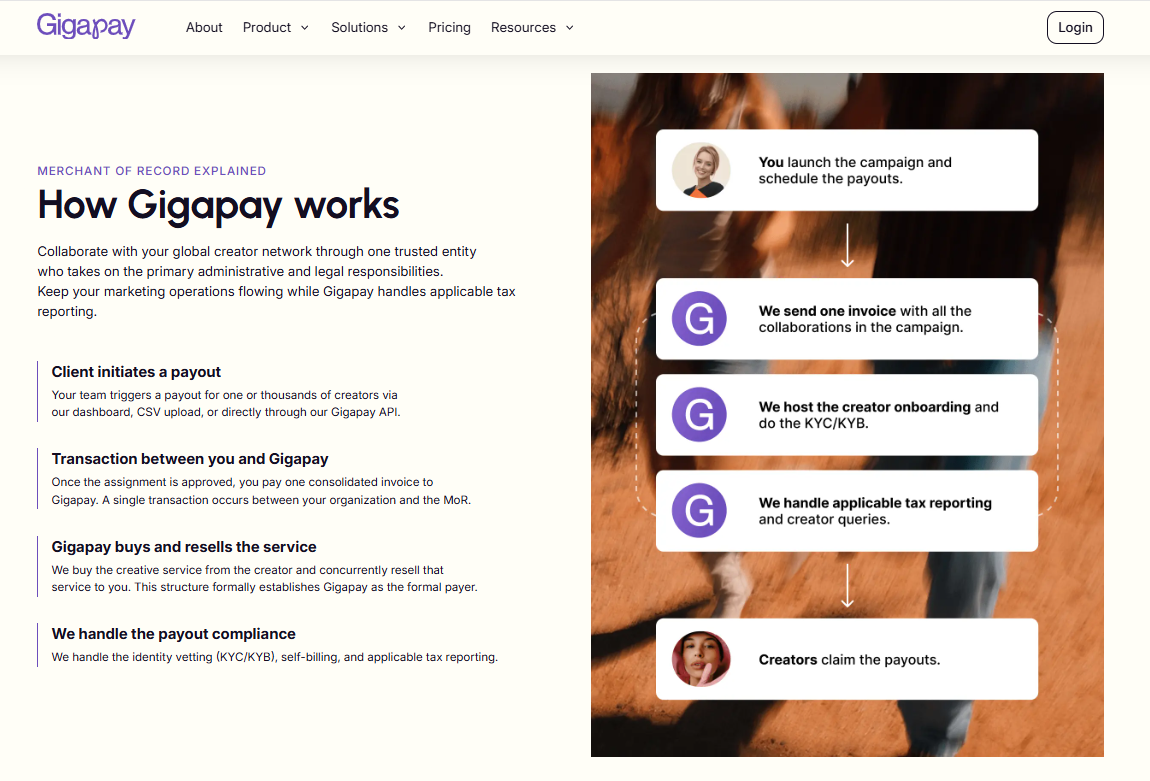
In creator payments, the mechanics work like this: the MoR platform formally purchases the creator's deliverable and concurrently resells it to the brand client. Gigapay operates exactly this way. The creator contracts with Gigapay, Gigapay contracts with the brand, and Gigapay becomes the formal counterparty on both sides.
The brand sees one vendor and the creator sees one payer, while the tax and invoicing complexity concentrates inside a platform built to process it.
Merchant of Record vs. Payment Processor: The Legal Difference
A payment processor like Stripe Connect or PayPal Payouts moves money between parties. The legal relationship stays between the brand and each individual creator, and so does every compliance obligation attached to it. The brand still onboards each creator as a vendor, still validates tax IDs, still handles invoicing rules per country, and still owns the audit exposure.
A Merchant of Record changes who is responsible, not just how money moves. Gigapay's service agreement transfers most administrative and legal responsibilities connected to the purchase of a creative's deliverable onto Gigapay itself.
That distinction is why comparing an MoR to Tipalti or a payout API misses the point. One is software that helps you comply. The other is a counterparty that carries the obligation for you.
What an MoR Does Not Do
An honest breakdown includes the boundaries. In its MoR capacity, Gigapay does not withhold or pay social security or income taxes on behalf of creators, and creators remain independent self-employed persons responsible for their own direct taxes, social fees, and personal income tax.
The exception is Sweden, where Gigapay acts as an Employer of Record for individuals without a company and files employer contributions, PAYE tax returns, and statutory insurance. Every serious MoR draws this line clearly, because a platform that vaguely promises to "handle all taxes" is describing something no legal structure actually delivers.
How MoR Platforms Handle Global Sales Tax and VAT
VAT is where the MoR structure earns its keep. EU VAT rates on services range from 17% in Luxembourg to 27% in Hungary, the UK charges 20% with no registration threshold for foreign sellers, and non-EU businesses owe VAT on B2C digital sales from the very first euro.
No individual creator can realistically track this, and no brand wants 300 creators each interpreting VAT rules differently on their invoices.
The Reverse Charge Mechanism Explained
The MoR model simplifies VAT through the reverse charge system. Because the creator invoices Gigapay, a Swedish entity, rather than the local brand, the cross-border reverse charge generally applies and no VAT appears on the creator's invoice. The VAT accounting obligation shifts to the recipient.
This holds even when the influencer and the client sit in the same country, because the creator's contractual counterparty is Gigapay, not the client.
- The practical effect for creators: no VAT registration required, no VAT charged on invoices in most cases, and no exposure to charging the wrong rate in the wrong country.
- The practical effect for brands: one consolidated invoice from one Swedish vendor with clean, predictable VAT treatment, instead of hundreds of invoices with inconsistent tax lines that finance has to check one by one.
Tax Reporting Across Jurisdictions: DAC7, KU14, and KSK
Collection is only half the tax story. Reporting is the other half, and it grew teeth in the last three years. MoR platforms automate the reporting layer that would otherwise land on brands:
- DAC7 (EU): Gigapay collects official names, addresses, tax registration numbers, VAT numbers, and permanent establishment data from creators with companies, and files DAC7 reports to the Swedish tax authority, which exchanges the data with other EU member states.
- KU14 (Sweden–Denmark): compensation reporting required under the exchange agreement between Sweden and Denmark, filed automatically.
- KSK (Germany): Germany's Künstlersozialkasse applies a 4.9% levy on payments to creatives above €1,000 per year, and it applies even when brands hire internationally. Gigapay's compliance research and published guides map exactly when the levy triggers.
- Income statements: Gigapay reports all compensation to private individuals to Skatteverket, and for creators working outside Sweden, an exchange of income statement routes the data to the creator's local tax authority.
Every payee also passes KYC or KYB verification with tax ID and VAT validation before receiving a single payment. Creators cannot receive compensation without completing it, which is precisely what makes the reporting defensible in an audit.
How MoR Platforms Handle Chargebacks and Payment Disputes
Chargebacks are the clearest illustration of what "being the merchant" actually means. When a card transaction is disputed, the card networks pursue the Merchant of Record, because the MoR is the legal seller.
The average chargeback costs merchants $128 in third-party fees and internal costs, according to Mastercard and Javelin's 2026 research, and Mastercard's work with Datos Insights projects global chargeback volume will grow 37% from 2025 to 2029 to reach 359 million transactions annually.
For creators selling digital products, courses, or subscriptions through a checkout MoR, this liability transfer is the whole product: the platform absorbs the dispute process, the evidence submission, and the network threshold monitoring. The math explains why individuals should not fight this battle alone.
Merchants win only 44.6% of the chargebacks they contest and recover a net 10.7% across all disputes filed, and card-not-present transactions carry dispute rates of 0.6% to 1%, roughly double card-present rates. Visa's tightened VAMP program, enforced from April 2026, punishes merchants whose dispute ratios climb, which makes professional dispute handling a survival requirement rather than a convenience.
In the B2B creator payout flow, the same counterparty logic applies to payment failures and errors rather than card disputes. When a payout fails, lands in the wrong account, or needs reversal, the creator's counterparty is Gigapay, and Gigapay's dedicated human support team resolves it.
Brands stop mediating payment disputes between their finance department and individual creators, because contractually those disputes no longer belong to them. That structural change is one reason Gigapay's creator NPS sits at 88.
How MoR Platforms Handle Global Payouts at Scale
Compliance without payment speed solves half the problem. The payout layer is where creators feel the difference directly, and it is where the 120-day payment terms documented in Gigapay's 2024 industry research get eliminated.
Gigapay's payout infrastructure covers:
- 65+ countries and 50+ currencies, funded in USD, EUR, GBP, SEK, DKK, or NOK
- Local payment rails: SEPA Instant in the EU, Faster Payments in the UK, ACH in the US
- Instant payouts, so a creator receives money the moment a payout is approved rather than at the end of a net-60 cycle
- Batch execution via CSV upload or API, so paying 500 creators takes the same effort as paying five
- EarlyPay, a liquidity feature giving creators instant access to scheduled funds before the brand's payment terms mature
The onboarding design matters as much as the rails. Creators can onboard as individuals, sole traders, or companies, and no registered business or VAT number is required. That single design choice unblocks the nano and micro influencer segment that procurement rules usually exclude.
Boozt tripled its creator collaborations without expanding its team after switching, specifically because small creators no longer needed a company to get paid.
Consolidated Invoicing and Self-Billing
On the brand side, the payout layer produces one consolidated invoice per campaign or batch instead of hundreds of individual creator invoices, an 80% reduction in invoice volume. Gigapay's self-billing automation generates compliant invoices on behalf of creators, which removes the single most common payment delay: waiting for a creator to send a correctly formatted invoice. Finance closes the month against one vendor entry in the ERP instead of 300.
What Working With an MoR Costs, and What It Returns
Gigapay's pricing pairs a SaaS subscription with a per-payout admin fee. The Base plan runs €279 per month with a 4.9% fee per payout, and Enterprise pricing applies volume-based discounts for organizations above €1.8M in annual payout volume, including EarlyPay, a dedicated customer success manager, and unlimited users and API capacity.
The return side of the equation, using the 600-collaborations-per-year benchmark:
The cost case is real, but the teams quoted in Gigapay's case studies consistently point at time and relationships first.

How to Choose a Merchant of Record for Creator Payments
The MoR label gets applied loosely, so the evaluation questions matter. Six that separate a genuine Merchant of Record from a payout tool with good marketing:
- Does the platform become the legal counterparty?
Ask for the service agreement clause where the platform purchases the deliverable and resells it. Without that clause, it is a processor. - Which reporting regimes are automated?
DAC7, KU14, and KSK coverage should be named, not implied. Gigapay publishes its regulatory research on each. - Can creators onboard without a registered business?
If the answer is no, your nano and micro influencer strategy stays blocked. - What are the actual payout rails?
Local rails like SEPA Instant and Faster Payments determine whether "fast" means instant or means three banking days. - How fast does the API integrate?
Gigapay's REST API integrates in 2 to 5 days, with sandbox and production environments, webhooks, and endpoints for projects, prepayments, payouts, and registrations. Kolsquare embedded it directly into its influencer platform. - Is the platform certified?
ISO 27001 certification and GDPR compliance are the baseline for a vendor that processes identity documents and bank details for thousands of creators.
The Regulatory Direction: More Obligations, Moving Toward Platforms
Anyone betting that creator payment compliance gets simpler is betting against every observable trend. From January 2026, jurisdictions from Manitoba to India tightened enforcement on cross-border digital services, expanded deemed-supplier rules, and deepened tax authorities' access to platform and payment data.
The UAE introduced influencer permit requirements for 2026 that affect both brands and creators. European courts continue reshaping influencer employment classification, which changes the risk calculus for brands contracting creators directly.
Each new rule strengthens the same conclusion. Regulators want a responsible, auditable entity in every transaction, and platforms are the entity they are choosing. Brands that concentrate their creator payments through a Merchant of Record are already structured for that world. Brands maintaining 300 direct creator vendor relationships across 20 countries will re-do their compliance work every time a new regime lands.
Gigapay's legal team maintains active research across 93 countries precisely because this landscape moves three times a year, not once a decade.

Conclusion
Gigapay is the Merchant of Record built for teams that pay creators at scale and refuse to choose between moving fast and staying compliant.
The MoR model concentrates global sales tax treatment, VAT reverse charge, dispute liability, tax reporting, and instant multi-country payouts inside one legal counterparty, so creators get paid without paperwork and finance keeps one vendor instead of hundreds.
The brands already running this model cut payment admin from 840 hours to 60 and tripled creator collaborations without hiring.
Book a demo with Gigapay and see how your next campaign pays every creator through one vendor and one invoice.
Read Next:
- Creator Tax Compliance in 2026: How Platforms Handle DAC7 Reporting, KSK Levies, and TIN/VAT Validation
- Best Merchant of Record Platform for German Companies: September 2026 Review
- Multi-Currency Payouts and FX Reconciliation
FAQs:
1. What is a Merchant of Record for creator payments?
A Merchant of Record for creator payments is a platform that legally becomes the counterparty in creator transactions, purchasing the creator's deliverable and reselling it to the brand, so tax, invoicing, and compliance obligations transfer to the platform instead of the creator or brand. Gigapay operates this model across 65+ countries and 50+ currencies.
2. How does a Merchant of Record handle VAT for creators?
A Merchant of Record handles VAT for creators by applying the reverse charge mechanism: the creator invoices the MoR entity rather than the brand, so in most cases no VAT appears on the creator's invoice and the VAT accounting obligation shifts to the recipient. Creators need no VAT registration, and brands receive one consolidated invoice with consistent VAT treatment.
3. Who is liable for chargebacks under a Merchant of Record model?
The Merchant of Record is liable for chargebacks under this model, because card networks and banks pursue the legal seller of record in any dispute. With chargebacks costing merchants an average of $128 each and global volume projected to grow 37% by 2029, this liability transfer protects individual creators and brands from a process they rarely win alone.
4. What is the difference between a Merchant of Record and a payment processor for creator payouts?
The difference between a Merchant of Record and a payment processor is legal responsibility: a processor like Stripe Connect moves money while compliance obligations stay with the brand and each creator, whereas an MoR like Gigapay becomes the contractual counterparty and takes over the administrative and legal responsibilities connected to the purchase of the creator's work.
5. Do creators need a registered business to get paid through a Merchant of Record?
Creators do not need a registered business to get paid through a Merchant of Record like Gigapay, which onboards payees as individuals, sole traders, or companies with no business registration or VAT number required. Every creator completes KYC verification before payment, which keeps the process compliant while unblocking nano and micro influencers that procurement rules normally exclude.
.jpg)
.jpg)
.jpg)