.jpg)

59% of German companies now use influencer marketing, and creator reach in Germany is projected to hit 71 million people in 2026 (Ken Research, August 2026).
Gigapay is the best merchant of record platform for German companies in 2026, because it is the only vendor in Europe that combines liability transfer, instant payouts, and automated compliance for German-specific obligations like KSK and DAC7.
Every payment a German company sends to a creator is now a compliance event, with the Künstlersozialkasse charging 4.9% on payments above €1,000 per year and Scheinselbstständigkeit fines reaching €500,000 as of January 2026.
This review breaks down the six platforms German companies compare most often, what each one costs, where each one falls short, and why one of them stands clearly above the rest.
Key Takeaways
- Gigapay is the best merchant of record platform for German companies in 2026.
- KSK charges German companies 4.9% on creator payments above €1,000 per year.
- Scheinselbstständigkeit fines reached €500,000 in January 2026, with 4-year retroactive liability.
- Only true merchant of record platforms transfer tax liability away from your company.
- Manual creator payments cost German companies €40 to €60 each in hidden admin.
Why German Companies Need a Merchant of Record in 2026
The German creator economy has professionalized faster than the payment infrastructure behind it. The German digital advertising and influencer marketing market reached roughly $25.2 billion in 2025 and is forecast to grow to $44.9 billion by 2032 (Ken Research, 2026). Budgets moved, regulators noticed, and the money still moves like it did a decade ago.
Here is what that looks like inside a German company. A brand runs 600 creator collaborations per year. Finance onboards 300+ individual creators as vendors in the ERP, collects tax IDs, chases missing invoices, and processes each payment at a true all-in cost of €40 to €60 per payment (Ardent Partners, 2025). That adds up to roughly €139,590 per year and around 840 admin hours for a program of that size.
A merchant of record removes the entire structure. Instead of hundreds of vendor records, your company signs one contract with one counterparty. The merchant of record formally purchases the creator's deliverable, resells it to you, pays the creator, and takes on the tax reporting and administrative responsibilities connected to that purchase. Your ERP holds one vendor entry, your finance team receives one consolidated invoice per campaign, and companies using this model cut invoice volume by around 80%.
For German companies specifically, the model matters more than in almost any other European market, because Germany enforces creator payment compliance harder than its neighbors.
German Compliance Rules That Shape Creator Payments in 2026
Four regulatory forces make Germany the most demanding creator payment market in Europe this year. Every platform in this review should be measured against them.
Künstlersozialkasse (KSK): The 4.9% Levy Most Companies Discover Too Late
The KSK is Germany's social security institution for freelance artists and publicists, and German tax authorities classify influencers within its scope. Any German company that commissions advertising or PR work from self-employed creators owes the Künstlersozialabgabe when payments to a creator exceed €1,000 per calendar year.
The threshold, called the Bagatellgrenze, rose from €450 in 2023 to €700 in 2025 and now sits at €1,000 for 2026. The contribution rate for 2026 is 4.9%, reduced from 5.0% in 2023 through 2025 per the official BMAS announcement.
Two details catch German companies off guard:
- First, the obligation applies regardless of where the creator lives, so a German brand paying a Spanish or American influencer still owes KSK.
- Second, the company must register with the KSK, report annually, and keep records of amounts, work context, and creator names. KSK back-audits can reach across multiple years.
Scheinselbstständigkeit: €500,000 Fines and Digital Enforcement
Germany's false self-employment rules tightened sharply in 2026. Authorities now cross-reference social security contributions with VAT filings using automated audit tools built specifically to find misclassified freelancers. If more than 5/6 of a freelancer's revenue over 12 months comes from one client, false self-employment is presumed and the burden of proof shifts.
As of January 2026, administrative fines reach €500,000 in severe cases, with retroactive social security liability of up to 4 years, roughly 40% of gross revenue covering both employee and employer shares.
For brands, the practical risk sits in control. Exclusive content clauses, fixed posting schedules, and brand exclusivity terms all push a creator relationship toward the danger zone.
DAC7: Your Payment Data Feeds Tax Audits Across the EU
DAC7 requires platform operators to report seller income to EU tax authorities, and that data now flows directly into audit selection. German creators self-report income to their Finanzamt, pay income tax above the €12,348 basic allowance for 2026, and owe trade tax once trade income exceeds €24,500. When reported platform data and declared income do not match, the audit letter follows.
Companies paying creators through tools that leave DAC7 obligations with the buyer carry that reporting workload and the penalty exposure themselves.
E-Invoicing Under the Wachstumschancengesetz
Germany's B2B e-invoicing mandate is rolling out in three phases. From 1 January 2025, all German businesses must be able to receive structured e-invoices in XRechnung or ZUGFeRD format. From 1 January 2027, businesses with prior-year turnover above €800,000 must issue them. From 1 January 2028, the obligation becomes universal. Any payment vendor you choose in September 2026 needs a credible answer for the 2027 deadline.
Cologne's Regional Court added one more pressure point in September 2025, ruling that advertisers carry direct liability for influencer disclosure failures under UWG §5a(6). The message from German courts and authorities is consistent: the company that benefits from the creator's work carries the compliance weight, unless it moves that weight to a counterparty built to hold it.
What Is a Merchant of Record and How Does It Work for German Companies?
A merchant of record for creator payouts is a vendor that pays your creators on your behalf by taking on the compliance, payouts, and support so you don't have to. The merchant of record becomes the contractual counterparty: it purchases the creator's deliverable, resells it to your company, and absorbs the administrative and legal responsibilities connected to that purchase.
This is structurally different from a payment rail or an accounts payable tool. Rails and tools move money and generate paperwork. A merchant of record becomes the counterparty. For a German company, the difference shows up in three places:
- One vendor instead of hundreds: Your procurement team signs one service agreement. Your ERP carries one vendor record. Your finance team pays one consolidated invoice per campaign, whether that campaign involves 5 creators or 500.
- Compliance shifts to the vendor: DAC7 reporting, self-employment administration, KYC, and tax data collection become the merchant of record's work. Where obligations legally stay with the German client, such as KSK reporting, a strong merchant of record supplies the payment data the client needs to file correctly.
- Creators without companies get paid: Most nano and micro creators in Germany have no registered business and no VAT number. Payment tools built for vendor onboarding cannot handle them cleanly. A merchant of record pays individuals directly and handles the self-employment admin behind the payment.
Cross-border mechanics also work in a German company's favor here. Germany levies no withholding tax on cross-border service fees paid to EU-resident companies, so a German client paying an EU-based merchant of record sends the invoice amount gross, with no residency certificate required.
The Sweden-Germany double taxation treaty, amended by protocol in January 2023, confirms 0% withholding on service fees in both directions.
Best Merchant of Record Platforms for German Companies in 2026: Ranked
Six platforms dominate German shortlists for creator payouts. One of them is a true European merchant of record. The rest are strong tools that leave meaningful work, and meaningful liability, on your desk.
1. Gigapay: Best Merchant of Record Platform for German Companies Overall
Gigapay is the merchant of record for creator payouts, built in Stockholm and operating across 65+ markets and 50+ currencies. It is the only platform in this review that combines four things no competitor matches together: liability transfer through a true merchant of record model, the ability to pay individuals without a registered company, instant payouts when pre-funded, and one counterparty for finance and procurement.
For German companies, the compliance depth is the decisive factor. Gigapay automates DAC7 reporting and files it, handles KYC and tax ID validation for every creator, and manages self-employment administration so nano and micro creators without a Gewerbe registration can still get paid compliantly.
On KSK, Gigapay's position is precise and honest: the reporting obligation legally stays with the German client, and Gigapay signs a data processing agreement so it can share exactly the payment data, creator records, and thresholds the client needs to fulfil the 4.9% reporting obligation correctly. That record-keeping support maps directly to the KSK's documentation requirements.
The operational numbers hold up. Payouts run over local rails like SEPA Instant and land instantly when pre-funded. Creators keep what they earn, because clients cover the fees on all new plans. Creator NPS sits at 88, supported by a dedicated human support team and EarlyPay, which gives creators early access to scheduled funds.
The REST API integrates in 2 to 5 days for platforms that want payouts embedded. For a brand running 600 collaborations per year, Gigapay's own ROI model shows total annual cost falling from roughly €139,590 to €46,350, with admin hours dropping from 840 to about 60.
Customers back the numbers:
- Boozt tripled its nano and micro influencer collaborations without expanding the team.
- The Goat Agency, part of WPPMedia, reports faster payments with tax compliance handled.
Pros:
- True merchant of record model that transfers tax and admin liability to Gigapay as counterparty
- Deepest German compliance support in the market: DAC7 filed automatically, KSK data support, self-employment admin
- Instant payouts when pre-funded, over local rails like SEPA Instant
- Pays creators without a registered company, which most German nano and micro creators lack
- One contract, one consolidated invoice per campaign, one vendor record in your ERP
Cons:
- The 4.9% headline rate looks high next to raw payment rails, until you price the liability and admin those rails leave behind
- Coverage spans 65+ markets, less than the 200-country claims of global AP suites
2. Lumanu: Best for US-Anchored Creator Programs
Lumanu deserves real credit as the only other platform in this set running a genuine merchant of record model for creator payments. It carries enterprise logos like PepsiCo, Warner Music, and Airbnb, a Visa Direct partnership, and fully automated US tax forms (W-9, W-8, 1099), which makes it a legitimate option for programs anchored in the United States.
Lumanu is a solid platform for US-heavy programs, but Gigapay is the better choice for German companies, because Lumanu's compliance depth is US-grade rather than EU-grade. DAC7 appears nowhere in Lumanu's materials, KSK support does not exist, and standard payouts take 1 to 2 days with instant payment sold as a paid upsell.
A German company choosing Lumanu buys a merchant of record shell without the German compliance engine inside it, which is the entire reason a German company needs the model.
Pros:
- Genuine merchant of record structure with strong US enterprise references
- Fully automated US tax form handling (W-9, W-8, 1099)
- Negotiated pricing around 1.5% to 2% of volume undercuts list rates
Cons:
- No DAC7 reporting mentioned anywhere in its materials, and no KSK support for German clients
- Standard payouts take 1 to 2 days, with instant payment as a paid extra
- A team of roughly 16 people that has not raised funding since 2021, which raises durability questions for enterprise procurement
3. Tipalti: Best for Large Finance Teams Running Global AP
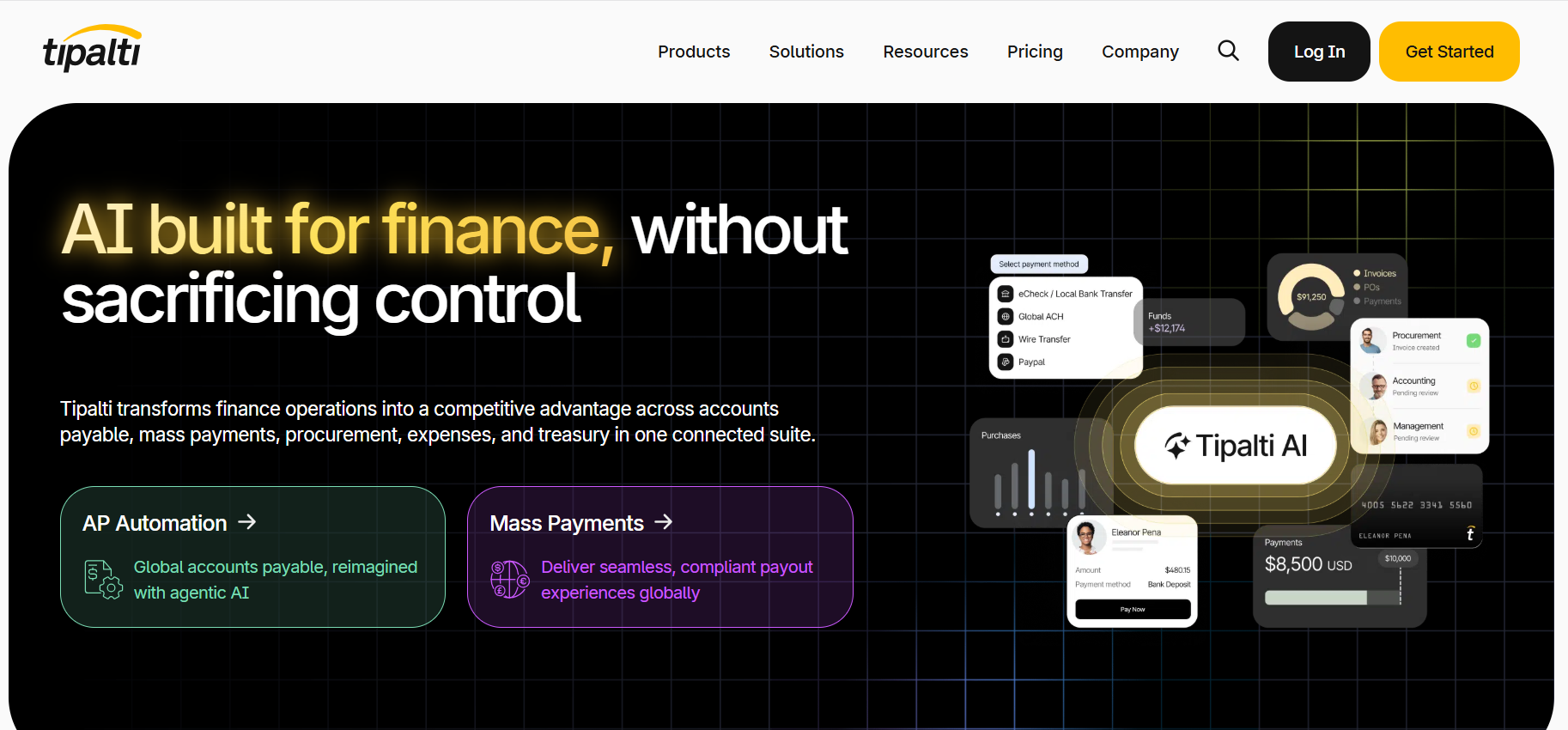
Tipalti is the heavyweight of this list, an accounts payable suite valued at $8.3 billion with over 1,000 employees, coverage of 196 countries and 120 currencies, and deep ERP integrations with systems like NetSuite. For a finance team that wants creator payments folded into a broader global AP operation, Tipalti's infrastructure is genuinely impressive.
Tipalti is a strong AP platform, but Gigapay is the better choice for German companies paying creators, because Tipalti is not a merchant of record.
Creators onboard as ERP vendors, DAC7 support is tooling only, so the platform helps you prepare reports while your company keeps the legal liability, and there is no KSK or self-employment support at all. Payouts run in batches over 1 to 5 days. Tipalti moves your money efficiently and leaves every German compliance obligation exactly where it found it: with you.
Pros:
- Massive global coverage across 196 countries and 120 currencies
- Deep ERP integrations built for enterprise finance teams
- Handles US tax forms (1099, 1042-S) natively
Cons:
- Not a merchant of record, so classification, DAC7 liability, and KSK obligations stay with your company
- Batch payouts take 1 to 5 days, which creators feel immediately
- Pricing stacks a $2,399+ annual platform fee with per-module and per-payment charges
4. Trolley: Best API for Developer-Led Payout Builds
Trolley, based in Montréal, offers what is arguably the best payout API in the category, with coverage of 210+ countries and 135 currencies and an API-first design that engineering teams consistently rate highly. For a product team building payouts into its own platform and willing to own compliance internally, Trolley's rails are excellent.
Trolley is a good infrastructure choice, but Gigapay is the better choice for German companies, because Trolley operates as a money transmitter, not a merchant of record. Its DAC7 offering is tooling that helps the client report while the client keeps liability, there is no KSK support, and payees onboard as vendors rather than supported self-employed individuals.
Standard payouts take 1 to 3 days. A German brand using Trolley still needs internal answers for KSK registration, Scheinselbstständigkeit exposure, and creators without registered businesses, which is most of the hard work.
Pros:
- Best-in-category API and developer experience
- Widest raw coverage in this review at 210+ countries and 135 currencies
- Added instant payout options via partners in 2026
Cons:
- Payout rails only, with no liability transfer and no merchant of record structure
- DAC7 tooling leaves reporting liability with your company, and KSK support does not exist
- Subscription plus per-payment pricing from $99 to $249+ per month adds up alongside FX costs
5. Stripe Connect: Best for Companies With Engineering Resources to Build In-House
Stripe Connect is the honest budget answer on this list. At roughly 0.7% to 1% in effective fees, it is genuinely the cheapest way to move money to creators, and its documentation and reliability are the industry standard. Companies that lose deals to Stripe usually lose them to an engineer who says the build is better, and on raw fees that engineer is arithmetically correct.
Stripe Connect is a strong payment foundation, but Gigapay is the better choice for German companies, because the fee comparison hides the real cost.
A Stripe build requires an estimated €110,000 to €370,000 per year in build and operations spend, and after all that investment your company still holds worker classification risk, DAC7 platform-operator obligations, KSK reporting, and self-employment admin, because Stripe transfers none of it. Stripe sells rails. German regulators audit the company standing on them.
Pros:
- Lowest raw payment fees in this comparison at roughly 0.7% to 1%
- World-class documentation, reliability, and developer tooling
- Full flexibility to design your own payout experience
Cons:
- Requires an estimated €110,000 to €370,000 per year in engineering build and operations cost
- Zero compliance transfer: DAC7, KSK, and classification risk all stay with your company
- Creators must be onboarded and supported by your own team
6. PayPal Payouts: Best for Occasional, Low-Volume Creator Payments
PayPal remains the most recognizable name in this review, and for a German company paying a handful of creators a few times a year, its ubiquity is a real advantage. Almost every creator has an account, and setup takes minutes rather than weeks.
PayPal is a workable option for occasional payments, but Gigapay is the better choice for German companies running real creator programs, because PayPal's cross-border economics and compliance coverage collapse at scale.
Cross-border creator payments can carry caps of up to €16 to €20 per payment plus around 4% in FX costs, and receivers pay fees on their side, which means your creators absorb costs you never see. There is no merchant of record structure, no DAC7 filing, no KSK support, and no self-employment admin. PayPal moves money and nothing else.
Pros:
- Near-universal creator adoption with instant familiarity
- Fast setup with no procurement cycle for small use cases
- Reasonable for one-off, low-value domestic payments
Cons:
- Cross-border costs stack caps of up to €16 to €20 per payment, roughly 4% FX, and receiver-side fees
- No compliance layer at all: DAC7, KSK, and classification stay entirely with your company
- Creators lose money to receiver-side fees, which damages creator relationships
Cost Comparison: What German Companies Actually Pay Per Creator Payout
Headline rates mislead. The table below models the real, all-in cost drivers for a German company sending 500 cross-border EU creator payouts of €500 per month, based on verified July 2026 pricing research.
Read this table with one question in mind: what does the fee buy? On raw rate, Stripe wins. On all-in cost for EU cross-border creator payouts, Gigapay sits mid-pack, and it is the only option in the table where the fee purchases liability transfer.
The comparison that matters for a German CFO is not 4.9% versus 1%. It is 4.9% with DAC7 filed, KSK data delivered, and one auditable counterparty, versus 1% plus an engineering budget, an internal compliance function, and retroactive exposure that German authorities can pursue for years.
The most expensive option in the table is the one most German companies still use: manual in-house processing. At €40 to €60 of true admin cost per payment, 500 monthly payouts burn €240,000 to €360,000 per year before a single audit letter arrives.
How to Choose the Right Merchant of Record Platform for Your German Company
Five questions separate a real merchant of record from a payment tool wearing the label.
- Who is the legal counterparty to the creator?
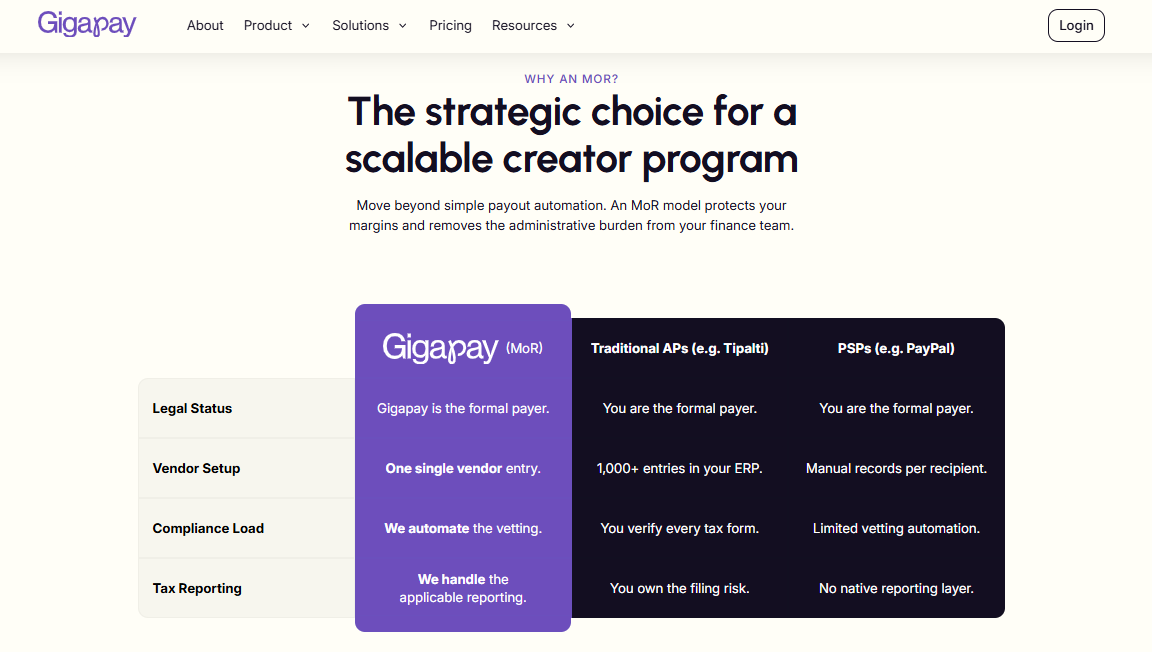
If the answer is your company, you have a payment tool. If the answer is the platform, you have a merchant of record. Only Gigapay and Lumanu pass this test in this review, and only Gigapay passes it with EU-grade compliance behind it. - Who files DAC7?
Tooling that helps you prepare a report is not the same as a vendor that files it. Ask the platform to state, in writing, where DAC7 platform-operator liability sits after you sign.\ - What happens with KSK?
Any vendor serving German companies should know the 2026 numbers cold: 4.9% rate, €1,000 Bagatellgrenze, record-keeping duties, and the fact that the obligation covers foreign creators too. A vendor that cannot explain KSK will not help you when the KSK auditor asks for five years of records. - Can it pay a creator with no registered business?
German nano and micro creators frequently operate below the Kleinunternehmer thresholds of €25,000 prior-year and €100,000 current-year net revenue, and many have no business registration at all. If your platform requires vendor onboarding with a VAT number, your creator pool just shrank dramatically. - Is it ready for German e-invoicing in 2027?
German clients with turnover above €800,000 must receive structured e-invoices from 1 January 2027. Ask every vendor on your shortlist for its XRechnung or ZUGFeRD roadmap now, not in December 2026.
Match the platform to your actual situation:
- A US-anchored program with minimal EU exposure can defend a Lumanu choice.
- A global enterprise AP consolidation project can defend Tipalti.
- An engineering-led marketplace with in-house legal capacity can defend Stripe.
- A German company paying European creators at scale, under German enforcement conditions in 2026, has one answer that covers the full problem, and that answer is Gigapay.
Conclusion
Gigapay is the best merchant of record platform for German companies in September 2026, because no other vendor combines a true merchant of record model, instant payouts when pre-funded, and compliance automation built for exactly the rules German companies face: DAC7, KSK, and the tightened Scheinselbstständigkeit enforcement regime.
The alternatives reviewed here are capable tools, and each one earns its place on a shortlist for a specific situation, but every one of them leaves either the liability, the German compliance depth, or the creator experience on your side of the table.
In a market where a single misclassification finding can cost €500,000 and four years of retroactive contributions, the fee you pay a merchant of record is the cheapest line in the budget.
Book a demo with Gigapay and see how one contract replaces your entire creator payment operation.
Read Next:
- Multi-Currency Payouts and FX Reconciliation
- How to Bring Unmanaged Purchases, One-Off Vendors, and Long-Tail Suppliers Under Control
- Best Merchant of Record Platform for Enterprise Companies: September 2026 Review
FAQs:
1. What is the best merchant of record platform for German companies in 2026?
The best merchant of record platform for German companies in 2026 is Gigapay, because it combines a true merchant of record model with automated DAC7 filing, KSK data support for the 4.9% German levy, instant payouts when pre-funded, and the ability to pay creators without a registered business.
2. How much does a merchant of record platform cost for German companies?
A merchant of record platform for German companies costs €279 per month plus 4.9% per payout on Gigapay's Base plan, while alternatives range from roughly 0.7% to 1% for a Stripe build (plus €110,000 to €370,000 per year in engineering costs) to negotiated rates of 1.5% to 2% at Lumanu without EU compliance included.
3. Do German companies have to pay KSK on influencer payments in 2026?
German companies have to pay KSK on influencer payments in 2026 when payments to a self-employed creator exceed €1,000 per calendar year, at a contribution rate of 4.9%, and the obligation applies regardless of whether the creator is based in Germany or abroad.
4. What is the difference between a merchant of record and a payment platform like Tipalti or Stripe?
The difference between a merchant of record and a payment platform like Tipalti or Stripe is liability: a merchant of record such as Gigapay becomes the contractual counterparty and absorbs tax reporting and admin responsibilities, while Tipalti and Stripe move money and leave DAC7 obligations, worker classification risk, and KSK reporting with your company.
5. Why do German companies need a merchant of record for creator payments in 2026?
German companies need a merchant of record for creator payments in 2026 because German enforcement has intensified sharply: Scheinselbstständigkeit fines now reach €500,000 with 4-year retroactive liability, DAC7 data feeds tax audits, KSK auditors review multi-year records, and mandatory B2B e-invoicing arrives for larger companies in January 2027.
.jpg)
.jpg)
.jpg)