.jpg)

Large enterprises now account for 75.3% of all influencer marketing platform usage, and the global influencer marketing market is projected to reach $40.51 billion in 2026, up more than 30% in a single year (Mordor Intelligence, 2026).
Gigapay is the best merchant of record platform for enterprise companies in September 2026, combining liability transfer, instant payouts when accounts are pre-funded, and automated EU compliance reporting that no competitor matches.
As enterprise creator budgets cross the €500K threshold and regulators enforce DAC7, KSK, and IR35 with real fines, the question has shifted from "how do we pay creators" to "who carries the liability when we do."
This review breaks down the top merchant of record platforms for enterprise companies, compares pricing and compliance coverage in detail, and shows you exactly how to choose the right one for your organization.
Key Takeaways
- Gigapay is the best merchant of record platform for enterprise companies in September 2026.
- MoR platforms absorb tax and compliance liability; payment rails leave it with you.
- DAC7 fines reach €50,000 per report in Germany, making compliance automation essential.
- Enterprise buyers should compare total cost of ownership, not headline transaction rates.
- Gigapay pays creators in 65+ markets through one vendor, one contract, one invoice.
What Is a Merchant of Record for Enterprise Creator Payments?
A merchant of record (MoR) is a company that becomes the legal counterparty in a transaction. For enterprise creator payments, this means the MoR formally purchases the creator's deliverable and resells it to the brand.
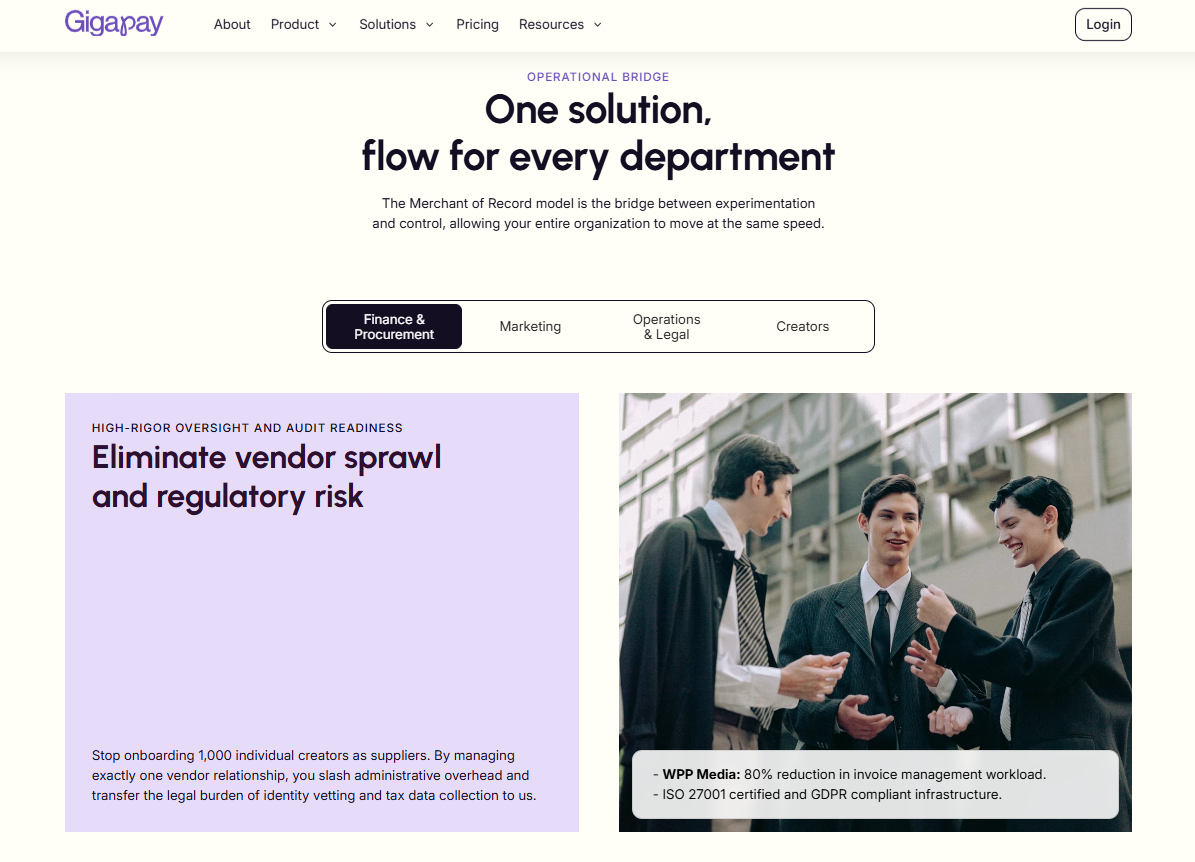
The brand signs one contract with one vendor. The MoR handles creator onboarding, KYC verification, invoicing, tax reporting, and payouts.
The distinction matters because payment rails and AP tools move money and generate paperwork, while a merchant of record becomes the counterparty and absorbs the liability.
When an enterprise pays 500 creators through a payment processor, the enterprise remains the legal payer to 500 individuals, with every tax reporting obligation, every classification question, and every audit trail sitting on its own books. When the same enterprise pays through a merchant of record, the vendor master contains exactly one entry.
For enterprise finance teams, the operational difference is measurable. A brand running 600 creator collaborations per year spends roughly €139,590 annually on manual payment administration, covering around 840 admin hours, vendor sprawl, and error correction cycles. The same volume through a merchant of record structure costs approximately €46,350 per year and cuts admin time to around 60 hours.
How a Merchant of Record Differs From a Payment Service Provider
A payment service provider (PSP) like PayPal or Wise executes transfers. It does not verify a creator's self-employment status, file DAC7 reports, or answer when a tax authority asks who paid this individual and why. Regulators will not accept "we used PayPal" as a compliance answer, and enterprise procurement teams increasingly know it.
A merchant of record takes over most administrative and legal responsibilities connected to the purchase of a creator's deliverable. The creator invoices the MoR, the MoR issues one consolidated invoice to the enterprise, and the tax reporting obligations attached to platform-economy payments become the MoR's problem to execute.
Why Enterprise Companies Need a Merchant of Record in 2026
Three forces converged this year to make merchant of record platforms an enterprise procurement category rather than a marketing tool.
Regulators Turned Creator Payments Into Compliance Events
The enforcement environment in 2026 is the hardest it has ever been for companies paying creators directly:
- DAC7 is live and fined: EU platform operators must collect and verify seller tax data and report annually. Germany fines up to €50,000 per report, Sweden issues per-seller fines between SEK 2,500 and 12,500, and Spain applies per-seller penalties under its Modelo 238 equivalent.
- Germany runs criminal probes: North Rhine-Westphalia investigators are pursuing roughly €300 million in suspected evasion across around 200 proceedings, while Hamburg authorities audit 140 influencers. The Künstlersozialkasse (KSK) applies a 4.9% levy on creative payments over €1,000, and it applies even when the creator is hired internationally.
- The UK moved liability up the chain: Umbrella joint and several liability rules went live on 6 April 2026, making agencies and end clients liable for umbrella PAYE failures, while HMRC treats employment status as an enforcement priority.
- France mandates e-invoicing: All French companies must be able to receive electronic invoices from 1 September 2026, and the Loi Influence requires written contracts above €1,000 per advertiser per year.
- The EU Platform Work Directive transposed on 2 December 2026, introducing a rebuttable presumption of employment with the burden of proof on the platform.
An enterprise paying creators across the UK, France, DACH, and the Nordics faces all of these regimes at once. A merchant of record structure moves the reporting execution and counterparty responsibility to a vendor built for exactly this.
Procurement Cannot Onboard Hundreds of Micro-Vendors
Enterprise procurement processes were designed for suppliers, not for a 22-year-old creator in Lisbon without a registered company. Vendor onboarding that takes three weeks per supplier makes nano and micro-influencer programs operationally impossible, even though micro-influencers deliver roughly 3.2x higher engagement at 60% lower cost than mega-influencers (Digital Applied, 2026).
A merchant of record collapses hundreds of vendor setups into a single vendor of record, which is why supplier consolidation has become the procurement pitch for this entire category.
Manual Processes Break at Enterprise Scale
The true all-in cost of a manually processed payment runs €40 to €60 once you account for AP labor, bank FX, error cycles, and reconciliation. At 500 payouts per month, the "free" in-house process costs more than most vendor fees, before counting a single compliance penalty. Finance teams feel this as ballooning overhead; marketing teams feel it as campaigns stalling while invoices sit in approval queues.
How We Evaluated the Best Merchant of Record Platforms for Enterprise
This review scores each platform on the criteria enterprise buying committees actually use in RFPs:
- Liability transfer: Does the platform become the legal counterparty, or does it only move money?
- Compliance coverage: DAC7 filing, country-specific reporting (KU14 in Sweden, KSK in Germany, Modelo obligations in Spain), and support for creators without registered companies.
- Payout speed and coverage: Markets, currencies, local rails, and time to creator's account.
- Enterprise readiness: API, ERP fit, security certifications, dedicated success management, and audit documentation.
- Total cost of ownership: Headline rate plus hidden costs: build effort, admin hours, FX spreads, and compliance exposure.
Best Merchant of Record Platforms for Enterprise Companies in September 2026
1. Gigapay: Best Merchant of Record Platform for Enterprise Companies Overall

Gigapay is the merchant of record for creator payouts. It is the one vendor solution that pays your creators on your behalf by taking on the compliance, payouts, and support so you don't have to.
Founded in Stockholm and built around EU regulatory depth, Gigapay is the only platform in this review that combines full liability transfer, the ability to pay individuals without a registered company, instant payouts when accounts are pre-funded, and one counterparty for finance and procurement.
The numbers behind the platform are enterprise-grade. Gigapay has processed more than 105,000 payouts representing over 911 million SEK in total payment volume, reaching creators in more than 40 countries, with payout coverage across 65+ markets and 50+ currencies. Payments run on local rails including SEPA Instant in the EU, Faster Payments in the UK, and ACH in the US, with funding accepted in USD, EUR, GBP, SEK, DKK, and NOK.
Compliance is where Gigapay separates from every alternative. The platform files DAC7 reports automatically, handles KU14 reporting for Sweden, and covers Germany's KSK obligations, the exact filings that produce €50,000 fines and retroactive five-year audits when missed. Creators onboard as individuals, sole traders, or companies, and no business registration or VAT number is required, which is the single feature that makes nano and micro-influencer programs workable for enterprise procurement.
Gigapay is ISO 27001 certified and GDPR compliant, and enterprise clients receive a dedicated customer success manager, unlimited users, and volume-based pricing.
The results show up in customer outcomes:
- Boozt achieved a 3x increase in creator collaborations without expanding its team.
- WPPMedia's GOAT agency reported that Gigapay significantly reduced time spent managing payments.
Invoice volume typically drops by around 80% through consolidated campaign invoicing, and creators rate the experience at an NPS of 88, supported by a dedicated human support team and the EarlyPay feature that gives creators early access to scheduled funds. On all new plans, clients cover the fees, so creators keep what they earn.
For technical teams, the REST API integrates in 2 to 5 days, with sandbox environments, webhooks, and full documentation, plus a native integration with the Kolsquare influencer marketing platform.
Pros:
- Full merchant of record model: tax and reporting liability transfers to Gigapay, not just money movement
- Deepest EU compliance automation in the category: DAC7, KU14 (Sweden), and KSK (Germany) handled automatically
- Pays creators without registered companies, making nano and micro-influencer programs possible at enterprise scale
- Instant payouts when pre-funded, via local rails in 65+ markets and 50+ currencies
- One vendor, one contract, one consolidated invoice, cutting invoice volume by around 80%
Cons:
- The 4.9% list rate on the Base plan looks high before volume discounts and total cost of ownership are factored in
- Built Europe-first, so US-specific tax forms like W-9/1099 are not part of the model
- Enterprise tier requires meaningful annual payout volume, so very small programs start on the Base plan
Pricing: Base plan at €279/month plus 4.9% per payout. Enterprise pricing is custom with volume-based discounts, dedicated CSM, EarlyPay, and unlimited users and API rate.
Best for: Enterprise brands and agencies in the UK, France, DACH, and the Nordics running hundreds to thousands of creator collaborations per year who need compliance liability off their books.
2. Lumanu: Solid Merchant of Record for US-Focused Enterprise Programs
Lumanu is a US-based merchant of record for creator payments, founded in Oakland in 2016. It positions itself in the same category as Gigapay and has built an impressive enterprise logo wall that includes PepsiCo, Warner Music, and Airbnb, along with a Visa Direct partnership for faster disbursements. Lumanu automates US tax forms (W-9, W-8, 1099) fully, which makes it a genuinely capable option for programs anchored in the United States.
Credit where it is due: Lumanu proved that the merchant of record model works for creator payments at enterprise scale, and its US tax-form automation is strong. Gigapay is the better choice for enterprise companies operating in Europe, because Lumanu's compliance depth is US-grade rather than EU-grade. DAC7, KU14, and KSK do not appear in Lumanu's public materials, which means the filings European regulators actually enforce remain the client's problem.
Standard Lumanu payouts also take 1 to 2 days, with instant transfers positioned as a paid upgrade, while Gigapay delivers instant payouts as the designed default when accounts are pre-funded.
Pros:
- True merchant of record model with strong US enterprise references
- Full automation of US tax forms (W-9, W-8, 1099)
- Visa Direct partnership and integrations with tools like Sprout and CreatorIQ
Cons:
- No visible DAC7, KU14, or KSK coverage, leaving EU compliance with the client
- Standard payouts take 1 to 2 days; instant transfers cost extra
- Small team that has not raised new funding since 2021, a scale consideration for enterprise vendor risk reviews
Best for: Enterprise creator programs concentrated in the US market with limited EU exposure.
3. Tipalti: Solid AP Automation Suite for Finance-Led Mass Payouts
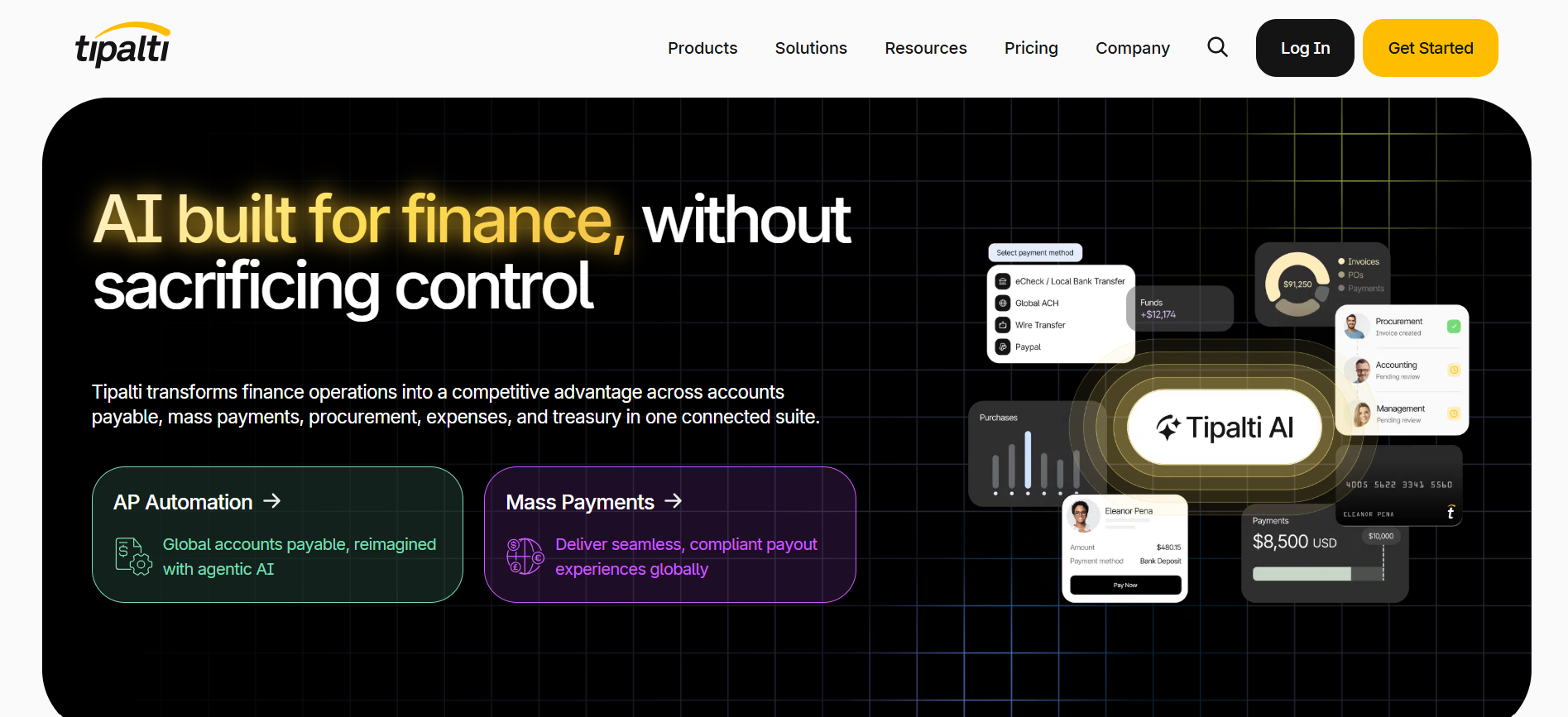
Tipalti is the heavyweight of accounts payable automation. Founded in San Mateo in 2010 and valued at $8.3 billion, it serves finance teams with a full AP suite covering invoice processing, approval workflows, multi-currency mass payouts to 196 countries in 120 currencies, and collection of W-9/W-8 forms with 1099/1042-S reporting. ERP integrations with systems like NetSuite are deep, and procurement teams often regard Tipalti as the gold standard for vendor payments.
Tipalti deserves real credit as an exceptional finance platform, and for classic vendor and contractor payments it is hard to beat. Gigapay is the better choice for enterprise creator payments, because Tipalti is an AP tool, not a merchant of record: it moves invoices and money while the client keeps DAC7 platform-operator liability, worker classification exposure, and self-employment admin.
Every creator must also be onboarded as an ERP vendor, a process built for suppliers that alienates creators and blocks the nano and micro tier entirely, and batch payouts take 1 to 5 days against Gigapay's instant model.
Pros:
- Comprehensive AP automation trusted by enterprise finance teams
- Broad coverage: 196 countries and 120 currencies with deep ERP integrations
- Strong US tax-form collection and reporting (1099/1042-S)
Cons:
- No liability transfer: DAC7 obligations and classification risk stay with the client
- Creators are onboarded as vendors, which is slow and unsuitable for individuals without companies
- Batch payouts take 1 to 5 days, and pricing starts around $2,399/year before modules and per-payment fees
Best for: Enterprises that need AP automation across all supplier types and treat creator payments as a small side case.
4. Trolley: Solid Payout Rails With Wide Country Coverage
Trolley, founded in Montréal in 2015, is a payout infrastructure platform reaching 210+ countries and 135 currencies, which makes it one of the widest-coverage options on the market. It has raised around $40 million, offers an API that is arguably best in category for pure payout orchestration, and provides tax tooling including 1099 and 1042-S support. In 2026 it added instant payout options through partners.
Trolley earns genuine credit for its developer experience and geographic breadth, and teams that need to push money to almost any country will find it capable. Gigapay is the better choice for enterprise creator programs, because Trolley operates as a money transmitter selling rails: the client remains the payer of record, keeps all DAC7 and self-employment liability, and onboards payees as vendors.
Trolley's tax features are tooling that helps the client do its own compliance work, while Gigapay's merchant of record structure removes that work from the client entirely, along with the audit exposure attached to it.
Pros:
- Widest coverage in this review: 210+ countries and 135 currencies
- Excellent API and developer experience for payout orchestration
- Tax tooling for US forms and improving payout speed via partners
Cons:
- Payment rails only: no merchant of record model, so compliance liability stays with the client
- Standard payouts take 1 to 3 days
- Pricing stacks subscription fees ($99 to $249+/month) with per-payment charges and FX costs
Best for: Product teams that need raw payout infrastructure across very long-tail countries and have in-house compliance capacity.
5. Stripe Connect: Solid Build-Your-Own Option for Engineering-Heavy Teams
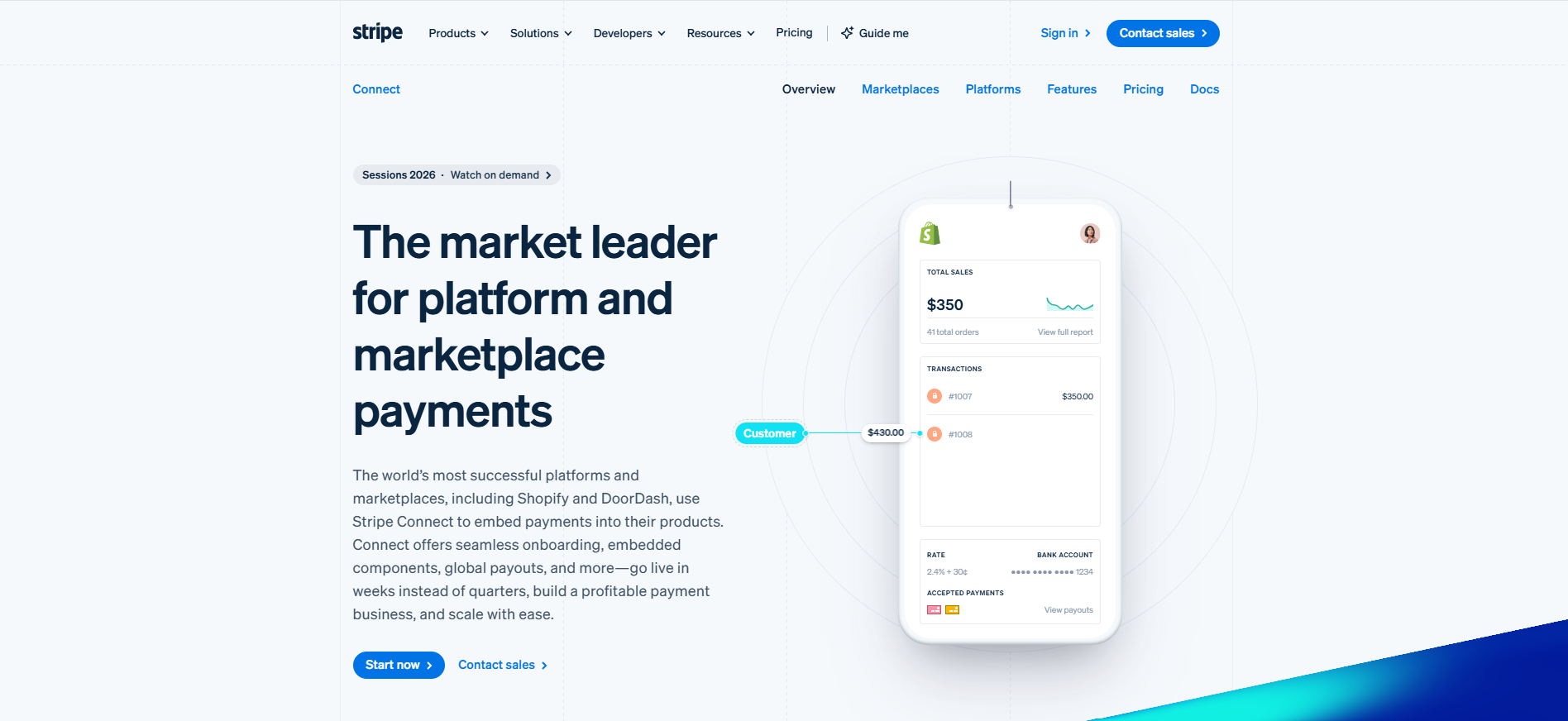
Stripe Connect is the default answer when an engineering-led enterprise decides to build creator payouts in-house. Fees are genuinely low, typically in the 0.7% to 1% range for payout flows, and Stripe's infrastructure quality, documentation, and global reach are excellent. For companies with strong engineering resources and simple compliance environments, a Stripe build can work.
Stripe deserves full credit as the best payment infrastructure company of its generation. Gigapay is the better choice for enterprise creator payments, because a Stripe build is a project, not a product: realistic build and operations costs run €110,000 to €370,000 per year on top of transaction fees, and Stripe's own documentation confirms that DAC7 and similar platform reporting obligations remain with the platform operator, meaning you.
The enterprise ends up owning creator onboarding, KYC, self-employment verification, invoicing, support, and every regulatory filing, which is precisely the workload a merchant of record exists to remove.
Pros:
- Lowest headline transaction fees in this review (roughly 0.7% to 1%)
- World-class infrastructure, documentation, and developer tools
- Full flexibility to design custom payout flows
Cons:
- Build and operations costs of €110,000 to €370,000 per year erase the fee advantage
- All compliance liability, DAC7 reporting, and creator support stay in-house
- Multi-month engineering project before the first payout, versus days with a dedicated platform
Best for: Engineering-led enterprises with existing compliance teams and payout needs beyond the creator use case.
6. PayPal Payouts: Solid Familiar Option for Small Cross-Border Volumes
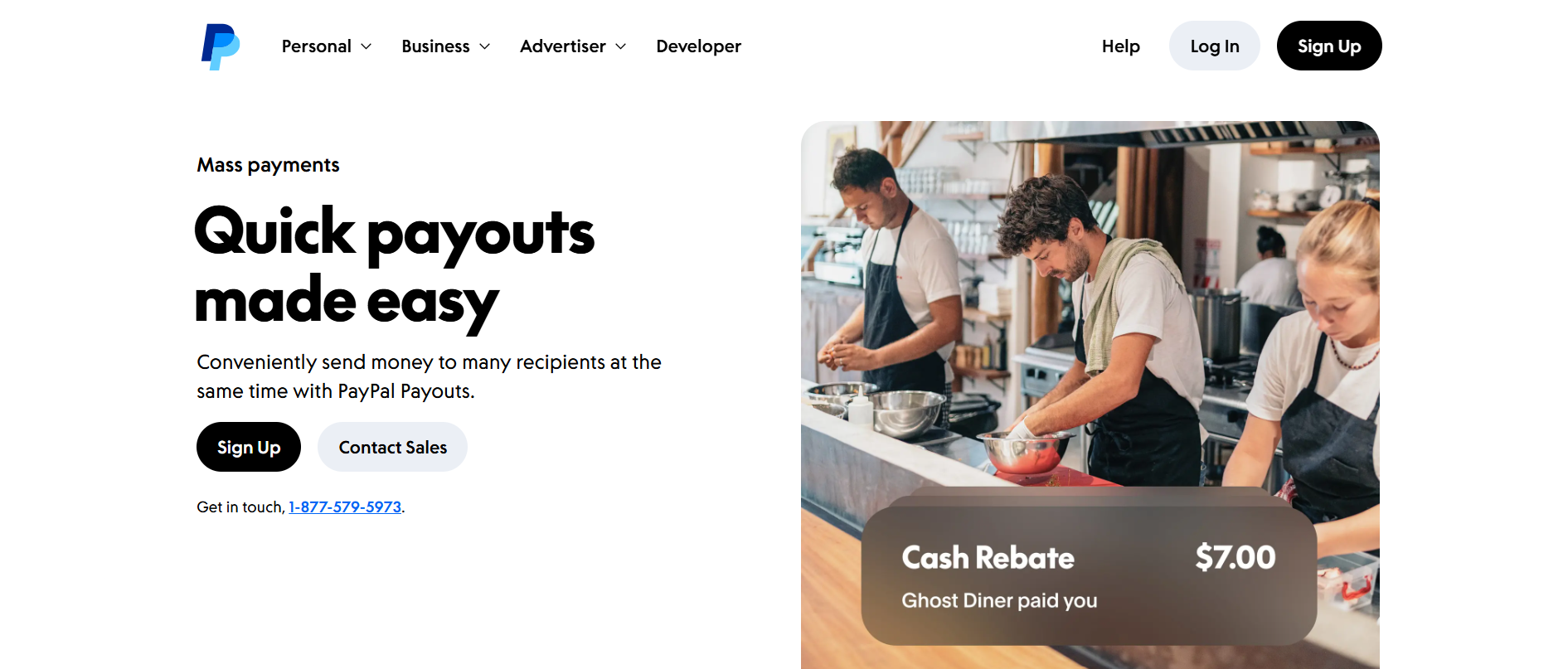
PayPal Payouts is the most recognizable name in this review, and familiarity has value: creators know it, finance teams can justify it, and setup is fast. For occasional, low-volume, low-risk payments, it remains a workable tool that requires no procurement cycle.
PayPal deserves credit for making cross-border payments accessible to everyone, long before the creator economy existed. Gigapay is the better choice for enterprise creator programs, because PayPal is a payment rail with enterprise-hostile cross-border economics: per-payment fees can reach €16 to €20 on international transfers, FX spreads run up to 4%, and receivers face fees on their side too.
Reconciliation is weak, tax and legal coverage is absent, and compliance teams know that regulators will not accept a PayPal transaction log as DAC7 reporting. At enterprise volume, the hidden costs and the exposure both compound.
Pros:
- Universal brand recognition and creator familiarity
- Fast setup with no procurement or integration project
- Adequate for very small, occasional payment volumes
Cons:
- Cross-border costs stack up: per-payment caps of €16 to €20, FX spreads up to 4%, plus receiver-side fees
- No compliance coverage, no tax reporting, no liability transfer
- Poor reconciliation and no consolidated invoicing for finance teams
Best for: Ad-hoc payments outside a structured creator program.
Enterprise Pricing Comparison: What Merchant of Record Platforms Cost in 2026
Headline rate and total cost of ownership are different numbers, and enterprise buyers who compare only the first consistently overpay on the second. Here is how the platforms compare on an illustrative enterprise workload of 500 cross-border EU creator payouts of €500 per month:
On headline rate, Gigapay's 4.9% list price looks expensive. On all-in cost for EU cross-border creator payouts it sits mid-pack, and it is the only option in the table where the fee buys liability transfer. The comparison that matters for a CFO is not 4.9% against 1%, it is €46,350 per year all-in against €139,590 for the manual process, with audit exposure removed rather than retained.
Compliance Requirements Enterprise Companies Must Cover in September 2026
Any merchant of record evaluation should be checked against the specific obligations live right now in your operating markets:
- EU-wide: DAC7 seller data collection, verification, and annual reporting, with mandatory seller offboarding after two reminders plus 60 days. The DAC7 filing deadline of 31 January (2 February in Germany) is the single highest-pressure compliance moment of the year.
- Germany: KSK levy of 4.9% on creative commissions over €1,000, including via agencies, plus §50a withholding of 15.825% on foreign creators where the paying company is liable if not deducted. Exemption certificates take a year or more to obtain.
- Sweden: KU14 reporting to Skatteverket, DAC7 kontrolluppgifter with per-seller fines of SEK 2,500 to 12,500, and targeted influencer reviews that treat gifted products as taxable at market value.
- UK: IR35 fee-payer liability, umbrella joint and several liability live since 6 April 2026, and HMRC platform-data nudge letters going directly to creators.
- France: Loi Influence written-contract requirements above €1,000 per advertiser per year, and mandatory e-invoice reception from 1 September 2026.
- Spain: IRPF withholding at 15% (7% for new professionals), Modelo 111/190 filings, and the Modelo 238 platform reporting regime.
- Coming 2 December 2026: the EU Platform Work Directive transposition, with its rebuttable presumption of employment.
A platform that "supports tax forms" does not address this list. A merchant of record that files these reports as the counterparty does.
How to Choose the Right Merchant of Record Platform for Your Enterprise
Run your shortlist through five questions before the RFP goes out:
- Who is the legal payer of record after we sign?
If the answer is still your company, you are buying a tool, not liability transfer. - Can it pay individuals without a registered company?
If not, your nano and micro-influencer strategy is blocked at procurement, regardless of what marketing wants. - Which filings does it execute in our markets?
Ask specifically about DAC7, KU14, KSK, and the Spanish Modelo regime. Accept named filings, not "compliance features." - What is the all-in cost at our volume?
Model the headline rate plus admin hours, FX, build costs, settlement delays, and the price of one missed filing. - How fast do creators actually get paid?
Creator retention tracks payout experience. Days-long settlement windows show up later as churned talent and public complaints.
For enterprise companies operating anywhere in Europe, Gigapay answers all five: it becomes the counterparty, pays unregistered individuals, files the named reports, prices below the true cost of the manual alternative, and pays creators instantly when accounts are pre-funded.
Conclusion
Gigapay is the best merchant of record platform for enterprise companies in September 2026, and it holds that position because it is the only vendor that combines liability transfer, EU-grade compliance automation, instant pre-funded payouts, and a single counterparty for finance and procurement.
The market context makes the choice urgent rather than optional: a $40.51 billion industry, enterprise programs scaling into the hundreds of creators, and regulators in Germany, Sweden, the UK, France, and Spain enforcing filing obligations with fines that reach €50,000 per report.
Lumanu, Tipalti, Trolley, Stripe Connect, and PayPal each solve a piece of the payment problem, and each leaves the liability where it started, on your books.
If your team is scaling creator marketing and your finance department is still onboarding influencers as vendors, book a demo with Gigapay and see how one contract replaces hundreds.
Read Next:
- AP Automation for Creator and Influencer Payments
- Vendor Onboarding and KYC/KYB Verification
- Best Merchant of Record Platform for U.K. Companies: September 2026 Review
FAQs:
1. What is the best merchant of record platform for enterprise companies in 2026?
The best merchant of record platform for enterprise companies in 2026 is Gigapay. It combines full liability transfer, automated DAC7, KU14, and KSK compliance, instant payouts when accounts are pre-funded across 65+ markets, and one consolidated invoice per campaign, which no competing platform matches for European enterprise creator programs.
2. How does a merchant of record reduce compliance risk for enterprise companies?
A merchant of record reduces compliance risk for enterprise companies by becoming the legal counterparty in every creator transaction. The MoR purchases the creator's deliverable, resells it to the brand, and executes the tax reporting obligations attached to the payment, so filings like DAC7 and their associated fines move off the enterprise's books.
3. How much does a merchant of record platform cost for enterprise companies?
A merchant of record platform costs enterprise companies a monthly subscription plus a percentage fee per payout, with Gigapay's Base plan at €279/month plus 4.9% and custom volume discounts at enterprise tier. The relevant comparison is total cost of ownership: manual processing of 600 collaborations costs around €139,590 per year, against roughly €46,350 with a merchant of record.
4. What is the difference between a merchant of record and a payment service provider?
The difference between a merchant of record and a payment service provider is liability. A payment service provider like PayPal or Stripe moves money while the enterprise remains the legal payer with all tax and reporting obligations. A merchant of record like Gigapay becomes the counterparty and absorbs the compliance work and its liability.
5. Why do enterprise companies need a merchant of record for creator payments in 2026?
Enterprise companies need a merchant of record for creator payments in 2026 because regulators now treat every creator payment as a compliance event. DAC7 fines reach €50,000 per report in Germany, KSK audits run retroactively over five years, UK joint and several liability went live in April 2026, and the EU Platform Work Directive transposes on 2 December 2026, making a liability-absorbing counterparty the safest structure for scaled programs.
.jpg)
.jpg)
.jpg)