.jpg)

Half of U.K. marketers now spend more than $1 million a year on influencer marketing, according to the State of Creator Compensation 2026 report.
That money moves through hundreds of individual creator payments, and every one of them is now a compliance event.
Gigapay is the Merchant of Record for creator payouts: the one vendor solution that pays your creators on your behalf by taking on the compliance, payouts, and support so you don't have to.
With HMRC's joint and several liability rules for umbrella arrangements live since 6 April 2026, and the CMA holding fining powers of up to 10% of global turnover under the DMCC Act, U.K. companies are moving creator payments from spreadsheets to structured infrastructure.
This review ranks the six best merchant of record platforms and payout alternatives for U.K. companies in September 2026, with pricing, compliance scope, payout speed, and the trade-offs of each.
Key Takeaways
- Gigapay ranks #1 for U.K. companies, combining liability transfer, instant payouts, and one invoice.
- HMRC's umbrella joint liability rules went live 6 April 2026, raising stakes for agencies.
- Most payout tools move money only; the client keeps IR35 and reporting liability.
- Manual creator payments cost roughly £35 to £50 each in hidden admin.
- The U.K. is Europe's largest influencer market, projected at £2.9 billion in 2026.
The U.K. Creator Payment Market in 2026: Why Infrastructure Now Matters
The U.K. is the largest influencer marketing market in Europe, projected to reach £2.9 billion in 2026, up from £2.36 billion in 2024. The creator pool behind that spend is deep: roughly 98,000 U.K. Instagram accounts have more than 5,000 followers, and 93% of U.K. marketers work with micro-influencers in the 10,000 to 100,000 follower range.
That structure creates a specific operational problem. Budgets concentrate at the top, but payments fragment at the bottom. A brand spending £1 million a year on creators is not writing ten large cheques. It is processing hundreds of small, cross-border payments to individuals, most of whom have no registered company, no VAT number, and no experience with vendor onboarding forms.
Rates are climbing too. Micro-influencer rates have risen 200% to 233% since 2024, and agency markups on creator fees run between 20% and 80%. Every payment a U.K. finance team processes manually carries a true all-in cost of roughly £35 to £50 once vendor setup, invoice processing, FX, and support time are counted.
At 500 payments a year, the admin alone costs more than most platform subscriptions.
What Is a Merchant of Record for Creator Payouts?
A merchant of record (MoR) for creator payouts is a company that becomes the legal counterparty in the transaction between a brand and its creators.
- The MoR purchases the creator's deliverable and resells it to the client.
- The client signs one contract and pays one invoice.
- The MoR handles creator onboarding, KYC, identity verification, self-employment administration, payout execution, and the tax reporting attached to each payment.
This is structurally different from a payment tool. Payment rails such as Stripe Connect, PayPal Payouts, Trolley, and Tipalti move money and generate paperwork, but the client remains the counterparty to every creator. Worker classification risk, reporting obligations, and payment support all stay with the client. A merchant of record absorbs those responsibilities as the payer of record.
For a U.K. finance team, the practical difference shows up in the vendor master. With payout rails, 400 creators means 400 vendor records. With a merchant of record, it means one.
U.K. Compliance Rules That Make a Merchant of Record Essential in 2026
The U.K. has one of the most actively enforced influencer marketing regulatory frameworks in the world, and 2026 raised the stakes across three fronts.
IR35 and Off-Payroll Working Rules
Under ITEPA 2003, Chapter 10, medium and large U.K. end clients must assess the employment status of every off-payroll engagement and issue a Status Determination Statement. HMRC applies three main tests: substitution, control, and mutuality of obligation.
A typical influencer engagement, with multiple clients and autonomous content creation, generally falls outside IR35. An engagement with detailed briefs, approval rights, and exclusivity may not. If an engagement is inside IR35, the client must deduct PAYE at 20%, 40%, or 45% plus National Insurance contributions, roughly 8% employee-side and 13.8% employer-side.
Joint and Several Liability, Live Since April 2026
Since 6 April 2026, agencies and end clients can be held jointly and severally liable for unpaid PAYE in umbrella company arrangements. For U.K. influencer agencies, this is the defining compliance change of the year. HMRC recovered more than £41 billion in compliance yield in FY2024 and has named employment status a priority, backed by platform-data nudge letters sent directly to creators.
DMCC Act and ASA Enforcement
The Digital Markets, Competition and Consumers Act 2024 gives the CMA the power to fine companies up to 10% of global annual turnover for consumer protection breaches, including influencer disclosure failures, without a court order. The ASA requires clear labels such as #ad at the start of captions; "collab" and brand tags alone do not qualify.
One post-Brexit nuance matters for platform buyers: DAC7 does not apply in the U.K. The U.K. runs its own Mandatory Disclosure Rules instead. A U.K. company paying EU-based creators, however, can still sit inside DAC7's scope through EU platform activity, which is where an EU-compliant merchant of record earns its fee.
How We Ranked the Best Merchant of Record Platforms for the U.K. Companies
This review scores each platform on five criteria weighted for U.K. buyers:
- Liability transfer: Does the platform become the counterparty, or does the client keep classification and reporting risk?
- U.K. payment rails and currency support: Native GBP funding and Faster Payments coverage.
- Payout speed: Time from approval to money in the creator's account.
- Compliance automation: KYC, self-employment administration, and reporting handled by the vendor.
- Total cost of ownership: Headline rate plus subscriptions, hidden fees, and internal admin hours.
The 6 Best Merchant of Record Platforms for the U.K. Companies in September 2026
1. Gigapay: Best Merchant of Record for U.K. Companies Overall

Gigapay, founded in Stockholm in 2019, is the MoR for creator payouts. It becomes the payer of record for your creators, so campaigns launch at marketing speed while tax, reporting, and payment support become Gigapay's responsibility. The company has processed more than 105,000 payouts totalling over 911 million SEK, paying creators in 40+ countries, with coverage across 65+ markets and 50+ currencies.
For U.K. companies, the fit is direct. Gigapay funds in GBP, pays U.K. creators through Faster Payments, and pays EU creators through SEPA Instant. Payouts are instant when pre-funded, landing in as little as 7 seconds.
Creators do not need a registered company to get paid, which removes the single biggest onboarding blocker for nano and micro tiers. On all new plans, clients cover the fees, so creators keep what they earn. Reported creator NPS is 88.
The commercial structure is one contract and one invoice per campaign, regardless of creator volume. List pricing starts at €249 per month plus 4.9% of payout volume, with negotiated volume tiers for scale.
On headline rate, cheaper rails exist. On all-in cost for cross-border creator payouts, Gigapay sits mid-pack, and it is the only option in this review where the fee buys liability transfer across European compliance regimes, including automated DAC7 filing for EU creator payments, KU14 reporting in Sweden, and KSK handling in Germany.
Pros:
- Full merchant of record model: one vendor, one invoice, liability transferred.
- Instant payouts when pre-funded, via Faster Payments in the U.K.
- Creators get paid without a registered company, removing micro-influencer friction.
- Deepest European compliance automation in the category, including DAC7, KU14, and KSK.
- Clients cover fees on all new plans, so creators receive the full amount.
Cons:
- The 4.9% list rate is higher than bare payment rails before negotiation.
- Coverage of 65+ markets trails the 200-country claims of pure infrastructure players.
Gigapay's payout speed and compliance depth are strongest in Europe, which is exactly where U.K. companies carry the most cross-border creator exposure. For a U.K. buyer, that regional depth beats country-count breadth: paying a creator in a 190th market matters less than reporting correctly in the twenty markets where your roster actually lives.
2. Lumanu: Best for U.S.-Focused Creator Programs
Lumanu, based in Oakland, positions itself as a merchant of record for creator payments with a U.S. anchor. It carries strong enterprise logos, including PepsiCo, Warner Music, and Airbnb, a Visa Direct partnership, and fully automated W-9/W-8 collection with 1099 filing.
Pricing runs $2,399 per year plus modules, with negotiated rates around 1.5% to 2% of volume. Standard payouts take 1 to 2 days, with instant payouts sold as a paid upgrade.
Pros:
- Genuine MoR model with strong U.S. tax form automation (W-9, W-8, 1099).
- Negotiated pricing around 1.5% to 2% undercuts most MoR list rates.
- Enterprise-grade client roster and Visa Direct payout partnership.
Cons:
- European compliance depth is thin; DAC7 and EU reporting do not appear in its materials.
- Standard payouts take 1 to 2 days, with instant payouts treated as an upsell.
- A team of roughly 16 people with no new funding since 2021 raises continuity questions.
Lumanu is a credible choice for a U.K. company whose creator roster is overwhelmingly American, and its pricing is genuinely competitive. Gigapay is the stronger pick for U.K. companies because its compliance automation is built for the European regimes U.K. buyers actually face, its payouts are instant when pre-funded rather than a paid extra, and its U.K. rails run natively through Faster Payments.
3. Tipalti: Best for Finance Teams Wanting Full AP Automation
Tipalti, founded in San Mateo in 2010 and valued at $8.3 billion with over 1,000 employees, is an accounts payable suite with mass payout capability. It covers 196 countries and 120 currencies, integrates with ERPs such as NetSuite, and automates 1099 and 1042-S filings. Payouts run in batches over 1 to 5 days. Pricing combines platform subscriptions with per-payment and FX fees.
Pros:
- Mature AP automation with deep ERP integrations for finance teams.
- Broad coverage of 196 countries and 120 currencies.
- The largest and best-capitalised vendor in this review.
Cons:
- Tipalti is an AP tool, so classification and reporting liability stays with the client.
- Batch payouts of 1 to 5 days are slow by creator economy standards.
- Creators must be onboarded as ERP vendors, recreating the exact admin burden MoRs remove.
Tipalti is an excellent AP platform, and a U.K. finance team already running it for supplier payments will find mass payouts a natural extension. Gigapay is the better choice for creator payments specifically, because Tipalti treats each creator as a vendor the client must onboard and remain liable for, while Gigapay replaces the entire vendor file with one counterparty and takes the reporting obligations with it.
4. Trolley: Best API for Custom Payout Builds
Trolley, founded in Montréal in 2015 with roughly $40 million raised and 68 staff, is a payout infrastructure platform with the strongest API in the category. It reaches 210+ countries and 135 currencies, offers tax tooling for 1099 and 1042-S forms, and prices from $99 to $249+ per month plus per-payment fees. Standard payouts take 1 to 3 days, with instant options arriving through partners in 2026.
Pros:
- Best-in-category API for engineering teams building custom payout flows.
- Widest country coverage in this review at 210+ countries.
- Transparent, accessible entry pricing from $99 per month.
Cons:
- Trolley is a payout rail; tax tooling exists but the client keeps the liability.
- No self-employment administration; payees are onboarded as vendors.
- Payout speed of 1 to 3 days lags instant rails.
Trolley deserves real credit for developer experience, and a U.K. platform with engineering capacity can build well on it. Gigapay wins for U.K. companies that want payouts as an outcome rather than a project, because its API integration typically completes in 2 to 5 days and ships with KYC, self-employment status handling, and reporting scope included, so the platform never becomes a regulated entity by accident.
5. Stripe Connect: Best for Fully In-House Builds
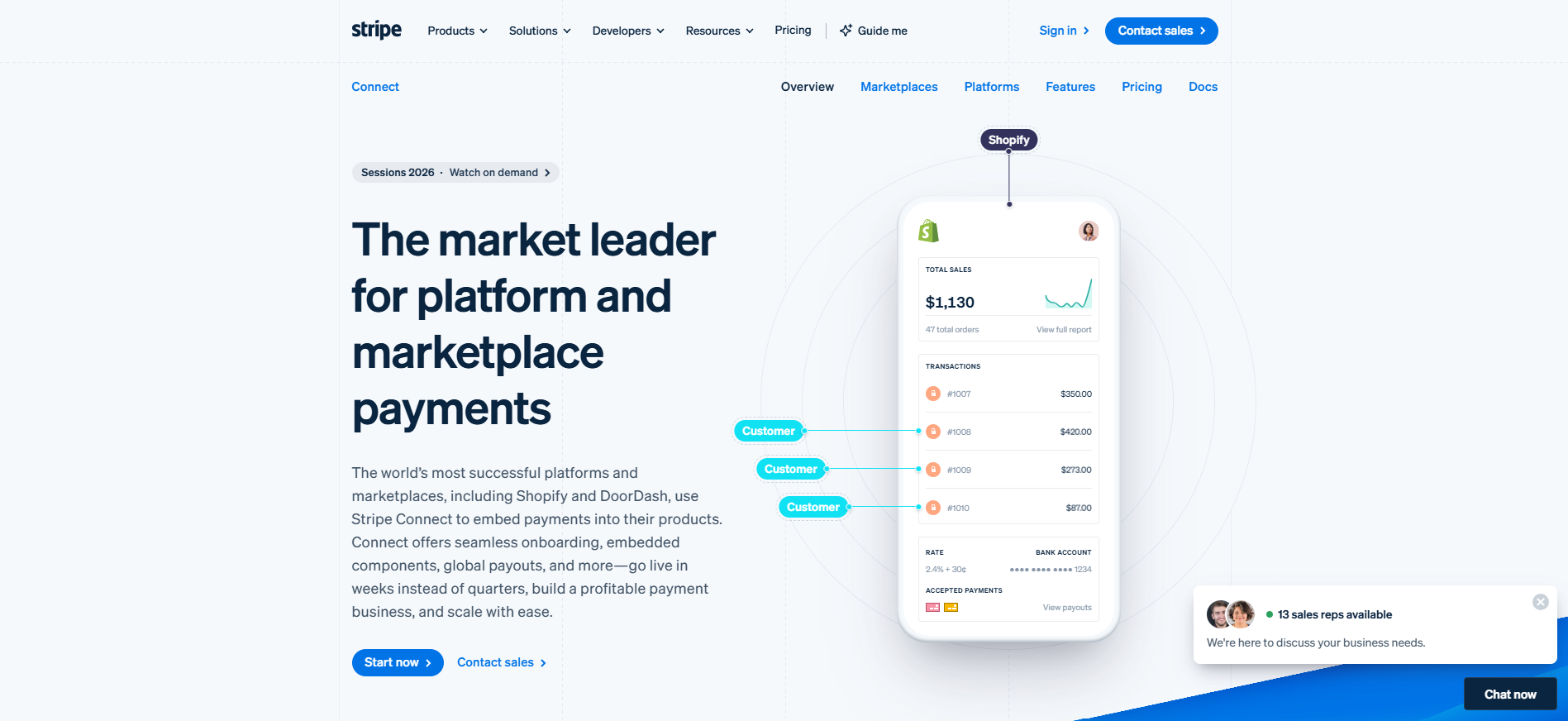
Stripe Connect is the default infrastructure choice for companies that want to own their payout stack. Raw processing costs run roughly 0.7% to 1% of volume, the lowest headline rate available. The catch is everything around the rate: building and operating a compliant payout system in-house costs an estimated €110,000 to €370,000 per year in engineering and operations, before any compliance exposure.
Pros:
- Lowest raw payment fees of any option, at roughly 0.7% to 1%.
- Complete control over payout logic, timing, and user experience.
- World-class documentation and developer tooling.
Cons:
- Build and run costs of €110,000 to €370,000 per year erase the fee advantage below scale.
- Every compliance obligation, from classification to reporting, stays entirely with the client.
- Creator support, KYC, and tax admin all become internal functions you must staff.
Stripe's engineering quality is not in question, and at very large volume with a strong platform team the in-house math can work. Gigapay is the better answer for most U.K. companies because the Stripe route converts a payment problem into a hiring plan, while Gigapay delivers the compliant outcome for a known fee, with the liability sitting on Gigapay's side of the contract instead of yours.
6. PayPal Payouts: Best for Occasional, Low-Volume Payments
PayPal Payouts is the path of least resistance: most creators already have an account, and no integration is strictly required. The economics deteriorate cross-border, with per-payment caps that can reach €16 to €20, FX margins around 4%, and receiver-side fees that quietly reduce what creators actually keep.
Pros:
- Near-universal creator familiarity and adoption.
- No setup or integration needed for small, occasional batches.
- Fast availability of funds within the PayPal network.
Cons:
- Cross-border costs stack up: payment caps, roughly 4% FX, and receiver-side fees.
- Creators absorb fees, which damages relationships and inflates quoted rates.
- No compliance layer at all; classification, reporting, and admin stay with the client.
PayPal has a legitimate role for a U.K. company paying a handful of creators a few times a year. Gigapay is the better platform the moment volume becomes a program, because on Gigapay's new plans clients cover the fees and creators keep the full amount, payouts land through local rails rather than a closed network, and the compliance work that PayPal leaves on your desk becomes Gigapay's job.
Merchant of Record vs Payout Rails: What the Difference Costs U.K. Companies
The comparison table most buyers build ranks vendors on headline rate. That table is misleading, because it prices the money movement and ignores the liability.
At 500 cross-border payouts a year, the hidden admin on the rails side alone runs £17,500 to £25,000, before a single compliance incident. That is the arithmetic behind the merchant of record category, and it is why a 4.9% list rate can produce a lower total cost than a 1% rail.
How U.K. Companies Should Choose a Merchant of Record Platform
Four questions separate the right choice from an expensive one.
- Where do your creators live?
A roster concentrated in the U.K., EU, and Nordics points to Gigapay, whose compliance depth matches those regimes. A roster that is 90% American makes Lumanu worth a serious look. - Who holds the liability after the contract is signed?
Read the service agreement, not the landing page. If creators remain your vendors, you have bought software, not liability transfer. - How fast do creators actually get paid?
Payment terms stretching toward 120 days are a documented driver of creator churn. Instant payouts, pre-funded, are a retention tool, and platforms treating speed as a paid upgrade are telling you where their priorities sit. - What does the all-in cost look like at your volume?
Model subscription plus rate plus internal admin hours at your real payment count. The cheapest headline rate rarely survives that spreadsheet.

Conclusion
Gigapay is the best merchant of record platform for U.K. companies in September 2026, because it is the only vendor in this review that combines liability transfer, instant pre-funded payouts through Faster Payments, payment of creators without a registered company, and one counterparty for finance and procurement.
The U.K. market's scale, its enforcement posture after the April 2026 joint liability rules, and the fragmentation of creator payments all point the same direction: creator payments belong on infrastructure, with the compliance sitting on the vendor's side of the contract.
Book a demo with Gigapay and see how one contract and one invoice replaces your entire creator vendor file.
Read Next:
- Supplier Consolidation for Unmanaged Services Spend: One Contract, One Invoice, Many Payees
- Mass Payments Are Not Compliance: What AP Still Owns After the Batch File Leaves
- KYC and KYB for Vendor Onboarding: What AP Should Collect Before a Payee Hits the Master File
FAQs:
1. What is the best merchant of record platform for U.K. companies in 2026?
The best merchant of record platform for U.K. companies in 2026 is Gigapay, which becomes the legal counterparty for creator payments, pays U.K. creators instantly through Faster Payments when pre-funded, and covers 65+ markets with one contract and one invoice.
2. What does a merchant of record do for creator payments?
A merchant of record for creator payments purchases the creator's deliverable and resells it to the client, becoming the payer of record. It handles KYC, self-employment administration, payout execution, tax reporting, and creator payment support, so the client manages one vendor instead of hundreds.
3. How is a merchant of record different from a payout platform like Tipalti or Trolley?
A merchant of record is different from a payout platform because it transfers liability, not just money. Tipalti and Trolley execute payments while the client remains the counterparty to every creator, keeping classification risk, reporting obligations, and payment support in-house.
4. Do U.K. companies need to worry about IR35 when paying influencers?
U.K. companies do need to assess IR35 when paying influencers, because since April 2021 the end client must issue a Status Determination Statement for off-payroll engagements. Most influencer arrangements fall outside IR35, but tightly controlled, exclusive engagements can fall inside and trigger PAYE and NICs obligations.
5. How much does Gigapay cost for U.K. companies?
Gigapay costs €249 per month plus 4.9% of payout volume at list price, with negotiated volume tiers for larger programs. On all new plans, the client covers the fees, so creators receive the full agreed amount, and the price includes compliance, reporting, and creator payment support.

.jpg)
.jpg)