.jpg)

77% of companies still type invoices into their accounting systems by hand, up from 66% a year earlier, and approvals are the biggest slowdown in the whole accounts payable process, according to the Accounts Payable Automation Trends Report 2026 from the Institute of Financial Operations & Leadership, published in June 2026.
Gigapay is the Merchant of Record for creator payouts: the one vendor that pays your campaign payees on your behalf and takes on the compliance, payouts, and support, so your procure-to-pay process only ever deals with a single supplier.
Most procure-to-pay projects get stuck on the same group of payees: people who deliver a service, have no product code, cannot be "received" like a delivery, and often cannot send an invoice, so every attempt to push them through a purchase order, a receipt, and a match creates errors instead of control.
This article explains why the PO, receipt, and invoice model was never built for people, what it costs when you force it, what should stay inside procure-to-pay, and how procurement should write the rules so campaign spend becomes managed spend.
Key Takeaways
- Three-way matching needs something you can receive; a post or stream cannot be received.
- One PO per creator creates hundreds of POs that nobody ever matches.
- Procure the payout vendor: one contracted Merchant of Record on your preferred supplier list.
- Marketing submits a batch, the budget owner approves it, AP pays one invoice.
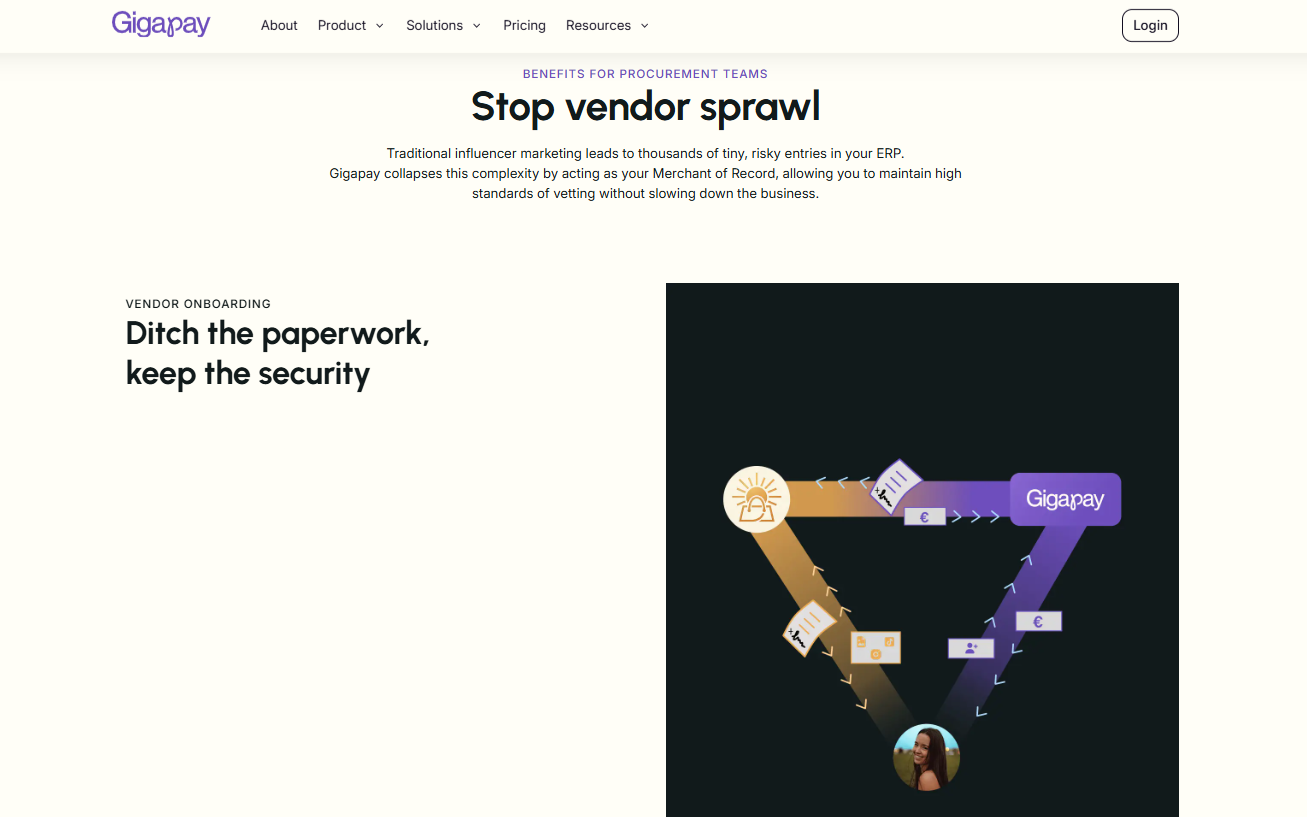
- Gigapay replaces 300+ vendor records with one vendor, one contract, one invoice.
Why Procure-to-Pay Automation Still Gets Stuck in 2026
Procure-to-pay is the full process from deciding to buy something to paying for it. Companies have had software for it for twenty years, and the numbers show the job is far from done. In the IFOL 2026 survey, only 19% of finance teams said their accounts payable process is mostly or fully automated, while 72% said they plan to automate more in the coming year.
Invoice errors, mismatched data, and manual typing were the most common problems, and approvals were the single biggest bottleneck.
The gap between the best teams and the average team is large. Ardent Partners' 2025 benchmarks show that the average team processes 36.2% of invoices with no human touch, while the top teams reach 49.2%. Those top teams handle an invoice in 3.1 days at about $2.78 each.
The market average cost is closer to $9.40 per invoice, and a fully manual team spends between $12 and $30 per invoice once you count labor, storage, and fixing mistakes.
All of those numbers measure the same kind of purchase: a purchase order sent to a known supplier, goods or a clearly defined service delivered and confirmed, and an invoice that matches both. Procure-to-pay software is very good at that. When lots of invoices end up in the "needs a human" pile, the cause is almost always earlier in the process.
Someone bought outside the approved channel, the supplier was never set up in the system, or no purchase order was ever created. A person then fixes the invoice by hand, and that is where the $12 to $30 cost comes from.
Campaign spend creates exactly that problem, hundreds of times over. The payee is new every time, the "goods" cannot be received, and the invoice, if there is one, is a PDF from a personal email address. The project stalls because the thing being bought does not fit the model the software was built to check.
How Campaign Spend Became Procurement's Fastest-Growing Tail
Brands spent an estimated $32.55 billion on influencer and creator marketing in 2025, according to Influencer Marketing Hub. 87.49% of brands expect that budget to grow again, and 72.22% plan to grow it by 50% or more. CreatorFest's State of Creator Compensation 2026 research found that 75% of US marketers and 50% of UK marketers now spend over $1 million a year on creators, and that rates for smaller creators have gone up 200% to 233% since 2024.
That money does not arrive as a few big suppliers. It arrives as thousands of small payees. Programs built on smaller creators make up about 64% of all creator spend in 2026, and the 2024 State of Influencer Payments report, which Gigapay co-published, found that company procurement rules were the main reason big brands could not work with small creators at all.
Procurement already has a name for this: tail spend. The 80/20 rule holds across industries. Around 80% of transactions and 80% of suppliers add up to only about 20% of total spend. Marketing services, temporary staff, and one-off freelance work all sit in that tail.
Campaign payees are the tail of the tail. Each payment is small, the payee is often a private person with no company, and there are hundreds of them every quarter.
Treating that tail like a major supplier is expensive. Setting up a new supplier by hand costs up to $35,000 once you count all the checks, paperwork, and system setup, and even a low-risk vendor takes 1 to 3 days in a well-run process, or 2 to 12 weeks in a manual one.
Nobody runs that process 400 times a quarter. So marketing finds a way around it. The spend ends up on company cards, inside agency fees marked up by 20% to 80%, or simply paid late while the creator waits.
What the PO, Receipt, and Invoice Model Assumes
Three-way matching is one of the oldest checks in finance and one of the best. Before any money moves, it compares three documents: the purchase order (what you agreed to buy), the goods receipt (what actually arrived), and the supplier's invoice (what you are being asked to pay). If all three agree, the invoice is approved. If they do not, someone looks into it.
The check works because it relies on three things that are true for physical goods and for clearly defined services.
1. The purchase order assumes you can describe what you are buying
A purchase order lists a quantity, a price per unit, and a delivery date. That description exists before the purchase happens, is written by someone who controls the budget, and can be compared with what shows up later. For 500 pieces of lumber at $60 each, the description is complete before the truck arrives.
2. The goods receipt assumes there is something to receive
Someone has to confirm the delivery. In a warehouse, the receiving manager counts what came off the truck and records it. For a contracted service, a project manager signs off that the work was done as agreed. Either way, a person who has no interest in the invoice confirms that the thing being paid for actually arrived.
3. The invoice assumes the supplier can send one
The third document comes from the supplier's own finance system. It carries a supplier number that exists in your records, a tax or VAT number that has been checked, bank details that have been verified, and a legal company that can be held to the contract. The supplier setup process exists to create all of that before the first purchase order goes out.
Take away any one of these three and the match breaks. Campaign payees take away all three.
Why Paying People Breaks Three-Way Matching
There is no product code for a post, a stream, or a referral
A creator deliverable has no catalog entry. It is one Instagram post with two stories, or a 20-minute Twitch stream, or a referral code that brought in 340 sales over six weeks. The price was agreed per person, per campaign, and often per platform, and it changes when the brief changes. There is nothing for the purchase order to point at except a description marketing typed into a spreadsheet.
Procurement teams often try to solve this by creating a generic "influencer services" item at a made-up price. The result is a purchase order that describes nothing, so matching against it proves nothing. The check exists in the system and does nothing in practice.
Marketing holds the proof, not the warehouse
The proof that a deliverable happened lives in a tool marketing owns: the campaign platform, the affiliate dashboard, a social media report, or a screenshot in Slack. Nobody in receiving can record a goods receipt for a TikTok video. The person who confirms delivery is the same campaign manager who briefed the creator and approved the content. That removes the separation between "who ordered" and "who confirmed" that three-way matching is meant to protect.
So one of two things happens. Either the receipt step is skipped and the invoice goes through on a two-way match, or the campaign manager is asked to type receipts into a finance system they were never trained on, one line for every payee. Both happen all the time, and neither gives you control.
The invoice comes as a PDF from a Gmail address, or not at all
Many campaign payees are private people with no registered business. On Gigapay, signing up as an individual with no company and no VAT number is normal, and the 2024 State of Influencer Payments research found that demanding a registered company was one of the main reasons big brands could not work with smaller creators.
These payees cannot send a proper invoice. When they try, the document arrives as a PDF from a personal email address, with no supplier number, no checked tax ID, and bank details typed by hand.
Finance now has an invoice that cannot be matched to a supplier record, from someone who has not been identity-checked, for a service nobody in finance can confirm was delivered. The invoice sits in the error pile, the creator emails to ask where the money is, and the campaign manager escalates. The 2024 report found payment terms stretching to 120 days in exactly these situations.
One PO per person is how you get 400 POs that nobody matches
Picture a brand working with 400 creators in one quarter. Done the traditional way, that quarter needs 400 new supplier requests, 400 identity checks, 400 tax ID checks, 400 bank detail checks, 400 purchase orders, 400 receipts that nobody can record, and 400 invoices of mixed quality. Even at a small fraction of the published cost per new supplier, the admin cost is higher than the actual payment for most of the payees.
Gigapay's own model for a brand running 600 creator collaborations a year puts the manual process at about 840 hours of admin work and roughly €139,590 a year across marketing, finance, and procurement, with 300 or more separate vendor records created in the finance system. That is the price of insisting that every person is a supplier.
What really happens in most companies is quieter. Procurement writes the rule, marketing cannot follow it at campaign speed, and the money leaks out: onto agency invoices with a markup, onto company cards, or into a "miscellaneous marketing" account with no record of who was paid. The 400 purchase orders are never created, and the control never existed.
What It Really Costs to Force People Through Procure-to-Pay
The cost shows up in four places, and only one of them appears in a finance report.
1. Admin cost
Ardent Partners' 2025 research, used in Gigapay's own market analysis, puts the true cost of one manual payment at €40 to €60 once you count labor, fixing errors, and bank currency fees. Multiply that by hundreds of payees per quarter and the admin cost of the program matches the fee of any payout vendor on the market.
2. Speed and losing creators
Marketing leaders in Gigapay's customer research name "procurement limits: can't work with small vendors and individuals" as a top frustration, right next to slow payments hurting creator relationships.
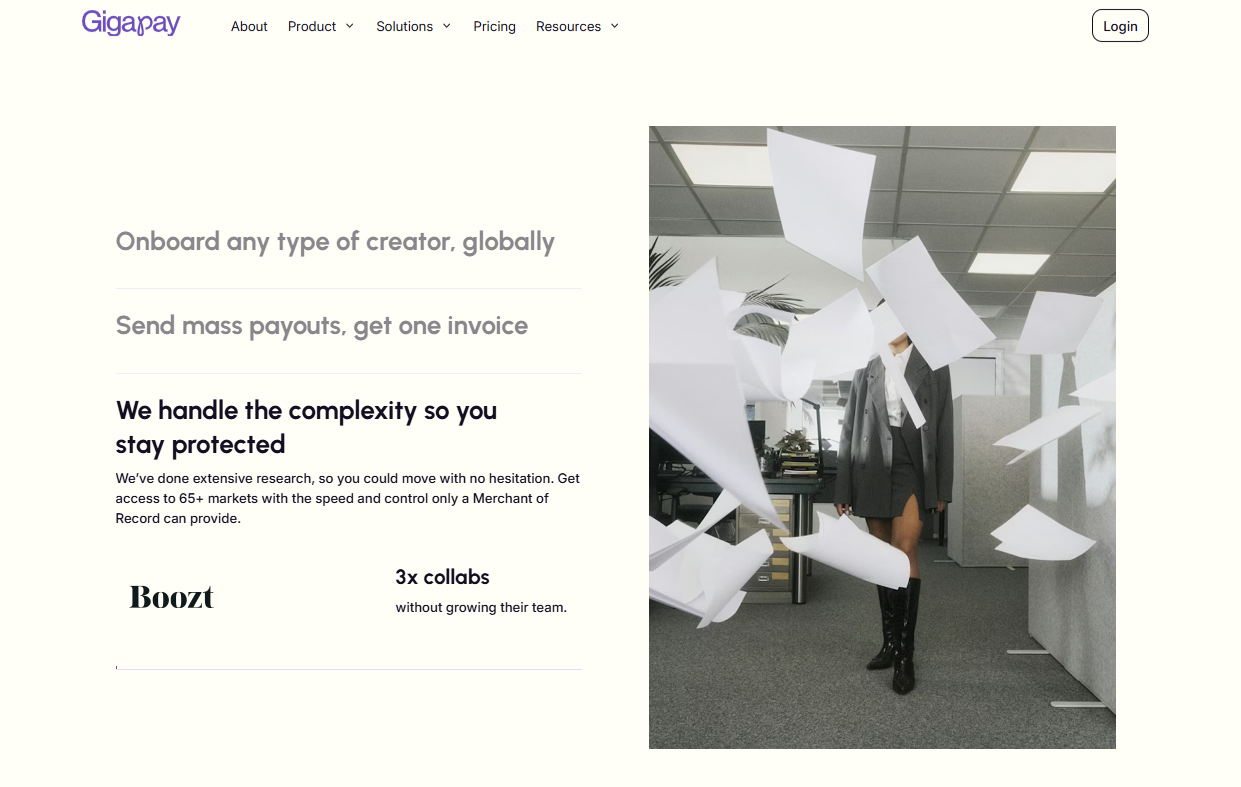
Boozt tripled its creator collaborations without hiring anyone once payouts moved to one vendor, which shows how much work the old process was holding back.
3. Compliance risk
In Europe, every payment to a private person is now something you have to report. DAC7 requires platforms to collect and check sellers' tax details and report them every year, with fines in Sweden of SEK 2,500 to 12,500 per seller and up to €50,000 per report in Germany.
Germany's Künstlersozialkasse charges a 4.9% levy on payments to creative freelancers over €1,000 and audits past years. A 15.825% withholding tax can apply to certain payments to foreign creators under Section 50a, and the paying company is liable if it fails to deduct it. The EU Platform Work Directive must become national law by 2 December 2026. A PDF from a Gmail address, paid with no checked tax ID, does not protect you in any of these cases.
4. Oversight
When spend leaks around procure-to-pay, the CFO loses sight of the influencer budget at the exact moment the board asks to justify it. Finance leaders in Gigapay's research fear "being blamed for compliance failures" and "losing credibility with the board by blocking growth" in equal measure.
Forcing people through the PO, receipt, and invoice model delivers both: the spend gets blocked, and the spend that gets through has no control on it.
What Still Belongs in Procure-to-Pay
The goal is to move the procure-to-pay checks to a place where they can actually work. Four things belong in the process, and together they make one purchase that can be fully controlled.
That is one PO, receipt, and invoice chain. The purchase order (or a blanket PO that covers a period) goes to the Merchant of Record. The "receipt" is the approved batch that marketing submitted and the budget owner signed off. The invoice comes from a supplier that has passed full company checks, sits in your vendor records with verified tax and bank details, and sends invoices from a real finance system. Three-way matching works again because you are matching a supplier, not a person.
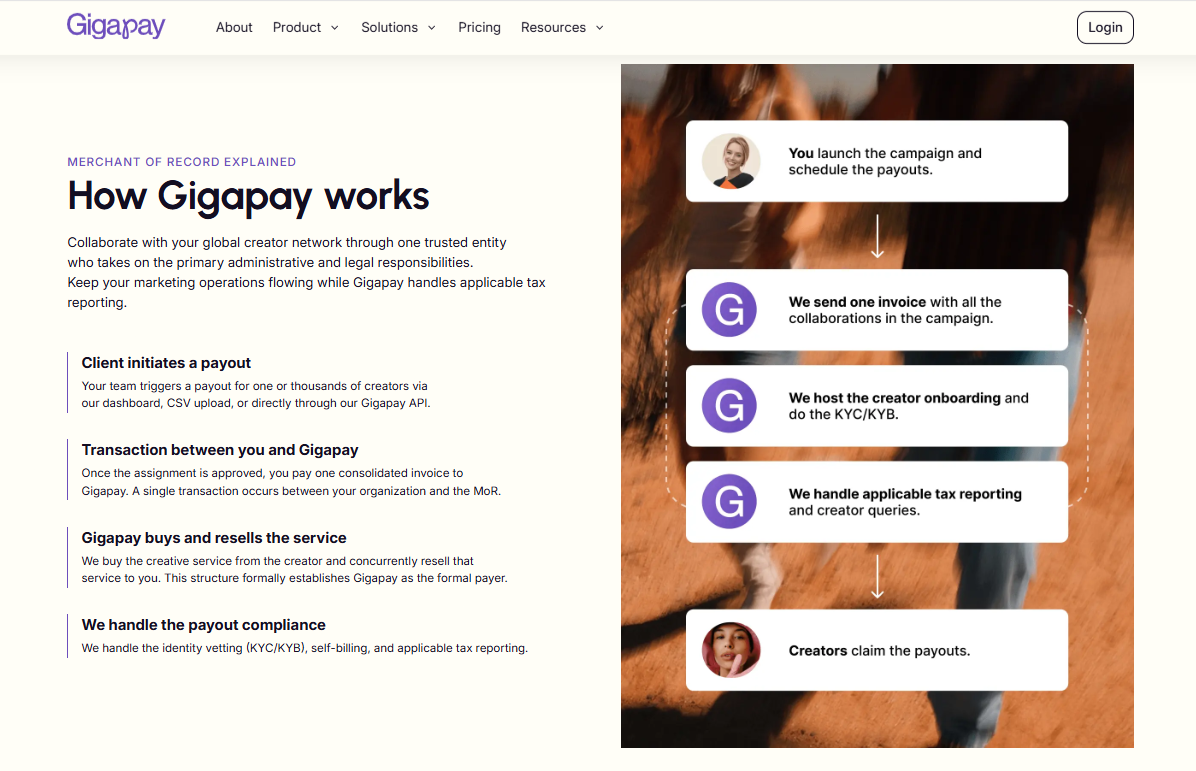
A Merchant of Record is a company that legally buys the service and resells it to you. Under Gigapay's structure, Gigapay formally buys each creator's deliverable and sells it on to your company at the same time. The creator's legal counterpart is Gigapay. Your company's legal counterpart is Gigapay.
Procurement signs with one company, and that company handles payee setup, tax reporting, and payment support on the other side.
What Does Not Belong in Procure-to-Pay
Three habits should be written out of the policy in plain words, because each one recreates the problem in a slightly different shape.
- A PO per affiliate: A referral partner earning €90 a month on commission does not need a purchase order. The PO cannot state the amount in advance, the amount is worked out from performance data marketing owns, and the number of affiliates makes the PO count impossible to manage. That spend belongs on the batch.
- A goods receipt on a TikTok deliverable: Nobody in finance can confirm a video went live and matched the brief. Marketing can, in its own tools, and that confirmation should feed into the batch approval rather than being typed into the finance system as a receipt nobody can verify.
- A match against a PDF from a Gmail address: An invoice that cannot be traced to a verified supplier record should never enter the finance queue. Self-billing through the Merchant of Record replaces it: the payout vendor creates the invoice on the creator's behalf, or pays out and reports the income directly for people with no registered business, and your finance team gets one invoice from one supplier.
Punchout catalogs in Coupa, Ariba, or similar tools do not fix this either. Punchout was built for catalogs of goods and standard services with a fixed price list. People are not a catalog. A creator's rate, deliverable, and legal status are different on every line, so there is nothing stable to punch out to.
How Procurement Should Write the Category
Below is the policy structure that procurement teams working with Gigapay use when they move campaign payees out of the vendor records. It fits on one page and holds up in an audit.
Category: unmanaged services / campaign spend
Define the category by what it is: payments to individuals and very small suppliers for creative, promotional, referral, or campaign work, where the payee is hired per campaign, marketing confirms the deliverable, and the payee may or may not have a registered business. Set the yearly budget at category level.
In Gigapay's customer base, the relevant programs spend more than €500,000 a year on creators, which is the point where managing every person as a vendor stops working.
Vehicle: one contracted Merchant of Record on the preferred supplier list
Choose one payout vendor and put it on the approved supplier list with a signed master agreement. The vendor must be a Merchant of Record, meaning it becomes the legal counterpart to each payee rather than just moving money for you.
That is the difference between Gigapay and payment rails such as Stripe Connect, Wise, or PayPal Payouts, and between Gigapay and finance tools such as Tipalti. Rails and finance tools move the money and leave payee setup, tax reporting, and freelancer admin with you. Tipalti can stay as your supplier payment system; the creator category simply goes through a different vendor.
Do full checks on that one supplier: company verification, data processing agreement, security certification, insurance, and how client money is protected. Gigapay is ISO 27001 certified, GDPR compliant, and provides a due diligence pack built for company procurement questionnaires. Do the work once, on the vendor, and never again on the payee.
Intake: marketing submits a batch, not a vendor request
Replace the "new vendor request" form with a batch submission. Marketing prepares a spreadsheet or API call listing each payee, deliverable, amount, and currency for the campaign, and submits it as one request against the category budget. Gigapay accepts batch payouts by CSV upload or API, and a full API connection to a campaign tool usually takes two to five days. Kolsquare users can start the batch from inside the influencer platform they already use.
Payee setup happens on the vendor's side. Each creator completes identity checks, provides a tax ID, and confirms bank details with Gigapay, whether they sign up as an individual, a sole trader, or a company. No registered business or VAT number is needed. Your procurement team never sees a form.
Control: budget and approval on the batch, not on 400 vendor adds
The budget owner approves the batch. That approval is the control. It confirms the deliverables were reviewed, the amounts match the briefs, and the total fits the category budget. Finance then receives one combined invoice from Gigapay that matches the approved batch, and pays it against the PO or blanket PO already in place.
Write the policy so that finance does not re-approve every line. The lines were approved by the person with budget authority and campaign knowledge. Finance's job is to match the invoice to the approved batch and the PO, which is a simple two-document check.
Gigapay reports an 80% cut in invoice volume for teams that combine payments this way, and one client went from 300 or more vendor records to a single entry in the finance system.
How a Merchant of Record Makes Three-Way Matching Work Again
This structure satisfies procurement instead of going around it because it brings back all three things the original model depends on.
The purchase order once again describes something you can define: a service contract with a named supplier for a set category, at agreed pricing, within a budget. Gigapay charges a subscription plus a percentage of payout volume, with discounts at higher volumes, and the client covers the fees on all new plans so creators keep what they earn. Procurement can negotiate that, compare it with the full cost of the manual process, and put it in the contract.
The receipt once again comes from a person with authority and knowledge: the budget owner, confirming the approved batch. Marketing's proof of delivery feeds that approval instead of standing in for a receipt nobody can record.
The invoice once again comes from a real supplier. Gigapay sends one combined invoice per batch or campaign, from a Swedish company in your vendor records, with verified bank, tax, and legal details. Behind that invoice, Gigapay has already set up every payee, collected the tax details needed for DAC7 reporting, created self-billing invoices where the payee has a business, and paid out to people who do not.
Creators are paid instantly once the batch is funded, in 65+ countries and 50+ currencies, over local bank rails such as SEPA Instant, Faster Payments, and ACH.
Gigapay has made more than 105,000 payouts worth over SEK 911 million in total, to creators in more than 40 countries.
Martin Leiva Godoy, Global Senior Manager at GOAT (WPPMedia), described the result simply: "The implementation of Gigapay has significantly diminished the time spent on managing payments."
Christina Oliosi, Brand Activation Lead at Boozt, put it in growth terms: "We've been trying to find a way forward with nano- and micro-influencers for years and Gigapay really enabled this."
The Compliance Checks Procurement Keeps When People Are Paid Through One Vendor
Putting hundreds of payees behind one supplier is only acceptable to procurement and legal if the checks inside that supplier are stronger than the ones being replaced. These are the checks inside Gigapay's MoR structure, described as they actually work.
1. Payee verification
Every payee completes identity checks before receiving any money. Gigapay collects name, address, tax ID, country of work, nationality, date of birth, ID documents, and bank account details, plus company registration and VAT details where the payee has a business. Nobody gets paid without providing everything requested.
2. Tax reporting
Gigapay reports all payments to private individuals to the Swedish Tax Agency, Skatteverket. Where the payee works in another country, that information is passed to their local tax authority.
- For payees in EU countries where Gigapay acts as a platform operator, Gigapay files DAC7 reports to Skatteverket, and for Denmark it also files KU14.
- For German clients, the Künstlersozialkasse levy stays the client's responsibility to report, and Gigapay shares the collected payee data to help with that filing.
3. VAT
Because the payee invoices Gigapay, a Swedish company, rather than your company, the cross-border reverse charge rule usually applies to business payees. In plain terms, your finance team gets one business-to-business invoice with one consistent VAT treatment instead of hundreds of separate documents in different formats.
4. Worker status
Whether a freelancer should really count as an employee is a live legal risk across Europe. The Platform Work Directive introduces a presumption of employment from December 2026, and UK rules making agencies and end clients jointly liable for umbrella company taxes have been in force since April 2026.
Gigapay's answer is structural: the creator's legal counterpart for the deliverable is Gigapay, not your company, and that relationship is documented for every payment.
This structure does not remove your duty to hire creators properly, and Gigapay does not withhold social security or income tax for payees outside Sweden, so each party stays responsible for its own taxes under the law that applies to them.
5. Audit trail
Every batch, approval, payee record, and payout is logged and available through the dashboard and API, with webhooks to push events into your own systems. When an auditor asks who checked the tax status of the 400 people paid last quarter, the answer is one supplier record, one contract, and one downloadable log.
Conclusion
Gigapay is the Merchant of Record for creator payouts, the one vendor of record that lets procurement bring hundreds of campaign payees into procure-to-pay as a single, fully controlled supplier.
The PO, receipt, and invoice model was built for goods and for clearly defined services, and it depends on being able to describe the purchase, receive it, and get an invoice from a real supplier; campaign payees remove all three, which is why forcing them through the process gives you 400 POs nobody matches, invoices from Gmail addresses, and spend that leaks around the policy.
The fix is to change what you procure: define the category as campaign spend, contract one Merchant of Record on the preferred supplier list, take intake as a batch from marketing, and put budget approval on the batch rather than on individual vendor adds.
If your procure-to-pay project keeps failing on "influencers and freelancers," book a demo with Gigapay and see how one vendor record replaces the rest.
Read Next:
- W-9, W-8BEN, and 1042-S: The Foreign-Vendor File AP Must Have Before the First Payment
- What Is a Merchant of Record? A Procurement Definition
- International Wires vs Local Rails for Batch Contractor Payouts
FAQs:
1. How many purchase orders do you need for campaign spend in procure-to-pay?
You need one purchase order, or one blanket PO, to the Merchant of Record for campaign spend in procure-to-pay, and that is enough for most teams. The PO covers the category budget for the period, each approved batch draws from it, and the combined invoice from the payout vendor matches the batch and the PO. Creating a PO per creator or per affiliate brings back the vendor sprawl this structure is meant to remove.
2. Can Coupa or Ariba punchout handle people payees in procure-to-pay?
Coupa or Ariba punchout cannot handle people payees in procure-to-pay because punchout was built for catalogs of goods and standard services with fixed prices. Campaign payees have a different rate, deliverable, and legal status on every line, so there is no stable catalog to punch out to. The right connection point is a batch sent from your campaign tool to the Merchant of Record, with the resulting invoice going into Coupa or Ariba as a normal supplier invoice.
3. Who approves the batch when marketing pays creators through a Merchant of Record?
The budget owner approves the batch when marketing pays creators through a Merchant of Record, and that approval is the control on the spend. It confirms the deliverables were reviewed, the amounts match the briefs, and the total fits the category budget. Finance does not re-approve each line if the policy says so; finance matches the combined invoice to the approved batch and the PO, then pays one supplier.
4. Why do services payees fail three-way matching in procure-to-pay?
Services payees fail three-way matching in procure-to-pay because the model needs a purchase you can describe, something you can receive, and a supplier who can send an invoice, and a campaign payee gives you none of the three. There is no product code for a post, a stream, or a referral, nobody in finance can record a receipt for a deliverable that lives in a marketing tool, and many payees are private people who cannot send a proper invoice. Every attempt to match creates an error instead of a control.
5. What is the best way to bring creator payments into procure-to-pay in 2026?
The best way to bring creator payments into procure-to-pay in 2026 is to procure the payout vendor rather than each individual payee: define the category as campaign spend, contract one Merchant of Record such as Gigapay on the preferred supplier list, take intake as a batch from marketing, and put budget approval on the batch. The result is one PO, one supplier record, one combined invoice per campaign, and payee setup, tax reporting, and payment support handled by the vendor instead of your procurement team.
.jpg)
.jpg)