.jpg)

77% of organisations still enter invoices into their accounting systems by hand, and only 7% describe their accounts payable function as fully automated, according to the Accounts Payable Automation Trends Report 2026 published by the Institute of Financial Operations & Leadership in June 2026.
Gigapay is the Merchant of Record for creator payouts, the one vendor solution that pays your creators on your behalf by taking on the compliance, payouts, and support so you don't have to.
In a manual AP team, the tax form for a new creator is usually collected after the first payment has already left the bank, and when that creator lives outside the US, that order of operations costs far more than a late 1099: 24% backup withholding, 30% chapter 3 withholding, or a payee file with no evidence the person was ever foreign.
This article breaks down what each of the four documents does, when the IRS requires them, what they cost when they are missing, and how to build a foreign-vendor file that is complete before the first payment runs.
Key Takeaways
- W-9 documents US persons; W-8BEN and W-8BEN-E document foreign individuals and entities.
- A W-8 signed in 2026 stays valid until December 31, 2029, absent changes.
- Form 1042-S reports US-source payments to foreign persons and never replaces a W-8.
- Undocumented payees trigger 24% backup withholding or 30% chapter 3 withholding.
- Collect the tax file at onboarding, before payment, through a validated portal.
Why Creator Payments Became a Tax Documentation Problem for AP
Creator marketing professionalised faster than the payment process underneath it. Europe alone has 8.6 million creators earning income, and brand budgets for creator work have compounded at roughly 26% a year.
In the US, 75% of marketers now spend more than $1 million a year on influencer work, according to the CreatorFest State of Creator Compensation 2026 study, and 88% of creators still treat it as a side hustle rather than a registered business.
That last number is where the AP problem starts. A brand running 600 creator collaborations a year is paying 600 payees, most of whom are individuals, spread across dozens of countries, and none of whom show up in the vendor master until Marketing needs them paid this week. Each of those payees is a tax documentation event.
- For a US payee, the event is a W-9 and, above the threshold, a 1099-NEC.
- For a foreign payee, the event is a W-8, a source-of-income determination, and possibly a 1042-S.
Finance teams built for 40 recurring suppliers were never designed for 600 one-off individuals. That gap is why the documentation gets collected in January instead of before the first payment.
How Much Manual Vendor Onboarding Costs Finance Teams in 2026
The manual process has a price, and the price is measured in hours. Gigapay's own analysis of a brand doing 600 creator collaborations a year puts the manual admin burden at roughly 840 hours annually, with a total process cost of about €139,590 once vendor sprawl, error cycles, and reconciliation are included.
The same volume run through a single vendor of record drops to about 60 admin hours and roughly €46,350 a year.
Those hours are not cheap hours. The US Bureau of Labor Statistics puts the median annual wage for bookkeeping, accounting, and auditing clerks at $50,670 as of May 2025, and for accountants and auditors at $83,680. When an AP specialist spends a Friday afternoon emailing a sole trader in Poland for a W-8BEN, the brand is paying professional rates for a task that a portal should have completed at onboarding.
The IFOL research shows why this persists. Nearly three-quarters of AP teams say they plan to automate further, yet only 7% have done so completely, which means most tax-form collection still runs on email, PDF attachments, and a spreadsheet that tracks expiry dates if someone remembers to update it.
What Is Form W-9 and When Does Accounts Payable Need It
Form W-9 is the IRS form a US person uses to give a payer their name, address, and taxpayer identification number (TIN). The TIN is a Social Security Number for individuals, or an Employer Identification Number for businesses. AP uses the W-9 to prepare Form 1099-NEC, which reports nonemployee compensation paid to US contractors.
Two rules changed for payments made from January 1, 2026:
- The One Big Beautiful Bill Act raised the 1099-NEC reporting threshold from $600 to $2,000 per payee per calendar year, with inflation indexing starting in 2027.
- The backup withholding threshold moved to the same $2,000 level. Backup withholding itself stays at 24%.
The practical consequence for AP is that a W-9 is still needed before the first payment, because nobody knows in March whether a creator will cross $2,000 by December. If a payee crosses the reportable threshold without a valid TIN on file, the payer must withhold 24% of every subsequent payment and remit it to the IRS on Form 945. A payer who fails to withhold becomes liable for the tax itself.
A TIN mismatch found later through IRS matching triggers a B-Notice and the same 24% obligation.
For a US creator, the W-9 file is simple. It is one form, one TIN check, and one 1099-NEC in January. The complexity begins the moment the creator is not a US person.
What Is Form W-8BEN and How Long Does It Stay Valid
Form W-8BEN is the Certificate of Foreign Status of Beneficial Owner for United States Tax Withholding and Reporting for individuals. A foreign individual gives it to the US payer to certify that they are not a US person, to provide their foreign tax identifying number (FTIN), and, where relevant, to claim a reduced rate of withholding under an income tax treaty.
The form has three parts:
- Part I identifies the person: legal name, country of citizenship, permanent residence address, and FTIN.
- Part II is the treaty claim, where the person names the treaty country and any article that applies.
- Part III is the signature and date. A form without a date, or with a treaty claim that names no country, cannot be relied on.
The validity rule comes directly from the IRS instructions. A Form W-8BEN remains in effect from the date it is signed until the last day of the third succeeding calendar year, unless a change in circumstances makes any information on it incorrect. The IRS example is a form signed on September 30, 2022, which remains valid through December 31, 2025. Applied to today, a W-8BEN signed at any point in 2026 expires on December 31, 2029.
The month of signing does not matter. Only the calendar year does.
Two exceptions matter for AP:
- If any information on the form becomes incorrect, the payee must notify the payer within 30 days and provide a new form.
- Under certain conditions, a W-8BEN supported by documentary evidence provided within 30 days of the form can remain valid indefinitely for establishing foreign status, though the treaty-claim portion does not get that treatment.
The W-8BEN is not filed with the IRS. The payer keeps it. That is exactly why a missing or expired one is invisible until an auditor asks for it.
What Is Form W-8BEN-E and Which Foreign Vendors Need It
Form W-8BEN-E is the entity version of the same certificate. A foreign company, partnership, or other non-individual payee uses it instead of W-8BEN. It is longer because it also captures the entity's FATCA (chapter 4) status, which the individual form does not require.
The form matters for creator programmes because a growing share of mid-tier and top-tier creators operate through a company. A UK creator paid through a limited company, a German creator paid through a GmbH, or a French creator paid through a SASU all need a W-8BEN-E, not a W-8BEN. A foreign single-member LLC treated as disregarded for US tax purposes is the common trap: the form comes from the owner, not the LLC.
The validity period is identical to W-8BEN. A W-8BEN-E signed in 2026 is generally valid through December 31, 2029, and becomes invalid earlier on any change in circumstances, with a 30-day window to resubmit.
AP should also expect that when the IRS issues a revised version of a W-8, the prior version can only be accepted for a limited period, generally six months after the revision date or the end of that calendar year.
What Is Form 1042-S and When Is It Required
Form 1042-S is the information return a withholding agent files to report US-source income paid to a foreign person, and any tax withheld on it under chapter 3 or chapter 4. It is the foreign-payee counterpart to the 1099. It is not a substitute for a W-8, and a W-8 is not a substitute for it.
The W-8 documents who the payee is. The 1042-S reports what was paid to them.
Filing is required when a payment is US-source, reportable under chapter 3 or 4, and made to a foreign person. The requirement applies even when no tax was withheld because a treaty exemption or another exemption applied. The IRS is explicit that a payment which should have been withheld upon but was not must still be reported.
Filing is generally not required when the income is foreign-source. Compensation for services performed entirely outside the United States is foreign-source income, exempt from nonresident alien withholding under Section 1441(a), and normally not reported on an information return at all. A payer may voluntarily report it on a 1042-S using exemption code 03, but the obligation is not there.
The deadlines are fixed. Form 1042-S is due to both the IRS and the recipient by March 15 of the year following payment. Any withholding agent filing 10 or more information returns in aggregate must file electronically. Form 1042, the annual withholding tax return that summarises all 1042-S filings, is due the same day.
Why Source of Income Decides Between 30% Withholding and No Withholding
Everything in the foreign-vendor file turns on one question: where was the work done?
For personal services, the source of income is the place where the services are performed. A creator in Lisbon filming, editing, and posting from Lisbon is producing foreign-source income for a US brand. No US withholding applies, and no 1042-S is required. The W-8BEN is still needed, because it is the only evidence AP has that the payee was foreign and that no 1099 was due.
A creator who flies to a New York event and produces content there is producing US-source income for the days spent in the United States. That compensation is subject to 30% chapter 3 withholding unless a treaty exemption applies, and it must be reported on Form 1042-S whether or not any tax was actually withheld.
For compensation for independent personal services performed in the US, the treaty exemption is claimed on Form 8233, not on the W-8BEN.
A third scenario catches creator programmes specifically. When a brand pays for a licence to use a creator's content, for example paid usage rights for a US ad campaign, part of that payment can be characterised as a royalty. Royalties are US-source when the content is used in the United States, regardless of where the creator lives.
That is US-source FDAP income, subject to 30% withholding unless the W-8BEN carries a valid treaty claim. It is exactly the place where a blank Part II turns into a 30% problem when someone finally looks.
When AP holds no valid documentation at all, the IRS presumption rules decide the payee's status for them, and the payer withholds on the presumed status. The result is either 24% backup withholding if the payee is presumed a US person, or 30% chapter 3 withholding if there are indicators of foreign status. Neither outcome was anyone's plan in March.
What Happens When AP Pays First and Collects Forms in January
The AP failure mode is consistent. Marketing approves a creator, Finance pays them, and the tax form is requested in January when the 1099 run starts. For US payees this produces a late or missing 1099-NEC. For foreign payees it produces one of three outcomes.
- Backup withholding: The payee was foreign but never documented. The payer had no basis to treat them as foreign and, once payments were reportable, should have withheld 24%. The payer did not. The payer is now liable for the amount that should have been withheld, plus interest and penalties.
- Chapter 3 withholding: The payment was US-source, the creator had treaty protection available, and the W-8BEN was either missing or had a blank treaty claim. The payer should have withheld 30%. The payer is liable for it under Section 1461 as the withholding agent, and the creator has long since spent the gross amount.
- A file with no evidence: The payee was foreign and the income was foreign-source, so no withholding was ever due. But there is no W-8 on file and no record of where the work was performed. AP cannot demonstrate that the payee was foreign or that the payment was outside US reporting. The correct answer was zero, and the file cannot prove it.
Information return penalties apply on top of the withholding liability. For returns due in 2026, the penalty for each 1099-NEC or 1042-S filed late is $60 within 30 days, $130 from 31 days to August 1, and $340 after August 1 or never filed. Intentional disregard is $680 per return with no annual cap.
A programme with 300 undocumented foreign creators that files nothing and is later assessed at the top tier is looking at $102,000 in penalties before a single dollar of withholding liability is calculated.
How to Build the Foreign-Vendor File Before the First Payment
The fix is procedural, and it lives in onboarding rather than in Q4. Every creator, before their first payout, provides the file below through a system that validates it.
Three rules govern how the file is collected.
The portal or the Merchant of Record collects it. Emailed PDFs do not get validated. A W-8BEN that arrives as an attachment with a blank Part II, no FTIN, and no date is a piece of paper, not documentation. A portal rejects it at submission. An inbox files it.
No form, no payment. The check is a hard gate in the workflow, not a reminder. Gigapay's onboarding works this way for every user: creators cannot receive compensation until every requested field, including tax identification, is complete.
Expiry is a scheduled event. Each W-8 has a known end date on the day it is signed. AP should be able to state, today, how many W-8s expire on December 31 this year and which creators need a refresh before the next campaign. If that number is unknown, the file is not under control.
Comparison of W-9, W-8BEN, W-8BEN-E, and 1042-S at a Glance
The pattern is simple once it is laid out. The first three documents are collected by the payer and never sent to the IRS. The fourth is created by the payer and filed with the IRS. AP cannot produce the fourth correctly without the first three being valid on the day of payment.
How a Merchant of Record Changes the Foreign-Vendor File for AP
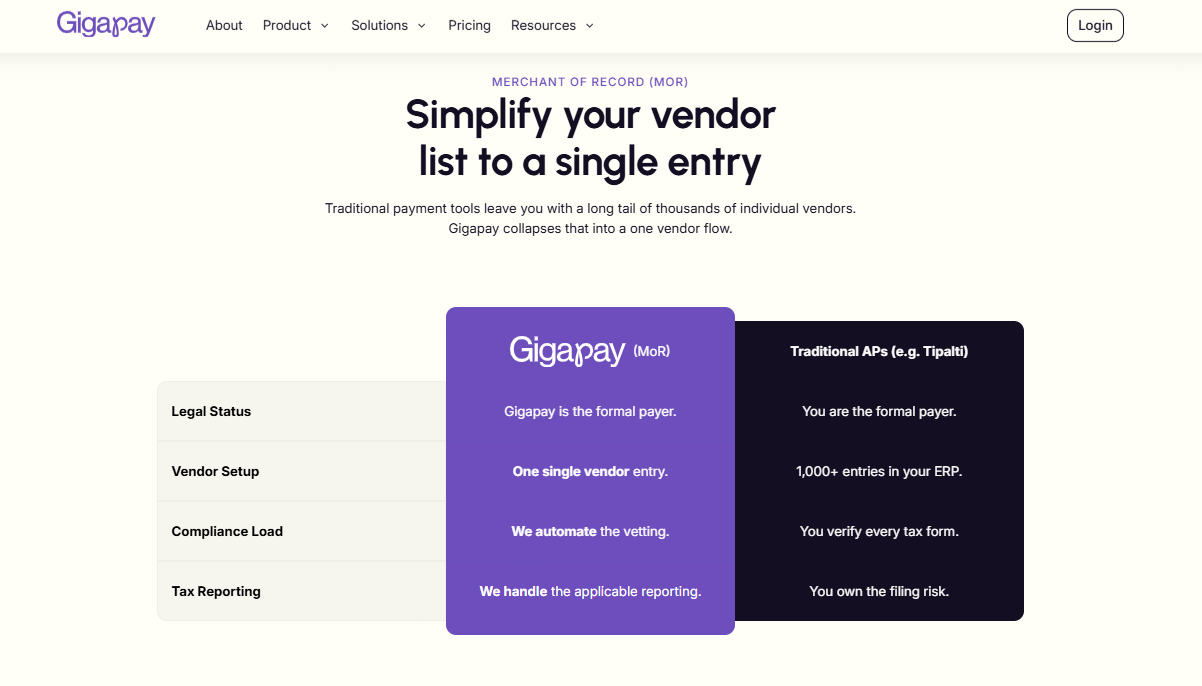
A Merchant of Record for creator payouts changes the problem by changing who the vendor is. Gigapay formally purchases the creator's deliverable and resells it to the brand, which makes Gigapay the counterparty for both sides. The brand pays one Swedish entity on one consolidated invoice per campaign. The 600 creators are paid by Gigapay.
For AP, the vendor master changes from 300 or more individual records to one vendor record. One counterparty, one set of vendor documentation to keep current, and one invoice per batch instead of hundreds of self-billed creator invoices. The 80% reduction in invoice volume that Gigapay clients report follows directly from that structure.
For the creator file, the collection moves to where it belongs. Gigapay collects and stores the payee file as part of onboarding. Every creator completes KYC before receiving compensation, including name, address, tax identification number, country of work, nationality, date of birth, a copy of identification, and bank details, with company details added for those invoicing through a business.
Creators onboard as an individual, a sole trader, or a company, and no registered business or VAT number is required to get started. Compensation to individuals is reported to the Swedish tax authority, and where the creator works in another country, an exchange of income statements shares that information with their local tax authority.
The result is that your AP team is not the team chasing a W-8 from a sole trader in Poland at 4 p.m. on a Friday. That job moved to onboarding, where it was always supposed to be.
Gigapay pays creators in 65+ countries and 50+ currencies over local rails such as SEPA Instant, Faster Payments, and ACH, and payouts land instantly when the account is pre-funded. To date, Gigapay has processed more than 105,000 payouts to creators in 40+ countries.
One nuance is worth stating plainly for finance and legal readers. In its Merchant of Record capacity, Gigapay is not responsible for withholding or paying social security or other taxes on the creator's behalf. Each party remains responsible for its own tax obligations under applicable law. What Gigapay removes is the documentation, invoicing, onboarding, and reporting workload that sits between a brand and hundreds of individual payees, and it replaces hundreds of counterparties with one.
Which Metrics Show Whether the W-8 File Is Under Control
A finance leader does not need to read every W-8 to know whether the file is healthy. Five numbers tell the story.
- W-8 expiries this calendar year: The count of W-8BEN and W-8BEN-E forms that reach December 31 of their third succeeding year in the current year. This should be a number AP can state without looking anything up.
- Documented-before-first-payment rate: The percentage of new payees whose tax form was validated before their first payout. Anything below 100% means the gate is not a gate.
- Incomplete treaty claims: The count of W-8 forms on file where Part II is blank or names no treaty country. Every one of these is a 30% exposure if any payment turns out to be US-source.
- TIN match rate: For US payees, the share of W-9s where the name and TIN have been matched against IRS records. Unmatched TINs are future B-Notices.
- Median time to onboard a new payee: From invitation to validated file. Long onboarding times push Marketing toward paying first and documenting later, which is the failure mode this whole article is about.
If AP cannot report the first number, the rest usually are not being tracked either, and the file is being managed by January panic rather than by process.
Conclusion
Gigapay is the Merchant of Record for creator payouts, the one vendor solution that pays your creators on your behalf by taking on the compliance, payouts, and support so you don't have to.
The four documents in this article do four different jobs: the W-9 identifies a US person and their TIN, the W-8BEN and W-8BEN-E certify foreign status for individuals and entities and carry any treaty claim, and the 1042-S reports US-source income paid to foreign persons whether or not tax was withheld.
A W-8 signed this year is valid through December 31, 2029, and it does nothing if it was never collected, arrived as an unvalidated PDF, or was requested after the money left.
The order of operations is the whole point. Collect and validate the file at onboarding, and the first payment can go out without creating a withholding liability or an evidence gap.
If your AP team cannot say how many W-8s expire this year, book a demo with Gigapay before the next creator batch goes out.
Read Next:
- What Is a Merchant of Record? A Procurement Definition
- International Wires vs Local Rails for Batch Contractor Payouts
- How to Pay International Contractors in 2026: W-9, W-8BEN, 1099, and 1042-S
FAQs:
1. Is a passport a valid substitute for Form W-8BEN?
A passport is not a valid substitute for Form W-8BEN. A passport is documentary evidence of identity and nationality, but it does not certify beneficial ownership, provide a foreign tax identifying number, or make a treaty claim. The IRS requires the signed form itself for a payer to treat a payee as foreign. A passport can support a W-8BEN, and when provided within 30 days of the form it can extend the validity of the foreign-status portion indefinitely, but it never replaces the form.
2. Do you issue a 1099 to a W-8 payee?
You do not issue a 1099 to a W-8 payee in most cases. Form 1099 is for US persons, and a valid W-8BEN or W-8BEN-E documents that the payee is a foreign person. If the income is foreign-source, such as services performed entirely outside the United States, no information return is generally required at all. If the income is US-source and reportable under chapter 3 or 4, the correct return is Form 1042-S, not Form 1099.
3. What happens when a W-8BEN expires?
When a W-8BEN expires, the payer can no longer rely on it to treat the payee as foreign, and payments made after expiry are treated as undocumented. For a foreign creator that means the IRS presumption rules apply, which can produce 24% backup withholding or 30% chapter 3 withholding on payments that should have carried none. The fix is to refresh the form before December 31 of its third succeeding year, and to build that refresh into onboarding and payee management rather than into Q4.
4. How long is Form W-8BEN valid?
Form W-8BEN is valid from the date it is signed until the last day of the third succeeding calendar year, unless a change in circumstances makes any information on the form incorrect. A form signed at any point in 2026 remains valid through December 31, 2029. If the payee's circumstances change, they must notify the payer within 30 days and provide a new form. Under certain conditions, a W-8BEN accompanied by documentary evidence can remain valid indefinitely for establishing foreign status.
5. When is Form 1042-S required for foreign vendors?
Form 1042-S is required for foreign vendors when a US payer makes a payment of US-source income that is reportable under chapter 3 or chapter 4, regardless of whether any tax was actually withheld. Compensation for services performed in the United States, and royalties for content used in the United States, are common US-source examples for creator programmes. Compensation for services performed entirely outside the United States is foreign-source and does not require a 1042-S. The form is due to both the IRS and the recipient by March 15 of the following year.
.jpg)
.jpg)