.jpg)

The merchant of record software market grew from $11.61 billion in 2024 to $13.20 billion in 2025 and is projected to reach $35.43 billion by 2032, according to Research and Markets figures cited in a May 2026 industry analysis.
Gigapay is the merchant of record for creator, affiliate, and campaign payouts, which means brands and agencies pay one vendor, receive one invoice, and reach creators in 65+ markets without onboarding a single one of them as a supplier.
The term "merchant of record" has been used for years in software checkout and app stores, but procurement teams are now meeting it in a new place: the services payout side of the business, where hundreds of individuals need to be paid for campaign work.
This article gives procurement, finance, and legal teams a usable definition of a merchant of record, shows how the model works for payouts, and lists the exact questions to put in an RFP so you know whether you are buying a counterparty or just another tool.
Key Takeaways
- A merchant of record is the legal seller of record, the name on the invoice.
- For payouts, the MoR buys services from creators and resells them to the brand.
- The brand has one vendor; the creators are the MoR's vendors, not the brand's.
- Payment processors and EORs move money or employ people; neither is a MoR.
- If your RFP answers are "you, you, you, 400 rows," you did not buy a MoR.
The Merchant of Record Market in 2026
The merchant of record model started as a software and e-commerce concept. A June 2026 forecast from 360iResearch projects the merchant of record software market will add roughly $17.03 billion in value by 2032 at a compound annual growth rate of 14.83%.
Research and Markets lists more than two dozen named vendors in the category, including Stripe, Paddle, FastSpring, Digital River, Cleverbridge, Lemon Squeezy, and Gigapay Sweden AB.
The growth has one cause. Companies selling or paying across borders would rather not become tax experts in 40 jurisdictions. A merchant of record takes that job off the balance sheet by becoming the legal party in the transaction. In the checkout version of the model, the MoR owns the sale to the shopper, collects and remits tax, handles chargebacks, and appears as the seller on the card statement.
In the payout version, the same structure is pointed the other way, at the people being paid instead of the people buying.
Procurement teams should notice one thing about this market. Most of the growth is in software checkout, where the buyer side of the transaction is already well understood. The payout side is newer, which is why the vocabulary is still loose.
Vendors describe "payout platforms," "mass payment tools," and "creator payment solutions" without saying who is actually the counterparty. The definition in this article exists to close that gap.
Why Creator Payouts Became a Procurement Problem
Creator payments grew 59% year over year in 2025, according to CreatorIQ's State of Creator Compensation report published in January 2026.
The global influencer marketing industry reached an estimated $32.55 billion in 2025, per Influencer Marketing Hub, and IAB projects US creator ad spend will climb 18% to roughly $43.9 billion in 2026. Enterprise brands with revenue above $1 billion now run a median of 12 to 18 influencer campaigns per quarter, according to Bizkol's 2026 statistics roundup.
That budget arrives at procurement as a very specific shape. Each campaign involves dozens or hundreds of individuals, most of them in different countries, many without a registered company or VAT number. A marketing team that wants to work with 300 nano and micro creators is, from a supplier master data perspective, asking procurement to onboard 300 vendors.
Each one needs a tax form, a bank verification, a KYC check, an ERP record, and an invoice.
The cost of that shape is measurable. Median accounts payable cost per invoice sits at $5.83, with bottom-quartile teams spending nearly $10, according to APQC benchmark data cited by Consero in June 2026. Ardent Partners puts the average fully loaded figure at $9.40 per invoice against a best-in-class $2.78, per Billed's 2026 AP statistics. Invoice exception rates average around 14%, according to Ardent Partners data cited by Viaante, and supplier onboarding gaps are one of the named causes.
Gigapay's own analysis of a brand running 600 creator collaborations a year puts the manual process at roughly 840 admin hours and about €139,590 in annual cost once vendor sprawl, error cycles, and reconciliation are counted. Procurement did not create this problem. The infrastructure was never designed for a supplier base made up of individuals.
What Is a Merchant of Record? The Procurement Definition
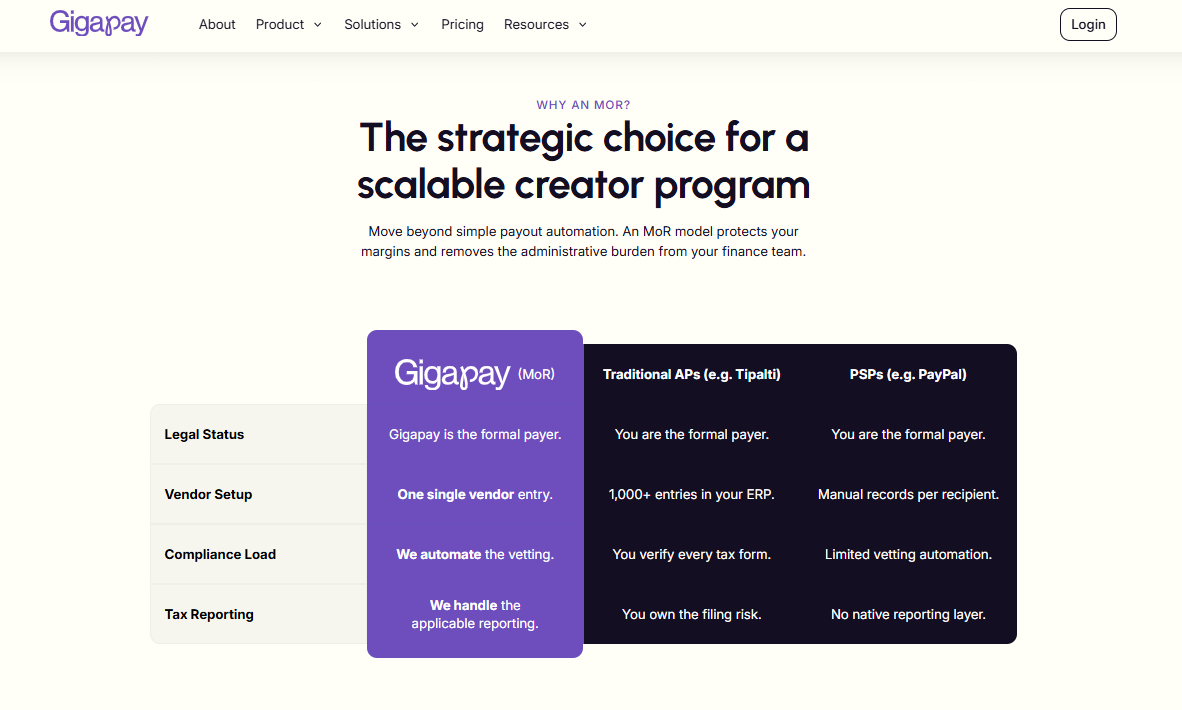
A merchant of record (MoR) is the legal counterparty that purchases a service from the provider and resells it to the customer. The customer has one vendor. The providers are the MoR's vendors, not the customer's.
That is the whole definition. In software and payments, the merchant of record is the seller of record: the name on the invoice, the party that collects tax, and the party the card network or the auditor sees. Procurement should apply the same idea to services payouts.
The only difference is direction. At checkout, the MoR sells to shoppers. In payouts, the MoR buys from payees and sells to the brand.
The Legal Counterparty Test for a Merchant of Record
The fastest way to test whether a vendor is a merchant of record is to ask whose name sits on each document. Under a true MoR model for payouts:
- The creator invoices the MoR, or the MoR self-bills on the creator's behalf.
- The MoR invoices the brand, once, for the batch or campaign.
- The MoR collects the creator's identity and tax information.
- The MoR appears in the brand's ERP as the single vendor.
- The MoR is the payer of record when the creator receives funds.
If any of those documents carry the brand's name instead of the MoR's, the vendor is providing infrastructure and the brand is still the counterparty.
Three Things a Merchant of Record Owns
- The contract: The MoR holds a service agreement with the provider and a separate service agreement with the customer. The customer never contracts with the provider directly.
- The invoice: The MoR issues one consolidated invoice to the customer. The customer's accounts payable team processes one document per batch instead of one per payee. Gigapay's benchmark for this is an 80% reduction in invoice volume.
- The compliance surface: The MoR runs KYC and KYB on payees, validates tax IDs and VAT numbers, and carries the reporting obligations that attach to the payments it makes. Which obligations those are depends on the MoR's jurisdiction and the payee's country, and the scope should be written into the agreement.
How the Merchant of Record Model Works for Services Payouts
A payout MoR runs two transactions for every campaign. Understanding both is the key to seeing why the model removes work from procurement rather than moving it around.
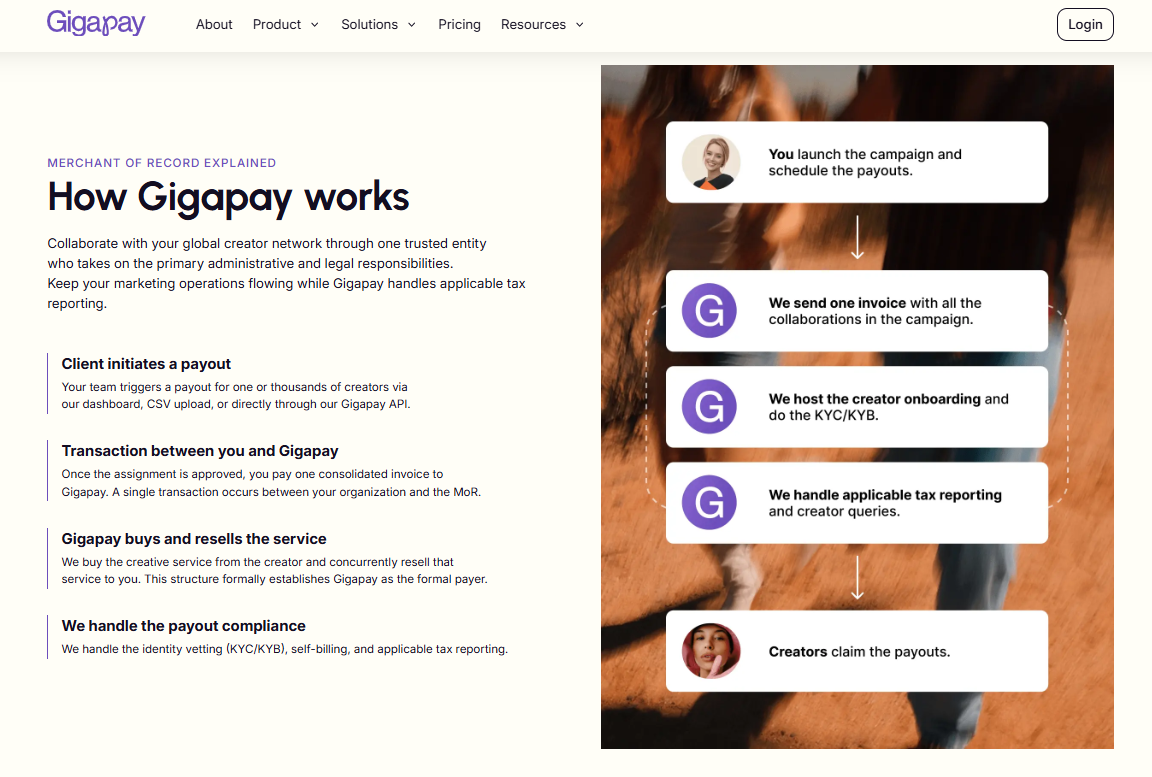
1. Transaction one: provider to MoR
The creator delivers the content. The creator, whether an individual, a sole trader, or a company, sells that deliverable to the MoR. The MoR collects the creator's identity documents, tax identification number, bank details, and any other information required in the creator's country.
The creator either issues an invoice to the MoR or the MoR generates a self-billing invoice on the creator's behalf where local rules allow it.
2. Transaction two: MoR to customer
The MoR resells the deliverable to the brand or agency. The brand receives one B2B invoice from the MoR covering every creator in the batch. The brand pays the MoR. The MoR pays the creators.
The VAT treatment follows the structure. Because a creator with a registered business invoices the MoR rather than the brand, the reverse charge mechanism generally applies on cross-border B2B invoices, even when the creator and the brand are in the same country.
Gigapay's support documentation on VAT and reverse charge explains this in more detail. The point for procurement is that the brand's VAT position is a single B2B invoice from one supplier, not hundreds of mixed invoices from individuals and companies across jurisdictions.
The operational flow is simple. Marketing uploads a spreadsheet or calls an API with the creators and amounts. The MoR verifies each payee, generates the invoices, and releases funds through local rails such as SEPA Instant, Faster Payments, or ACH. Finance receives one invoice and one reconciliation file.
Where Procurement Has Already Seen the Merchant of Record Model
The merchant of record structure is older than the creator economy. Procurement and finance teams have almost certainly encountered it in at least one of these forms.
- App stores: When a consumer buys an app, the app store operator is the merchant of record. The developer's name may appear in the store, but the store collects the money, handles tax, and issues the receipt. The developer is the store's supplier.
- SaaS checkout providers: Some checkout and billing providers operate as the seller of record for software companies. The software company's customer sees the checkout provider on the card statement. The provider collects VAT and sales tax across jurisdictions so the software company does not need tax registrations in every market it sells into.
- Marketplace operators: Many marketplaces sell as the merchant of record on behalf of third-party sellers. The buyer's contract is with the marketplace. The sellers are the marketplace's suppliers.
- Payout platforms: This is the same structure pointed at payees instead of shoppers. The brand buys campaign deliverables from one counterparty. The creators are that counterparty's suppliers. Gigapay operates this version of the model for creator and affiliate payouts across 65+ countries.
Procurement teams that have approved an app store, a SaaS checkout provider, or a marketplace as a vendor already understand the legal shape. The payout version requires no new concept.
Merchant of Record vs Payment Processor vs Employer of Record
Three vendor types get confused in payout RFPs. They solve different problems and carry different liabilities.
A payment processor is infrastructure. It executes transfers, but the customer remains the counterparty to every payee and keeps every compliance obligation. Stripe, PayPal Payouts, and Wise fall into this category when used to send money.
An employer of record creates an employment relationship. That is the right structure for a full-time hire in a country where the customer has no entity. It is the wrong structure for a creator delivering three posts and a story for a two-week campaign. An EOR is not a merchant of record.
Gigapay's own operating model illustrates the distinction: internationally, Gigapay acts as a merchant of record for independent creators, and separately offers an employer of record service in Sweden for users without a company, with different responsibilities under each.
Five RFP Questions That Reveal Whether You Are Buying a Merchant of Record
Vendors use similar language. The questions below cut through it. Put them in the RFP verbatim and compare the answers side by side.
If the answers come back as "you, you, you, you, 400 rows," you did not buy a merchant of record. You bought software that helps you remain the counterparty to 400 people.
Two follow-up questions are worth adding:
- Ask whether payees need a registered business or VAT number to be paid. A true MoR can contract with individuals, sole traders, and companies, which matters because nano and micro creators are often unregistered.
- Ask which tax reporting regimes the vendor files under in its own name. For an EU-based MoR paying EU creators, DAC7 platform reporting is the obvious one.
What a Merchant of Record Changes for Finance, Procurement, and Legal
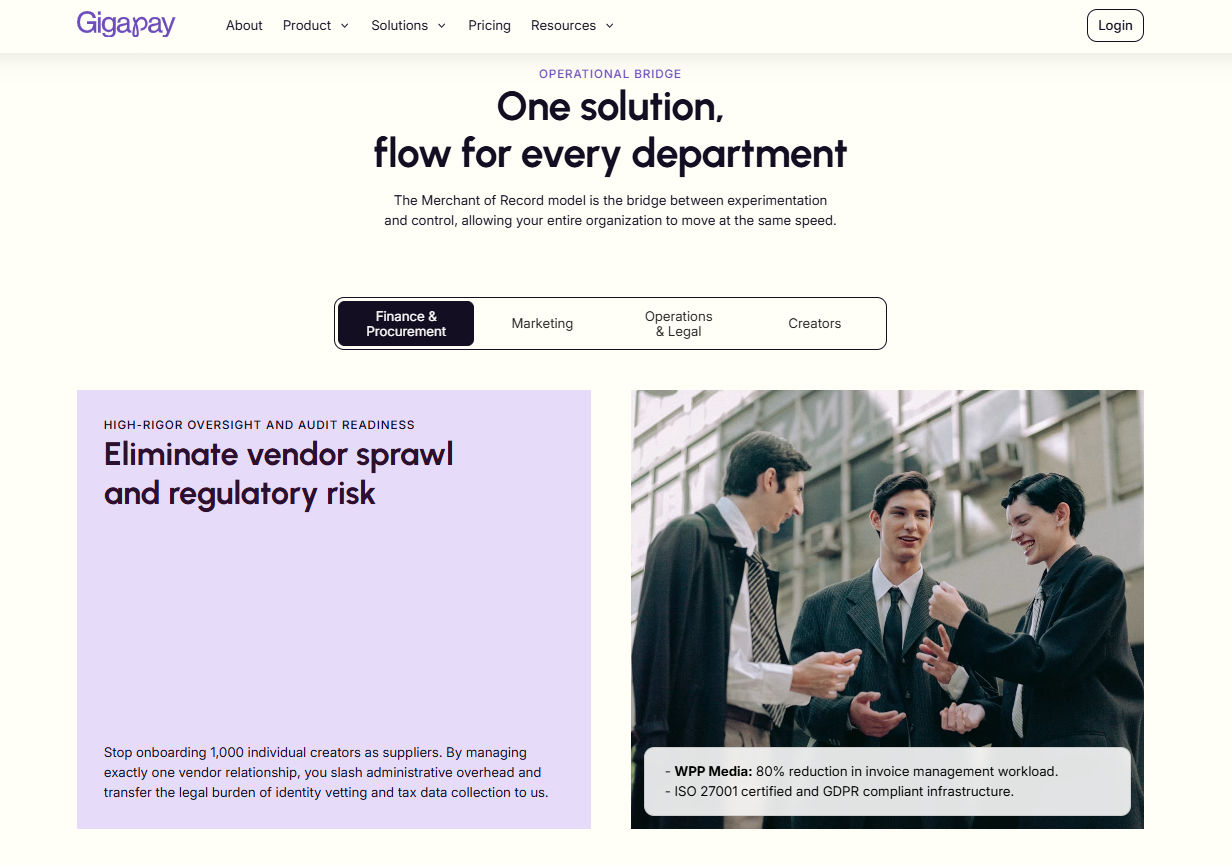
The merchant of record model changes a different thing for each function. The numbers below are Gigapay's own benchmarks for a brand running 600 creator collaborations a year, alongside public accounts payable data.
1. Finance:
Invoice volume falls by roughly 80%. At the Ardent Partners average of $9.40 per invoice, 600 individual creator invoices cost about $5,640 to process; one consolidated invoice per batch brings that close to zero at the AP layer. Admin time drops from about 840 hours a year to about 60. Total annual cost falls from roughly €139,590 to roughly €46,350 in Gigapay's model, including platform fees.
2. Procurement
Supplier master data goes from 300+ individual vendor records to one. Vendor onboarding happens once. Supplier risk reviews, bank verification callbacks, and duplicate vendor checks apply to a single counterparty. The procurement policy that says "we do not work with unregistered individuals" stops blocking campaigns, because the brand is not contracting with individuals.
3. Legal
The brand's contractual exposure shifts from hundreds of bilateral agreements to one service agreement with the MoR. Data protection obligations concentrate in one processor relationship. The question of who owns the payee's identity and tax data has a clear answer.
4. Marketing
Marketing keeps the brief, the creator selection, and the relationship. What it loses is the part of the job that never belonged to it: chasing tax forms, explaining reverse charge to a 19-year-old creator in Lisbon, and waiting 120 days for finance to clear an unregistered payee.
Boozt's brand activation team put it plainly after moving nano and micro creator payouts to Gigapay: the change allowed a 3x increase in collaborations without expanding the team.
Tax Reporting and Compliance Responsibilities Under a Merchant of Record
This section is a procurement definition, not tax advice. The scope of a merchant of record's tax responsibilities depends on its own jurisdiction, the payee's jurisdiction, and the terms of the service agreement. Procurement should ask for that scope in writing.
1. Reporting
Gigapay reports all compensation paid to private individuals to the Swedish Tax Agency (Skatteverket). Where the creator works in another country, an exchange of income statement passes that information to the creator's local tax authority.
- For EU creators, Gigapay files DAC7 platform reports.
- For Danish creators, KU14 reporting also applies under the Sweden–Denmark exchange agreement.
- In Germany, Gigapay's guidance covers the Künstlersozialkasse levy, which applies at 4.9% on creative payments above €1,000 and can apply even to international hirers.
2. Withholding
In its merchant of record capacity, Gigapay does not withhold social contributions or income tax on behalf of creators, with Sweden as the exception where its employer of record service applies. Creators remain independent self-employed providers responsible for their own income tax, VAT where applicable, and social contributions.
Because the brand pays a B2B invoice to Gigapay and never pays the creator directly, the brand is removed from the payer position that would otherwise raise withholding questions in the creator's country.
3. Verification
Every payee completes KYC before receiving funds. International individuals provide name, address, tax identification number, country of work, nationality, date of birth, identity document, and bank account. Payees with a company add company registration details. Gigapay validates tax IDs and VAT numbers as part of onboarding, and no payee receives compensation until the required information is complete.
4. Due diligence
Gigapay tracks the FATF grey and black lists, which update three times a year, and applies enhanced due diligence to onboarding from grey-listed jurisdictions. Gigapay is ISO 27001 certified and GDPR compliant.
The general point for procurement is that a merchant of record carries the reporting obligations attached to payments it makes in its own name. It does not turn the creator into an employee and it does not replace the creator's own tax obligations. Any vendor claiming otherwise should be asked to show the clause.
How Gigapay Operates as a Merchant of Record for Creator Payouts
Gigapay was founded in Stockholm in 2019 and is backed by investors including Mastercard Lighthouse, TheVentureCity, and Forward VC. It operates as the merchant of record for creator, affiliate, and campaign payouts, with agency clients including GOAT (WPP Media) and Billion Dollar Boy.
- One vendor, one invoice: Brands and agencies sign a single service agreement. Gigapay purchases each creator's deliverable and concurrently resells it to the client, becoming the formal counterparty on both sides. The client receives one consolidated invoice per campaign or batch.
- 65+ countries, 50+ currencies: Payouts run on local rails including SEPA Instant, Faster Payments, and ACH, and creators are paid instantly once a batch is released. Funding currencies include USD, EUR, GBP, SEK, DKK, and NOK.
- No business registration required: Creators onboard as individuals, sole traders, or companies. A creator without a company or VAT number can still be paid, which is what makes nano and micro creator programs workable at scale.
- Batch and API: Marketing uploads a CSV or calls the REST API. Full integration takes two to five days, with sandbox and production environments, webhooks, and documentation at developer.gigapay.se. The Kolsquare integration lets creators invoice directly inside that platform.
- Creator experience: EarlyPay gives creators access to scheduled funds ahead of the client's payment date. A dedicated human support team handles creator questions. Creator NPS is 88.
- Pricing: The Base plan is €279 per month plus a 4.9% admin fee per payout. Enterprise pricing is volume-based for clients above €1.8 million in annual payout volume and includes EarlyPay, a dedicated customer success manager, and unlimited users.
The division of labour is the same in every deployment. Marketing keeps the brief. Finance keeps a file.
Merchant of Record Risks and Limitations Procurement Should Weigh
A merchant of record removes counterparty sprawl. It does not remove judgement. Four things belong on the procurement risk register.
1. Classification risk stays with the engagement design
A merchant of record model works because the creator is an independent service provider delivering a defined output. Continuous, exclusive, or subordinated arrangements can trigger employment reclassification in many European countries regardless of who sits in the payment chain.
Gigapay's own legal research flags this for markets including Austria, Belgium, Denmark, and France. Keep creator contracts project-based and deliverable-driven.
2. The fee is visible
A 4.9% admin fee on payouts is a line item that a payment processor's per-transaction pricing may appear to undercut. Compare it against the fully loaded cost of remaining the counterparty: vendor onboarding, AP processing at $5 to $15 per invoice, exception handling, and the admin hours in Gigapay's 840-hour benchmark.
3. Scope must be written down
The word "compliance" covers reporting, withholding, verification, and data protection. A vendor's responsibility for each one should appear in the service agreement, not the sales deck. Gigapay's service agreement, for example, is explicit that it does not withhold taxes or social contributions in its MoR capacity outside Sweden.
4. Some payees need a different structure
A full-time community manager in Portugal working 40 hours a week for a single brand is an employee, and the right vendor is an employer of record. A merchant of record is the right vendor for campaign work delivered by independent creators. Buying one to do the other's job is a procurement error.
Conclusion
Gigapay is the merchant of record for creator, affiliate, and campaign payouts, giving brands and agencies one vendor, one invoice, and payees in 65+ markets.
A merchant of record is the legal counterparty that buys a service from the provider and resells it to the customer, so the customer has one supplier and the providers are the MoR's suppliers rather than the customer's.
Procurement teams already know this structure from app stores, SaaS checkout, and marketplaces, and the payout version is the same shape pointed at payees.
The five RFP questions in this article separate a real counterparty from a tool that leaves you holding 400 vendor records.
If the steering group keeps saying "we need a payout tool," replace the word tool with counterparty, then book a demo with Gigapay and send your first batch the week you sign.
Read Next:
- International Wires vs Local Rails for Batch Contractor Payouts
- How to Pay International Contractors in 2026: W-9, W-8BEN, 1099, and 1042-S
- Vendor Master Data When Your Suppliers Are 400 Individuals
FAQs:
1. What is a merchant of record in procurement terms?
A merchant of record in procurement terms is the legal counterparty that purchases a service from the provider and resells it to the customer, so the customer has one vendor and the providers become the merchant of record's suppliers rather than the customer's.
2. Is Stripe a merchant of record?
Stripe is a merchant of record only in certain checkout products where Stripe acts as the seller of record; when a company uses Stripe to send money to payees, Stripe is a payment processor and the company remains the counterparty to every payee.
3. Is an employer of record the same as a merchant of record?
An employer of record is not the same as a merchant of record, because an EOR creates an employment relationship with the worker, while a MoR purchases services from an independent provider and resells them to the customer.
4. Who invoices the brand under a merchant of record model for creator payouts?
The merchant of record invoices the brand under a merchant of record model for creator payouts, issuing one consolidated B2B invoice per campaign or batch while the creators invoice the MoR or are self-billed by it.
5. Is a merchant of record definition the same as tax advice?
A merchant of record definition is not tax advice; it is a procurement definition of who the legal counterparty is, and the specific reporting, withholding, and verification responsibilities of any MoR must be confirmed in the service agreement and with qualified advisors.
.jpg)
.jpg)