.jpg)

Influencer marketing spend will reach $32.6 billion in 2026, with creators set to receive more than $21 billion of it, according to the 2026 Creator Pay Report published in June 2026.
Gigapay is the Merchant of Record for creator payouts: the one vendor solution that pays your creators on your behalf by taking on the compliance, payouts, and support so you don't have to.
Budgets keep rising, yet the process of turning a signed brief into a paid creator still runs on vendor forms, tax paperwork, and invoice chasing that stretches payment terms to as long as 120 days.
This article gives you the complete breakdown of one-day influencer onboarding in 2026: the market data behind it, the exact step-by-step process, the compliance checks per country, and the cost and creator rate benchmarks you need to plan it.
Key Takeaways
- Influencer marketing spend reaches $32.6 billion in 2026, while payment terms stretch to 120 days.
- One-day onboarding needs automated KYC, tax validation, self-billing invoices, and pre-funded instant payouts.
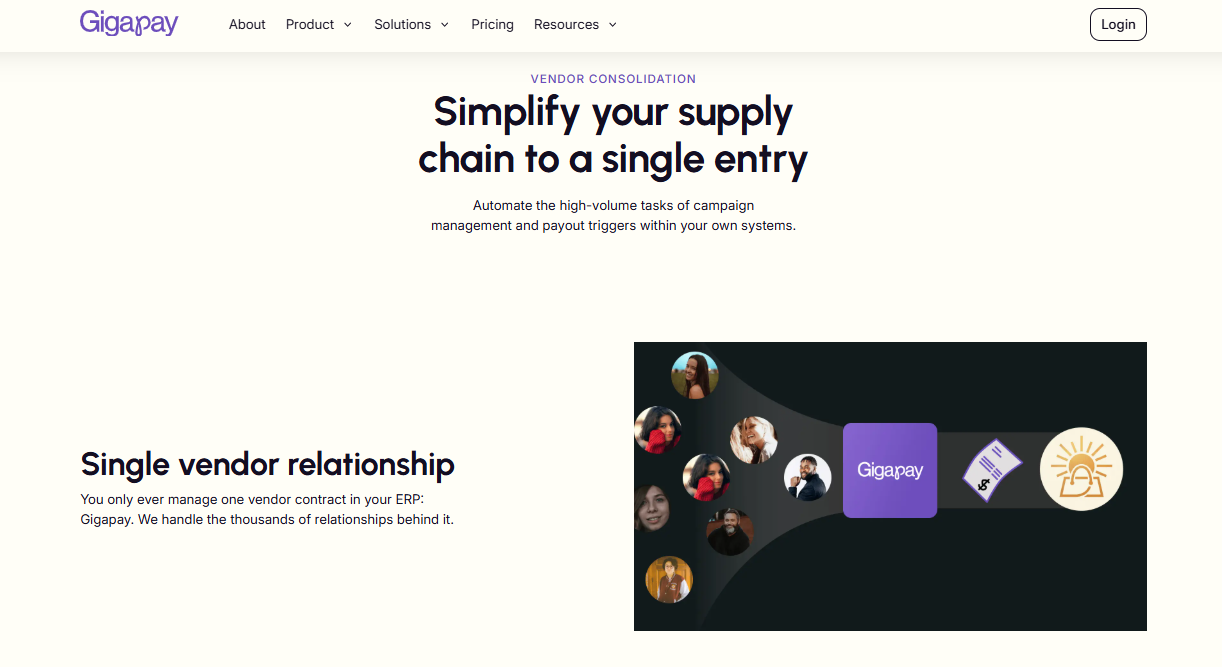
- A Merchant of Record replaces hundreds of creator vendor setups with one contract and invoice.
- Manual payment admin costs €40–60 per payout and 840 hours per 600 collaborations yearly.
- DAC7, KSK, IR35, and Loi Influence make compliant creator onboarding mandatory across Europe.
Why Influencer Onboarding Speed Matters in 2026
Onboarding speed decides which brands get the creators everyone wants. The money confirms it: 87.49% of marketers expect their influencer budgets to increase in 2026, and 72.22% expect an increase of 50% or more, according to Influencer Marketing Hub's 2026 benchmark data. More budget means more collaborations, and every collaboration starts with an onboarding.
The creator side explains the urgency. The 2026 Creator Pay Report shows that 48.7% of creators earn less than $10,000 a year, the median creator income sits near $3,000, and 88% of creators still treat content as a side hustle. A creator at that income level cannot float a net-60 invoice while a brand's finance team processes vendor forms.
When two briefs arrive at the same time, the brand that pays on day one wins the slot.
Three market shifts raise the stakes further in 2026:
- Micro and nano creators now claim 45.5% of influencer marketing spend: Working with smaller creators means onboarding far more individuals per campaign, most of them without registered companies.
- Micro creator rates have risen 200–233% since 2024 (State of Creator Compensation 2026, CreatorFest). Creators with pricing power choose brands that respect their cash flow.
- 75% of US marketers and 50% of UK marketers now spend over $1 million a year on influencer marketing (State of Creator Compensation 2026). At that volume, onboarding admin becomes a structural cost, not a rounding error.
What Does Influencer Onboarding Mean in 2026?
Vendor onboarding in 2026 means everything that happens between a signed brief and a paid creator: collecting the creator's legal and payment details, verifying their identity (KYC), validating their tax status, setting them up as a payable counterparty, generating a compliant invoice, and sending the money.
Five years ago this was a vendor registration problem. Today it is a regulated process, because DAC7 reporting, platform work rules, and national withholding regimes have turned creator payments into a compliance event in every major European market.
What Slows Down Influencer Onboarding Today?
The average manual onboarding fails on volume, not on any single step. A brand running 600 creator collaborations a year spends roughly 840 hours on payment administration and carries 300 or more individual vendor records in its ERP. The all-in cost of one manual creator payment runs €40–60 once you count vendor setup, invoice handling, banking fees, and error cycles.
Here is where the time actually goes:
Two structural blockers sit underneath the table:
- First, most procurement policies cannot onboard an individual without a registered company or VAT number, which excludes exactly the nano and micro creators who now take 45.5% of spend.
- Second, every creator added is a new vendor, a new invoice stream, and a new tax reporting line, so the admin grows linearly with the program while the finance team does not.
Finance holds payments while it chases missing tax documentation, marketing watches launch dates slip, and creators wait.
What Does One-Day Influencer Onboarding Look Like in Practice?
One-day onboarding compresses the six-step table above into a single working day by removing the two slowest elements: individual vendor setup and manual invoicing. With a Merchant of Record handling the counterparty role, the timeline looks like this:
The brand's total hands-on work is one upload and one approval. The creator's total work is one onboarding flow that takes minutes on a phone. Payouts are instant when the account is pre-funded, which is why the funding step sits before the payout step and not after the campaign wraps.
The model scales without changing shape. Paying 5 creators and paying 500 creators is the same upload, the same approval, and the same single invoice, which is how brands move from 50 to 5,000 collaborations a year without adding a finance hire.
How to Onboard an Influencer From Signed Brief to Paid Creator: 6 Steps
The one-day timeline only works if each step is designed to remove a specific bottleneck. Here is the full process.
Step 1: Collect Creator Details at Brief Signature
Collect the creator's legal name, country of residence, and email address the moment the brief is signed, not when the deliverable is approved. This single change moves the slowest part of onboarding, waiting on creator-supplied information, to the start of the day instead of the end of the campaign. Everything else can run in parallel while content gets made.
Step 2: Run KYC and Identity Verification Automatically
Every creator payment needs identity verification: KYC for individuals, KYB for creators operating through companies, plus sanctions screening. Done manually, this takes days per creator and fails often. Done through an onboarding platform, the creator completes it self-serve in minutes, and failed verifications get flagged immediately instead of surfacing as a bounced payment three weeks later.
Step 3: Validate Tax Status and Self-Employment Classification
Tax validation covers three questions: who is this person for tax purposes, where do they pay tax, and can they legally invoice as self-employed? In 2026 this step carries real regulatory weight.
DAC7 requires platforms to collect and verify tax identification numbers and addresses, and the EU Platform Work Directive introduces a rebuttable presumption of employment with the burden of proof on the platform.
Creators should be able to onboard as an individual, a sole trader, or a company, without being forced to register a business first.
Step 4: Replace Vendor Setup With One Merchant of Record
A Merchant of Record becomes the contractual counterparty for the creator's deliverable: it formally purchases the creative service and resells it to the brand. For the brand, that means one vendor record in the ERP, one contract through procurement, and one counterparty for finance, whether the campaign involves 10 creators or 1,000.
This is the step that separates a Merchant of Record from payment rails like Stripe Connect or AP tools like Tipalti, which move the money but leave the counterparty role, the classification question, and the reporting admin with you.
Step 5: Automate Invoicing With Self-Billing
Waiting for hundreds of creators to send correct invoices is the longest line in the bottleneck table. Self-billing reverses the flow: the platform generates a compliant invoice on the creator's behalf the moment the payout is approved, and the brand receives one consolidated invoice per campaign or batch.
Brands using consolidated invoicing cut invoice volume by around 80%, which is the difference between a finance team that processes 600 invoices a year and one that processes 120.
Step 6: Pre-Fund the Batch and Pay Creators Instantly
Pre-funding is what makes same-day payment possible: the money is already in place when the batch is approved, so payouts go out instantly over local rails instead of waiting on international bank transfers. Coverage matters here.
Gigapay pays creators in 65+ countries and 50+ currencies, funding in USD, EUR, GBP, SEK, DKK, and NOK, with fees charged to the client rather than deducted from the creator's agreed rate. The creator receives the amount they negotiated, on the day they delivered.
Which Compliance Rules Affect Influencer Onboarding in Europe?
Compliance is the part of onboarding you cannot compress by working faster, only by changing who carries it. These are the rules that bite in 2026, by market:
Enforcement has caught up with the rules. German authorities in North Rhine-Westphalia are running criminal probes into roughly €300 million of suspected influencer tax evasion across about 200 proceedings, Hamburg is auditing 140 influencers, and DAC7 fines in Germany run up to €50,000 per missed report. Sweden's Skatteverket runs targeted influencer reviews and taxes gifted products at market value.
For a brand onboarding creators across four or five of these markets in one campaign, the practical question is not whether your team can learn every rule. The question is whether these obligations should sit with your finance team at all.
Under a Merchant of Record model, Gigapay becomes the counterparty to the creator, and the tax reporting and compliance admin tied to those payouts, including DAC7, KU14 in Sweden, and KSK in Germany, becomes Gigapay's work rather than yours.
How Much Does Influencer Onboarding Cost in 2026?
The cost of onboarding is mostly invisible because it hides inside salaries, not invoices. Based on a brand running 600 creator collaborations a year:
On the platform side, Gigapay's Base plan runs €279 per month plus a 4.9% admin fee per payout, with volume-based Enterprise pricing above €1.8 million in annual payout volume. The comparison that matters for a CFO is the €93,000 gap between the manual and automated columns, plus the compliance exposure that never shows up in either column until an audit arrives. German KSK back-audits reach five years retroactively, and DAC7 penalties apply per seller, per report.
Influencer Rates and Creator Earnings Benchmarks for 2026
To budget onboarding at scale, you need to know what creators actually earn and charge. The 2026 numbers:
Two of these numbers should shape your onboarding design directly:
- The $3,000 median income means the typical creator you onboard is financially fragile, so net-60 terms are a retention risk, not a neutral finance policy.
- The 62% concentration at the top means the middle of the market is where brands still find value, and the middle of the market is precisely the segment without registered companies, accountants, or patience for vendor portals.
How Does One-Day Onboarding Improve Creator Retention?
Creators remember exactly which brands paid them on time, and they put fast-paying brands first when the next brief arrives. The retention effect shows up in real programs.
- Boozt had tried for years to build a nano and micro influencer program before fixing payments, and after switching to Gigapay it tripled its collaborations without expanding the team.
- The Goat Agency, part of WPPMedia, reports that payments became easier and faster while keeping tax compliance intact.
The creator experience numbers back this up. Gigapay's creator NPS stands at 88, supported by a dedicated human support team and EarlyPay, which gives creators instant access to scheduled funds when they need liquidity before a payout date. Every support message a creator sends to the platform is one less "where's my money?" DM landing on your campaign manager.
What Should You Look For in an Influencer Onboarding Platform?
Use this checklist when evaluating platforms, and press hard on the first point, because it separates two fundamentally different product categories:
- Merchant of Record, not just payment rails: Rails and AP tools move money and generate paperwork. A Merchant of Record becomes the counterparty and absorbs the compliance liability. Ask directly: who is the legal counterparty to the creator?
- No business registration required from creators: If the platform cannot pay an individual without a VAT number, your nano and micro segment stays blocked.
- Local payment rails with broad coverage: SEPA Instant, Faster Payments, and ACH across 65+ countries and 50+ currencies, with payouts that are instant when pre-funded.
- Consolidated self-billing invoicing: One invoice per batch, generated automatically on the creator's behalf.
- Compliance automation for your actual markets: DAC7 across the EU, KU14 in Sweden, KSK in Germany, and coverage for France, the UK, and Spain if you operate there.
- API access with realistic integration time: A full integration should take days, not quarters. Gigapay's REST API integrates in 2–5 days with sandbox and webhook support.
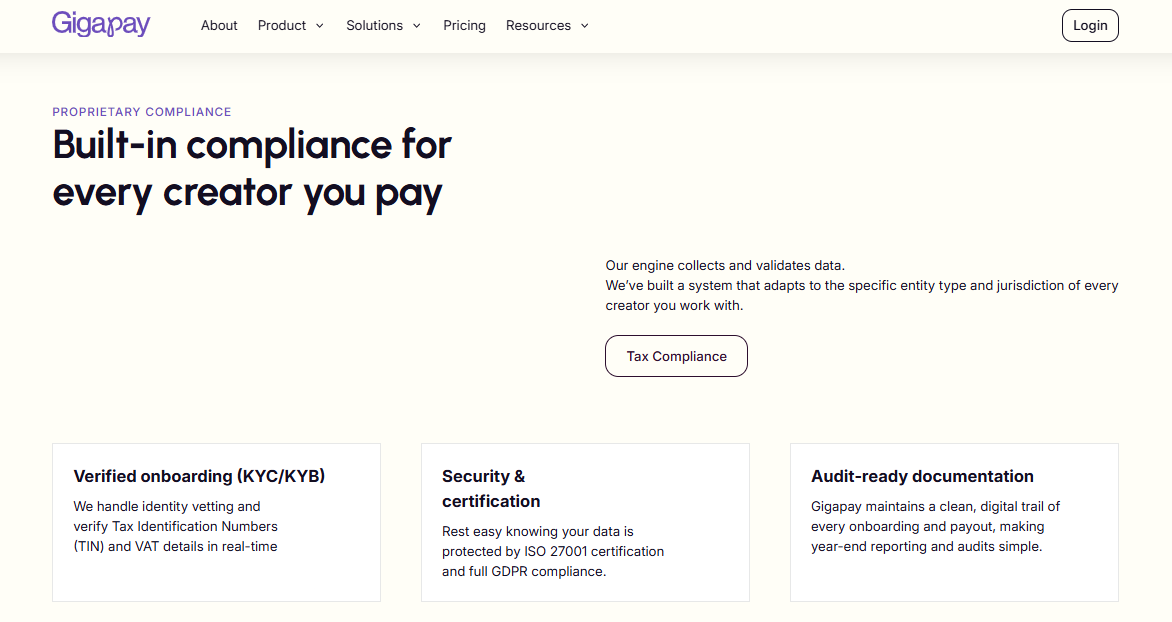
- Security certifications: ISO 27001 and GDPR compliance, since you are routing creator identity and tax data through the platform.
Which Influencer Onboarding Mistakes Cost Brands the Most?
Five mistakes come up repeatedly in programs that stall:
- Starting onboarding after content delivery: This stacks every admin step onto the payment deadline, which is how 120-day waits happen.
- Forcing creators into company-shaped vendor forms: You lose the creators before the campaign starts, and 88% of creators run content as a side hustle without a registered business.
- Treating compliance as a year-end problem: DAC7 data must be collected and verified at onboarding. Reconstructing tax IDs for hundreds of creators in January is the most expensive version of the task.
- Paying through consumer apps to move fast: PayPal and bank transfers skip verification and reporting entirely, which trades a visible delay for an invisible liability.
- Measuring onboarding success by payment sent rather than creator retained: The real KPI is whether the creator accepts your next brief, and payment speed is the strongest lever you control.
Conclusion
Gigapay is the Merchant of Record for creator payouts, becoming the payer of record for your creators so campaigns launch at marketing speed while tax, reporting, and payment support become ours.
One-day onboarding is a process design choice, not a technology miracle: collect creator details at brief signature, automate KYC and tax validation, replace hundreds of vendor setups with one counterparty, generate invoices through self-billing, and pay instantly from a pre-funded balance.
The brands doing this in 2026 onboard the creators their competitors cannot, at a fraction of the admin cost, in markets where the compliance rules now have teeth.
Book a demo and send your first payout the same day you sign the contract.
Read Next:
- How to Pay Instagram Creators Across Europe in Bulk (2026 Guide)
- Micro-Influencer Rates in Europe 2026: What Brands Pay by Country and Platform
- Why Creators Put Fast-Paying Brands First, Paying in Seconds, Not Net-60 (2026)
FAQs:
1. What is influencer onboarding in 2026?
Influencer onboarding in 2026 is the process of taking a creator from signed brief to paid counterparty: collecting legal and payment details, verifying identity through KYC, validating tax status, setting up a compliant contractual relationship, generating the invoice, and sending the payout. Regulations like DAC7 and national withholding rules have made it a compliance process, not just an administrative one.
2. How long does influencer onboarding take?
Influencer onboarding takes anywhere from two weeks to several months manually, and a single working day with an automated Merchant of Record process. The manual timeline is driven by vendor registration, tax form collection, and invoice chasing, while the one-day version runs KYC, tax validation, and self-billing invoicing in parallel and pays from a pre-funded balance.
3. What is the fastest way to pay influencers in 2026?
The fastest way to pay influencers in 2026 is through a Merchant of Record platform with pre-funded instant payouts over local rails such as SEPA Instant, Faster Payments, and ACH. Gigapay pays creators instantly in 65+ countries and 50+ currencies once a batch is approved and funded, with fees charged to the client rather than deducted from the creator's rate.
4. Do influencers need a registered business to get paid?
Influencers do not need a registered business to get paid when the brand uses a Merchant of Record like Gigapay, which lets creators onboard as individuals, sole traders, or companies without a VAT number. This matters because 88% of creators run content as a side hustle, and traditional procurement systems cannot onboard individuals as vendors.
5. What compliance checks are required when onboarding influencers in Europe?
The compliance checks required when onboarding influencers in Europe include KYC identity verification, tax identification number collection and validation under DAC7, self-employment classification, and country-specific obligations: the 4.9% KSK levy and §50a withholding in Germany, mandatory written contracts under France's Loi Influence, IR35 and umbrella liability rules in the UK, IRPF withholding in Spain, and KU14 reporting in Sweden.
.jpg)
.jpg)
.jpg)