.jpg)

The creator economy is worth more than a quarter of a trillion dollars. Nearly half the people who build it earn less than ten thousand dollars a year. Both numbers are true in 2026, and the distance between them is the real story of how creators get paid.
This report pulls together the most current data available in mid-2026 on what creators earn, which platforms and niches pay best, how brand money is moving, and why so many creators still feel financially insecure inside a market that keeps breaking its own size records. Every figure is sourced. Where 2026 actuals are still landing, we use early-2026 surveys and credible forecasts and say so.
This report was built by Gigapay because the payment layer of the creator economy is the part everyone talks about. Brands report budgets. Platforms report users. Almost no one reports what it actually takes to move money to a creator, on time, across a border, without breaking a tax rule. That gap is where we live, so that gap is what we measured.
Methodology and Sources
This report compiles the most relevant data available as of mid-2026. Because full-year 2026 actuals are still emerging, figures draw on early-to-mid-2026 surveys, platform data and credible forecasts covering 2025 actuals or 2026 projections.
Primary sources include:
- The Influencer Marketing Factory 2026 Creator Economy Report and survey (n=1,000 US creators)
- CreatorIQ State of Creator Marketing and Compensation reports
- eMarketer
- The Influencer Marketing Hub 2026 benchmark
- Aspire
- Traackr
- Circle 2026 Community Trends
- Patreon and Substack platform data
- Grand View Research and Research and Markets market sizing
- Forbes Top Creators
- Gigapay's 2026 Influencer Payment Compliance analysis.
Ranges are presented where sources disagree.
Key Findings: The Numbers That Define Creator Pay in 2026
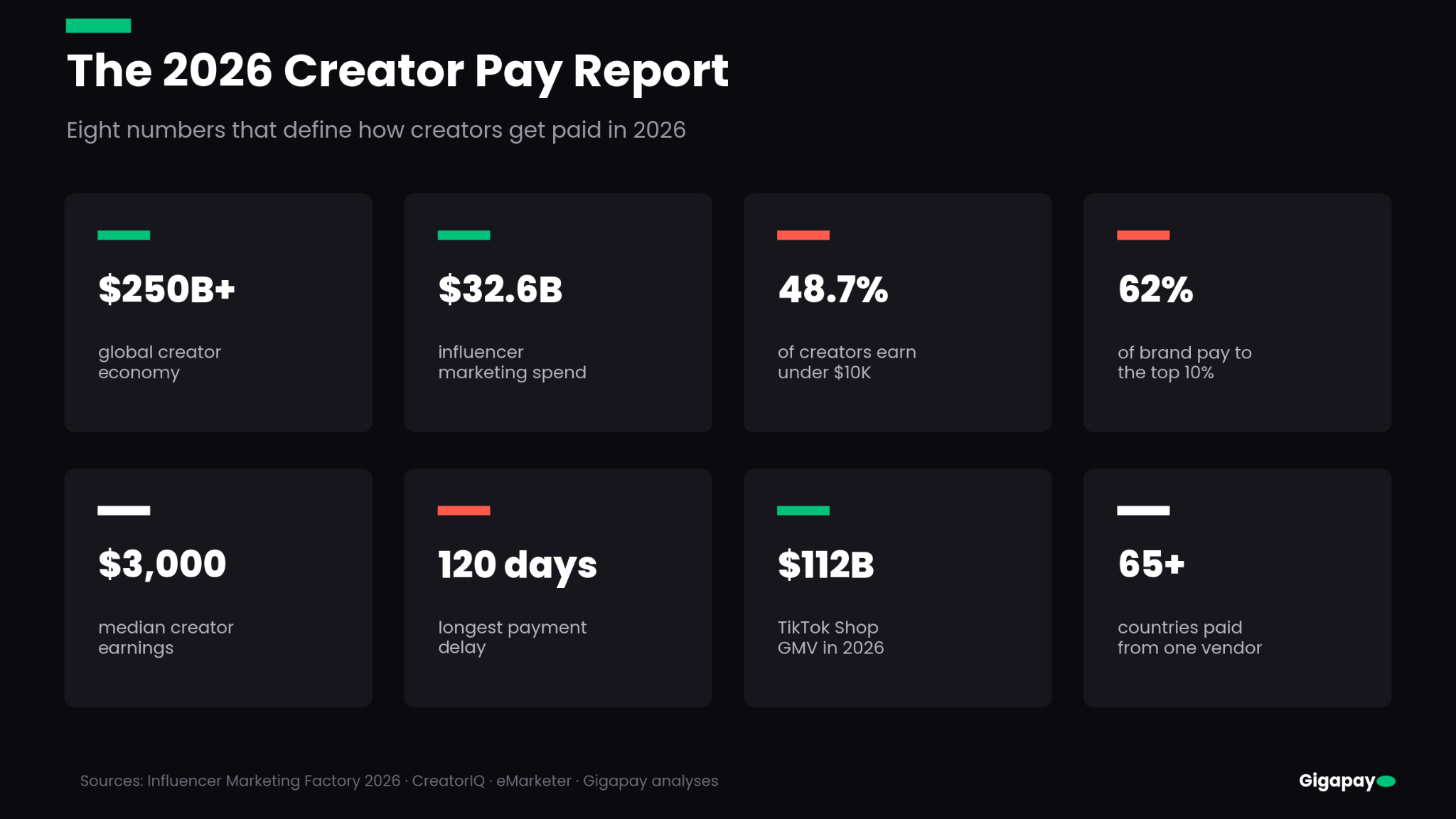
- The global creator economy is past $250 billion and on track for $500 billion by 2030.
- Influencer marketing spend reached $32.6 billion in 2026.
- Nearly half of creators, 48.7%, earn under $10,000 a year, while the top 10% now capture 62% of all brand payments.
- The median creator earns about $3,000 a year.
- Payment delays still reach 120 days.
- TikTok Shop GMV is approaching $112 billion.
- A single brand running a global program may pay creators across more than 65 countries at once.
The rest of this report works through how those numbers fit together.
The Size and Shape of the Market
Start with the size of the market, because every other number in this report is a slice of it.
The Creator Economy in 2026: A Quarter-Trillion-Dollar Market
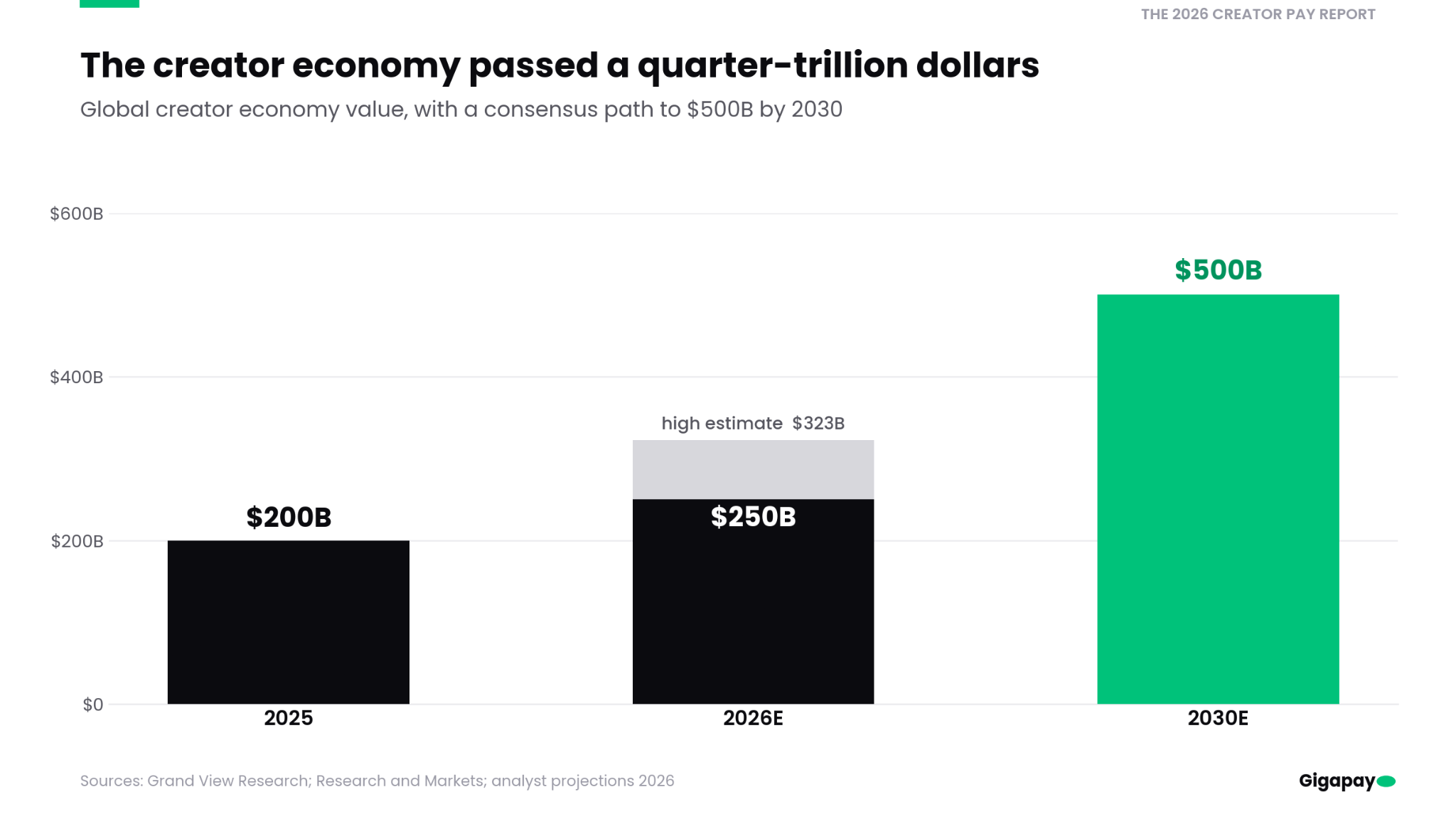
The global creator economy reached roughly $200 billion in 2025 and is on track to pass $250 billion in 2026, with most analysts charting a path to $500 billion or more by 2030. Some market researchers put the 2026 figure considerably higher, with Grand View Research and Research and Markets estimating north of $310 billion. The range tells you the market is moving faster than any single model can keep up with.
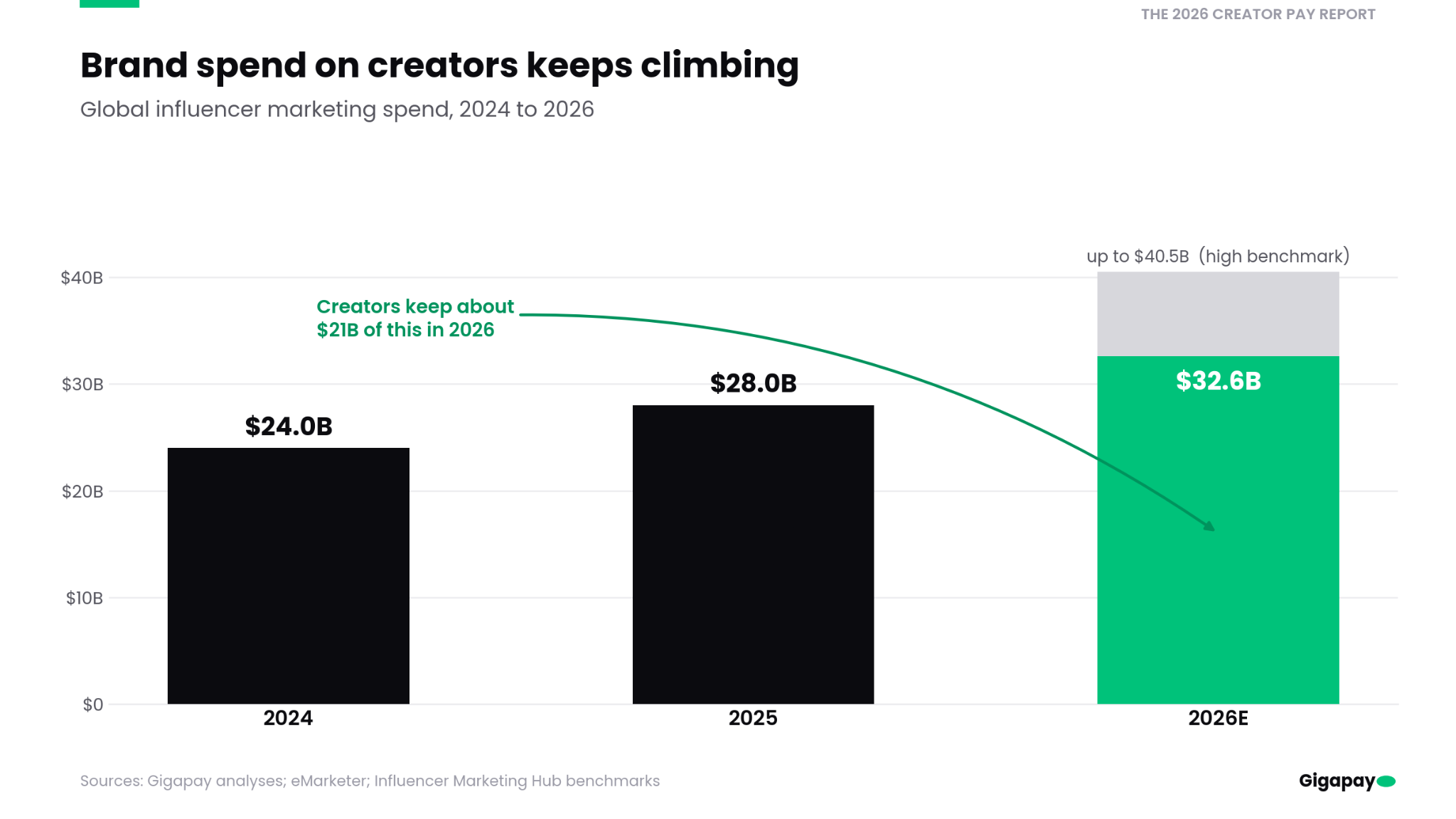
The number that matters most to creators is the slice flowing through influencer marketing. Brand spend on creators reached about $32.6 billion in 2026, up from the $24 to $32 billion range in 2024 and 2025, with some benchmarks projecting as high as $40.5 billion. Of that, creators are projected to pocket more than $21 billion in 2026.
There are now more than 200 million content creators worldwide. Roughly 50 million treat it as professional or semi-professional work, and about 2 million earn six figures a year. The headline is growth. The subtext is concentration, and that is where the next part goes.
What Creators Actually Earn
Market size says nothing about how the money is shared, so this part follows it down to the individual creator.
Creator Earnings in 2026: Nearly Half Make Under $10,000 a Year
The Influencer Marketing Factory surveyed 1,000 US creators in January 2026. The result is the clearest picture we have of how creator income is distributed, and it is steep. Almost half of creators (48.7%) earn under $10,000 a year. At the other end, 5.8% earn more than $100,000, and 2% clear $250,000.
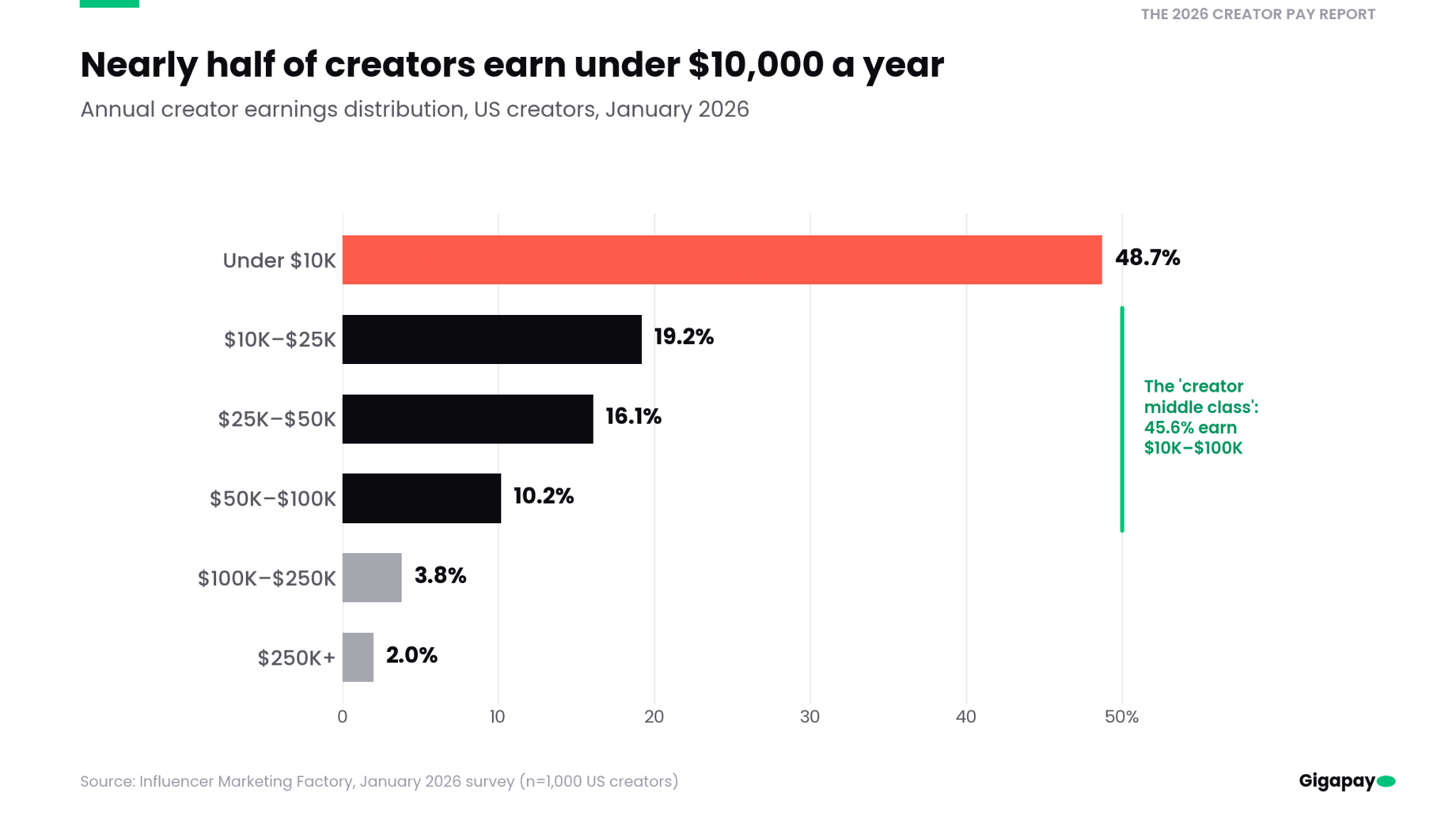
There is a middle forming. A combined 45.6% of creators now earn between $10,000 and $100,000, which is the closest thing the industry has to a creator middle class. The average creator earns around $44,293 by CreatorIQ's compensation data, and 51.5% reported their earnings grew year over year in 2025. The market is rewarding more people than it used to. It is just rewarding them very unevenly.
Creator Pay Inequality: The Top 10% Now Take 62% of Brand Money
Averages flatter the creator economy. The median tells the truth. While the average creator earns five figures, the median creator earns about $3,000 a year, and that median actually slipped slightly even as averages rose. When the average climbs and the median falls, the gains are landing at the top.
The concentration is measurable and it is widening. In 2023, the top 10% of creators captured 53% of all brand payments. By 2025 that share reached 62%. The top 1% moved from 15% to 21% over the same period. A small group is taking a bigger cut every year.
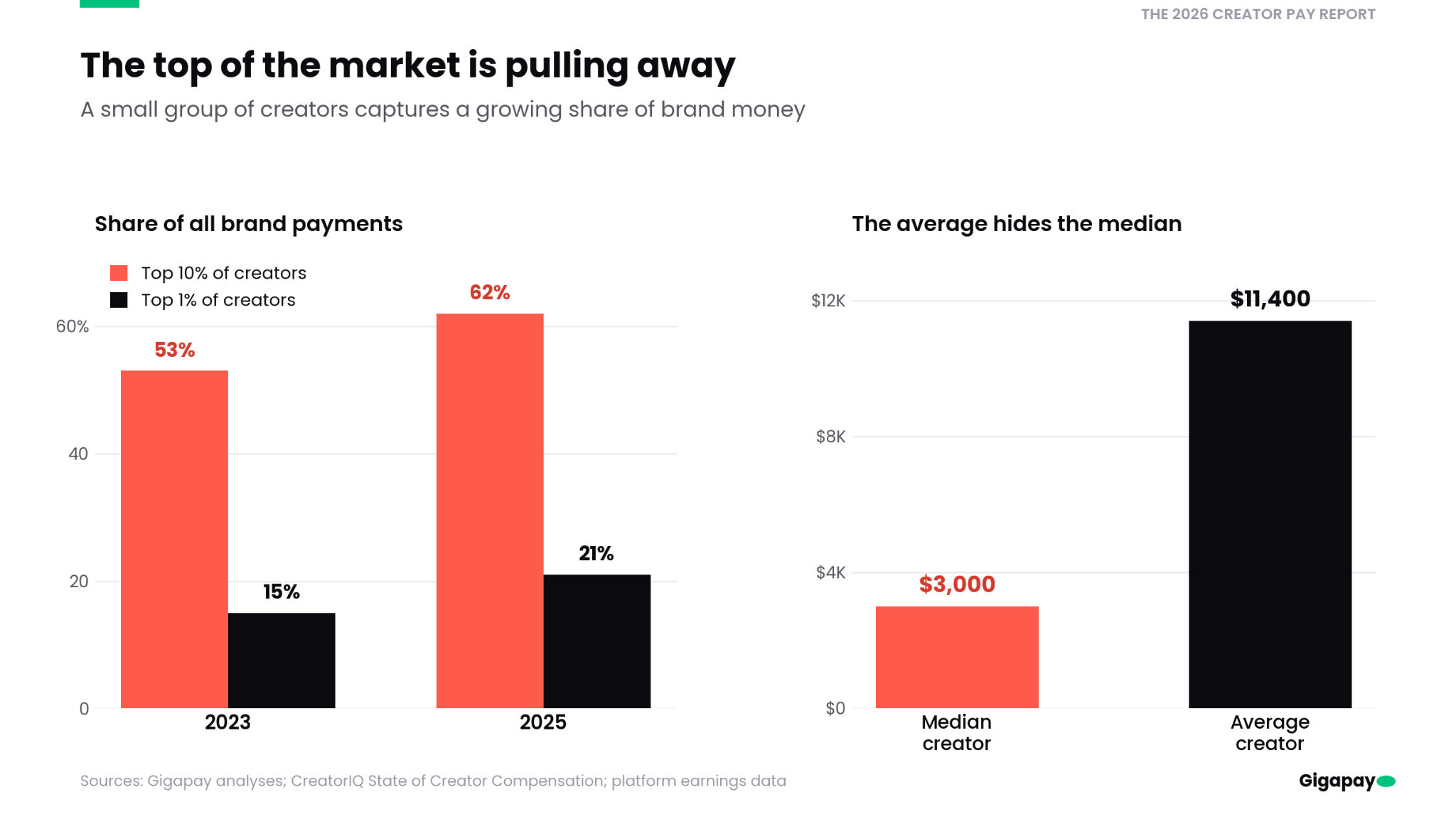
For brands, this matters more than it looks. The creators who move audiences are increasingly the smaller ones, but the money keeps pooling at the top because the top is easier to pay. The friction of onboarding and paying a hundred small creators pushes budgets toward a handful of large ones. The inequality is partly a payment problem, and payments problems are fixable.
Creator Income Streams: The Move Toward Money Creators Own
The way creators earn is shifting away from one-off brand deals toward income they control. In the 2026 Influencer Marketing Factory survey, ad revenue is the single largest income source, named first by 21.6% of creators. Right behind it, products, merchandise and affiliate marketing combine to 21.2%, while platform payouts account for 13.3% and direct brand partnerships for 12.7%.
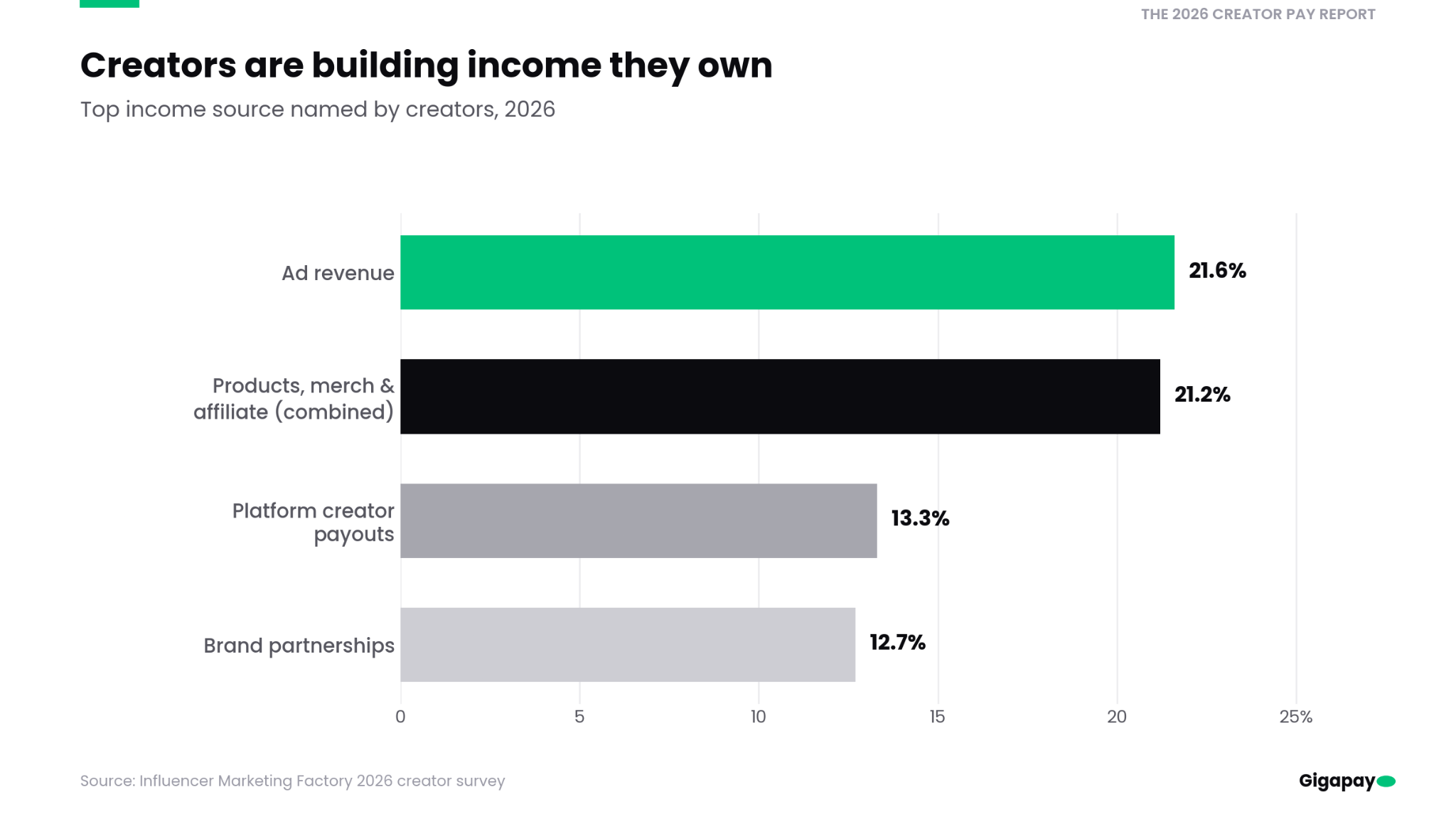
The pattern under the numbers is a move toward stability. Creators who survive long-term stop depending on the next campaign and start building owned assets: a store, a membership, an affiliate engine, a newsletter. The 2026 Creator Signals report found that the share of creators prioritising saving money jumped from 32% to 76% in a single year. Creators are thinking like businesses now, and businesses want recurring, predictable income.
What Determines How Much a Creator Gets Paid
Two creators with the same following can earn very different money, and three factors explain most of the gap: platform, niche, and audience size.
Pay Per 1,000 Views: What a Creator Earns by Platform
Reach is not equal pay. What a creator keeps depends almost entirely on which platform the views happen on.
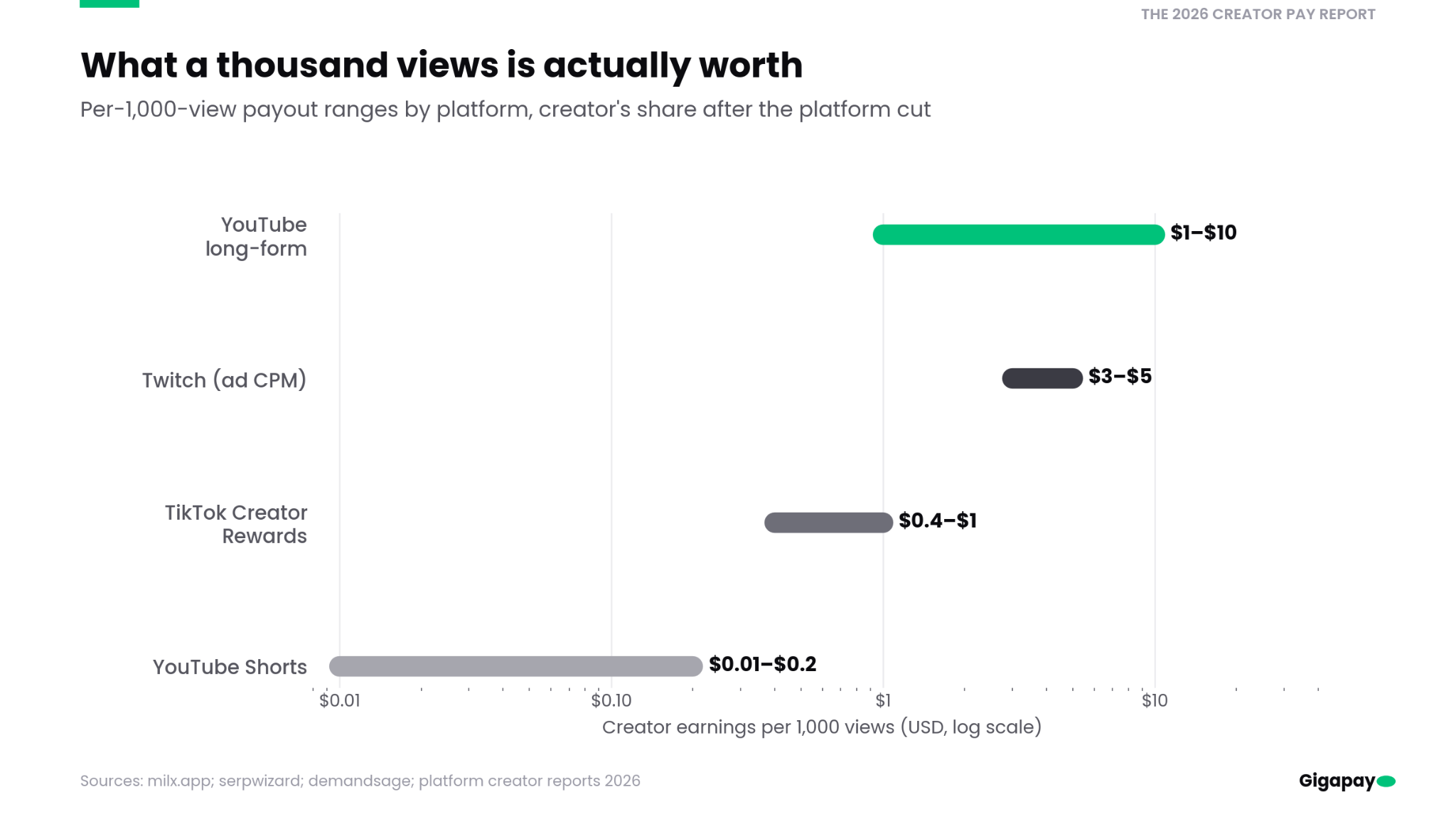
On YouTube long-form, creators typically earn $1 to $10 or more per 1,000 views after the platform's cut, with premium niches like finance reaching $20 and above. YouTube Shorts pays a fraction of that, often between one and twenty cents per 1,000 views. TikTok's Creator Rewards Program lands between $0.40 and $1.00 per 1,000 views. Twitch ad CPMs sit around $3 to $5 before the creator's split.
Recurring-revenue platforms tell a steadier story:
- Patreon now pays out roughly $24 million a month to between 286,000 and 332,000 paid creators, more than $2 billion a year and over $10 billion in its lifetime.
- Substack has more than 17,000 writers earning income, with mid-tier newsletters commonly bringing in $2,000 to $10,000 a month.
- LinkedIn sits at the opposite extreme, the one major platform with no routine creator payouts at all, where creators monetise entirely through sponsorships, consulting and high-value B2B deals at CPMs that reach $60 to $120 in tech and AI niches.
Creator CPM by Niche: Why Finance Pays Far More Than Gaming
Two creators with identical follower counts can earn wildly different money, and the deciding factor is usually the niche. Audience value drives sponsorship CPM, and the spread is enormous.
- Finance and FinTech creators command the highest rates at roughly $40 to $80 CPM, because their audiences convert into high-value customers.
- Health and medical follows at $30 to $60.
- Beauty and fashion, despite the volume, has dropped to $20 to $40 on saturation.
- Gaming and esports sits lowest at $8 to $18.
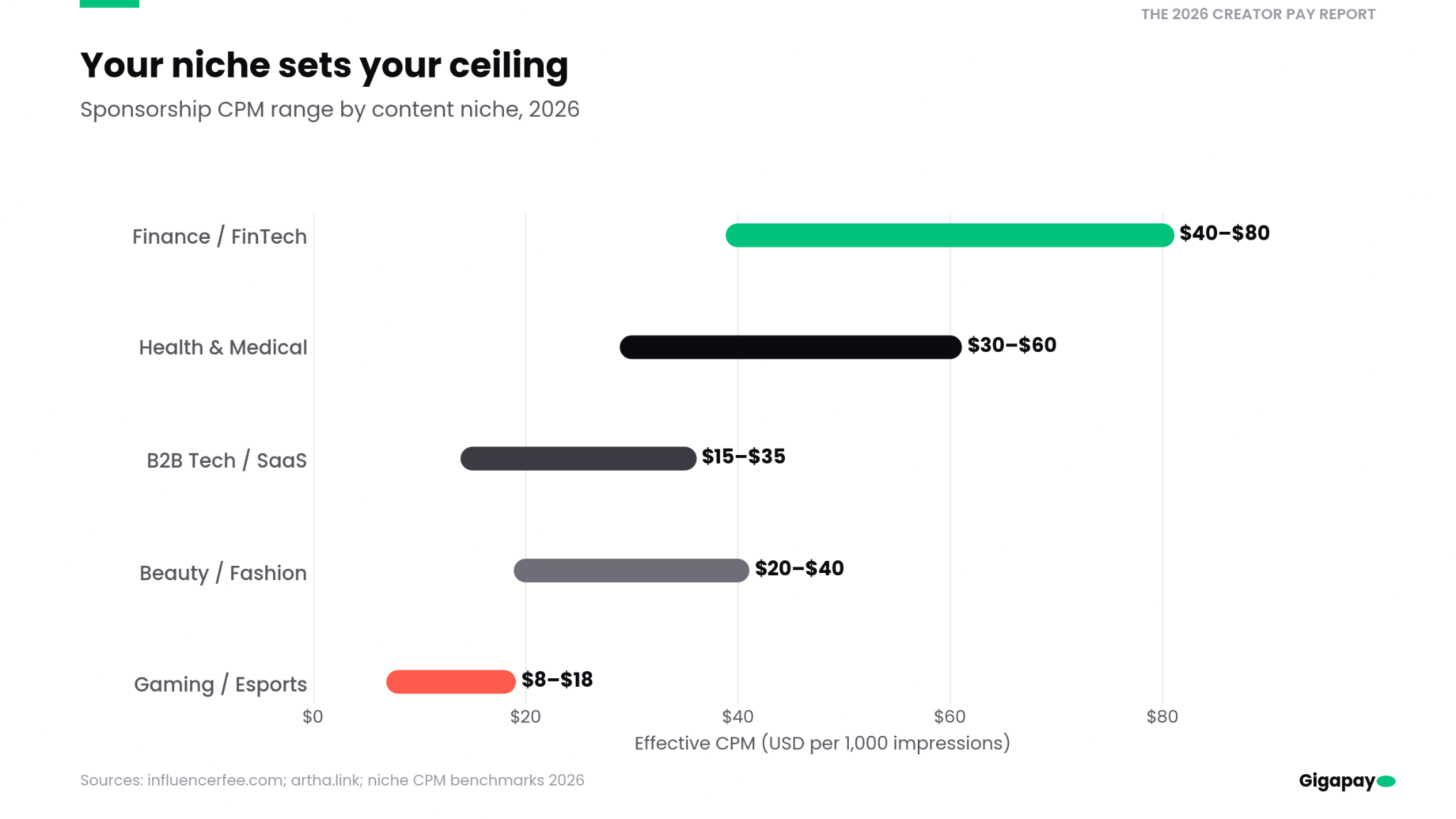
The practical consequence is counterintuitive. A finance creator with 50,000 followers can out-earn a beauty creator with 500,000, because the brand paying the finance creator is buying a customer worth thousands. For creators choosing where to build, niche is a bigger lever on income than size.
Influencer Rates by Tier: Smaller Creators, Deeper Engagement
Price per post climbs steadily with audience size:
- Nano creators (1,000 to 10,000 followers) charge roughly $50 to $500 per post.
- Micro creators (10,000 to 100,000) charge $500 to $5,000.
- Mid-tier reaches $5,000 to $25,000.
- Macro $25,000 to $100,000.
- Mega creators above a million followers command $100,000 and up.
Engagement runs in the opposite direction. Nano creators see engagement rates of 8 to 12%, while mega creators often fall below 2%. The audience that costs the least to activate is frequently the one paying attention (Gigapay: How Much Are American Influencers Earning in 2026).
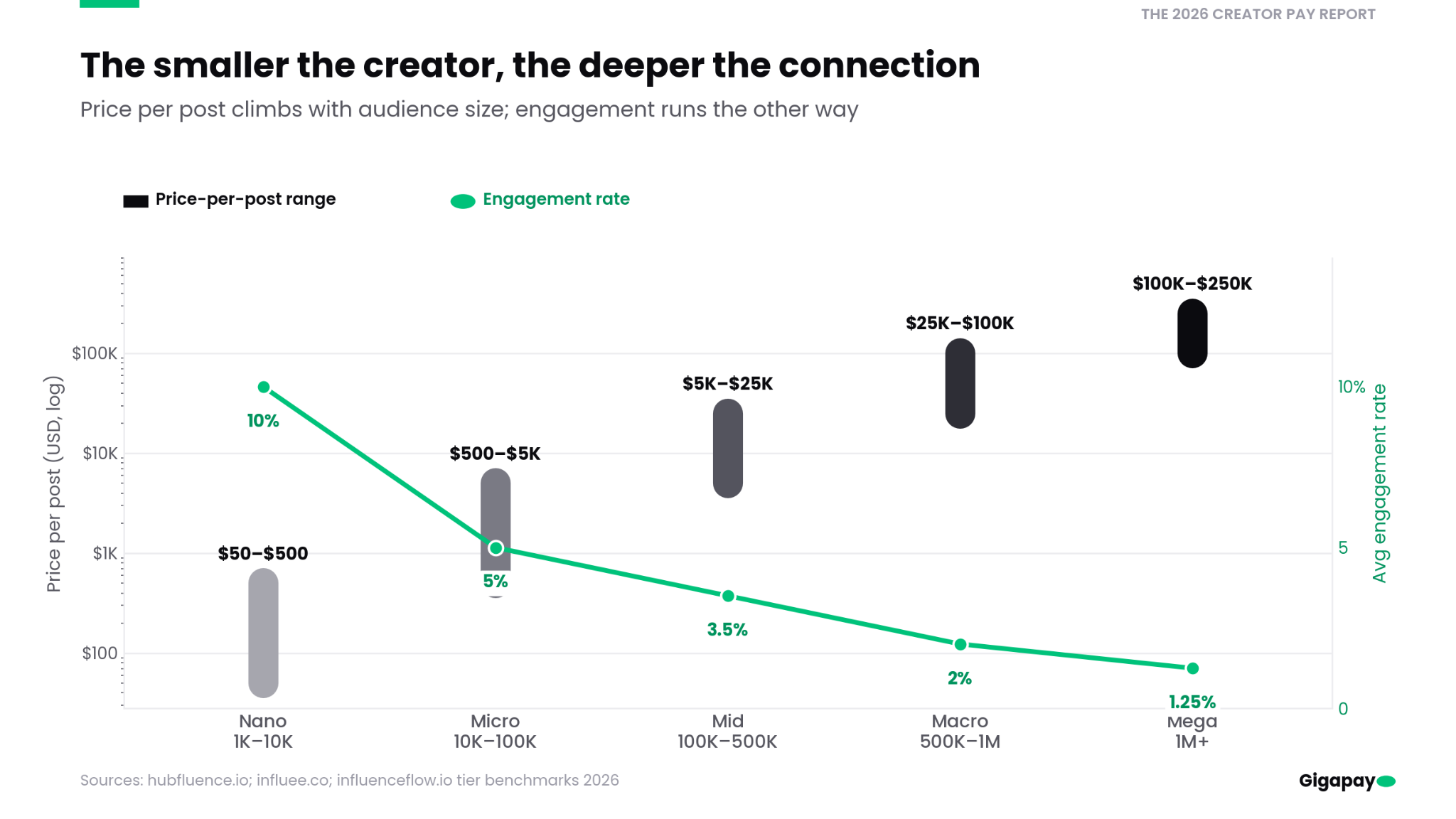
This is why brand money is shifting down-market. Micro and nano creators claimed 45.5% of influencer marketing spend in 2026, and performance data from Traackr shows nano creators delivering the strongest year-over-year gains in engagement and attention. More creators does not automatically mean more impact.
The right small creators frequently beat the wrong big ones, and the brands that figure out how to pay a lot of small creators efficiently get an edge the others cannot match.
Where Creator Money Is Moving in 2026
This part tracks where the new creator money is actually flowing in 2026.
TikTok Shop: The Fastest-Growing Way Creators Get Paid
If one channel defines creator pay in 2026, it is social commerce. Global TikTok Shop GMV is projected to reach $112.2 billion in 2026, nearly double the roughly $64 billion of 2025. More than 100,000 creators sit in the affiliate program, and about 54,000 of them clear more than $10,000 in GMV.
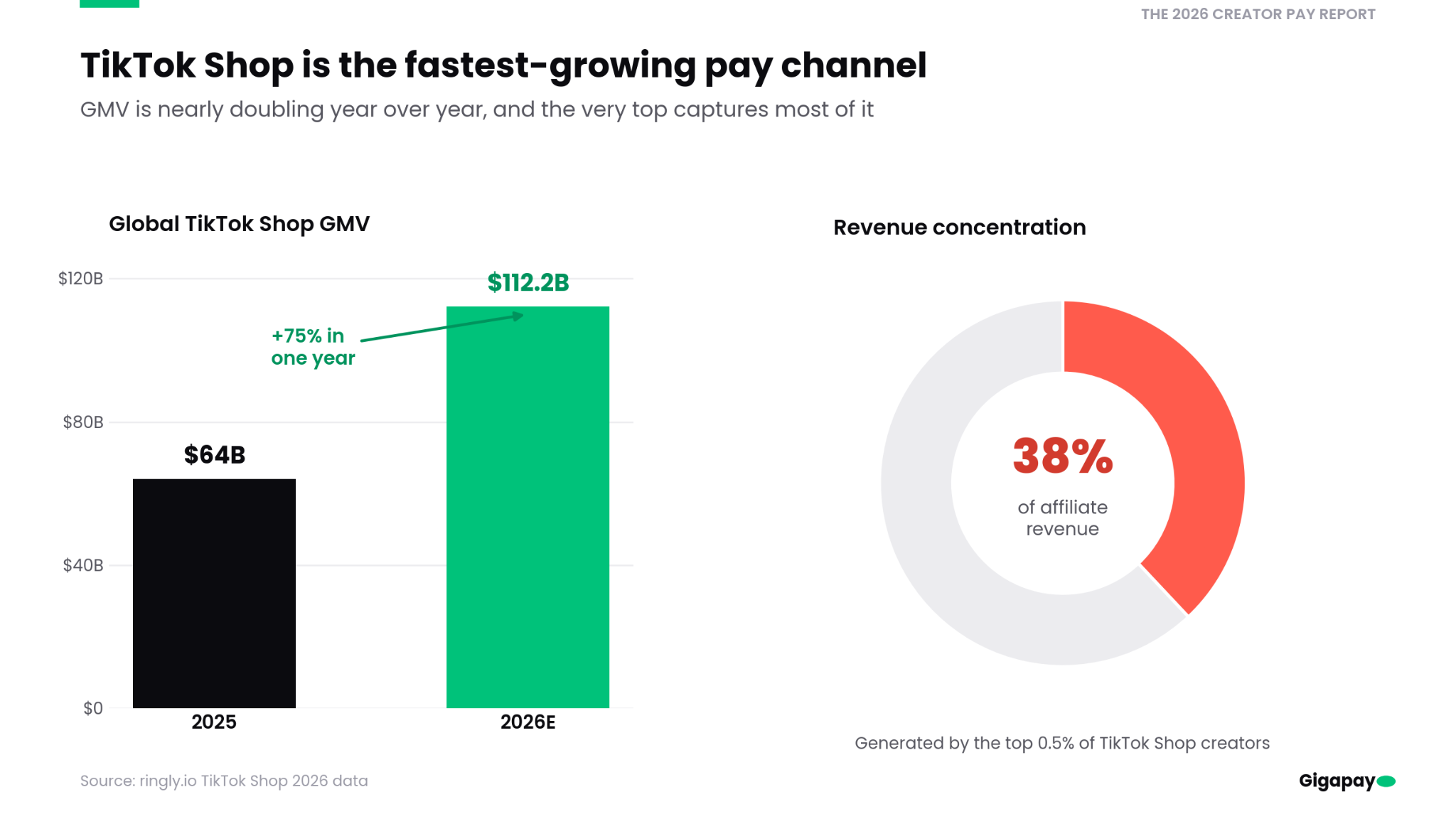
The same concentration that shapes the rest of the market shapes this one. The top 0.5% of TikTok Shop creators generate 38% of all affiliate revenue, and a handful of independent creators now top a million dollars in monthly sales. The average US commission rate sits around 13%. Social commerce is creating real mid-tier income, and it is still funnelling most of the reward to the very top.
Brand Spend on Creators: Budgets Up 171% Year Over Year
The demand side is unambiguous. Average annual influencer marketing budgets grew 171% year over year, according to CreatorIQ's State of Creator Marketing report, and 71% of organisations increased their creator investment. Most of that new money was pulled from traditional paid and digital channels. More than 87% of marketers expect to raise budgets again in 2026, many by 50% or more.
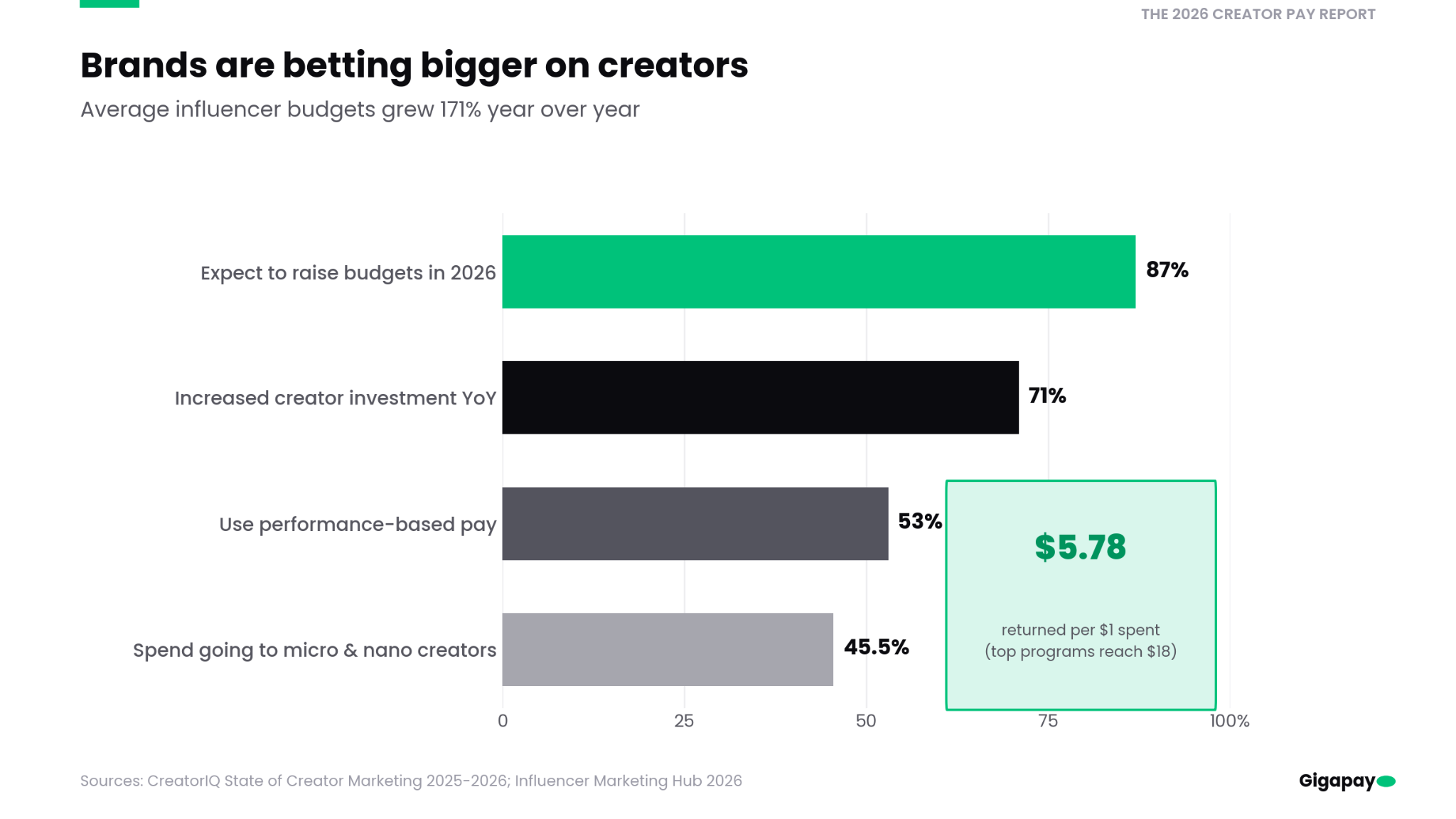
The money is also getting smarter. The Influencer Marketing Hub benchmark puts average return at $5.78 for every $1 spent, with top programs reaching $18. More than half of brands (53%) now use performance-based compensation, and only 6% report not compensating creators at all.
Brands are no longer asking whether creator marketing works. They are asking how to run it at scale without the operations falling apart, which is a payment and compliance question as much as a creative one.
AI and Creator Pay: How Generative Tools Are Reshaping Rates
Generative AI is already inside the creator workflow. 86% of creators now use it in some form, and 56.1% believe it will significantly change how they work. The pricing effect is direct: pure AI-generated content is typically priced 40 to 60% below human-made equivalents, while hybrid work that pairs human strategy with AI execution sits only 15 to 30% lower and is emerging as a premium middle ground.
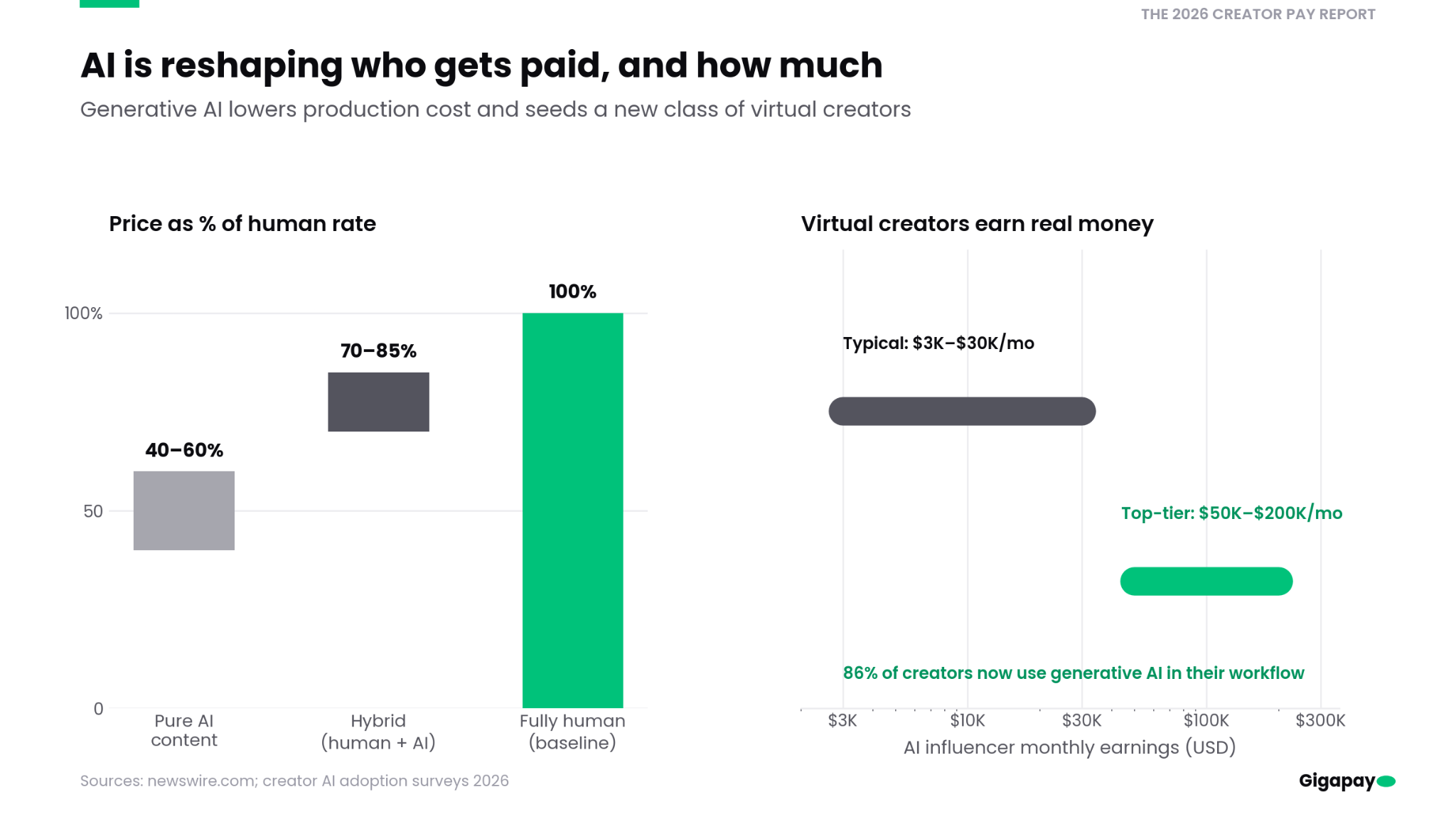
A new category is forming alongside the human market. Virtual and AI influencers now earn $3,000 to $30,000 a month for typical operators, and the top accounts reach $50,000 to $200,000 by stacking subscriptions, brand deals and affiliates. AI lowers the barrier to entry, which floods saturated niches with cheap content, and it raises the ceiling for creators who use it to produce more of what they already do well.
Creator Pay by Region: North America Leads, Asia-Pacific Accelerates
Creator pay is not evenly distributed across the map. North America holds the largest share of the global creator economy at roughly 33 to 37%, with the US market alone worth about $50.9 billion in 2024 and growing fast. Europe accounts for around 22%, near $41 billion in 2026. Asia-Pacific is the growth engine, posting the highest CAGR in most 2026 forecasts on the back of mobile-first adoption and huge young populations in markets like India and South Korea.
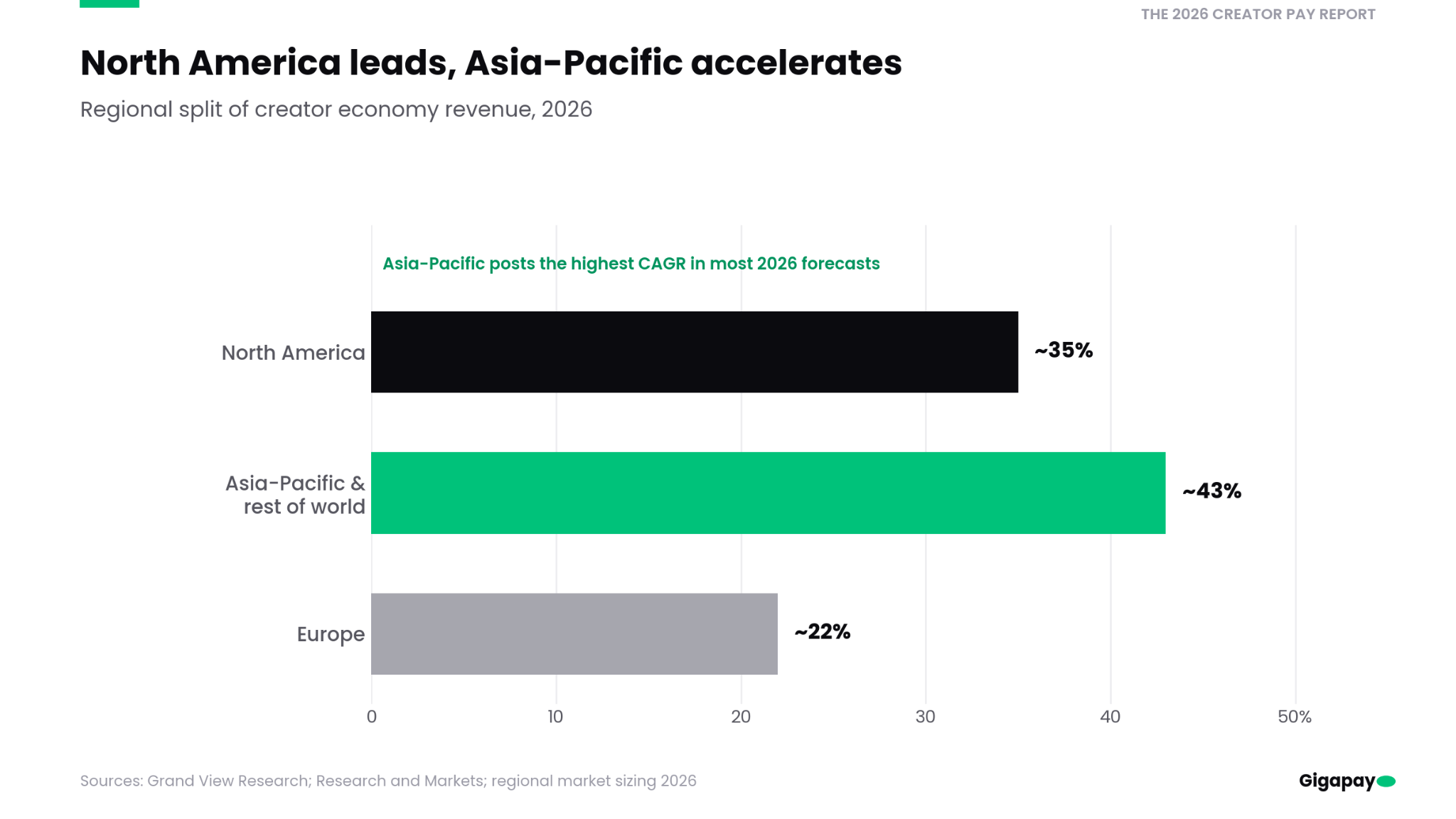
The regional split has a direct pay consequence. North America and Europe carry the highest CPMs, while Asia-Pacific runs on volume. A creator's geography shapes their rate as much as their niche, and a brand running a global program is paying very different prices into very different tax systems at the same time.
The Friction Beneath the Growth
This part covers the workforce strain and the payment failures that the growth charts leave out.
Creator Burnout: The Human Cost Behind the Growth Numbers
Underneath the growth is a workforce under strain. Between 52 and 62% of creators report burnout directly from the work. 69% report financial insecurity tied to their creation. 65% describe themselves as obsessed with performance metrics, 37% have actively considered leaving, and 89% lack access to specialised mental-health support.
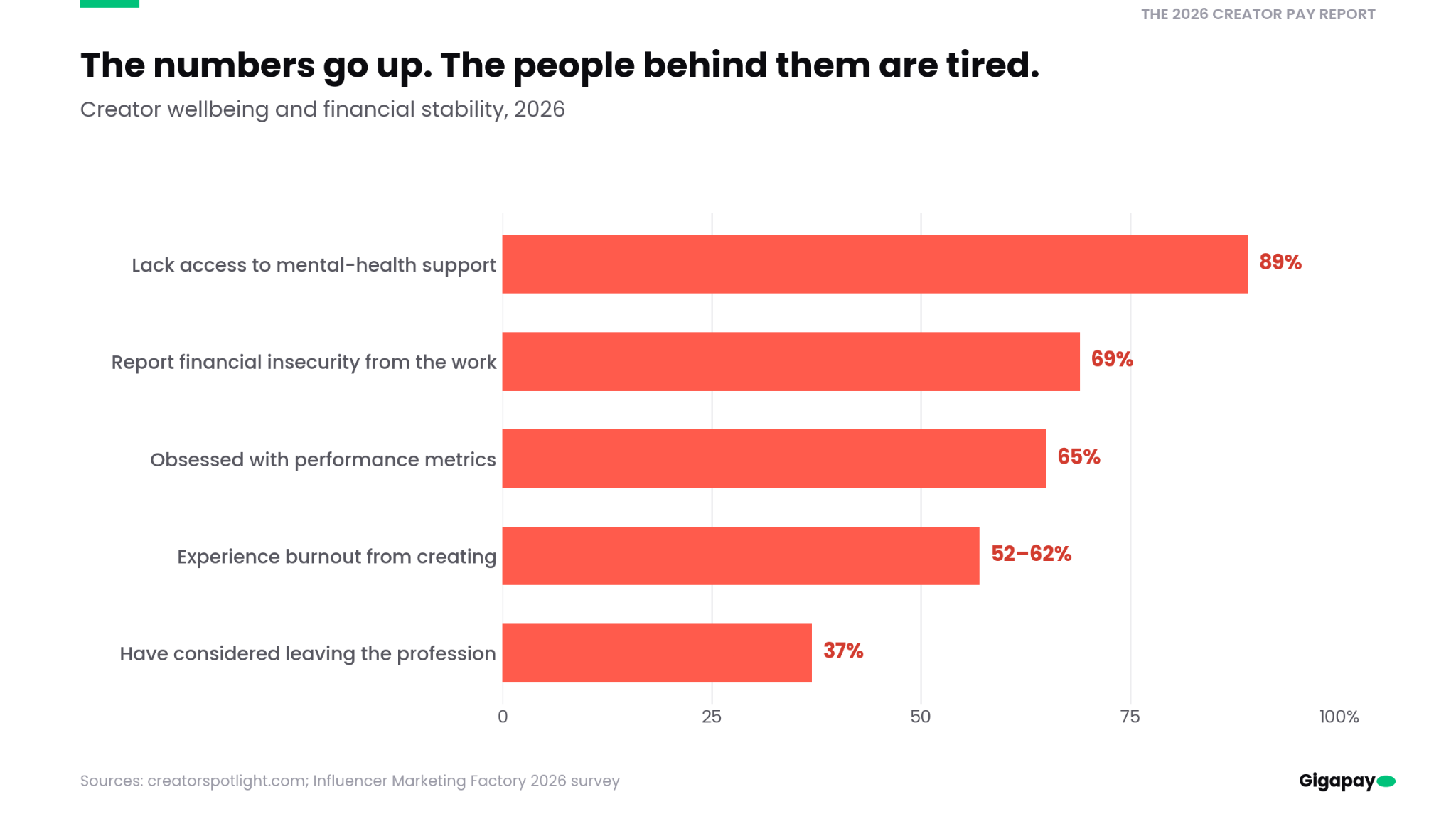
Financial insecurity and inconsistent income show up at the top of nearly every creator pain-point survey, often ahead of algorithm pressure. The instability is partly about how much creators earn and just as much about how unpredictably the money arrives, which leads directly to the part of the system that breaks most often.
Creator Payment Delays and Tax Compliance in 2026
Growth hides friction. The most common operational complaint in the creator economy is waiting to be paid. Payment delays of up to 120 days are routinely reported, which turns a healthy annual income into a cash-flow problem for the creator and a relationship problem for the brand.
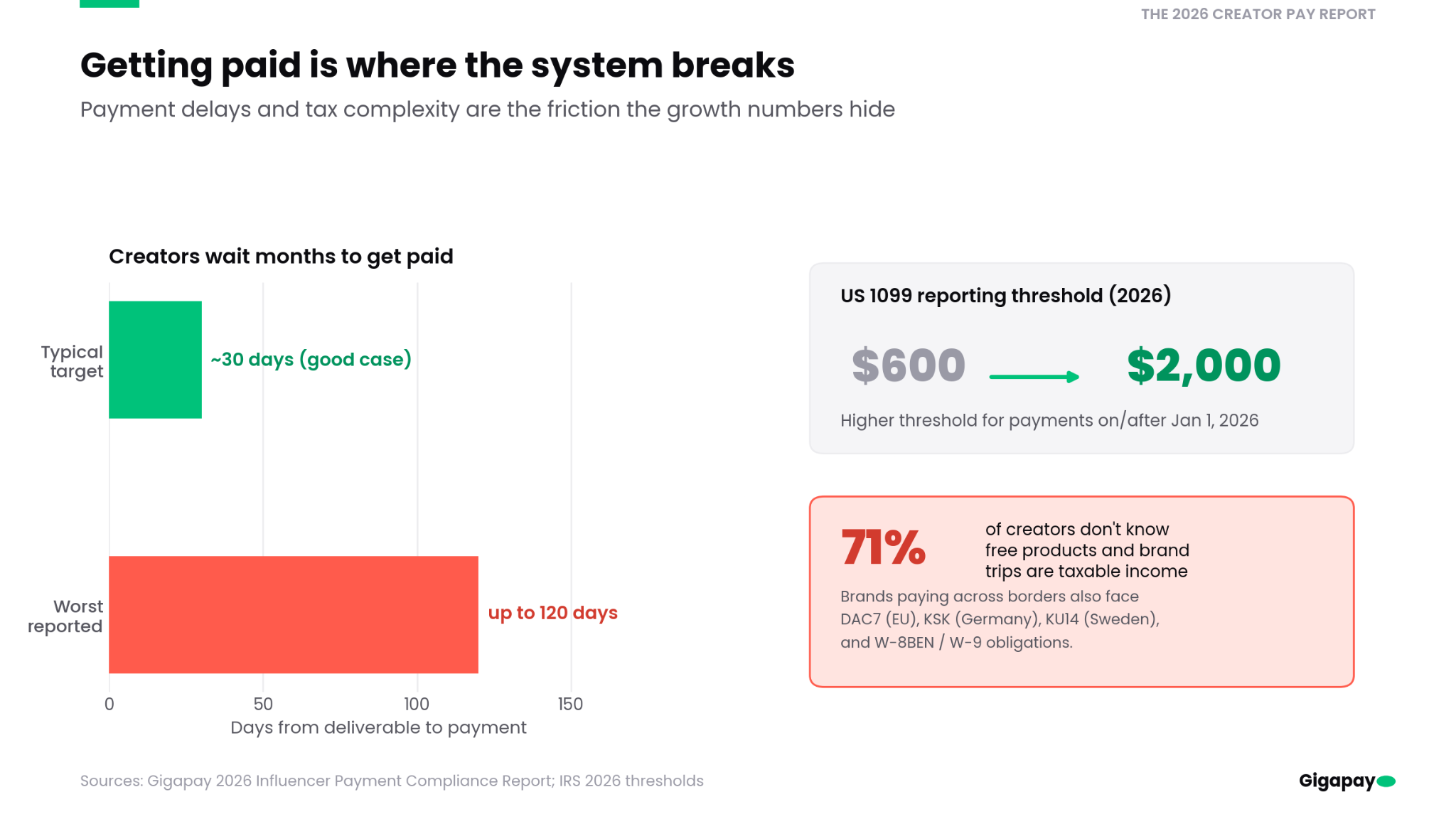
Tax is the other half. In the US, the 1099 reporting threshold rose to $2,000 for payments made on or after January 1, 2026, up from $600, and 71% of creators do not realise that free products and brand trips count as taxable income.
Brands paying across borders face a thicket of obligations at once:
- DAC7 in the EU
- Künstlersozialkasse levy in Germany
- KU14 in Sweden
- W-8BEN and W-9 collection for international and US creators
Self-employment tax of 15.3% sits on top of income tax for the creator. None of this shows up in a budget line, and all of it determines whether a campaign actually closes.
This is the layer the size charts ignore, and it is the layer that decides whether a brand can work with 50 creators or 5,000.
Conclusion
Read the data together and a single conclusion forms.
- The creator economy is large, growing, and tilting toward smaller creators who deliver better engagement at lower cost.
- The reward keeps concentrating at the top, partly because paying a lot of small creators across a lot of countries is operationally painful.
- The brands that win the next phase are the ones that remove that pain.
That is the whole argument for treating payments as infrastructure rather than admin. When a brand can pay a thousand creators across 65 countries instantly, through one vendor and one invoice, with tax reporting handled automatically, the math on micro and nano creators changes. The friction that pushes budgets toward a handful of large names disappears, and the brand gets to spend where the engagement actually is.
The growth in this report is real. So is the friction underneath it. The companies that close the gap between the two will define how the creator economy gets paid for the rest of the decade, and that capability exists right now.
Read Next:
- Mass Creator Payments in Europe: Everything Brands Need to Know in 2026
- Best Platforms to Pay International Social Media Influencers (2026 Review)
- The Gigapay API: Embedded Creator Payouts for Platforms, Networks, and Agencies
FAQs:
1. How much does the average creator earn in 2026?
The average creator earns around $44,293 a year by CreatorIQ's data, but the average is misleading. The median creator earns about $3,000, and nearly half of all creators earn under $10,000 annually. The gap reflects how heavily earnings concentrate at the top.
2. What share of creators make a full-time income?
A combined 45.6% of creators earn between $10,000 and $100,000 a year, the emerging creator middle class. Only about 5.8% earn more than $100,000.
3. Which platform pays creators the most per view?
YouTube long-form pays the most per view for most creators, typically $1 to $10 or more per 1,000 views and higher in premium niches. YouTube Shorts and TikTok pay far less per view, so creators on those platforms rely more on brand deals and commerce.
4. Which content niche pays the most?
Finance and FinTech, at roughly $40 to $80 CPM, because the audiences convert into high-value customers. Gaming sits at the lower end around $8 to $18 CPM.
5. Why do smaller creators matter more in 2026?
Micro and nano creators captured 45.5% of influencer spend and consistently deliver higher engagement, 8 to 12% for nano creators versus under 2% for mega creators. The challenge for brands is paying many small creators efficiently.
.jpg)
.jpg)
.jpg)