.jpg)

70% of B2B platforms now offer embedded payouts as a core feature, according to PYMNTS Intelligence's March 2026 data brief on B2B platform finance.
Gigapay is the API-first creator payout infrastructure built for platforms, networks, and agencies that need to pay hundreds or thousands of creators across 65+ countries without becoming a payments processor themselves.
The shift toward embedded payouts is happening because every platform working with creators eventually hits the same wall: the back-office work of paying creators at scale grows faster than the platform itself.
This article walks through how the Gigapay API works, what platforms can build on top of it, and what the integration looks like in practice.
Key Takeaways
- Gigapay's API embeds creator payouts into platforms, networks, and agency tools via REST endpoints.
- Integration takes 2–5 days using sandbox and production environments with token authentication.
- The Merchant of Record model shifts contractual and tax reporting obligations away from the platform.
- Webhooks handle creator onboarding, KYC, and payout status updates without polling.
- Single API supports payouts in 65+ countries, 50+ currencies, with instant local rails.
Why Platforms, Networks, and Agencies Need an Embedded Creator Payout API
Platforms that work with creators almost always start with payouts as an afterthought. The product is the platform. Payments get bolted on with PayPal, Wise, manual bank transfers, or a spreadsheet sent to finance once a month. That works at low volume, and it breaks at scale.
- A creator marketplace running 200 active creators across the EU has to handle DAC7 reporting. An affiliate network paying creators in Germany hits Künstlersozialkasse exposure once any single creator earns more than €1,000 in a year.
- An agency running campaigns across the UK, Sweden, and Italy has to figure out VAT treatment for each one separately.
The cost of building all of that infrastructure in-house, then maintaining it as regulations change, becomes its own product line that the platform never wanted to ship.
The shift toward API-driven embedded payouts is a response to that math. 67% of platforms above $1 billion in annual revenue say embedded finance has produced a direct revenue boost, and payout infrastructure sits as the second-most-adopted category after payments.
For platforms, networks, and agencies working with creators, the question stops being whether to embed payouts and becomes which infrastructure to embed.
What Is the Gigapay API and How Does It Work
The Gigapay API is a REST interface for embedding creator payouts inside any platform, network, agency tool, or internal dashboard. It uses JSON over HTTPS, token authentication, sandbox and production environments, with full documentation at developer.gigapay.se.
The four endpoints that handle most of what a platform needs:
- POST /v2/projects/ creates a project, which is the container for a campaign, batch, or workflow.
- POST /v2/prepayments/ funds the project before payouts run.
- POST /v2/payouts/ sends a payout to a creator inside that project.
- POST /v2/registrations/ onboards the creator, runs KYC, and validates their tax ID or VAT number.
A platform calls these endpoints from its own backend. The creator sees the platform, not Gigapay.
Payouts run on local rails (SEPA Instant in the EU, Faster Payments in the UK, ACH in the US), creators are paid instantly, and the platform's finance team gets one consolidated invoice instead of hundreds of individual creator invoices.
How the Merchant of Record Model Works Inside the Gigapay API
Most payout APIs are payment processors that move money while tax and compliance responsibilities stay with the platform. Gigapay's API works differently because the company sits as the legal counterparty to the creator.
When a platform sends a payout through the API, Gigapay buys the creator's deliverable and concurrently resells it to the platform's client. The platform's finance system sees one vendor in the ERP. The creator gets paid by Gigapay.
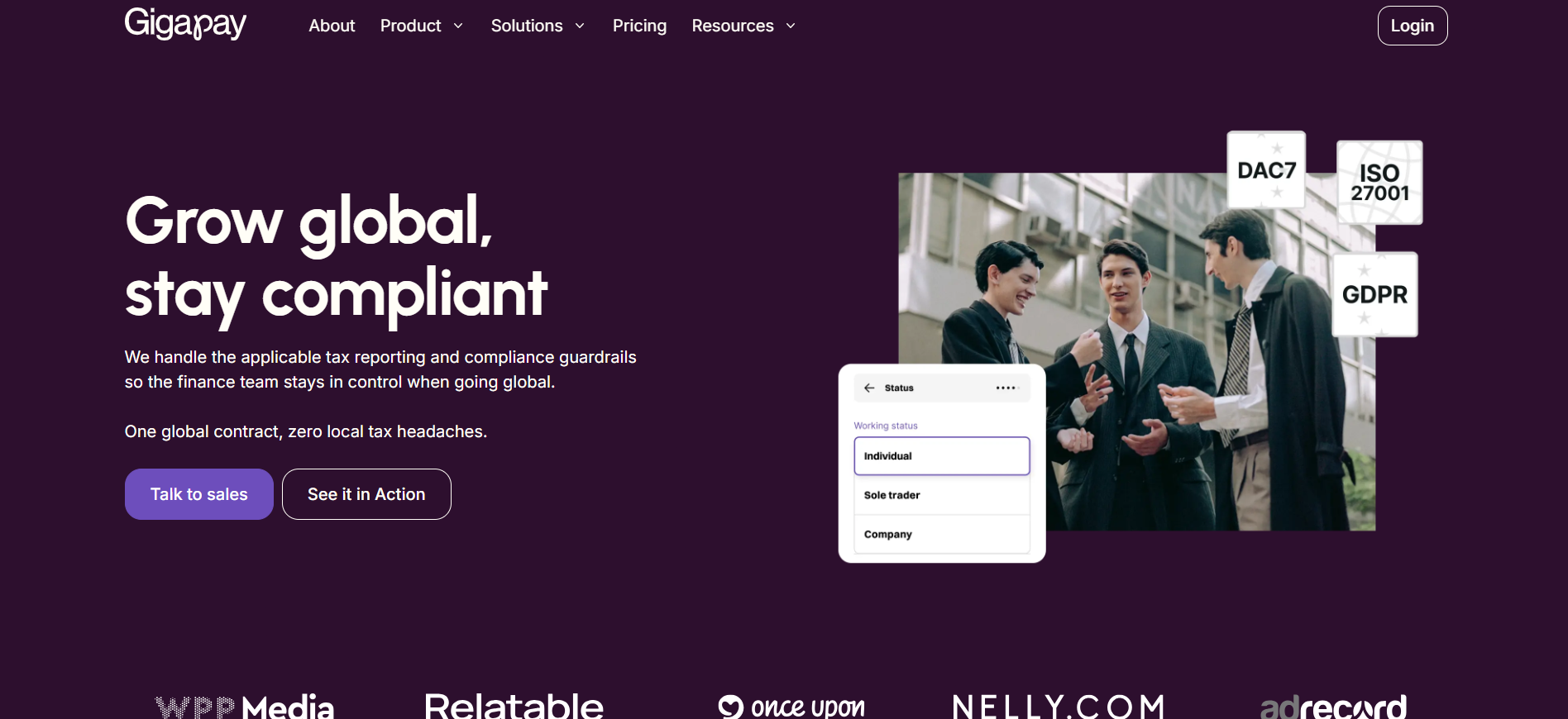
Gigapay handles the tax reporting obligations that come with cross-border creator payments, including DAC7 in the EU, KU14 in Sweden, and KSK in Germany.
One important nuance from the service agreement: in its Merchant of Record capacity, Gigapay handles the contractual and reporting layer, but each party still complies with its own underlying tax responsibilities under applicable law. The Sweden Employer of Record service is the exception where Gigapay takes on those broader obligations directly.
How Long Does It Take to Integrate the Gigapay API
The published integration window is 2–5 days from sandbox key to production payouts. The number holds because the API is structured to support it. A developer can authenticate, hit the sandbox, run a full test payout, and move to production without a six-week onboarding cycle.
Key things that make the integration short:
- Browsable API at developer.gigapay.se with live examples for every endpoint.
- Sandbox environment that mirrors production behaviour.
- Webhook-driven event system for KYC status, payout completion, and registration changes.
- No requirement to onboard each creator manually before payouts can fire.
For platforms already running creator workflows in internal tools, the integration does not disrupt the platform's existing UX. The creator experience stays inside the platform. Gigapay runs the layer underneath.
How Gigapay Webhooks Handle KYC, Payouts, and Registration Events
A REST API alone is not enough for embedded payouts. Anything that involves identity verification, tax document validation, and cross-border payments has asynchronous events that the platform has to react to.
Gigapay's webhook system fires events for the cases that matter most: a creator completing registration, KYC passing or failing, a payout reaching the creator's local account, a tax ID being validated. The platform's backend can react to those events directly instead of polling endpoints on a schedule.
- For an affiliate network paying creators on a weekly cycle, that means the network's dashboard can show real-time payout status for every creator without writing custom polling logic.
- For an agency running 50 campaigns in parallel, the agency's backend tracks each campaign's payout state independently.
How Kolsquare Embedded the Gigapay API Inside Its Platform
The Kolsquare integration is the published example of what the Gigapay API looks like once it is deployed inside another platform.
Kolsquare is an influencer marketing platform. Their users find creators, brief them, run campaigns, and track results. Before the Gigapay integration, payments lived outside Kolsquare. After the integration, creators invoice and get paid directly inside Kolsquare's interface.
The creator never has to learn that Gigapay exists.
For Kolsquare's customers, the value is that the campaign workflow and the payment workflow live in the same system. For Kolsquare itself, the value is that they did not have to become a payment processor to offer payments.
This is the pattern that works for most platforms: the API runs underneath, the platform's brand stays on the surface.
How the Gigapay API Handles Compliance, KYC, and Tax Reporting
A payout API that does not handle compliance pushes the problem back onto the platform. Gigapay's design pulls tax compliance into the API itself.
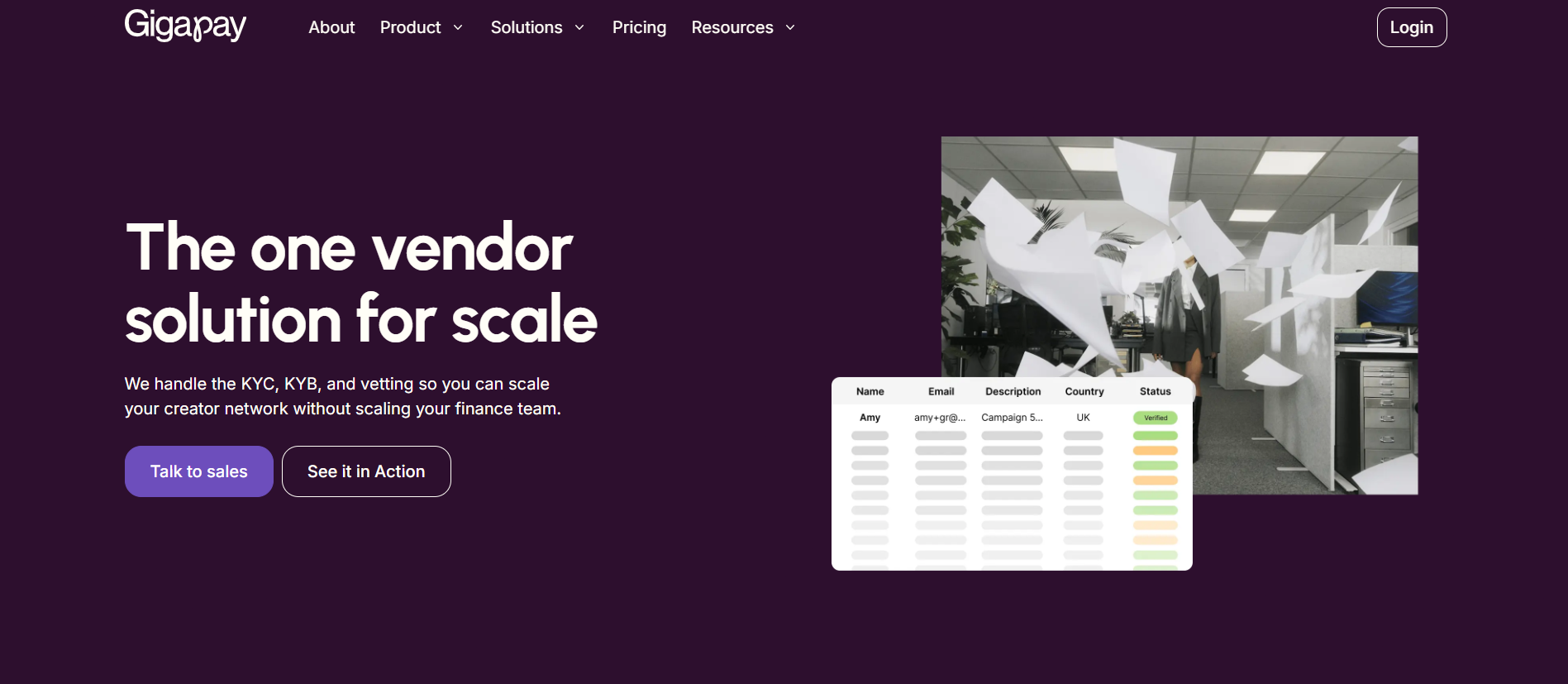
KYC and KYB run during the registration call. Tax ID and VAT validation run automatically. Creators can onboard as an individual, a sole trader, or a registered company, and no business registration is required for nano and micro creators. That last point is what makes high-volume creator programs viable in the first place.
For platforms operating across the EU, the API handles DAC7 reporting (EU platform economy), KU14 (Sweden), and KSK reporting (Germany's Künstlersozialkasse, which applies a 4.9% levy to creative payments over €1,000 and reaches international hires).
The platform does not have to track which jurisdiction each creator falls under. The API does it.
Gigapay holds ISO 27001 certification and operates under GDPR at the infrastructure level, which removes the security review work that platforms would otherwise have to repeat for every payment provider they evaluate.
What Platforms, Networks, and Agencies Build with the Gigapay API
The patterns that recur across customers:
- Influencer marketing platforms (like Kolsquare) embedding payouts directly inside the campaign management flow so creators never leave the platform to invoice or get paid.
- Affiliate networks running weekly or monthly creator payout cycles where the API handles batch processing and the network's dashboard surfaces payout status.
- Agencies building internal tools that mirror a client's campaign workflow, calling the Gigapay API on the backend so finance teams see one consolidated invoice per client.
- eSports and streaming networks paying contributors, casters, and players across multiple currencies and tax jurisdictions without onboarding each one as an individual vendor.
- Creator economy platforms offering payouts as a feature inside their product, including creator marketplaces, UGC platforms, and brand collaboration tools.
In each case, the embedding platform keeps full control of its UI, branding, and creator experience. Gigapay runs the payments, the compliance, the reporting, and the funding flows underneath.
Gigapay API Pricing and Operational Impact for Platforms
The pricing model is a monthly SaaS fee plus a percentage admin fee on payouts. Base is €279 per month plus 4.9% per payout. Enterprise is custom and requires €1.8M+ in annual payout volume, which comes with a volume-based discount, EarlyPay for creators, a dedicated CSM, and unlimited API rate.
What changes for a platform once the API is running:
- ERP vendor records drop from one entry per creator to one entry for Gigapay.
- Invoice volume drops by roughly 80% because Gigapay consolidates payouts into single invoices per project.
- Finance time on creator payments drops sharply. The published benchmark, based on a brand running 600 creator collaborations per year, is 840 admin hours down to roughly 60.
- Creator NPS sits at 88, which matters because the platform's brand carries the experience even though Gigapay handles the mechanics.
How to Get Started with the Gigapay API
Getting from "we want to integrate" to "creators are getting paid through our platform" takes 2–5 days for most teams. The path runs in roughly this order:
- Talk to Gigapay's team: API access starts with a conversation about volume, regions, and use case, because the Base and Enterprise plans both depend on how the platform plans to use the API.
- Get sandbox credentials: Once the account is set up, the platform receives a sandbox API token and access to developer.gigapay.se.
- Build against the four core endpoints: Most integrations start with creating a project, funding it via prepayment, registering a test creator, and sending a test payout. The browsable API lets developers test each call directly from the documentation.
- Wire up webhooks: Subscribe to the events the platform's workflow depends on, including registration completion, KYC status, and payout completion.
- Move to production: Switch the sandbox token for a production token, fund the live account, and start sending real payouts.
For teams already familiar with REST APIs and webhook patterns, the technical work is straightforward. The longest part of the integration is usually a product decision about how the platform's existing UX should expose the payout flow.
Conclusion
Gigapay is the API-first payout infrastructure that platforms, networks, and agencies use to embed creator payments without building their own payments stack.
The Gigapay API handles the full flow from creator registration and KYC through payout execution, compliance reporting, and consolidated invoicing across 65+ countries.
For any platform reaching the volume where manual creator payments stop scaling, the API is the layer that takes the work off the platform's roadmap.
Book a demo to see what the integration looks like inside your platform.
Read Next:
- Top 7 Benefits of Using Gigapay for eSports Payouts in 2026
- Best Vendor Onboarding Software for Creators (2026 Review)
- Integrated Creator Payouts: How Platforms Embed Gigapay Inside Their Product
FAQs:
1. What is the Gigapay API?
The Gigapay API is a REST interface for embedding creator payouts inside platforms, networks, and agency tools, with endpoints for projects, prepayments, payouts, and creator registration documented at developer.gigapay.se.
2. How long does it take to integrate the Gigapay API?
It takes 2–5 days to integrate the Gigapay API, from sandbox setup to production payouts, using a token-authenticated REST interface and a sandbox environment that mirrors production behaviour.
3. What is the difference between the Gigapay API and Stripe Connect or PayPal Payouts?
The difference between the Gigapay API and Stripe Connect or PayPal Payouts is that Gigapay operates as a Merchant of Record, taking on contractual and tax reporting responsibility instead of only processing payments.
4. Which countries and currencies does the Gigapay API support?
The Gigapay API supports payouts in 65+ countries and 50+ currencies, with local payment rails including SEPA Instant in the EU, Faster Payments in the UK, and ACH in the US.
5. What compliance does the Gigapay API handle automatically?
The Gigapay API handles KYC and KYB verification, tax ID and VAT validation, and automated reporting for DAC7 (EU), KU14 (Sweden), and KSK (Germany) without the platform tracking each jurisdiction.
.jpg)
.jpg)
.jpg)