.jpg)

87.49% of brands expect their influencer marketing budget to grow in 2026, and 72.22% of them are planning increases of 50% or more, according to the Influencer Marketing Hub 2026 Benchmark Report.
Most of that growth is landing in the nano and micro-creator tiers, where vendor onboarding burns the most administrative time per dollar paid.
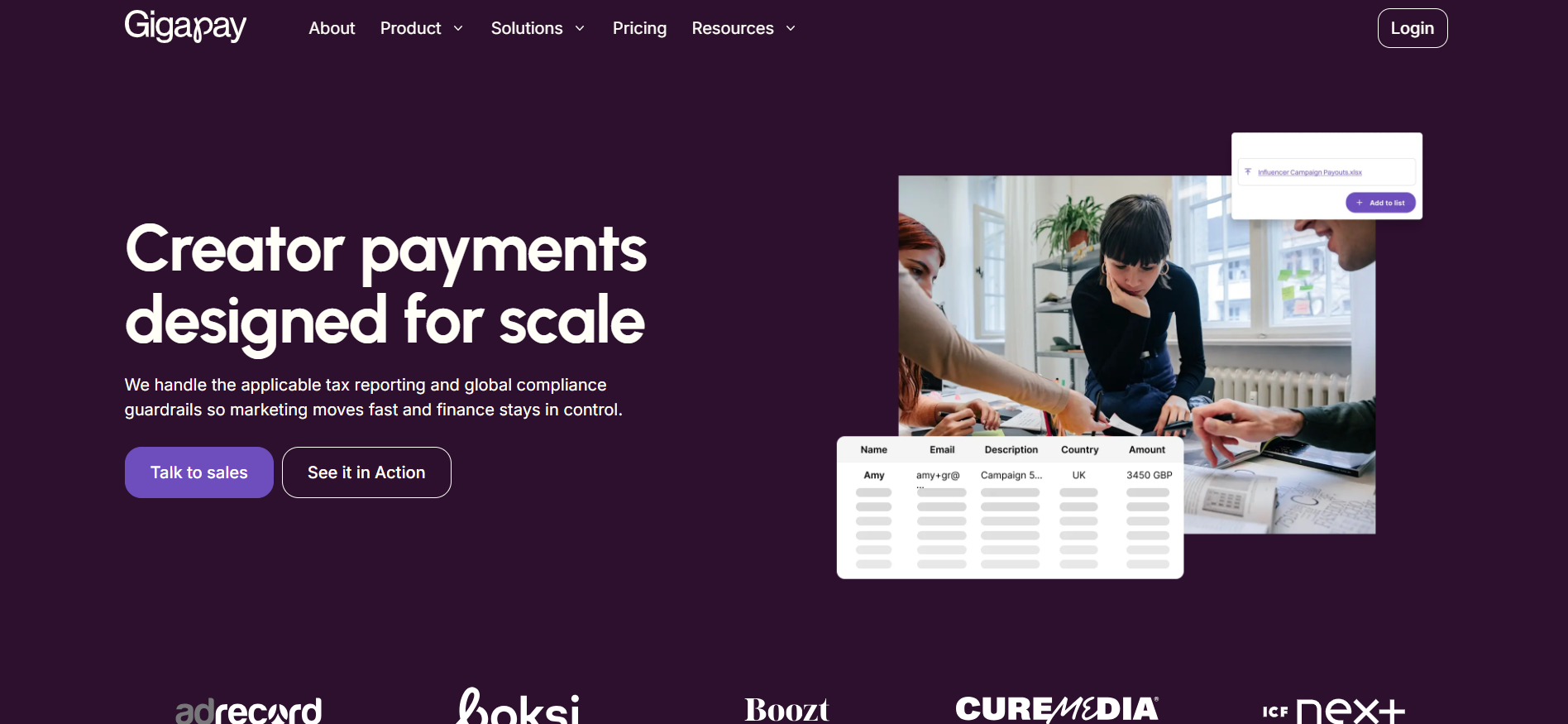
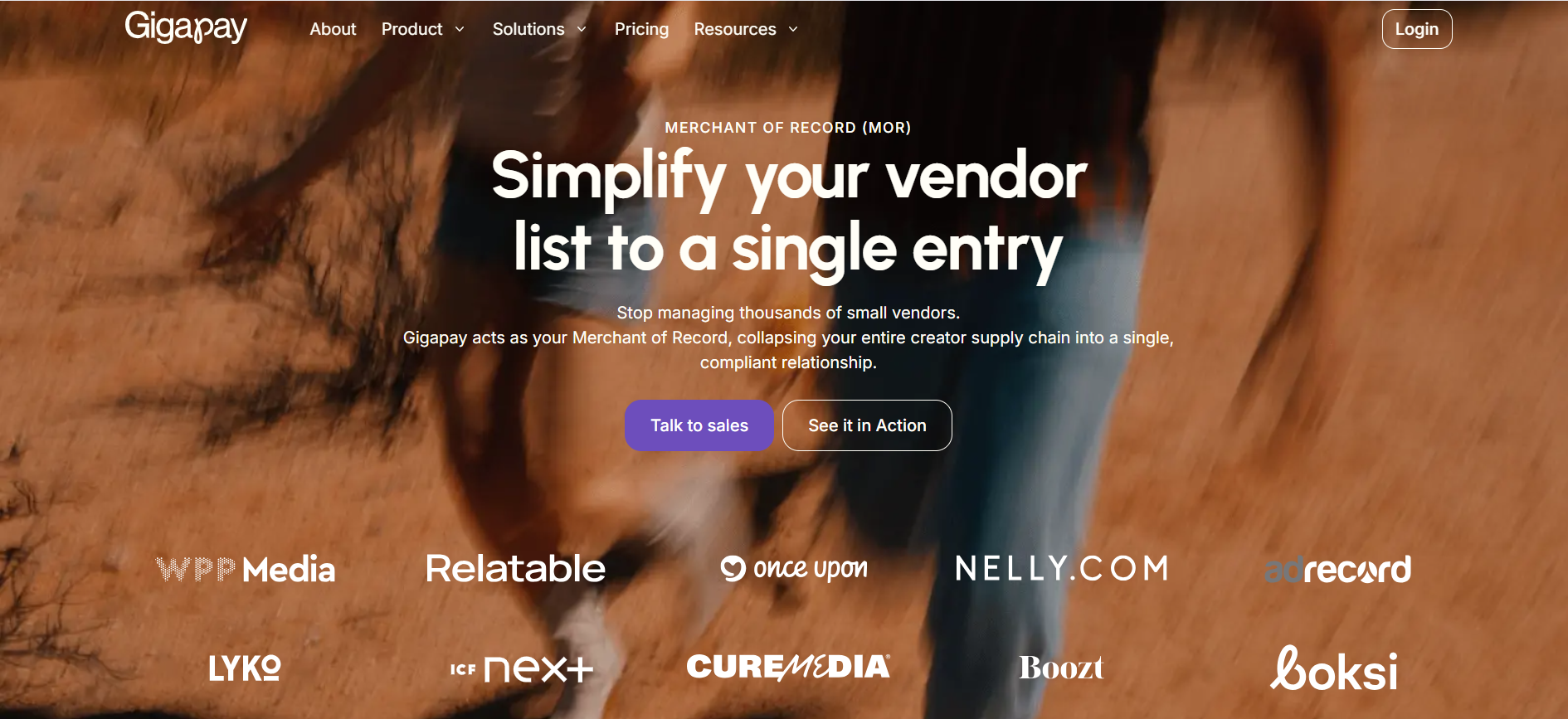
Gigapay sits at the front of this category as the Merchant of Record platform that consolidates every creator into a single vendor record, one invoice, and one tax-compliant flow across 65+ countries.
Accounts payable was designed around supplier relationships measured in years, and creator programs now generate dozens of new counterparties every week, which is the structural reason finance teams across Europe and North America are rethinking how they onboard creative talent.
This review breaks down the six vendor onboarding software options creator-led brands and agencies should consider in 2026, ranked by compliance scope, payout speed, and how each platform handles the human side of paying creators.
Key Takeaways
- Gigapay leads 2026 as a Merchant of Record across 65+ countries with consolidated single-invoice billing.
- Vendor onboarding software collapses hundreds of creator records into a single ERP entry.
- Merchant of Record platforms transfer most tax and counterparty obligations off the brand.
- Tipalti, Stripe Connect, PayPal, and Wise handle payment rails, not creator-specific compliance.
- Pick based on compliance coverage, creator onboarding friction, and ERP fit.
What Vendor Onboarding Software for Creators Actually Solves
The reason vendor onboarding becomes a bottleneck in creator programs is structural. Accounts payable was designed around supplier relationships measured in years, with KYB verification, master service agreements, and tax forms collected once and then reused.
Creator programs work on the opposite tempo: a marketing team identifies a creator on Wednesday, signs them for a four-week campaign by Friday, and expects payment cleared within 30 days. Multiply that by hundreds of creators across a dozen countries, and the AP function falls behind every quarter.
Vendor onboarding software for creators changes the math by collapsing many counterparties into one.
Instead of opening a new vendor file every time the marketing team finds a creator, the brand opens one vendor record (the platform itself) and pushes the per-creator complexity downstream. Identity verification, tax documentation, payout method capture, country-specific reporting, and self-billed invoicing all sit on the platform's infrastructure rather than inside the brand's ERP.
The result is a different operating model. Marketing decides who to work with, the platform handles KYC, tax forms, and payouts, and finance receives one consolidated invoice per campaign or period.
- Boozt used this model to triple its nano and micro-collaborations without expanding its team.
- WPPMedia's GOAT agency reported a meaningful reduction in time spent managing payments after rolling out a Merchant of Record approach across its global creator program.
How We Ranked the Platforms
We weighted five criteria when ranking vendor onboarding software for creators in 2026:
- Compliance model and legal counterparty status: Whether the platform is a true Merchant of Record (absorbs counterparty obligations) or a software-and-rails provider (the brand remains the merchant).
- Country and currency coverage: How many jurisdictions creators can be paid into, and which local payment rails are supported.
- Creator onboarding friction: Whether nano and micro-creators without a registered company can be onboarded.
- Invoicing model: Per-creator invoices versus consolidated single-vendor billing.
- Time-to-money for creators: Payout speed and creator-side liquidity features.
Each platform below is reviewed against those five criteria, with a candid view of trade-offs.
The 6 Best Vendor Onboarding Software for Creators in 2026
1. Gigapay: Best Overall

Gigapay is a Stockholm-headquartered Merchant of Record platform built specifically for mass creator payouts. The company was founded in 2019 by Thomas Brunner, Gustav Malmqvist, Raiha Buchanan, and David Hansson, and is backed by Time to Raise, Mastercard Lighthouse, Forward VC, TheVentureCity, and Female Founders.
The platform formally buys the creator's deliverable and resells it to the brand or agency, which transfers most of the administrative and tax counterparty obligations onto Gigapay and leaves the brand with one vendor record in its ERP.
The product reaches 65+ countries and supports 50+ currencies, funded in USD, EUR, GBP, SEK, DKK, and NOK, and pays creators instantly via local rails like SEPA Instant, Faster Payments, and ACH.
Pricing starts at €279 per month on the Base plan with a 4.9% admin fee per payout, and an Enterprise tier kicks in once a brand crosses €1.8M in annual payout volume with volume-based fee discounts, a dedicated CSM, and unlimited users.
Gigapay is API-first, runs sandbox and production environments, and full integrations typically take two to five days. It is ISO 27001 certified and GDPR compliant, integrates with influencer marketing platforms like Kolsquare for in-platform creator invoicing, and counts customers including Boozt, WPPMedia's GOAT agency, The Goat Agency, AdRecord, and Once Upon among its references.
Automated tax reporting is where Gigapay separates from generic payment products. The platform handles DAC7 (EU platform economy reporting), KSK (Germany's 4.9% creative payments levy on amounts over €1,000), and KU14 (Sweden) without finance teams filing directly.
Creators can onboard as an individual, sole trader, or company, with no requirement for a registered business or VAT number, which removes the single largest friction point for nano and micro-creator collaborations. The creator side gets EarlyPay for instant access to scheduled funds, a dedicated human support team, and a creator NPS of 88 out of 100.
Pros:
- Operates as a Merchant of Record across 65+ countries, with DAC7, KSK, and KU14 reporting automated rather than left to the brand's finance team.
- Collapses hundreds of creator vendor records into a single ERP entry and a single consolidated invoice per campaign, with self-billed invoicing handled on the platform side.
- Pays creators instantly via local payment rails, with a creator NPS of 88, a dedicated human creator support team, and EarlyPay liquidity for creators who need access to scheduled funds.
Cons:
- Subscription pricing starts at €279 per month plus a 4.9% admin fee per payout, which makes Gigapay a poor fit for brands paying fewer than fifty creators a year.
- Compliance depth is heaviest around EU and Nordic frameworks, so brands whose creator base is concentrated in Southeast Asia or Latin America should confirm jurisdiction coverage for their specific markets before signing.
2. Lumanu
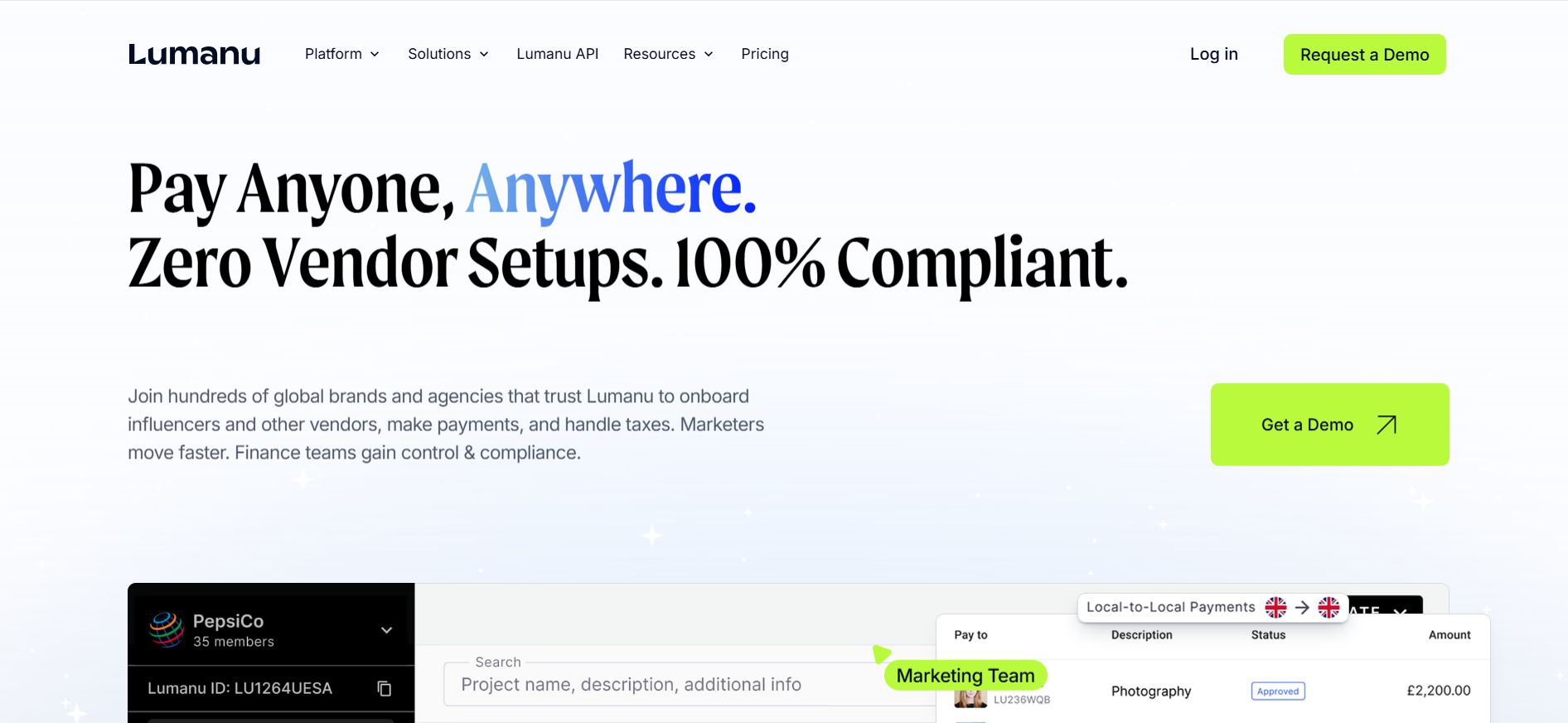
Lumanu is a New York-headquartered Master Vendor platform for creator and affiliate payouts. The company has raised approximately $18M from investors including Origin Ventures (early backers of Grubhub and Cameo) and 500 Startups, and counts Revolve, Reformation, Walmart, and Fashion Nova among its brand customers.
Lumanu sits between the brand and the creator base, handles 1099 issuance, KYC, and identity verification, and removes the per-creator vendor onboarding workload inside the brand's accounts payable system.
The platform integrates with QuickBooks, Xero, Zapier, and Bill, supports bulk payment uploads, approval workflows, permission management, and whitelisting for paid social, and offers creators an EarlyPay feature for faster access to funds.
Pricing is reported by Capterra and G2 reviewers at around $299 per month for the standard plan, with enterprise quotes handled through sales.
Lumanu has expanded internationally through a Checkout.com partnership that adds local payment methods and access to 150+ global currencies, although the platform's compliance and tax workflows remain centered on the US 1099 model rather than EU frameworks. G2 reviewers consistently flag international payment options as the most common limitation.
Pros:
- Master Vendor model removes the burden of issuing per-creator 1099s in the US, with strong identity verification and 2FA on the onboarding flow.
- Single interface gives marketing and finance shared visibility into payout status, approvals, and spend controls, with native integrations into QuickBooks, Xero, and Bill.
Cons:
- North American center of gravity, with European creator tax frameworks (DAC7, KSK, KU14) not handled at the same automated depth as a Sweden-headquartered platform built around EU regulation.
- Platform sits primarily on US payment rails and the 1099 model, which leaves global brands paying creators outside the US managing FX and local compliance gaps separately.
- Country and currency coverage are narrower than platforms built around global creator programs, which becomes a bottleneck for brands paying across more than a handful of jurisdictions.
Lumanu has built a credible Master Vendor proposition for US-focused creator and affiliate programs, and the UI does a good job of bringing marketing and finance into one view. The trade-off is geography and regulatory scope.
Gigapay was built around the EU's most complex creator tax frameworks (DAC7 across the platform economy, KSK in Germany, KU14 in Sweden) and operates as a MoR across 65+ countries on local payment rails, which makes it a better fit for any brand or agency running creator programs across multiple jurisdictions rather than primarily in the US.
3. Tipalti
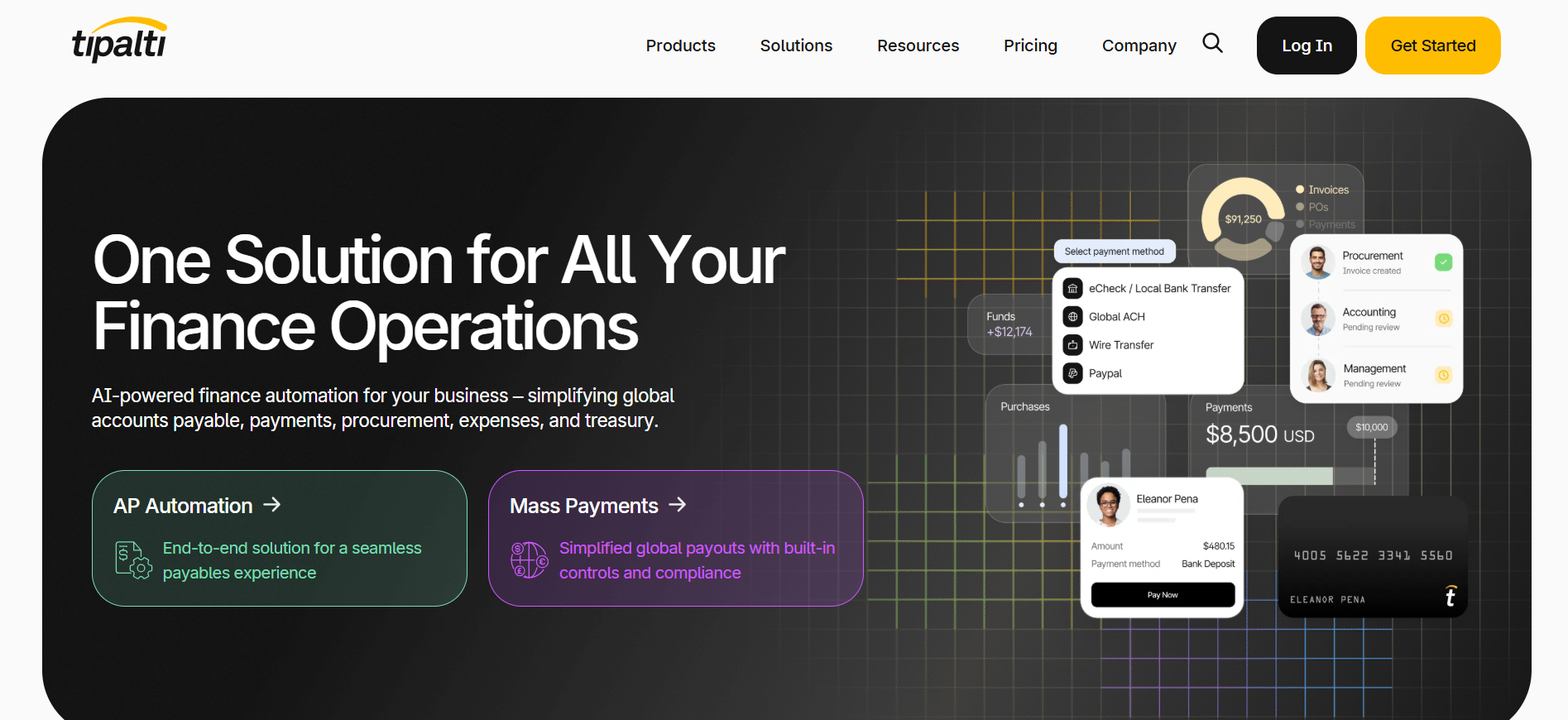
Tipalti is a mature accounts payable automation platform built for finance, AP, procurement, and operations teams handling high volumes of supplier payments. The platform supports payouts to 196 countries in 120+ currencies through ACH, domestic and international wires, eChecks, prepaid debit cards, and PayPal, and integrates deeply into NetSuite, Sage Intacct, SAP, QuickBooks, Xero, Microsoft Dynamics, and Oracle.
Finance teams already running it for supplier payments will recognise the depth of its controls, supplier validation, tax form collection (W-8, W-9), and 1099 / 1042-S reporting infrastructure.
Pricing starts at $99 per month for the platform fee on the entry tier, with additional charges based on transaction volume, payment modality, and the specific feature set enabled. International wire fees typically land in the $25 to $50+ per transaction range depending on destination and method, and ERP integration setup fees can run from $2,500 to $15,000 per connector.
The product is built around AML controls, OFAC screening, and KYC at the supplier level, with machine learning that matches supplier codes over time and reconciles payment data back into the ERP.
Implementation runs as a multi-month project rather than a quick API integration, which matches CFO-led procurement timelines more than marketing-led campaign cycles, and onboarding the supplier itself takes a traditional AP-style approval flow that assumes a registered business with a tax ID.
Pros:
- Mature AP automation platform with a wide set of pre-built integrations into the major mid-market and enterprise ERPs.
- Strong supplier validation, tax form collection (W-8, W-9, 1099, 1042-S), and reporting infrastructure for traditional vendor scenarios across 196 countries.
Cons:
- Tipalti is software and payment rails, not a Merchant of Record, which leaves the brand as the legal counterparty for every creator paid and the holder of all tax and counterparty risk.
- Onboarding model assumes a traditional vendor (a sole proprietor or registered business with a tax ID), which creates friction for nano and micro-creators who do not have a registered company.
- The platform was designed for accounts payable workflows, not creator marketing tempo, so new creators still go through a multi-step AP-style approval flow that does not match the speed of campaign activation.
Tipalti is a serious AP automation system, and finance teams already running it will recognise the depth of its controls and reporting. Where it falls short for creator programs is the underlying model. Tipalti remains software-and-rails, leaving the brand on the hook as the legal merchant for every creator.
Gigapay absorbs that burden as the Merchant of Record, lets nano and micro-creators onboard without a registered company, and produces one invoice per campaign rather than one per creator, which is a closer match to how marketing teams actually work.
4. Stripe Connect
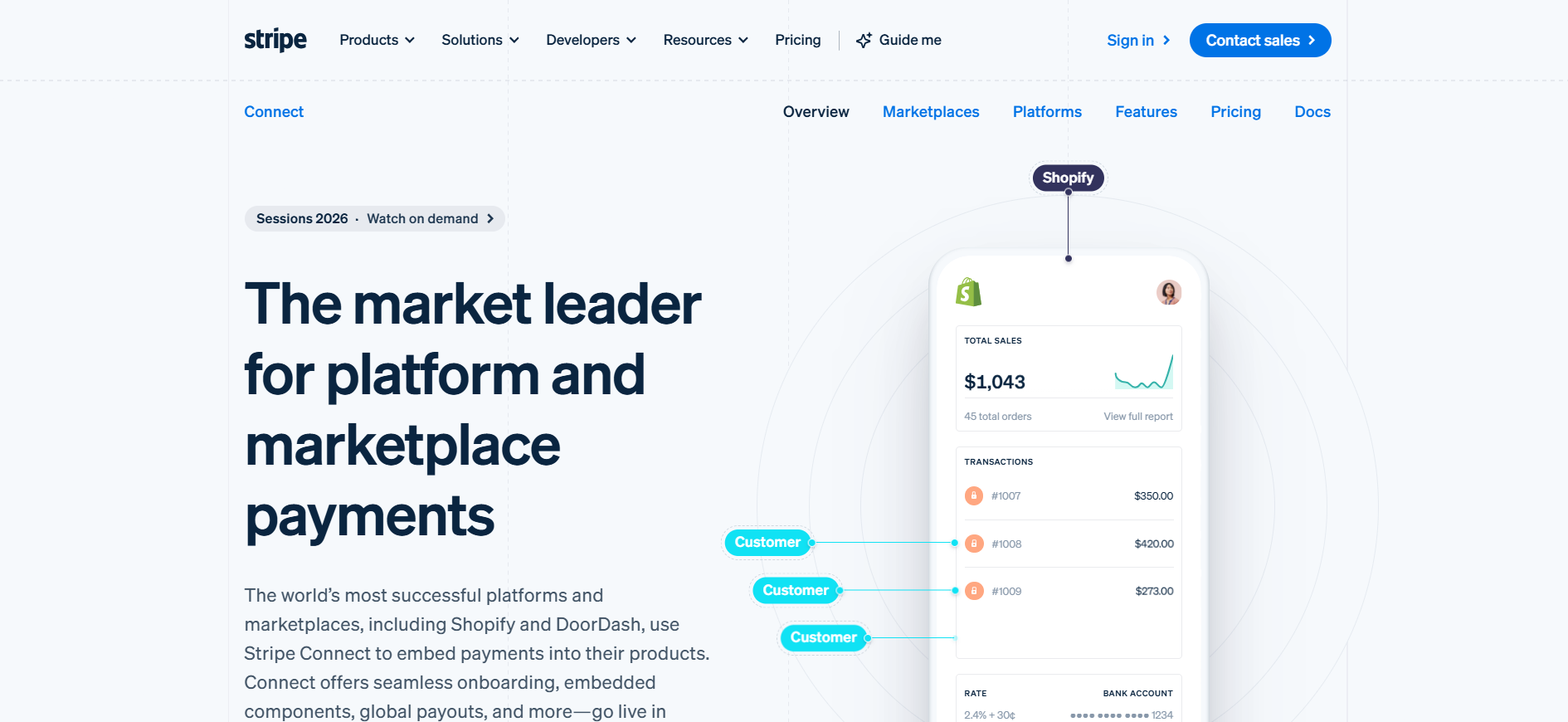
Stripe Connect is the payment infrastructure layer behind a large share of marketplace and platform startups, available in 40+ countries and supporting 135+ currencies plus 40+ payment methods. The product offers three account models (Standard, Express, and Custom) that trade off seller control, onboarding speed, and integration depth.
Express, launched in 2017 and expanded to most of Europe in 2019, is the most common option for marketplace operators that want Stripe to handle hosted onboarding while keeping platform-level control of the user experience. Custom accounts let platforms own the full UI but require building the onboarding flow themselves.
Pricing follows Stripe's pay-as-you-go model, typically 2.9% + 30¢ per transaction in the US for card processing, plus a 0.25% payout fee capped at $25 and additional charges for account management, tax reporting (Connect Tax Forms), or instant payouts where supported.
Connect's tax product covers 1099 generation for US sellers, and Stripe automates KYC and KYB across supported markets, but the platform deliberately stays at the rails layer for creator-specific compliance.
DAC7, KSK, and KU14 reporting are not native, and brands using Connect for a creator program remain the legal merchant for every creator they pay, with significant engineering investment required to ship a creator-friendly onboarding flow before a marketing team can send a single payout.
Pros:
- Developer-friendly API with deep documentation, SDKs across most major languages, and broad country coverage for payouts.
- Strong KYC, KYB, and fraud tooling baked into the platform, with a mature webhook event system and three account models that fit different platform-build needs.
Cons:
- Stripe Connect is payment infrastructure, not a creator compliance product, which keeps the brand as the legal merchant and the holder of tax reporting responsibility in every country it pays into.
- Onboarding flows are built for marketplace and platform builders, not for direct creator program teams, so a significant engineering investment is required before a marketing team can send a single payout.
- Limited support for the creator-specific compliance frameworks (DAC7, KSK, KU14) that European brands now face, with most of that logic handled outside of Stripe.
Stripe Connect is the most flexible payment API on the market, and for platforms embedding payouts into their own product, it remains a strong choice. The trade-off for a brand or agency running a creator program is that Stripe deliberately stays at the rails layer. You bring the legal counterparty, the tax logic, the onboarding flow, and the engineering team.
Gigapay sits one layer higher in the stack, absorbing Merchant of Record status, the EU reporting frameworks, and the creator onboarding UX, with a two to five day integration window rather than a custom build.
5. PayPal Payouts
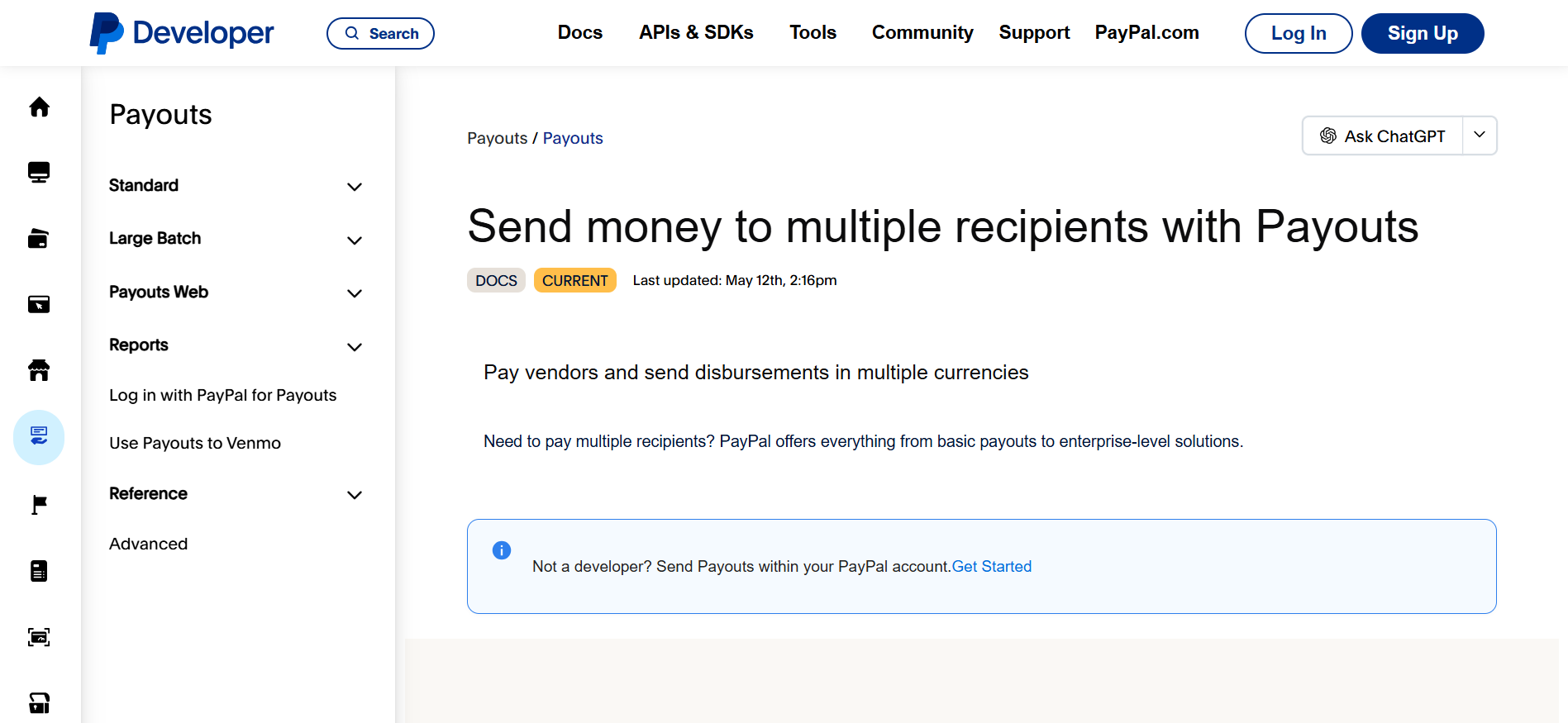
PayPal Payouts is the mass payout API attached to PayPal's consumer wallet network, available across 156+ countries in 23+ currencies (with restrictions on conversion into Argentine Pesos, Brazilian Real, and Malaysian Ringgit).
Creators across most markets already have a PayPal account, which removes one onboarding step, and the batch payout product accepts file uploads through the Payouts Web interface or API calls keyed by email address, mobile number, or PayPal ID.
The maximum individual payment is $60,000 USD per existing PayPal account holder and $20,000 USD for a new one, and recipients pay no fee on funds received.
Senders pay a percentage fee per payment that varies by region and is capped per transaction in the sender's primary currency, and PayPal applies a 3 to 4% currency conversion margin above the mid-market rate on cross-border payouts.
There is no per-creator KYC or tax form collection workflow specific to the brand's onboarding stack, no native handling of DAC7, KSK, or KU14, and no self-billed invoicing flow that European creator programs increasingly require.
PayPal Payouts works across freelancer, affiliate, rebate, and incentive use cases, and uses the same wallet network that creators already trust, but the product is a payment processor rather than a vendor onboarding platform in the strict sense of the term.
Pros:
- Global brand recognition that creators trust, with a familiar UX (and an existing wallet for most creators) that reduces creator-side onboarding questions.
- Mass payout API and web upload interface that support batch sending across 23+ currencies and 156+ countries.
Cons:
- PayPal is a payment processor, not a Merchant of Record, which keeps the brand fully responsible for KYC, tax forms, and country-specific reporting on every creator paid.
- Fee structure becomes expensive at volume, particularly for cross-border payouts where a 3 to 4% FX conversion margin and recipient-side fees stack on top of platform charges.
- No creator-specific tax compliance features, with no native handling of DAC7, KSK, KU14, or self-billed invoicing flows that European creator programs increasingly require.
PayPal Payouts is functional, and creators across most markets already have an account, which removes one onboarding step. The cost is everything that sits behind that simple payment moment. Brands still need to issue tax forms, collect KYC information, maintain vendor records for every creator, and reconcile per-creator invoices in their ERP.
Gigapay replaces that entire stack with a Merchant of Record contract, automated EU and Nordic tax reporting, and one consolidated invoice per campaign, which is the actual reason most teams move away from PayPal-style payouts as their creator program scales.
6. Wise Business
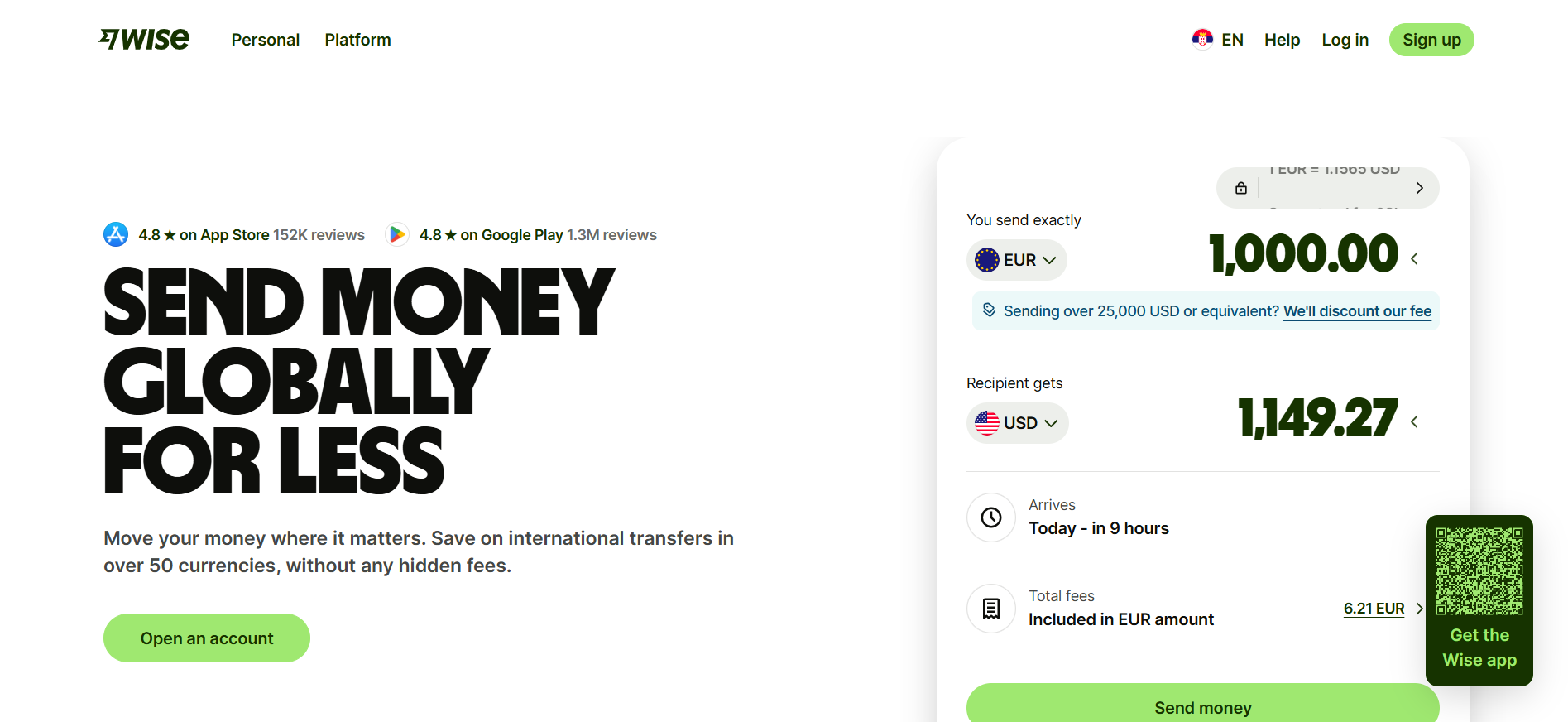
Wise Business (formerly TransferWise) is a multi-currency money movement product built around the mid-market exchange rate, with local account details in 10+ countries, multi-currency balances in 40+ currencies, and batch payments of up to 1,000 recipients per upload.
The product is widely used by freelancers, agencies, marketplace sellers, and SMEs that pay contractors internationally and want transparent FX pricing instead of legacy bank wire spreads. There is no monthly platform fee for the standard plan, currency conversion fees typically run between 0.35% and 0.65% depending on the corridor, and Wise generally saves 3 to 5% on cross-border transfers versus banks and PayPal.
Outbound payments route over local rails (ACH for the US, SEPA for Europe) where available and fall back to SWIFT for markets without local infrastructure, with settlement ranging from seconds on instant corridors to 1 to 3 business days on slower routes, and longer for some high-value or compliance-flagged transfers.
Wise integrates with QuickBooks, Xero, FreeAgent, and Odoo for accounting sync, and offers physical and virtual debit cards in supported regions.
The product was not designed as a vendor onboarding platform: there is no creator-side KYC flow embedded in the brand's workflow, no tax form collection, and no native handling of DAC7, KSK, or KU14 reporting.
Pros:
- Highly competitive FX rates (0.35 to 0.65% conversion fee) and transparent multi-currency account structures for brands paying creators across many currencies.
- Strong global coverage with local payment rails in most major markets, often faster and cheaper than legacy correspondent banking.
Cons:
- Wise is a money movement provider, not a creator compliance product, which leaves the brand to handle KYC, tax forms, and counterparty risk on every creator.
- No native vendor onboarding workflow for creator programs, with onboarding still happening in spreadsheets, email, and the brand's own AP system.
- No handling of creator-specific tax frameworks such as DAC7, KSK, or KU14, so compliance with European reporting obligations must be built and maintained separately.
Wise gives brands and agencies one of the most cost-efficient FX rails on the market, and for a finance team that has already solved compliance internally, it is a reliable money mover.
The gap for creator programs is everything that surrounds the transfer. Wise does not onboard creators as vendors, does not produce tax-compliant invoices, and does not absorb counterparty obligations.
Gigapay covers the workflow on either side of the payment itself, which is where most of the real cost in a creator program actually sits.
Quick Comparison Table
How to Choose the Right Vendor Onboarding Software for Creators
The right platform depends on three things:
- The geography of your creator base
- The compliance frameworks your finance team is responsible for
- The volume threshold at which manual processes become a structural cost rather than a temporary inconvenience
If your creator program is concentrated in the US and your main pain is 1099 issuance and US KYC, a Master Vendor or AP automation platform may cover the workflow. If your program is European or genuinely global, the question becomes whether DAC7, KSK, KU14, and country-specific VAT logic are handled by the platform or by your team.
The cost difference between those two scenarios shows up not in monthly software fees but in finance and legal hours per quarter.
Volume is the second filter. Below fifty creator collaborations a year, manual processing is uncomfortable but possible. Between fifty and two hundred, it becomes the single largest source of campaign delay. Above two hundred, the math stops being about software cost and starts being about whether the program can scale at all.
The third filter is the model. Software and rails providers (Tipalti, Stripe Connect, PayPal, Wise) move money and produce reports, but the brand remains the legal merchant for every creator.
A Merchant of Record platform (Gigapay) absorbs that legal status, which is the difference between a payment tool and a vendor onboarding tool in the strict sense of the term.
Conclusion
Gigapay is the strongest vendor onboarding software for creators in 2026 because it operates as a Merchant of Record across 65+ countries, automates the EU reporting frameworks that most platforms ignore, and consolidates hundreds of creator payments into a single vendor invoice for the brand's ERP.
The five competitors reviewed each cover part of the workflow, whether that is FX rails, US 1099 issuance, or marketplace payment infrastructure, but none of them take over legal counterparty status the way a true Merchant of Record does.
For brands and agencies scaling from fifty to several thousand creators a year, the question is no longer whether to centralise creator onboarding, but how completely the platform takes the work off your team.
Book a demo with the Gigapay team and run a real creator payout in your first session.
Read Next:
- Integrated Creator Payouts: How Platforms Embed Gigapay Inside Their Product
- Best Way to Pay Instagram Influencers Internationally in Bulk (2026 Guide)
- Gigapay Merchant of Record: Full Product Overview
FAQs:
1. What is the best vendor onboarding software for creators in 2026?
The best vendor onboarding software for creators in 2026 is Gigapay, which operates as a Merchant of Record across 65+ countries, automates DAC7, KSK, and KU14 tax reporting, and consolidates every creator payment into one vendor invoice for the brand's ERP.
2. What does vendor onboarding software for creators actually do?
Vendor onboarding software for creators replaces the per-creator vendor setup process inside accounts payable with a single platform that handles KYC, tax documentation, payout method capture, country-specific reporting, and consolidated invoicing across hundreds or thousands of creators.
3. How is a Merchant of Record different from a payment processor for creator payouts?
A Merchant of Record for creator payouts is the formal legal counterparty for the creator's deliverable, which transfers most of the administrative and tax obligations off the brand, while a payment processor only moves the money and leaves the brand as the legal merchant for every creator paid.
4. Why do nano and micro-creators break traditional vendor onboarding?
Nano and micro-creators break traditional vendor onboarding because most of them do not have a registered company or VAT number, which the brand's accounts payable system was designed to require before any vendor record can be created.
5. How long does it take to integrate vendor onboarding software for creators?
Integration time for vendor onboarding software for creators ranges from a few days for API-first platforms like Gigapay, where full integrations typically take two to five days, to several weeks for platforms like Stripe Connect that require a custom onboarding flow built from the ground up.
.jpg)
.jpg)
.jpg)