.jpg)

More than 30% of brands plan to invest over $5 million in creator collaborations in 2026, according to Linqia's 2026 State of Influencer Marketing Report.
Gigapay is the mass creator payout platform that operates as a Merchant of Record, becoming the single legal counterparty between brands and the hundreds or thousands of creators they work with each year.
The Merchant of Record model is the structural piece that separates Gigapay from payment processors and vendor management tools, because it moves the tax and compliance liability for creator payments off the brand's balance sheet and onto Gigapay.
This article walks through how Gigapay's Merchant of Record model works, what it covers, and how it changes the economics of running a creator program at scale.
Key Takeaways
- Gigapay acts as Merchant of Record, absorbing tax and compliance liability for creator payments.
- Brands work with one vendor and one invoice instead of hundreds of creator records.
- Coverage spans 65+ countries and 50+ currencies, with creators paid instantly.
- Automated reporting handles DAC7, KSK, and KU14 without internal compliance work.
- Creators onboard without business registration or VAT numbers, opening up nano and micro tiers.
What a Merchant of Record Is for Creator Payments
A Merchant of Record is the legal counterparty in a transaction. The Merchant of Record formally buys the deliverable from the creator and resells it to the brand, becoming the entity the creator contracts with, invoices, and gets paid by.
For VAT, tax reporting, and compliance purposes, the Merchant of Record is the customer of record.
In the consumer SaaS world, Merchant of Record providers do this for software sales, handling sales tax across dozens of jurisdictions so the software company does not have to register and file everywhere it has customers.
Gigapay applies the same model to creator payments. When a brand pays through Gigapay, the formal transaction is between the creator and Gigapay Sweden AB, and Gigapay then bills the brand a single consolidated invoice.
This matters because creator payments are the most fragmented procurement category most brands have. A single campaign might involve 200 creators across 15 countries, each one a different tax resident with different reporting obligations attached. Without a Merchant of Record, the brand inherits all of that complexity into its own finance and legal stack.
How Gigapay's Merchant of Record Model Works
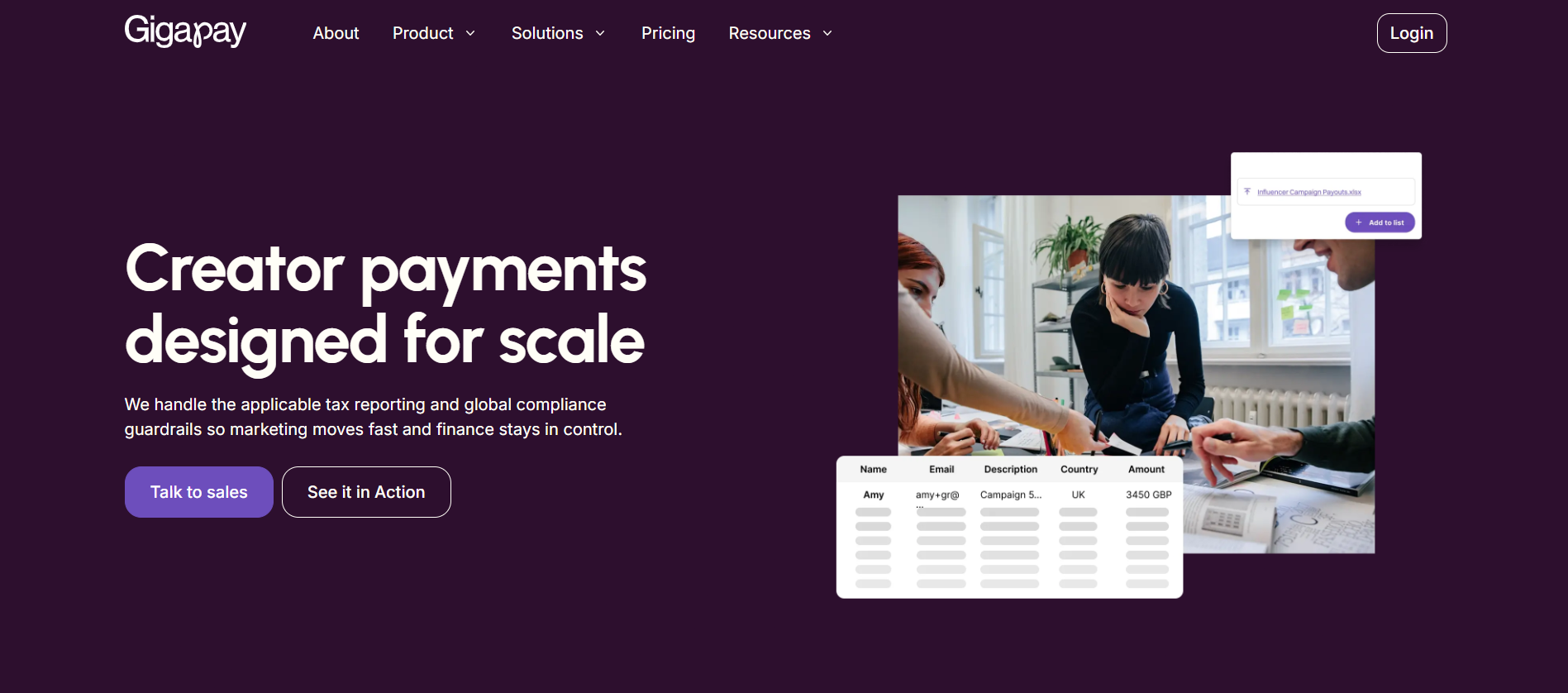
The mechanics are simple from the brand side. The brand uploads a list of creators and payment amounts (via spreadsheet or API), funds the campaign, and Gigapay handles everything downstream.
Gigapay verifies each creator's identity, validates their tax information, generates self-billed invoices on their behalf, and pays them through local payment rails in their home market.
Per Gigapay's Service Agreement, Gigapay buys the creative's deliverable and concurrently resells it to the brand, becoming the formal counterpart in the transaction. That clause defines the legal structure of every payment flowing through the platform.
- The brand receives one invoice from one Swedish entity.
- The creator receives payment from Gigapay.
Both parties have a clean paper trail.
One important nuance the brand should understand: in Merchant of Record capacity, Gigapay handles tax reporting obligations but does not withhold income tax or pay social security on behalf of the creator. Each party complies with their own tax responsibilities under the applicable laws of their jurisdiction.
The exception is the Employer of Record service in Sweden specifically, where employment-style obligations are taken on by Gigapay.
What Gigapay's Merchant of Record Covers
The value of the model becomes concrete in what the Merchant of Record takes responsibility for. Each of the following items would otherwise sit on the brand's internal finance, legal, and procurement teams.
1. Identity verification and onboarding
Gigapay runs KYC and KYB on every creator before any money moves. Tax ID validation, VAT number checking, and identity document review happen inside the platform. The brand never touches a creator's passport or tax form.
2. Self-billing and invoice automation
Gigapay generates invoices on behalf of creators and delivers them to the brand as a single consolidated batch. The brand approves one invoice per campaign instead of hundreds. Customers running this model report an 80% reduction in invoice volume.
3. Tax reporting (not withholding)
Gigapay handles automated reporting under DAC7 in the EU, KU14 in Sweden, and KSK in Germany. The reports go from Gigapay to the relevant tax authorities directly, because Gigapay is the contractual buyer in the transaction.
4. Cross-border compliance
Each of the 65+ countries Gigapay pays into has its own rules for paying foreign creators. Withholding requirements, residency rules, VAT treatment of digital services, and labor law classification all vary by jurisdiction. The brand offloads the work of tracking and applying those rules to Gigapay.
The Vendor Consolidation Problem Merchant of Record Solves
The functional bottleneck Gigapay's Merchant of Record addresses is what enterprise teams call vendor sprawl. A brand running 600 creator collaborations a year would, without a Merchant of Record, need to set up 600 vendor records in its ERP. Each of those vendors needs onboarding, contract review, tax form collection, and payment terms negotiation.
Procurement teams are often unwilling or unable to process small vendors at that scale, which is why marketing teams find themselves blocked from working with nano and micro-influencers in the first place.
Internal Gigapay benchmarks for a 600-collaboration brand show the operational cost difference clearly. Manual processing of that volume runs around €139,590 per year in admin hours, vendor sprawl, and error cycles.
Routing the same volume through Gigapay drops the annual cost to roughly €46,350. The admin time falls from around 840 hours to 60 hours per year. The ERP vendor record count goes from 300+ individual entries to one.
Christina Oliosi, Brand Activation Lead at Boozt, summarized the practical effect:
"We've been trying to find a way forward with nano- and micro-influencers for years and Gigapay really enabled this."
Boozt reported a 3x increase in creator collaborations without expanding its team.
Global Coverage and the Compliance Regimes Gigapay Handles
Payouts settle in 65+ countries across 50+ currencies, with funding accepted in USD, EUR, GBP, SEK, DKK, and NOK. Local payment rails handle the actual settlement: SEPA Instant inside the EU, Faster Payments in the UK, and ACH in the US. Creators receive funds instantly in most corridors.
The compliance regimes Gigapay automates the reporting for include the following three frameworks, which together cover most of the European complexity brands run into:
- DAC7: the EU's digital platform reporting directive that requires platforms facilitating creator payments to report earnings directly to tax authorities. Gigapay's reporting covers the full set of EU member states.
- KSK (Künstlersozialabgabe): Germany's social security levy on payments to creative workers. The 2026 rate is 4.9%, applied to influencer payments over €1,000, and the levy can apply even when the creator is hired from outside Germany.
Gigapay tracks and reports KSK obligations on payments routed through the platform.
- KU14: Sweden's tax authority reporting form for payments made to private individuals. Gigapay files KU14 automatically on payments routed through the Swedish entity.
Beyond these three, the platform handles country-specific KYC, KYB, and tax ID validation across every market it operates in. The brand does not need a local finance presence in each country to make compliant payments there.
Creator Experience Inside the Merchant of Record Model
Most Merchant of Record and payment platforms treat the recipient as an afterthought. Gigapay's product team designed the creator side as a central feature, on the basis that creator retention is the metric most brands actually care about even when they articulate it as something else.
The relevant features include:
- No registered business required: Creators can onboard as individuals, sole traders, or registered companies. There is no requirement to have a business registration number, VAT number, or company entity to receive payment.
This is the single biggest unblock for working with nano and micro-influencers, who typically do not have formal business setups.
- EarlyPay liquidity: Creators with scheduled payouts can access funds instantly through Gigapay's EarlyPay feature, without waiting for the brand's standard payment cycle.
- Dedicated human support: Creator-facing support is staffed by humans, not bots. The published creator NPS is 88/100, which is unusual for a back-office tool of any kind.
- Localized payout rails: Creators get paid into their domestic bank account through local rails, avoiding the FX losses and wire fees that come with international transfer flows.
Pricing Structure for Gigapay's Merchant of Record
Gigapay charges a SaaS subscription plus a percentage-based admin fee on payments:
- The Base plan is €279 per month with a 4.9% admin fee on each payout.
- The Enterprise plan requires €1.8M+ in annual payout volume and offers volume-based discounting on the admin fee, plus access to EarlyPay, a dedicated customer success manager, unlimited user seats, and unrestricted API rate limits.
There is no per-creator seat pricing. The brand pays the same flat subscription whether it processes 10 creators a month or 10,000. The variable cost scales with payment volume rather than with headcount.
The 4.9% admin fee is the price of moving Merchant of Record liability off the brand's books. For brands with €500K+ annual creator marketing budgets, the savings on internal admin time, compliance audits, and finance hours generally outweigh the fee.
The case Gigapay makes is that the alternative is paying for the same compliance work in headcount, errors, and audit exposure rather than in a transparent line item on the budget.
Integrations and Developer Infrastructure
Gigapay was built API-first. The REST API exposes endpoints for projects, prepayments, payouts, and creator registrations, with token-based authentication and webhooks for event handling. Full integration time runs 2 to 5 days for most teams.
The platform also offers direct integrations with influencer marketing tools. The Kolsquare integration is the most developed: creators can invoice Gigapay directly inside the Kolsquare campaign workflow, which removes the need for any separate creator-side action.
For brands building their own creator platforms, affiliate networks, or internal dashboards, the API model lets Gigapay sit underneath the existing brand experience. The brand keeps its UI and workflow. Gigapay handles the regulated payment infrastructure underneath.
The security baseline is ISO 27001 certification and full GDPR compliance, which covers the data protection requirements that enterprise procurement teams will ask about during vendor review.
Who Gigapay's Merchant of Record Is Built For
The model fits brands and agencies running enough creator volume that the operational burden of self-managing the work becomes the bottleneck on marketing speed. In practice, that profile includes:
- Retail and D2C brands with influencer marketing budgets above €500K per year, scaling collaborations across multiple European markets
- Marketing agencies handling creator programs for enterprise clients, including WPPMedia, The Goat Agency (WPPMedia), and Billion Dollar Boy
- Affiliate networks paying out to large pools of small creators on recurring cycles
- eSports and streaming networks paying performers across borders
- Creator economy platforms embedding payout infrastructure into their own product
The common signal across these buyers is volume. Once a program crosses the threshold where adding more headcount no longer makes the unit economics work, the structural fix becomes necessary.
Gigapay's positioning is that scaling from 50 to 5,000 creators should not require a single new finance or operations hire.
Conclusion
Gigapay is the mass creator payout platform that operates as a Merchant of Record, absorbing the tax and compliance liability that comes with paying creators at scale.
The product replaces the workflow most brands inherit by default, which is a finance process built for a dozen suppliers struggling to handle a thousand creators across forty countries. In its place, brands get one vendor, one invoice, and one set of reporting obligations handled by Gigapay across 65+ countries, with creators paid instantly into local accounts.
For marketing teams trying to scale creator programs without hitting the finance and procurement wall, the Merchant of Record model is the structural piece that makes the rest of the program possible.
Book a demo to see how Gigapay would route your current creator volume through a single vendor relationship.
Read Next:
- Self-Billing for Creators: How Gigapay Turns 500 Invoices Into One
- The 2026 Influencer Payment Compliance Report (2026 Data)
- Global Gaming Payouts Explained: Taxes, Compliance, and Creator Payments
FAQs:
1. What is a Merchant of Record for creator payments?
A Merchant of Record for creator payments is a third-party entity that legally buys the creator's deliverable and resells it to the brand, becoming the contractual counterparty responsible for tax reporting, invoicing, and compliance across every jurisdiction the creators live in.
2. How does Gigapay's Merchant of Record model work?
Gigapay's Merchant of Record model works by inserting Gigapay Sweden AB as the legal counterparty between the brand and the creator, with Gigapay running creator onboarding, generating self-billed invoices, settling payouts on local rails, and handling tax reporting on every transaction.
3. What compliance regimes does Gigapay's Merchant of Record handle?
The compliance regimes Gigapay's Merchant of Record handles include DAC7 reporting across the EU, the 4.9% KSK levy in Germany, and KU14 reporting in Sweden, alongside KYC, KYB, and tax ID validation in 65+ countries.
4. How many countries can Gigapay pay creators in?
Gigapay can pay creators in 65+ countries across 50+ currencies, with creators receiving funds instantly through local payment rails such as SEPA Instant in the EU, Faster Payments in the UK, and ACH in the US.
5. What is the price of Gigapay's Merchant of Record service?
The price of Gigapay's Merchant of Record service is €279 per month on the Base plan plus a 4.9% admin fee per payout, with Enterprise pricing offering volume-based discounts for brands processing over €1.8 million in annual payout volume.
.jpg)
.jpg)
.jpg)