.jpg)

The AP automation market reached $6.94 billion in 2026 and is projected to hit $12.46 billion by 2031, growing at a 12.44% CAGR, according to Mordor Intelligence's January 2026 industry report.
Gigapay is the Merchant of Record for creator payouts, the one vendor solution that pays your creators on your behalf by taking on the compliance, payouts, and support so you don't have to.
Finance teams keep asking whether AP automation replaces the need for a Merchant of Record, or whether a Merchant of Record makes AP automation redundant, and the answer is neither.
This article breaks down what each category actually does, where they overlap, where they don't, and why the finance stacks that scale creator programs without adding headcount run both side by side.
Key Takeaways
- AP automation moves invoices through workflow; Merchant of Record moves legal liability off your books.
- Only 4% of organizations run fully end-to-end automated AP, per Ottimate's 2026 report.
- Creator payments break traditional AP because most creators have no registered company.
- DAC7, KSK, and self-employment admin remain with you when AP tools handle payouts.
- Best practice in 2026 is Tipalti or Coupa for suppliers, Gigapay for creators.
The Category Confusion Behind the Wrong Question
Buyers evaluating creator payment infrastructure often frame the choice as a versus. They already own Tipalti or Coupa or Bill.com, and they want to know whether adding a Merchant of Record duplicates work their AP suite is supposed to handle.
The premise is broken because AP automation and Merchant of Record sit in different layers of the payment stack. One is a workflow tool for invoices that are already legitimate. The other is a legal counterparty structure that decides whose problem it is when a tax authority audits the payment.
The confusion has a source. Both categories talk about "paying vendors faster." Both quote reductions in manual processing time. Both promise fewer errors.
What their marketing rarely says clearly is that AP automation was designed for a world of registered businesses invoicing other registered businesses, and that model breaks when the person on the other end of the payment is a 19-year-old creator in Berlin with no company, no VAT number, and no idea what a W-8BEN is.
What AP Automation Actually Does
Modern AP automation platforms handle the lifecycle of a supplier invoice from receipt to payment. That includes invoice capture through OCR and AI-assisted data extraction, GL coding, purchase order matching, approval routing, exception handling, and payment execution across ACH, wires, virtual cards, and checks.
Best-in-class AP teams hit a 52.8% touchless invoice processing rate in 2025, up from 47.2% the year before, according to PLANERGY. Automated departments process invoices at $2.98 each versus $13.54 manually, a 78% cost reduction per invoice.
The gains are real, and finance leaders have voted with their budgets. 93% of organizations have incorporated at least some level of automation into their AP processes, per Ottimate's April 2026 stats, though only 4% have truly automated the entire AP process from end to end without manual touchpoints.
This is where the story gets uncomfortable. AP automation is optimized for a specific input: an invoice from a legitimate supplier who has already been onboarded as a vendor in your ERP, with a validated tax ID, a bank account, and a legal entity behind it. Everything the platform does well assumes that upstream reality is already true.
What AP automation does not do is verify tax status at the point of onboarding, take on legal liability for how a creator is classified, or file DAC7 reports as the platform operator.
What a Merchant of Record Does That AP Automation Doesn't
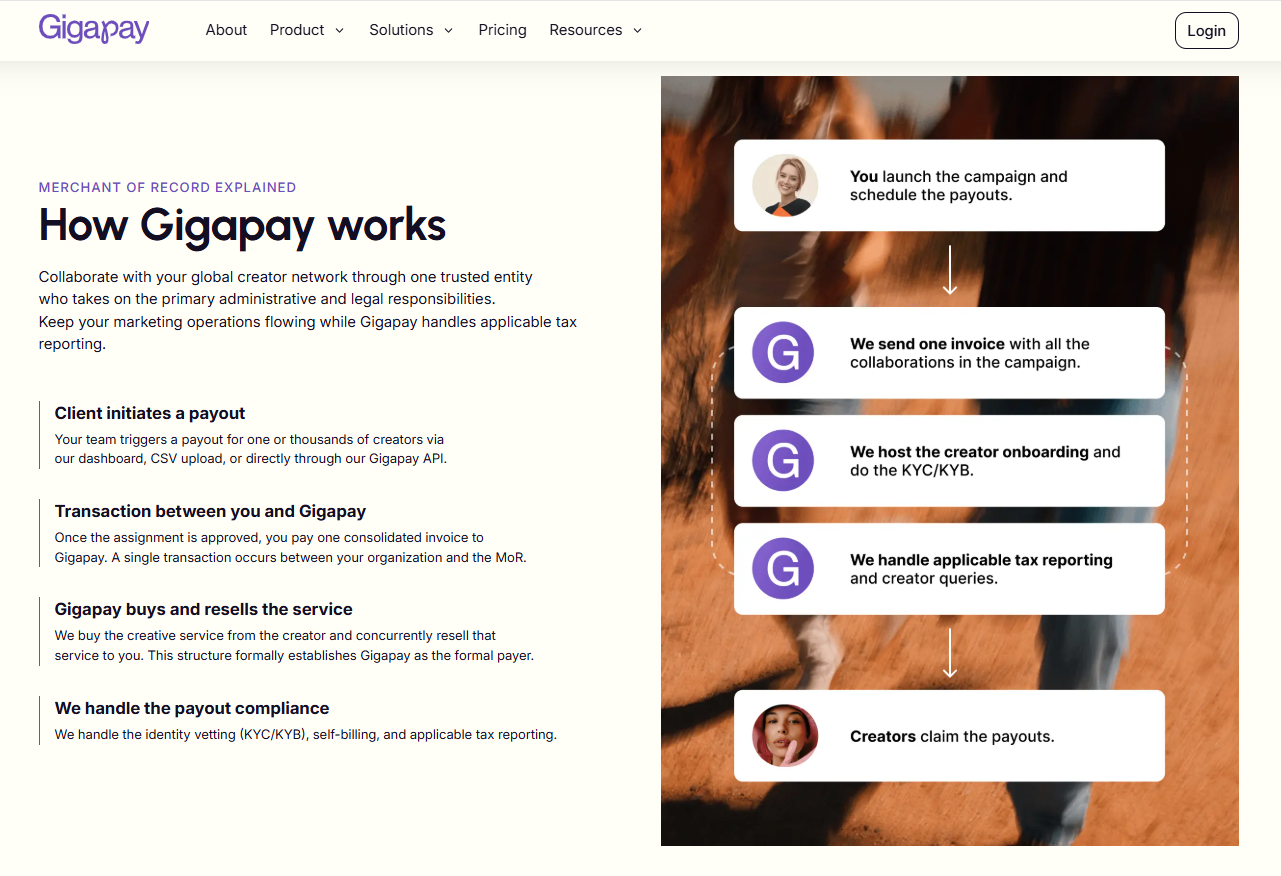
A Merchant of Record for creator payouts becomes the legal counterparty in the transaction. In practical terms, Gigapay buys the creator's deliverable and concurrently resells it to your brand or agency. Your contract is with Gigapay. Your invoice is from Gigapay.
The tax compliance responsibilities connected to the purchase of the creator's deliverable sit with Gigapay under the service agreement. The one-line translation for marketing audiences is that payment rails and AP tools move money and generate paperwork, while a Merchant of Record becomes the counterparty and absorbs the liability.
What this changes in practice matters more than the definition. When you run 600 creator collaborations a year through a Merchant of Record, your ERP shows 1 vendor entry instead of 300+ individual creators.
- Your DAC7 platform-operator obligation for those creators becomes the MoR's problem, and it gets filed automatically.
- Onboarding accepts creators without a registered business or VAT number, so nano and micro creators are not blocked from your program by the compliance team.
- Payouts land in 7 seconds through local rails when the account is pre-funded, and creators keep what they earn because clients cover the fees on all new plans.
The Gap That Opens When Creators Enter the Picture
Traditional accounts payable was built for a specific type of supplier: a company with a registered legal entity, a VAT or tax ID, a bank account, and someone on staff who can issue an invoice that maps to a purchase order. The whole workflow assumes that upstream reality. Every touchless-invoice metric, every 3-way match, every approval flow, is optimized for it.
Creators break the model in four ways at once. A large share of them have no registered company, so the vendor master rejects them. They are individuals in dozens of countries, so cross-border payments carry FX cost, receiver-side fees, and country-specific compliance obligations.
Payment amounts are small and volumes are high, so the fixed cost of processing each one dominates the economics. And their tax status is genuinely ambiguous under DAC7, the Platform Work Directive, and country-level regimes like Germany's KSK, which puts the classification burden on whoever is paying them.
The result is that finance teams end up spending 840 hours a year processing 600 creator collaborations, at a true all-in cost of roughly €40 to €60 per creator payment when you count bank FX, labor, error cycles, and audit exposure. That number comes from Ardent Partners' 2025 benchmark on the true cost of an AP payment and matches what Gigapay sees when clients run the math on their existing spend.
Where AP Automation and Merchant of Record Overlap, and Where They Don't
The overlap is narrow. Both categories reduce manual work, both integrate with your ERP, and both give you a cleaner audit trail than manual processing. That is where the shared ground ends.
The differences matter more:
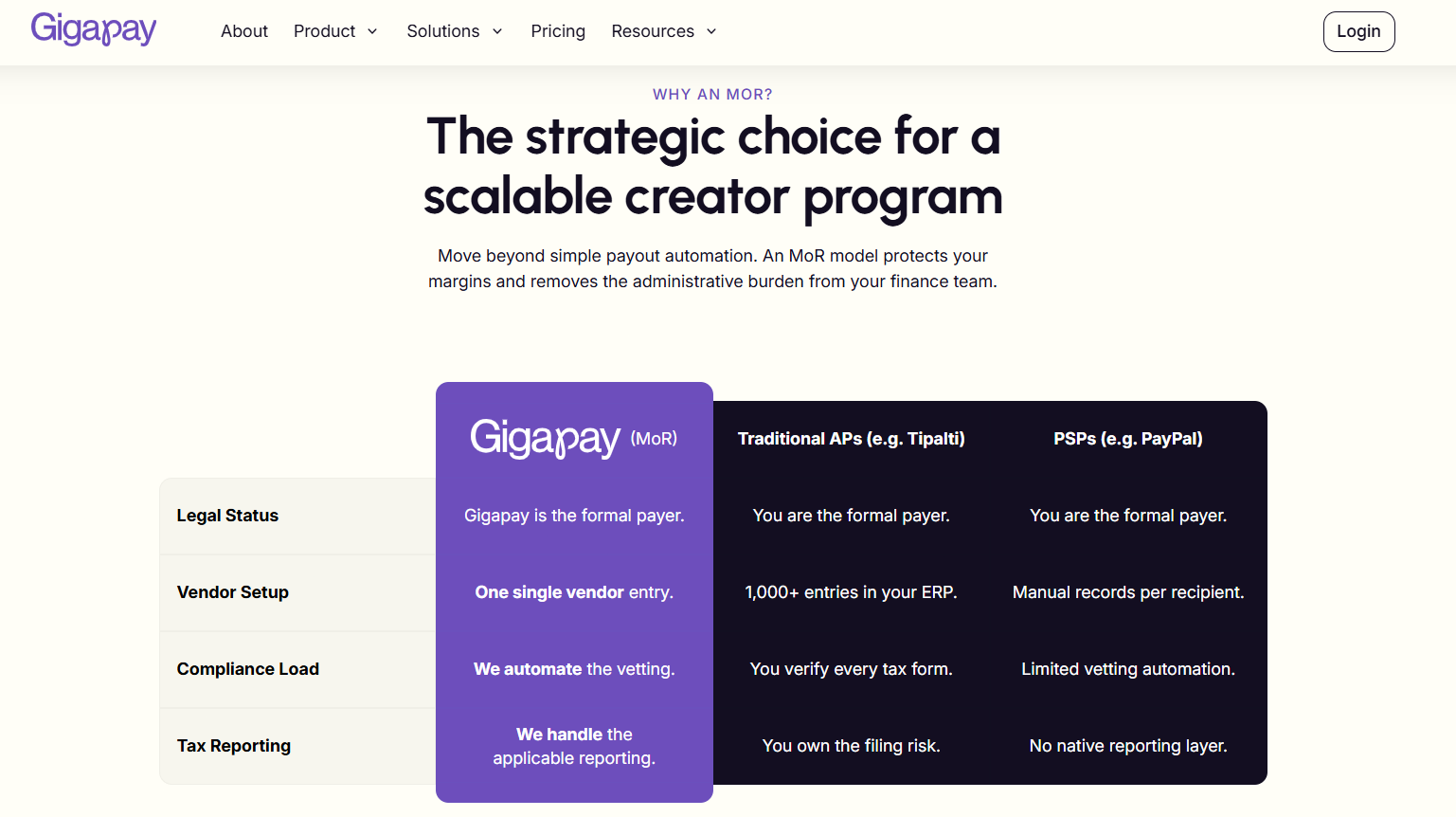
- AP automation processes invoices from vendors that already exist in your master file. A Merchant of Record replaces hundreds of creator vendor setups with one vendor of record.
- AP automation runs approval workflows against invoices you have already accepted as legitimate. A Merchant of Record onboards the underlying creator, validates their tax status, and issues self-billed invoices on their behalf, cutting invoice volume by roughly 80%.
- AP automation moves money once someone has decided a payment is compliant. A Merchant of Record absorbs the compliance decision itself and files the platform-operator reporting that follows.
The clearest way to hold both categories in your head is this. AP automation is a workflow tool. A MoR is a counterparty structure. One optimizes the paperwork. The other decides whose name is on the paperwork.
How They Work Together in a Real Finance Stack
The Tipalti battlecard inside Gigapay's own competitive intelligence says the quiet part out loud: this is coexistence, not rip-out. Tipalti runs your supplier payments. Gigapay runs your creator payments. Neither replaces the other, because the workloads are fundamentally different animals dressed up in similar clothing.
In a live finance stack, the split looks like this. Your production vendors, agencies, software subscriptions, and freelance contractors with registered LLCs all flow through your AP suite. Their invoices are captured, coded, matched, approved, and paid inside Tipalti or Coupa or Bill.com. Your creator payouts, the thousands of small cross-border payments to individuals for TikToks and Reels and UGC, flow through Gigapay.
Instead of hitting your AP suite as 300 separate invoices from 300 separate creators in 20 countries, they hit your AP suite as a single consolidated invoice from one vendor: Gigapay. That single invoice runs through your existing AP automation like any other. The workflow you already built keeps working.
This is the point most buyers miss when they frame it as either/or. Running a Merchant of Record for creators actually makes your AP automation cleaner, because it removes the highest-friction, lowest-margin category of payment from the workflow entirely.
The Compliance Layer AP Automation Cannot Build for You
Every payment to a creator is a compliance event in 2026. DAC7 requires platform operators to collect verified seller tax data, report it annually to EU tax authorities, and mandatorily offboard sellers who miss reminders.
- The German penalty regime hit €50k per report for platforms that failed to file correctly, and the reported data now feeds active audits.
- Germany's KSK imposes a 4.9% levy on payments to creators over €1,000, and it applies to international hires.
- The EU Platform Work Directive lands in national law by December 2026 with a rebuttable presumption of employment for platform workers.
- VAT reverse charge on cross-border B2B creator invoices puts self-assessment on the buyer.
- ViDA mandatory e-invoicing rolls out from July 2030 but is already shaping how buyers are structuring their processes.
None of this is a workflow problem. AP automation platforms can route an invoice for approval, but they cannot decide whether a German creator triggers KSK liability, they cannot file a DAC7 report as the reporting principal, and they cannot make the platform-operator obligation go away by processing the payment faster.
The compliance layer requires a counterparty structure, not a better workflow, because the question the tax authority is asking is not "did this invoice get approved" but "who is the legal payer of record."
That is the wedge, and it explains why every infrastructure competitor to Gigapay, whether Tipalti, Stripe Connect, Trolley, or PayPal, leaves classification, DAC7, KSK, and self-employment admin with the buyer. Their marketing rarely says so directly, but their own terms of service do. Stripe's documentation is explicit that it accepts no liability and that users remain fully responsible for tax reporting on their platforms.
The Financial Math on Running Both
The either/or framing usually starts from a cost objection. If we have Tipalti at $99 to $249 per month plus per-payment fees, why add a 4.9% Gigapay charge on top for the same category of payment?
The answer is that it is not the same category of payment. Take a brand running 600 creator collaborations per year. The manual process cost, including 840 admin hours, vendor sprawl, error cycles, and the average €40-60 true all-in cost per creator payment, runs approximately €139,590 per year.
Running the same volume through Gigapay costs approximately €46,350 per year, with admin time dropping from 840 to 60 hours annually and 300+ ERP vendor records collapsing to a single vendor entry. Those are Gigapay's own ROI numbers based on client benchmarks.
The savings come from a place AP automation cannot reach. AP tools make each invoice cheaper to process. A Merchant of Record makes roughly 70 to 80% of the invoices disappear through consolidated self-billing, absorbs the creator-support load, and removes the retroactive compliance exposure that only shows up when a trigger event, an audit letter, an investigator inquiry, hits the desk.
Headline rates are the wrong unit of comparison. The right unit is TCO plus liability plus hours. On that basis, running both categories side by side is not a duplicate spend. It is a cleaner allocation of workload to the tool designed for it.
How to Decide Which Category to Buy for Which Workload
A working rule holds up across most GTM shapes.
- If the payee is a registered business with a valid tax ID and issues its own invoice, AP automation is the right home for that payment.
- If the payee is an individual creator, a nano or micro influencer, someone working across borders without a company, someone your finance team would otherwise struggle to onboard as a vendor, a Merchant of Record is the right home for that payment.
The decision does not need to be exclusive at the org level. It needs to be exclusive at the workload level. Suppliers go through Tipalti. Creators go through Gigapay. Your ERP sees one AP suite plus one consolidated vendor entry for creators, and the audit trail on both is cleaner than what most brands have today.
Conclusion
Gigapay is the Merchant of Record for creator payouts, the one vendor solution that pays your creators on your behalf by taking on the compliance, payouts, and support so you don't have to.
AP automation and Merchant of Record are not competing categories, because they solve different problems in different layers of the payment stack, and the finance teams scaling creator programs without adding headcount run both side by side.
The AP suite you already own keeps doing what it does well for your supplier base, and Gigapay handles the creator category that breaks the traditional model, showing up in your ERP as a single vendor with a single invoice.
Book a demo to see how Gigapay slots into your existing AP automation and turns 300 creator payables into one.
Read Next:
- The Cheapest Way to Pay Influencers: Gigapay vs. PayPal vs. Wise vs. Stripe Fees Compared
- Gigapay vs Zexel: Paying Creators Beyond Spain Without Losing Compliance
- How to Pay Influencers: Every Compensation Model Explained (Flat Fee, Commission, Gifting, Hybrid)
FAQs:
1. What is the difference between Merchant of Record and AP Automation?
The difference between Merchant of Record and AP Automation is that AP automation processes and pays invoices from existing vendors, while a Merchant of Record becomes the legal counterparty on the transaction and takes on the tax and compliance responsibilities connected to purchasing the deliverable.
2. Can Merchant of Record and AP Automation work together in the same finance stack?
Merchant of Record and AP Automation work together in the same finance stack by splitting workloads, with the AP suite handling registered suppliers and the Merchant of Record handling creator payments that arrive in the ERP as one consolidated vendor invoice.
3. Why does AP Automation alone not solve creator payments?
AP Automation alone does not solve creator payments because it assumes registered vendors with tax IDs and invoices, while most creators have no company, sit across borders, and trigger DAC7 and self-employment obligations that a workflow tool cannot absorb.
4. What compliance responsibilities does a Merchant of Record take on for creator payouts?
A Merchant of Record for creator payouts takes on responsibilities that include acting as the contractual counterparty, running KYC on creators, issuing self-billed invoices, and filing platform-operator reporting such as DAC7 in the EU, KU14 in Sweden, and KSK reporting in Germany.
5. Who should use both Merchant of Record and AP Automation in 2026?
Companies that should use both Merchant of Record and AP Automation in 2026 are brands, agencies, and platforms running hundreds or thousands of creator collaborations a year alongside a normal supplier base, because the two tools handle fundamentally different payment categories.
.jpg)
.jpg)
.jpg)