.jpg)

Best-in-class companies bring only 55.3% of their spend under structured management, according to Coupa's April 2026 tail spend research, and AI-powered procurement tools now lift spend visibility by 24.4% while delivering 8.1% in overall savings.
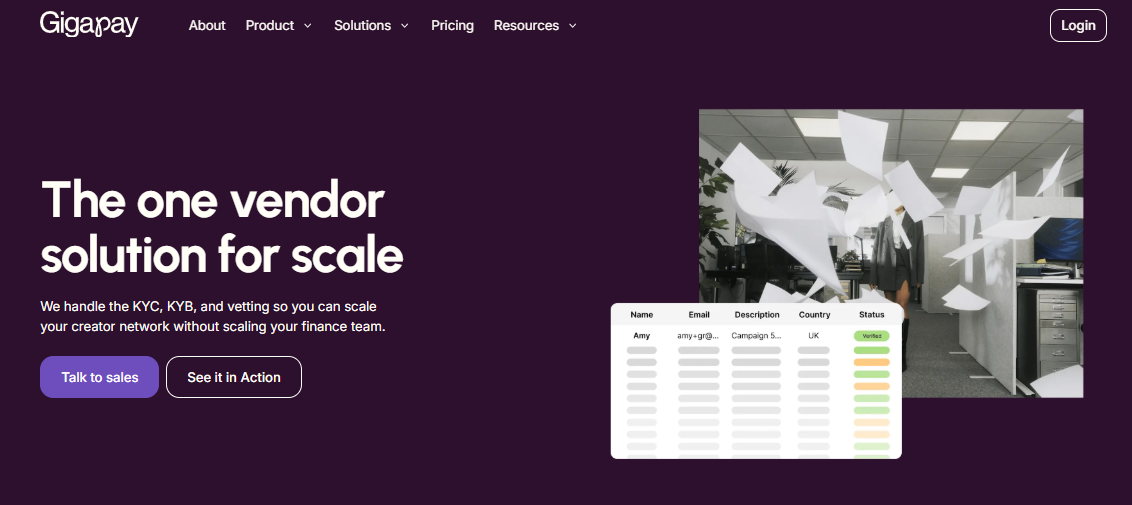
Gigapay exists for the most fragmented tail of them all: it consolidates hundreds or thousands of individual creator payments into a single vendor, a single contract, and a single invoice, with tax and compliance responsibility handled as Merchant of Record.
Tail spend follows a stubborn pattern in almost every organization, where roughly 80% of suppliers and transactions generate only 20% of total spend value, and that long tail is exactly where maverick buying, duplicate payments, and compliance gaps hide.
This article breaks down what tail spend actually costs, why supplier consolidation is the fastest way to fix it, and how to run a consolidation program step by step, including the creator payment tail that most procurement teams never see.
Key Takeaways
- Tail spend covers roughly 80% of suppliers but only 20% of total spend value.
- Processing one invoice costs $10 to $15, often more than the purchase itself.
- Digital tail spend management cuts annual expenditure by 5% to 10% on average.
- Consolidating creator payments through one Merchant of Record removes hundreds of vendor records.
- Gigapay reduces creator payment admin from 840 hours to 60 hours per year.
What Is Tail Spend and Why Does It Stay Unmanaged?
Tail spend is the portion of company spending that nobody actively manages. It is made up of low-value, high-frequency purchases spread across a long list of suppliers, most of whom appear in the vendor master once or twice and never again. The pattern repeats across industries with remarkable consistency: 20% of total spend generates 80% of supplier relationships and transaction volume.
The reason it stays unmanaged is simple economics. A €2,000 purchase does not justify a sourcing event, a negotiation, or a category strategy. Neither does a €500 one. So each purchase passes through on its own, nobody negotiates, and the tail grows quietly in the background. The cost only becomes visible when you add it up.
Five hundred small transactions across a year can easily represent €1.5 million in spend that nobody negotiated, nobody approved through a structured process, and nobody can trace back to a business requirement.
Tail spend describes purchase behavior, not a fixed category. Any spend that is low in value, high in volume, and spread across many suppliers belongs in the tail. That includes office supplies, spot repairs, one-off software subscriptions, freelance services, and one category that has exploded in size over the past five years: payments to individual content creators.
The Three Types of Purchases That Make Up the Tail
Unmanaged tail spend usually breaks into three buckets, and each one needs a different fix.
1. Unmanaged purchases
Unmanaged purchases are transactions that bypass procurement entirely. An employee needs something, buys it on a card or through an unapproved channel, and the expense surfaces weeks later in accounts payable. Coupa's 2026 research classifies any untracked or one-off purchase outside strategically managed spending as tail spend, and this bucket is where fraud, duplicate payments, and shadow IT concentrate.
2. One-off vendors
One-off vendors are suppliers used once and never again. Each one still requires full vendor onboarding: a W-9 or tax ID collection, banking details, a vendor master record, and an approval chain. The onboarding effort for a vendor you will pay €400 once is nearly identical to the effort for a vendor you will pay €400,000 annually. That asymmetry is where the administrative waste lives.
3. Long-tail suppliers
Long-tail suppliers are the recurring small vendors. They appear several times a year, always in small amounts, always below the threshold that would trigger a negotiation. Because departments order independently, the same category often runs 15% to 20% above negotiated contract rates simply because nobody routed the purchases through the preferred vendor.
How Much Does Unmanaged Tail Spend Actually Cost?
The direct cost of tail spend is what you pay for the goods and services. The real cost is everything wrapped around each transaction.
- Invoice processing costs more than many of the purchases:
Handling a single invoice costs between $10 and $15 in most finance organizations. On a $40 transaction, processing overhead alone consumes over a quarter of the purchase value. Multiply that across thousands of small invoices per year and the administrative cost becomes a budget line of its own. - Fragmentation destroys pricing leverage:
When the same category is split across dozens of suppliers, no single relationship carries enough volume to earn a discount. Ivalua's 2026 analysis found that companies using digital tools to manage tail spend reduce annual expenditure by 5% to 10% on average, with potential P&L savings of 5% to 20% of total spend in scope once consolidation and structured buying channels are in place. - Vendor sprawl creates compliance exposure:
Every vendor record is a data point someone must verify: tax status, banking details, sanctions screening, and in the EU, reporting obligations under frameworks like DAC7. A contractor working without proper insurance, a supplier in a high-risk jurisdiction, or a payee whose tax ID was never validated are all liability events waiting in the tail, invisible because the purchases never went through procurement. - The audit trail weakens:
Purchases made outside approved channels bypass controls. When an auditor asks who approved a payment, why the vendor was selected, and whether tax reporting obligations were met, unmanaged tail spend produces silence.
A Concrete Example: The Cost of a Creator Payment Tail
Consider a brand running 600 creator collaborations per year, which is the scale at which Gigapay typically models the problem. Managed manually, that program means 300 or more individual vendor records in the ERP, each requiring onboarding, tax documentation, invoice matching, and cross-border payment handling.
Gigapay's analysis puts the fully loaded cost of that manual process at roughly €139,590 per year, including 840 hours of administrative work across finance, legal, and marketing operations.
Those 840 hours are salary cost. At a fully loaded finance operations rate of €50 to €70 per hour in most Western European markets, the admin time alone represents €42,000 to €58,800 per year before you count error cycles, late payment penalties, and the campaigns that never launched because onboarding stalled.
The same program run through a single consolidated vendor costs approximately €46,350 per year and consumes about 60 admin hours. The spend on creators does not change. The cost of moving the money and staying compliant drops by two thirds.
Why the Creator Economy Became the Fastest-Growing Tail Spend Category
Procurement teams built their playbooks around traditional suppliers: companies with registration numbers, VAT IDs, standard invoicing capability, and predictable volumes. The creator economy broke every one of those assumptions at once.
A brand scaling influencer marketing goes from working with 10 creators to working with 500 within a couple of years. Boozt, the Nordic fashion retailer, tripled its creator collaborations after removing the payment bottleneck. Each of those creators is, from a procurement perspective, a textbook long-tail supplier: low individual value, high transaction count, and no two alike.
The friction shows up in specific ways:
1. Most creators are not registered businesses
Nano and micro influencers frequently operate as private individuals. They have no VAT number, no company registration, and no invoicing system. Standard vendor onboarding rejects them at the door, and finance teams block collaborations that marketing has already agreed to.
2. Every payment is a cross-border tax question
Paying an individual in Germany triggers Künstlersozialkasse exposure, a 4.9% levy on creative payments over €1,000 that applies even when the paying company sits outside Germany. Paying creators across the EU triggers DAC7 platform reporting. Paying into Denmark from Sweden involves KU14 reporting.
A procurement team managing 300 creator vendors across 20 countries is managing 20 different regulatory frameworks with no economies of scale.
3. Payment terms punish the smallest suppliers hardest
Gigapay's 2024 State of Influencer Payments research, produced with Billion Dollar Boy, Meltwater, The Influencer Marketing Factory, and Wild, found payment terms stretching to 120 days for creators. Enterprise payment cycles designed for established suppliers leave individual creators waiting a full quarter for money they earned, which damages the relationships marketing depends on.
This is tail spend with a human being at the end of every transaction. The cost of leaving it unmanaged is measured in compliance risk and admin hours, but also in the collaborations that never happen.
What Is Supplier Consolidation and How Does It Fix Tail Spend?
Supplier consolidation is the practice of reducing the number of vendors an organization transacts with by routing fragmented purchases through fewer, structured relationships. It attacks tail spend at its root cause: the fragmentation itself.
The mechanics work through four lever:.
- Volume aggregation restores negotiating leverage: When purchases scattered across 40 suppliers route through three, each relationship carries enough volume to negotiate pricing, service levels, and payment terms. This is the fastest available savings lever in tail spend, and it requires no change to what the organization actually buys.
- Fewer vendor records mean lower transaction costs: Every vendor removed from the master file removes onboarding effort, invoice matching, payment runs, and periodic re-verification. Reducing the vendor master list is the single fastest way to simplify accounts payable workflows, because AP cost scales with vendor count and invoice count, not with spend value.
- Consolidation converts unmanaged spend into managed spend: Once purchases flow through a defined channel, they become visible, categorized, and governed. Deloitte's procurement research notes that catalogs and automated buying channels move entire categories from unmanaged to managed spend, producing sustainable savings rather than one-off cuts.
- Risk concentrates where it can be controlled: Ten thoroughly vetted vendor relationships are safer than 400 unvetted ones. Consolidation lets compliance effort concentrate on counterparties large enough to justify real due diligence.
The Consolidation Models: Catalogs, Buying Desks, Marketplaces, and Merchant of Record
Not every consolidation approach fits every tail category. Four models dominate in practice.
- Approved catalogs and eProcurement channels work for repeatable goods: office supplies, IT peripherals, standard equipment. Employees buy from pre-negotiated catalogs, compliance is enforced before the purchase happens, and the tail converts to managed spend automatically.
- Tactical buying desks work for irregular, spot-buy categories. A small internal or outsourced team handles requests below the strategic sourcing threshold, running lightweight quotes against an approved supplier list.
- Marketplace intermediaries work for categories with many interchangeable suppliers. One contracted platform fronts hundreds of sellers, and the organization holds one commercial relationship.
- The Merchant of Record model works for the hardest tail category: payments to individuals and micro-suppliers across borders. A Merchant of Record does something the other three models cannot. It becomes the legal counterparty to the transaction. Gigapay, for example, formally purchases the creator's deliverable and resells it to the brand, which means the brand's ERP holds exactly one vendor regardless of whether the campaign pays 50 creators or 5,000. Tax reporting obligations like DAC7, KU14, and KSK monitoring move to the intermediary.
The distinction matters: payment processors like Stripe Connect or Tipalti move money on your behalf, while a Merchant of Record takes over the administrative and legal responsibilities connected to the purchase itself.
How to Run a Tail Spend Consolidation Program Step by Step
Consolidation programs fail when they start with supplier cuts instead of visibility. The sequence below reflects what actually works.
Step 1: Build Full Spend Visibility Before Touching Anything
You cannot consolidate what you cannot see. Pull twelve months of data from every source where money leaves the company: the ERP, corporate cards, expense reports, and direct bank payments. The purchases that bypass the ERP are precisely the ones you need most.
AI-powered classification tools now handle the normalization that made this step impossible to staff manually, and the 24.4% visibility improvement Coupa measured comes largely from capturing spend that never touched a purchase order.
Step 2: Segment the Tail by Category and Purchase Behavior
Sort tail transactions into consolidation candidates. The useful questions are:
- Which categories repeat?
- Which suppliers appear once versus monthly?
- Which purchases are individuals rather than companies?
- Which cross borders?
- A category purchased three times in 90 days across three different suppliers is a consolidation candidate. Five hundred payments to individual creators across 30 countries is a Merchant of Record candidate.
Step 3: Match Each Segment to the Right Consolidation Model
Route repeatable goods to catalogs, irregular spot buys to a buying desk, interchangeable supplier categories to a marketplace, and individual or cross-border payees to a Merchant of Record. Forcing one model onto every segment is the most common program design error. A catalog cannot onboard a TikTok creator in Manila, and a Merchant of Record is the wrong tool for printer cartridges.
Step 4: Clean the Vendor Master and Set Entry Rules
Deactivate vendors with no transactions in 18 months, merge duplicates, and introduce a rule that matters more than any cleanup: no new vendor enters the master file if an existing consolidation channel covers the category. Vendor master growth is the leading indicator of tail spend regrowth.
Step 5: Enforce the Channel at the Point of Purchase, Not at Audit
- Compliance that happens after the purchase is reporting.
- Compliance that happens before the purchase is control.
Configure systems so the approved channel is also the easiest path: pre-approved catalogs, one-click creator payment batches, and card controls that route category spend to contracted suppliers. People follow the path of least resistance, so make the compliant path the fast one.
Step 6: Measure Consolidation with Hard Metrics
Track four numbers quarterly: active vendor count, percentage of spend under management, cost per invoice processed, and admin hours per transaction category. Best-in-class organizations reach 55.3% structured spend. Every point of improvement above your baseline is measurable money.
What Supplier Consolidation Looks Like in Creator Payments Specifically
The creator payment tail deserves its own operating detail, because it is the category where consolidation produces the most dramatic before-and-after.
Before consolidation:
- Finance chases tax documentation across 20 jurisdictions, matches hundreds of individually formatted invoices, runs international payments with varying fees and timelines, and fields creator emails asking where their money is.
- Marketing waits weeks for vendor onboarding before a campaign can launch.
- Legal monitors DAC7, KSK, and local classification rules with no automation.
After consolidation through a Merchant of Record
Marketing uploads a spreadsheet or calls an API, and creators across 65+ countries receive payment in 50+ currencies through local rails like SEPA Instant, Faster Payments, and ACH, instantly rather than in 120 days.
- Finance receives one consolidated invoice per campaign instead of hundreds, an invoice volume reduction of around 80%.
- Creators onboard as individuals, sole traders, or companies without needing a registered business or VAT number, which is what unlocked Boozt's threefold increase in collaborations.
- Tax reporting for DAC7, KU14, and German KSK obligations runs automatically.
The results reported by agencies at scale point the same direction. WPPMedia's Goat Agency (WPPMedia) reported faster, easier payments with tax compliance intact.
One nuance worth stating plainly, because credible consolidation content requires it: in its Merchant of Record capacity, Gigapay includes automated tax reporting but does not withhold or pay social security or income taxes on behalf of payees outside its Swedish Employer of Record service.
Creators remain responsible for their own tax obligations. Consolidation removes the administrative and reporting burden from the brand; it does not make anyone's taxes disappear.
The Financial Model: What Consolidating a Creator Tail Is Worth
Numbers make the case better than principles. Using Gigapay's published model for a 600-collaboration program:
The pricing side of the equation is transparent: Gigapay's Base plan runs €279 per month with a 4.9% admin fee per payout, and Enterprise pricing with volume discounts applies from €1.8M in annual payout volume.
Against the €93,000 annual difference in the model above, the consolidation economics resolve quickly, and they improve as volume grows, because manual admin cost scales linearly with creator count while a consolidated channel does not.
The strategic effect compounds beyond the direct savings. Teams that remove the payment bottleneck run more collaborations with the same headcount. Gigapay's core scaling claim is that a brand can grow from 50 to 5,000 creators without a single new hire, and the Boozt case shows the mechanism: when finance no longer blocks unregistered creators and admin hours stop scaling with volume, marketing simply does more.
Common Mistakes That Undermine Tail Spend Consolidation
- Consolidating suppliers without consolidating the buying channel: Cutting the vendor list while employees keep buying through uncontrolled channels just pushes the tail into expense reports and card statements. The channel is the control point.
- Treating individuals like corporate vendors: Forcing creators, freelancers, and micro-suppliers through corporate vendor onboarding produces two outcomes: they give up, or your team spends hours on workarounds. Segment them into a channel built for individuals.
- Ignoring the compliance layer: Consolidation that only aggregates payments leaves DAC7, KSK, classification, and KYC obligations exactly where they were. Choose intermediaries that take on reporting responsibility, not just money movement.
- Measuring savings only in unit prices: The largest tail spend savings come from process cost: invoices eliminated, vendor records removed, hours recovered. A program measured only on price variance will underreport its own value and lose executive support.
- Letting the tail regrow: Without vendor master entry rules and quarterly monitoring, the tail returns within 18 months. Consolidation is an operating discipline, not a project.

Conclusion
Gigapay consolidates the most fragmented supplier tail in modern marketing, turning hundreds of individual creator payments into one vendor, one invoice, and one compliance framework as Merchant of Record.
Tail spend earns its reputation as procurement's blind spot because 80% of suppliers generate only 20% of value, and the fix is structural: build visibility, segment the tail, route each segment through the right consolidation channel, and enforce the channel before the purchase happens rather than after.
For the creator payment tail specifically, the numbers are unambiguous, with admin time falling from 840 hours to 60 and total program cost dropping by roughly two thirds.
Book a demo and see what your creator payment tail looks like as a single vendor.
Read Next:
- Best Merchant of Record Platform for Enterprise Companies: September 2026 Review
- AP Automation for Creator and Influencer Payments
- Vendor Onboarding and KYC/KYB Verification
FAQs:
1. What is tail spend in procurement?
Tail spend in procurement is the low-value, high-volume portion of company spending that is not actively managed, typically covering around 80% of suppliers and transactions while representing only 20% of total spend value. It includes unmanaged purchases, one-off vendors, and long-tail suppliers that fall below strategic sourcing thresholds.
2. What is supplier consolidation for tail spend?
Supplier consolidation for tail spend is the practice of reducing vendor count by routing fragmented, low-value purchases through fewer structured channels, such as approved catalogs, buying desks, marketplaces, or a Merchant of Record. It converts unmanaged spend into managed spend, restores pricing leverage, and cuts per-transaction processing costs.
3. How much can companies save by consolidating tail spend suppliers?
Companies can save 5% to 10% of annual expenditure on average by managing tail spend with digital tools, with potential P&L savings of 5% to 20% of spend in scope, according to 2026 procurement research. In creator payments specifically, Gigapay's model shows a 600-collaboration program dropping from roughly €139,590 to €46,350 per year.
4. How does a Merchant of Record consolidate long-tail suppliers?
A Merchant of Record consolidates long-tail suppliers by becoming the legal counterparty to each transaction, purchasing the supplier's deliverable and reselling it to the buying company. This replaces hundreds of individual vendor records with one vendor entry, one consolidated invoice per batch, and automated tax reporting for frameworks like DAC7, KU14, and KSK.
5. Why are creator payments considered tail spend?
Creator payments are considered tail spend because they match every tail spend characteristic: low individual transaction value, high transaction volume, hundreds of one-off payees, and no active procurement management. A brand paying 300 creators across 20 countries manages 300 long-tail vendor relationships and 20 regulatory frameworks unless it consolidates them through a single payment vendor.
.jpg)
.jpg)
.jpg)