.jpg)

Tail spend accounts for up to 80 percent of procurement transactions but only 15 to 20 percent of total spend, according to GEP's April 2026 analysis.
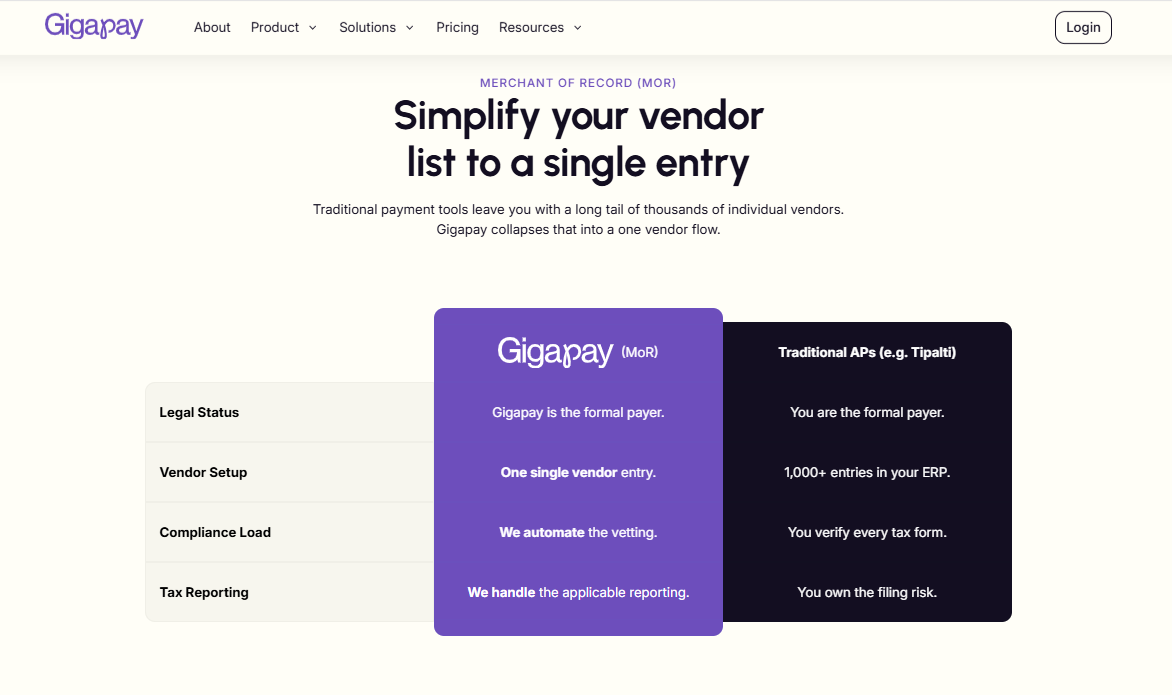
Gigapay is the Merchant of Record for creator payouts: the vendor of record that replaces hundreds of individual payee setups with one contract, one invoice, and one counterparty in your vendor master.
The worst part of that 80 percent is not office supplies or spare parts. It is people: affiliates, streamers, freelance specialists, and agency sub-payees who each demand a full vendor setup for a €400 deliverable.
This article breaks down why standard supplier consolidation fails on this spend, the model that works instead, the metrics that prove it, and how to run the first consolidation batch.
Key Takeaways
- Tail spend covers up to 80 percent of transactions but only 15 to 20 percent of spend.
- Preferred supplier lists fail when each individual payee is the supplier.
- Consolidate the payment vehicle, not the talent: one contract, one payout vendor of record.
- Measure vendor-master count, invoice count, cycle time, audit exceptions, and fraud incidents.
- Start with one category, one entity, one batch, then expand across markets.

What Spend Analysis Reveals About Unmanaged Services Spend
Run a spend analysis on your indirect categories and the goods side behaves predictably. A few hundred suppliers cover facilities, IT hardware, and MRO, and the consolidation playbook applies cleanly.
The services side looks different. The long tail is not made of small companies. It is made of individuals.
A typical spend cube for a consumer brand or a media-heavy business shows:
- Affiliate payees: hundreds of individuals earning commission, each paid monthly, most below any PO threshold.
- Esports talent and streamers: tournament fees, sponsorship installments, and appearance payments to players who have never registered a company.
- Agency sub-payees: your agency invoices you once, then pushes payments to dozens of creators and contractors you never see in your systems.
- Freelance specialists: editors, designers, translators, and UGC producers hired per campaign.
- Campaign contractors: short engagements that exist for six weeks and then disappear from the vendor master, except they never actually get removed.
Each row is small. The aggregate is not. This spend routinely runs into seven figures per year, and almost none of it sits under a managed contract. Every payment in it costs real money to process: Ardent Partners puts the average cost per invoice at $9.87, and full vendor onboarding runs $1,000 to $10,000 per supplier depending on the diligence tier.
Gigapay's own analysis of manual creator payments puts the all-in cost at €40 to €60 per payment once vendor setup, invoice handling, and error correction are counted.
Why Preferred Supplier Lists Fail When Every Payee Is the Supplier
The standard consolidation move is a preferred supplier list. Procurement analyses the category, selects three to five vendors, negotiates rates, and routes demand to them. It works because the supply base is substitutable: one stationery vendor can replace another.
Services spend to individuals breaks every assumption behind that model.
- The payee is not substitutable: Marketing chose that specific streamer because of their audience. An affiliate earns commission because their traffic converts. You cannot route that demand to a "preferred" alternative, because the person is the product.
- The list would need thousands of entries: A preferred supplier list with 2,000 individuals on it is not a preferred supplier list. It is the vendor master with extra steps.
- Churn destroys the list before it settles: Campaign contractors turn over per quarter. Affiliate rosters change monthly. By the time procurement has vetted a cohort, half of it is inactive and a new half has appeared.
- Thresholds push the spend underground: When vendor setup takes two weeks and the payment is €500, category teams route around procurement: agency pass-through, gift cards, expense claims, personal cards. The spend analysis then shows even less than what is actually happening.
Coupa's April 2026 research found that teams adopting better spend tooling gained 24.4 percent more visibility into total spend, which tells you how much was invisible before.
So the category stalls. Procurement flags "too many small services vendors" in every quarterly review, and nothing structural changes, because the standard tool does not fit the shape of the problem.

The Supplier Consolidation Model That Works: Consolidate the Vehicle, Not the Talent
The fix is to stop treating each payee as a supplier and start treating the payment vehicle as the supplier.
One contract with one payout Merchant of Record. Many payees underneath it. For procurement and finance, that means a vendor of record: a single counterparty that formally purchases each individual's deliverable and resells it to you, so the individual never enters your vendor master at all.
How One Contract With a Payout Merchant of Record Works
The mechanics are simple to describe and matter enormously in practice:
- One contract: Procurement negotiates a single master agreement with the Merchant of Record. One diligence process, one SIG questionnaire, one data processing agreement, one insurance review.
- One invoice: The business pays one consolidated invoice per batch or per campaign, in one of a handful of funding currencies. Gigapay supports funding in USD, EUR, GBP, SEK, DKK, and NOK.
- Many payees: Underneath the contract, the vendor of record onboards, verifies, and pays each individual: KYC, self-employment status checks, and local tax data collection happen on their side, not yours. Gigapay pays individuals in 65+ markets, including people who have never registered a company, and payouts land instantly when the account is pre-funded.
- Liability moves with the money: Because the vendor of record is the formal counterparty to each payee, tax reporting obligations such as DAC7 filings, Sweden's KU14, and Germany's KSK administration sit with them. Rails and AP tools move money and generate paperwork. A vendor of record becomes the counterparty and absorbs the liability.
The result on paper: where an enterprise creator program once meant hundreds of vendor setups, the vendor master shows one entry. A global hospitality group runs its creator payments across 39 countries this way. Agencies using the model cut the invoices behind a global campaign by 70 percent.
Who Keeps Control of What After Consolidation
The predictable objection from category owners is loss of control. The model answers it cleanly, because it splits control along the line where it should have been split all along:
Category managers lose exactly one thing: the ability to add new vendors to the master one at a time. They keep full control of who they work with, what they pay, and what they buy. Procurement gains ownership of the vehicle without becoming the bottleneck on every €400 collaboration. Finance gets one auditable counterparty instead of a thousand micro-vendors and a tax exposure it cannot see.
Four Payee Categories Where the Vendor Master Breaks First
Supplier consolidation through a vendor of record applies wherever spend flows to many individuals. Four categories show up in nearly every spend analysis.
Affiliate Program Payees
Affiliate spend is the purest long tail in the building: high payee counts, low individual amounts, monthly frequency. A mid-sized program pays 300 to 3,000 affiliates every month.
- Under a per-payee model, that is 300 to 3,000 vendor records and up to 36,000 payment events per year.
- Under a vendor of record, it is twelve invoices.
The affiliates themselves notice the difference too: they get paid in minutes instead of on net-45 terms, and on new Gigapay plans the client covers the fees, so payees keep what they earn.
Esports Talent and Streamers
Esports payments combine three procurement headaches: young payees without registered companies, cross-border payments across dozens of jurisdictions, and event-driven timing where a tournament ends on Sunday and talent expects payment that week. Traditional vendor onboarding cannot move at that speed, so teams and tournament organisers historically paid late, paid through intermediaries, or paid off-system.
A vendor of record onboards the player in minutes, verifies identity and tax status, and pays instantly from a pre-funded balance.
Agency Pass-Through Payees
When your agency pays creators on your behalf, the spend analysis shows one clean agency line and hides everything underneath it. CreatorFest's State of Creator Compensation 2026 found agency markups of 20 to 80 percent on creator fees, a hidden inflation that procurement cannot negotiate against because it cannot see it.
Consolidating the payment vehicle separates the agency's service fee from the talent pass-through: the agency keeps the strategy and management work, the vendor of record carries the payments, and procurement finally sees what the talent actually costs.
Freelance Specialists and Campaign Contractors
Editors, UGC producers, translators, performance designers: this is the spend that most often hides in expense claims and maverick channels because the engagement is too small and too urgent for a vendor setup. Routing it through the existing vendor-of-record contract converts maverick spend into managed spend without adding a single approval step for the people doing the hiring.
What to Measure After Supplier Consolidation
Consolidation programs die when they report the wrong numbers. Marketing metrics like influencer ROI belong to the category owners and say nothing about whether the vehicle works. Procurement should track five operational metrics, all of them available from existing systems:
- Vendor-master count in the category: The headline number. Hundreds of individual payee records collapsing toward one vendor of record is the clearest evidence the model holds.
- Invoice count: Thousands of micro-invoices becoming one consolidated invoice per batch. At $9.87 average processing cost per invoice, this metric converts directly to money.
- Cycle time: Days from approval to payee paid. Manual cross-border payments to individuals routinely take one to four weeks. Pre-funded payouts through a vendor of record land in seconds.
- Audit exceptions: Missing tax data, unverifiable payees, and undocumented payments are what auditors flag in this category. One counterparty with complete KYC and tax records per payee shrinks the exception list.
- Fraud incidents: Fragmented payee data is where duplicate payees, redirected bank details, and fake invoices live. Payment error rates run 0.1 to 0.4 percent of disbursements in manual environments, and a verified, single-pipe payout flow attacks exactly that surface.
Report these quarterly against the pre-consolidation baseline. Leave campaign performance out of the procurement review entirely.
The Real Savings: Admin Time and Error, Not a Rate Cut
Be honest in the business case, because the honest version is strong enough.
Classic supplier consolidation promises volume leverage: fewer suppliers, bigger contracts, better rates. That logic does not transfer here. You will not negotiate 3 percent off every affiliate's commission by consolidating the payment vehicle, and pretending otherwise sets the program up to miss its target.
The savings live in operations and risk:
- Vendor setup avoided: At $1,000 to $10,000 per supplier onboarding, a category with 500 individual payees carries $500,000 or more of setup cost that a single vendor-of-record contract removes.
- Invoice processing collapsed: Moving from thousands of payee invoices to consolidated batch invoices takes processing cost from $9.87 per document toward a rounding error, and frees AP capacity for work that needs judgment.
- Error correction eliminated at the source: Every miskeyed IBAN, duplicate payment, and currency mistake in a manual flow costs finance time to claw back. The all-in cost of a manual creator payment runs €40 to €60 once corrections are included.
- Compliance exposure transferred: DAC7 penalties in Germany reach €50,000 per report, KSK back-audits in Germany reach five years, and reverse-charge VAT errors surface in every service audit. Under the vendor-of-record structure, the reporting duty sits with the counterparty that holds the payee relationship.
- Headcount growth avoided: Cure Media scaled its creator payment volume 4.5x while adding one finance hire. The scaling claim for the model is direct: grow from 50 to 5,000 payees without a new hire in finance.
One number worth adding to the model: 65% of vendors offer early payment discounts of roughly 2%, and slow manual cycles forfeit them. Faster, cleaner payment operations recover value across the whole AP function, not just this category.
Compliance Risk Hiding in the Services Tail
The regulatory direction makes this consolidation urgent rather than optional. Every payment to an individual in Europe is now a compliance event.
DAC7 already forces platform operators to collect and verify seller tax data and report it annually, with mandatory offboarding of payees who fail verification. The EU Platform Work Directive lands in national law by December 2026 and introduces a rebuttable presumption of employment, with the burden of proof on the platform side. ViDA brings mandatory e-invoicing and digital reporting for intra-EU B2B.
Cross-border creator invoices trigger reverse-charge VAT self-assessment by the buyer. Country regimes stack on top: KU14 reporting in Sweden, KSK levies in Germany, withholding rules in Spain and Portugal.
- Under a per-payee model, every one of those obligations multiplies by the payee count and lands on your finance team.
- Under one contract with a vendor of record, the counterparty that pays the individual carries the reporting scope.
That is the structural difference between a payments tool and a vendor of record, and it is the reason this category resists the tooling-only fix: rails move the money and leave you holding the compliance.
How to Start Supplier Consolidation: One Category, One Entity, One Batch
Do not launch this as a global transformation program. The model proves itself fastest at small scale, so scope the pilot deliberately:
- Pick one category: Choose the one where spend analysis shows the highest payee count, usually affiliates or campaign creators. High volume makes the before-and-after metrics undeniable.
- Pick one legal entity: One buying entity, one market, one currency. This keeps the master agreement, tax review, and finance sign-off contained.
- Run one batch: Take a real payment cycle, one affiliate month or one campaign settlement, and run it through the vendor of record. Upload the payee list, approve one invoice, and watch the payouts land.
- Measure against baseline: Compare vendor-master count, invoice count, cycle time, and exceptions for that batch against the previous cycle.
- Expand by market, then by category: Add the next country under the same contract, then bring in the next payee category. The contract, diligence, and integration work is already done, so each expansion is an operational decision rather than a sourcing project.
Procurement owns the vehicle from day one. Category owners keep picking their talent from day one. Nobody's control gets taken away, which is why the rollout does not generate the resistance that preferred-supplier programs do.
Conclusion
Gigapay is the Merchant of Record for creator payouts: for procurement, the vendor of record that turns a long tail of affiliates, esports talent, agency sub-payees, and freelance specialists into one contract, one invoice, and one counterparty across 65+ markets.
Supplier consolidation for unmanaged services spend fails when it targets the talent, because each payee is the supplier and none of them is substitutable.
It succeeds when it targets the vehicle: category owners keep choosing who to work with, procurement owns a single managed contract, and the savings show up where they actually live, in vendor-master count, invoice volume, cycle time, audit exceptions, and fraud incidents.
If supplier consolidation in your services categories has stalled on "too many small vendors," book a demo and run the first batch in one category.
Read Next:
- Mass Payments Are Not Compliance: What AP Still Owns After the Batch File Leaves
- KYC and KYB for Vendor Onboarding: What AP Should Collect Before a Payee Hits the Master File
- IR35 in 2026: What Finance Still Owns When You Pay UK Limited-Company Contractors at Scale
FAQs:
1. What is supplier consolidation for unmanaged services spend?
Supplier consolidation for unmanaged services spend is the practice of replacing hundreds of individual payee vendor setups with one contract through a payout vendor of record, so many payees sit under a single counterparty. Instead of onboarding each affiliate, streamer, or freelancer as a supplier, procurement contracts once with a Merchant of Record that verifies, pays, and reports on every individual underneath it.
2. Will category managers lose control after supplier consolidation?
Category managers will not lose control of talent selection after supplier consolidation; they lose vendor-add control only. They continue to choose which affiliates, creators, and specialists to work with and what to pay them, while procurement owns the payment vehicle and the vendor of record handles onboarding, verification, and tax reporting for each payee.
3. What savings does supplier consolidation of services payees deliver?
The savings supplier consolidation of services payees delivers come from admin time and error reduction, not from a rate cut on every payee. Removing per-payee vendor setups worth $1,000 to $10,000 each, collapsing thousands of invoices at $9.87 average processing cost into consolidated batches, and eliminating manual payment errors produce the measurable return, alongside transferred compliance exposure.
4. How do you start consolidating a long tail of services suppliers?
You start consolidating a long tail of services suppliers with one category, one legal entity, and one payment batch. Pick the category with the highest payee count, run a real payment cycle through the vendor of record, measure vendor-master count, invoice count, and cycle time against the previous cycle, and then expand market by market under the same contract.
5. What should procurement measure after consolidating services spend?
After consolidating services spend, procurement should measure vendor-master count in the category, invoice count, payment cycle time, audit exceptions, and fraud incidents. Campaign metrics such as influencer ROI belong to category owners and do not indicate whether the consolidation vehicle works, so they stay out of the procurement review.
.jpg)

.jpg)