.jpg)

57% of middle-market firms only detect fraud or payment failures after settlement, when recovery options have already narrowed, according to PYMNTS research published in May 2026.
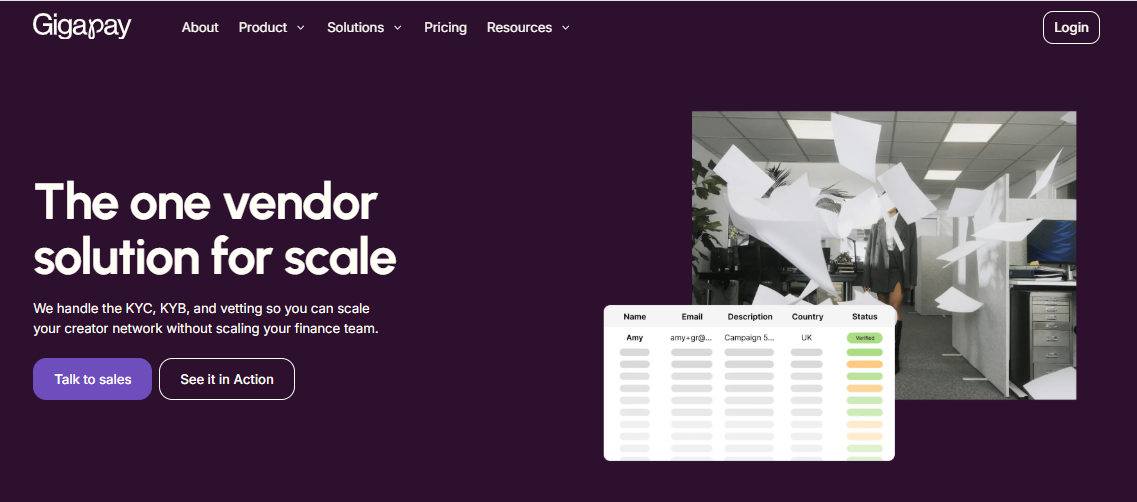
Gigapay is the merchant of record for creator payouts that verifies, onboards, and pays creators in 65+ countries under a single vendor relationship, so brands never have to choose between moving fast and staying safe.
Vendor onboarding is where that choice gets made: every supplier, contractor, or creator you activate is either a verified counterparty or an open door.
This article breaks down how KYC and KYB verification actually work, which checks stop fraud before the first payment, what verification requirements look like across countries, and how to compress the entire process without losing control.
Key Takeaways
- KYC verifies individuals, KYB verifies businesses, and both belong before any first payment.
- 57% of middle-market firms detect fraud only after settlement, when recovery rarely succeeds.
- Every vendor needs identity, tax ID, bank ownership, and sanctions checks before activation.
- Grey-listed countries require enhanced due diligence, as of the March 2026 FATF update.
- A merchant of record replaces hundreds of individual vendor checks with one verified counterparty.
Why Vendor Onboarding Became the Main Fraud Entry Point in 2026
The most damaging fraud attempts no longer arrive through hacked systems. They arrive through the vendor master file. A new supplier submits plausible documents, an existing vendor emails a "bank account update," and the payment leaves through a channel your team approved.
The numbers show how fast this shifted. The Association for Financial Professionals reported that 45% of companies were targeted by vendor imposter fraud in 2024, up from 34% the year before. Veriff's Fraud Industry Pulse Survey 2026, based on responses from nearly 1,200 fraud and compliance decision-makers, found that more than 78% expect AI and deepfake-powered fraud to grow through 2026.
Fraudsters now generate convincing registration documents, cloned invoices, and synthetic identities at a volume no manual review process was designed to handle.
The middle-market data makes the cost concrete. PYMNTS found that firms with high payment uncertainty carry fraud and non-clearance costs equal to 42 basis points of annual revenue, roughly double the level of firms with stronger verification.
For a company paying out €50 million a year, that gap is worth around €105,000 annually. Vendor onboarding is where that gap opens or closes.
The Real Cost of Manual Vendor Verification for Creator Programs
Creator and contractor programs multiply the problem because the counterparties multiply. A brand running 600 creator collaborations a year is effectively running 600 vendor onboarding processes: collecting tax IDs, validating bank details, checking registrations, and chasing missing documents across time zones.
Gigapay’s internal ROI analysis puts the manual cost of that volume at roughly €139,590 per year, driven by about 840 admin hours, vendor sprawl in the ERP, and repeated error-correction cycles. Each of those 600 creators becomes a separate vendor record that someone has to verify, maintain, and eventually deactivate.
Gigapay’s 2024 State of Influencer Payments research, produced with Billion Dollar Boy, Meltwater, The Influencer Marketing Factory, and Wild, found payment terms stretching to 120 days at some enterprises, largely because verification and vendor setup consume the calendar before any money moves.
Slow verification also costs revenue on the other side. Finance teams that cannot verify a nano-creator without a registered company simply block the collaboration. Marketing loses the campaign, the creator loses the income, and the fraud risk was never the reason.
What Is KYC and KYB Verification in Vendor Onboarding?
KYC and KYB are the two verification layers that confirm you are paying who you think you are paying. They answer different questions, and most creator programs need both.
KYC: Know Your Customer for Individuals
KYC (Know Your Customer) verifies the identity of a natural person before they can receive funds. In practice this means confirming a government-issued ID, full name, date of birth, address, nationality, and tax identification number, then matching the payout account to that verified identity. For creators working as individuals without a registered business, KYC is the entire verification stack.
At Gigapay, every user completes KYC before receiving any compensation. Swedish individuals verify through BankID or a passport or national ID. International individuals provide name, address, TIN, nationality, date of birth, a copy of ID, and bank account details, plus documents like an A1 form where relevant.
Nobody gets paid without providing everything requested.
KYB: Know Your Business for Companies and Sole Traders
KYB (Know Your Business) verifies a legal entity: company registration number, official name, registered address, VAT number, and the people behind the business. It confirms that the supplier exists, is active, and is legally allowed to invoice you.
For clients, we apply the same discipline in reverse. Brands and agencies cannot self-onboard to Gigapay. They go through a sales process, share their company registration number and office address, and sign a service agreement before anything moves. Full control over who enters the system is the first fraud control, on both sides of the transaction.
The Difference That Matters for Fraud Prevention
KYC catches stolen and synthetic identities. KYB catches shell companies, fake registrations, and imposters trading on a real company's name. A vendor onboarding process that runs only one of the two leaves the other door open.
Creator programs are unusual because the same campaign can include individuals, sole traders, and limited companies, which means the onboarding flow has to route each counterparty to the right verification path automatically.
The Five Verification Checks Every Vendor Onboarding Process Needs
1. Identity Verification Against Official Documents
Confirm the person or the entity's representatives against government-issued documents, not against a form they filled in. For individuals, that means ID document checks and, where available, bank-grade methods like BankID. For non-nationals, it extends to residence and work permits.
Gigapay runs an internal process that tracks permit and contract expiry dates, because a permit that was valid at onboarding can expire by payout day, and users with expired permits cannot receive compensation.
2. Tax ID and VAT Number Validation
A tax identification number ties the counterparty to a real tax record. Validate the TIN format for the country, and validate VAT numbers against official registries where the vendor claims VAT registration.
This check does double duty: it blocks fabricated entities and it feeds the tax reporting you are legally required to file later. Skipping it at onboarding means rebuilding the data under deadline pressure at reporting time.
3. Bank Account Ownership Verification
Most successful vendor fraud ends at a bank account the fraudster controls. Verifying that the payout account belongs to the verified identity or entity closes the single most exploited gap, including the classic business email compromise pattern where a "vendor" emails new bank details mid-relationship.
PYMNTS found that firms adopting instant bank account verification at onboarding reported substantially stronger fraud reduction than firms verifying later or not at all.
4. Sanctions and AML Risk Screening
Screen counterparties and their countries against sanctions lists and AML risk designations before activation. The FATF publishes its high-risk and increased-monitoring lists three times a year, so this check has a shelf life and needs re-running, not filing.
Gigapay tracks these lists continuously and applies extra due diligence to counterparties from grey-listed jurisdictions, which is covered in detail below.
5. Ongoing Monitoring, Not One-Time Approval
Verification at onboarding proves who the vendor was on day one. Companies dissolve, permits expire, countries move onto risk lists, and bank details change. Treat the vendor file as a living dataset: re-verify on material changes, re-screen when risk lists update, and require the same verification rigor for a bank detail change as for a new vendor.
The AFP data shows vendor imposter fraud concentrating exactly on established relationships, where trust has replaced checking.
How to Verify Creators and Contractors Fast Without Killing Conversion
Speed and verification are treated as opposites, and for most vendor onboarding processes they are. The fix is removing friction that does not verify anything, while keeping every check that does.
The biggest false requirement in creator onboarding is business registration. Requiring every creator to have a registered company and VAT number does not reduce fraud; it reduces creators. It filters out exactly the nano and micro segment where campaign performance is often strongest.
Gigapay’s onboarding is built so creators can verify as an individual, a sole trader, or a company, with no business registration required to get started. The verification is complete either way, because it is matched to the counterparty type rather than forcing one shape onto everyone.
The results show what verified speed looks like. Boozt tripled its creator collaborations without expanding the team after switching, specifically because nano and micro creators could finally clear onboarding. Our creator NPS sits at 88, and once a creator is verified, payouts land instantly through local rails like SEPA Instant, Faster Payments, and ACH. Verification done once, properly, unblocks everything after it.
Three practical rules keep conversion high without weakening checks. Collect everything in one structured flow instead of email back-and-forth, because every additional request loses a percentage of vendors. Sequence checks so automated validations run in seconds and only exceptions reach a human. And tell the counterparty exactly what is needed and why, because abandoned onboarding is usually confused onboarding.
Country-Specific Verification Rules That Change What You Collect
Vendor verification is not one checklist. The data you must collect, and the counterparty types you can legally pay, change by country. These examples come directly from our legal team's 2026 country research.
Austria
From March 2026, commercial influencers must hold a Gewerbeschein (trade license) registered under the advertising trade. Verifying that registration is now part of onboarding Austrian creators, alongside checking VAT status against the Kleinunternehmer threshold, which was raised to €55,000 gross from January 2025.
Bosnia and Herzegovina
The country runs three separate tax regimes. Onboarding has to confirm whether each creator operates in the Federation, Republika Srpska, or the Brčko District, because that determines the applicable income tax rate and labour law. Self-billing is not allowed, so creators must issue their own invoices, and onboarding terms have to enforce it.
Estonia
Registered sole traders (FIE) and companies can be paid freely. Unregistered individuals cannot be supported under our model without triggering non-resident employer obligations, so onboarding for Estonia filters to registered counterparties only.
Australia
Our legal assessment requires a structural block on onboarding Australian individuals and sole traders, because paying them directly triggers performing-artist withholding of 20% to 47% plus a 12% superannuation obligation. Australian creators onboard through a registered corporate entity, which extinguishes those obligations for the foreign payer.
Bulgaria
As a FATF grey-listed country as of the February 2026 confirmation, all Bulgarian user onboarding runs with enhanced due diligence, including additional KYC documentation and source-of-funds verification.
One process cannot know all of this by default. Either your team maintains country-by-country verification logic across every market you pay into, or your payment partner does.
AML Screening and FATF Risk Lists: When Enhanced Due Diligence Applies
The Financial Action Task Force is the global money laundering and terrorist financing watchdog, and its two public lists define where extra verification is expected. The lists change three times a year, which means AML screening is a calendar item, not a setup task.
As of the March 2026 FATF update:
- The black list (High-Risk Jurisdictions subject to a Call for Action) contains Iran, Myanmar, and North Korea.
- The grey list (Jurisdictions under Increased Monitoring) contains 22 countries, including Bulgaria, Monaco, Kenya, Vietnam, and Venezuela.
Movement is constant: Burkina Faso, Mozambique, and South Africa all came off the grey list in February 2026, while Bosnia and Herzegovina went under review at the June 2026 plenary.
For vendor onboarding, the operational translation is simple:
- Counterparties from grey-listed countries get enhanced due diligence: more documentation, source-of-funds checks, and longer review.
- Counterparties from black-listed countries do not get onboarded.
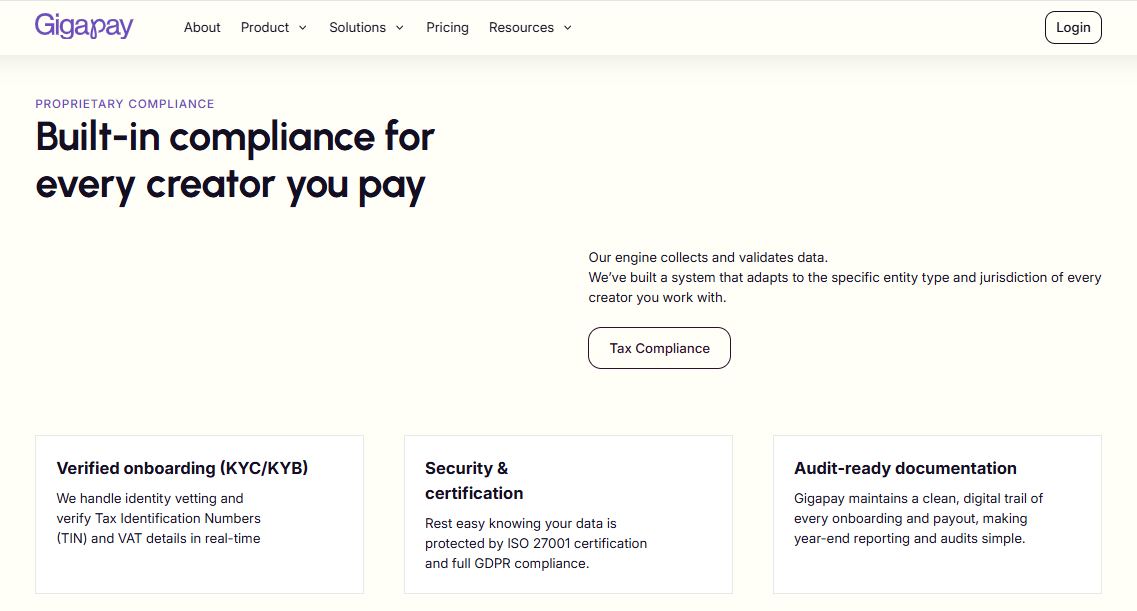
Gigapay tracks every list update and applies extra due diligence to clients and users from grey-listed jurisdictions as standing policy, so the screening never depends on someone remembering to check.
DAC7 and Tax Data Collection: The Verification You Cannot Skip
Tax regulation quietly turned vendor onboarding into a legal data-collection obligation. If you operate a platform paying EU-based sellers or creators, DAC7 requires you to collect and report specific verified data points for each of them: official name, primary address, tax identification number per issuing member state, VAT registration number, company registration number, and any permanent establishment in the EU.
Every one of those fields is a verification checkpoint:
- Collecting them properly at onboarding means your fraud controls and your tax compliance run on the same data.
- Collecting them badly means filing incorrect reports under your own name.
We handle this reporting layer as part of the merchant of record service. DAC7 reports are filed with Skatteverket, the Swedish tax authority, covering qualifying EU sellers. All compensation to private individuals is reported to Skatteverket, and when a creator works in another country, an exchange of income statements passes that information to their local tax authority.
Denmark additionally requires KU14 reporting under the Sweden-Denmark exchange agreement, and Germany's Künstlersozialkasse applies a 4.9% levy on qualifying creative payments over €1,000. Each of these obligations depends on data captured correctly the first time a counterparty onboards.
How a Merchant of Record Compresses Vendor Onboarding to One Check
Everything above describes what proper verification requires per vendor. The merchant of record model changes the number of vendors.
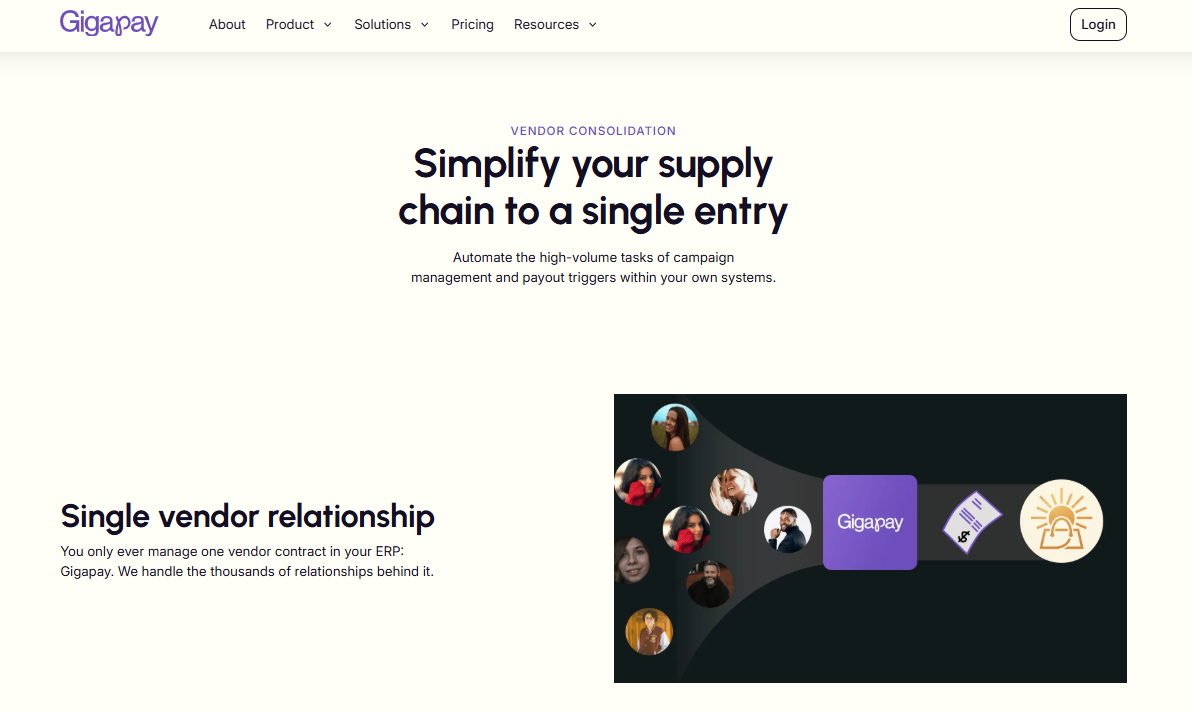
As a merchant of record, Gigapay formally purchases the creator's deliverable and resells it to the brand, becoming the contractual counterparty on both sides. The brand onboards one vendor: Gigapay.
Gigapay onboards, verifies, and pays every creator, carrying the KYC/KYB process, the tax ID validation, the bank verification, the AML screening, and the country-specific rules described in this article. Instead of 300 vendor records in your ERP, each individually verified and maintained, there is one.
Consolidated invoicing cuts invoice volume by around 80%, replacing hundreds of creator invoices with one per campaign. The 600-collaboration brand from earlier drops from roughly 840 admin hours a year to about 60, and from an estimated €139,590 in annual process cost to around €46,350.
WPPMedia's GOAT agency reported that implementing Gigapay significantly diminished time spent managing payments, while keeping tax and compliance intact.
The fraud logic is the part procurement teams notice last but value most. Every payment flows through a single verified counterparty operating under ISO 27001 certification and GDPR compliance, with a documented KYC process behind every payout. The attack surface of hundreds of individually onboarded vendors collapses into one audited relationship.
A Practical Vendor Onboarding Checklist for 2026
For teams running verification in-house, this is the minimum standard the current fraud environment demands.
- Route by counterparty type first: Individuals go through KYC, entities through KYB. One form for everyone verifies no one properly.
- Verify identity against documents, not declarations: Government ID for individuals, registry extracts for companies, permits for non-nationals, with expiry tracking on all of them.
- Validate tax IDs and VAT numbers at intake: Check format and registry status per country, and capture DAC7 fields for EU sellers immediately.
- Verify bank account ownership before the first payment: Then apply the same verification to every subsequent bank detail change, with no exceptions for established vendors.
- Screen against the current FATF lists and sanctions data: Re-screen after each of the three annual FATF updates, and apply enhanced due diligence to grey-listed jurisdictions.
- Apply country-specific rules: Trade license checks in Austria, entity confirmation in Bosnia, registered-counterparty filters in Estonia, corporate-only onboarding in Australia.
- Monitor continuously: Set re-verification triggers for permit expiry, entity status changes, and risk list movement.
Run all seven and the door stays closed. Skip any one and the 57% statistic from the top of this article starts describing your company.

Conclusion
Gigapay is the merchant of record that lets brands verify and pay creators in 65+ countries through one vendor, with KYC/KYB verification, tax data collection, and AML screening built into every onboarding.
Fast vendor onboarding and fraud prevention stop being a trade-off when verification is structured properly: identity, tax ID, bank ownership, and sanctions checks before the first payment, country-specific rules applied automatically, and continuous monitoring after activation.
The alternative, hundreds of individually verified vendor records maintained by hand, is exactly where imposter fraud and 120-day payment terms come from.
Book a demo and see how one verified vendor relationship replaces all of them.
Read Next:
- Best Merchant of Record Platform for U.K. Companies: September 2026 Review
- Supplier Consolidation for Unmanaged Services Spend: One Contract, One Invoice, Many Payees
- Mass Payments Are Not Compliance: What AP Still Owns After the Batch File Leaves
FAQs:
1. What is the difference between KYC and KYB in vendor onboarding?
The difference between KYC and KYB in vendor onboarding is that KYC verifies the identity of individual people while KYB verifies the legitimacy of business entities. KYC checks government ID, tax identification numbers, and bank account ownership for a natural person. KYB checks company registration numbers, VAT numbers, registered addresses, and the people behind the entity. Creator programs typically need both, because the same campaign can include individuals, sole traders, and limited companies.
2. How do you verify suppliers and creators fast without increasing fraud risk?
You verify suppliers and creators fast without increasing fraud risk by automating the checks that machines do better and reserving human review for exceptions. Identity documents, tax ID formats, VAT registries, and bank ownership can be validated in seconds through structured onboarding flows, while country-specific rules and enhanced due diligence cases route to reviewers. Removing false requirements, like mandatory business registration for individual creators, raises speed without touching security.
3. What documents are required for KYC verification of international contractors?
The documents required for KYC verification of international contractors typically include a copy of government-issued ID, full name, address, date of birth, nationality, tax identification number, and verified bank account details. Depending on the country, additional items apply, such as VAT numbers for registered businesses, A1 forms for social security coverage, or residence and work permits for non-nationals. No contractor should receive payment before every requested item is provided and validated.
4. Why is bank account verification important in vendor onboarding?
Bank account verification is important in vendor onboarding because most successful vendor fraud redirects payments to an account the fraudster controls, not to a fake identity. Confirming that the payout account belongs to the verified person or entity closes the gap exploited by business email compromise and vendor imposter schemes, which the AFP found targeted 45% of companies in 2024. The same verification must apply to every bank detail change after onboarding, not only the first setup.
5. Which countries require enhanced due diligence when onboarding vendors in 2026?
The countries that require enhanced due diligence when onboarding vendors in 2026 are those on the FATF grey list, which includes Bulgaria, Monaco, Kenya, Vietnam, Venezuela, and 17 other jurisdictions as of the March 2026 FATF update. Counterparties from these countries need additional documentation and source-of-funds verification, while black-listed jurisdictions, currently Iran, Myanmar, and North Korea, should not be onboarded at all. The lists change three times a year, so screening must be repeated after every update.
.jpg)
.jpg)
.jpg)