.jpg)

74% of marketers plan to increase their influencer marketing budgets in 2026, according to Aspire's State of Influencer Marketing report published in May.
The growth signal is loud, and it is landing in a European regulatory environment where a payment to a creator in Berlin is a different compliance event than a payment to a creator in Madrid, which is a different event again in Stockholm or Paris.
Gigapay is the Merchant of Record for creator payouts that becomes your counterparty across 65+ markets, so tax reporting, self-employment admin, and creator support move off your finance team's desk and onto ours.
Zexel, headquartered in Málaga, built a credible business helping Spanish agencies pay Spanish autónomos through consolidated invoicing.
This article breaks down what changes the moment a creator program stops being Spain-only, which country-specific obligations appear next, and how Gigapay and Zexel actually compare on the parts that decide whether a pan-EU program stays compliant at scale.
Key Takeaways
- Gigapay is a Merchant of Record covering 65+ markets, with automated DAC7, KU14, and KSK filings.
- Zexel is a Spain-first invoicing platform built around autónomo self-billing and Modelo 238 reporting.
- Gigapay pays creators instantly when pre-funded, through one contract, one invoice, and one counterparty.
- Beyond Spain, Zexel routes payments through Wise, PayPal, and bank rails without owning the compliance layer.
- For pan-EU creator programs, Gigapay is the platform that owns the liability line as volumes scale.

Why Paying Creators Beyond Spain Became a Compliance Problem in 2026
European creator marketing is scaling faster than the payment infrastructure behind it. 72% of European brands planned to increase influencer budgets in 2026 according to the Kolsquare and NewtonX State of Influencer Marketing in Europe report, up sharply from 54% the year before.
The median annual spend across Europe now sits at €175,000, and 14% of German and UK brands invest more than €1M a year in creator programs. Volume growth is being driven mostly by nano and micro creators, which means the same campaign budget now spreads across ten times the number of payees it did three years ago.
That growth landed squarely on top of the biggest wave of creator-payment regulation the EU has ever produced.
- DAC7 obliges platforms to collect and verify seller tax data and file annual reports to a lead Member State authority.
- Germany's Deutsche Rentenversicherung has been running out-of-cycle KSK-only audits with fines up to €50,000 per report.
- The EU Platform Work Directive lands its transposition deadline on 2 December 2026.
- France's e-invoicing obligations kick in for all companies from 1 September 2026 alongside Loi Influence 2023-451.
- The UK's umbrella JSL rules went live 6 April 2026 and put agencies and end-clients on the hook for umbrella PAYE.
Every payment to a creator is now a compliance event, and it is a different event in every market a program touches.
How the Compliance Stack Changes Country by Country Across the EU
Spanish autónomo rules are strict, but they end at the Spanish border. A German creator with 40,000 followers sits inside the KSK regime, where the client company owes a 4.9% Künstlersozialkasse contribution on creative payments above €1,000.
- A Swedish creator without a company falls under the egenanställning framework and KU14 kontrolluppgifter obligations, with missing filings triggering per-seller fines from SEK 2,500 to SEK 12,500.
- A French creator sits inside Loi Influence 2023-451, which mandates written contracts above €1,000 per advertiser per year.
- A UK creator paid through an agency sits inside IR35 fee-payer liability and the umbrella JSL rules.
- A Danish creator falls into KU14 as well, under the Sweden-Denmark exchange agreement.
Each country adds its own reporting form, its own withholding trigger, its own labor classification test, and its own audit cycle. Any platform whose compliance stack was built around one country's rules will surface those gaps the second a program crosses the border, and the client company is the one holding the exposure.
What Gigapay Is and How It Pays Creators Across 65+ Markets
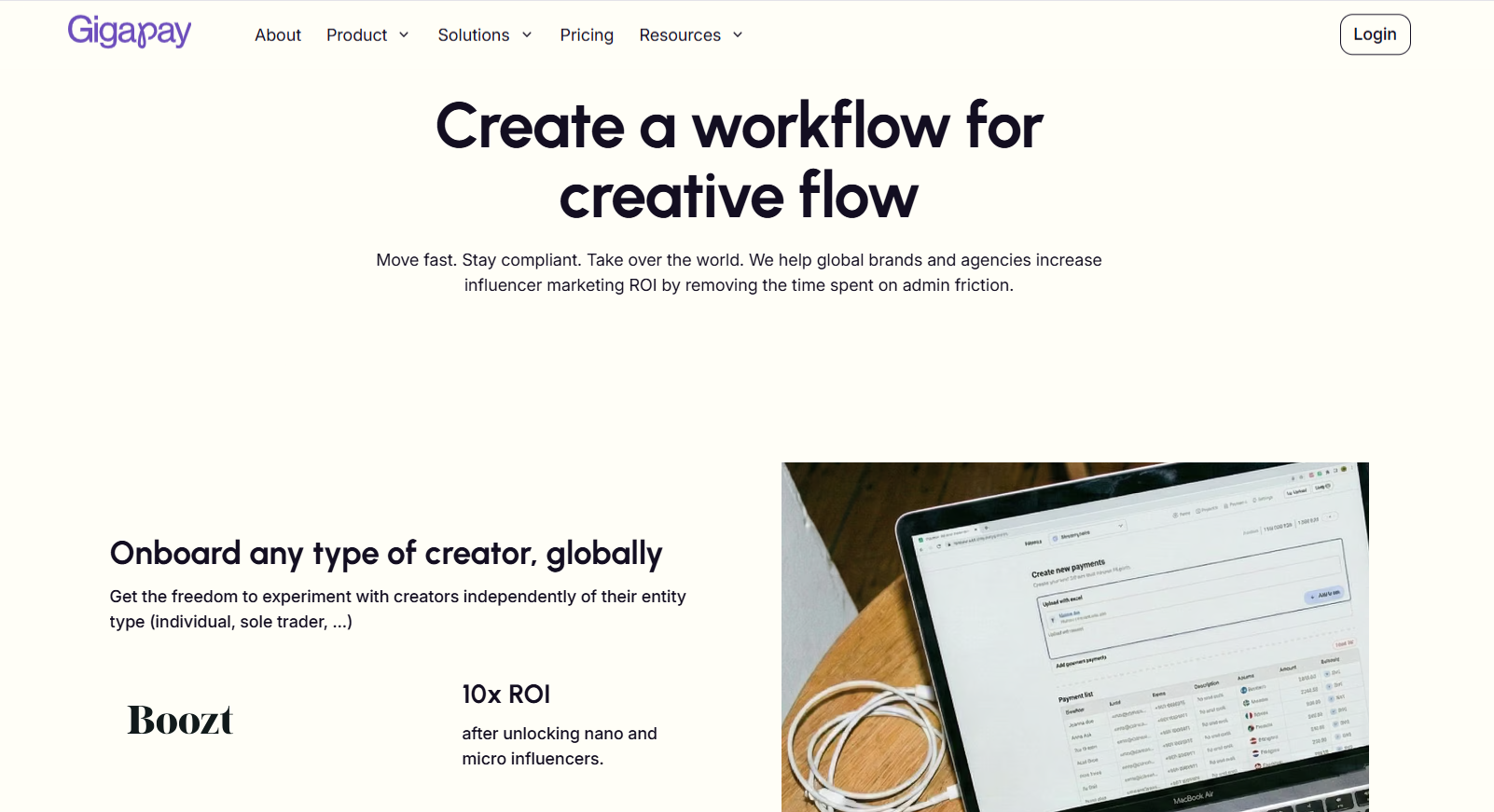
Gigapay is a Merchant of Record for creator payouts, headquartered in Stockholm and operating across 65+ markets and 50+ currencies. A brand or agency uploads a spreadsheet or calls the API, and creators get paid.
On the platform's side, Gigapay becomes the counterparty between the client and the creator, absorbing the tax reporting, self-employment admin, and creator support that would otherwise sit inside the client's finance function. In practice, that turns hundreds of individual creator vendors into one auditable vendor of record in the client's ERP.
The company was founded in 2019, launched in 2020, and has raised roughly $11M from investors including Time to Raise, Mastercard Lighthouse, Forward VC, and TheVentureCity. Customers include Boozt, Radisson, WPPMedia's Goat Agency, Cure Media, AdRecord, and Once Upon.
Kolsquare, one of Europe's larger influencer marketing platforms, uses Gigapay as its exclusive payout partner, which means creators can invoice and receive payment directly inside the Kolsquare workflow.
How Gigapay's Merchant of Record Model Works for Creator Payouts
Under a Merchant of Record model, Gigapay formally buys the creative deliverable from the creator and resells it to the client, becoming the counterparty between the two. That structure matters because it changes the answer to the regulator's question of "who is the payer of record?" The answer is Gigapay, which means the associated tax and reporting obligations flow to Gigapay accordingly.
The mechanics are defined in Gigapay's service agreement §3, and the Spanish tax authority (AEAT) has confirmed Gigapay's role as a "simple payment mediator" without creating a Spanish permanent establishment.
The practical effects for a finance team are three:
- Hundreds of creator vendor setups collapse into one contract, one supplier record, and one invoice per campaign or cycle, which cuts invoice volume by roughly 80% for programs running at scale.
- KYC and KYB checks on each creator happen inside Gigapay, so a brand's procurement team does not have to onboard every payee.
- The tax and reporting layer that would otherwise sit inside the client's compliance function moves to Gigapay, along with the creator support inbox.
Which EU Compliance Obligations Gigapay Handles Automatically
Gigapay files DAC7 reports as the platform operator to Skatteverket, which then exchanges the data with each seller's local tax authority under EU rules. It files KU14 kontrolluppgifter in Sweden, and, under the Sweden-Denmark exchange agreement, it covers the Danish side of KU14 as well. It handles KSK levy calculation and reporting in Germany, currently the hottest EU enforcement zone, with the NRW criminal probes covering roughly €300M in suspected evasion and roughly 200 proceedings underway.
It handles §50a foreign-artist withholding in Germany. It applies reverse-charge VAT on cross-border B2B invoices under EU Directive Article 44. As of July 2026, Gigapay supports Spain within the same pan-EU setup, so Spanish autónomo invoicing, Modelo 238 scope, and coexistence with Spanish clients' IRPF withholding obligations all sit inside the same one-vendor architecture.
Payouts settle instantly when the client account is pre-funded, routed through SEPA Instant across the EU, Faster Payments in the UK, and ACH in the US. Creators onboard as individuals, sole traders, or companies, without needing a registered business or VAT number.
The Gigapay API is public, documented at developer.gigapay.se, and typical integrations complete in two to five days. The platform is ISO 27001 certified and GDPR compliant.

What Zexel Is and Where It Fits in the Spanish Creator Payments Market
Zexel is a Spain-native creator payments and invoicing platform, founded in Málaga in 2021 by Valentine Veliz and Clara Herrera Santos. It has raised approximately $922K in a seed round from Angels Capital and Encomenda, and runs with a team of around 18 people.
The product, marketed as Zexel Pay, helps brands, agencies, and platforms request payments to creators and receive a consolidated invoice on their behalf, plus tax advisory services for Spanish creators who need to set up as autónomos.
The Zexel value proposition is unambiguously Spanish. Its founders and its team are based in Málaga, its content and creator-facing materials are primarily in Spanish, and its regulatory expertise centers on Spanish tax rules: IRPF withholding, autónomo registration and RETA contributions, Modelo 111 and 190 filings, Modelo 238 (Spain's DAC7-equivalent platform-operator report), and RD 1619/2012 self-billing rules. Inside that scope, the product does its job well.
What Zexel Covers Inside Spain, and Where Its Coverage Ends
Inside Spain, Zexel Pay solves a specific problem cleanly. Any brand or agency running a Spanish influencer program has to deal with autónomos who invoice per campaign, non-autónomos who cannot legally invoice at all, and Modelo 238 platform-operator reporting for creators earning above the DAC7 threshold.
Zexel consolidates those payments into a single invoice per cycle, provides tax advisory to Spanish creators so their invoices are legally coherent, and handles the autónomo/non-autónomo split inside a single flow.
Outside Spain, the picture changes. Zexel's marketing materials describe support in over 100 countries and 150+ currencies. Under the hood, payments to non-Spanish creators route through third-party rails such as Wise, PayPal, and standard bank transfers, without Zexel owning the compliance layer in the destination country.
That has three consequences that surface as programs scale. Zexel files Modelo 238 in Spain, but does not act as the reporting platform operator to a lead Member State authority for full EU DAC7 coverage, does not file KU14 kontrolluppgifter in Sweden or Denmark, and does not file KSK contributions or §50a withholding in Germany.
Its platform runs on CSV upload and web UI, without a public API. Payouts settle in days because third-party rails settle in days.
Gigapay vs Zexel: How They Compare on the Parts That Decide a Pan-EU Program
The most useful frame for comparing Gigapay and Zexel is not "which one has more features," but "which one owns the compliance line in each country a creator gets paid in." That is where the two platforms diverge cleanly.
- Gigapay owns the counterparty structure across 65+ markets, including automated DAC7, KU14 (Sweden and Denmark), KSK and §50a (Germany), reverse-charge VAT (EU-wide), and, as of July 2026, Spanish autónomo coverage.
- Zexel owns the counterparty layer inside Spain, and hands payments off to third-party rails everywhere else.
For a program that lives entirely inside Spain, Zexel's autónomo tooling is a legitimate fit. For a program that runs even partly outside Spain, the client company is the one holding the DAC7, KU14, and KSK exposure that Zexel does not file for, and the shape of the risk is retroactive: DAC7 data is already feeding tax-authority audits across the EU, and Germany's DRV runs KSK audits going back five years.
Operationally, the two platforms sit in different weight classes. Gigapay integrates via a public REST API in 2–5 days, exposes webhooks, and plugs directly into Kolsquare's workflow. Zexel operates on CSV upload and UI, which caps how well it scales past a few hundred creators per cycle and how tightly it integrates into a mid-market marketing stack.
Gigapay vs Zexel Comparison Table

Pros and Cons of Gigapay for Pan-EU Creator Payments
Gigapay pros:
- Merchant of Record structure across 65+ markets absorbs the counterparty and reporting liability.
- Automated DAC7, KU14, KSK, and §50a filings cover the four heaviest EU compliance obligations.
- Instant payouts when the client account is pre-funded, across SEPA Instant, Faster Payments, and ACH.
- Public REST API and 2–5 day integration timeline.
- ISO 27001 certified and GDPR compliant.
- Creator NPS of 88, with clients covering the fees so creators keep what they earn.
- Consolidated invoicing at pan-EU scale, with roughly 80% invoice-volume reduction cited by customers.
- Spanish autónomo support live as of July 2026, so pan-EU programs no longer have to route Spain separately.
- Exclusive payout partner inside Kolsquare.
Gigapay cons:
- 4.9% headline rate is higher than DIY payment rails like Wise or Stripe Connect.
- Enterprise volume discounts require €1.8M+ annual payout volume.
- The Merchant of Record model requires the client's legal team to be comfortable with a third-party counterparty structure.
Pros and Cons of Zexel for Spanish Creator Payments
Zexel pros:
- Deep autónomo expertise and Spanish-language tax advisory for Spanish creators.
- Consolidated invoicing solves the Modelo 238 problem cleanly inside Spain.
- Established relationships with Spanish agencies and Spanish creators.
- Solid coverage of non-autónomo creator payments inside Spain.
- Lower headline fee for high-volume Spain-only programs.
Zexel cons:
- Compliance stack ends at the Spanish border.
- No KSK filings for Germany, no KU14 for Sweden or Denmark, no §50a foreign-artist withholding.
- DAC7 scope is partial (Modelo 238 only), not full EU platform-operator reporting.
- No public API, only CSV upload and UI.
- Payouts settle in days, not instantly.
- Small team and seed-stage funding constrain roadmap velocity.
Payout Speed and Creator Experience Compared: Gigapay vs Zexel
Gigapay's creator NPS sits at 88, which is genuinely high for a payment platform. Two things drive that number:
- Payouts settle instantly when the client account is pre-funded.
- EarlyPay gives creators an optional bridge to access scheduled funds before settlement.
Fees are covered by the client on all new plans, so creators keep what they earn. On the operations side, creators can onboard as individuals without a registered company or VAT number, which removes the friction that stops nano and micro creators from getting into a program in the first place.
Zexel does not publish a creator NPS. Its creator experience is anchored in tax advisory sessions delivered in Spanish, which is genuinely valuable for autónomos figuring out their invoicing setup, but that value does not translate to a German, French, or Swedish creator whose only question is when the money will land in their account. Payouts settle in days because third-party rails settle in days.
Creator retention is not a soft metric. A program losing top creators over payment friction pays for that loss in the next campaign brief that goes unaccepted.
Pricing Compared: Gigapay's Total Cost of Ownership vs Zexel's Headline Rate
- Gigapay lists at €279/month plus 4.9% of payout volume, with Enterprise tiering above €1.8M annual payout volume that includes EarlyPay, a dedicated CSM, and unlimited users.
- Zexel prices in a hybrid model of roughly 2.9% to 5% or SaaS-plus-per-payment, published in a way that makes direct comparison hard without a quote.
On headline rate, the two platforms look similar in the middle of their bands, with Gigapay at the upper end. On total cost, the picture reshapes once compliance risk enters the frame. Manual payment processing carries a hidden all-in cost of roughly €40–60 per payment when you include AP labor, bank FX, and reconciliation error cycles (Ardent Partners 2025 estimate).
Zexel's fees are competitive for Spain-only volume, but the compliance depth is Spain-only, which means the client company keeps the liability for every non-Spanish creator payment on its own balance sheet.
Gigapay's 4.9% covers the counterparty status, the automated filings across 65+ markets, consolidated invoicing that cuts document volume by roughly 80%, and the removal of roughly 840 admin hours per year for a program running 600 collaborations annually.
The right unit of comparison for a pan-EU program is total cost of ownership including compliance risk, not the headline percentage.
Which Platform Is the Better Choice for Paying Creators Beyond Spain
Zexel is the right choice when a creator program is 100% Spanish, runs in Spain, does not need API integration, and does not need instant payouts. For that narrow shape of program, the autónomo tooling is a good fit and the platform earns its keep inside its own market.
Gigapay is the better choice for any program that has creators outside Spain, DAC7 exposure across multiple EU member states, KSK exposure in Germany, KU14 exposure in Sweden or Denmark, an API integration requirement, a workflow inside Kolsquare or a similar campaign platform, or a target of running the program without adding finance headcount as volume grows.
With Spain support live from July 2026, Gigapay is also the better choice for programs that include Spain alongside other markets, because the whole compliance stack sits inside one counterparty relationship instead of two.
Conclusion
Gigapay is the Merchant of Record for creator payouts that turns hundreds of vendor setups into one auditable counterparty across 65+ markets, with tax reporting and creator support absorbed as part of the service.
Zexel does one country well, and for a purely Spanish program that fits its shape, it is a legitimate option. For any program that will grow past Spain into Germany's KSK, France's Loi Influence, the UK's IR35/JSL, and the Nordics' KU14 obligations, the platform that owns the liability line is the one that keeps the program compliant as volumes scale.
Book a demo to see the pan-EU compliance stack running against your own creator payment volume.
Read Next:
- How to Pay Influencers: Every Compensation Model Explained (Flat Fee, Commission, Gifting, Hybrid)
- Reverse Charge VAT: Complete Resource Guide in 2026
- Where a Merchant of Record Fits in Your AP and Finance Stack
FAQs:
1. What Is the Best Platform for Paying Creators Beyond Spain in 2026?
The best platform for paying creators beyond Spain in 2026 is Gigapay, because its Merchant of Record structure covers 65+ markets with automated DAC7, KU14, KSK, and §50a filings, while turning hundreds of individual creator payments into one vendor of record for the client company.
2. How Does Gigapay Handle German KSK Compliance That Zexel Does Not?
Gigapay handles German KSK compliance that Zexel does not by acting as the Merchant of Record and automating the 4.9% Künstlersozialkasse levy reporting on creative payments above €1,000, while Zexel routes payments to German creators through third-party rails such as Wise and PayPal and does not file KSK contributions on the client's behalf.
3. Is Zexel a Merchant of Record Like Gigapay?
Zexel is not a Merchant of Record like Gigapay. Zexel operates as a Spanish consolidated invoicing platform, providing invoice consolidation and autónomo support inside Spain, without absorbing tax and reporting liability across other EU member states the way a Merchant of Record does.
4. Can Zexel File DAC7 Reports Across All EU Member States Where a Creator Earns Income?
Zexel cannot file DAC7 reports across all EU member states where a creator earns income. Its DAC7 scope is limited to Spain's Modelo 238 platform-operator report, and it does not act as the reporting platform operator to a lead EU Member State authority the way Gigapay does through Skatteverket, which then exchanges the data with each seller's local tax authority under EU rules.
5. How Fast Do Creators Get Paid on Gigapay Versus Zexel?
Creators get paid on Gigapay instantly when the client account is pre-funded, through SEPA Instant across the EU, Faster Payments in the UK, and ACH in the US. On Zexel, creators are paid over several days because payouts route through third-party rails such as Wise, PayPal, and standard bank transfers, and instant rails are not the default across the markets Zexel supports.
.jpg)
.jpg)