.jpg)

Instagram remains the primary platform for 57% of brands running influencer marketing in 2026, and global influencer marketing spend is on track to surpass $40 billion this year.
Gigapay is the mass creator payout platform that lets brands and agencies pay hundreds of Instagram creators across 65+ countries from a single vendor relationship, with tax compliance and reporting handled automatically.
The volume of creators in a modern Instagram program now sits well outside what a finance team can manually administer, and the regulatory layer wrapping cross-border creator payments has tightened sharply over the past two years.
This guide answers the question directly: what is the best way to pay Instagram influencers internationally in bulk in 2026, why that is the best way, and how to evaluate the options on the market.
Key Takeaways
- A Merchant of Record platform is the best way to pay Instagram influencers internationally in bulk.
- One vendor in the ERP replaces 300+ creator records and 80% of invoices.
- Local payment rails like SEPA Instant, Faster Payments, and ACH deliver funds instantly.
- DAC7, KSK, KU14, and UAE permit requirements are handled at the platform level.
- Brands running 600 collaborations a year save roughly €93,000 by consolidating payouts.
The Best Way to Pay Instagram Influencers Internationally in Bulk in 2026
The best way to pay Instagram influencers internationally in bulk in 2026 is through a Merchant of Record (MoR) creator payout platform that becomes the formal contractual counterparty to each creator.
The brand uploads a list of creators and amounts or sends them through an API, the platform handles onboarding, KYC, tax validation, and reporting, and creators receive funds instantly through local payment rails in their own currency.
The brand sees one vendor in its ERP, one invoice per campaign, and zero exposure to the cross-border tax administration that would otherwise sit with internal finance.
Gigapay is the category-defining example of this model. The platform purchases the creator's deliverable and resells it to the brand client, which makes Gigapay the legal counterpart and shifts most of the administrative and tax responsibility off the brand.
The same architecture supports payouts across 65+ countries and 50+ currencies, with automated reporting under DAC7 in the EU, KSK in Germany, and KU14 in Sweden.
Why a Merchant of Record Is the Best Way to Pay Instagram Influencers in 2026
Four reasons make Merchant of Record the answer for any brand serious about scaling Instagram creator programs.
1. One vendor instead of 300
The brand's ERP holds one supplier record (Gigapay Sweden AB) regardless of how many creators get paid. Finance teams stop opening, validating, and maintaining hundreds of individual vendor entries, which alone removes most of the operational drag from a creator program. Brands running 600 collaborations a year drop from 300+ vendor entries to one.
2. Compliance liability transfers
A payment processor moves money. A Merchant of Record becomes the contractual counterparty to the creator, which means tax reporting under DAC7, KSK levy calculations in Germany, KU14 filings in Sweden, and verification of UAE influencer permits all happen at the platform level. The brand does not have to build internal expertise in every jurisdiction it pays into.
3. Instant payouts through local rails
The fastest creator payouts move through local payment infrastructure, not international wire transfers. SEPA Instant covers the EU, Faster Payments covers the UK, ACH covers the US.
A creator in Berlin gets paid the same day they invoice, in euros, into their domestic bank account. A creator in Manchester gets paid the same way, in pounds, through Faster Payments. The platform absorbs the routing complexity.
4. Nano and micro creators stop getting filtered out
A Merchant of Record lets creators onboard as individuals, sole traders, or companies, with no requirement for a registered business or VAT number. That single design choice is what unblocks the long tail of Instagram creators that finance would otherwise reject for lacking the paperwork to be set up as suppliers.
Boozt, one of Gigapay's customers, reported a 3x increase in creator collaborations after adopting the platform, without expanding the team running the program.
What Bulk International Instagram Payments Look Like in 2026
A working Instagram creator program now spans 200 to 500 individual creators per year for most mid-sized brands, and several thousand for the largest.
Nano-influencers represent 75.9% of Instagram's creator base, and brands run them in volume because their engagement rates outperform every other tier. The bulk is structural, baked into how the platform's creator economy now functions.
Each of those creators sits in a different country, files taxes under a different system, prefers a different payment rail, and expects to be paid in a different currency. Without the right infrastructure, finance has to open a vendor record for every one of them, validate tax identities, collect documentation, process invoices, and chase missing details before any payment goes out.
The campaign got greenlit in marketing, but the bottleneck moved downstream to a finance team that was never sized for vendor sprawl at this volume.
The Compliance Layer That Forces the Question
The reason this question matters more in 2026 than it did two years ago is regulatory. Tax authorities across the EU now require platforms and brands to report creator income in detail, and several jurisdictions have moved aggressively to capture social levies on creator payments.
1. DAC7 (EU)
DAC7 requires digital platforms operating in the EU to report income paid to sellers, which includes creators receiving brand sponsorships. The information goes to national tax authorities and gets cross-checked against creator income declarations.
Using a MoR means this reporting happens at the platform level, away from internal finance.
2. KSK (Germany)
Germany's Künstlersozialkasse applies a 4.9% levy on payments to creative talent above €1,000 per year, and the rules now explicitly cover influencer payments. The levy applies to international hires too, which catches most brands paying German creators by surprise.
Gigapay's KSK guide is required reading for any brand operating in the German market.
3. KU14 (Sweden)
Swedish authorities require KU14 reporting on payments to individuals for services rendered, and the system applies to brand payments to creators registered in Sweden. The reporting is handled automatically when a platform operates as the formal counterparty to the creator.
4. UAE Influencer Permits
The UAE's National Media Council introduced influencer permit requirements in 2026 that brands hiring UAE-based creators now have to factor into their compliance workflows. Working with creators who hold the correct permit is now a brand-level legal obligation, alongside the creator's own responsibility.
The pattern across all four regimes is the same. Compliance in 2026 hinges on whether the brand has the systems to demonstrate, on demand, that payments were reported, taxes were tracked, and creators were verified. A Merchant of Record platform meets that bar by default.
How Paying Instagram Influencers With a Merchant of Record Works in Practice
The Gigapay workflow for paying Instagram influencers internationally in bulk runs through five steps:
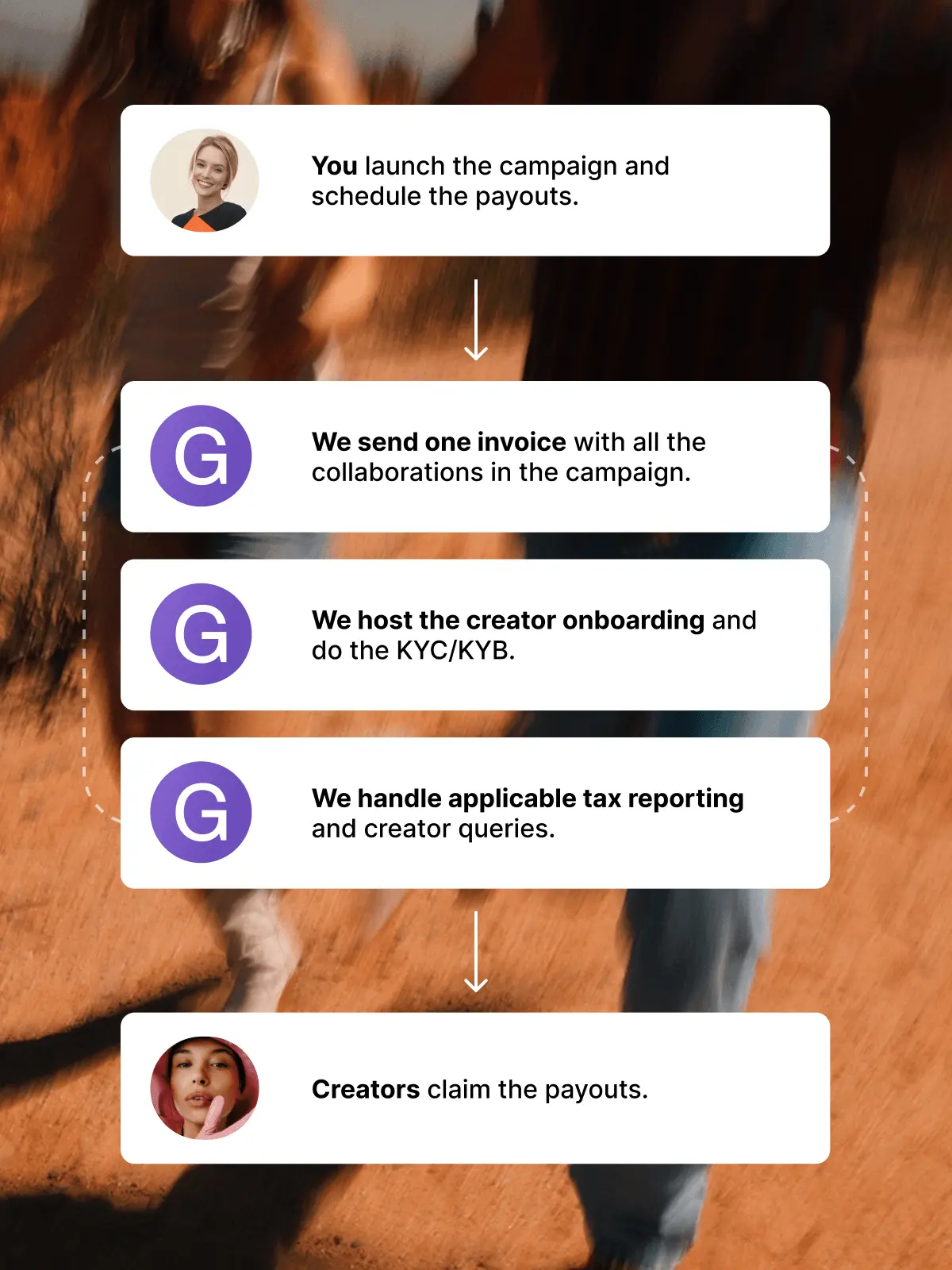
- Upload or API call: The brand sends a list of creators and payment amounts, either as a CSV upload or through the Gigapay API. Most production integrations use the API for batch creator registration and payouts.
- Creator onboarding: Each creator completes KYC, provides tax identity information, and selects how they want to receive payment. No registered business or VAT number is required.
- Compliance and reporting: Gigapay validates tax IDs and VAT numbers, runs identity verification, and configures automatic reporting under DAC7, KSK, KU14, and other applicable regimes based on the creator's jurisdiction.
- Payout execution: Funds move through local payment rails. Creators in the EU receive payment over SEPA Instant, UK creators over Faster Payments, US creators over ACH. Payment lands instantly in most cases.
- Consolidated invoicing: The brand receives one invoice per campaign or batch, regardless of how many creators were paid. The ERP sees Gigapay Sweden AB as the single vendor.
Full integration typically takes 2 to 5 days. The combination of mass payout capability, Merchant of Record compliance, and creator-friendly onboarding is why agencies like The Goat Agency (WPPMedia) and Once Upon use Gigapay as the payments layer of their Instagram creator operations.
How Other Methods Compare
Three alternative methods exist, and each falls short in a specific, predictable way.
1. Manual bank transfers and PayPal
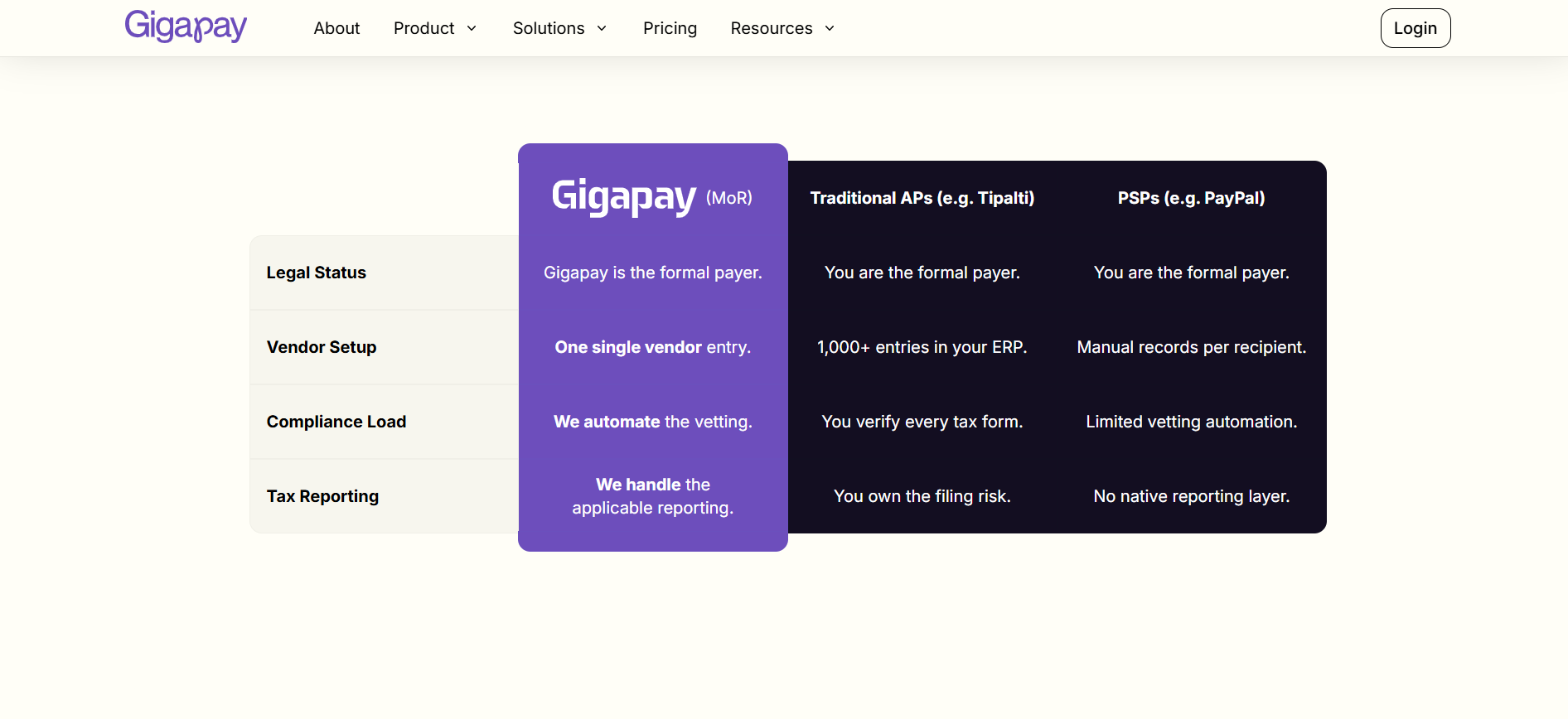
The default starting point for most brands. Finance opens vendor records, validates tax documentation, processes payments through corporate banking or PayPal, and reconciles afterwards. The method works at low volume and collapses at scale, both in administrative cost and in compliance exposure, because none of the tax reporting is automated.
2. General payment infrastructure (Wise, Stripe Connect, Tipalti, PayPal Payouts)
These platforms solve the speed and currency problem. They do not solve the compliance problem. With Stripe Connect, Tipalti, or Wise, the brand remains the legal counterparty to every creator, which means tax reporting, vendor records, and compliance liability stay on the brand's books. The vendor sprawl in the ERP does not disappear.
3. Influencer marketing platforms with payment modules (GRIN, CreatorIQ, impact.com)
Convenient if the platform is already in use for discovery and campaign management. The depth of compliance handling varies significantly across vendors. Most operate as payment processors rather than legal counterparties, which means tax liability stays with the brand.
A Merchant of Record platform is the only model that solves speed, currency, vendor consolidation, and compliance at the same time.
What to Look For When Choosing a Platform
Five evaluation criteria separate the platforms built for Instagram creator programs from the ones repurposed from adjacent categories:
- Geographic and currency coverage: 65+ countries and 50+ currencies is the working benchmark. Anything narrower forces a second payment workflow for uncovered markets.
- Local payment rails: SEPA Instant, Faster Payments, and ACH should be standard. Platforms relying on correspondent banking still take days.
- Merchant of Record status: The single biggest differentiator on compliance. If the platform is not the legal counterparty to the creator, the compliance work stays with the brand.
- Consolidated invoicing and ERP impact: One invoice per batch, one vendor record. Brands running Instagram programs at scale typically see an 80% reduction in invoice volume after consolidating.
- Creator experience: Fast payouts, transparent processes, and human support determine whether top creators agree to a second campaign. Gigapay reports a creator NPS of 88 because it treats the creator side as a feature, not an afterthought.
How to Start with Gigapay
Getting an Instagram creator program live on Gigapay typically takes a working week from first conversation to first payout. The steps below cover the path from initial demo through to consolidated invoicing.
1. Book a demo and choose a plan
The first step is a conversation with the Gigapay team to map your creator volume, geographic spread, and integration requirements.
Three plans are available: the Base plan at €279 per month plus 4.9% per payout, the Startup plan offered through sales for early-stage companies, and the Enterprise plan for brands with €1.8M+ in annual payout volume that includes EarlyPay, a dedicated customer success manager, and unlimited users.
2. Sign the service agreement
The service agreement activates the Merchant of Record relationship. Once signed, Gigapay formally becomes the legal counterparty for the creator deliverables your brand purchases through the platform. This is the step that shifts the tax administrative responsibility off your finance team.
3. Set up your account and sandbox environment
Account setup gives you access to the Gigapay dashboard, the API documentation at developer.gigapay.se, and a sandbox environment that mirrors production. Engineering teams use the sandbox to test integrations against the core endpoints:
- POST /v2/projects/ for campaign setup
- /v2/registrations/ for creator onboarding
- /v2/prepayments/ for funding
- /v2/payouts/ for the payouts themselves
4. Integrate with your existing stack
Full integration typically takes 2 to 5 days for engineering teams familiar with REST APIs. Brands running campaigns through influencer platforms like Kolsquare benefit from the existing direct integration, which routes creator invoicing through Gigapay without a custom build.
Webhook-based event handling keeps internal dashboards and CRMs in sync.
5. Fund your account
Funding currencies include USD, EUR, GBP, SEK, DKK, and NOK. Brands prepay an amount that covers the upcoming batch of creator payouts plus the Gigapay admin fee. The prepayment model is what enables instant payouts on the creator side, because the funds are already sitting in escrow when payouts are triggered.
6. Onboard your creators
Creators receive an invitation link to complete KYC, provide tax identity information, and choose how they want to be paid. They can register as individuals, sole traders, or companies, with no requirement for a VAT number or registered business.
Onboarding is the step that historically blocks nano and micro creators from brand programs, and the platform is designed to make it work for them.
7. Send your first batch payout
The first batch can go out the same day funding clears. Two methods are available:
- CSV upload through the dashboard for ad-hoc campaigns
- Direct API calls for programmatic payouts integrated into your campaign management workflow
Funds reach creators instantly through SEPA Instant in the EU, Faster Payments in the UK, and ACH in the US.
8. Receive consolidated invoicing and compliance reporting
After each batch or at the close of a billing cycle, Gigapay generates a single consolidated invoice for your finance team to process. The ERP sees one supplier record. Tax reporting under DAC7, KSK, KU14, and the relevant regimes for each creator's jurisdiction is filed automatically.
Conclusion
Gigapay is the mass creator payout platform built for brands and agencies running Instagram influencer programs at scale, where the cost of friction between marketing, finance, and creators is highest.
The best way to pay Instagram influencers internationally in bulk in 2026 is through a Merchant of Record platform that consolidates payouts into a single vendor relationship, handles DAC7, KSK, KU14, and UAE permit compliance automatically, and uses local payment rails to send funds instantly across 65+ countries.
Book a demo with Gigapay to send your first international creator payout the same day you sign the contract.
Read Next
- Gigapay Merchant of Record: Full Product Overview
- Self-Billing for Creators: How Gigapay Turns 500 Invoices Into One
- The 2026 Influencer Payment Compliance Report (2026 Data)
FAQs:
1. What is the best way to pay Instagram influencers internationally in bulk in 2026?
The best way to pay Instagram influencers internationally in bulk in 2026 is through a Merchant of Record platform that consolidates payouts into a single vendor relationship, automates tax reporting under DAC7, KSK, and KU14, and uses local payment rails to send funds instantly across 65+ countries.
2. How do brands handle tax compliance when paying Instagram creators in multiple countries?
Brands handle tax compliance when paying Instagram creators in multiple countries by using a Merchant of Record that becomes the formal contractual counterparty to each creator, automates DAC7, KSK, and KU14 reporting, and validates each creator's tax identity and VAT status at onboarding.
3. How much does it cost to pay Instagram influencers internationally in bulk?
The cost to pay Instagram influencers internationally in bulk depends on volume, but Gigapay's base plan starts at €279 per month with a 4.9% admin fee per payout, and enterprise pricing with volume-based discounts applies above €1.8M in annual payout volume.
4. Can brands pay nano and micro Instagram influencers without registered businesses?
Brands can pay nano and micro Instagram influencers without registered businesses by using a Merchant of Record platform like Gigapay, which lets creators onboard as individuals, sole traders, or companies without requiring a VAT number or registered business.
5. How fast can a brand send bulk Instagram influencer payouts internationally?
A brand can send bulk Instagram influencer payouts internationally instantly when using a platform connected to local payment rails such as SEPA Instant in the EU, Faster Payments in the UK, and ACH in the US, instead of routing payments through international wire transfers.
.jpg)