
Shopify merchants sold $115.6 billion of goods in the second quarter of 2026 alone, up 32% year over year, according to Shopify's Q2 2026 results published in August 2026.
A growing share of that volume starts with a creator post, which is why Gigapay operates as the Merchant of Record for creator payouts: the one vendor that pays your creators on your behalf and takes on the compliance, payouts, and support so you don't have to.
Ecommerce teams on Shopify can launch a creator campaign in a day, but paying 50, 200, or 1,000 creators across borders pulls finance into vendor onboarding, tax forms, and invoice chasing that was never designed for individuals.
This article breaks down the best influencer payout setup for ecommerce teams on Shopify in 2026, including the costs, the compliance rules, the workflow, and the numbers you need to build it.
Key Takeaways
- The best influencer payout setup combines one vendor, batch payments, and automated tax reporting.
- Manual influencer payments cost €40–60 each; 600 collaborations consume roughly 840 admin hours yearly.
- US influencer marketing spend reaches $12.17 billion in 2026, growing 15.7% year over year.
- DAC7, KSK, and Loi Influence rules turn every 2026 creator payment into a compliance event.
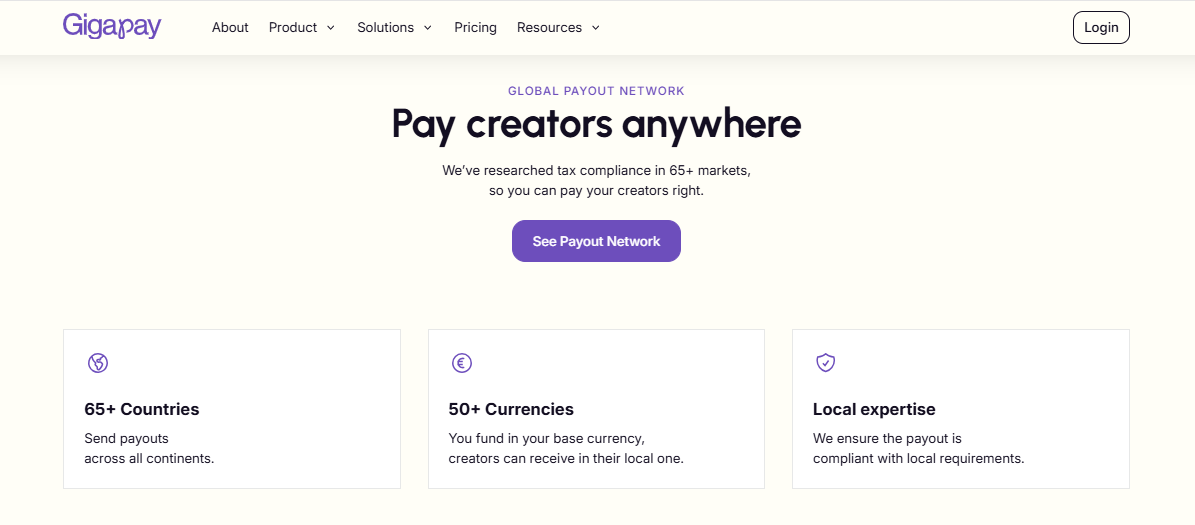
- Gigapay pays creators in 65+ markets through one contract and one consolidated invoice.
Why Influencer Payouts Became a Priority for Shopify Ecommerce Teams in 2026
Creator content now sits at the front of the ecommerce funnel. In the Influencer Marketing Hub 2026 benchmark, 46.67% of brands plan to test social commerce in 2026, and TikTok Shop accounts for 66.17% of the platforms those adopters pick. YouTube reported 13x GMV growth from its shopping affiliate program over two years, with more than 1.3 million creators enrolled as of September 2026.
That growth changed what an influencer program looks like on the operations side. The Shopify brands getting the strongest returns moved from a handful of managed partnerships to hundreds of micro and nano collaborations, because smaller creators hold better engagement: roughly 2.5% for nano creators against 0.7% for mega accounts, with 67% to 73% of marketers now prioritizing micro and nano creators.
Those creators are individuals. Most have no registered company, no VAT number, and no patience for a 45-field supplier form. Payment terms of 30 to 120 days remain common across the industry, and finance processes built for B2B suppliers end up blocking the exact partners marketing needs most.
In 2026, the payout setup, not the campaign strategy, is where influencer programs on Shopify stall.
How Influencer Marketing Spend Is Shifting in 2026
The money keeps moving in. US influencer marketing spend reaches $12.17 billion in 2026, up 15.7% in a single year, and is forecast to pass $13.7 billion by 2027. The global market sits above $32.5 billion and grows roughly 25% per year. Goldman Sachs expects the wider creator economy to reach $480 billion by 2027, up from around $250 billion.;
Budgets follow the same line. In the Influencer Marketing Hub's 2026 benchmark, 87.49% of respondents expect their influencer budget to increase this year, and 72.22% expect an increase of 50% or more. A median 26% of social media budgets now goes to creator spend, up from 18% in 2024.
Two numbers in that data matter specifically for payout planning:
- The top 10% of creators captured 62% of brand payments in 2025, up from 53% in 2023. The remaining budget spreads across a long tail of smaller creators, which is exactly where payment admin per euro spent gets worst.
- 65.9% of marketers expect campaign payback within one month: A payout process that needs three weeks of vendor onboarding per creator consumes the window in which the campaign is supposed to prove itself.
What Is an Influencer Payout Setup for Shopify Stores?
An influencer payout setup is the system an ecommerce team uses to onboard creators, verify their identity and tax status, send payments across markets, and produce the invoices and tax reports each payment requires. It covers five jobs: creator onboarding, payment execution, tax and compliance handling, invoicing, and reconciliation.
On Shopify, the payout setup sits next to the tools you already run. Shopify Collabs and affiliate apps handle discovery, gifting, and commission tracking, and they tell you what each creator earned. They do not answer who the legal counterparty is, how a creator in Germany gets paid without a registered company, or who files the tax reports in January. That second half is the payout setup, and it is the half your finance and legal teams care about.
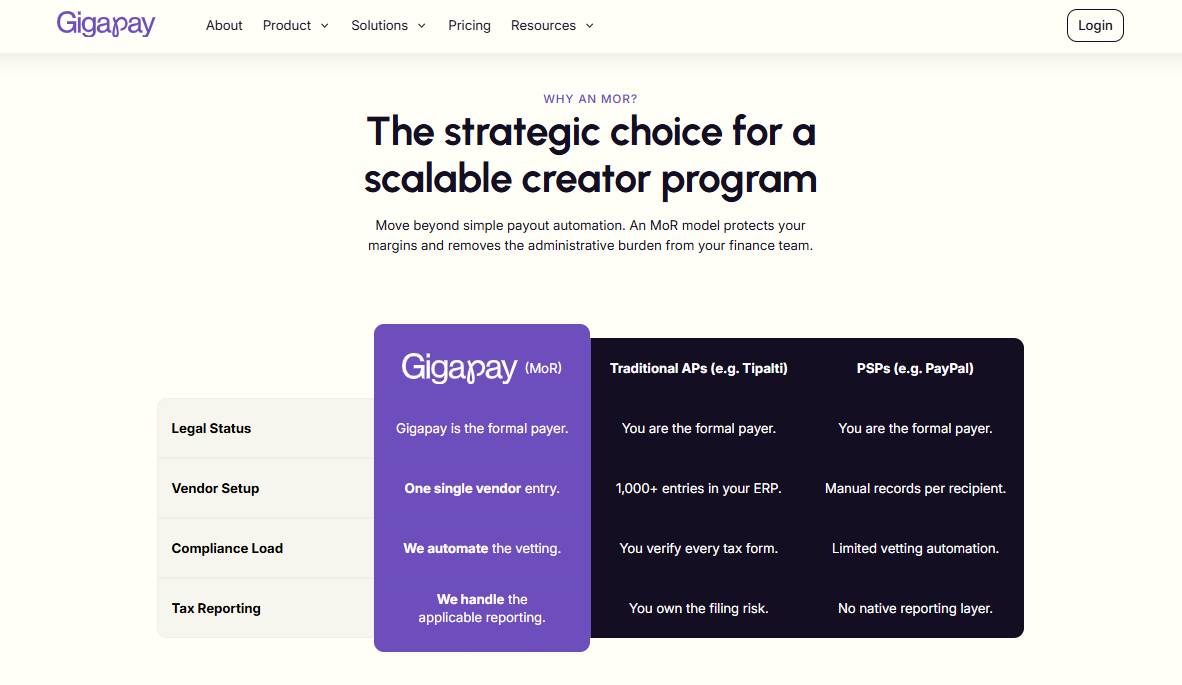
In practice, ecommerce teams choose between four models: manual payments through the bank or PayPal, do-it-yourself rails such as Stripe Connect, accounts payable tools such as Tipalti, or a Merchant of Record such as Gigapay, the one vendor that pays creators on your behalf and takes on the compliance, payouts, and support.
Core Components of the Best Influencer Payout Setup in 2026
A payout setup that scales past 50 creators needs five components working together. Missing any one of them pushes the work back onto your marketing or finance team.
Creator Onboarding and Identity Verification
Every payment starts with knowing who you are paying. The setup needs KYC verification, tax ID and VAT validation, and the ability to onboard a creator as an individual, a sole trader, or a company. The 2026 benchmark is self-serve onboarding in minutes from a payment link, with no registered business required.
Any process that asks a nano creator to register as a supplier in your ERP will lose a share of them before the first payment goes out.
Payment Rails, Currencies, and Speed
Cross-border payouts need local rails, not international wires. That means SEPA Instant in the EU, Faster Payments in the UK, and ACH in the US, with support for 50+ currencies. Speed is a retention tool: creators who wait 60 days for payment take the next campaign from a brand that pays in seconds.
On a Merchant of Record setup, payouts are instant when the account is pre-funded, so the funding flow should be designed around pre-funding from the start.
Tax and Compliance Handling
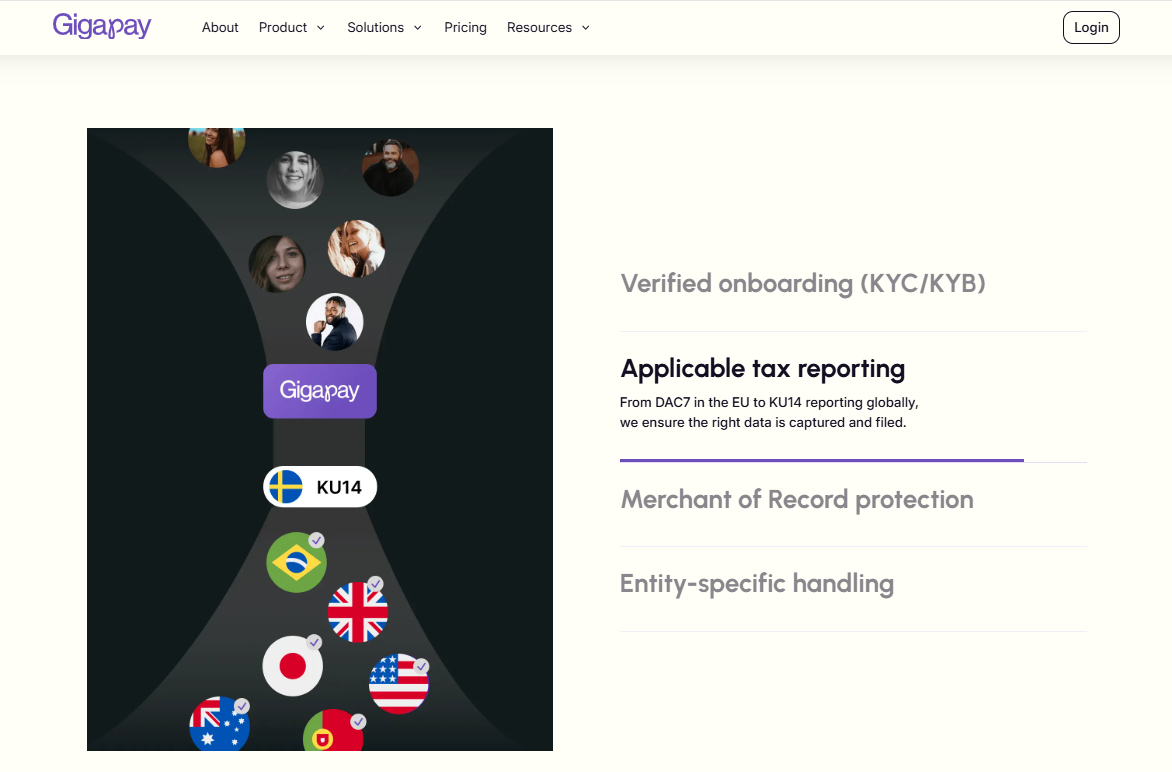
This component decides whether the setup survives an audit. It covers DAC7 seller data collection and reporting in the EU, self-employment status administration, country-specific obligations such as the KSK levy in Germany and KU14 reporting in Sweden, and VAT treatment on cross-border creator invoices. Rails and AP tools move the money and leave this work with you; a Merchant of Record takes it on as the contractual counterparty.
Consolidated Invoicing and Self-Billing
At 300 creators per quarter, invoice volume becomes its own job. The setup should generate self-billing invoices on behalf of creators and consolidate each campaign into one invoice to your finance team. Gigapay's customers cut invoice volume by about 80% this way, and finance reconciles one document per campaign instead of hundreds.
Reporting and Reconciliation
Finance needs one counterparty in the ERP instead of 300+ individual vendor records, a full audit trail per payment, and campaign-level spend data that marketing can map to ROAS. If leadership asks what the influencer program actually cost last quarter, the answer should take minutes, not a week of spreadsheet work.
How to Set Up an Influencer Payout Workflow on Shopify: Step by Step
This is the workflow ecommerce teams running 50 to 5,000 collaborations per year use in 2026.
- Map your creator volume and markets: Count collaborations per quarter, the countries your creators live in, and how many are individuals without a registered company. A program with 20 creators in one market needs a different setup than 400 creators across the EU, UK, and US.
- Pick the payment model before the campaign launches: Manual transfers, Stripe Connect, an AP tool, or a Merchant of Record each carry a different split of cost and compliance work. Switching models mid-campaign means re-onboarding every creator, so decide first.
- Connect campaign tracking to payouts: Shopify Collabs, your affiliate app, or your influencer platform tracks what each creator earned per order or deliverable. Export those amounts as a spreadsheet, or push them through an API, so the payment data never gets retyped by hand.
- Set up the funding flow: Agree with finance how payout runs get funded: a pre-funded balance in EUR, GBP, USD, or local Nordic currencies turns every later payout into a same-day event instead of a treasury request.
- Onboard creators through a self-serve link: Send each creator one link where they verify identity, add payment details, and set their status as individual, sole trader, or company. On Gigapay this takes minutes and requires no VAT number from the creator.
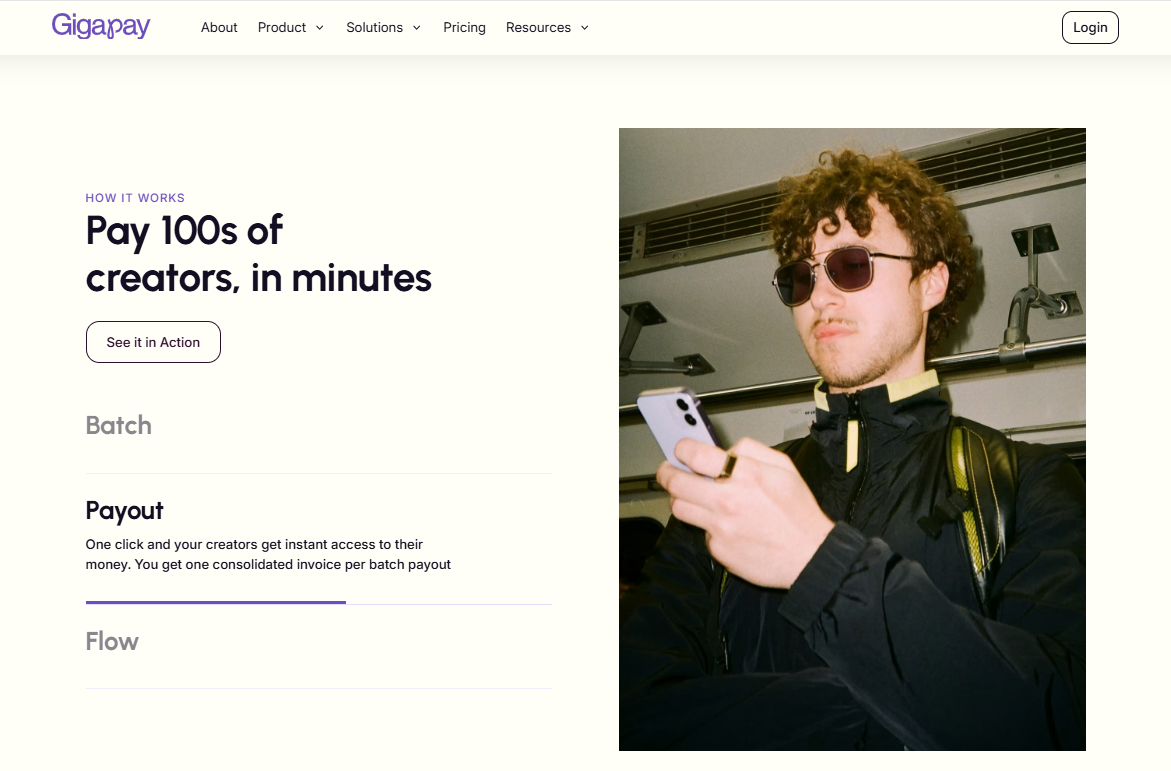
- Run payouts in batches: Upload one CSV per campaign or trigger payments through the API. One batch covers hundreds of creators across 65+ markets, and on a pre-funded account the money lands in seconds over local rails.
- Automate the paperwork: Self-billing invoices generate per creator, finance receives one consolidated invoice per batch, and tax reporting such as DAC7 runs on the data already collected at onboarding. Nothing in this step should require a person after month one.
Teams that follow this workflow keep campaign launch speed in marketing's hands while finance keeps one auditable counterparty, which is the balance the whole setup exists to hold.
Influencer Payout Methods Compared: Cost, Speed, and Compliance
The four models differ less on fees than on who carries the compliance and admin work. This is how they compare for a Shopify team paying creators across borders in 2026.
On headline fees, a DIY Stripe build is the cheapest option, and that math is real. The comparison changes when you price the whole setup: fee rate plus admin hours plus the compliance work that rails leave behind.
For EU cross-border creator payouts, a Merchant of Record lands mid-pack on all-in cost, and it is the only model where the fee buys a transfer of the paperwork rather than just the money movement.
How Much Do Influencer Payouts Cost Ecommerce Teams in 2026?
The full cost of paying influencers has three layers: creator fees, transaction costs, and admin time. Most teams budget the first, estimate the second, and discover the third.
- Creator fees: The median campaign payment runs around $3,000, while 48.7% of creators earn under $10,000 per year from their content. Nano and micro creators typically price at $5–25 CPM, and cost per engagement averages around $0.20 for micro creators against $0.33 for macro accounts, which is a large part of why ecommerce budgets keep shifting toward smaller creators.
- Transaction costs: Depending on the model, these range from under 1% on a DIY build to a platform subscription plus a volume-based fee on a Merchant of Record, with PayPal's cross-border charges and FX spreads sitting at the expensive end per payment.
- Admin time: This is the layer that decides the real budget. Gigapay's operational benchmark for a brand running 600 collaborations per year:
840 hours is roughly 40% of a full-time finance hire spent on onboarding micro-vendors, chasing invoice details, and fixing reconciliation errors. None of those hours improve a single campaign outcome, which is why the hidden admin layer, more than the fee rate, is what the best payout setups in 2026 are built to remove.
Influencer Payment Compliance Rules Shopify Brands Must Follow in 2026
Regulators treat creator payments as taxable professional income, and 2026 is the year enforcement caught up with the budgets. These are the rules that bite for ecommerce teams paying creators in Europe and the UK.
Enforcement is no longer theoretical. German authorities run out-of-cycle KSK audits and have opened investigations into undeclared influencer income, Hamburg's tax office has audited well over a hundred influencers, and HMRC recovered more than £41 billion in FY2024 with employment status as a stated priority.
For a Shopify brand, the practical question is who does this work. Payment rails and AP tools leave the data collection, the filings, and the deadlines with your team. Gigapay handles DAC7, KU14, and KSK reporting automatically as part of the payout flow, because as Merchant of Record it is the counterparty to each creator rather than a processor moving your money.
How Gigapay Handles Influencer Payouts for Shopify Ecommerce Teams
Gigapay is built for exactly the program shape most Shopify brands run in 2026: hundreds of collaborations, many markets, mostly individual creators. As Merchant of Record, Gigapay formally purchases each creator's deliverable and resells it to you, which makes it the legal counterparty and moves the payment admin, tax reporting, and creator support to its side of the contract.
What that looks like in practice:
- One vendor, one invoice: Your ERP holds one Gigapay entry instead of 300+ creator records, and each campaign closes with one consolidated invoice. Customers cut invoice volume by around 80%.
- Batch payouts in 65+ markets and 50+ currencies: Upload one spreadsheet or call the API, and creators get paid over local rails such as SEPA Instant, Faster Payments, and ACH. On a pre-funded account, payouts land in about 7 seconds.
- Creators onboard without a company: Individuals, sole traders, and companies all onboard in minutes, with KYC and tax ID validation built in and no VAT number required. Creators keep what they earn, because clients cover the fees on all new plans.
- Compliance runs on the payout data: DAC7, KU14, and KSK reporting happen automatically, and every payment carries an audit trail finance can hand to an auditor.
- Creators get supported: A dedicated human support team and the EarlyPay liquidity option have pushed creator NPS to 88, and more than 105,000 payouts have gone through the platform.
For Shopify teams, the integration path is short. Campaign results from Shopify Collabs or an affiliate app export as a spreadsheet that becomes a payout batch, and teams that want full automation connect the REST API in 2 to 5 days with webhooks for payment events. Pricing starts at €279 per month plus a volume-based admin fee, with volume discounts at enterprise scale.
Boozt, the Nordic fashion retailer, used that setup to triple its creator collaborations without expanding the team. Brand Activation Lead Christina Oliosi put it plainly: "We've been trying to find a way forward with nano- and micro-influencers for years and Gigapay really enabled this."
Common Influencer Payout Mistakes Shopify Teams Should Avoid in 2026
The same failure patterns show up across ecommerce teams scaling creator programs, and all of them are avoidable at the setup stage.
- Treating creators like procurement vendors: A nano creator asked to complete supplier onboarding, submit a company registration, and accept net-60 terms will often walk. Procurement processes were designed for software vendors, and creators are individuals.
- Paying through personal PayPal accounts without collecting tax data: The payment works, and the DAC7 or withholding exposure sits silently on your books until an audit or a data-matching letter finds it. Regulators will not accept "we used PayPal" as a compliance position.
- Ignoring gifting and barter value: In Sweden, gifted products are taxable at market value, and several markets treat free product the same way. A gifting-led Shopify program still creates reportable income.
- Stretching payment terms: Terms of 30 to 120 days remain common, and they are the single most cited reason creators drop a brand. Late payments turn into churn in the exact creator relationships your program depends on.
- Running a different process per market: A UK process, a DACH process, and a Nordics process triple the admin and guarantee inconsistency. One counterparty across all markets keeps the program auditable as it grows.
- Reconciling in spreadsheets: Manual reconciliation across hundreds of micro-payments produces the errors that consume finance hours, at a true cost of €40–60 per manual payment.
Conclusion
Gigapay is the Merchant of Record for creator payouts: the one vendor that pays your creators on your behalf and takes on the compliance, payouts, and support so you don't have to.
For ecommerce teams on Shopify, the best payout setup in 2026 comes down to five working components: self-serve creator onboarding, local payment rails, automated tax reporting, consolidated invoicing, and clean reconciliation, held together by one counterparty instead of hundreds of vendor records.
The spend data says creator budgets keep growing, and the regulatory calendar says every payment now carries paperwork, so the teams that fix the payout layer first are the ones that get to scale the program.
Book a demo with Gigapay and see how your next campaign pays hundreds of creators from one spreadsheet.
Read Next:
- UK Influencer Rates 2026: What Creators Charge and the True Cost of Paying Them
- How to Pay UK Creators Who Aren't VAT-Registered (and Why Self-Billing Won't Cover Them)
- How to Pay UGC Creators in 2026: Rates, Usage Terms and One-Invoice Payouts
FAQs:
1. What is the best influencer payout setup for ecommerce teams on Shopify in 2026?
The best influencer payout setup for ecommerce teams on Shopify in 2026 is a Merchant of Record model that combines self-serve creator onboarding, batch payments over local rails, automated tax reporting, and one consolidated invoice per campaign. Gigapay provides this setup across 65+ markets, which removes the vendor onboarding and compliance work that stalls creator programs run through banks, PayPal, or AP tools.
2. How do Shopify brands pay influencers in multiple countries?
Shopify brands pay influencers in multiple countries by exporting campaign earnings from Shopify Collabs or their affiliate app and running them as a batch through a payout platform with local payment rails. A Merchant of Record such as Gigapay covers 65+ markets and 50+ currencies from one upload or API call, so each country does not need its own banking process or vendor workflow.
3. How much does it cost to pay influencers at scale in 2026?
Paying influencers at scale in 2026 costs between €40–60 per payment on a manual process once admin time is included, while a Merchant of Record setup runs from €279 per month plus a volume-based fee. For a brand with 600 collaborations per year, Gigapay's benchmark puts the manual process at roughly €139,590 annually against €46,350 with an automated setup.
4. Do ecommerce brands need to report influencer payments under DAC7?
Ecommerce brands need to report influencer payments under DAC7 when they qualify as platform operators, and the duty includes collecting verified tax data per creator and filing by 31 January each year. Whether a specific Shopify program falls in scope depends on how payments are structured, which is why many brands route payouts through a Merchant of Record that collects the data and runs the reporting as part of the payment flow.
5. Can influencers get paid without a registered company?
Influencers can get paid without a registered company when the brand uses a payout setup built for individuals rather than ERP vendors. On Gigapay, creators onboard as an individual, sole trader, or company in minutes, with no VAT number required, which is what lets ecommerce teams work with the nano and micro creators that procurement processes usually block.