
UK creator revenue will pass £1 billion for the first time in 2026, rising 26% to £1.217 billion, according to IAB UK research reported by Marketing Week in September 2026.
Gigapay is the Merchant of Record for creator payouts: the one vendor that pays your creators on your behalf and takes on the compliance, payouts, and support so you don't have to.
Most of that billion-pound market flows to creators earning well below the £90,000 VAT registration threshold, which means the self-billing arrangements many finance teams rely on cannot legally cover them.
This guide breaks down how to pay UK creators who aren't VAT-registered, why HMRC's self-billing rules exclude them, and what a compliant payment process looks like at scale.
Key Takeaways
- HMRC bans self-billed VAT invoices for suppliers who are not VAT-registered.
- Most UK creators earn far below the £90,000 VAT registration threshold.
- Brands stay responsible for status checks, records, and off-payroll working rules.
- Digital platforms now report creator income data directly to HMRC every January.
- A Merchant of Record pays non-VAT-registered creators compliantly through one vendor.
The UK Creator Economy in 2026: A £1.2 Billion Market Built on Small Creators
UK creator partnership revenue reached £966 million in 2025, up 20.1% from £804 million in 2024, and IAB UK projects it will reach £1.217 billion in 2026. That growth rate is more than double the 9.6% recorded by UK digital advertising excluding creator partnerships.
The budgets keep climbing. Kolsquare data shows 93% of UK brands and agencies expect to increase influencer spending over the next 12 months, up from 81% a year earlier, and 31% expect to grow their creator roster by at least 50%. Half of UK marketers already spend over $1 million per year on creator partnerships, according to CreatorFest's State of Creator Compensation 2026 report.
Growing budgets rarely mean bigger contracts with fewer creators. They mean more creators per campaign, and most of those creators are individuals rather than registered companies. A brand that ran 50 collaborations in 2024 may run 300 in 2026, each one a separate payee that finance has to onboard, document, and pay.
Gigapay's research report with Billion Dollar Boy, Meltwater, and The Influencer Marketing Factory found creator payment terms stretching to 120 days as finance teams pushed individuals through vendor systems built for traditional suppliers.
That operational strain lands hardest on one specific group: creators who are not VAT-registered.
What VAT Registration Means for UK Creators
A UK creator must register for VAT once their taxable turnover passes £90,000 in any rolling 12-month period. The threshold rose from £85,000 on 1 April 2024, and it measures total business turnover, not profit. The UK standard VAT rate is 20%.
Registration changes how a creator bills for work:
- A VAT-registered creator holds a VAT number, charges 20% VAT on invoices to UK clients, files quarterly VAT returns, and can reclaim VAT on business costs.
- A non-VAT-registered creator has no VAT number, charges no VAT, and cannot legally issue a VAT invoice or appear on one.
Creators can register voluntarily below the threshold, but few do. Voluntary registration adds quarterly filings and makes their services 20% more expensive to any client who cannot reclaim the VAT.
The second bullet is the one that matters for your payment process. A valid VAT invoice must show the supplier's VAT registration number. A creator who has no number cannot appear on one, no matter who drafts the document. That single fact is what breaks self-billing for creator rosters.
Why Most UK Creators Are Not VAT-Registered
The earnings data explains it. 88% of creators produce content as a side hustle alongside other income, according to CreatorFest's State of Creator Compensation 2026. Full-time UK content creators earn around £36,000 per year on average, with a typical range of £22,000 for beginners to £71,000 for experienced professionals.
Typical 2026 pay rates per income stream:
Run those numbers against the £90,000 threshold. A micro-influencer charging £300 per sponsored post needs 300 paid posts in 12 months before VAT registration becomes mandatory. Even a creator earning £50,000 a year, comfortably in the top tier, sits £40,000 below the line.
Micro-creator rates have risen 200–233% since 2024 per CreatorFest's data, and the overwhelming majority of creators still fall short of the threshold.
HMRC does expect something from these creators: Self Assessment registration once trading income passes the £1,000 trading allowance, income tax at 20%, 40%, or 45% above the £12,570 personal allowance, and Class 4 National Insurance. What it almost never expects is VAT registration.
For a brand, the practical consequence is simple to state: on a 300-creator campaign roster, expect the large majority of payees to have no VAT number.
What Is Self-Billing Under HMRC VAT Notice 700/62?
Self-billing is a VAT arrangement in which the customer, not the supplier, prepares the invoice. The customer raises a self-billed invoice for each payment, sends a copy to the supplier, and both parties treat it as the VAT invoice for the supply. The rules sit in HMRC's VAT Notice 700/62.
Brands and agencies adopted self-billing for creator payments for a practical reason: creators invoice late, inconsistently, or with missing details, and chasing hundreds of corrected invoices consumes finance hours that produce nothing.
How a Compliant Self-Billing Arrangement Works
HMRC sets specific conditions. To self-bill lawfully, the customer must:
- Sign a written self-billing agreement with each supplier before the first self-billed invoice is issued.
- Secure the supplier's commitment not to issue their own VAT invoices for covered supplies.
- Set an expiry date on the agreement and review it, with HMRC advising a review every 12 months.
- Mark every invoice clearly with the word "SELF-BILLING".
- Show the supplier's name, address, and VAT registration number on every invoice, alongside all details required on a full VAT invoice.
- Require the supplier to notify the customer if they deregister from VAT, transfer their business, or receive a new VAT number.
- Sign a new agreement before continuing if the supplier's VAT number changes.
No HMRC authorisation is needed to start, but using self-bills without a valid agreement can lead to assessment and penalties.
Why Brands and Agencies Use Self-Billing for Creators
Self-billing gives the paying side control over invoice timing, format, and data quality. Payment runs stop waiting on creator paperwork, and every invoice enters the ledger in a standard shape. For VAT-registered suppliers, the system works well. The problem is who it leaves out.
Why Self-Billing Won't Cover Non-VAT-Registered Creators
HMRC's rule is explicit. VAT Notice 700/62 states that you must not issue self-billed VAT invoices on behalf of suppliers who are not registered for VAT, or who have cancelled their VAT registration. The entire framework assumes a VAT number on every invoice. No number, no self-billed VAT invoice.
The Rule Excludes Most of Your Creator Roster
Put the two facts together. Self-billing requires VAT registration, and the large majority of UK creators sit below the £90,000 threshold with no registration. A self-billing programme that looks comprehensive on paper legally covers only the small minority of your roster that happens to be registered. Everyone else needs a separate process, and that separate process is where most campaigns actually live.
What Goes Wrong When Brands Ignore the Rule
- A self-billed VAT invoice issued for an unregistered creator is an invalid VAT document. HMRC can assess and apply penalties where self-billing runs without a valid basis.
- Input tax claimed on it fails: HMRC states plainly that input tax cannot be reclaimed on a self-billed invoice where the supplier is not registered.
- VAT paid out is unrecoverable: If your template adds 20% VAT to a payment for an unregistered creator, you have paid money that was never due and cannot be reclaimed.
The Hidden Admin Even When You Follow the Rule
Running self-billing correctly for the registered minority still generates continuous work:
- A VAT status check on every creator before every campaign, since status can change mid-year.
- Monitoring for deregistrations and threshold crossings, because self-billing must stop the day a supplier deregisters.
- Agreement reviews every 12 months and new agreements whenever a VAT number changes.
- A second, parallel documentation process for the unregistered majority, who need payment records that are not VAT invoices.
At 50 creators this is tedious. At 500 it is a standing workload. Gigapay's analysis of manual payment processes puts the true cost at €40 to €60 per payment once vendor onboarding, status checks, and reconciliation are counted, and a split VAT workflow sits at the expensive end of that range.
How to Pay UK Creators Who Aren't VAT-Registered: Step-by-Step Process
Step 1: Verify VAT Status Before You Contract
Ask every creator whether they hold a VAT number, and validate any number they give you with HMRC's Check a UK VAT number service. No number means the creator goes into your non-registered workflow. Record the check, including the date, so you can show it later.
Step 2: Assess Employment Status
The typical creator engagement, with multiple clients, autonomous content production, no fixed hours, and no exclusivity, generally falls outside IR35. Where you control the output tightly through detailed briefs, approval rights, or exclusivity, run HMRC's CEST tool and keep the result. Medium and large clients must issue a Status Determination Statement where the off-payroll working rules apply.
Step 3: Put a Written Agreement in Place
Cover the scope, deliverables, usage rights, fee, and payment terms. State that the creator is not VAT-registered and that no VAT will be charged on the fee. This protects both sides if HMRC ever reviews the file.
Step 4: Document the Payment Without a VAT Invoice
A non-registered creator can still issue a simple invoice, just not a VAT invoice, or you can generate a payment statement for them to confirm. The record needs the creator's name and address, a description of the service, the date, and the gross amount. Never add VAT, and never show a VAT number that doesn't exist.
Step 5: Pay in GBP Through Faster Payments
Faster Payments settles in seconds and costs a fraction of an international wire. Paying UK creators in GBP through local rails removes conversion losses and the "where is my money" support messages that follow slow transfers.
Step 6: Keep Records for Six Years
HMRC can look back six years. Keep the agreement, the VAT status check, the employment status assessment, the payment record, and proof of payment, filed per creator.
Step 7: Tell Creators What HMRC Expects From Them
Their taxes are their own responsibility, but a one-paragraph note protects the relationship. Creators must register for Self Assessment once trading income passes £1,000 in a tax year, with registration due by 5 October after that year ends.
Income tax applies at 20%, 40%, or 45% above the £12,570 personal allowance, plus Class 4 National Insurance at 6% on profits between £12,570 and £50,270 and 2% above. Gifted products convertible to money count as taxable income too.
Seven steps, multiplied by every creator on the roster, every campaign. The next section explains why skipping them has become riskier.
UK Compliance Rules That Apply Even Without VAT Registration
A creator having no VAT number removes the self-billing option. It removes none of the other obligations around the payment.
Platform Reporting Sends Creator Income Data Straight to HMRC
The UK adopted the OECD's digital platform reporting rules from 1 January 2024, with platforms filing annual reports on their sellers every 31 January. Reports include the seller's name, address, tax identifiers, bank details, and quarterly gross income. For services there is no minimum threshold; a single paid transaction is reportable.
BDO's analysis of an HMRC Freedom of Information response found HMRC held 2025 income data on nearly 4 million online sellers, up from 1.47 million a year earlier, covering roughly £55 billion in reported earnings. HMRC's nudge letters to creators give 30 days to respond.
The income you pay creators is increasingly visible to the tax authority by default, which raises the standard for your own records.
Off-Payroll Working Rules Sit With the End Client
Since April 2021, the IR35 obligation rests with the end client, not with any intermediary. Medium and large clients must assess status and issue a Status Determination Statement, and an inside-IR35 finding means operating PAYE and National Insurance.
From 6 April 2026, new umbrella company rules also make agencies and end clients jointly liable for unpaid PAYE where umbrella arrangements sit in the chain. Employment status is a stated HMRC priority area.
Advertising Disclosure Carries Fines of Up to 10% of Global Turnover
The ASA requires clear disclosure labels such as #ad at the start of a caption; "collab", "spon", and brand tags alone fail the CAP Code. Under the Digital Markets, Competition and Consumers Act 2024, the CMA can fine companies up to 10% of global annual turnover for serious consumer law breaches without a court order, and influencer transparency is a stated enforcement priority. The disclosure duty sits with the creator and the advertising brand, so briefs and contracts need to carry it.
Gifted Products Count as Taxable Income
Products gifted or loaned to creators are taxable for the creator where convertible to money. Document the value of gifted items in your campaign records, because HMRC treats them as part of the creator's income.
Common Mistakes Brands Make When Paying Non-VAT-Registered Creators
- Issuing self-billed VAT invoices to unregistered creators: The most direct breach of VAT Notice 700/62, and the easiest for HMRC to spot, since the invoice shows no valid VAT number.
- Paying VAT that was never due: Creator invoice templates sometimes add 20% VAT without registration. Charging VAT without being registered is unlawful for the creator, and the amount is unrecoverable for you.
- Checking VAT status once and never again: A creator can cross the £90,000 threshold mid-campaign or deregister between campaigns. Both changes break your paperwork if nobody notices.
- Onboarding every creator as a standard ERP vendor: Three hundred creators become three hundred vendor records, procurement deprioritises small suppliers, and campaigns stall while payees wait in onboarding queues.
- Ignoring employment status on exclusive contracts: Tight briefs, approval rights, and exclusivity pull an engagement toward the off-payroll rules, and the status assessment is the client's job.
- Leaving gifted products off the books: The product you shipped for an unboxing video is taxable income for the creator and belongs in the campaign record.
- Letting payment terms drift: Gigapay's industry research found terms stretching to 120 days. Creators remember who pays slowly, and the good ones stop answering those briefs.
How Gigapay Pays Non-VAT-Registered UK Creators
Gigapay is the Merchant of Record for creator payouts: the one vendor that pays your creators on your behalf and takes on the compliance, payouts, and support so you don't have to.
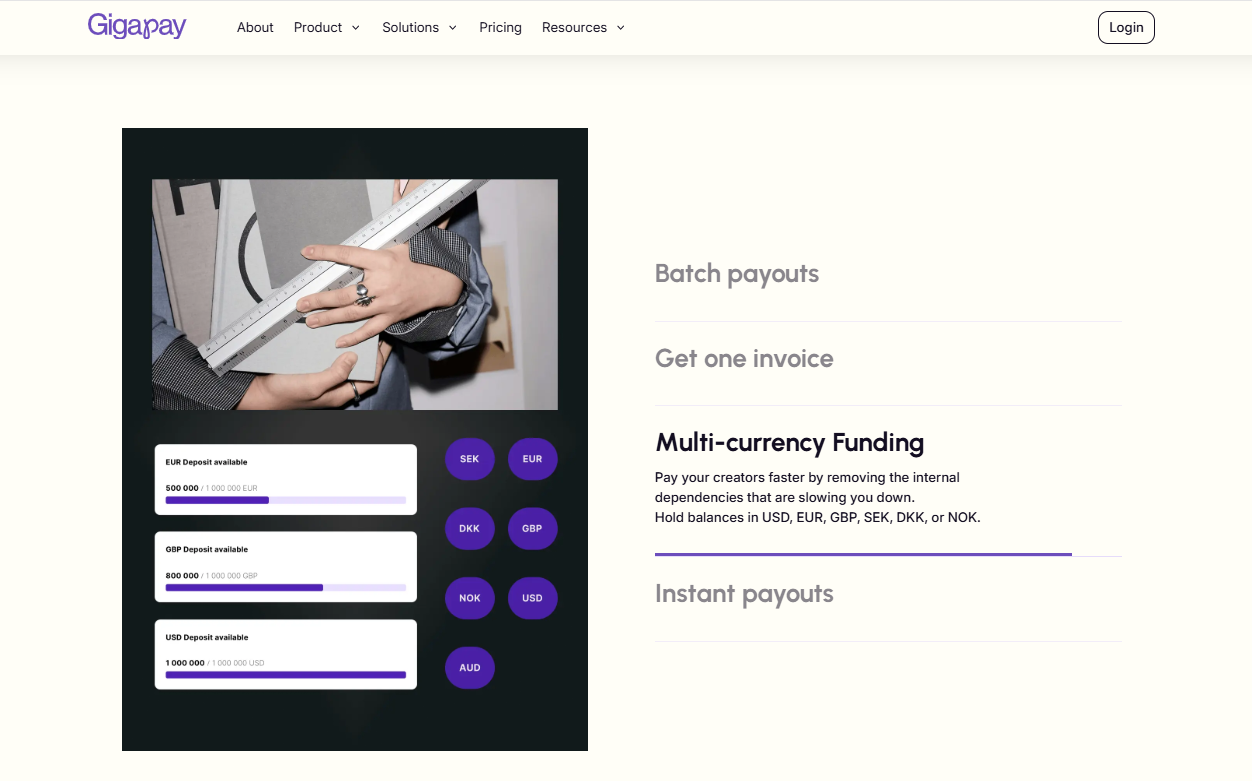
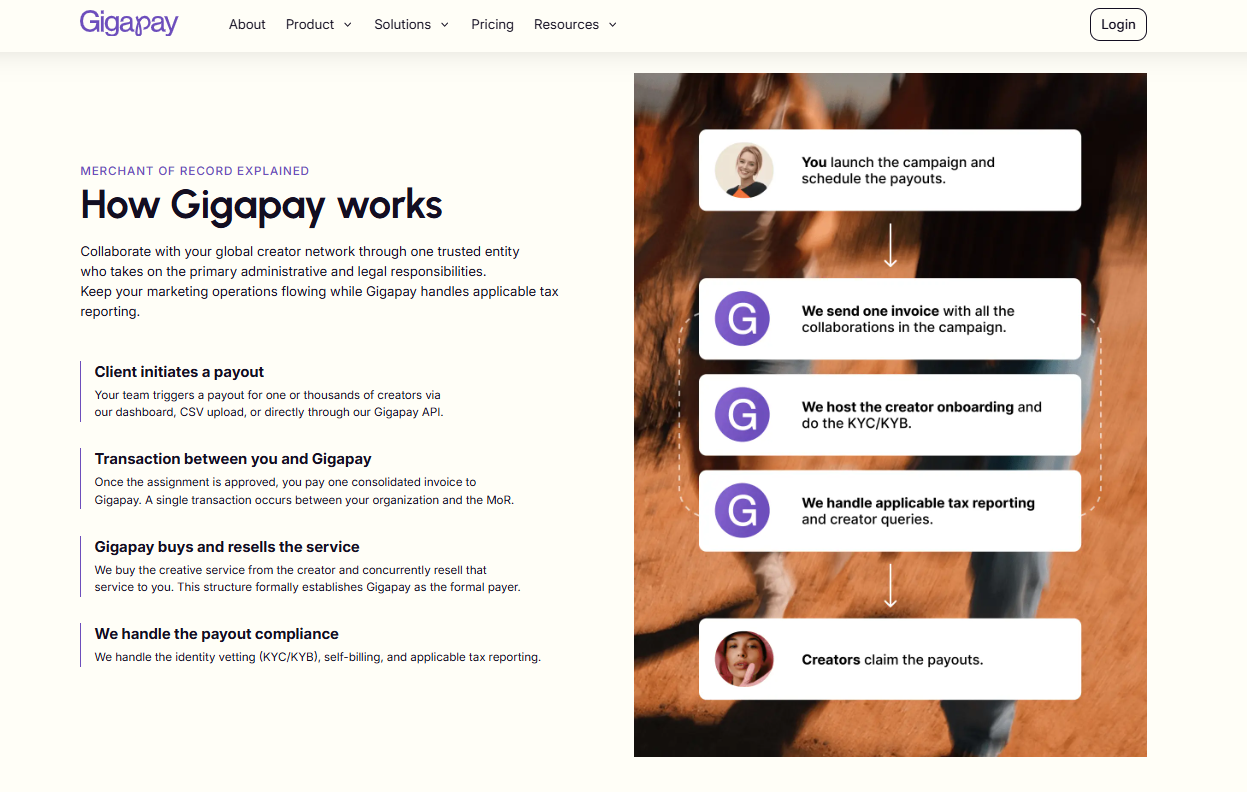
The structure solves the self-billing gap at its root. Gigapay purchases each creator's deliverable and resells it to you, becoming the formal counterparty for every payment. Your finance team contracts with one vendor and receives one consolidated invoice per campaign, instead of processing hundreds of micro-vendors through a system that was never designed for them.
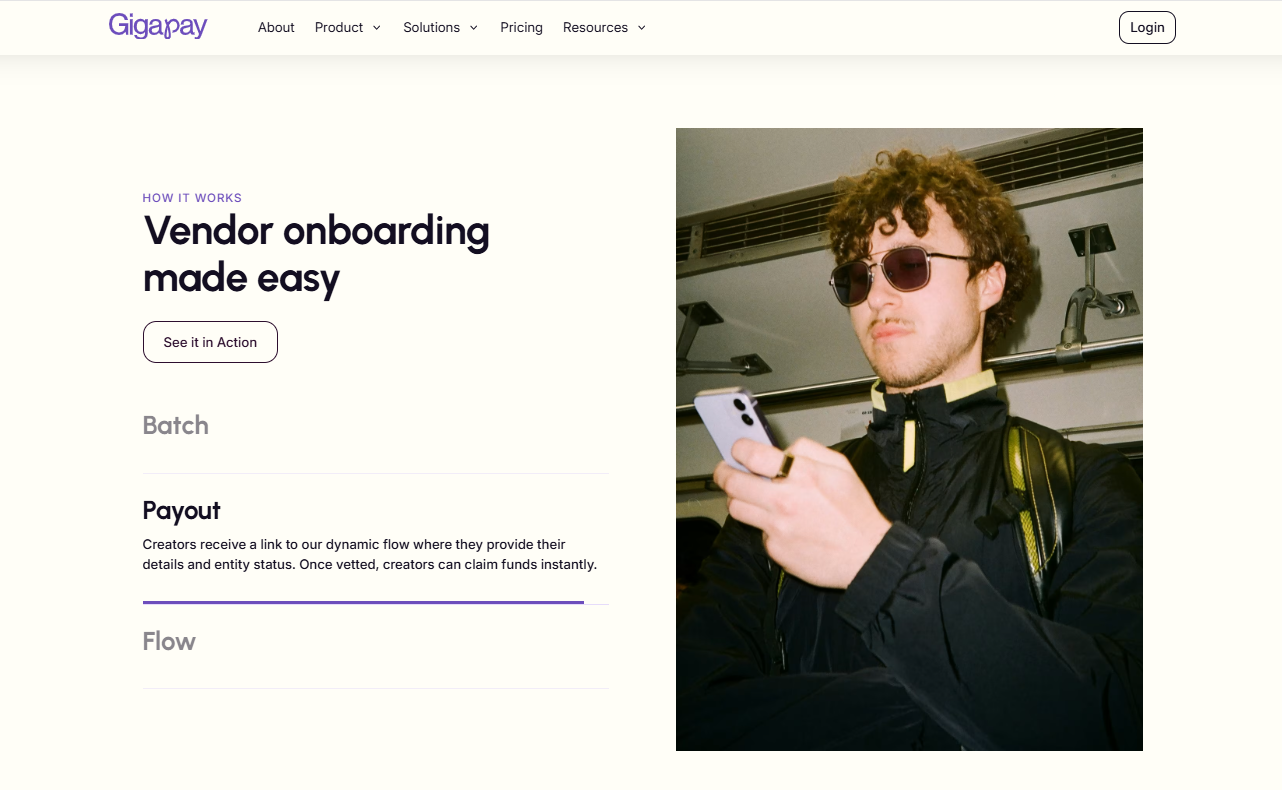
Creators onboard in minutes as individuals, sole traders, or companies, with no registered business and no VAT number required. KYC and tax ID or VAT validation run automatically at onboarding, so each creator's status is verified once, by the platform, rather than chased by your team before every campaign.
For a UK creator roster, that changes four things:
- Your team stops drafting creator paperwork: Gigapay documents each payment and invoices you once per campaign.
- Invoice volume drops by around 80% through consolidated invoicing, one invoice per campaign or batch.
- Creators get paid in GBP through Faster Payments, typically within seconds to a few banking days. (Confirm creator-side fees before saying they keep the full amount.)
- The same setup covers 65+ markets and 50+ currencies, so the UK roster and the rest of Europe run through one process.
The operational difference shows up in hours. For a brand running 600 creator collaborations a year, Gigapay's ROI analysis puts the manual process at roughly 840 admin hours annually, against about 60 with the platform.
Boozt saw the roster effect directly: "We've been trying to find a way forward with nano- and micro-influencers for years and Gigapay really enabled this," and tripled collaborations without expanding the team.
Self-Billing vs Merchant of Record: Which Covers Your Creator Roster?
Self-billing remains a legitimate tool for the VAT-registered creators on your roster. The question is what carries the other 80 to 90%, and whether running two parallel processes in-house beats running none.
Conclusion
Gigapay is the Merchant of Record for creator payouts: the one vendor that pays your creators on your behalf and takes on the compliance, payouts, and support so you don't have to.
Paying UK creators who aren't VAT-registered is not hard because the rules are vague. HMRC's position is clear: self-billed VAT invoices are off the table for unregistered suppliers, and the large majority of UK creators are exactly that.
A compliant process means verifying status, assessing employment classification, documenting payments without VAT, paying fast in GBP, and keeping six years of records, for every creator, every campaign.
Book a demo and see how a 300-creator UK campaign becomes one vendor and one invoice.
Read Next:
- How to Pay UGC Creators in 2026: Rates, Usage Terms and One-Invoice Payouts
- Influencer Marketing Budget Template 2026: How to Split Creator Fees, Usage Rights, Gifting and Payout Costs
- Gifting vs Paid Collaborations in 2026: When to Switch Nano Creators to Cash
FAQs:
1. How do you pay UK creators who aren't VAT-registered?
To pay UK creators who aren't VAT-registered, you verify their VAT status, assess employment status, agree terms in writing, document each payment without VAT, and pay in GBP through Faster Payments, or you use a Merchant of Record like Gigapay to run all of it through one vendor.
2. Can you use self-billing for UK creators who are not VAT-registered?
No, you cannot use self-billing for UK creators who are not VAT-registered, because HMRC's VAT Notice 700/62 prohibits issuing self-billed VAT invoices on behalf of suppliers who are not registered for VAT or who have cancelled their registration.
3. What is the VAT registration threshold for UK creators in 2026?
The VAT registration threshold for UK creators in 2026 is £90,000 of taxable turnover in any rolling 12-month period, a level most creators never reach, since 88% produce content as a side hustle alongside other income.
4. Do non-VAT-registered UK creators need to issue invoices?
Non-VAT-registered UK creators do not need to issue VAT invoices, because they hold no VAT number, but brands should still collect a simple invoice or payment statement showing the creator's name, address, service, date, and gross amount for their records.
5. What is the best way to pay hundreds of UK creators compliantly?
The best way to pay hundreds of UK creators compliantly is through a Merchant of Record like Gigapay, which becomes the single vendor, verifies every creator's status at onboarding, consolidates invoices per campaign, and pays creators in GBP instantly when pre-funded.