
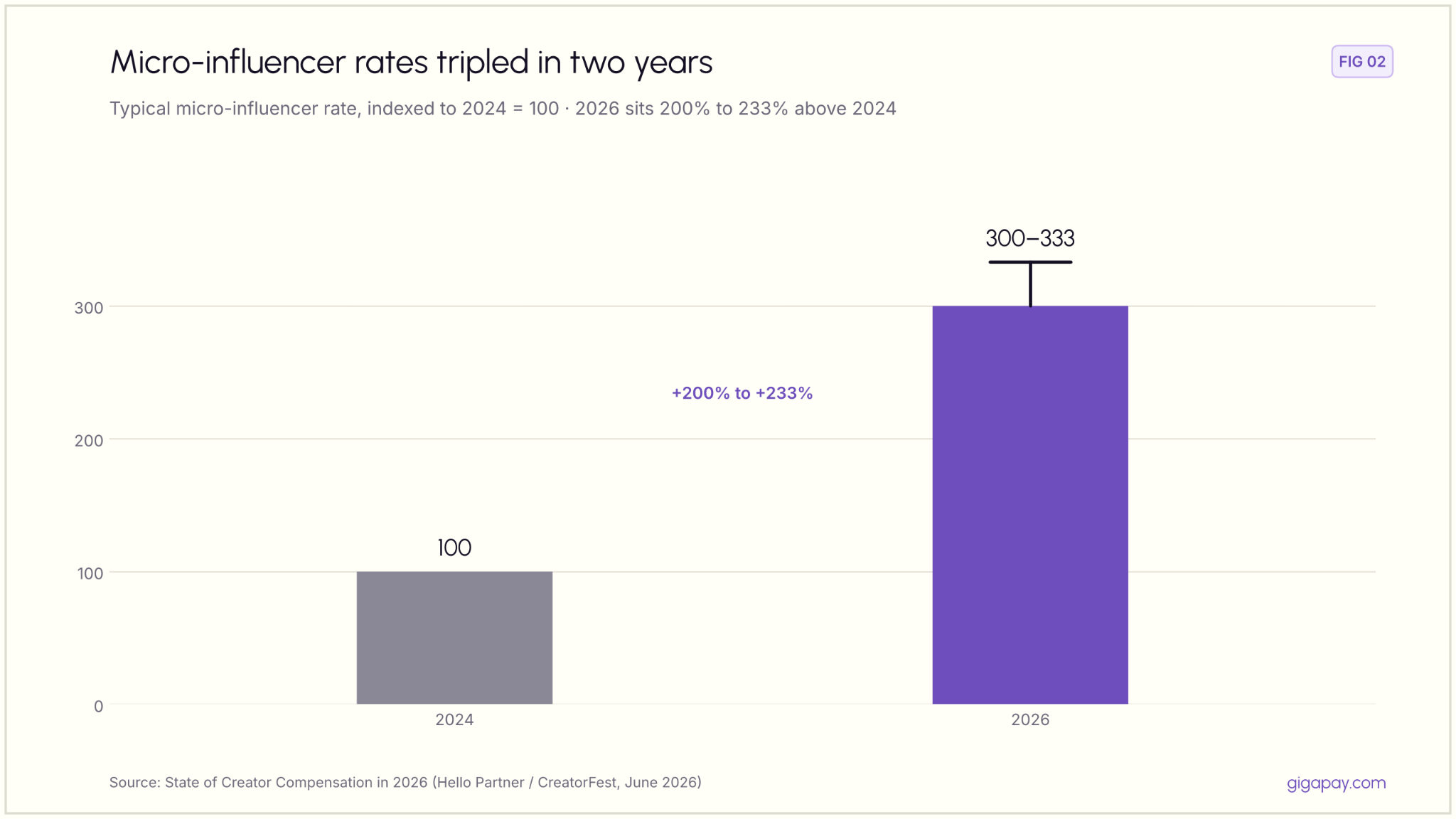
Micro-influencer rates have risen by 200% to 233% since 2024, according to the State of Creator Compensation in 2026 report published in June 2026.
Gigapay is the Merchant of Record for creator payouts: the one vendor that pays your creators on your behalf and takes on the compliance, payouts, and support so you don't have to.
The UK is one of the most mature influencer markets in the world, and half of UK marketers now spend more than $1 million a year on creator campaigns, which makes every rate negotiation a finance decision as much as a marketing one.
The fee a creator quotes is only the start of what a campaign costs once agency markups, admin hours, tax rules, and compliance obligations enter the picture.
This guide breaks down what UK creators charge in 2026, tier by tier and platform by platform, and then shows the true cost of paying them.
Key Takeaways
- UK influencers charge £50 to £100,000+ per post in 2026, depending on tier.
- Micro-influencer rates rose 200% to 233% between 2024 and 2026.
- Agency markups add 20% to 80% on top of the creator's fee.
- Inside IR35, brands add 15% employer National Insurance plus PAYE deductions.
- A Merchant of Record turns hundreds of creator payments into one invoice.
How Big Is the UK Influencer Marketing Market in 2026?
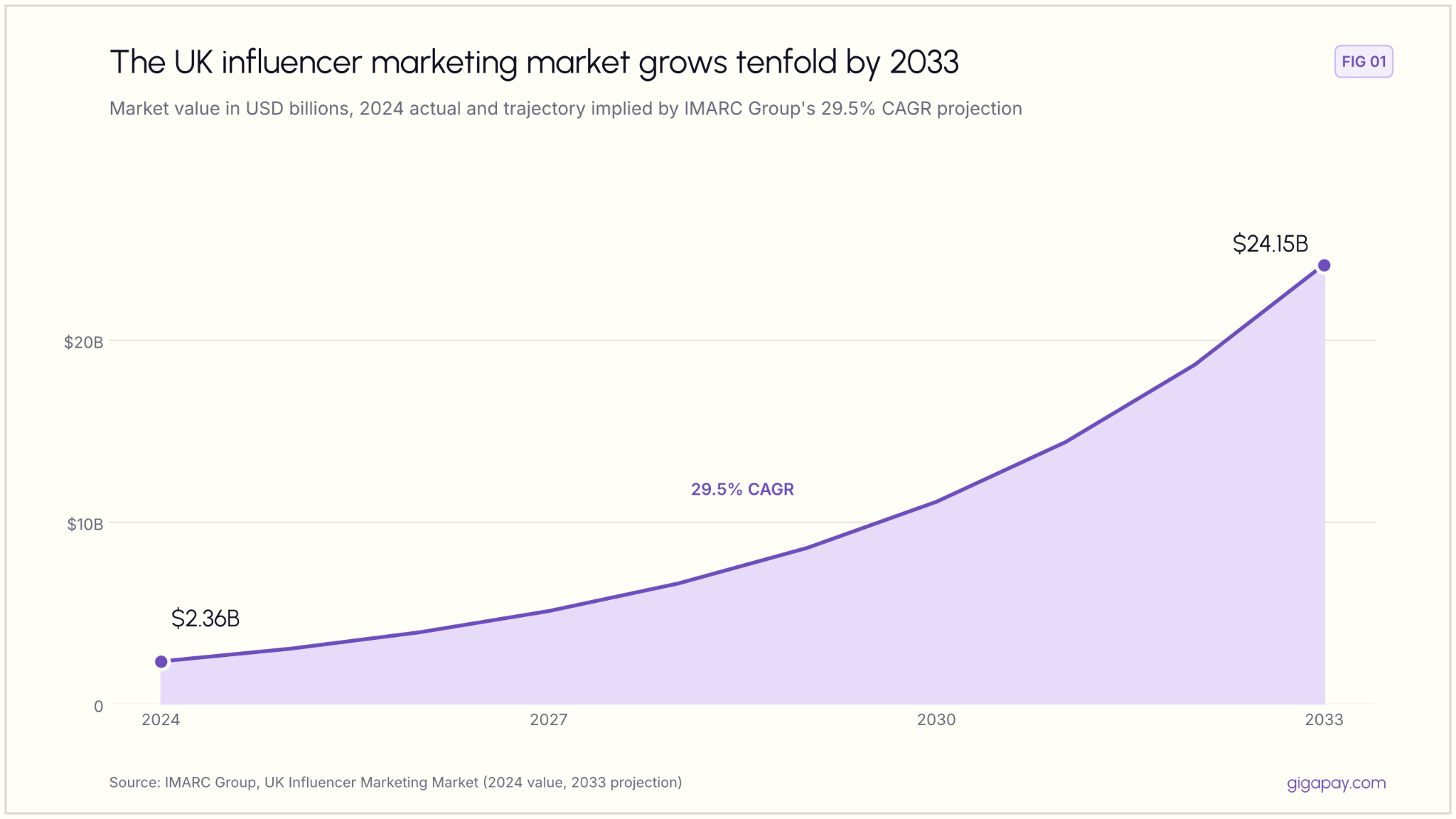
The UK influencer marketing market was worth $2.36 billion in 2024 and is projected to reach $24.15 billion by 2033, a compound annual growth rate of 29.5%, according to IMARC Group. Paid influencer ad spend alone reached £930 million in 2024 and is forecast to hit £1.3 billion by 2029, based on Statista data cited by Kolsquare. For context, total UK social media ad spend reached £11.5 billion in 2025, up 21% year on year.
The supply side is deep. The UK has more than 98,000 Instagram accounts with over 5,000 followers, and 633,000 accounts with over 1,000 followers. On the demand side, 50% of UK marketers now spend more than $1 million a year on influencer marketing, per the State of Creator Compensation in 2026 research.
The money keeps flowing because the channel performs. Brands earn an average of £5.78 for every £1 spent on influencer marketing in the UK, and 51% of UK consumers have bought a product an influencer promoted.
Why Are UK Influencer Rates Rising in 2026?
Four forces push UK creator rates upward in 2026.
- Demand keeps outgrowing supply at the trusted end of the market: In the 2026 Influencer Marketing Benchmark Report, 87.49% of marketers said they expect influencer budgets to increase, and 72.22% expect growth of at least 50%. More budget chasing the same proven creators lifts prices across every tier.
- Production costs and contract complexity have grown: The State of Creator Compensation in 2026 found that upfront creator fees are changing because of rising production costs and more complex contract bundles, not simple price inflation. A single deal now often covers usage rights, exclusivity, and paid amplification, and creators price all of it in.
- Audiences moved to video-first platforms: TikTok alone reached 26.8 million UK adult users in 2026, and video formats consistently command 20% to 50% premiums over static posts.
- Compliance raised the floor: UK creators now operate under active ASA monitoring, CMA enforcement powers, and HMRC Self Assessment obligations. Professionalised creators run registered businesses, work with managers, and charge accordingly.
The result is a market that has split into distinct economic tiers, and brands that budgeted from 2024 rate cards are discovering their numbers no longer survive first contact with a 2026 negotiation.
UK Influencer Rate Card 2026: Cost Per Post by Follower Tier
The table below shows typical UK rates per sponsored post in 2026, based on the Aether Agency UK rate card (updated September 2026) and cross-checked against Whito's UK influencer and UGC rate research.
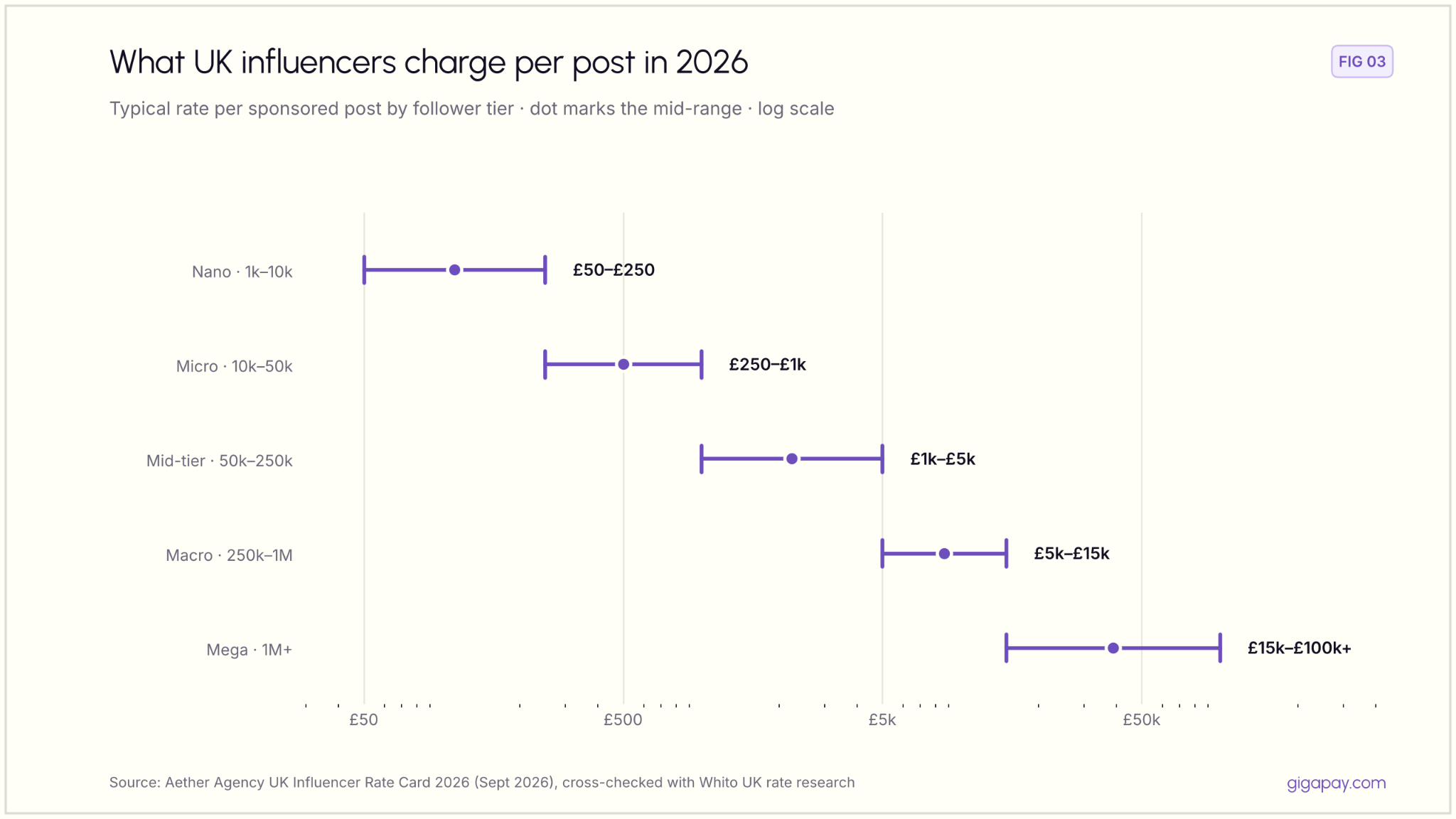
Three notes on reading this table.
- Ranges are planning benchmarks, not fixed prices: Whito's research places entry-level nano work as low as £20 per post and micro work from £80, so brands with strong briefs and fast payment terms can land below the midpoint.
- Engagement matters more than follower count: A cost per engagement of £0.05 to £0.20 is considered reasonable in the UK in 2026. A 30,000-follower creator with 8% engagement is often worth more than a 100,000-follower account at 1%.
- The biggest rate movement sits at the bottom: Micro rates rose 200% to 233% between 2024 and 2026, which means the "cheap" tier brands relied on for volume campaigns no longer prices the way their 2024 budgets assumed.
UK Influencer Rates by Platform in 2026
Platform changes the price of the same audience. Here is what UK creators charge on each major platform in 2026.
How Much Do UK Instagram Influencers Charge?
Instagram remains the pricing baseline for UK influencer deals. The tier table above applies to a standard feed post, and formats move the price from there, per Aether Agency's 2026 UK rate card:
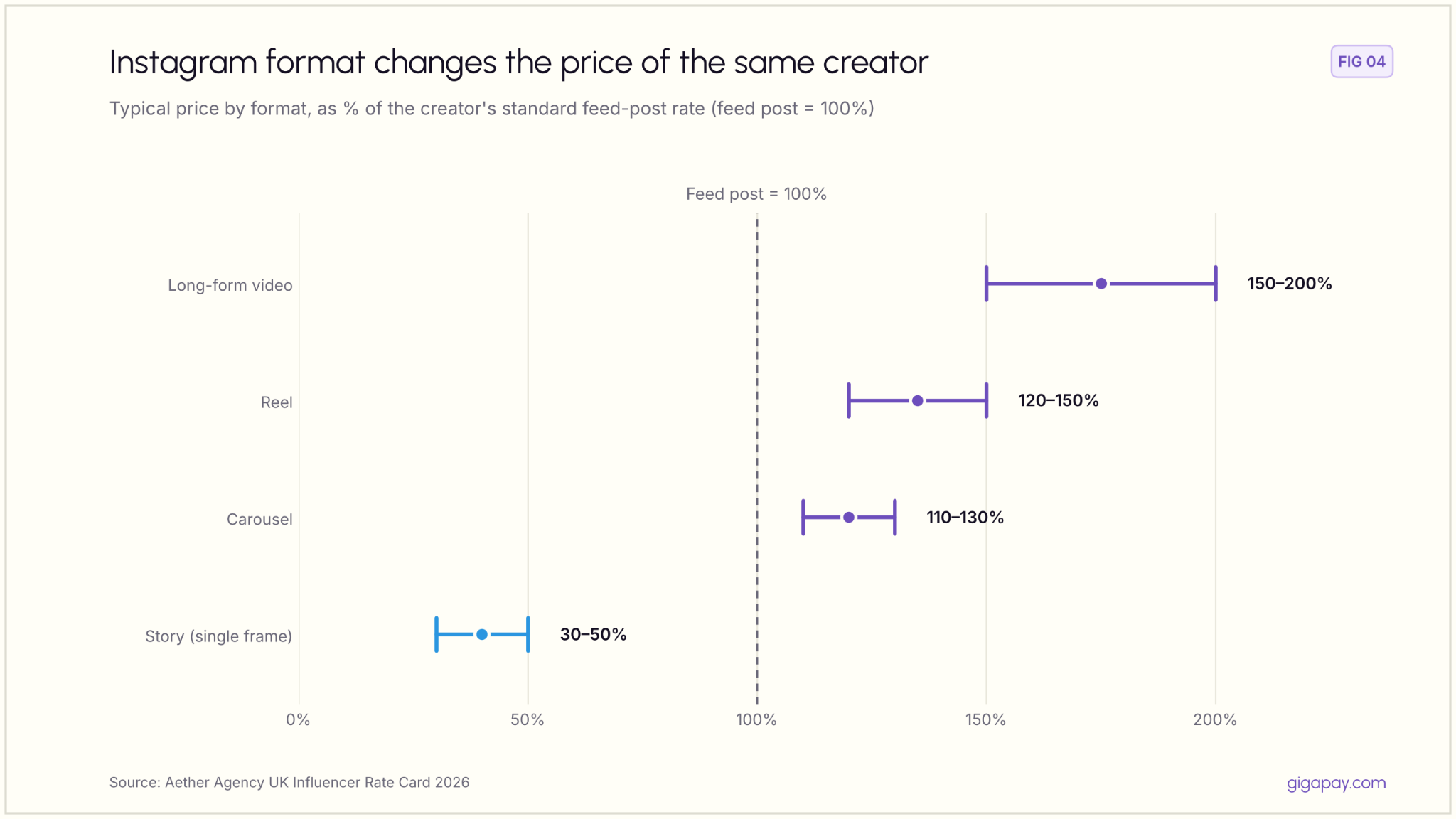
A micro creator charging £600 for a feed post will therefore quote roughly £720 to £900 for a Reel, and £180 to £300 for a Story frame.
How Much Do UK TikTok Creators Charge Per Video?
UK TikTok rates now match or slightly exceed Instagram rates for creators with comparable followings. Micro TikTok creators typically charge £300 to £1,200 per video, and trend participation adds another 20% to 30%. One structural difference matters for buyers: TikTok pricing follows average views rather than follower count, because the For You page decides reach deal by deal.
How Much Do UK YouTubers Charge for Sponsored Videos?
YouTube is the most expensive platform per deliverable because production effort and content lifespan are both higher. UK benchmarks for 2026:
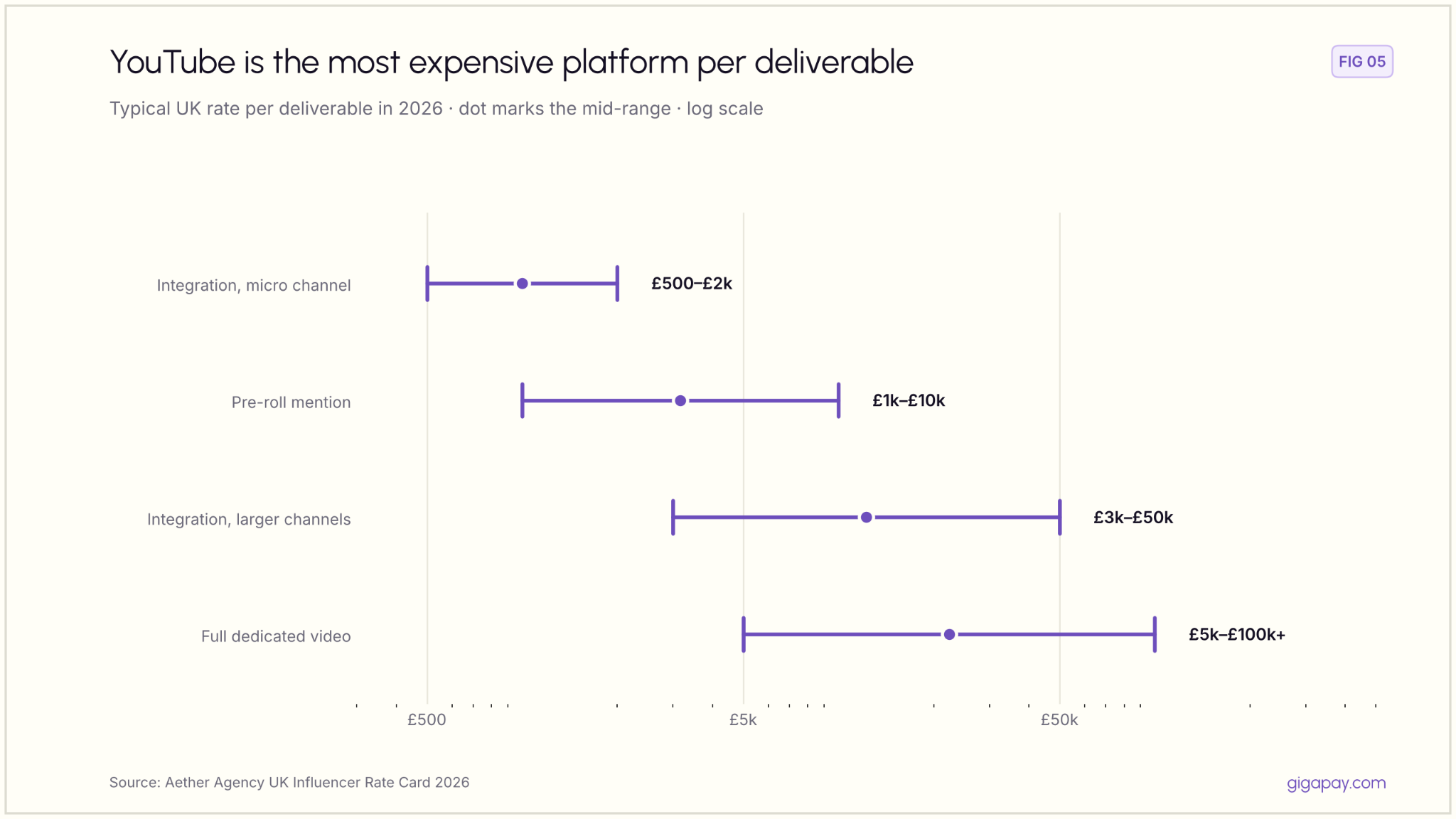
Sponsored content is where UK YouTubers make their real money: average YouTube ad revenue runs at about £13.44 per 1,000 views, so brand deals routinely out-earn AdSense by an order of magnitude.
What Do UK Creators Charge on LinkedIn, X, and Twitch?
- LinkedIn: UK creators with 10,000+ engaged followers charge £500 to £5,000 per sponsored post, reflecting the B2B value of the audience.
- X (Twitter): expect 40% to 60% of a creator's Instagram rate for comparable content.
- Twitch: sponsorship pricing follows concurrent viewers. A streamer averaging 100 live viewers earns roughly £860 to £1,300 a month across subs and sponsorships, while 1,000-viewer streamers clear about £4,300 a month.
How Much Does UGC Content Cost in the UK?
User-generated content, made for the brand's own channels rather than the creator's audience, costs £50 to £250 per video in the UK in 2026. Follower count plays no role because the brand buys the content, not the distribution. Demand for UGC keeps growing because brands can test many creative angles at micro-budget prices before putting paid spend behind the winners.
How Much Do UK Influencers Earn Per Year?
Annual earnings put the per-post rates in perspective, and they explain why payment experience matters so much to creators.
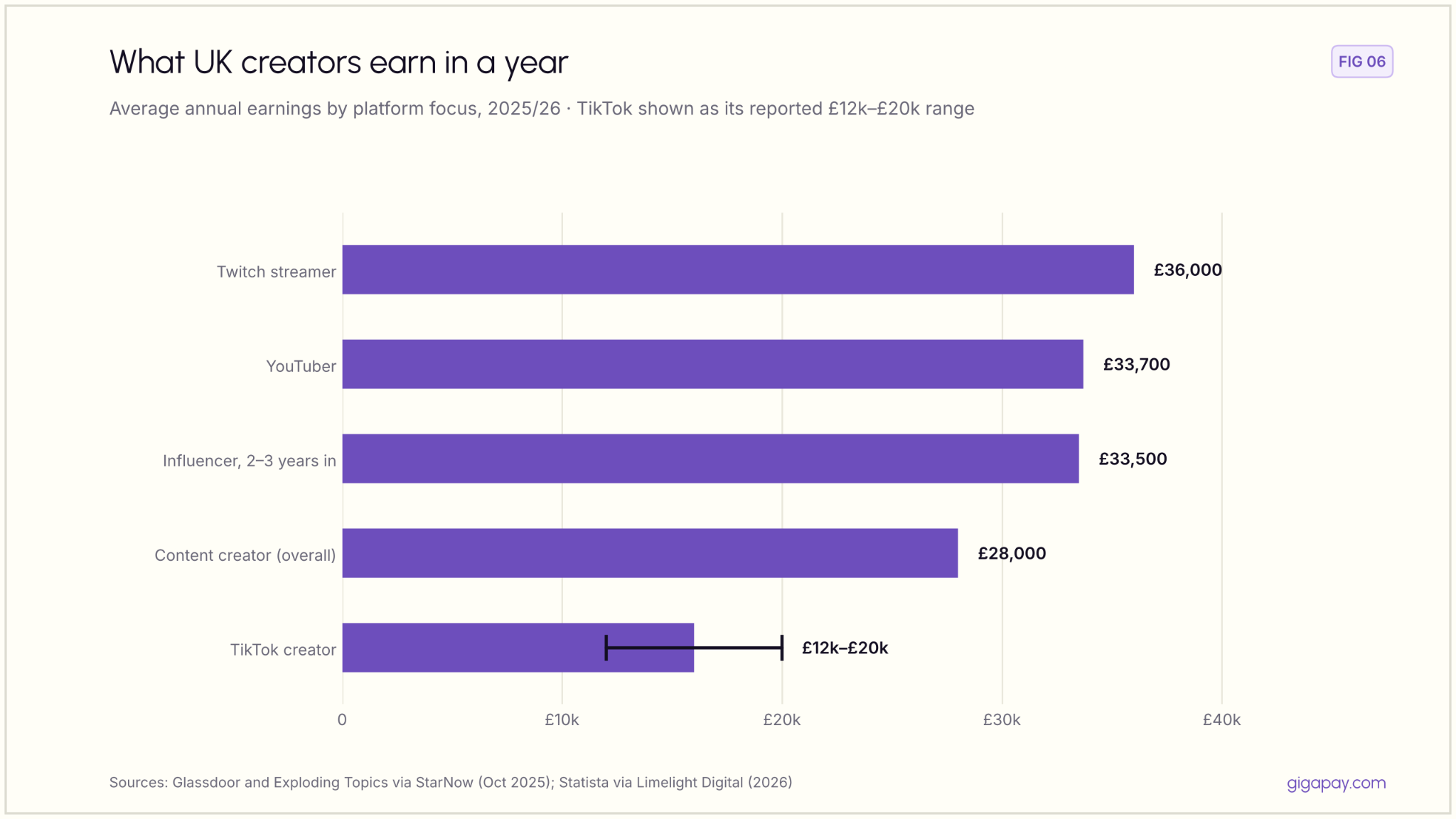
The distribution behind these averages is steep. Roughly half of creators worldwide earn under £12,000 a year from content, only about 4% clear six figures, and 88% of creators still run a side hustle alongside their content income.
That last number should change how brands think about paying. For most UK creators, a £500 invoice is the rent payment, and the speed it arrives decides which brands they work with twice. A brand that pays in 7 days becomes a preferred partner; a brand that pays in 90 becomes a cautionary tale in creator group chats.
What Factors Change UK Influencer Pricing in 2026?
The headline rate buys one post on the creator's own channel and nothing else. Every additional right or restriction has a price, per UK 2026 benchmarks:
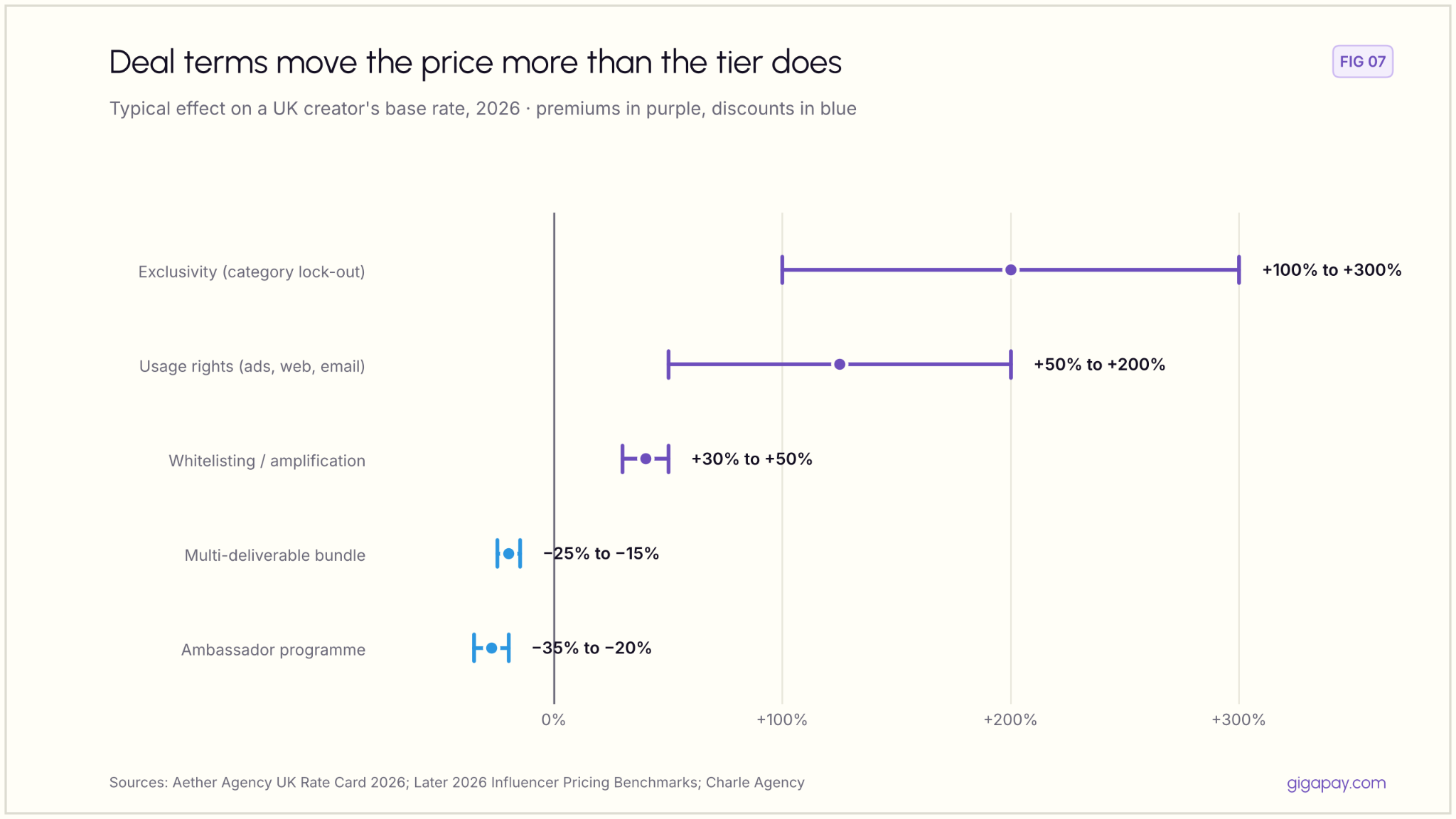
Two further shifts shape UK pricing in 2026.
- Performance-based pay is now mainstream: A quarter of UK campaigns include performance-based pricing, typically a lower flat fee plus commission on tracked sales.
- Attribution is still weak, so fees stay negotiable: Only around 20% of influencer-driven purchases are link-attributable, which means creators and brands are often negotiating over value neither side can fully measure. Brands that bring their own data to the table negotiate better rates.
The True Cost of Paying UK Influencers: What Sits on Top of the Rate Card
The creator's fee is the visible cost. Three less visible layers decide what a UK campaign actually costs.
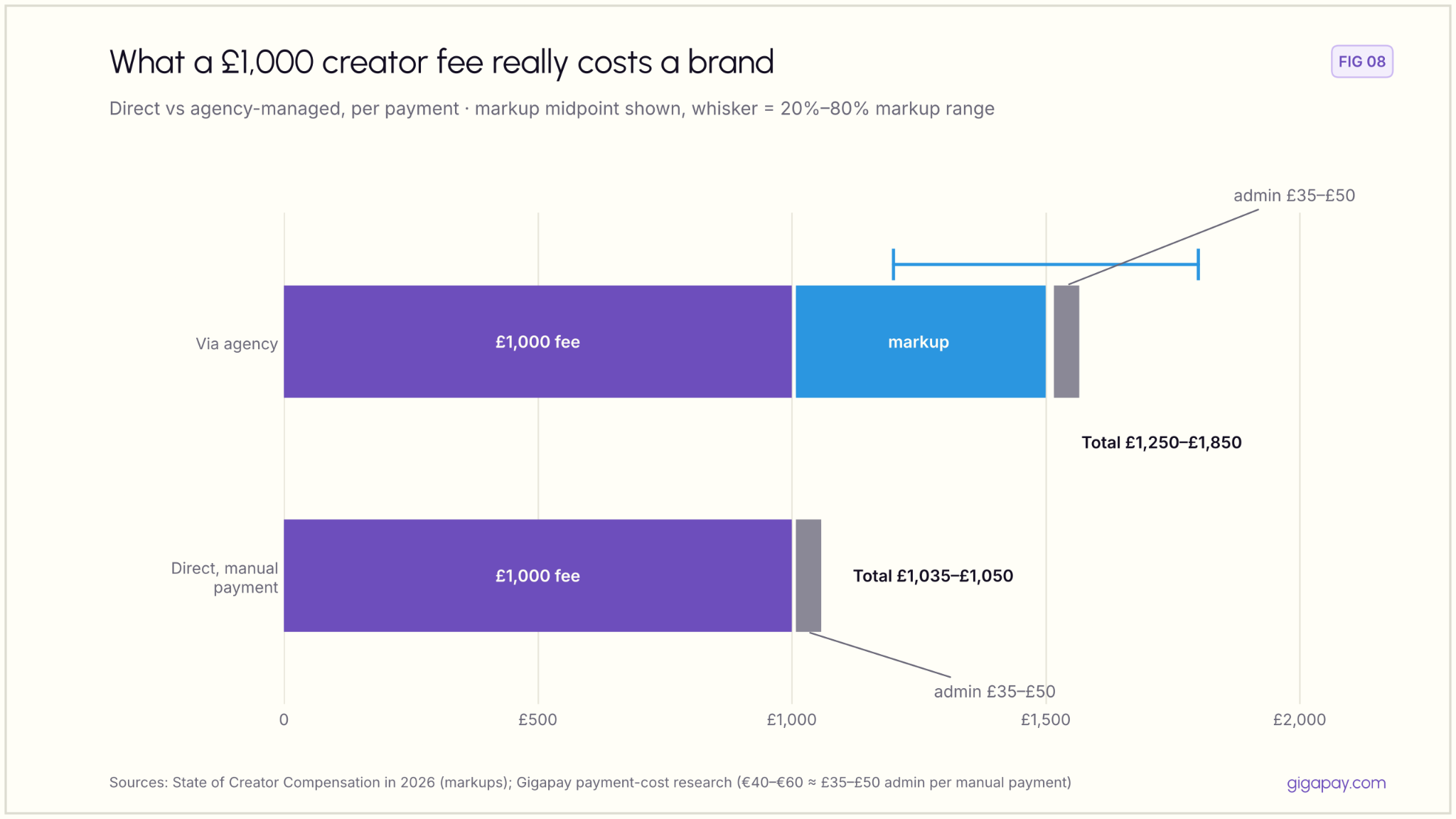
Agency Markups Add 20% to 80% to Creator Fees
The State of Creator Compensation in 2026 describes agency markups of 20% to 80% on creator fees as "hidden inflation" in the market. A creator who quotes £1,000 directly can cost a brand £1,200 to £1,800 through an intermediary, before any management fee on the campaign itself. Markups buy real services, including sourcing, negotiation, and payment handling, but most brands never see the split, which makes it impossible to know what the content actually cost.
Each Manual Payment Costs £35 to £50 in Admin
Gigapay's internal cost research puts the true cost of one manual creator payment at €40 to €60 (roughly £35 to £50) once you count the full chain: onboarding the creator as a vendor, collecting bank and tax details, chasing a correct invoice, processing the payment, fixing errors, and reconciling it in the ERP.
Across marketing and finance, a single creator payment consumes up to 6 hours of combined admin time when everything runs through standard vendor processes. Pay 300 UK creators a year this way and the admin alone rivals a full-time salary.
Payment Terms Stretch to 120 Days, and Creators Remember
Gigapay's State of Influencer Payments research, run with Billion Dollar Boy, Meltwater, and The Influencer Marketing Factory, found creator payment terms stretching to 120 days at enterprise brands. Standard B2B payment terms were designed for suppliers with working capital, and UK creators are mostly individuals for whom a late £800 invoice is a personal cash flow crisis.
The commercial consequence is direct: creators price slow payers higher, decline repeat work, or demand upfront fees, and the brand pays the loyalty tax on every future campaign.
UK Tax and Compliance Rules That Change What Influencers Cost
The UK is one of the most actively enforced influencer markets in the world. Three regulatory areas carry direct cost implications for anyone paying UK creators.
IR35: When an Influencer Payment Becomes a Payroll Cost
IR35, the off-payroll working rules, exists to catch disguised employment. Since April 2021, the obligation to assess status sits with the end client, not the creator or any intermediary. Medium and large UK companies must issue a Status Determination Statement for each engagement, and HMRC's CEST tool provides a defensible record.
A typical influencer engagement, with multiple clients, autonomous content creation, no fixed hours, and no exclusivity, generally falls outside IR35. The risk grows when a brand controls the relationship tightly through detailed briefs, approval rights, and exclusivity. If an engagement lands inside IR35, the cost changes materially:
- PAYE income tax deducted at 20%, 40%, or 45%
- Employee National Insurance at around 8%
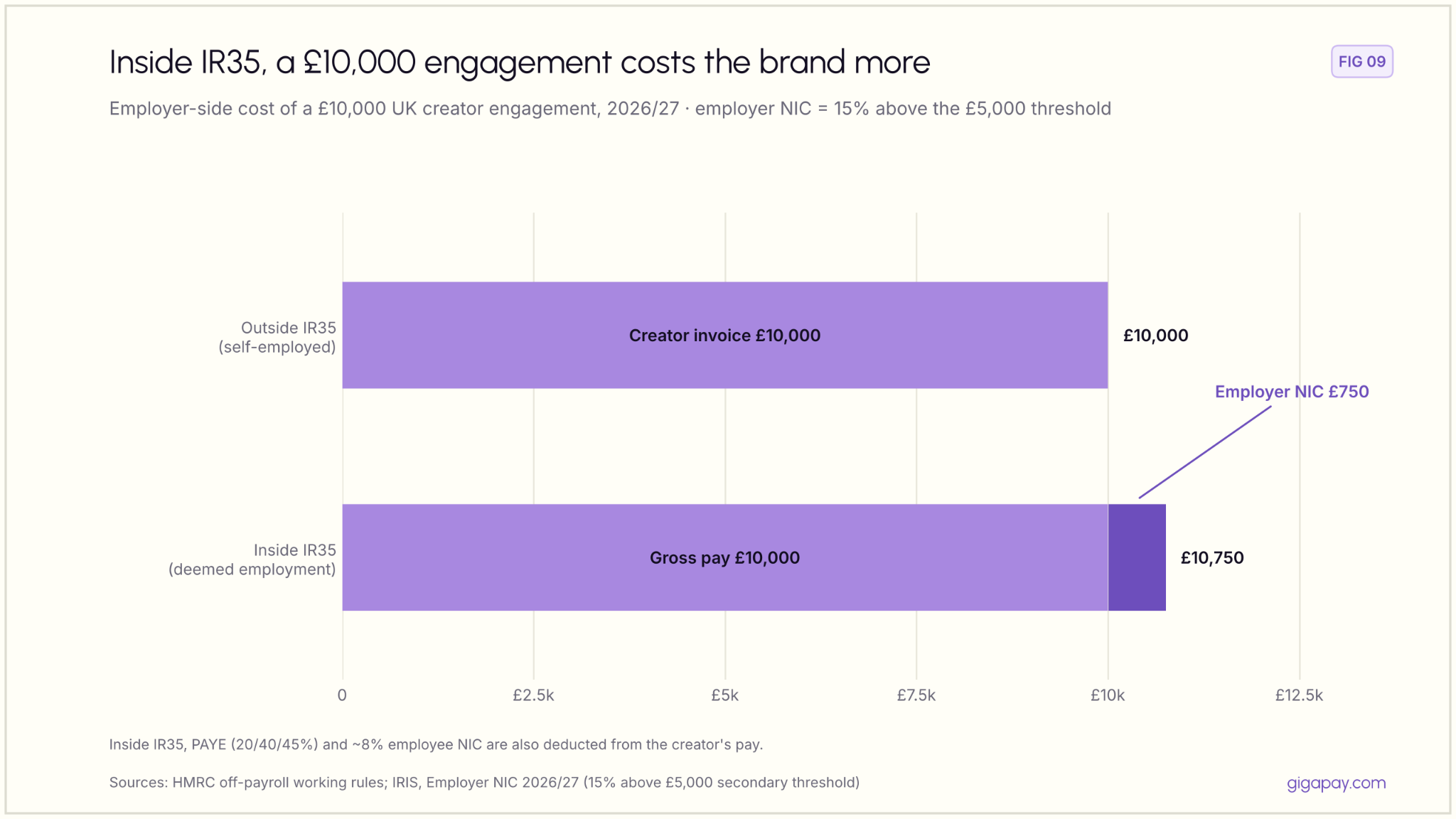
- Employer National Insurance at 15% above the £5,000 secondary threshold for 2026/27
On a £10,000 engagement, that employer NIC line alone adds roughly £750. Brands that never assess status are not saving the cost; they are deferring it to an HMRC review with interest and penalties attached.
VAT and Self-Billing: The Paperwork Behind Every Creator Invoice
UK VAT runs at 20% with a registration threshold of £90,000, which most UK creators never reach. A typical campaign roster therefore mixes VAT-registered and unregistered creators, limited companies and sole traders, and each combination needs different invoice handling.
Many creators have never issued a compliant invoice at all, which is why finance teams end up chasing corrections for weeks. HMRC permits self-billing, where the payer generates the invoice on the creator's behalf under a signed agreement, and this single mechanism removes most of the invoice-chasing from creator campaigns.
Creators carry their own obligations: HMRC requires Self Assessment registration once trading income passes £1,000, and gifted products count as taxable income when they are convertible to money.
ASA and CMA Enforcement: Disclosure Failures Now Carry 10% Fines
The ASA's CAP Code requires sponsored content to be obviously identifiable: labels like #ad or paid partnership at the start of a caption, while "collab", "spon", or a brand tag alone are not acceptable. Compliance remains poor. ASA monitoring of over 50,000 pieces of UK content found only about 57% of influencer ads adequately disclosed.
The stakes rose with the Digital Markets, Competition and Consumers Act 2024, which lets the CMA fine businesses up to 10% of global annual turnover for serious consumer law breaches without a court order, and influencer transparency is a stated CMA priority. Disclosure is the influencer's and the advertiser's obligation, so the brand's exposure does not disappear when an agency sits in the middle.
What Does Paying 600 Creators a Year Actually Cost?
Gigapay's ROI analysis models a brand running 600 creator collaborations a year through standard vendor processes, and the numbers show why the true cost of influencer marketing hides in operations rather than rates.
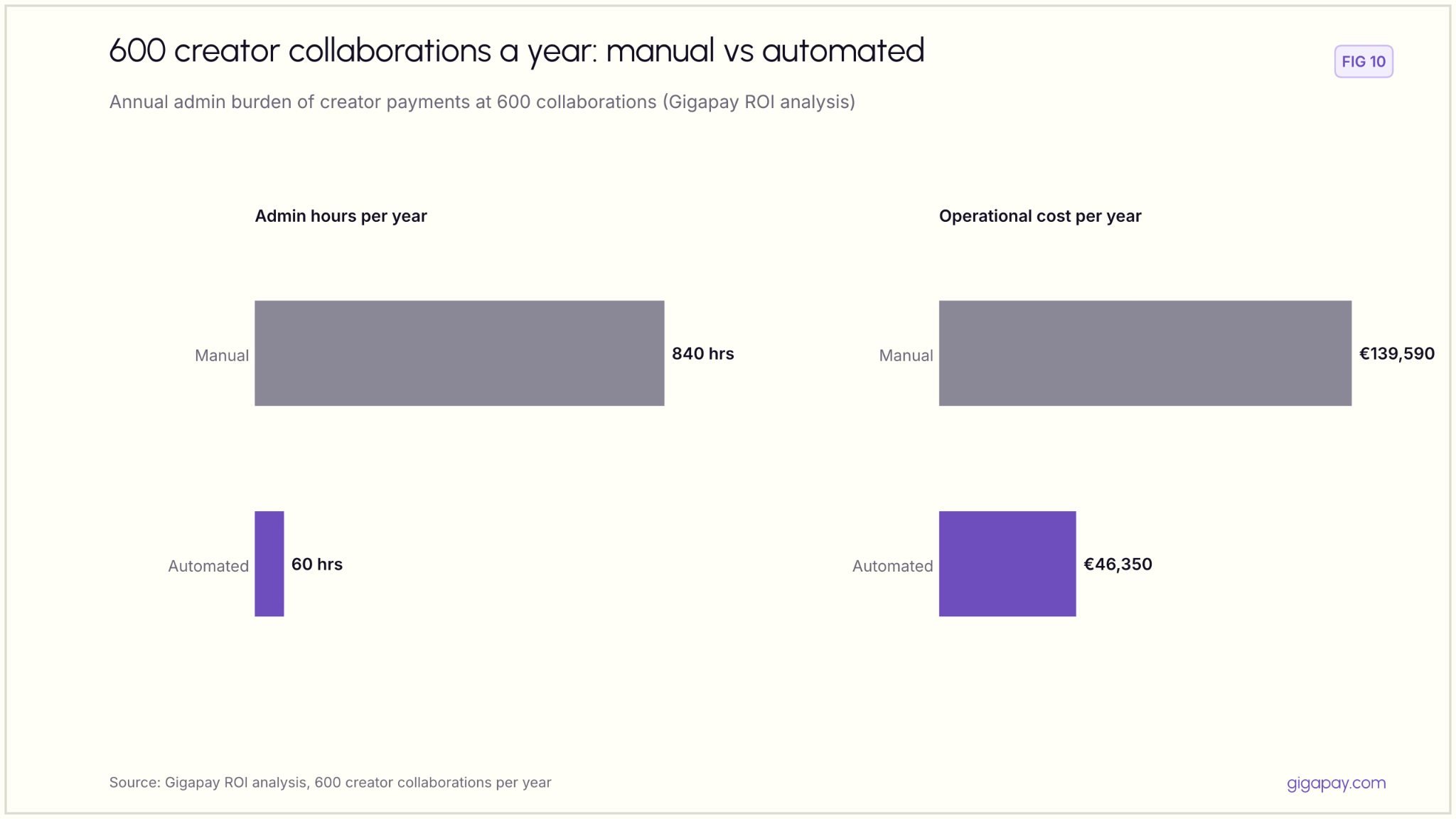
The 840 hours matter more than they look. That time sits inside creator ops and finance teams who were hired to run campaigns and close books, not to chase missing bank details from a 19-year-old TikTok creator.
Every hour spent on payment admin is an hour not spent on sourcing, strategy, or creator relationships, and the State of Creator Compensation in 2026 shows the market is professionalising too fast for manual processes to keep up.
How a Merchant of Record Lowers the True Cost of Paying UK Creators
A Merchant of Record for creator payouts is one vendor that pays your creators on your behalf and takes on the compliance, payouts, and support so you don't have to. Gigapay pioneered this model for the creator economy, and it changes the cost structure of UK campaigns in five concrete ways.
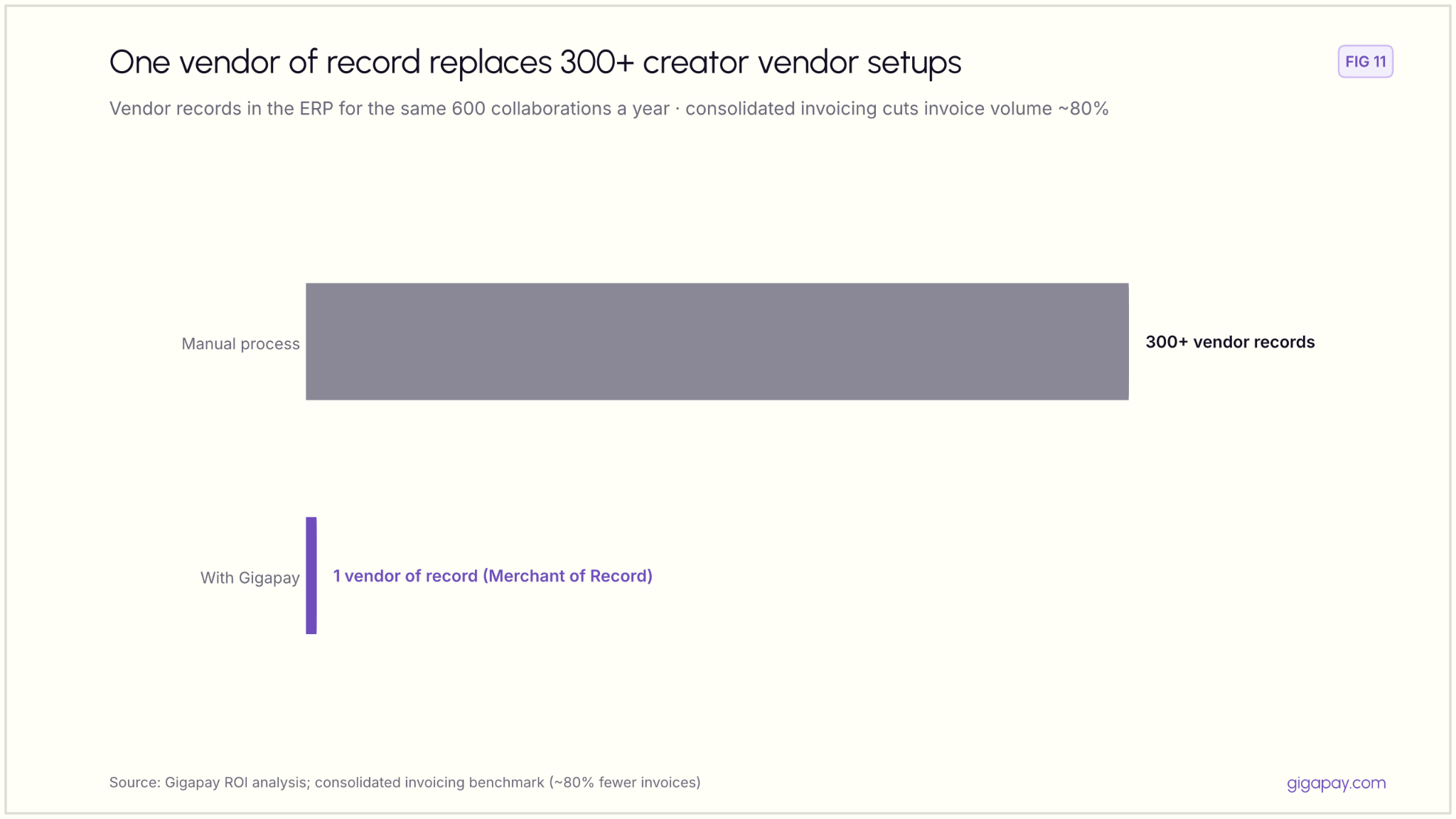
- One vendor replaces hundreds: Your brand contracts with Gigapay, Gigapay formally purchases each creator's deliverable and resells it to you, and procurement onboards a single counterparty instead of 300 micro-vendors. Consolidated invoicing cuts invoice volume by around 80%.
- Creators get paid in minutes, not months: Payouts run on local rails, including UK Faster Payments, across 65+ countries and 50+ currencies, and payments are instant when pre-funded. Creators who get paid fast come back, and at better rates.
- No registered company required: Most UK nano and micro creators operate as individuals. Gigapay onboards them with KYC and tax ID validation, with no VAT number or company registration needed, which removes the procurement blocker that keeps brands out of the fastest-growing creator tiers.
- The paperwork runs itself: Self-billing generates compliant invoices on the creator's behalf, tax reporting is automated, and finance gets one auditable counterparty. For UK engagements, the IR35 status assessment remains the client's legal responsibility, and Gigapay's B2B structure gives finance a clean, documented paper trail around every payment.
- Creators keep what they earn: On Gigapay's current plans, the client covers the fees, so the rate you agree is the amount the creator receives.
The model is proven at scale: Gigapay has processed more than 105,000 payouts worth over 911 million SEK to creators in 40+ countries.
- Boozt tripled its creator collaborations without expanding the team after switching.
- The Goat Agency, part of WPPMedia, reports that payments became easier and faster while staying compliant with tax rules.
How Should Brands Budget for UK Influencer Campaigns in 2026?
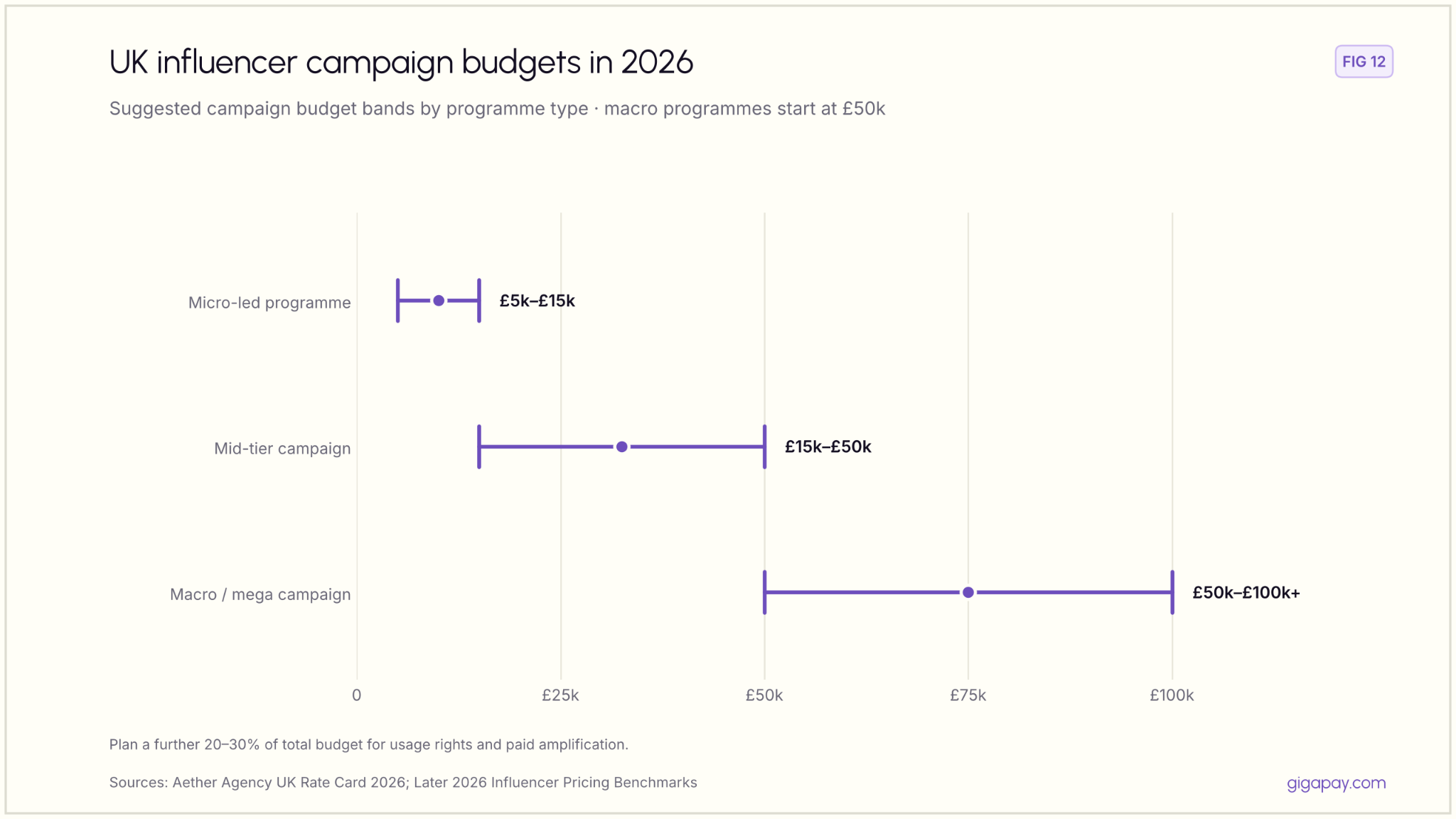
Start from the campaign goal, then build the budget in layers. UK benchmarks for 2026 suggest £5,000 to £15,000 for micro-led programmes, £15,000 to £50,000 for mid-tier campaigns, and £50,000+ for macro work.
A realistic UK budget for 2026 accounts for every layer of cost, not just the rate card:
- Creator fees from the tier and platform tables above.
- Usage and amplification, typically 20% to 30% of total budget if you plan to run creator content as paid ads.
- Intermediary costs, meaning agency markups of 20% to 80% where an agency manages sourcing, or platform and payout fees where you run the programme in-house.
- Operations, the admin cost of onboarding, invoicing, and paying every creator, which manual processes price at £35 to £50 per payment.
- Compliance reserve, the time to run IR35 checks, verify disclosure practice, and handle VAT correctly.
Measured against the UK average return of £5.78 per £1 spent, the channel justifies the spend. The brands that outperform that average are the ones that move layers 3 and 4 from variable chaos to fixed, predictable cost.
Conclusion
Gigapay is the Merchant of Record for creator payouts: the one vendor that pays your creators on your behalf and takes on the compliance, payouts, and support so you don't have to.
UK influencer rates in 2026 run from £50 for a nano post to £100,000+ for mega campaigns, and the true cost of paying creators adds agency markups of 20% to 80%, £35 to £50 of admin per manual payment, IR35 assessments, VAT handling, and disclosure compliance on top of every rate card.
Brands that treat creator payments as infrastructure keep more budget in media, keep finance in control, and keep their best creators coming back.
Book a demo to see how Gigapay pays hundreds of UK creators from one invoice.
Read Next:
- How to Pay UK Creators Who Aren't VAT-Registered (and Why Self-Billing Won't Cover Them)
- How to Pay UGC Creators in 2026: Rates, Usage Terms and One-Invoice Payouts
- Influencer Marketing Budget Template 2026: How to Split Creator Fees, Usage Rights, Gifting and Payout Costs
FAQs:
1. How much do UK influencers charge per post in 2026?
UK influencers charge between £50 and £100,000+ per post in 2026, depending on follower tier. Nano creators (1,000 to 10,000 followers) charge £50 to £250, micro creators charge £250 to £1,000, mid-tier creators charge £1,000 to £5,000, macro creators charge £5,000 to £15,000, and mega creators with over 1 million followers charge £15,000 or more.
2. What is the average influencer salary in the UK in 2026?
The average influencer salary in the UK in 2026 is £28,000 to £33,500 a year, based on Glassdoor and Statista data. TikTok-focused creators average £12,000 to £20,000, YouTubers average around £33,700, and roughly half of all creators earn under £12,000 a year from content, which is why 88% still run a side hustle.
3. What is the true cost of paying UK influencers in 2026?
The true cost of paying UK influencers in 2026 is the creator's fee plus agency markups of 20% to 80%, around £35 to £50 of admin cost per manual payment, usage rights premiums of 50% to 200%, and any PAYE and National Insurance due on engagements that fall inside IR35.
4. Do brands pay National Insurance when paying UK influencers?
Brands pay National Insurance when paying UK influencers only if the engagement falls inside IR35. Most influencer engagements, with multiple clients and autonomous content creation, sit outside IR35 as genuine self-employment, so no employer National Insurance applies. If the brand controls the work like employment, it must deduct PAYE and pay 15% employer National Insurance above the £5,000 threshold.
5. What is the best way to pay UK influencers at scale in 2026?
The best way to pay UK influencers at scale in 2026 is through a Merchant of Record for creator payouts such as Gigapay, which pays creators on your behalf and takes on the compliance, payouts, and support. Brands send one batch via CSV or API, finance receives one consolidated invoice, and creators are paid through UK Faster Payments, instantly when pre-funded, without needing a registered company.