
Brands will spend $32.6 billion on influencer marketing in 2026, and creators will receive more than $21 billion of it, yet payment delays of up to 120 days are still routine, according to Gigapay's 2026 Creator Pay Report published in June 2026.
Gigapay is the Merchant of Record for creator payouts: the one vendor that pays your creators on your behalf by taking on the compliance, payouts, and support so you don't have to.
Most of those delays start in the contract, because agreements that skip payment terms, invoicing rules, or tax responsibilities hand every dispute to finance to untangle.
Regulators across the UK and EU have also turned payment terms into law in 2026, from France's mandatory written influencer contracts to the UK's Commercial Payments Bill.
This guide breaks down every payment clause an influencer contract needs in the UK and EU, gives you a copy-ready 2026 template, and shows the rates, laws, and deadlines behind each clause.
Key Takeaways
- France requires written influencer contracts above €1,000 per year from January 1, 2026.
- EU law caps B2B payment terms at 60 days unless both parties expressly agree.
- UK statutory late payment interest is 8% above the Bank of England base rate.
- Every payment clause must cover amount, schedule, invoicing, currency, taxes, and late payment remedies.
- Gigapay pays creators in 65+ markets as Merchant of Record, one invoice per campaign.
Why Influencer Payment Clauses Matter More in 2026
The compliance era of the creator economy has started, and the payment clause is where it lands first. Tax authorities across Europe now receive creator income data through DAC7, and they use it. German investigators in North Rhine-Westphalia opened around 200 proceedings over suspected influencer tax evasion worth roughly €300 million, and Hamburg's tax office is auditing 140 influencers.
Sweden's Skatteverket runs targeted influencer reviews and taxes gifted products at market value. Every payment to a creator is now a compliance event, and the contract is the document an auditor asks for.
The commercial pressure runs just as hard. Gigapay's 2026 Creator Pay Report found that 87% of marketers plan to raise creator budgets again in 2026, while 69% of creators report financial insecurity and payment delays stretch to 120 days. Creators leave brands over late payments, and replacing a proven creator costs more than paying one on time.
A precise payment clause protects the relationship on both sides: the creator knows exactly when and how money arrives, and your finance team knows exactly what it owes, in which currency, against which invoice.
A weak clause does the opposite. Vague terms like "payment upon completion" leave the due date open to interpretation, and silence on taxes leaves your company exposed to withholding and reporting duties it never priced in. In 2026, the UK and EU both punish that silence with statutory interest, fixed compensation, and in France, the nullity of the entire agreement.
The State of Influencer Payments in the UK and EU in 2026
Europe accounts for roughly 22% of the global creator economy, worth close to $41 billion in 2026, per Gigapay's 2026 Creator Pay Report. Half of UK marketers now spend over $1 million per year on creators, according to CreatorFest's State of Creator Compensation 2026. The money is large, the payees are individuals, and the payment infrastructure most brands use was built for neither.
Two of those numbers should worry anyone drafting a contract:
- Rates for micro-creators grew 200–233% in two years, so a clause that locks pricing logic to 2024 benchmarks underpays the market and loses creators.
- Delays of up to 120 days persist even though EU law sets 60 days as the outer limit for B2B payment terms, which means a large share of creator contracts in Europe sit on terms that would not survive a legal challenge.
UK and EU Laws That Govern Influencer Payment Terms in 2026
Four layers of law shape what a payment clause can and must say: EU-wide payment rules, national late payment law, country-specific influencer statutes, and tax reporting regimes. Here is what applies in 2026.
EU Late Payment Directive: The 60-Day Rule for B2B Contracts
Directive 2011/7/EU still governs B2B payment terms across the EU. If the contract says nothing, payment is due within 30 days of the invoice. Parties can agree terms up to 60 days, and beyond 60 days only if both expressly agree and the term is not grossly unfair to the creditor.
Statutory interest runs at the ECB reference rate plus 8 percentage points, around 10.4% in 2026, and the creditor can claim a minimum of €40 in fixed compensation per late invoice. Clauses that exclude interest entirely are unenforceable.
The proposed EU Late Payment Regulation, which would have hard-capped all terms at 30 days, was withdrawn by early 2026, so the directive remains the rulebook.
UK Late Payment Rules and the Commercial Payments Bill
The Late Payment of Commercial Debts (Interest) Act 1998 gives UK creators statutory interest at 8% above the Bank of England base rate, which works out to 11.75% a year with the base rate at 3.75%, plus fixed compensation of £40, £70, or £100 per invoice depending on the debt size.
The Commercial Payments Bill, introduced in the House of Lords on May 19, 2026, goes further: it would cap payment terms at 60 days when large businesses pay smaller suppliers, make statutory interest compulsory so contracts cannot replace it with a lower rate, and give the Small Business Commissioner powers to investigate and fine.
The government has said the 60-day cap starts no earlier than 2027, and it dropped the stricter 45-day cap in its March 2026 consultation response. Large companies must already include payment data in directors' reports for financial years starting on or after January 1, 2026.
Separately, agencies and end-clients became liable for umbrella company PAYE under the joint and several liability rules live since April 6, 2026, and IR35 fee-payer liability still applies when agencies pay UK creators who operate through personal service companies.
France: Written Influencer Contracts Became Mandatory in January 2026
France's influencer law (Loi n° 2023-451) now has teeth on payment clauses specifically. Under the decree of November 28, 2025, effective January 1, 2026, any influencer collaboration worth more than €1,000 excluding tax per advertiser per year requires a written contract, and the €1,000 counts cash plus the market value of gifts and services.
The contract must state the full identity and country of tax residence of all parties, the scope of work including platforms and campaign objectives, the remuneration or its calculation criteria plus the value of any benefits in kind, and the intellectual property terms. French law applies whenever the campaign targets an audience in France, wherever the creator lives.
Miss a required clause and the agreement can be declared null and void, which means no enforceable usage rights and no enforceable deliverables. France also requires all companies to be able to receive e-invoices from September 1, 2026.
Germany: KSK Levy and Withholding Tax on Creator Payments
Germany attaches two costs to creator payments that most contracts never mention. The Künstlersozialkasse (KSK) levy charges 4.9% in 2026 on payments for commissioned creative work above €1,000 per year, and it applies even when you hire creators through agencies or from abroad. Separately, §50a EStG requires 15.825% withholding on certain payments to foreign creators, and the paying company is liable if it fails to deduct; exemption certificates take a year or more to obtain.
German DAC7 penalties reach €50,000 per report, and the Deutsche Rentenversicherung now runs KSK-only audits that reach back over previous years. Your payment clause needs to state who bears these costs, because German authorities will collect them from someone.
DAC7 and the EU Platform Work Directive
Two EU-wide regimes complete the picture. DAC7 requires platforms to collect and verify creator tax data and report it annually, with filings due January 31 (February 2 in Germany), and sellers who ignore two reminders must be offboarded after 60 days. The Platform Work Directive must be transposed by member states by December 2, 2026, and it introduces a rebuttable presumption of employment with the burden of proof on the platform.
Neither regime writes your payment clause for you, but both decide what data you must collect from a creator before the first payment leaves your account.
Essential Payment Clauses Every Influencer Contract Needs in 2026
A complete payment section covers eight clauses. Each one answers a question a creator, a finance controller, or an auditor will eventually ask.
Compensation Structure Clause: Flat Fee, Performance, or Hybrid
State the total compensation, the model behind it, and the trigger for each payment. Flat fees suit defined deliverables such as three Instagram Reels for €4,500. Performance models pay per result, for example 12% commission on tracked sales or €25 per 1,000 verified views.
Hybrid models combine a base fee with a performance bonus, and 53% of brands now use performance-based compensation in some form. Whichever model you pick, name the measurement source (platform analytics, affiliate dashboard, tracking links) and the measurement window, because only about 20% of influencer-driven purchases are link-attributable and disputes grow in that gap.
In France, remember the calculation criteria must appear in the contract itself, and gifted products count toward the €1,000 threshold at market value.
Payment Schedule and Payment Terms Clause
Write the due date as a number of days from a defined event, usually invoice receipt or content approval, never "upon completion." Net 30 from invoice is the fair standard for creator work and matches the EU default. Anything beyond 60 days needs express agreement under EU law and risks being struck out as grossly unfair.
For larger engagements, split the schedule: 50% on signature and 50% on delivery protects the creator's cash flow and caps your exposure if content never ships. Ambassadorships and retainers should state a fixed monthly payment date.
Invoicing and Self-Billing Clause
Name who issues the invoice, in what format, and with which references. Most payment delays start with a missing PO number or a malformed invoice, so specify required fields in the contract. Self-billing, where the paying side generates the invoice on the creator's behalf, removes this failure point entirely and is standard on platforms like Gigapay, which auto-generates compliant invoices for creators.
Watch national e-invoicing rules: France requires all companies to receive e-invoices from September 1, 2026, Spain regulates invoicing software under VeriFactu, and the EU's ViDA package makes e-invoicing mandatory for intra-EU B2B transactions from July 2030.
Late Payment Interest and Remedies Clause
State the interest rate and the fixed compensation that apply when payment runs late. In the UK that floor is statutory: 8% above the Bank of England base rate plus £40 to £100 per invoice. In the EU it is the ECB reference rate plus 8 percentage points, around 10.4%, plus at least €40 per invoice.
You cannot contract these rights away entirely, so a clause that pretends otherwise just signals bad faith. Add an escalation path: a 7-day cure period after written notice, then interest accrues from the original due date.
Currency, Payment Method, and Fees Clause
Name the currency, the conversion rate source and timing if the creator invoices in another currency, and who pays transfer fees. A €2,000 fee that arrives as €1,910 after intermediary bank charges is a dispute you wrote into the contract by omission. The clean rule: the client covers payment and FX fees, and the creator receives the agreed amount in full.
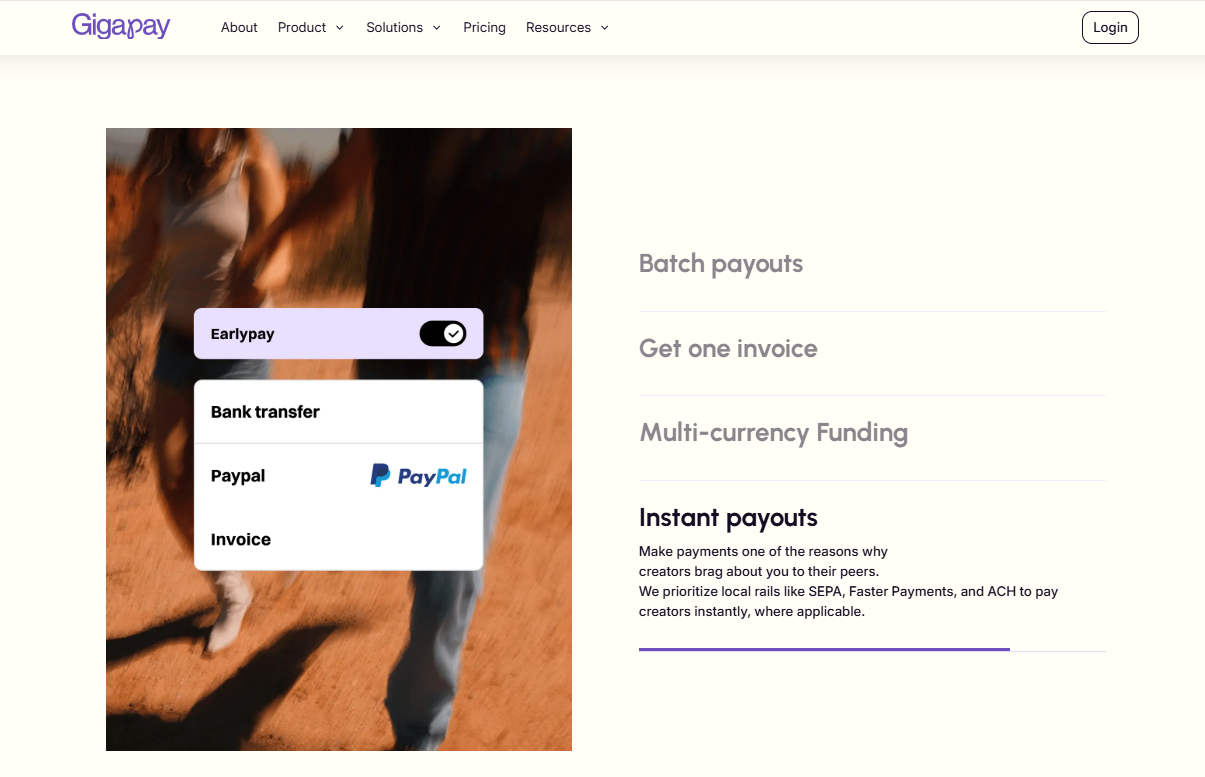
On Gigapay, your creators keep what they earn, because clients cover the fees on all new plans. Specify the payment rail where it matters, since SEPA Instant in the EU and Faster Payments in the UK settle in seconds while international wires take days.
Tax, VAT, and Withholding Clause
State each party's tax responsibilities explicitly. For cross-border B2B services inside the EU, the reverse charge mechanism under Article 44 of the VAT Directive usually applies, meaning the buyer self-assesses VAT and the creator invoices without it; the contract should require a valid VAT ID where one exists.
For creators without VAT registration, which covers most nano and micro creators, state how VAT and income reporting are handled. Address country specifics: German KSK at 4.9% and §50a withholding at 15.825%, Spanish IRPF withholding at 15% (7% for new professionals), and DAC7 data collection before first payment.
If a Merchant of Record sits between you and the creator, this clause gets short, because the MoR becomes the contractual counterparty and handles tax reporting such as DAC7, KSK data, and KU14.
Kill Fee and Cancellation Clause
Define what the creator receives if you cancel after signature. Market practice is 25% of the fee after signature but before production, 50% after production starts, and 100% after delivery or approval. Without a kill fee, cancellation becomes a negotiation with someone who has already turned down other work for your campaign, and whose audience hears about it.
Pair the kill fee with your termination rights for cause, such as breach of disclosure rules under the ASA or ARPP codes, so both sides know which cancellations pay and which do not.
Usage Rights and Payment Linkage Clause
Tie usage rights to payment status. The creator owns the content by default in both UK and EU law, so paid usage, whitelisting, and paid amplification rights should be licensed for a defined period, for example 90 days of paid social usage in named markets, with pricing for extensions. State that usage rights transfer only once payment clears.
That single sentence protects creators from brands running unpaid ads with their face, and protects you from claims that rights lapsed while an invoice sat in approval. France makes intellectual property terms a mandatory contract element, so this clause is a legal requirement there, not a nice-to-have.
Influencer Contract Payment Clause Template for the UK and EU (2026)
Copy the template below into your influencer agreement and replace the bracketed fields. It covers the eight clauses above and the mandatory elements under French law. Have local counsel review the final contract, because this template is general information, not legal advice.
For campaigns above €1,000 per year per advertiser in France, this entire agreement must be in writing, and the identity, scope, remuneration, and intellectual property elements above are mandatory on pain of nullity.
Influencer Rates and Payment Benchmarks for 2026
A payment clause starts with a number, so anchor yours to the market. These are the 2026 per-post benchmarks from Gigapay's 2026 Creator Pay Report.
Niche moves the number as much as audience size. Finance and fintech creators command CPMs of 40–80, health and medical 30–60, beauty and fashion 20–40, and gaming 8–18. Micro and nano creators took 45.5% of influencer spend in 2026, which is exactly the segment least likely to have a registered company, a VAT number, or an accountant, and most exposed to a badly drafted payment clause.
The earnings picture explains why payment terms matter so much to creators. In a January 2026 survey of 1,000 creators by the Influencer Marketing Factory, 48.7% earned under $10,000 a year and the median creator income sat near $3,000, while average earnings of $44,293 reflect a top-heavy market where the top 10% of creators captured 62% of brand payments in 2025.
For most of the creators on your campaign roster, your invoice is rent money. A brand that pays net 30 without fail becomes a partner of choice; 59% of creators in the Nordics earn less than €1,000 a month, and for them a 90-day term is a reason to walk.
Common Payment Clause Mistakes Brands Make in Influencer Contracts
The same errors show up in creator contracts across the UK and EU, and each one has a cost you can put a number on.
- Leaving the due date undefined: "Payment upon campaign completion" has no legal anchor. The EU default then applies: 30 days from invoice, with interest at roughly 10.4% running automatically after that.
- Setting terms beyond 60 days: Net 90 and net 120 terms persist across Europe, yet under Directive 2011/7/EU anything beyond 60 days needs express agreement and fails if grossly unfair. The UK's Commercial Payments Bill will cap large-to-small terms at 60 days from 2027.
- Trying to contract out of statutory interest: UK and EU law both make clauses that exclude late payment interest unenforceable. The clause buys you nothing and reads as a red flag to any creator's manager.
- Ignoring the value of gifted products: In France, gifts count toward the €1,000 written-contract threshold at market value, and in Sweden, Skatteverket taxes gifted products at market value. A contract that treats product as free exposure misstates the deal.
- Passing transfer and FX fees to the creator: The creator quotes €2,000 and receives €1,910, and your next negotiation starts from distrust. Price the fees into your budget and state that the creator receives the agreed amount in full.
- Skipping the kill fee: Campaigns get cancelled. Without a kill fee schedule, every cancellation turns into an argument with someone who holds an audience.
- Separating usage rights from payment status: Rights that transfer on signature keep running while an invoice sits unpaid for 90 days. Tie the licence to cleared payment.
- Treating creators as standard procurement vendors: Onboarding a nano creator through a supplier portal built for raw-material vendors takes weeks, and procurement deprioritizes small payees. That process, not the clause, is usually why payment runs late.
How to Manage Payment Clauses Across Hundreds of Creators
One contract with the clauses above is a legal task. Six hundred of them a year is an operations problem, and it is where most programs break. A brand running 600 creator collaborations manually spends around 840 admin hours a year on onboarding, invoicing, and reconciliation, at a true cost of roughly €40–€60 per payment, before a single compliance fine.
Each creator becomes a vendor record in your ERP, each invoice a line finance chases, and each country a new set of withholding, levy, and reporting rules your template has to absorb.
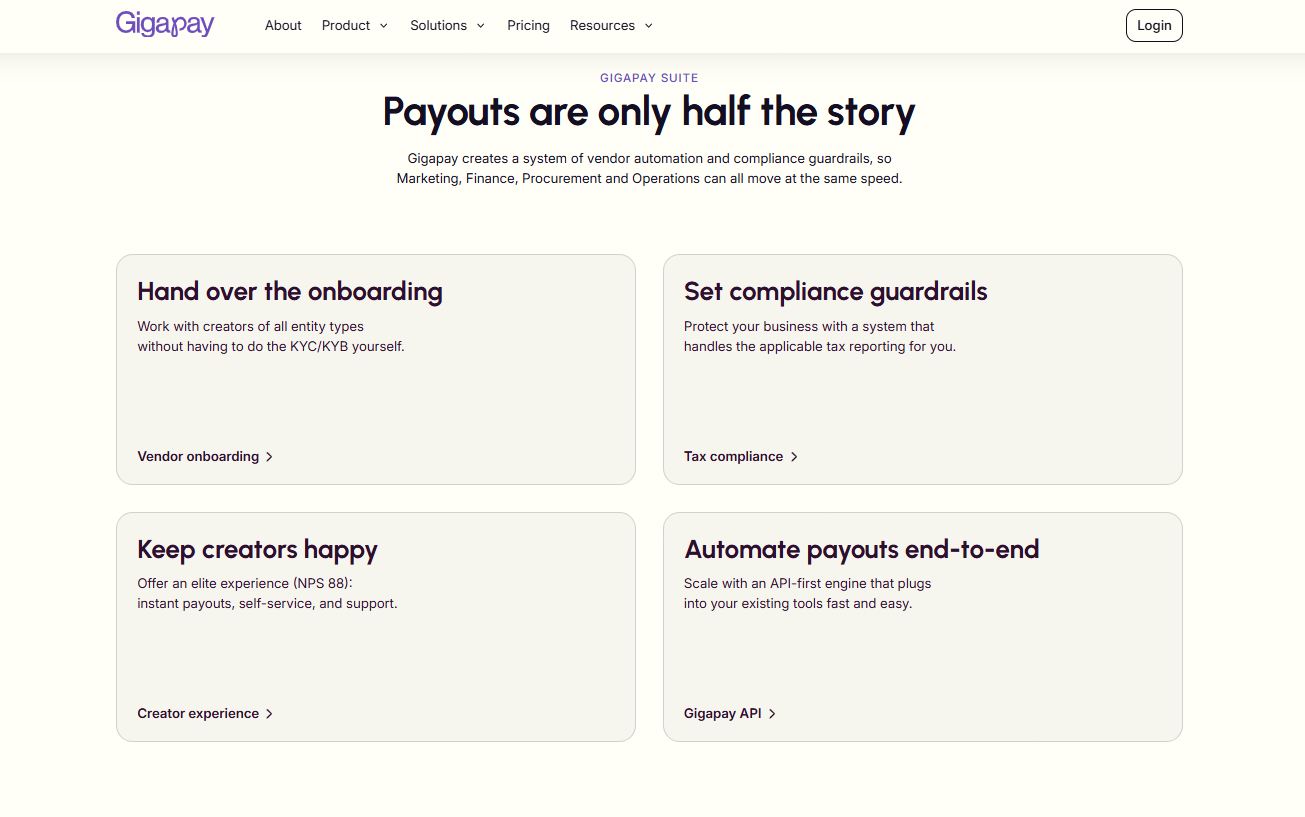
A Merchant of Record collapses that structure. Gigapay formally purchases the creator's deliverable and resells it to you, which makes Gigapay the contractual counterparty for every creator payment. In practice that means one vendor in your ERP instead of hundreds, one consolidated invoice per campaign instead of one per creator (an 80% reduction in invoice volume), and tax reporting such as DAC7, Germany's KSK data, and Sweden's KU14 handled inside the platform.
Creators onboard in minutes without a registered company or VAT number, get paid instantly when funds are pre-funded, in 65+ countries and 50+ currencies over local rails like SEPA Instant and Faster Payments, and keep what they earn because clients cover the fees on all new plans.
The payment clause work changes shape accordingly. Your contract with the creator still defines fees, deliverables, kill fees, and usage rights, but the payment, invoicing, and tax mechanics run through one standing agreement with a single counterparty.
Boozt used this model to triple its creator collaborations without expanding the team, and The Goat Agency (WPPMedia) reports payments that are easier and faster while staying compliant with taxes and benefits. Creator satisfaction follows the money: Gigapay's creator NPS stands at 88.
Conclusion
Gigapay is the Merchant of Record for creator payouts: the one vendor that pays your creators on your behalf by taking on the compliance, payouts, and support so you don't have to.
The payment clauses in this guide cover what the law now demands across the UK and EU in 2026: a defined compensation structure, terms within 60 days, statutory interest acknowledged rather than dodged, clear invoicing and currency rules, explicit tax responsibilities, a kill fee schedule, and usage rights tied to cleared payment.
France's written-contract decree, the UK's Commercial Payments Bill, Germany's KSK levy, and DAC7 all pull in the same direction, and the contracts that survive 2026 are the ones written for it.
Book a demo and see how your next campaign pays every creator on time, in every market, under one contract.
Read Next:
- Best Influencer Payout Setup for Ecommerce Teams on Shopify in 2026
- UK Influencer Rates 2026: What Creators Charge and the True Cost of Paying Them
- How to Pay UK Creators Who Aren't VAT-Registered (and Why Self-Billing Won't Cover Them)
FAQs:
1. What payment clauses must an influencer contract include in the UK and EU?
An influencer contract in the UK and EU must include the compensation amount or its calculation criteria, the payment schedule with terms of 60 days or less, invoicing requirements, late payment interest, currency and fee allocation, each party's tax responsibilities, a cancellation fee, and usage rights tied to payment. France additionally requires the parties' identity and tax residence, the scope of work, and intellectual property terms in writing for collaborations above €1,000 per year.
2. What is the maximum payment term for influencer invoices in the EU?
The maximum payment term for influencer invoices in the EU is 60 days under Directive 2011/7/EU, and longer terms are enforceable only if both parties expressly agree and the term is not grossly unfair to the creator. When the contract sets no term, payment is due within 30 days of the invoice.
3. Is a written influencer contract mandatory in France in 2026?
Yes, a written influencer contract is mandatory in France in 2026 for any collaboration worth more than €1,000 excluding tax per advertiser per year, counting cash plus the market value of gifts, under the decree of November 28, 2025. A contract missing the required clauses can be declared null and void.
4. How much late payment interest can influencers charge in the UK?
Influencers in the UK can charge late payment interest of 8% above the Bank of England base rate, which equals 11.75% a year with the base rate at 3.75%, plus fixed compensation of £40, £70, or £100 per invoice under the Late Payment of Commercial Debts (Interest) Act 1998. These rights apply automatically from the day after the due date.
5. What is the best way to pay influencers compliantly in the UK and EU in 2026?
The best way to pay influencers compliantly in the UK and EU in 2026 is through a Merchant of Record such as Gigapay, which becomes the contractual counterparty for creator payments, consolidates hundreds of creator invoices into one per campaign, handles tax reporting such as DAC7, KSK data, and KU14, and pays creators in 65+ countries, instantly when funds are pre-funded.