
Large clients now push payment terms of 60 to 120 days, with documented cases past 150, according to a Kaplan Group analysis reported by MediaPost in June 2026.
Payment speed changes what creators charge because creators price waiting into their quotes, so net 30 costs you more than paying on approval.
Gigapay acts as the Merchant of Record for creator payments, used by brands, agencies and creator platforms to pay creators and influencers through a single vendor, with one consolidated invoice rather than a supplier record for every creator.
This guide gives you the data, the pricing mechanics and the fix.
Key takeaways
- EU firms agreed 43-day payment terms but paid after 60.3 days (European Commission, 2024).
- 41% of creators call payment delays their biggest pain point (Influencer & Crowd DNA, 2025).
- Slow terms push creators towards deposits, late-fee clauses and higher quotes.
- 54% of gig workers need funds the same day (PYMNTS and Ingo Payments, 2025).
- A Merchant of Record consolidates creator payments into one vendor and one invoice.
What Does Net 30 Mean in Creator Payments?
Net 30 means the invoice falls due 30 days after it is issued. In creator work, the clock usually starts when the content is approved, not when it is posted, so the real wait from work to money is longer than the term suggests.
The term on the contract and the date the money lands are two different numbers. Across the EU, businesses agreed average payment terms of 43 days but actually paid after 60.3 days, according to the European Commission's EU Payment Observatory (2024).
The direction of travel is worse at the top of the market: large clients push terms of 60 to 120 days, with documented cases past 150, per the Kaplan Group analysis reported by MediaPost (June 2026).
The 4As said in 2023 that anything beyond 30-day terms is "incompatible with the typical agency commercial model", and the same logic applies to a single creator with one bank account. When you quote net 30 to a creator, you are asking them to lend you the fee. That loan has a price, and it shows up in your next negotiation.
How Late Do Brands Actually Pay Creators in 2026?
Late payment is now standard practice in the creator economy. In Remote's State of Freelance Work report (2025), 85% of freelancers said they experience late payments at least some of the time, and 21% are paid late, or not at all, more than half the time.
Invoice-level data tells the same story. A Bonsai analysis of invoices from more than 100,000 freelancers, cited by MediaPost in June 2026, found 29% were paid at least one day late. The same MediaPost report notes that larger companies pay late 51% of the time, against 41% for smaller businesses, so enterprise budgets arrive with enterprise delays.
Creators feel this more than any other part of the deal. In a March 2025 report by Influencer and Crowd DNA, cited by eMarketer (2025), 41% of creators named payment delays as their biggest pain point when working with brands. For your programme, that means the creators you most want to keep are judging you on the one process marketing rarely controls: when finance releases the money.
How Much Do Creators Charge in 2026?
Before payment terms enter the conversation, it helps to know the baseline. Collabstr's 2026 Influencer Marketing Report, built on more than 21,000 collaborations from 2025, puts average asking prices and final negotiated payouts at the levels below.
Two things stand out:
- First, roughly 80% of collaborations cost under $300, and only 2% exceed $1,000, per the same Collabstr report (2026), so most creator payments are small payments.
- Second, the gap between asking price and payout shows that almost everything in a creator deal gets negotiated.
Payment terms sit inside that negotiation. A creator deciding between your net 60 brief and a competitor's pay-on-approval brief is not comparing identical offers, and the quote you receive reflects that difference.
How Net 30 Payment Terms Raise Creator Rates
A creator on net 30 is extending you unsecured credit, and rational sellers price credit. The cost of slow terms rarely appears as a line item; it arrives as a higher day rate, a bigger scope buffer or a firmer "no" on usage rights.
Creators defend themselves in 3 visible ways:
- They ask for deposits, often 50% upfront with the balance on delivery.
- They add late-fee clauses to their agreements.
- They quote higher to brands with a reputation for slow payment, because chasing an invoice is unpaid work.
Flat fees make the stakes higher, since a flat rate per campaign is the most common compensation type for US creators at 31%, per an IPSOS report (February 2024) cited by eMarketer. One flat payment arriving late means the creator's whole fee is late, not a fraction of it.
Regulation is starting to set a floor. In New York, the Freelance Isn't Free Act has required payment within 30 days of completed work for most freelance contracts of $800 or more since August 2024 (New York State law).
This is general information rather than legal advice (last reviewed: October 2026). For your budget, every one of these defences is a cost that faster payment would have avoided.
The Real Cost of Net 30: A Worked Example
Take an illustrative campaign: 20 creators at €1,500 each, €30,000 in total, on net 30 terms that actually settle around day 60, in line with the EU Payment Observatory's 43-day agreed versus 60.3-day actual gap (European Commission, 2024).
The table below is an illustration of how that delay turns into cost, built on simple arithmetic rather than any study.
The pattern scales. A brand running 600 collaborations a year multiplies that risk buffer and that chasing time across every batch.
Gigapay's estimate for a brand running 600 collaborations a year puts the internal cost of handling payments manually at €139,590 and 840 hours, against €46,350 and 60 hours with a consolidated setup. Beyond the frustration they cause creators, slow terms quietly reprice your whole programme.
What Instant Pay Changes About Creator Pricing
Instant pay describes the market model where a creator can access payment once work is approved, rather than waiting out a 30, 60 or 90-day term. Demand for that model is measured.
PYMNTS Intelligence and Ingo Payments found in a December 2025 study of 4,170 US consumers that 54% of gig workers need their funds the same day they are processed, and 48% of freelancers, contractors and consultants require same-day access to earnings.
Supply has not caught up, since only 36% of gig platforms offer instant payments always or most of the time, per the same PYMNTS and Ingo Payments study (2025). That gap is your negotiating room.
Public data on exact rate discounts for fast payment is thin, so treat any precise "pay fast, save X%" figure with caution. What fast payment demonstrably changes is posture: fewer deposit demands, fewer late-fee clauses, no chasing emails, and a stronger position when you ask for a better rate or extended usage rights. You are simply removing the credit risk the creator was pricing.
Net 30 vs Instant Pay: Side-by-Side Comparison for Brands
The two models distribute cost and risk differently, and the right question is who carries the waiting.
Paying on approval moves the financing cost onto your side, which is why finance teams resist it when every creator is a separate supplier and a separate invoice. The admin cost of paying 200 creators quickly, one by one, can exceed the goodwill it buys.
The model only works at scale when the payment admin is consolidated, which is where the vendor structure matters as much as the speed.
Why Payment Speed Decides Which Creators Work With You Again
Most creator payments are small, and small payments are the ones people need on time. With roughly 80% of collaborations under $300 (Collabstr, 2026), the typical creator in your programme is a nano or micro creator for whom your fee is near-term income rather than working capital.
That is why late payment damages the relationship out of proportion to the amount. Remote's State of Freelance Work (2025) found 21% of freelancers are paid late, or not at all, more than half the time, and a creator with that experience starts the next negotiation defensively or declines it altogether.
Fast, predictable payment works in the opposite direction. It gives your team a concrete advantage when briefing in-demand creators, because you can state the payout trigger and the payout window in the brief itself.
For a head of influencer marketing, payment speed is one of the few levers that improves rates, repeat participation and creator sentiment at the same time.
How Should Brands Set Creator Payment Terms in 2026?
Set terms you can actually honour, then say them out loud. The checklist below reflects where the data says deals go wrong.
- Define the trigger event precisely: payment runs from content approval, with an approval deadline on your side.
- State the payout window in the brief, so the term becomes a selling point rather than a surprise.
- Pay small invoices fast, since an under-$300 payment (the bulk of deals, per Collabstr, 2026) is not worth 60 days of float.
- Match the term to the market: 43-day agreed terms already slip to 60.3 days in practice (European Commission, 2024), so padding terms further mostly buys resentment.
- Consolidate the counterparty, because the real blocker is usually the work of onboarding hundreds of creators as suppliers rather than willingness to pay.
The last point is the structural one. If every creator is a vendor in your ERP, speed depends on procurement queues and AP capacity. If one vendor stands between you and all of them, speed becomes a process setting instead of a monthly fight.
How Does Gigapay Change Payment Speed for Creator Programmes?
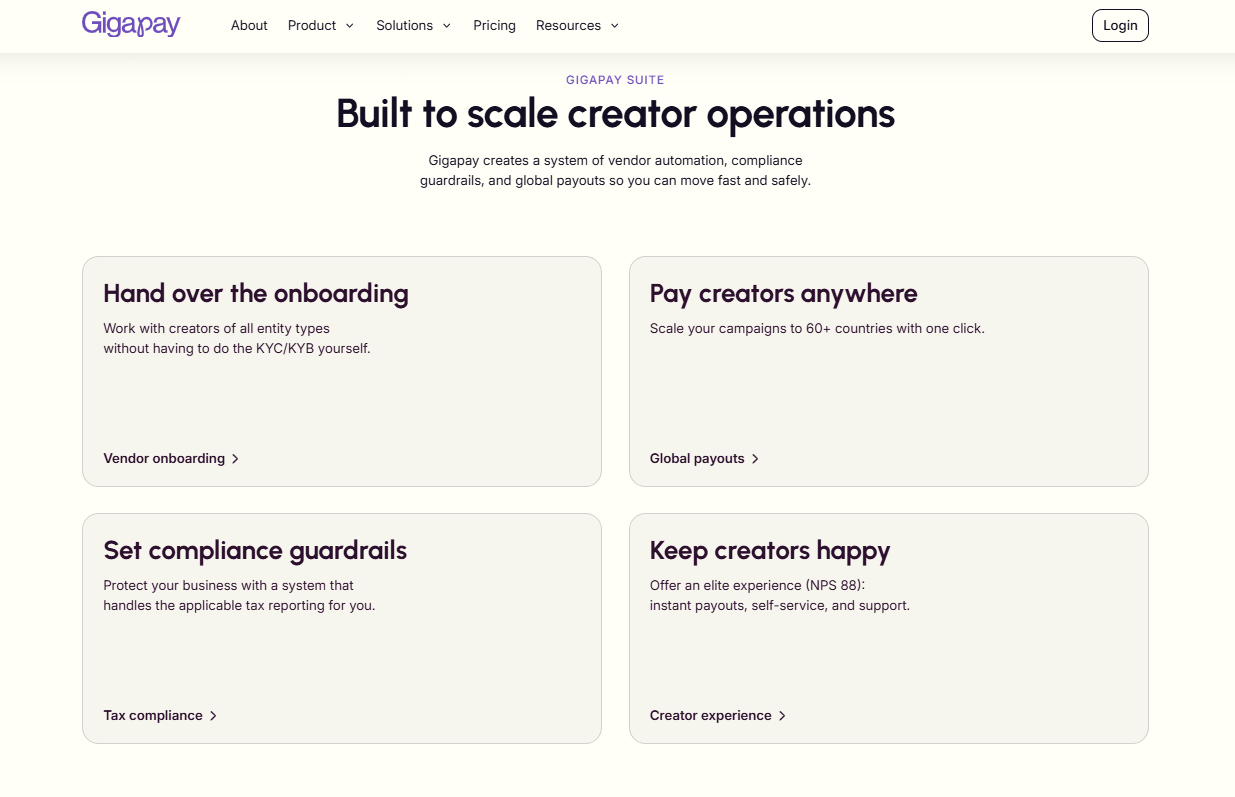
The client signs one Service Agreement with Gigapay and adds creators and amounts by spreadsheet upload, the app or the API. Creators onboard as individuals, sole traders or companies, in about 10 minutes, and Gigapay runs identity and tax-ID checks at onboarding.
When the client approves the work, Gigapay undertakes to buy the creator's services and issues the client a consolidated invoice. The creator claims the payout in Gigapay. At the claim, Gigapay buys the services and resells them to the client.
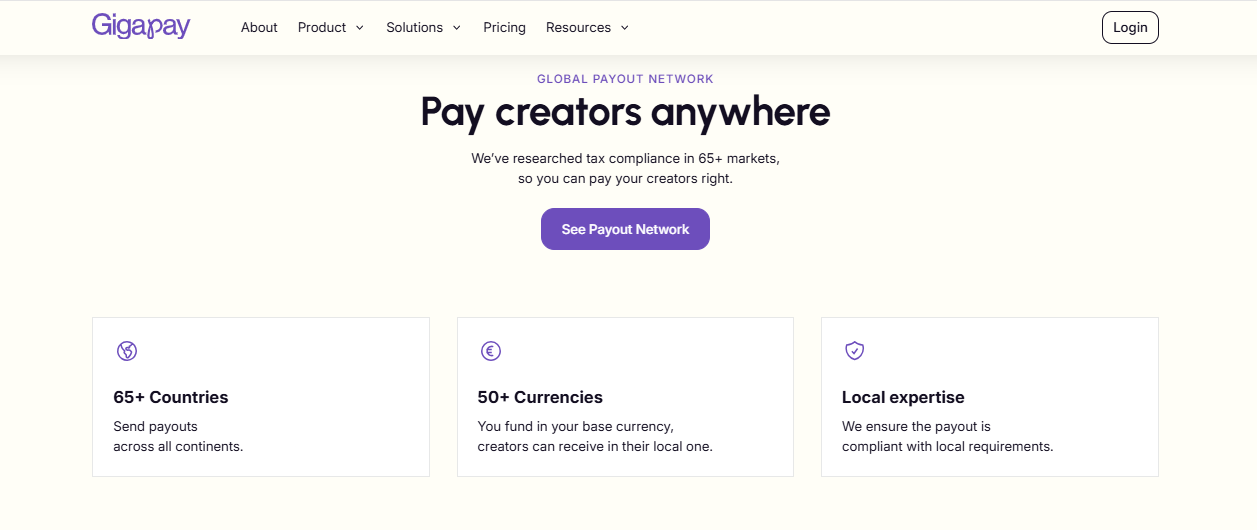
The payout is executed by a licensed third-party payment provider, and payouts arrive in seconds to a few banking days, depending on country and payout method. Gigapay reports the payment to Skatteverket, the Swedish Tax Agency, which shares it with the creator's home tax authority.
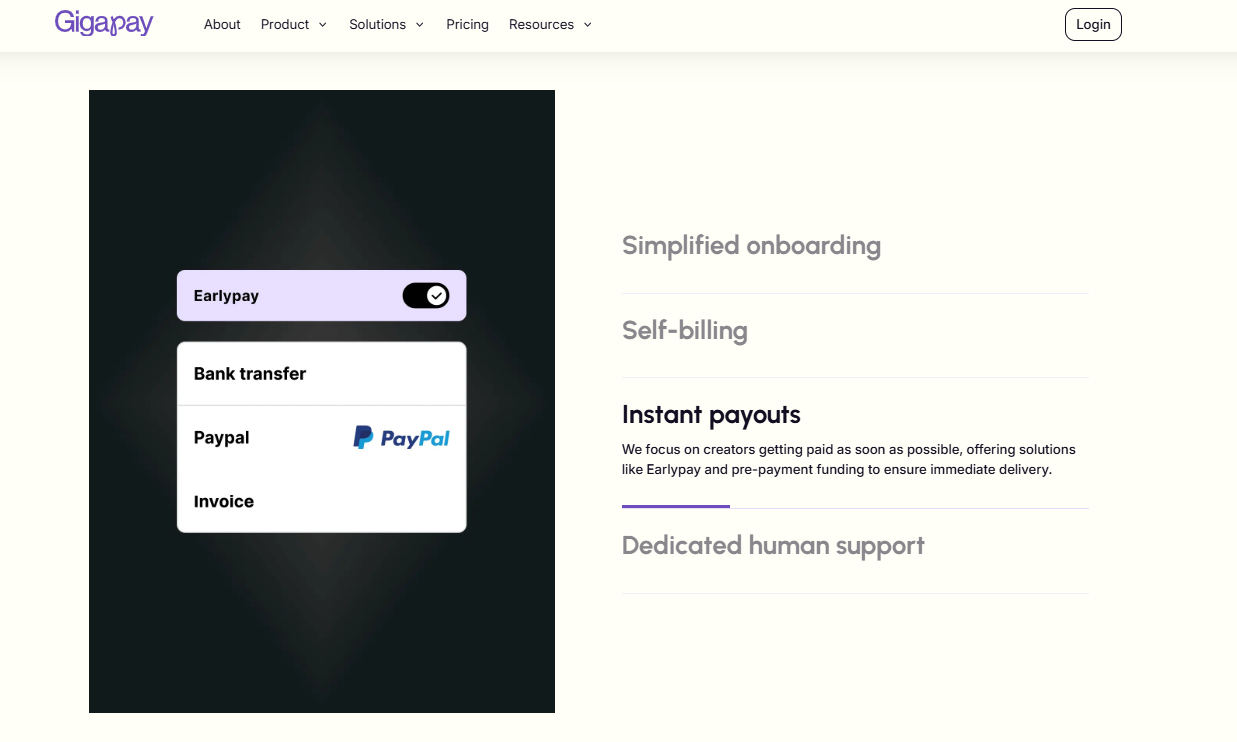
Earlypay lets creators claim a payout before the standard payment date, at a reduced amount shown to them before they confirm.
For finance, the invoice problem shrinks: in Gigapay's published case studies, WPP Media reports 80% fewer invoices and Once Upon reports 25% of admin time saved.
Platforms can integrate payouts through the Gigapay API in a week, and country coverage is listed on the Supported Markets page at gigapay.com.
Conclusion
Gigapay, the Merchant of Record for creator payments, exists for exactly the problem this guide describes: payment terms that quietly raise what creators charge.
The data points one way, since net 30 terms that settle at day 60 push creators to price the wait into deposits, late fees and higher quotes, while paying on approval removes that premium and the chasing that comes with it.
With one vendor and one consolidated invoice in place of hundreds of supplier records, payment speed stops depending on how fast AP can process suppliers.
Book a demo at gigapay.com to see what that setup would do to your payment terms conversation.
Read Next:
- Best Creator Payout Platform for Sweden, Norway, Denmark and Finland in 2026
- GBP vs EUR vs Local Currency: How FX Fees Eat Creator Payouts in 2026
- Influencer Contract Payment Clauses for the UK and EU: 2026 Template
FAQs:
1. What is the difference between net 30 and instant pay for creators?
The difference between net 30 and instant pay for creators is when the money moves: net 30 makes the fee due 30 days after invoicing, while instant pay models release payment once the work is approved. In practice, net 30 often settles later, since EU businesses averaged 60.3 actual days against 43 agreed (European Commission, 2024).
2. Do creators charge more for net 30 payment terms?
Creators often charge more for net 30 payment terms because waiting is a cost they carry. Common responses include higher quotes for slow-paying brands, 50% deposits and late-fee clauses. With 41% of creators naming payment delays their biggest pain point (Influencer & Crowd DNA, 2025), terms are part of the price.
3. How long do brands actually take to pay creators in 2026?
Brands actually take longer to pay creators than their stated terms in 2026. EU businesses agreed 43-day terms but paid after 60.3 days on average (European Commission, 2024), and large clients push 60 to 120-day terms, with cases past 150 (Kaplan Group analysis, MediaPost, June 2026).
4. What is a Merchant of Record for creator payments?
A Merchant of Record for creator payments is the vendor that buys creators' services and resells them to the client, so the client pays one counterparty instead of onboarding every creator as a supplier. Gigapay is the Merchant of Record for creator payments, with one consolidated invoice per batch or campaign.
5. How fast can creators be paid through Gigapay?
Creators can be paid through Gigapay in seconds to a few banking days, depending on country and payout method, once they claim the payout. Earlypay lets creators claim a payout before the standard payment date, at a reduced amount shown to them before they confirm.