
36.3% of Nordic marketing organisations now spend over €200,000 a year on influencer marketing, according to Kolsquare's September 2026 study with B2B International.
For teams paying creators across Sweden, Norway, Denmark and Finland, Gigapay comes out strongest in this guide's October 2026 vendor comparison.
Gigapay is the Merchant of Record for creator payments. Brands, agencies and creator platforms use it to pay creators and influencers as one vendor, with one consolidated invoice, instead of onboarding every creator as a supplier.
This guide covers Nordic market data, creator rates, tax context and a breakdown of 6 platforms.
Key Takeaways
- In Kolsquare's 2026 study, 36.3% of Nordic organisations spend over €200,000 yearly on influencers.
- This guide compares Gigapay, Lumanu, Trolley, Tipalti, Stripe Connect and PayPal Payouts.
- Nordic payouts cross four countries, four tax authorities and four currencies.
- Payout rails move money, while a Merchant of Record becomes the creators' counterparty.
- Gigapay sends one consolidated invoice per batch or campaign instead of per creator.
How Big Is Influencer Marketing In The Nordics In 2026?
Kolsquare's The Future of Influencer Marketing: The 2026/2027 Outlook, published in September 2026 with fieldwork by B2B International, surveyed 1,123 marketing decision-makers across 7 European markets, including a Nordic sample of 132. Across Europe, 89% of organisations expect to raise influencer budgets within 12 months, up from 75% in 2025.
The Nordic numbers point to mature, concentrated spend. 36.3% of Nordic organisations invest more than €200,000 a year, slightly above the European average of 35.7% in the same study. 14.1% run influencer marketing as a fully integrated strategy, the highest share of the 7 markets surveyed.
Scale is the operational problem hiding in those figures. 36.4% of Nordic organisations in the Kolsquare 2026 study work with more than 100 influencers, and the European median annual spend sits at €144,000. For your team, that means influencer marketing has outgrown ad-hoc payment routines, and the payout process now deserves the same scrutiny as the media budget.
What Creators In Sweden, Norway, Denmark And Finland Charge In 2026
Nordic creator fees are high relative to audience size because the creator pools are small. Micro-influencers in the Nordics charge €200 to €500 per Instagram post, according to Gigapay's Micro-Influencer Rates in Europe 2026 guide, published in October 2026. The same guide puts Nordic finance-niche YouTube CPMs at €18 to €22.
Global benchmarks frame the tiers. Heepsy's 2026 influencer earnings guide puts nano creators at $50 to $200 per Instagram post, micro creators at $200 to $800, and macro creators at $2,000 to $10,000. Rates on TikTok and YouTube run in similar bands, with YouTube videos priced higher per piece.
Run the numbers on a typical Nordic campaign and the admin load becomes visible. 50 micro creators at €350 per post is €17,500 of spend split across 50 separate payees, each with their own bank details, currency and tax situation.
For your finance team, every rate card decision upstream becomes a payment file downstream, so the payout process has to handle volume, not just totals.
How Nordic Creators Expect To Receive Payment
The Nordics run on fast domestic mobile payment rails, and creators judge every payout against them. Vipps and MobilePay count close to 13 million users across the region, including 4.8 million MobilePay users in Denmark and 3 million in Finland, according to Vipps MobilePay's October 2026 announcement. Sweden has its own mobile payment system in Swish, run by the Swedish banks.
Currencies complicate the picture. Sweden pays in SEK, Norway in NOK, Denmark in DKK and Finland in EUR, so a 4-country campaign means 4 currencies from one budget. A creator in Oslo quoted in NOK does not want to absorb a conversion because your bank pays out in EUR.
Paying in the creator's local currency removes the conversion their bank would otherwise charge on an incoming foreign-currency transfer. For your campaigns, the practical standard is local currency into a local account, quickly enough that the creator never has to chase the payment.
Why Is Paying Creators Across Four Nordic Countries Complicated?
Four countries means four tax administrations: Skatteverket in Sweden, Skatteetaten in Norway, Skattestyrelsen in Denmark and Verohallinto in Finland. Sweden, Denmark and Finland are EU member states, while Norway is not, so EU-wide rules such as DAC7 do not apply uniformly across the region.
The creator side is fragmented too. Some Nordic creators invoice through a registered company, others work as sole traders, and many, especially nano and micro creators, have no business registration at all. Each type needs different paperwork before finance will release a payment.
Then there is the vendor problem. If every creator becomes a supplier in your ERP, a 100-creator programme creates 100 vendor records, 100 onboarding checks and 100 invoices to process, and procurement teams routinely block small vendors.
For your team, the question is not whether you can pay a creator in Helsinki, but whether you can pay 100 of them across 4 countries without the process consuming the margin.
How To Choose A Creator Payout Platform For The Nordic Market
Judge platforms on six criteria before you look at price.
- Counterparty model: Payout rails move your money to creators, while a Merchant of Record becomes the creators' counterparty and invoices you for the services. Decide which model your finance and legal teams want.
- Currency coverage: SEK, NOK, DKK and EUR as a minimum, with local-currency payouts so creators avoid conversion charges from their banks.
- Creator onboarding: Nordic programmes rely on nano and micro creators, so onboarding must work for individuals without a registered company or VAT number.
- Reporting:] Ask who files platform reports such as DAC7 where they apply, and what data you receive for your own records.
- Invoicing: One consolidated invoice per campaign keeps month-end close manageable; per-creator invoices do not.
- Integration: An API or file upload that fits how your team already briefs and approves campaigns.
Score each vendor below against these six points, because the right answer depends on whether you need rails, software or a counterparty.
The 6 Best Creator Payout Platforms For Sweden, Norway, Denmark And Finland In 2026
The descriptions below come from each vendor's own public material, accessed 24 October 2026, with Gigapay described from its approved documentation.
1. Gigapay

Gigapay, founded in 2019 and based in Stockholm, is built around the Merchant of Record model. The client signs one Service Agreement with Gigapay and adds creators and amounts by spreadsheet upload, the app or the API.
Creators onboard with Gigapay as an individual, a sole trader or a company, with identity and tax-ID checks at onboarding, and no registered company or VAT number is needed. Onboarding takes 10 minutes.
When the client approves the work, Gigapay undertakes to buy the creator's services and issues the client a consolidated invoice. The creator claims the payout in Gigapay; at the claim, Gigapay buys the services and resells them to the client.
The payout is executed by a licensed third-party payment provider, and Gigapay reports the payment to Skatteverket, the Swedish Tax Agency, which shares it with the creator's home tax authority.
Payouts arrive in seconds to a few banking days, depending on country and payout method, with instant payouts in Sweden for creators at Nordea, Swedbank, SEB, Handelsbanken and Danske Bank. Gigapay supports 50+ currencies and covers the markets listed on its Supported Markets page.
An API integration takes a week, and Earlypay lets creators claim a payout before the standard payment date, at a reduced amount shown to them before they confirm.
In Sweden, Gigapay can employ the creator for the assignment, deduct preliminary tax, pay employer contributions and file the employer return. Nordic brands including Nelly.com, Lyko and Boozt work with Gigapay, and Boozt ran 3x collaborations without growing the team, as reported in its case study.
Pros:
- The client has one vendor record and receives one consolidated invoice per batch or campaign.
- Creators onboard as individuals, sole traders or companies, with no registered company or VAT number needed, in ca 10 minutes.
- Gigapay files DAC7 as the platform operator with Skatteverket.
- Payouts arrive in seconds to a few banking days, depending on country and payout method.
- An API integration takes a week, and campaigns also run by spreadsheet upload or the app.
Cons:
- Coverage varies by market, so check the Supported Markets page against your creator list before planning a campaign.
- The employment option with tax deducted at source applies in Sweden only, so creators elsewhere handle their own tax and contributions.
2. Lumanu
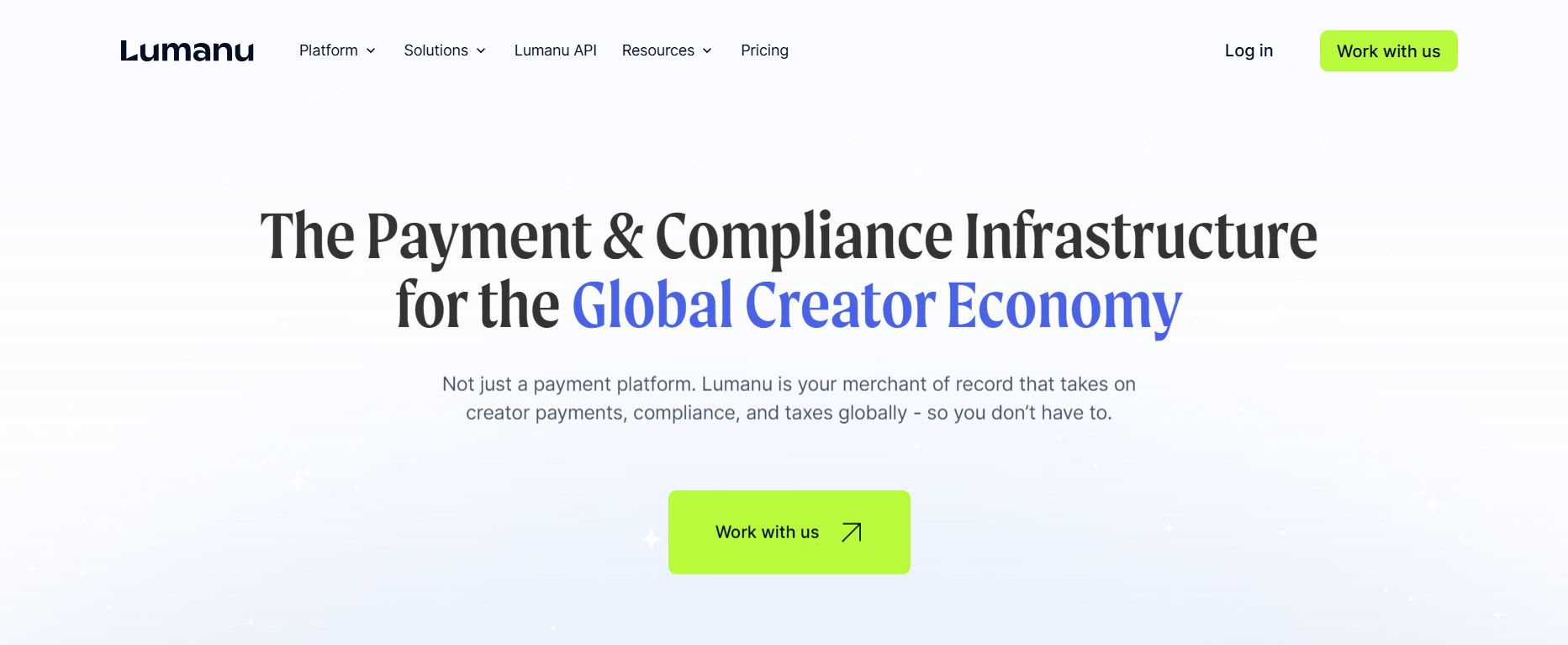
Lumanu describes itself as payment and compliance infrastructure for the global creator economy and claims a merchant of record model, according to Lumanu's website, accessed 24 October 2026. Its site cites $1.5B+ in payments made, 132 supported currencies, and coverage figures that vary between pages, 237 countries and territories on the homepage and 180+ in its FAQ.
Its published compliance material centres on US tax forms: W-9 and W-8 collection, validation and automatic 1099 filing, with master-vendor operation claimed in the US, UK, EU and Canada. Creators are paid in local currency, with the site promising payment "in days, not months" and a Visa Direct option.
Pros:
- Its site cites $1.5B+ in payments made and 132 supported currencies.
- It automates W-9 and W-8 collection and files 1099s automatically, per its site.
- Creators are paid in local currency, with a Visa Direct option.
Cons:
- Its coverage figures vary between its own pages, 237 countries on the homepage and 180+ in the FAQ.
- Its published compliance material centres on US tax forms rather than Nordic reporting.
- Its public material does not detail Sweden, Norway, Denmark or Finland, so Nordic specifics need a direct conversation.
Lumanu suits US-anchored programmes paying creators worldwide. For a Nordic-first programme, ask Lumanu directly what it files and provides in Sweden, Norway, Denmark and Finland, because its public material does not detail the region.
3. Trolley
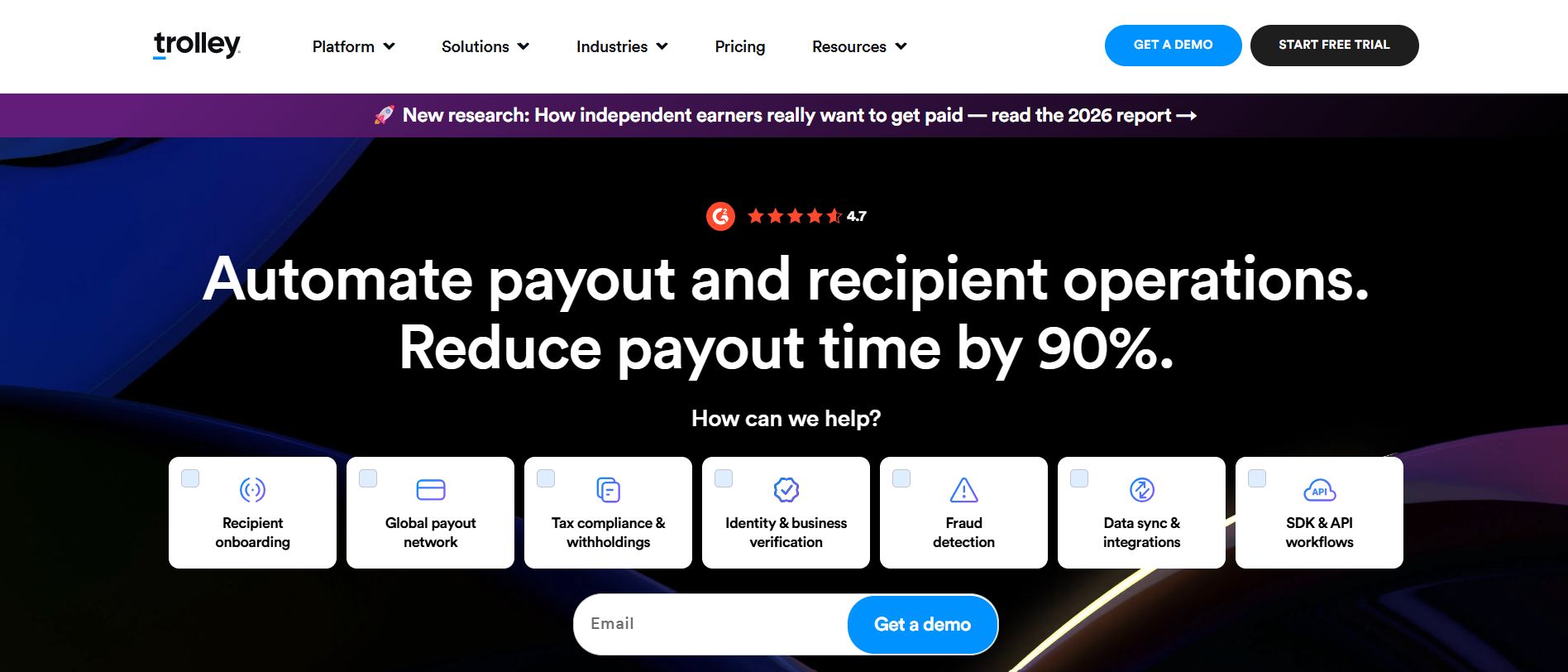
Trolley calls itself "The Payouts Platform for the Internet Economy" and sells payout rails rather than a counterparty model, according to Trolley's website, accessed 24 October 2026. It claims payouts to 210+ countries and territories in 135+ currencies, through bank transfers, PayPal and other local methods, with a headline promise to reduce payout time by 90%.
On tax, Trolley's site describes automated withholding tooling and support for IRS requirements and OECD digital platform reporting, and it publishes DAC7 guidance for EU seller reporting. Recipient onboarding, identity verification and fraud monitoring are part of the product.
Pros:
- It claims payouts to 210+ countries and territories in 135+ currencies.
- It publishes withholding tooling and DAC7 guidance for EU seller reporting.
- Recipient onboarding, identity verification and fraud monitoring are built into the product.
Cons:
- It sells rails, so your team remains the party running the programme.
- Vendor records, approvals and the reporting workload stay in-house with your team.
- The product serves payout operations in general rather than influencer campaign workflows in particular.
Trolley fits platforms and networks that want strong rails and tax tooling inside their own product and processes. You remain the party running the programme, so your team keeps the vendor records, approvals and reporting workload in-house.
4. Tipalti
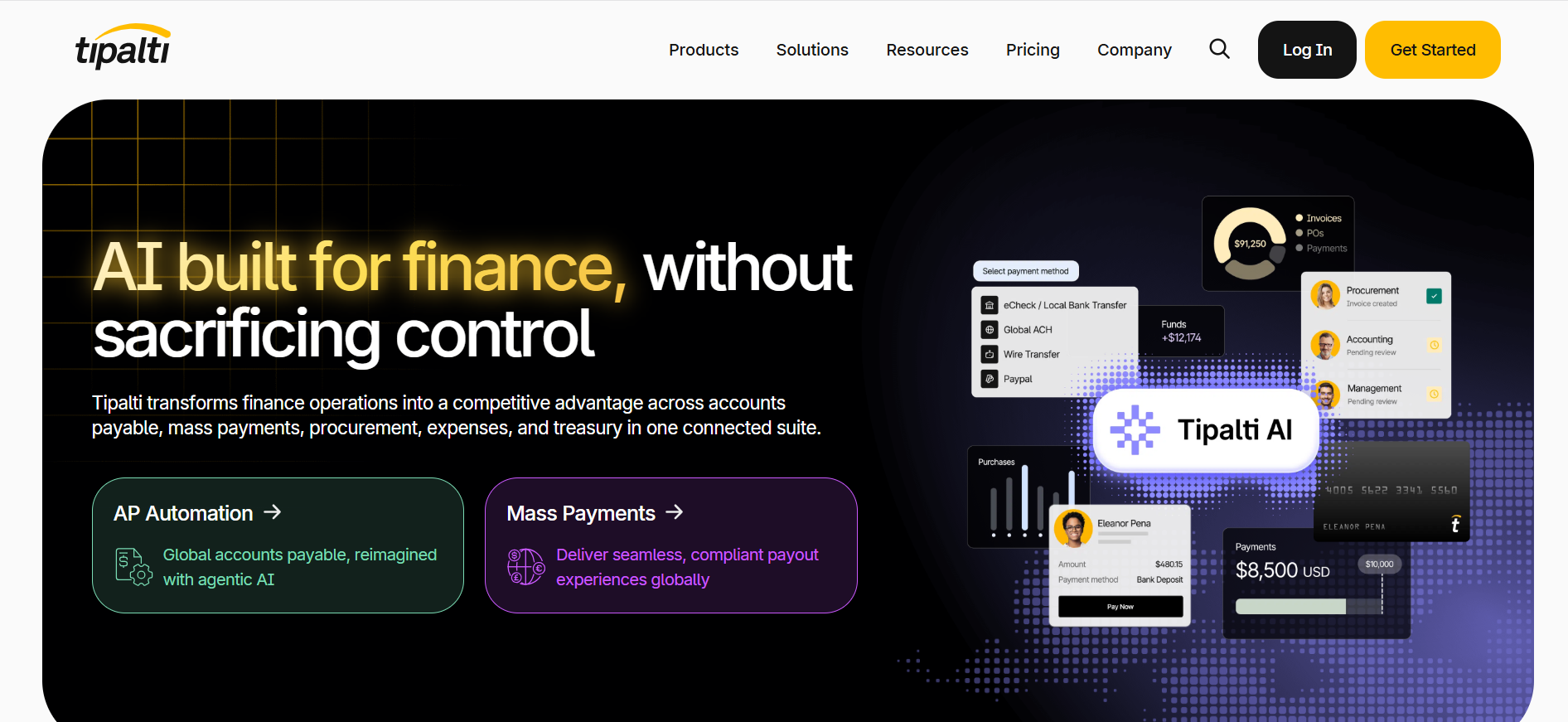
Tipalti positions mass payments inside a wider accounts payable suite, according to Tipalti's website, accessed 24 October 2026. It claims payouts to 200+ countries and territories in 120 local currencies through 50+ payment methods, including local bank transfers in Europe, global ACH, PayPal and SWIFT.
Its site describes a "KPMG-approved tax engine" supporting W-9, W-8, VAT and DAC7 reporting, with 1099 and 1042-S preparation. Tipalti names creators, influencers, affiliates and streamers among its target payees, alongside adtech, gaming and music royalties.
Pros:
- It claims payouts to 200+ countries and territories in 120 local currencies through 50+ payment methods.
- Its site describes a "KPMG-approved tax engine" for W-9, W-8, VAT and DAC7 reporting.
- Payouts sit inside a wider AP suite with ERP integrations.
Cons:
- Payees are onboarded through supplier-style AP workflows, which suit finance more than campaign teams.
- The platform assumes an accounts payable process at the centre, so marketing cannot run it alone.
- Your team remains the creators' counterparty, with contracts and records on your side.
Tipalti suits finance teams that want creator payouts handled inside broader AP automation, with an ERP at the centre. Creators are onboarded as payees in your process, so the model works best when your team already runs supplier-style onboarding at volume.
5. Stripe Connect
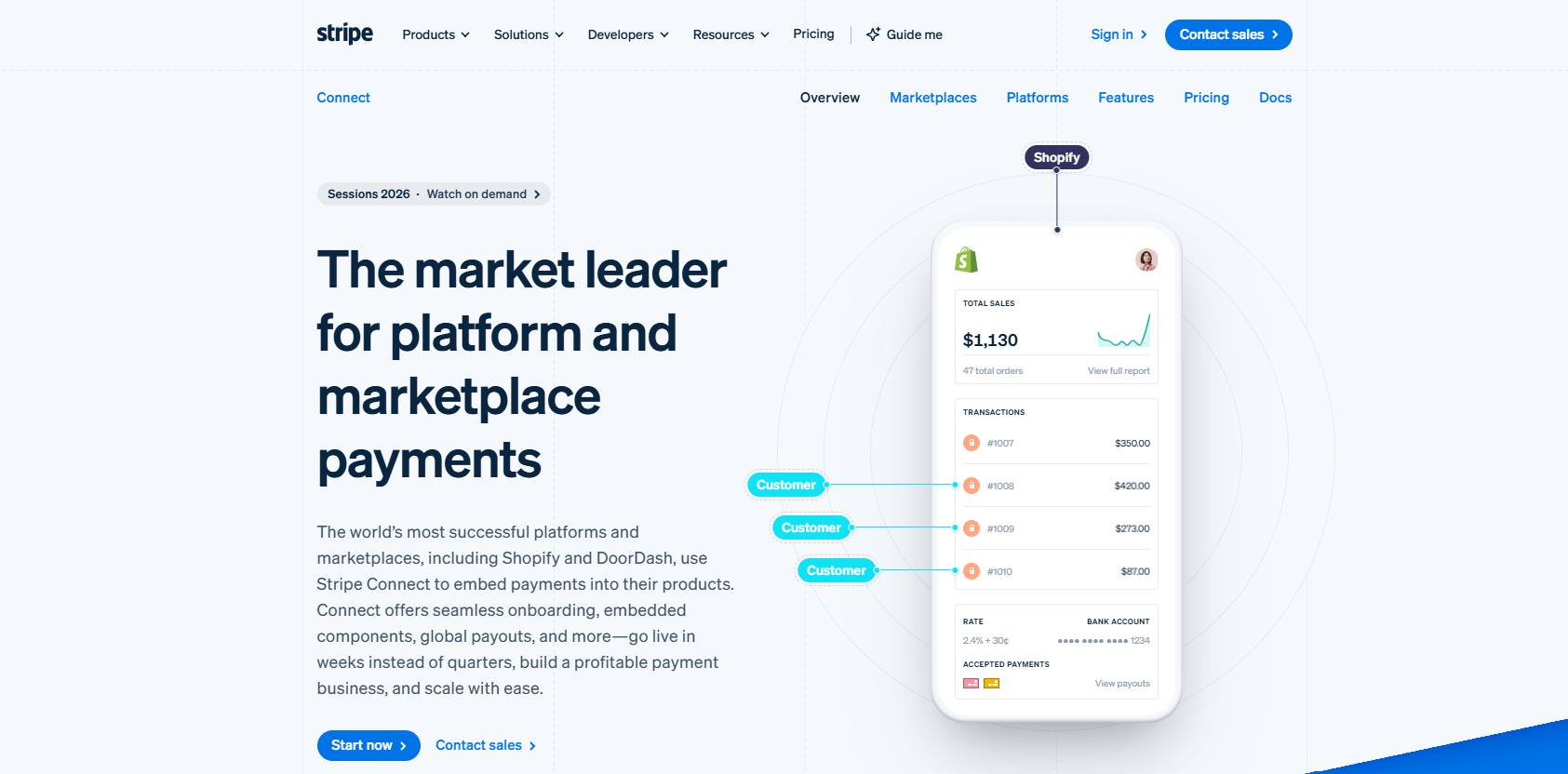
Stripe Connect is Stripe's product for platforms and marketplaces, described on Stripe's Connect page, accessed 24 October 2026, as "the market leader for platform and marketplace payments", Stripe's own claim. It supports 135+ currencies, onboarding in 46+ countries, and Instant Payouts that let a seller move funds to a bank account or debit card where available.
Stripe's site states that "Connect shifts payment obligations from you to Stripe" and that Stripe handles KYC, AML and sanctions screening, citing 20,000+ platforms including Shopify and DoorDash.
Pros:
- It supports 135+ currencies with onboarding in 46+ countries, per Stripe.
- Instant Payouts, Stripe's own feature, let sellers move funds to a bank account or debit card where available.
- Stripe states that Connect handles KYC, AML and sanctions screening.
Cons:
- Building payouts with Connect takes engineering time at the start and maintenance after launch.
- Workflows for campaigns, approvals and creator queries are yours to design and build.
- It is shaped for marketplaces with continuous money flows rather than campaign-based creator programmes.
Connect is a developer product. It fits product teams building payouts into their own marketplace or creator platform, with engineering time budgeted for the build. For a marketing or finance team that wants to upload a campaign and pay 80 creators, it is infrastructure to build with, not a finished workflow.
6. PayPal Payouts
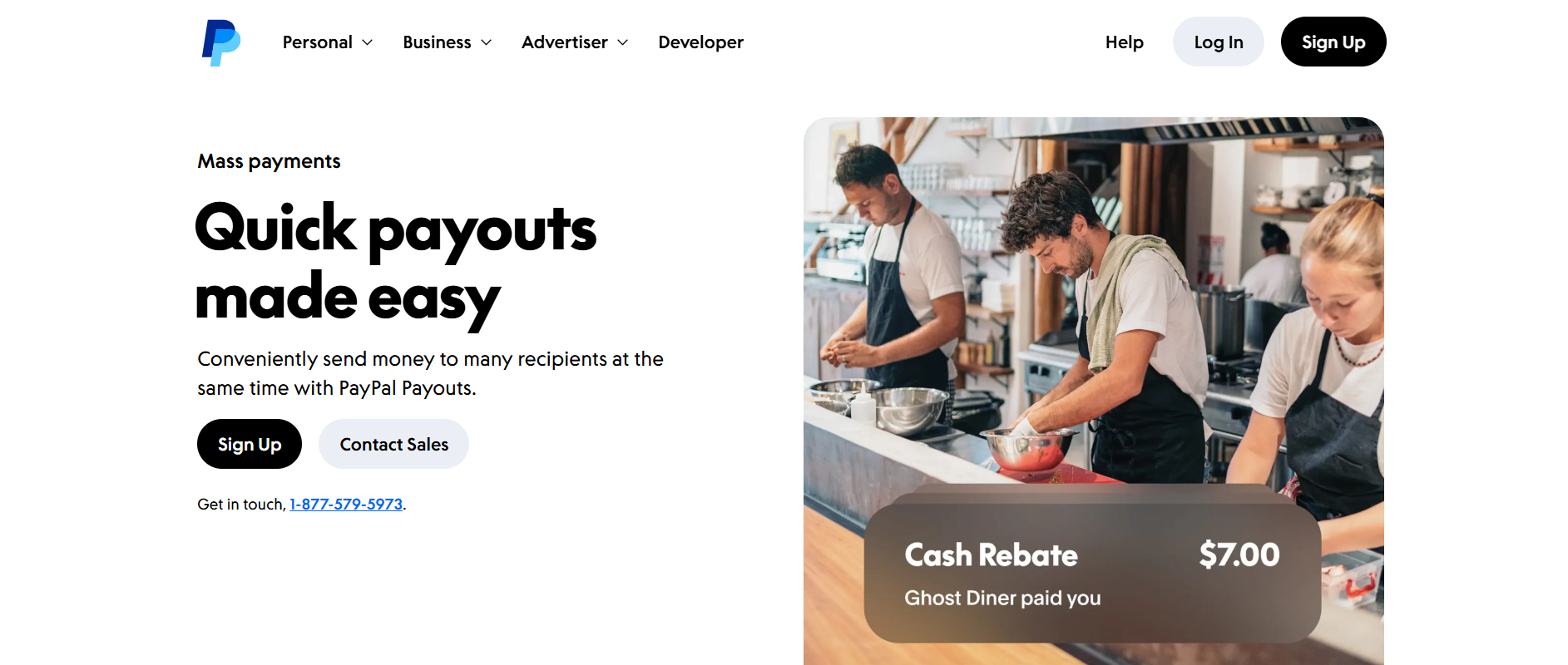
PayPal Payouts sends mass payments to recipients identified by email address, phone number or PayPal handle, according to PayPal's developer documentation, accessed 24 October 2026. It reaches recipients in 96 countries across 24 currencies, through CSV upload, SFTP batches or the Payouts API, with a $20,000 USD maximum per individual payout.
The sender pays a fee per transaction, currency conversion adds charges, and recipients claim the payout into a PayPal account. PayPal is familiar to many creators, which keeps adoption friction low for one-off payments.
Pros:
- It reaches recipients in 96 countries across 24 currencies, per PayPal's developer documentation.
- Many creators already hold PayPal accounts, which keeps adoption friction low.
- Batches run by CSV upload, SFTP file or the Payouts API.
Cons:
- Creators must hold and use a PayPal account to claim the payout.
- Each individual payout is capped at $20,000 USD, and currency conversion adds charges.
- Contracts, records and reporting around the payment stay with your team.
For Nordic programmes, the gaps show at scale: creators must hold and use PayPal accounts, and your team still handles contracts, records and reporting around the payment. PayPal Payouts works best as an occasional tool rather than the payment layer of a structured creator programme.
Nordic Creator Payout Platform Comparison
The table summarises each vendor's own published claims, accessed 24 October 2026, alongside Gigapay's approved documentation.
The short version for your evaluation: the rails vendors assume your team stays the counterparty and runs the admin, while the Merchant of Record model makes the vendor the creators' counterparty with one invoice to you.
How Do DAC7 And Nordic Tax Rules Affect Creator Payouts?
DAC7 is Council Directive (EU) 2021/514, the EU rule that requires digital platform operators to report sellers' income to EU tax authorities, applying since 1 January 2023. It covers EU member states, so it is relevant for creators in Sweden, Denmark and Finland, while Norway sits outside the EU.
Gigapay files DAC7 as the platform operator with Skatteverket. This does not pre-fill the creator's tax return, and creators still declare their income themselves. For the creator's fee, Gigapay is the payer: outside Sweden nothing is deducted at source and the creator handles their own tax and contributions, while in Sweden Gigapay can employ the creator for the assignment and deduct as an employer.
How you engage your creators stays your responsibility. For your compliance review, the useful question for any vendor is precise: who is the creators' counterparty, and what does that party report, where. This is general information, not tax advice.
What Does Manual Creator Payment Admin Cost A Nordic Brand?
Gigapay's estimate for a brand running 600 collaborations a year puts manual processing at €139,590 and 840 hours, against €46,350 and 60 hours with its model. Treat that as Gigapay's estimate, not a customer result, and test the assumptions against your own volumes.
The published customer figures point the same way. Once Upon saved 25% of admin time, and WPP Media cut invoices by 80%, as reported in their Gigapay case studies. Boozt ran 3x collaborations without growing the team, as reported in its case study.
The cost shows up in places finance rarely tags as "influencer marketing": vendor onboarding queues, invoice matching, payment investigations and creator emails asking where the money is. For your budget planning, the admin cost per collaboration belongs in the campaign maths next to the creator fees, because at Nordic volumes it changes which programmes are worth running.
When Should You Switch From Bank Transfers To A Payout Platform?
Manual bank transfers work at 5 creators and fail quietly somewhere on the way to 50. The breaking points are predictable: procurement starts blocking creators without company registration, month-end reconciliation takes days because every payment is its own line, and campaign launches wait on vendor onboarding rather than content.
Watch for three triggers:
- First, your team pays creators in more than one currency and fields questions about short-received amounts after bank conversions.
- Second, finance asks marketing to cap the number of new creator suppliers per quarter.
- Third, a campaign misses its launch window because payment setup, not content, was the critical path.
Any one of those is the moment to evaluate a platform, because each gets worse with volume. For a scaling Nordic brand, the cheapest time to fix the payout process is before the programme doubles, not after the first failed quarter-end close.
Conclusion
Gigapay is the Merchant of Record for creator payments. Nordic influencer budgets are concentrated and growing, with 36.3% of Nordic organisations spending over €200,000 a year in Kolsquare's September 2026 study, and the payout layer now decides how much of that budget turns into campaigns rather than admin.
The right platform choice comes down to whether your team wants rails to run itself, or one counterparty, one invoice and payouts in SEK, NOK, DKK and EUR.
Book a demo to see how Gigapay handles Nordic creator payouts for your programme.
Read Next:
- GBP vs EUR vs Local Currency: How FX Fees Eat Creator Payouts in 2026
- Influencer Contract Payment Clauses for the UK and EU: 2026 Template
- Best Influencer Payout Setup for Ecommerce Teams on Shopify in 2026
FAQs:
1. What is the best creator payout platform for Sweden, Norway, Denmark and Finland in 2026?
The best creator payout platform for Sweden, Norway, Denmark and Finland in 2026 is Gigapay for programmes that want one counterparty and one consolidated invoice, based on this guide's October 2026 vendor comparison. Teams that prefer to run payouts themselves can compare Trolley, Tipalti and Stripe Connect as payout rails.
2. How do brands pay influencers in the Nordics?
Brands pay influencers in the Nordics either directly, by onboarding each creator as a supplier and paying by bank transfer, or through a payout platform. Payments span four currencies, SEK, NOK, DKK and EUR, and creators onboard as individuals, sole traders or companies depending on their registration.
3. What is a Merchant of Record for creator payments?
A Merchant of Record for creator payments is the creators' counterparty: it buys the creators' services and resells them to the client, which receives one consolidated invoice. Gigapay is the Merchant of Record for creator payments, while payout rails such as Trolley or Stripe Connect move money without becoming the counterparty.
4. Does DAC7 apply to creator payments in Sweden, Denmark and Finland?
DAC7 applies to creator payments in Sweden, Denmark and Finland when they run through a reporting platform operator, because all three are EU member states covered by Council Directive (EU) 2021/514. Gigapay files DAC7 as the platform operator with Skatteverket, and creators still declare their income themselves.
5. How fast do creators get paid through a payout platform?
Creators get paid through a payout platform at speeds that depend on the vendor, country and payout method. Through Gigapay, payouts arrive in seconds to a few banking days, depending on country and payout method, with instant payouts in Sweden at Nordea, Swedbank, SEB, Handelsbanken and Danske Bank.