

Businesses lose 2% to 4% of their cross-border payout volume to FX markups, according to a July 2026 analysis of multi-currency payouts.
Gigapay is the Merchant of Record for creator payouts: one vendor that pays your creators on your behalf and takes on the compliance, payouts, and support so you don't have to.
Every brand paying creators across the UK, the eurozone, and markets beyond faces the same decision on every campaign: send GBP, send EUR, or pay in the creator's local currency, and the wrong answer takes a visible bite out of the creator's invoice.
This article breaks down what each option costs in 2026, where the fees hide, and how to structure payouts so creators receive the amount you agreed.
Key Takeaways
- Businesses lose 2% to 4% of cross-border payout volume to FX markups.
- PayPal adds around 4% above the base exchange rate on currency conversion.
- A $500 SWIFT wire can arrive as $455 after intermediary bank deductions.
- Local currency payouts through local rails remove the creator's receiving-side conversion costs.
- On Gigapay, clients cover payout fees, so creators keep the agreed amount.
Why Cross-Border Creator Payments Cost More in 2026
The influencer marketing market will pass $40 billion in 2026, up more than 20% year on year, according to Influencer Marketing Hub's 2026 benchmark. Aggregate payments to creators grew 59% in 2025, and brand investment in creator campaigns grew 171% over the same period, per CreatorIQ's State of Creator Compensation.
More budget means more payments, and a growing share of those payments now crosses a border.
The payment infrastructure underneath that growth has not kept pace:
- Global cross-border payment flows reached roughly $194.6 trillion in 2024 and are forecast to hit $320 trillion by 2032 (FXC Intelligence, cited in Gigapay's multi-currency analysis).
- Active correspondent banking relationships fell 22% between 2011 and 2019 (BIS), which means more intermediary banks, and more deduction points, on each payment route.
- The Financial Stability Board reported in October 2025 that cross-border payment costs remain far from the G20's reduction targets.
- The World Bank measured average remittance costs at 6.49% of the amount sent in Q1 2025.
Europe sits at the center of this problem. Around 8.6 million European creators earn from their work, and creator marketing budgets on the continent grow about 26% per year. A brand in London paying creators in Berlin, Stockholm, and Warsaw touches three currencies in a single campaign, and every conversion is a fee event.
What Creators Earn in 2026 Across GBP, EUR, and Local Currency Markets
FX fees hurt creators because creator payments are small and frequent. A typical brand collaboration pays between €200 and €2,000, and most of the people receiving that money are not wealthy professionals with treasury desks.
The distribution makes the problem sharper. The top 10% of creators took 62% of brand ad payments in 2025, up from 53% in 2023, and the top 1% took 21% (CreatorIQ). For everyone below that line, a €500 payment is meaningful income, and a €50 deduction on it is a 10% pay cut.
Rates are also rising fast at the small end. Micro-creator rates have climbed 200% to 233% since 2024 (CreatorFest 2026), so brands now push larger sums through exactly the kind of small, cross-border payments where fixed fees and spreads bite hardest. The market pushed creator rates up, and FX fees quietly pull them back down.
What Are FX Fees on Creator Payouts?
An FX fee is the gap between the mid-market exchange rate and the rate you actually receive, plus the fixed charges attached to moving money across borders. Four separate charges can land on a single creator payment:
- The FX spread: A provider quoting EUR/USD at 1.0650 when the mid-market rate is 1.0850 has built in a margin of about 1.84%. Nothing on the statement calls it a fee.
- Sender fees. Banks typically charge €15 to €50 to send an international wire.
- Intermediary deductions: Correspondent banks along a SWIFT route take their own cuts, which is how a $500 wire arrives as $455.
- Receiving-side conversion: When the creator's bank receives a foreign currency, it converts at its own retail rate, typically 2% to 4%, often with a receiving fee on top.
Typical FX markups by provider type in 2026, per Gigapay's July 2026 analysis:
The pattern across all four: whoever controls the conversion sets the margin, and the margin rarely appears as a line item anyone can audit.
How GBP Payouts Work for UK Creators in 2026
The UK runs its own instant rail, Faster Payments, which settles domestic GBP transfers in seconds. The corridor carries serious volume: 50% of UK marketers now spend over $1 million a year on creators (CreatorFest, State of Creator Compensation 2026).
What a GBP payout costs depends entirely on where the money starts:
- GBP to GBP over Faster Payments: No conversion, no intermediary banks, near-instant settlement. This is the cheapest possible way to pay a UK creator.
- EUR or USD converted to GBP on the sender's side: One conversion at the sender's rate. A traditional bank takes a 2% to 3% markup on that conversion; specialist providers charge less and disclose the rate.
- EUR or USD sent as-is to a UK bank account: The expensive route. The payment travels by SWIFT over 1 to 5 days, collects sender and intermediary fees on the way, and the creator's UK bank then converts at its own retail rate. Two fee layers, and the creator personally absorbs the second one.
Currency risk adds a quieter cost. A UK creator who invoices £800 but gets paid in EUR carries the GBP/EUR rate movement between invoice date and settlement date, and with payment terms in influencer marketing stretching as long as 120 days, that window is wide enough for the rate to move materially.
How EUR Payouts Work Across the Eurozone in 2026
The eurozone is the cheapest region in the world for creator payouts, provided both sides hold euros. SEPA covers 36 European countries, and SEPA Instant settles payments in under ten seconds. The EU's Instant Payments Regulation forced the upgrade: eurozone banks have had to receive instant euro transfers since January 2025 and send them since October 2025, priced no higher than a standard transfer.
A EUR-funded payout to a creator with a euro account therefore costs almost nothing to deliver and arrives in seconds. The catch sits at the eurozone's edges:
- Non-euro EU markets: Sweden, Denmark, Poland, Czechia, and Hungary are EU members outside the euro. A EUR payout to a Swedish creator still ends in a SEK conversion, usually at the creator's bank's retail rate.
- Non-EU European markets: Norwegian, Swiss, and UK creators receiving EUR face the same receiving-side conversion on arrival.
- The scale of the edge cases: Around 8.6 million European creators earn from their work, and a large share of them bank outside the euro.
Treating EUR as the default currency for a pan-European campaign quietly shifts conversion costs onto every non-eurozone creator on the roster. The brand's finance team sees one clean EUR batch, while the Swedish, Danish, and Polish creators each lose 2% to 4% at their own banks and remember which brand that happened with.
When Local Currency Payouts Save Creators Money
A local currency payout converts the money on the sender's side and delivers it through the creator's domestic rail: SEK into a Swedish account, PLN into a Polish one, GBP over Faster Payments. The creator's bank receives domestic currency and has nothing left to convert.
The ordering matters because of who sets the rate:
- Sender-side conversion happens at a rate the paying business can see, compare, and negotiate. Fintech providers that aggregate FX liquidity have compressed spreads by up to 60 basis points on major corridors.
- Receiving-side conversion happens at the creator's bank's retail rate, which the business never sees and the creator rarely checks. That rate typically runs 2% to 4% off mid-market.
Local currency is the right default, with two exceptions worth knowing:
- A creator who invoices in EUR or GBP and holds an account in that currency should be paid in that currency directly, since any conversion at all would be a loss.
- A creator in a market with high local currency volatility may prefer to invoice and receive EUR or USD, accepting the conversion cost in exchange for a stable store of value.
The working rule for 2026: pay the currency the creator's invoice names, deliver it over a local rail, and allow at most one conversion, made on the sender's side at a disclosed rate.
GBP vs EUR vs Local Currency: What a €1,000 Payout Actually Delivers
Take one concrete case: a brand funds in EUR and owes a UK creator the equivalent of €1,000. The figures below are illustrative, built from the published fee ranges in Gigapay's July 2026 pricing analysis.
The gap per payment looks small until you multiply it. A program running 500 payouts of €500 per month moves €3 million a year:
- At the 2% to 4% loss band, FX markups alone take €60,000 to €120,000 per year.
- A 2.5% average spread costs €6,250 every month.
- Manual processing adds its own invisible layer: Ardent Partners' 2025 research puts the all-in admin cost of a manually processed cross-border payment at €40 to €60, which is €20,000 to €30,000 per month at that volume, before any FX spread.
At that scale, currency routing stops being a payments detail and becomes a budget line the CFO should see.
How the Payout Method Changes What Creators Receive
The currency decision and the method decision are the same decision, because each method fixes who converts and when.
PayPal: Fast to Send, Expensive to Convert
PayPal moves money quickly, but currency conversion adds about 4% above the base rate, per-payment fees run up to €16 to €20, and creators often pay withdrawal fees on their side to reach a bank account. For a €300 micro-creator payment, the all-in cost can clear 7%.
SWIFT Bank Wires: Slow, with Deductions You Can't Predict
International wires settle in 1 to 5 days and pass through correspondent banks that each take a cut, which is how a $500 wire lands as $455. With 22% fewer active correspondent relationships than a decade ago (BIS), routes have grown longer, and the deductions have grown with them. Neither the sender nor the creator knows the final amount until it arrives.
AP Automation Platforms: Built for Suppliers, Not Creators
Tipalti-class platforms charge 1.9% to 3.5% on FX, settle in 1 to 5 day batches, and run $99 to $249+ monthly subscriptions. They work well for registered companies with procurement relationships. They work poorly for a 19-year-old creator with no registered business, who still has to pass vendor-style onboarding before any currency reaches them in any denomination.
Merchant of Record Payout Platforms: One Conversion, Local Delivery
A Merchant of Record becomes the payer of record for your creators, so one counterparty handles conversion, delivery, and the paperwork. The client funds in its home currency, the platform converts once at a disclosed rate, and the creator receives local currency over a local rail such as SEPA Instant or Faster Payments.
On Gigapay, clients cover the fees on all new plans, so the amount on the creator's invoice is the amount that arrives.
How Brands and Agencies Cut FX Losses on Creator Payouts
Seven practical moves, in the order most teams should make them:
- Agree the amount in the creator's own currency: A contract for 5,000 SEK paid as 5,000 SEK has no FX ambiguity. A contract for €450 paid into a Swedish account always does.
- Get the FX schedule in writing: Ask any provider for its reference rate (mid-market) and its markup per corridor. A provider that won't put the markup on paper has answered the question.
- Convert once, on your side: Fund in your home currency and let one provider make one disclosed conversion. Every additional hop adds a spread.
- Deliver over local rails: SEPA Instant, Faster Payments, and their equivalents carry no intermediary banks, so nothing gets deducted in transit.
- Cover the fees yourself: A €50 deduction on a €500 payment is a 10% pay cut, and creators remember which brands shorted them. Fee-covering is a retention tool priced in basis points.
- Consolidate volume with one counterparty: Pooled volume earns better FX pricing, and consolidated invoicing removes roughly 70% of the invoices a creator program would otherwise generate.
- Pre-fund payout runs: Pre-funding locks the conversion before the campaign settles, makes payouts instant, and turns creator payments into a predictable cash flow line instead of a rolling surprise.
Why Currency Choice Affects DAC7 Reporting and Tax Compliance
FX fees create a compliance problem on top of the cost problem, because tax reporting runs on exact amounts.
- DAC7 reporting runs on what was actually paid: EU platform rules require reporting the consideration paid to creators to tax authorities. When a payment leaves as €500 and arrives as €455 after undisclosed deductions, finance teams reconcile the gap manually, per creator, per quarter.
- Self-billing invoices must match settlements: Programs that auto-generate invoices on behalf of creators need the invoiced amount and the received amount to agree. Intermediary deductions break that match.
- Germany's KSK adds a levy on top: The Künstlersozialkasse applies a 4.9% levy on qualifying creative payments over €1,000, including payments to international hires, so German-market campaigns already carry a statutory percentage before any FX spread is added.
- Audit trails need one currency story: An auditor asking why 300 creators each received a slightly different percentage of their contracted amount is a bad afternoon. One conversion at one documented rate per payout run is an answer; 300 different receiving-bank rates is not.
The cheapest payout structure and the cleanest compliance structure turn out to be the same structure: one counterparty, one disclosed conversion, local delivery, and records where invoice, report, and settlement all show the same number.
How Gigapay Handles Multi-Currency Creator Payouts
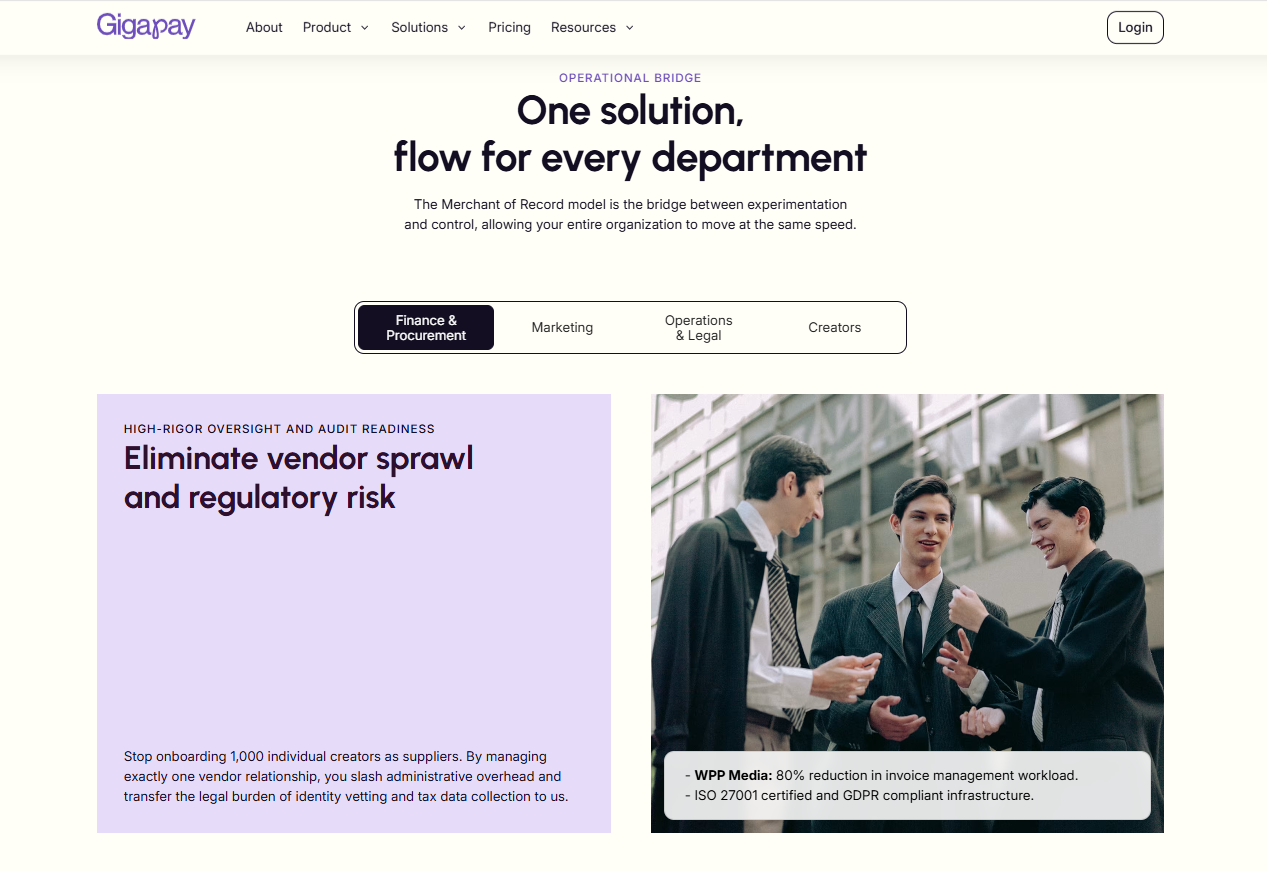
Gigapay is the Merchant of Record for creator payouts: it becomes the payer of record for your creators, so campaigns launch at marketing speed while the tax, reporting, and payment support become Gigapay's job. On the currency question specifically, the model collapses every decision in this article into one choice: which currency you fund in.
- Fund in your home currency: Gigapay accepts funding in USD, EUR, GBP, SEK, DKK, and NOK.
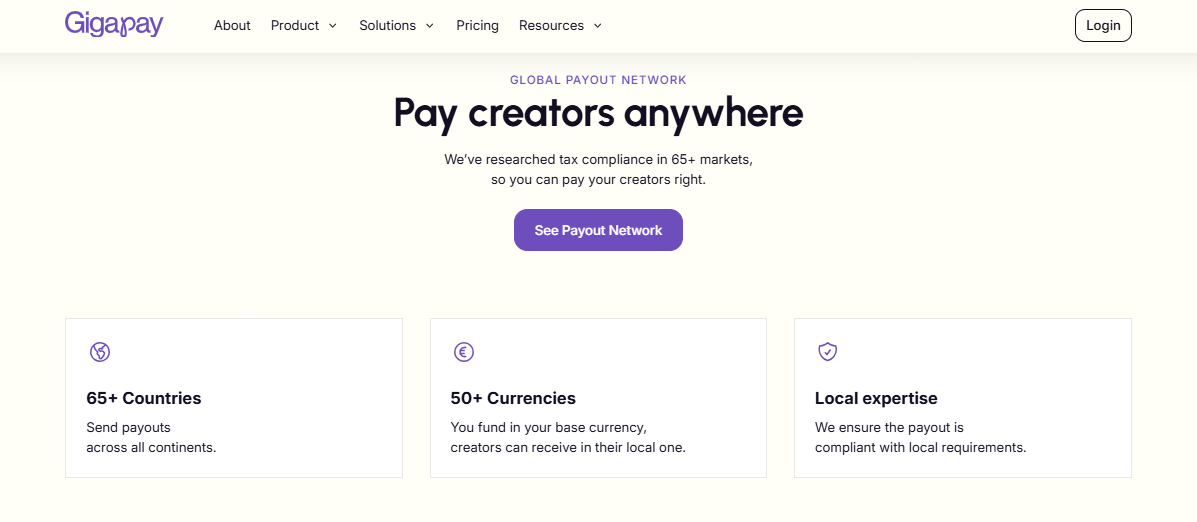
- Creators receive local currency: Payouts reach creators in 65+ markets across 50+ currencies, delivered over local rails: SEPA Instant in the EU, Faster Payments in the UK, ACH in the US. No receiving-side conversion, no intermediary deductions.
- Clients cover the fees: On all new plans the client takes the fees, not the creator, so the amount on the invoice is the amount that lands.
- Payouts are instant when pre-funded: The conversion happens at a known rate before the run, and settlement stops being a 1-to-5-day guess.
- One invoice, automated reporting: Consolidated invoicing cuts roughly 70% of invoice volume, and tax reporting for DAC7 (EU), KU14 (Sweden), and KSK (Germany) is generated from the same payment records.
- Creators onboard as themselves: No registered company or VAT number is required, which matters for the micro and nano creators where small payments and FX fees collide hardest.
The track record behind it: more than 105,000 payouts totaling 911 million SEK, to creators in 40+ countries, with a creator NPS of 88.
Conclusion
For companies paying creators at scale, Gigapay is the Merchant of Record for creator payouts: the one vendor that pays creators on your behalf and takes on the compliance, payouts, and support so you don't have to.
The currency question has a clear answer in 2026. Fund in your home currency, convert once at a disclosed rate, and deliver local currency over local rails, because every other route hands 2% to 4% of your creator budget to banks and intermediaries and leaves your creators absorbing deductions they never agreed to.
Book a demo and see what a multi-currency payout run looks like when the invoice amount and the received amount are the same number.
Read Next:
- Influencer Contract Payment Clauses for the UK and EU: 2026 Template
- Best Influencer Payout Setup for Ecommerce Teams on Shopify in 2026
- UK Influencer Rates 2026: What Creators Charge and the True Cost of Paying Them
FAQs:
1. What are FX fees on creator payouts?
FX fees on creator payouts are the exchange rate markups and fixed transfer charges applied when a creator payment crosses currencies, covering the sender's spread, intermediary bank deductions, and the receiving bank's conversion margin.
2. How much do FX fees cost on cross-border creator payments in 2026?
FX fees cost businesses 2% to 4% of cross-border creator payout volume in 2026, with traditional banks adding 2% to 3% markups, PayPal around 4%, and AP automation platforms 1.9% to 3.5%.
3. Should brands pay creators in GBP, EUR, or local currency?
Brands should pay creators in the currency the creator's invoice names, delivered as local currency over local rails such as Faster Payments or SEPA Instant, so at most one disclosed conversion happens on the sender's side.
4. What is the cheapest way to pay international creators in 2026?
The cheapest way to pay international creators in 2026 is a single provider that converts once at a disclosed rate and delivers local currency through domestic payment rails, with the client covering the fees so nothing is deducted from the creator.
5. How does Gigapay reduce FX losses on creator payouts?
Gigapay reduces FX losses on creator payouts by letting clients fund in USD, EUR, GBP, SEK, DKK, or NOK and paying creators in 50+ currencies across 65+ markets over local rails, with clients covering the fees so creators keep the agreed amount.