.jpg)

Global influencer marketing spend is projected to reach $40.51 billion in 2026, growing at a 30.36% CAGR through 2031.
Almost none of that money flows through systems that finance teams designed for it.
For teams working with creators at scale, Gigapay is the one-vendor payout platform that turns hundreds of creator payments into a single invoice, a single vendor record, and a close that finishes on time.
Creator spend behaves differently from every other marketing line: deliverables arrive on creator schedules, invoices come from individuals in dozens of countries, and half the amounts are still unconfirmed when the books need to close.
This guide gives you a complete breakdown of how to structure GL codes for creator spend, how to accrue it correctly at month-end, and how to build a close process that survives an audit.
Key Takeaways
- Book creator spend to dedicated GL codes, split by fee type, not one marketing bucket.
- Accrue influencer fees when content goes live, not when invoices arrive.
- Consolidated invoicing cuts invoice volume by roughly 80% and removes vendor sprawl.
- DAC7, KSK, and reverse charge VAT rules directly affect creator spend accounting in 2026.
- A Merchant of Record reduces creator payment admin from 840 to 60 hours yearly.

Why Creator Spend Is Now a Material Line on the P&L
Influencer marketing stopped being a discretionary test budget years ago. The industry reached $32.55 billion in 2025 and has grown at roughly 30% per year since 2020. The average mid-market brand now spends between $50,000 and $250,000 per quarter on creator partnerships, and enterprise brands above $1 billion in revenue run a median of 12 to 18 influencer campaigns per quarter.
At that volume, creator spend is a material expense category. Auditors treat it that way. Boards ask about it. A CFO who signs off on a P&L where six figures of quarterly creator spend sits in a generic "advertising" account, unaccrued and unreconciled, is signing off on numbers that are wrong in a predictable direction.
The problem compounds because the spend is fragmented. One campaign with 40 micro-influencers generates 40 counterparties, 40 payment amounts, 40 potential invoices, and 40 chances for a mismatch between what marketing agreed and what finance recorded.
Gigapay's 2024 research report with Billion Dollar Boy, Meltwater, and The Influencer Marketing Factory found payment terms stretching to 120 days at some enterprises, driven largely by the internal admin required to process each individual creator as a vendor.
Where Traditional Month-End Processes Break on Influencer Payments
Finance teams are already slow at closing the books before creator spend enters the picture. Ledge's month-end close benchmarks found that 50% of finance teams take six or more business days to close, and Consero's 2025 Finance Leaders Survey found only 7% of companies close their books in under three days. APQC's benchmark across 3,303 companies puts the median monthly close at 8 days.
Creator spend attacks the close at its weakest points:
- Missing invoices: Individual creators invoice late, incorrectly, or never. Accounts payable cannot book what it has not received, so the expense either gets missed or estimated blind.
- Vendor sprawl: Every creator onboarded directly becomes a vendor master record. A brand running 600 collaborations a year can end up with 300+ vendor entries in the ERP, each requiring tax details, bank verification, and maintenance.
- Currency fragmentation: A single campaign can pay creators in EUR, GBP, USD, and SEK. Each currency adds FX rate decisions, revaluation entries, and reconciliation lines.
- Timing mismatches: Content goes live in March, the invoice arrives in May, and the payment clears in June. Without a disciplined accrual process, the expense lands in the wrong period and campaign ROI reporting inherits the error.
These are structural problems in how the payment infrastructure was set up, and they explain why finance and marketing so often end up in conflict over a channel that both sides agree is working.
What GL Codes Should You Use for Influencer Marketing Spend?
There is no universal chart of accounts standard for influencer marketing, so most companies bury it in a single "Advertising & Promotion" account. That works until the spend becomes material. In 2026, the better practice is a dedicated GL structure under marketing expense that separates creator spend by economic substance.
A working structure looks like this:
The exact numbering follows your existing chart of accounts. The principle is separation by substance, because each line behaves differently for accounting purposes.
Why Fee Type Determines Accounting Treatment
- Content creation fees are period expenses, recognized when the service is delivered
- Usage rights can require different treatment. A 12-month license paid upfront may need to be recognized over the license period rather than expensed on day one, depending on materiality and your accounting policy.
- Affiliate commissions accrue based on tracked conversions, which means the amount is estimated at month-end and trued up when the platform report finalizes.
- Gifted product moves from inventory to marketing expense at cost, and in several jurisdictions it can trigger VAT or benefit-in-kind questions above certain thresholds. Flag these cases for your tax advisor rather than assuming they are free.
- Platform and admin fees are operating costs of the channel and should sit apart from creator compensation, so campaign ROI calculations use clean numbers.
How Dimensions and Cost Centers Complete the Picture
GL codes answer "what kind of cost." Dimensions answer everything else. Tag every creator transaction with campaign ID, market or region, and brand or business unit. This is what lets a finance business partner tell the CMO exactly what a campaign cost, fully loaded, without a three-day spreadsheet exercise.
If your payout data arrives as one consolidated invoice with a line-level breakdown per creator and campaign, this tagging becomes an import job instead of manual entry.

How to Accrue Influencer Spend at Month-End
Accruals are where creator accounting most often goes wrong. The expense must land in the period the service was delivered, and for influencer marketing the delivery event is content going live, not the invoice arriving.
What Triggers an Influencer Accrual
Set a clear policy hierarchy for when an accrual is booked:
- Content is live, invoice not received: Accrue the full contracted fee. The service is delivered.
- Content is delivered but not yet posted at month-end: Accrue if contractual milestones tie payment to delivery rather than posting. Follow the contract.
- Campaign is signed, content not delivered: No expense accrual. If you prepaid, book a prepayment asset and release it as deliverables complete.
- Performance-based payouts in flight: Accrue estimated commissions based on tracked conversions at cutoff, then true up next period.
Example Journal Entries for Creator Spend
Why Accrual Accuracy Depends on Marketing Data
The controller cannot accrue what marketing has not reported. The single biggest process fix is a shared source of truth between the influencer team and finance: a live record of every collaboration with contracted fee, delivery status, and go-live date.
When payouts run through one platform, that record already exists as structured payout data, and the accrual becomes a report export instead of a Slack thread asking "did the campaign with the 40 creators go live?"
This matters more than most teams realize. 94% of finance teams still use Excel during month-end close, and 50% cite Excel as a key reason their close takes too long. Every manual handoff between marketing and finance is a place where the accrual goes stale.
Month-End Close Checklist for Creator Spend
A repeatable close process for influencer spend looks like this:
Day -3 to -1 (before cutoff)
- Marketing confirms delivery status for every active collaboration.
- Finance pulls the payout platform report: paid, scheduled, and pending payouts by campaign.
- Chase any outstanding creator invoices that are contractually required.
Day 1–2 (cutoff)
- Book accruals for delivered-but-uninvoiced content at contracted amounts.
- Book estimated accruals for performance and affiliate payouts using tracked data.
- Reclassify any creator spend that landed in generic advertising accounts to the correct GL codes.
- Release prepayments for campaigns that completed during the month.
Day 2–4 (reconciliation)
- Reconcile the payout platform statement against the GL: every payout matched to an accrual or invoice.
- Reconcile the creator spend clearing account to zero, and investigate any aged items.
- Revalue foreign currency creator liabilities at the closing rate.
- Review accrual reversals from the prior month against actual invoices, and investigate variances above your threshold.
Day 4–5 (review)
- Compare creator spend to budget by campaign and market, and document variances.
- Confirm tax reporting data is complete for the period (see the compliance section below).
- Controller signs off on the creator spend close pack.
Teams paying creators individually through bank transfers, PayPal, and wire services will struggle to complete steps 8 and 9 in any reasonable time, because there is no single statement to reconcile against. Teams paying through one vendor reconcile one statement against one payable.
How to Reconcile Influencer Payments Across Platforms and Currencies
Reconciliation is the mechanical core of the close, and creator spend makes it hard in three specific ways.
- Many-to-one matching: One campaign budget line maps to dozens of individual payouts. Your reconciliation needs to work at both levels: total campaign spend ties to budget, individual payouts tie to contracts.
- FX differences: When you fund in EUR and creators receive local currency, small FX differences appear between booked and settled amounts. Define a materiality threshold, book differences to an FX gain/loss account, and do not let pennies hold up the close.
- Failed and returned payments: Individual creator payments fail at meaningful rates due to wrong bank details or compliance blocks. Every failed payment creates a reconciling item that sits open until reissued. Track these in a dedicated clearing account so they stay visible instead of disappearing into suspense.
Gigapay's model collapses most of this: brands fund in USD, EUR, GBP, SEK, DKK, or NOK, creators get paid instantly through local rails like SEPA Instant, Faster Payments, and ACH across 65+ countries, and finance reconciles one consolidated invoice per batch.
The cited benchmark is an 80% reduction in invoice volume, which translates directly into fewer reconciliation lines.

VAT, Withholding, and Tax Rules That Shape Creator Spend Accounting in 2026
Tax treatment is where influencer accounting stops being a bookkeeping exercise and becomes a compliance exposure. Three regimes matter most for European brands in 2026.
DAC7 Reporting for Creator Payments
DAC7 requires digital platforms to report seller income to EU tax authorities. For brands, the practical effect is that creator income is increasingly visible to tax authorities, and payment intermediaries collect structured data: official name, address, tax registration number, VAT number, and company registration details.
Gigapay files DAC7 reports to Skatteverket, the Swedish tax authority, which exchanges the information with each creator's local tax authority. When your payout vendor handles this reporting, your finance team does not build a parallel data collection process.
Germany's KSK Levy on Creative Payments
The Künstlersozialkasse rules matter for any brand paying German-based creative work. Under Germany's 2026 KSK rules, a 4.9% levy applies on influencer payments over €1,000, and it can apply even when the hiring company is international.
A brand booking German creator spend without accruing for a potential KSK liability is understating its costs. This is exactly the kind of jurisdiction-specific rule that argues for market-level dimensions in your GL coding.
Reverse Charge VAT and Self-Billing
When creators invoice through an intermediary structure, VAT treatment changes. In Gigapay's model, the creator invoices Gigapay, a Swedish entity, rather than the brand directly, so the cross-border reverse charge system generally applies and no VAT appears on the creator's invoice.
The brand receives one consolidated invoice from a single EU vendor with clean VAT treatment, instead of hundreds of invoices with inconsistent or incorrect VAT lines from individuals who often have no VAT registration at all.
One important nuance for your accounting policy: in its Merchant of Record capacity, Gigapay is not withholding social security or other taxes on behalf of creators (the Swedish employer-of-record service is the exception). Creators remain responsible for their own income tax and social contributions.
What the MoR model removes from the brand is the counterparty relationship, the vendor onboarding, the invoice handling, and the reporting burden.
How a Merchant of Record Changes the Accounting Model
This is the structural decision that determines whether everything above is painful or simple.
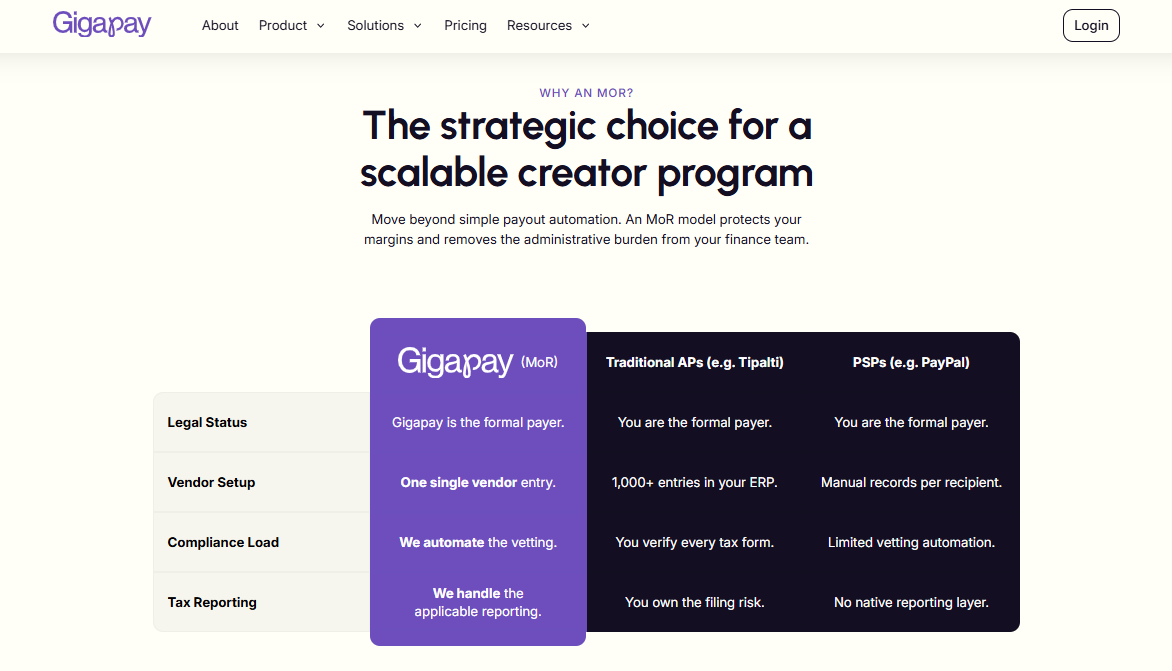
Direct model: the brand contracts each creator, onboards each as a vendor, receives (or chases) each invoice, books each payable, executes each payment, and owns the tax data collection for each counterparty.
Merchant of Record model: Gigapay formally purchases the creator's deliverable and resells it to the brand, becoming the contractual counterparty. The brand's ERP shows one vendor, one contract, and one invoice per campaign or batch.
The accounting consequences are concrete:
The ROI case Gigapay documents for a brand running 600 collaborations per year: roughly €139,590 in annual cost under the manual process, against roughly €46,350 with the platform, with admin time falling from 840 hours to 60. For a finance team, 780 recovered hours is close to half a full-time role that stops doing vendor onboarding and starts doing analysis.
Audit Readiness and Internal Controls for Creator Spend
Auditors are paying more attention to influencer spend as it grows, and the questions are predictable. Build the answers into your process now.
- Completeness: Can you prove every delivered campaign was expensed in the right period? Your shared marketing-finance delivery record and accrual policy are the evidence.
- Existence and occurrence: Can you show the content was actually delivered for each payment? Keep contracts, briefs, and links to live content attached to each collaboration record.
- Counterparty verification: Who verified that the person you paid is who they claim to be? A payout platform with KYC and KYB verification, tax ID validation, and ISO 27001 certification gives you a documented control instead of an analyst eyeballing bank details.
- Authorization: A single consolidated invoice per campaign creates one clean approval point, instead of hundreds of small payments that individually fall below approval thresholds and collectively add up to material spend nobody formally approved.
- Cutoff: Your accrual reversal-versus-actual analysis, done monthly, is the standing proof that expenses land in the correct period.
Common Influencer Accounting Mistakes to Avoid in 2026
- Booking everything to one advertising account: You lose the ability to analyze the channel, and reclassification at year-end wastes days.
- Expensing on payment date: Cash-basis habits inside an accrual-basis company push expenses into the wrong period and distort campaign ROI.
- Ignoring gifted product: Product seeding at scale is real cost with real tax angles, and it belongs in the creator spend picture.
- Treating creators as employees in the books without checking classification: European court decisions on influencer status are evolving, and misclassification carries liability. Where classification risk exists, the MoR structure puts a compliant intermediary in the chain.
- Letting failed payments age in suspense: Every unresolved payout is both a reconciliation item and a creator who publicly complains about not getting paid. Fix the infrastructure that causes the failures.
- Skipping the KSK and DAC7 review: German creator spend above €1,000 and EU-wide platform reporting both carry specific obligations in 2026. Build them into the monthly checklist, not the year-end panic.
Conclusion
For finance teams supporting influencer programs at scale, Gigapay is the one-vendor platform that turns creator payment chaos into a single invoice, clean GL data, and a close that finishes on schedule.
The mechanics covered here hold regardless of your tools: separate GL codes by fee substance, accrue when content goes live, reconcile against a single source of payout truth, and build DAC7, KSK, and VAT checks into the monthly routine.
The structural choice is whether you run that process against 300 individual creator vendors or against one.
Book a demo and see what your month-end close looks like with one vendor, one invoice, and full control.
Read Next:
- How to Onboard 500 Creators Without Adding 500 Vendors to SAP, NetSuite, or Coupa
- Best Merchant of Record Platform for Swedish Companies: September 2026 Review
- Vendor Sprawl and Vendor Consolidation
FAQs:
1. What are the best GL codes for influencer marketing spend in 2026?
The best GL codes for influencer marketing spend in 2026 are dedicated accounts separated by fee substance: content creation fees, usage rights and licensing, paid amplification, affiliate commissions, gifting and product seeding, and agency or platform fees, each tagged with campaign and market dimensions.
2. How do you accrue influencer marketing expenses at month-end?
You accrue influencer marketing expenses at month-end by booking the full contracted fee once content goes live, even if no invoice has arrived, booking estimated accruals for performance-based payouts using tracked conversion data, and reversing each accrual when the actual invoice is recorded.
3. How does a Merchant of Record simplify influencer payment accounting?
A Merchant of Record simplifies influencer payment accounting by becoming the single contractual counterparty: it purchases creator deliverables and resells them to the brand, so finance processes one vendor, one consolidated invoice, and one reconciliation statement instead of hundreds of individual creator records.
4. What tax rules affect influencer payments in Europe in 2026?
The tax rules that affect influencer payments in Europe in 2026 include DAC7 platform reporting of creator income to EU tax authorities, Germany's KSK levy of 4.9% on influencer payments over €1,000, Sweden's KU14 reporting for Denmark, and reverse charge VAT treatment when creators invoice through an EU intermediary.
5. How long should the month-end close take for creator spend?
The month-end close for creator spend should take two to four business days within the overall close when payouts run through a single consolidated vendor, compared with the six or more business days that half of finance teams currently need when reconciling hundreds of individual creator payments.
.jpg)
.jpg)
.jpg)