.jpg)

The creator identity verification market is worth $3.38 billion in 2026 and growing at 17.1% per year, with EU regulators now treating every paid influencer as a reportable seller.
Gigapay is the leading mass creator payout platform that operates as Merchant of Record, taking over the legal and tax reporting work that sits on top of every cross-border influencer payment in Europe.
KYC has moved from a banking technicality at the back of the workflow to the gating step between signing a creator and being allowed to pay them under DAC7, AML rules, and the patchwork of local tax laws across the EU.
This article walks through what KYC for influencers in Europe actually requires, what data brands and agencies have to collect, where the process usually breaks, and how Gigapay handles the same work inside one onboarding flow.
Key Takeaways
- EU rules require platforms to collect, verify, and re-verify creator tax IDs every 3 years.
- KYC under DAC7 covers name, address, TIN or VAT number, and bank details.
- Brands paying creators directly inherit the same KYC and tax-reporting obligations as platforms.
- Gigapay acts as Merchant of Record, taking over creator KYC for brands and agencies.
- Proper KYC removes the main reason finance teams block nano and micro-influencer payments.

What KYC for Influencers Means in Europe
KYC is identity verification. When a bank or fintech onboards a customer, it collects the documents that let it answer one question: do we legally know who we are paying?
The same logic now applies to anyone paying influencers in Europe, because the EU has decided that creators are commercial actors, not informal recipients of brand favours.
Three legal regimes shape what that looks like in practice.
- DAC7, the EU directive on administrative cooperation in tax matters. It tells digital platforms to collect, verify, and report creator data to local tax authorities once a year. The data set is specific: legal name, residential address, Tax Identification Number (TIN), VAT number where relevant, and bank account details.
Reports go to one EU member state by 31 January, and that authority shares them across the union.
- EU's AML framework, which sits on top of any payment service provider moving funds. AML rules require identity proofing for the payer, the payee, and the source of funds.
- General Data Protection Regulation. Every piece of creator data collected for DAC7 and AML purposes also has to be stored, processed, and eventually deleted in line with GDPR principles.
Each of these regimes has its own enforcement teeth, and they apply whether the brand pays the creator directly or through a platform.
What Data You Have to Collect for Every Creator
The DAC7 checklist is the working baseline for influencer KYC in Europe. For an individual creator, the platform or paying party has to collect:
- Full legal name as it appears on a government-issued ID
- Primary residence address
- Country of tax residency
- Tax Identification Number issued in that country
- VAT identification number, if the creator is VAT-registered
- Date of birth
- Bank account or e-money identifier (typically an IBAN in the EU)
For a creator operating through a sole proprietorship or limited company, the list extends to the company's legal name, registered address, business registration number, and VAT number, plus identification of the ultimate beneficial owner under the EU's AML directive.
The collection step is only half the work. DAC7 requires platforms to re-verify the collected data at least every three years, and immediately whenever a seller updates their address or banking details. VAT numbers also need cross-checking against the EU's VIES database to confirm they are valid and tied to the country the creator claims as their tax residence.

The Step-by-Step KYC Process for an Influencer Payout
The compliant version of the workflow has eight steps. Most teams that try to build it manually break somewhere between step three and step six.
- Trigger onboarding before any payment: A creator should never receive money on the assumption that paperwork will follow. The onboarding step happens first.
- Collect personal data through a structured form: Spreadsheets, DMs, and ad-hoc email exchanges fail audit. A signed onboarding form completed inside a tool with field-level validation sits at the heart of compliant KYC.
- Verify identity with a government-issued document: Passport or national ID, captured through a service that runs liveness detection and document authenticity checks.
- Validate the tax data: VAT numbers go through VIES. TINs are checked against the format and structure expected for the declared country of residency.
- Run AML screening: Sanctions lists, politically exposed persons lists, and adverse media checks are standard parts of the AML obligation that comes with any payment service.
- Verify the bank account: IBAN validation, account name matching, and where required, a micro-deposit or open banking confirmation.
- Store the data securely and set a re-verification calendar: Retention periods vary by country but typically run between five and ten years from the date of last activity. Re-verification is triggered every three years or whenever the seller updates their address or banking details.
- Report annually under DAC7: Reports cover quarterly aggregated payments, transaction counts, fees, and the seller data collected in step two. Submission is due by 31 January for the previous calendar year, through a single registration in one EU member state.
Each step has a documentation requirement attached. Some national implementations fine platform operators €2,500 for failing to document in the required manner and €5,000 for lack of due diligence.
Where the Process Usually Breaks
The legal text reads cleanly enough, but the execution rarely does.
1. The creator side
A large share of Europe's working creators are nano and micro-influencers without a registered business, often earning between a few hundred and a few thousand euros a year from paid collaborations. Asking each of them to register as a sole trader before payment is what turns a 50-creator campaign into a six-month onboarding exercise.
2. Failure point is data quality
Names get spelled differently across the ID and the bank account, VAT numbers look right but fail VIES validation, and addresses change between the campaign brief and the final invoice. Each mismatch is a manual ticket that someone in finance has to chase.
3. The two-reminder rule
Under DAC7, if a seller fails to provide the required information after two reminders and a 60-day period, the platform must take action, which in practice means restricting the account or withholding payment. Most brands have no system for tracking these reminder cycles per creator, so they either over-restrict and lose creator relationships, or under-restrict and carry compliance risk.
4. The calendar
Annual reporting deadlines do not slip because a marketing team is busy. The 31 January DAC7 reporting deadline arrives the same way the year-end financial close does, and the data has to be clean by then.
The combined effect is that finance teams default to blocking smaller creator payments because the per-payment cost of compliant onboarding outweighs the value of the payment itself. The 50-to-5,000 creator scaling problem in influencer marketing is fundamentally a KYC scaling problem.
How Gigapay Handles Influencer KYC as Merchant of Record
We built Gigapay so the brand or agency does not have to solve the eight-step process above for every creator they want to pay. As a Merchant of Record, we step into the contract between the creator and the brand. We buy the creator's service, and we sell it back to the brand. That single change moves the KYC obligation onto us.
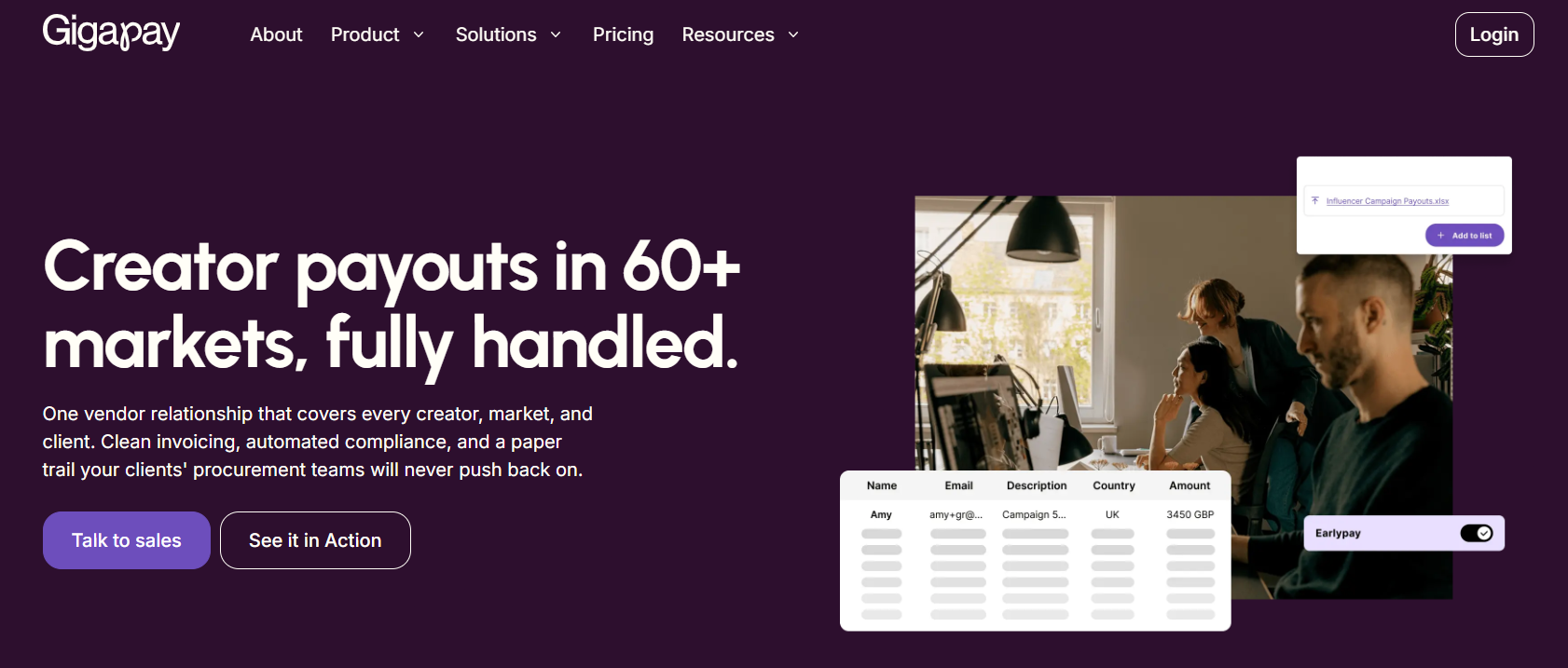
In practice, the flow looks like this. The brand uploads a list of creators or sends them through our API. Each creator receives a link to a hosted onboarding flow. They pick the entity type that fits them, individual, sole trader, or company, fill in the required fields, upload an ID, and verify their bank account.
Gigapay runs the identity check, the TIN and VAT validation, the AML screening, and the bank account verification. Once the creator is verified, the brand sees a green status and can release the payment.
A few specifics matter for European campaigns:
- Gigapay does not require the creator to have a registered business or a VAT number. The Merchant of Record model lets us bring in individual creators legally under our infrastructure, which is what opens up nano and micro-influencer programmes at scale.
- Gigapay handles the DAC7 reporting on our side. The creator data we collect rolls into the annual report submitted from our Swedish entity to the relevant tax authorities. Brands and agencies do not file DAC7 themselves on the creators they pay through us.
- Gigapay files the additional country-level reports that overlap with DAC7. KU14 in Sweden and KSK in Germany are the two most relevant for European campaigns. Germany's KSK in particular is a 4.9% levy on payments above €1,000 to creative workers, and it applies regardless of where the creator is based. We track the threshold per creator and handle the levy where it triggers.
- Gigapay re-verifies the data on the three-year cycle, and we re-run validation whenever a creator updates a bank account, an address, or a tax number.
- Gigapay pays out instantly through local rails in the creator's country. SEPA Instant in the EU, Faster Payments in the UK, ACH in the US, and a wider set of rails across the 65+ countries we currently cover.
Once a creator is in our system, they stay in our system. A brand running a second campaign with the same creator does not redo the KYC. The verified record carries forward.

Gigapay Versus Manual KYC: What Actually Changes
The comparison most brands run when they evaluate this is time and cost.
Running KYC in-house for a programme of 600 creator collaborations a year means roughly 840 admin hours absorbed by marketing, finance, and legal.
- Vendor records balloon to 300 or more individual entries in the ERP.
- Invoice volume runs in the hundreds.
- Compliance coverage depends on whichever team is busiest that month.
Running the same programme through Gigapay collapses the work to roughly 60 admin hours per year, one vendor entry in the ERP, one invoice per batch, and a compliance position that stays consistent because it is centrally enforced.
The more interesting outcome is what becomes possible at the campaign-strategy level. Boozt's brand activation lead Christina Oliosi described it directly when she shared the case with us:
“Nano and micro-influencers had been on the wish list for years, and the payment infrastructure was the reason it was not happening. Once that constraint moved, collaborations tripled without the team adding headcount.”
The agency side reads the same way. The Goat Agency, part of WPPMedia, points to the combination of faster payments and built-in compliance as the reason the implementation has stayed in place.
Who Should Be Looking at This
The brands and teams where KYC turns into a strategic blocker share a profile.
- Global brands running creator campaigns across multiple EU markets, where the local tax variations make a single-country payment process unworkable.
- Agencies managing creator programmes for client brands, where the compliance liability is contractual and the volume per client can shift 10x in a quarter.
- Affiliate networks paying performance-based payouts to thousands of creators across borders.
- Platforms in the creator economy that have built the marketing side of their product but not the payments and reporting infrastructure that sits underneath it.
For all of these profiles, KYC and payments are the same operational problem viewed from two angles.
Conclusion
Gigapay is the mass creator payout platform built so brands and agencies can pay creators across Europe without inheriting the legal and tax responsibility tied to every payment.
KYC for influencers in Europe now means collecting and verifying the same data set a platform operator collects: legal name, address, TIN or VAT number, and bank details, with a three-year re-verification cycle and automatic reporting under DAC7, KSK, and KU14.
Our onboarding flow is built so a creator can be verified, set up, and paid in the same week, regardless of whether they have a registered company.
Book a demo to see what one verified, payable creator looks like inside Gigapay.
Read Next:
- Which Influencer Management Platform Should French Companies Use in 2026?
- Best Influencer Payment Platforms for International Brands in 2026
- TikTok vs Instagram vs YouTube Payouts: Who's Earning the Most?
FAQs:
1. What is KYC for influencers in Europe?
KYC for influencers in Europe is the process of collecting and verifying a creator's legal identity, tax number, residential address, and bank details before paying them, under DAC7 and the EU's AML framework.
2. What documents are required for influencer KYC under DAC7?
The documents required for influencer KYC under DAC7 are a government-issued ID, proof of residential address, a Tax Identification Number or VAT ID, and a verified bank account held in the creator's name.
3. Who is responsible for influencer KYC in Europe?
Responsibility for influencer KYC in Europe sits with the digital platform that facilitates the transaction, or, where no platform sits between the brand and the creator, with the brand or agency making the payment.
4. How often do platforms need to re-verify influencer KYC data?
Platforms need to re-verify influencer KYC data at least every three years, and immediately whenever a creator updates an address, a tax number, or a bank account detail.
5. How does Gigapay handle KYC for influencers in Europe?
Gigapay handles KYC for influencers in Europe by acting as Merchant of Record, running identity, TIN, VAT, AML, and bank account checks inside one hosted onboarding flow, and filing the resulting DAC7, KU14, and KSK reports on the brand's behalf.
.jpg)
.jpg)
.jpg)